India's Cultural Roots
A Deep History
Indian culture is very old and has a
rich history, like an ancient tree with
many roots and branches.
Rich Heritage
The roots show common traditions,
while the branches represent different
parts of Indian culture, such as art,
literature, science, medicine, religion,
governance, and martial arts.
Unified Roots
All these parts come from the same
foundation.
Indian culture also includes many "schools of thought," where groups of people share similar ideas about life and the world.
Some experts believe Indian culture began with the Indus Valley or Harappan civilization. Over time, many different schools
of thought developed in India, each adding to its unique identity. By learning about these early schools, we can better
understand India.
by sandeep swamy
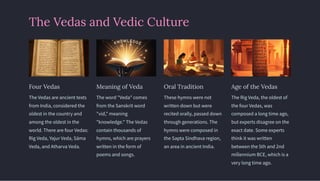
The Vedas and Vedic Culture
Four Vedas
The Vedas are ancient texts
from India, considered the
oldest in the country and
among the oldest in the
world. There are four Vedas:
Rig Veda, Yajur Veda, Säma
Veda, and Atharva Veda.
Meaning of Veda
The word "Veda" comes
from the Sanskrit word
"vid," meaning
"knowledge." The Vedas
contain thousands of
hymns, which are prayers
written in the form of
poems and songs.
Oral Tradition
These hymns were not
written down but were
recited orally, passed down
through generations. The
hymns were composed in
the Sapta Sindhava region,
an area in ancient India.
Age of the Vedas
The Rig Veda, the oldest of
the four Vedas, was
composed a long time ago,
but experts disagree on the
exact date. Some experts
think it was written
between the 5th and 2nd
millennium BCE, which is a
very long time ago.
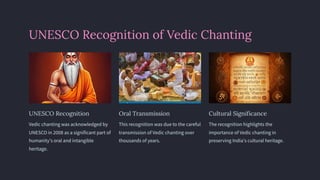
UNESCO Recognition of Vedic Chanting
UNESCO Recognition
Vedic chanting was acknowledged by
UNESCO in 2008 as a significant part of
humanity's oral and intangible
heritage.
Oral Transmission
This recognition was due to the careful
transmission of Vedic chanting over
thousands of years.
Cultural Significance
The recognition highlights the
importance of Vedic chanting in
preserving India's cultural heritage.
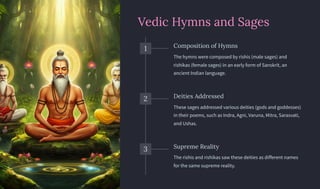
Vedic Hymns and Sages
1 Composition of Hymns
The hymns were composed by rishis (male sages) and
rishikas (female sages) in an early form of Sanskrit, an
ancient Indian language.
2 Deities Addressed
These sages addressed various deities (gods and goddesses)
in their poems, such as Indra, Agni, Varuna, Mitra, Sarasvati,
and Ushas.
3 Supreme Reality
The rishis and rishikas saw these deities as different names
for the same supreme reality.
Importance of Truth in Vedic Worldview
1 Truth as God
In the Vedic worldview, "Truth"
was very important and was
often considered another name
for God.
2 Unity Among People
The Rig Veda also emphasizes
the importance of unity among
people, encouraging them to
come together, speak together,
and share a common purpose.
3 Rig Veda Verse
For example, one verse from
the Rig Veda says, [verse
omitted in input]
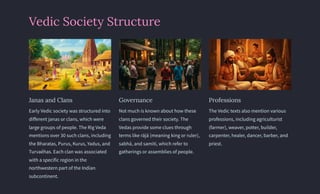
Vedic Society Structure
Janas and Clans
Early Vedic society was structured into
different janas or clans, which were
large groups of people. The Rig Veda
mentions over 30 such clans, including
the Bharatas, Purus, Kurus, Yadus, and
Turvaéhas. Each clan was associated
with a specific region in the
northwestern part of the Indian
subcontinent.
Governance
Not much is known about how these
clans governed their society. The
Vedas provide some clues through
terms like räjä (meaning king or ruler),
sabhä, and samiti, which refer to
gatherings or assemblies of people.
Professions
The Vedic texts also mention various
professions, including agriculturist
(farmer), weaver, potter, builder,
carpenter, healer, dancer, barber, and
priest.
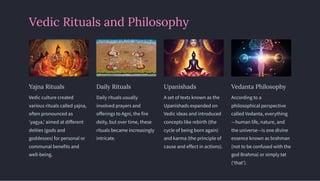
Vedic Rituals and Philosophy
Yajna Rituals
Vedic culture created
various rituals called yajna,
often pronounced as
'yagya,' aimed at different
deities (gods and
goddesses) for personal or
communal benefits and
well-being.
Daily Rituals
Daily rituals usually
involved prayers and
offerings to Agni, the fire
deity, but over time, these
rituals became increasingly
intricate.
Upanishads
A set of texts known as the
Upanishads expanded on
Vedic ideas and introduced
concepts like rebirth (the
cycle of being born again)
and karma (the principle of
cause and effect in actions).
Vedanta Philosophy
According to a
philosophical perspective
called Vedanta, everything
—human life, nature, and
the universe—is one divine
essence known as brahman
(not to be confused with the
god Brahma) or simply tat
('that').
Concept of Atman and
Interconnectedness
Atman
The Upanishads also introduced the idea of atman or Self, which is the
divine essence present in every being and ultimately united with
brahman.
Interconnectedness
This concept implies that everything in the world is interconnected and
interdependent.
Universal Prayer
A common prayer reflecting this idea begins with sarve bhavantu
sukhinah, meaning "May all creatures be happy," and continues with
wishes for freedom from disease and sorrow.
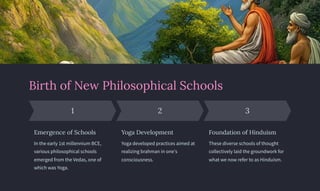
Birth of New Philosophical Schools
1
Emergence of Schools
In the early 1st millennium BCE,
various philosophical schools
emerged from the Vedas, one of
which was Yoga.
2
Yoga Development
Yoga developed practices aimed at
realizing brahman in one's
consciousness.
3
Foundation of Hinduism
These diverse schools of thought
collectively laid the groundwork for
what we now refer to as Hinduism.
Buddhism: The Life of Siddhartha Gautama
Birth and Early Life
About 2,500 years ago, a
young prince named
Siddhārtha Gautama was
born in Lumbini, which is
now in Nepal. Scholars have
different opinions on the
exact year of his birth, but
we will use 560 BCE as an
approximate date for this
story.
The Four Sights
Siddhārtha Gautama grew
up in a very protected
environment in the palace.
When he was 29 years old,
he asked to go out into the
city for the first time. During
this trip, he saw an old man,
a sick man, and a dead
body. He also met an
ascetic who seemed happy
and peaceful.
Renunciation
After this experience,
Siddhārtha decided to leave
his life in the palace and
give up his wife and son. He
traveled as an ascetic,
meeting other ascetics and
scholars, searching for the
main cause of suffering in
human life.
Enlightenment
After meditating for many
days under a pipal tree at
Bodh Gaya (now in Bihar),
he reached enlightenment.
He understood that avidyā
(ignorance) and attachment
are the roots of human
suffering and found a way
to eliminate these causes.
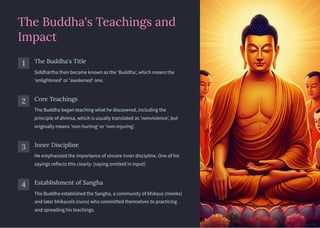
The Buddha's Teachings and
Impact
1 The Buddha's Title
Siddhārtha then became known as the 'Buddha', which means the
'enlightened' or 'awakened' one.
2 Core Teachings
The Buddha began teaching what he discovered, including the
principle of ahimsa, which is usually translated as 'nonviolence', but
originally means 'non-hurting' or 'non-injuring'.
3 Inner Discipline
He emphasized the importance of sincere inner discipline. One of his
sayings reflects this clearly: [saying omitted in input]
4 Establishment of Sangha
The Buddha established the Sangha, a community of bhikṣus (monks)
and later bhikṣuṇīs (nuns) who committed themselves to practicing
and spreading his teachings.
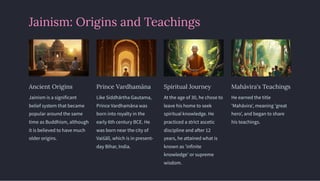
Jainism: Origins and Teachings
Ancient Origins
Jainism is a significant
belief system that became
popular around the same
time as Buddhism, although
it is believed to have much
older origins.
Prince Vardhamāna
Like Siddhārtha Gautama,
Prince Vardhamāna was
born into royalty in the
early 6th century BCE. He
was born near the city of
Vaiśālī, which is in present-
day Bihar, India.
Spiritual Journey
At the age of 30, he chose to
leave his home to seek
spiritual knowledge. He
practiced a strict ascetic
discipline and after 12
years, he attained what is
known as 'infinite
knowledge' or supreme
wisdom.
Mahāvira's Teachings
He earned the title
'Mahāvira', meaning 'great
hero', and began to share
his teachings.
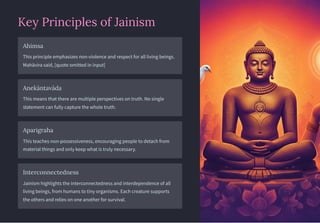
Key Principles of Jainism
Ahimsa
This principle emphasizes non-violence and respect for all living beings.
Mahāvira said, [quote omitted in input]
Anekāntavāda
This means that there are multiple perspectives on truth. No single
statement can fully capture the whole truth.
Aparigraha
This teaches non-possessiveness, encouraging people to detach from
material things and only keep what is truly necessary.
Interconnectedness
Jainism highlights the interconnectedness and interdependence of all
living beings, from humans to tiny organisms. Each creature supports
the others and relies on one another for survival.
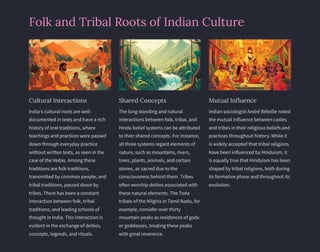
Folk and Tribal Roots of Indian Culture
Cultural Interactions
India's cultural roots are well-
documented in texts and have a rich
history of oral traditions, where
teachings and practices were passed
down through everyday practice
without written texts, as seen in the
case of the Vedas. Among these
traditions are folk traditions,
transmitted by common people, and
tribal traditions, passed down by
tribes. There has been a constant
interaction between folk, tribal
traditions, and leading schools of
thought in India. This interaction is
evident in the exchange of deities,
concepts, legends, and rituals.
Shared Concepts
The long-standing and natural
interactions between folk, tribal, and
Hindu belief systems can be attributed
to their shared concepts. For instance,
all three systems regard elements of
nature, such as mountains, rivers,
trees, plants, animals, and certain
stones, as sacred due to the
consciousness behind them. Tribes
often worship deities associated with
these natural elements. The Toda
tribals of the Nilgiris in Tamil Nadu, for
example, consider over thirty
mountain peaks as residences of gods
or goddesses, treating these peaks
with great reverence.
Mutual Influence
Indian sociologist André Béteille noted
the mutual influence between castes
and tribes in their religious beliefs and
practices throughout history. While it
is widely accepted that tribal religions
have been influenced by Hinduism, it
is equally true that Hinduism has been
shaped by tribal religions, both during
its formative phase and throughout its
evolution.