Unite 10
Endocrine System
Presented by:
Dr Fouad M. Y. Al-Khalli,
Associate Prof. of Med. Physiology,
Taiz and Sana’a University
Dr Fouad Al-Khalli
General
Medical Physiology
Dr Fouad Al-Khalli
Dr Fouad Al-Khalli
• Endocrinology is the branch of science that deals with
hormones, hormonal regulations of metabolism and
diseases associated with hormonal abnormalities.
• Metabolism is the integrative functioning of many
pathways through which fats, carbohydrates, proteins
and minerals are ultimately utilized by the living cell.
• In all body cells, hormones influence the metabolism
of nucleotides, proteins, lipids, carbohydrates,
vitamins, water and electrolytes.
• The information and knowledge concerning
endocrinology and metabolism are of tremendous
importance specially in new medicine because all
diseases are associated with metabolic changes.
Definition and rationalization:
Dr Fouad Al-Khalli
GENERAL OBJECTIVES:
The aim of this course is to enable the student
to understand:
• the major metabolic pathways and their Inter-
relationship(Biochemistry),
• the hormonal regulation of metabolism,
• the structure and function of endocrine
glands,
• the common occurring endocrine disorders.
Dr Fouad Al-Khalli
The Specific Objectives:
• Define hormone and endocrine system;
• Compare and contrast the nervous and endocrine systems.
• List the hormones produced by the hypothalamus and pituitary gland;
• Explain how the hypothalamus and pituitary are controlled and coordinated;
• Describe the functions of growth hormone;
• Describe the effects of pituitary hypo- and hypersecretion.
• Discuss the formation, secretion, metabolism and the mode of action of thyroid hormones.
• Describe the influence of the thyroid hormones on growth and other metabolic processes.
• Discuss the presentation, clinical feature pathology and abnormalities of thyroid hypo and
hyperactivity, and thyroid swellings( simple and nodular goiter).
• Discuss the formation, secretion, metabolism and mode of action of parathyroid hormones.
• Discuss the calcium metabolism and related clinical manifestations.
• Discuss the formation, secretion, metabolism and mode of action of the adrenal hormone.
• Describe the influence of adrenal hormones on body metabolic process.
• Discuss the presentation, clinical features pathology and abnormalities of adrenal hypo and
hyperactivity.
• Discuss the mode of action of insulin and its control.
• Discuss the factors involved in the control of normal blood sugar level.
• Discuss the possible etiological factors in diabetes mellitus.
• Discuss the clinical presentation and the underlying pathophysiological mechanism in diabetes
mellitus ( the major differences between type I and type II diabetes).
Dr Fouad Al-Khalli
The Course Content:
- Endocrine glands and hormones: chemical classification of hormones,
common aspects of neural and endocrine regulation, hormone
interactions, effects of hormone concentrations on tissue response.
- Mechanisms of hormone action: hormones that bind to nuclear receptor
proteins, hormones that use second messengers.
- Pituitary gland: pituitary hormones, hypothalamic control of the posterior
pituitary, hypothalamic control of the anterior pituitary, feedback control
of the anterior pituitary, higher brain function and pituitary secretion,
- Thyroid and parathyroid glands: production and action of thyroid
hormones, parathyroid glands.
- Adrenal glands: functions of the adrenal cortex, functions of the adrenal
medulla, stress and the adrenal gland.
- Pancreas: Islets of Langerhans: beta and alpha cells( insulin and
glucagon), and diabetes mellitus.
- Autocrine and paracrine regulation: examples of autocrine regulation,
prostaglandins.
- Other endocrine glands: pineal gland, gastrointestinal tract, gonads and
placenta( will be discussed in the relating units).
• The endocrine system is one of the
body’s two major communications
(controlling) systems.
• It consists of all the glands that secrete
hormones, which are chemical
messengers carried by the blood from
the endocrine glands to target cells
elsewhere in the body.
Definition
Dr Fouad Al-Khalli
Function of the Endocrines System
1. Maintenance of the Internal Environment:
- Ion regulation
- Water balance
- Heart rate and blood pressure regulation
- and others.
2. Regulation of Energy Utilization.
3. Growth and Development.
4. Reproduction.
Dr Fouad Al-Khalli
Hormones
They are:
• Chemical Messengers act as
physiologic regulators,
• Effective in minute quantities,
• Synthesized in specific gland cells,
• Secreted directly into the bloodstream,
• Transported by circulating blood to
specific targeted organs where they
• Exert specific action.
Dr Fouad Al-Khalli
Endocrine Glands
Dr Fouad Al-Khalli
From: Human Body images, ANATOMICA, 2000, macromedia.
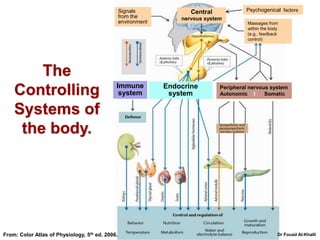
The
Controlling
Systems of
the body.
From: Color Atlas of Physiology, 5th ed. 2006. Dr Fouad Al-Khalli
Immune
system
Endocrine
system
Peripheral nervous system
Autonomic I Somatic
Psychogenical factors
Central
nervous system
Massages from
within the body
(e.g., feedback
control)
Signals
from the
environment
Plasma glucose concentration
Insulin’s target cells
Action of Insulin
Plasma insulin concentration
Controller
Activator
Controlled
Process
Feedback
Transducer
+
+
–
+
Simple Negative Feedback Regulation in
Insulin Secretion
From: Vander et . Al., Human Physiology.. 9th ed, 2004. Dr Fouad Al-Khalli
Insulin-secreting cells
Insulin secretion
–
Controlled Process
Controller
Activator
Stimulus
Response
+
+
+
–
–
Negative Feedback Regulation
From: Vander et al., Human Physiology. 9th ed, 2004.
Dr Fouad Al-Khalli
Stress Nonstress neural imputs
Anterior pituitary
 ACTH secretion
Adrenal cortex
 Cortisol secretion
Target cells for cortisol
Respond to increaseed cortisol
 Plasma cortisol
CORTISOL
–
–
 Plasma ACTH
Hypothalamus
 CRH secretion
Plasma CRH
(in hypothalamo-pituitary portal vessels)
CRH = corticotropin releasing hormone
Dr Fouad Al-Khalli
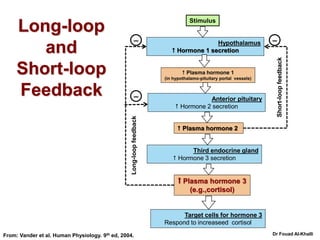
Stimulus
Hypothalamus
 Hormone 1 secretion
Third endocrine gland
 Hormone 3 secretion
Target cells for hormone 3
Respond to increaseed cortisol
⬆ Plasma hormone 3
(e.g.,cortisol)
–
–
 Plasma hormone 2
Anterior pituitary
 Hormone 2 secretion
 Plasma hormone 1
(in hypothalamo-pituitary portal vessels)
–
Long-loop
feedback
Short-loop
feedback
Long-loop
and
Short-loop
Feedback
From: Vander et al. Human Physiology. 9th ed, 2004.
Example of
Feedback control
in Regulation of
Hormones (Cortisol
And Adrenaline)
Concentrations in
plasma
From Color Atlas of Physiology, 5th ed. 2006. Dr Fouad Al-Khalli
(1) Is an example of Long-loop feedback.
(2) and (3) are examples of Short-loop
feedback.
Adrenal
medulla Endocrine gland
cell
Anterior
pituitary
Hormone
Hormone Hormone
Hormone
(Adrenaline)
Posterior
pituitary
Autonomic
ganglion
Hormone
+
+
+
+ -
-
or
or
Hypothalamus Autonomic nervous
system
Central Nervous System
Pathways by which the nervous system
influences hormone secretion
Dr Fouad Al-Khalli
From: Vander. Human Physiology. 9th ed, 2004.
Causes of Excess
and Deficiency of
Hormones
From Color Atlas of Pathophysiology, Int. ed. 2006.
9
8
7
6
5
4
3
2
1
Dr Fouad Al-Khalli
1. Regulating influences - 
2. a) Hypoplasia, Aplasia - 
b) Hyperplasia - .
3. Ectopic hormone production - .
4. Receptos: density, affinity- .
5. Hormone synthesis, intracellular
transport, release - .
6. Feedback - .
7. Breakdown - .
8. Conversion - .
9. Intracellular transmission - .
Dr. Fouad Al-Khalli
Possible Fates and Actions of the Hormone
Endocrine cell
Secretes Hormones
Plasma Hormone
Excreted Inactivated by
metabolism
Activated by
metabolism
Catalyzes formation of
active hormones from
plasma protein
Target cells
Respond to hormone
From: Vander et al. Human Physiology. 9th ed, 2004.
Abnormalities of Hypothalamus Regulated
Hormones
From Color Atlas of Physiology, 5th ed. 2006. Dr Fouad Al-Khalli
 
Hypothalamic-
Pituitary
Hormone
Secretion
From : Color Atlas of Physiology, 5th ed. 2006. Dr Fouad Al-Khalli
NPY (neuropeptide y)
Dr Fouad Al-Khalli
Endocrine
Glands
Hormones Major Function* Is Control of:
Summary of the Hormones
Adipose tissue
cells
Leptin Food intake; metabolic rate.
Adrenal:
Adrenal
cortex
Adrenal
medulla
1. Cortisol
2. Androgens
3. Aldosterone
1. Adrenaline
2. Noradrenalin
Org. metabolism; response to stress; immune system.
Sex drive in women.
Sodium, potassium, and acid excretion by kidneys.
Organic metabolism; cardiovascular function;
response to stress.
GI tract: 1. Gastrin
2. Secretin
3. Cholecystokinin
4. Glucose-
dependent
insulinotropic
peptide (GIP) †
5. Motilin
Gastrointestinal tract; liver; pancreas;
gallbladder
* This table does not list all functions of the hormones.
† The names and abbreviations in parentheses are synonyms.
Dr Fouad Al-Khalli
Summary of the Hormones continued 2
Gonads:
Ovaries: ♀
Testes: ♂
1. Estrogen
2. Progesterone
3. Inhibin
4. Relaxin
5. Testosterone
6. Inhibin
7. Müllerian -
inhibiting hormone
Reproductive system; breasts growth and
development; influences gametes.
FSH secretion.
? Relaxation of cervix and pubic ligaments.
Reproductive system; growth and
development; sex drive; influences gametes
FSH secretion.
Regression of Müllerian ducts
Heart Atrial natriuretic factor
(ANF, atriopeptin)
Sodium excretion by kidneys; blood pressure.
Hypothalamus Hypophysiotropic
hormones:
1.Corticotropin releasing
hormone (CRH)
2.Thyrotropin releasing
hormone (TRH)
3.Growth hormone
releasing hormone
(GHRH)
4.Somatostatin (SS)
5.Gonadotropin releasing
hormone (GnRH
Secretion of hormones by the anterior pituitary
Secretion of adrenocorticotropic hormone
(stimulation)
Secretion of thyroid-stimulating hormone
(stimulation)
Secretion of growth hormone (stimulation)
Secretion of growth hormone (inhibition)
Secretion of luteinizing hormone and
folliclestimulating hormone (stimulation)
Dr Fouad Al-Khalli
Summary of the Hormones continued 3
Hypothalamus
(continued)
6. Dopamine (DA, also called
prolactin-inhibiting hormone, PIH)
7. Posterior pituitary hormones
Secretion of prolactin (inhibition)
See posterior pituitary
Kidneys 1. Renin (an enzyme that generates
angiotensin)
2. Erythropoietin
3. 1,25-dihydroxyvitamin D3
Aldosterone secretion; blood
pressure.
Erythrocyte production.
Plasma calcium.
Leukocytes,
macrophages,
endothelial cells
and fibroblasts
Cytokines ‡ (these include the
interleukins, colony-stimulating
factors, interferon, tumor necrosis
factors).
Immune defenses.
Liver and other: Insulin-like growth factors (IGF-I and II) Cell division and growth
Pancreas: 1. Insulin (B cells)
2. Glucagon (A cells)
3. Somatostatin (D cells)
Organic metabolism; plasma glucose
Parathyroids: Parathyroid hormone
(PTH, PH, parathormone
Plasma calcium and phosphate
Pineal?: Melatonin Sexual maturity; body rhythms
‡ Some classifications include the cytokines under the category of growth factors.
Dr Fouad Al-Khalli
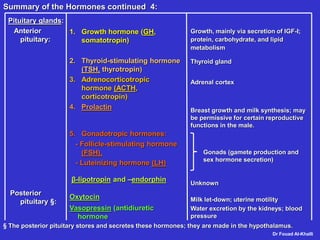
Summary of the Hormones continued 4:
Pituitary glands:
Anterior
pituitary:
Posterior
pituitary §:
1. Growth hormone (GH,
somatotropin)
2. Thyroid-stimulating hormone
(TSH, thyrotropin)
3. Adrenocorticotropic
hormone (ACTH,
corticotropin)
4. Prolactin
5. Gonadotropic hormones:
- Follicle-stimulating hormone
(FSH),
- Luteinizing hormone (LH)
β-lipotropin and –endorphin
Oxytocin
Vasopressin (antidiuretic
hormone
Growth, mainly via secretion of IGF-I;
protein, carbohydrate, and lipid
metabolism
Thyroid gland
Adrenal cortex
Breast growth and milk synthesis; may
be permissive for certain reproductive
functions in the male.
Gonads (gamete production and
sex hormone secretion)
Unknown
Milk let-down; uterine motility
Water excretion by the kidneys; blood
pressure
§ The posterior pituitary stores and secretes these hormones; they are made in the hypothalamus.
Dr Fouad Al-Khalli
Summary of the Hormones continued 5:
Placenta: 1. Chorionic gonadotropin (CG)
2. Estrogens
3. Progesterone
4. Placental lactogen (Human
somatomammotropin)
Maintains corpus luteum of pregn.
See Gonads in this table: ovaries
Breast development; organic
metabolism
Thymus: Thymopoietin T-lymphocyte function
Thyroid: - Thyroxine (T4)
- Triiodothyronine (T3)
- Calcitonin
Metabolic rate; growth; brain
development and function.
Plasma calcium
Multiple cell
types
Growth factors ‡ (e.g., epidermal
growth factor
Growth and proliferation of
specific cell types
‡ Some classifications include the cytokines under the category of growth factors.
This table with some modification is reproduced from: Vander : Human
Physiology: The Mechanisms of Body Function. 9th ed., 2004.
From Color Atlas of Physiology, 5th ed. 2006. Dr Fouad Al-Khalli
I. The great majority of receptors for steroid and thyroid
hormones are inside the target cells; those for the
peptide hormones and catecholamines are on the
plasma membrane.
II. Hormones can cause up-regulation and down-
regulation of their own receptors and those of other
hormones. The induction of one hormone’s receptors
by another hormone increases the first hormone’s
effectiveness and may be essential to permit the first
hormone to exert its effects.
Mechanisms of Hormone Action
Dr Fouad Al-Khalli
III. Receptors activated by peptide hormones and
catecholamines utilize one or more of the signal
transduction pathways available to plasma-
membrane receptors; the result is altered membrane
potential or activity of proteins in the cell.
IV. Intracellular receptors activated by steroid and
thyroid hormones function as transcription factors,
combining with DNA in the nucleus and inducing the
transcription of DNA into mRNA; the result is
increased synthesis of particular proteins.
V. In pharmacological doses, hormones can have
effects not seen under ordinary circumstances.
Dr Fouad Al-Khalli
 
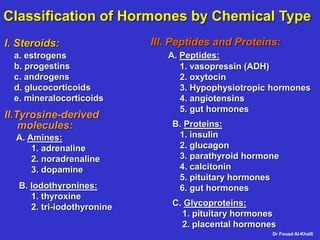
Classification of Hormones by Chemical Type
I. Steroids:
a. estrogens
b. progestins
c. androgens
d. glucocorticoids
e. mineralocorticoids
II.Tyrosine-derived
molecules:
A. Amines:
1. adrenaline
2. noradrenaline
3. dopamine
B. Iodothyronines:
1. thyroxine
2. tri-iodothyronine
III. Peptides and Proteins:
A. Peptides:
1. vasopressin (ADH)
2. oxytocin
3. Hypophysiotropic hormones
4. angiotensins
5. gut hormones
B. Proteins:
1. insulin
2. glucagon
3. parathyroid hormone
4. calcitonin
5. pituitary hormones
6. gut hormones
C. Glycoproteins:
1. pituitary hormones
2. placental hormones
Dr Fouad Al-Khalli
Dr Fouad Al-Khalli
Categories of Hormones
according to their transport and rate of effect.
Types
Major
Form in
Plasma
Location of
Receptors
Signal Transduction
Mechanisms
Rate of
Excretion/Metabolism
Peptides and
catecholamines
Free Plasma
membrane
Receptors alter:
- Channels intrinsic to the
receptors,
- Enzymatic activity
intrinsic to the receptor,
- Enzymatic activity of
cytoplasmic JAK kinases
associated with the
receptor,
- G proteins in the plasma
membrane. These control
plasma-membrane
channels or enzymes that
generate second
messengers (cAMP, DAG,
IP3).
Fast (minutes to
an hour)
Steroids and
thyroid
hormones
Protein
bound
Cell
interior
Receptors directly alter
gene transcription
Slow (hours to
days)
Dr Fouad Al-Khalli
Targets and Major Functions of the Six
Classical Anterior Pituitary Hormones
Anterior pituitary
FSH LH GH TSH Prolactin ACTH
Gonads
1.Germ cells
development.
2. Secretes hormones:
Liver
and
other
cells:
Secrete
IGF-I
Many
organs and
tissues:
Proteine
syntheses,
carbohydrate
and lipid
metabolism
Thyroid
Secretes
thyroxin,
triiodo-
thyronine
Breasts
Breast
development
and milk
production. (in
male may
facilitate
reproductive
function).
Adrenal
cortex
Secretes
cortisol
Female
↓
Estrogen,
progesteron
Male
↓
Testest-
erone
IGF-I = insulin-like growth factor I
From: Vander .: Human Physiology: The Mechanisms of Body Function. 9th ed., 2004.

1. Endocrine System - General..pptx

  • 1.
    Unite 10 Endocrine System Presentedby: Dr Fouad M. Y. Al-Khalli, Associate Prof. of Med. Physiology, Taiz and Sana’a University Dr Fouad Al-Khalli General Medical Physiology
  • 2.
  • 3.
    Dr Fouad Al-Khalli •Endocrinology is the branch of science that deals with hormones, hormonal regulations of metabolism and diseases associated with hormonal abnormalities. • Metabolism is the integrative functioning of many pathways through which fats, carbohydrates, proteins and minerals are ultimately utilized by the living cell. • In all body cells, hormones influence the metabolism of nucleotides, proteins, lipids, carbohydrates, vitamins, water and electrolytes. • The information and knowledge concerning endocrinology and metabolism are of tremendous importance specially in new medicine because all diseases are associated with metabolic changes. Definition and rationalization:
  • 4.
    Dr Fouad Al-Khalli GENERALOBJECTIVES: The aim of this course is to enable the student to understand: • the major metabolic pathways and their Inter- relationship(Biochemistry), • the hormonal regulation of metabolism, • the structure and function of endocrine glands, • the common occurring endocrine disorders.
  • 5.
    Dr Fouad Al-Khalli TheSpecific Objectives: • Define hormone and endocrine system; • Compare and contrast the nervous and endocrine systems. • List the hormones produced by the hypothalamus and pituitary gland; • Explain how the hypothalamus and pituitary are controlled and coordinated; • Describe the functions of growth hormone; • Describe the effects of pituitary hypo- and hypersecretion. • Discuss the formation, secretion, metabolism and the mode of action of thyroid hormones. • Describe the influence of the thyroid hormones on growth and other metabolic processes. • Discuss the presentation, clinical feature pathology and abnormalities of thyroid hypo and hyperactivity, and thyroid swellings( simple and nodular goiter). • Discuss the formation, secretion, metabolism and mode of action of parathyroid hormones. • Discuss the calcium metabolism and related clinical manifestations. • Discuss the formation, secretion, metabolism and mode of action of the adrenal hormone. • Describe the influence of adrenal hormones on body metabolic process. • Discuss the presentation, clinical features pathology and abnormalities of adrenal hypo and hyperactivity. • Discuss the mode of action of insulin and its control. • Discuss the factors involved in the control of normal blood sugar level. • Discuss the possible etiological factors in diabetes mellitus. • Discuss the clinical presentation and the underlying pathophysiological mechanism in diabetes mellitus ( the major differences between type I and type II diabetes).
  • 6.
    Dr Fouad Al-Khalli TheCourse Content: - Endocrine glands and hormones: chemical classification of hormones, common aspects of neural and endocrine regulation, hormone interactions, effects of hormone concentrations on tissue response. - Mechanisms of hormone action: hormones that bind to nuclear receptor proteins, hormones that use second messengers. - Pituitary gland: pituitary hormones, hypothalamic control of the posterior pituitary, hypothalamic control of the anterior pituitary, feedback control of the anterior pituitary, higher brain function and pituitary secretion, - Thyroid and parathyroid glands: production and action of thyroid hormones, parathyroid glands. - Adrenal glands: functions of the adrenal cortex, functions of the adrenal medulla, stress and the adrenal gland. - Pancreas: Islets of Langerhans: beta and alpha cells( insulin and glucagon), and diabetes mellitus. - Autocrine and paracrine regulation: examples of autocrine regulation, prostaglandins. - Other endocrine glands: pineal gland, gastrointestinal tract, gonads and placenta( will be discussed in the relating units).
  • 7.
    • The endocrinesystem is one of the body’s two major communications (controlling) systems. • It consists of all the glands that secrete hormones, which are chemical messengers carried by the blood from the endocrine glands to target cells elsewhere in the body. Definition Dr Fouad Al-Khalli
  • 8.
    Function of theEndocrines System 1. Maintenance of the Internal Environment: - Ion regulation - Water balance - Heart rate and blood pressure regulation - and others. 2. Regulation of Energy Utilization. 3. Growth and Development. 4. Reproduction. Dr Fouad Al-Khalli
  • 9.
    Hormones They are: • ChemicalMessengers act as physiologic regulators, • Effective in minute quantities, • Synthesized in specific gland cells, • Secreted directly into the bloodstream, • Transported by circulating blood to specific targeted organs where they • Exert specific action. Dr Fouad Al-Khalli
  • 10.
    Endocrine Glands Dr FouadAl-Khalli From: Human Body images, ANATOMICA, 2000, macromedia.
  • 11.
    The Controlling Systems of the body. From:Color Atlas of Physiology, 5th ed. 2006. Dr Fouad Al-Khalli Immune system Endocrine system Peripheral nervous system Autonomic I Somatic Psychogenical factors Central nervous system Massages from within the body (e.g., feedback control) Signals from the environment
  • 12.
    Plasma glucose concentration Insulin’starget cells Action of Insulin Plasma insulin concentration Controller Activator Controlled Process Feedback Transducer + + – + Simple Negative Feedback Regulation in Insulin Secretion From: Vander et . Al., Human Physiology.. 9th ed, 2004. Dr Fouad Al-Khalli Insulin-secreting cells Insulin secretion –
  • 13.
    Controlled Process Controller Activator Stimulus Response + + + – – Negative FeedbackRegulation From: Vander et al., Human Physiology. 9th ed, 2004. Dr Fouad Al-Khalli Stress Nonstress neural imputs Anterior pituitary  ACTH secretion Adrenal cortex  Cortisol secretion Target cells for cortisol Respond to increaseed cortisol  Plasma cortisol CORTISOL – –  Plasma ACTH Hypothalamus  CRH secretion Plasma CRH (in hypothalamo-pituitary portal vessels) CRH = corticotropin releasing hormone
  • 14.
    Dr Fouad Al-Khalli Stimulus Hypothalamus Hormone 1 secretion Third endocrine gland  Hormone 3 secretion Target cells for hormone 3 Respond to increaseed cortisol ⬆ Plasma hormone 3 (e.g.,cortisol) – –  Plasma hormone 2 Anterior pituitary  Hormone 2 secretion  Plasma hormone 1 (in hypothalamo-pituitary portal vessels) – Long-loop feedback Short-loop feedback Long-loop and Short-loop Feedback From: Vander et al. Human Physiology. 9th ed, 2004.
  • 15.
    Example of Feedback control inRegulation of Hormones (Cortisol And Adrenaline) Concentrations in plasma From Color Atlas of Physiology, 5th ed. 2006. Dr Fouad Al-Khalli (1) Is an example of Long-loop feedback. (2) and (3) are examples of Short-loop feedback.
  • 16.
    Adrenal medulla Endocrine gland cell Anterior pituitary Hormone HormoneHormone Hormone (Adrenaline) Posterior pituitary Autonomic ganglion Hormone + + + + - - or or Hypothalamus Autonomic nervous system Central Nervous System Pathways by which the nervous system influences hormone secretion Dr Fouad Al-Khalli From: Vander. Human Physiology. 9th ed, 2004.
  • 17.
    Causes of Excess andDeficiency of Hormones From Color Atlas of Pathophysiology, Int. ed. 2006. 9 8 7 6 5 4 3 2 1 Dr Fouad Al-Khalli 1. Regulating influences -  2. a) Hypoplasia, Aplasia -  b) Hyperplasia - . 3. Ectopic hormone production - . 4. Receptos: density, affinity- . 5. Hormone synthesis, intracellular transport, release - . 6. Feedback - . 7. Breakdown - . 8. Conversion - . 9. Intracellular transmission - .
  • 18.
    Dr. Fouad Al-Khalli PossibleFates and Actions of the Hormone Endocrine cell Secretes Hormones Plasma Hormone Excreted Inactivated by metabolism Activated by metabolism Catalyzes formation of active hormones from plasma protein Target cells Respond to hormone From: Vander et al. Human Physiology. 9th ed, 2004.
  • 19.
    Abnormalities of HypothalamusRegulated Hormones From Color Atlas of Physiology, 5th ed. 2006. Dr Fouad Al-Khalli  
  • 20.
    Hypothalamic- Pituitary Hormone Secretion From : ColorAtlas of Physiology, 5th ed. 2006. Dr Fouad Al-Khalli NPY (neuropeptide y)
  • 21.
    Dr Fouad Al-Khalli Endocrine Glands HormonesMajor Function* Is Control of: Summary of the Hormones Adipose tissue cells Leptin Food intake; metabolic rate. Adrenal: Adrenal cortex Adrenal medulla 1. Cortisol 2. Androgens 3. Aldosterone 1. Adrenaline 2. Noradrenalin Org. metabolism; response to stress; immune system. Sex drive in women. Sodium, potassium, and acid excretion by kidneys. Organic metabolism; cardiovascular function; response to stress. GI tract: 1. Gastrin 2. Secretin 3. Cholecystokinin 4. Glucose- dependent insulinotropic peptide (GIP) † 5. Motilin Gastrointestinal tract; liver; pancreas; gallbladder * This table does not list all functions of the hormones. † The names and abbreviations in parentheses are synonyms.
  • 22.
    Dr Fouad Al-Khalli Summaryof the Hormones continued 2 Gonads: Ovaries: ♀ Testes: ♂ 1. Estrogen 2. Progesterone 3. Inhibin 4. Relaxin 5. Testosterone 6. Inhibin 7. Müllerian - inhibiting hormone Reproductive system; breasts growth and development; influences gametes. FSH secretion. ? Relaxation of cervix and pubic ligaments. Reproductive system; growth and development; sex drive; influences gametes FSH secretion. Regression of Müllerian ducts Heart Atrial natriuretic factor (ANF, atriopeptin) Sodium excretion by kidneys; blood pressure. Hypothalamus Hypophysiotropic hormones: 1.Corticotropin releasing hormone (CRH) 2.Thyrotropin releasing hormone (TRH) 3.Growth hormone releasing hormone (GHRH) 4.Somatostatin (SS) 5.Gonadotropin releasing hormone (GnRH Secretion of hormones by the anterior pituitary Secretion of adrenocorticotropic hormone (stimulation) Secretion of thyroid-stimulating hormone (stimulation) Secretion of growth hormone (stimulation) Secretion of growth hormone (inhibition) Secretion of luteinizing hormone and folliclestimulating hormone (stimulation)
  • 23.
    Dr Fouad Al-Khalli Summaryof the Hormones continued 3 Hypothalamus (continued) 6. Dopamine (DA, also called prolactin-inhibiting hormone, PIH) 7. Posterior pituitary hormones Secretion of prolactin (inhibition) See posterior pituitary Kidneys 1. Renin (an enzyme that generates angiotensin) 2. Erythropoietin 3. 1,25-dihydroxyvitamin D3 Aldosterone secretion; blood pressure. Erythrocyte production. Plasma calcium. Leukocytes, macrophages, endothelial cells and fibroblasts Cytokines ‡ (these include the interleukins, colony-stimulating factors, interferon, tumor necrosis factors). Immune defenses. Liver and other: Insulin-like growth factors (IGF-I and II) Cell division and growth Pancreas: 1. Insulin (B cells) 2. Glucagon (A cells) 3. Somatostatin (D cells) Organic metabolism; plasma glucose Parathyroids: Parathyroid hormone (PTH, PH, parathormone Plasma calcium and phosphate Pineal?: Melatonin Sexual maturity; body rhythms ‡ Some classifications include the cytokines under the category of growth factors.
  • 24.
    Dr Fouad Al-Khalli Summaryof the Hormones continued 4: Pituitary glands: Anterior pituitary: Posterior pituitary §: 1. Growth hormone (GH, somatotropin) 2. Thyroid-stimulating hormone (TSH, thyrotropin) 3. Adrenocorticotropic hormone (ACTH, corticotropin) 4. Prolactin 5. Gonadotropic hormones: - Follicle-stimulating hormone (FSH), - Luteinizing hormone (LH) β-lipotropin and –endorphin Oxytocin Vasopressin (antidiuretic hormone Growth, mainly via secretion of IGF-I; protein, carbohydrate, and lipid metabolism Thyroid gland Adrenal cortex Breast growth and milk synthesis; may be permissive for certain reproductive functions in the male. Gonads (gamete production and sex hormone secretion) Unknown Milk let-down; uterine motility Water excretion by the kidneys; blood pressure § The posterior pituitary stores and secretes these hormones; they are made in the hypothalamus.
  • 25.
    Dr Fouad Al-Khalli Summaryof the Hormones continued 5: Placenta: 1. Chorionic gonadotropin (CG) 2. Estrogens 3. Progesterone 4. Placental lactogen (Human somatomammotropin) Maintains corpus luteum of pregn. See Gonads in this table: ovaries Breast development; organic metabolism Thymus: Thymopoietin T-lymphocyte function Thyroid: - Thyroxine (T4) - Triiodothyronine (T3) - Calcitonin Metabolic rate; growth; brain development and function. Plasma calcium Multiple cell types Growth factors ‡ (e.g., epidermal growth factor Growth and proliferation of specific cell types ‡ Some classifications include the cytokines under the category of growth factors. This table with some modification is reproduced from: Vander : Human Physiology: The Mechanisms of Body Function. 9th ed., 2004.
  • 26.
    From Color Atlasof Physiology, 5th ed. 2006. Dr Fouad Al-Khalli
  • 27.
    I. The greatmajority of receptors for steroid and thyroid hormones are inside the target cells; those for the peptide hormones and catecholamines are on the plasma membrane. II. Hormones can cause up-regulation and down- regulation of their own receptors and those of other hormones. The induction of one hormone’s receptors by another hormone increases the first hormone’s effectiveness and may be essential to permit the first hormone to exert its effects. Mechanisms of Hormone Action Dr Fouad Al-Khalli
  • 28.
    III. Receptors activatedby peptide hormones and catecholamines utilize one or more of the signal transduction pathways available to plasma- membrane receptors; the result is altered membrane potential or activity of proteins in the cell. IV. Intracellular receptors activated by steroid and thyroid hormones function as transcription factors, combining with DNA in the nucleus and inducing the transcription of DNA into mRNA; the result is increased synthesis of particular proteins. V. In pharmacological doses, hormones can have effects not seen under ordinary circumstances. Dr Fouad Al-Khalli  
  • 29.
    Classification of Hormonesby Chemical Type I. Steroids: a. estrogens b. progestins c. androgens d. glucocorticoids e. mineralocorticoids II.Tyrosine-derived molecules: A. Amines: 1. adrenaline 2. noradrenaline 3. dopamine B. Iodothyronines: 1. thyroxine 2. tri-iodothyronine III. Peptides and Proteins: A. Peptides: 1. vasopressin (ADH) 2. oxytocin 3. Hypophysiotropic hormones 4. angiotensins 5. gut hormones B. Proteins: 1. insulin 2. glucagon 3. parathyroid hormone 4. calcitonin 5. pituitary hormones 6. gut hormones C. Glycoproteins: 1. pituitary hormones 2. placental hormones Dr Fouad Al-Khalli
  • 30.
    Dr Fouad Al-Khalli Categoriesof Hormones according to their transport and rate of effect. Types Major Form in Plasma Location of Receptors Signal Transduction Mechanisms Rate of Excretion/Metabolism Peptides and catecholamines Free Plasma membrane Receptors alter: - Channels intrinsic to the receptors, - Enzymatic activity intrinsic to the receptor, - Enzymatic activity of cytoplasmic JAK kinases associated with the receptor, - G proteins in the plasma membrane. These control plasma-membrane channels or enzymes that generate second messengers (cAMP, DAG, IP3). Fast (minutes to an hour) Steroids and thyroid hormones Protein bound Cell interior Receptors directly alter gene transcription Slow (hours to days)
  • 31.
    Dr Fouad Al-Khalli Targetsand Major Functions of the Six Classical Anterior Pituitary Hormones Anterior pituitary FSH LH GH TSH Prolactin ACTH Gonads 1.Germ cells development. 2. Secretes hormones: Liver and other cells: Secrete IGF-I Many organs and tissues: Proteine syntheses, carbohydrate and lipid metabolism Thyroid Secretes thyroxin, triiodo- thyronine Breasts Breast development and milk production. (in male may facilitate reproductive function). Adrenal cortex Secretes cortisol Female ↓ Estrogen, progesteron Male ↓ Testest- erone IGF-I = insulin-like growth factor I From: Vander .: Human Physiology: The Mechanisms of Body Function. 9th ed., 2004.