Chapter -9
The Endocrine System
1
Introduction
 Endocrinology is the study of the endocrine system, which is
composed of hormone-secreting cells (e.g. brain, heart
,intestine) and endocrine glands.
 Glands are group of cells that produces chemical messagers
 Hormones are chemical messengers that are secreted into the
bloodstream and stimulate the physiology of cells in another
tissue or organ, often a considerable distance away.
 Endocrine system together with nervous system regulate
homeostasis of the body
2
3
Introduction….
1. The nervous system: Regulates homeostasis by releasing
chemical messengers called neurotransmitters
2. The endocrine system:
Regulates homeostasis by releasing chemical messengers
called hormones
 Difference b/n hormones and NTs
 Speed of action
 Duration of action
 Distribution
 Common aspects:
 small quantities
 regulate other cells & tissues
 act through receptors
 functional overlap between some hormones &
neurotransmitters
Endocrine glands
 The body contains two kinds of glands:
 exocrine glands
 endocrine glands.
 Exocrine glands (exo- outside) secrete their products into ducts
that carry the secretions into different parts of the body
 includes sudoriferous (sweat), sebaceous (oil), mucous, and
digestive glands.
 Endocrine glands (endo- within) secrete their products (hormones)
into the interstitial fluid then into blood capillaries and blood carries
them to target cells throughout the body.
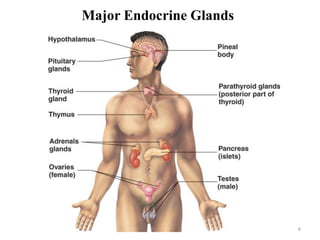
 include the pituitary, thyroid, parathyroid, adrenal, and pineal
glands, etc
4
5
1. Pituitary gland (anterior & posterior)
2. Thyroid gland.
3. Parathyroid gland.
4. Adrenal gland (cortex & medulla)
5. Islets of langerhans ( in the pancreas)
6. Male gonads ( testes) & Female gonads
7.Placenta. (Human Chorionic Gonadotropin (hCG), Human
Chorionic Somammotropin (hCS), Relaxin , Estrogen
(E),Progesterone (P))
The Principle Endocrine Glands
6
Major Endocrine Glands
Endocrine glands…
 Several organs and tissues are not exclusively classified as
endocrine glands but contain cells that secrete hormones.
 Include the:
 hypothalamus, thymus
 kidneys, stomach, liver
 small intestine, skin
 heart, adipose tissue
 Thus, all endocrine glands and hormone-secreting cells
constitute the endocrine system
7
8
Principal functions of hormones
1. Regulation of reproduction: gametogenesis, sexual desire,
coitus, fertilization.
2. Regulation of body growth and development.
3. Production, utilization and storage of energy
4. Homeostasis: maintenance of the internal environment in
the body (maintaining the optimum biochemical
environment).
 Water-electrolyte balance (stability of body fluid
composition)
 Regulation of acid-base balance
 Regulation of arterial blood pressure, heart rate
 Control of body temprature, emotion
 Change in mass of bone, muscle and fat
Hormonal activity
 A given hormone affects only specific target cells
 A target cell has a specific receptor that bind and recognize
that hormone
 Receptors are constantly being synthesized and broken down
 A target cell has 2000 to 100,000 receptors for a particular
hormone
 If a hormone is present in excess, the number of target-cell
receptors may decrease an effect called down-regulation
 makes a target cell less sensitive to a hormone
 when a hormone is deficient, the number of receptors may
increase, which is called up-regulation
 makes a target cell more sensitive to a hormone
9
10
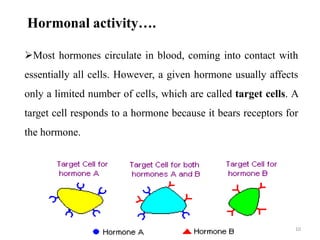
Hormonal activity….
Most hormones circulate in blood, coming into contact with
essentially all cells. However, a given hormone usually affects
only a limited number of cells, which are called target cells. A
target cell responds to a hormone because it bears receptors for
the hormone.
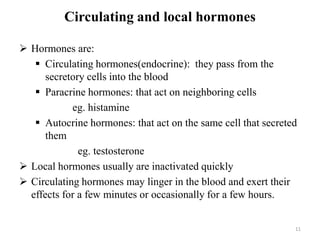
Circulating and local hormones
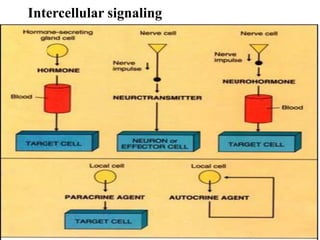
 Hormones are:
 Circulating hormones(endocrine): they pass from the
secretory cells into the blood
 Paracrine hormones: that act on neighboring cells
eg. histamine
 Autocrine hormones: that act on the same cell that secreted
them
eg. testosterone
 Local hormones usually are inactivated quickly
 Circulating hormones may linger in the blood and exert their
effects for a few minutes or occasionally for a few hours.
11
12
Intercellular signaling
13
Chemical nature of hormones
1. Amines (derived from tyrosine)
 Hydroxylation - catecholamines
 Iodination - thyroid hormones
2. Peptides/polypeptides or proteins
3. Steroids (derived from cholesterol)
 Adrenocorticoids
 Sex hormones
 Active metabolites of vitamin D3
4. Eicosanoids (derived from fatty acids)
 Prostaglandins
 Thromboxanes
Mechanism of Hormone Acton
 The physiological processes regulated by hormones result from
interaction of the hormone with receptors
 Nature of hormone receptors
 Receptors are larger proteins or glycoprotein
Location
On or within the cell membrane : Peptide/protein and
catecholamine
 Within the cytoplasm or nucleus: Steroid and thyroid
hormones.
15
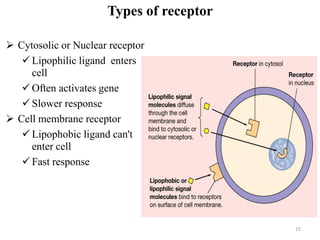
Types of receptor
15
 Cytosolic or Nuclear receptor
 Lipophilic ligand enters
cell
 Often activates gene
 Slower response
 Cell membrane receptor
 Lipophobic ligand can't
enter cell
 Fast response
16
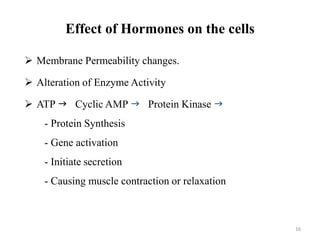
Effect of Hormones on the cells
 Membrane Permeability changes.
 Alteration of Enzyme Activity
 ATP  Cyclic AMP  Protein Kinase 
- Protein Synthesis
- Gene activation
- Initiate secretion
- Causing muscle contraction or relaxation
Hormone transport and metabolism
 Transport: hormones are transported in blood in two forms:
1. In the free form
2. In combination with plasma proteins (albumin & globulin). It has
3 advantages
a. prolong the biological half life of hormones
b. serve as a reservoir of hormones
c. increasing their solubility in blood
 Metabolism: metabolized in the liver or by target cells
 Excretion: urine, feces, sweat
17
Hormone Interaction
 The responsiveness of a target cell to a hormone depends on:
 the hormone’s concentration
 the abundance of the target cell’s hormone receptors
 influences exerted by other hormones
 The actions of some hormones on target cells require a simultaneous
or recent exposure to a second hormone.
 In such cases, the second hormone is said to have a permissive
effect.
 For example, epinephrine and thyroid hormones (T3 and T4)
18
Hormone interaction….
 When the effect of two hormones acting together is greater or
more extensive than the effect of each hormone acting alone,
the two hormones are said to have a synergistic effect.
 For example, normal development of oocytes in the ovaries
requires both follicle-stimulating hormone and estrogens.
 When one hormone opposes the actions of another hormone,
the two hormones are said to have antagonistic effects.
 insulin and glucagon
19
20
Regulation of hormonal secretion
Hormonal secretion is regulated by at least 3 mechanisms.
1. Feedback regulatory mechanisms
 Negative feedback mechanism (most hormones)
 Positive feedback mechanism (LH- surge)
2. Nervous control of hormonal secretion
 Secretion of OT, ADH, AD, NA
3. Circadian rhythm (periodic variations)
 Cortisol, sex hormones
21
Feedback control of hormone production
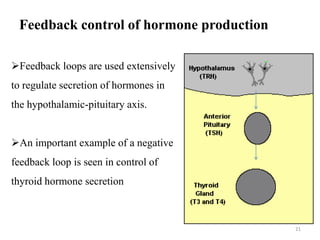
Feedback loops are used extensively
to regulate secretion of hormones in
the hypothalamic-pituitary axis.
An important example of a negative
feedback loop is seen in control of
thyroid hormone secretion
22
Negative feedback effects
23
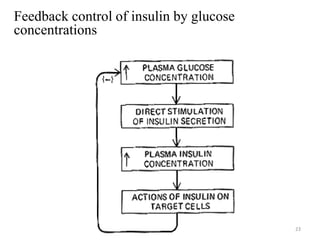
Feedback control of insulin by glucose
concentrations
24
24
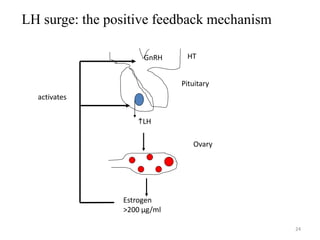
LH surge: the positive feedback mechanism
HT
Pituitary
Ovary
GnRH
LH
Estrogen
>200 µg/ml
activates
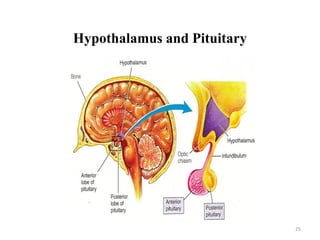
Hypothalamus and Pituitary
25
26
Hypothalamus
 HT is part of the diencephalons, which forms the floor and the
lateral wall of the 3rd ventricle.
 Located near the bottom of the brain (below thalamus); blood
brain barrier in this area is weaker than in rest of the brain
 HT represents less than 1% of the brain mass, about 5 gm
 Regardless of its size, it plays most important role in
controlling homeostasis.
 It is the main brain structure involved in regulating hormonal
levels in the body
27
Function of Hypothalamus
1. Controls the ANS
2. Endocrine function
– Controls adenohypophyseal hormones
– Controls neurohypophyseal hormones
– Controls adrenal medulla
3. Regulation of body temperature
4. Contributes to the regulation of sleep, wakefulness, emotions,
sexual arousal, anger, fear, pain, and pleasure.
5. Controls food intake (hunger sensation):
6. Control of water-electrolyte balance
7. Control of sexual behavior: libido, sexual activities are
controlled by cerebral cortex, limbic system and HT.
8. Regulates MR by stimulating calorigenic hormones such as
T3/T4, AD, NA, glucocorticoids.
9. Controls milk letdown and uterine contraction.
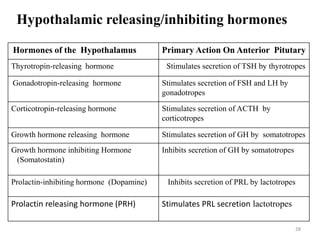
Hypothalamic releasing/inhibiting hormones
28
Hormones of the Hypothalamus Primary Action On Anterior Pitutary
Thyrotropin-releasing hormone Stimulates secretion of TSH by thyrotropes
Gonadotropin-releasing hormone Stimulates secretion of FSH and LH by
gonadotropes
Corticotropin-releasing hormone Stimulates secretion of ACTH by
corticotropes
Growth hormone releasing hormone Stimulates secretion of GH by somatotropes
Growth hormone inhibiting Hormone
(Somatostatin)
Inhibits secretion of GH by somatotropes
Prolactin-inhibiting hormone (Dopamine) Inhibits secretion of PRL by lactotropes
Prolactin releasing hormone (PRH) Stimulates PRL secretion lactotropes
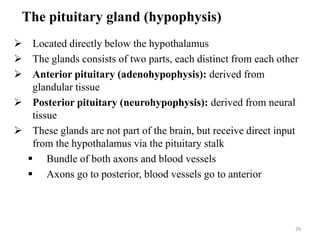
The pituitary gland (hypophysis)
 Located directly below the hypothalamus
 The glands consists of two parts, each distinct from each other
 Anterior pituitary (adenohypophysis): derived from
glandular tissue
 Posterior pituitary (neurohypophysis): derived from neural
tissue
 These glands are not part of the brain, but receive direct input
from the hypothalamus via the pituitary stalk
 Bundle of both axons and blood vessels
 Axons go to posterior, blood vessels go to anterior
29
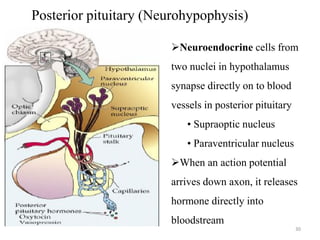
Posterior pituitary (Neurohypophysis)
Neuroendocrine cells from
two nuclei in hypothalamus
synapse directly on to blood
vessels in posterior pituitary
• Supraoptic nucleus
• Paraventricular nucleus
When an action potential
arrives down axon, it releases
hormone directly into
bloodstream
30
Posterior pituitary…..
 Does not synthesize hormones,
 It does store and release two hormones.
 Oxytocin
 Antidiuretic hormone (ADH) or vasoperssion
 The paraventricular nucleus synthesizes the hormone oxytocin
 Induces uterus contraction (Labor)
 Induces myoepithelial contraction (lactation)
 The supraoptic nucleus produces antidiuretic hormone (ADH)
 Promotes reabsorption of water in the renal tubules
 Vasoconstriction of arteries and arterioles
 Regulates osmolality and volume of ECF
31
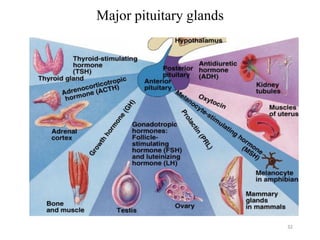
Major pituitary glands
32
End
33

physiology6 Endocrine system -1 (2).pdf

  • 1.
  • 2.
    Introduction  Endocrinology isthe study of the endocrine system, which is composed of hormone-secreting cells (e.g. brain, heart ,intestine) and endocrine glands.  Glands are group of cells that produces chemical messagers  Hormones are chemical messengers that are secreted into the bloodstream and stimulate the physiology of cells in another tissue or organ, often a considerable distance away.  Endocrine system together with nervous system regulate homeostasis of the body 2
  • 3.
    3 Introduction…. 1. The nervoussystem: Regulates homeostasis by releasing chemical messengers called neurotransmitters 2. The endocrine system: Regulates homeostasis by releasing chemical messengers called hormones  Difference b/n hormones and NTs  Speed of action  Duration of action  Distribution  Common aspects:  small quantities  regulate other cells & tissues  act through receptors  functional overlap between some hormones & neurotransmitters
  • 4.
    Endocrine glands  Thebody contains two kinds of glands:  exocrine glands  endocrine glands.  Exocrine glands (exo- outside) secrete their products into ducts that carry the secretions into different parts of the body  includes sudoriferous (sweat), sebaceous (oil), mucous, and digestive glands.  Endocrine glands (endo- within) secrete their products (hormones) into the interstitial fluid then into blood capillaries and blood carries them to target cells throughout the body.  include the pituitary, thyroid, parathyroid, adrenal, and pineal glands, etc 4
  • 5.
    5 1. Pituitary gland(anterior & posterior) 2. Thyroid gland. 3. Parathyroid gland. 4. Adrenal gland (cortex & medulla) 5. Islets of langerhans ( in the pancreas) 6. Male gonads ( testes) & Female gonads 7.Placenta. (Human Chorionic Gonadotropin (hCG), Human Chorionic Somammotropin (hCS), Relaxin , Estrogen (E),Progesterone (P)) The Principle Endocrine Glands
  • 6.
  • 7.
    Endocrine glands…  Severalorgans and tissues are not exclusively classified as endocrine glands but contain cells that secrete hormones.  Include the:  hypothalamus, thymus  kidneys, stomach, liver  small intestine, skin  heart, adipose tissue  Thus, all endocrine glands and hormone-secreting cells constitute the endocrine system 7
  • 8.
    8 Principal functions ofhormones 1. Regulation of reproduction: gametogenesis, sexual desire, coitus, fertilization. 2. Regulation of body growth and development. 3. Production, utilization and storage of energy 4. Homeostasis: maintenance of the internal environment in the body (maintaining the optimum biochemical environment).  Water-electrolyte balance (stability of body fluid composition)  Regulation of acid-base balance  Regulation of arterial blood pressure, heart rate  Control of body temprature, emotion  Change in mass of bone, muscle and fat
  • 9.
    Hormonal activity  Agiven hormone affects only specific target cells  A target cell has a specific receptor that bind and recognize that hormone  Receptors are constantly being synthesized and broken down  A target cell has 2000 to 100,000 receptors for a particular hormone  If a hormone is present in excess, the number of target-cell receptors may decrease an effect called down-regulation  makes a target cell less sensitive to a hormone  when a hormone is deficient, the number of receptors may increase, which is called up-regulation  makes a target cell more sensitive to a hormone 9
  • 10.
    10 Hormonal activity…. Most hormonescirculate in blood, coming into contact with essentially all cells. However, a given hormone usually affects only a limited number of cells, which are called target cells. A target cell responds to a hormone because it bears receptors for the hormone.
  • 11.
    Circulating and localhormones  Hormones are:  Circulating hormones(endocrine): they pass from the secretory cells into the blood  Paracrine hormones: that act on neighboring cells eg. histamine  Autocrine hormones: that act on the same cell that secreted them eg. testosterone  Local hormones usually are inactivated quickly  Circulating hormones may linger in the blood and exert their effects for a few minutes or occasionally for a few hours. 11
  • 12.
  • 13.
    13 Chemical nature ofhormones 1. Amines (derived from tyrosine)  Hydroxylation - catecholamines  Iodination - thyroid hormones 2. Peptides/polypeptides or proteins 3. Steroids (derived from cholesterol)  Adrenocorticoids  Sex hormones  Active metabolites of vitamin D3 4. Eicosanoids (derived from fatty acids)  Prostaglandins  Thromboxanes
  • 14.
    Mechanism of HormoneActon  The physiological processes regulated by hormones result from interaction of the hormone with receptors  Nature of hormone receptors  Receptors are larger proteins or glycoprotein Location On or within the cell membrane : Peptide/protein and catecholamine  Within the cytoplasm or nucleus: Steroid and thyroid hormones.
  • 15.
    15 Types of receptor 15 Cytosolic or Nuclear receptor  Lipophilic ligand enters cell  Often activates gene  Slower response  Cell membrane receptor  Lipophobic ligand can't enter cell  Fast response
  • 16.
    16 Effect of Hormoneson the cells  Membrane Permeability changes.  Alteration of Enzyme Activity  ATP  Cyclic AMP  Protein Kinase  - Protein Synthesis - Gene activation - Initiate secretion - Causing muscle contraction or relaxation
  • 17.
    Hormone transport andmetabolism  Transport: hormones are transported in blood in two forms: 1. In the free form 2. In combination with plasma proteins (albumin & globulin). It has 3 advantages a. prolong the biological half life of hormones b. serve as a reservoir of hormones c. increasing their solubility in blood  Metabolism: metabolized in the liver or by target cells  Excretion: urine, feces, sweat 17
  • 18.
    Hormone Interaction  Theresponsiveness of a target cell to a hormone depends on:  the hormone’s concentration  the abundance of the target cell’s hormone receptors  influences exerted by other hormones  The actions of some hormones on target cells require a simultaneous or recent exposure to a second hormone.  In such cases, the second hormone is said to have a permissive effect.  For example, epinephrine and thyroid hormones (T3 and T4) 18
  • 19.
    Hormone interaction….  Whenthe effect of two hormones acting together is greater or more extensive than the effect of each hormone acting alone, the two hormones are said to have a synergistic effect.  For example, normal development of oocytes in the ovaries requires both follicle-stimulating hormone and estrogens.  When one hormone opposes the actions of another hormone, the two hormones are said to have antagonistic effects.  insulin and glucagon 19
  • 20.
    20 Regulation of hormonalsecretion Hormonal secretion is regulated by at least 3 mechanisms. 1. Feedback regulatory mechanisms  Negative feedback mechanism (most hormones)  Positive feedback mechanism (LH- surge) 2. Nervous control of hormonal secretion  Secretion of OT, ADH, AD, NA 3. Circadian rhythm (periodic variations)  Cortisol, sex hormones
  • 21.
    21 Feedback control ofhormone production Feedback loops are used extensively to regulate secretion of hormones in the hypothalamic-pituitary axis. An important example of a negative feedback loop is seen in control of thyroid hormone secretion
  • 22.
  • 23.
    23 Feedback control ofinsulin by glucose concentrations
  • 24.
    24 24 LH surge: thepositive feedback mechanism HT Pituitary Ovary GnRH LH Estrogen >200 µg/ml activates
  • 25.
  • 26.
    26 Hypothalamus  HT ispart of the diencephalons, which forms the floor and the lateral wall of the 3rd ventricle.  Located near the bottom of the brain (below thalamus); blood brain barrier in this area is weaker than in rest of the brain  HT represents less than 1% of the brain mass, about 5 gm  Regardless of its size, it plays most important role in controlling homeostasis.  It is the main brain structure involved in regulating hormonal levels in the body
  • 27.
    27 Function of Hypothalamus 1.Controls the ANS 2. Endocrine function – Controls adenohypophyseal hormones – Controls neurohypophyseal hormones – Controls adrenal medulla 3. Regulation of body temperature 4. Contributes to the regulation of sleep, wakefulness, emotions, sexual arousal, anger, fear, pain, and pleasure. 5. Controls food intake (hunger sensation): 6. Control of water-electrolyte balance 7. Control of sexual behavior: libido, sexual activities are controlled by cerebral cortex, limbic system and HT. 8. Regulates MR by stimulating calorigenic hormones such as T3/T4, AD, NA, glucocorticoids. 9. Controls milk letdown and uterine contraction.
  • 28.
    Hypothalamic releasing/inhibiting hormones 28 Hormonesof the Hypothalamus Primary Action On Anterior Pitutary Thyrotropin-releasing hormone Stimulates secretion of TSH by thyrotropes Gonadotropin-releasing hormone Stimulates secretion of FSH and LH by gonadotropes Corticotropin-releasing hormone Stimulates secretion of ACTH by corticotropes Growth hormone releasing hormone Stimulates secretion of GH by somatotropes Growth hormone inhibiting Hormone (Somatostatin) Inhibits secretion of GH by somatotropes Prolactin-inhibiting hormone (Dopamine) Inhibits secretion of PRL by lactotropes Prolactin releasing hormone (PRH) Stimulates PRL secretion lactotropes
  • 29.
    The pituitary gland(hypophysis)  Located directly below the hypothalamus  The glands consists of two parts, each distinct from each other  Anterior pituitary (adenohypophysis): derived from glandular tissue  Posterior pituitary (neurohypophysis): derived from neural tissue  These glands are not part of the brain, but receive direct input from the hypothalamus via the pituitary stalk  Bundle of both axons and blood vessels  Axons go to posterior, blood vessels go to anterior 29
  • 30.
    Posterior pituitary (Neurohypophysis) Neuroendocrinecells from two nuclei in hypothalamus synapse directly on to blood vessels in posterior pituitary • Supraoptic nucleus • Paraventricular nucleus When an action potential arrives down axon, it releases hormone directly into bloodstream 30
  • 31.
    Posterior pituitary…..  Doesnot synthesize hormones,  It does store and release two hormones.  Oxytocin  Antidiuretic hormone (ADH) or vasoperssion  The paraventricular nucleus synthesizes the hormone oxytocin  Induces uterus contraction (Labor)  Induces myoepithelial contraction (lactation)  The supraoptic nucleus produces antidiuretic hormone (ADH)  Promotes reabsorption of water in the renal tubules  Vasoconstriction of arteries and arterioles  Regulates osmolality and volume of ECF 31
  • 32.
  • 33.