CLIMATE AND BUILT 
ENVIRONMENT
 UNIT I CLIMATE AND HUMAN 
COMFORT 
 Factors that determine climate of a place – 
Components of Climate – Climate classifications for 
 building designers in tropics – Climate 
characteristics. Human body heat balance – Human 
body 
 heat loss – Effects of climatic factors on human body 
heat loss – Effective temperature – Human 
 thermal comfort – Use of C.Mahony’s tables. 
MAGESHWARI .A (B.ARCH) II ND YR
1 . DEFINE THE TERM “ CLIMATE “ 
Climate is a measure of the average pattern of variation 
in temperature, humidity, atmospheric pressure, wind, 
precipitation, atmospheric particle count and 
other meteorological variables in a given region over long periods 
of time 
2 . HOW DOES CLIMATE DIFFER FROM WEATHER 
. Climate is different from weather, in that weather only 
describes the short-term conditions of these variables in a given 
region. 
MAGESHWARI .A (B.ARCH) II ND YR
3 .DEFINE “WEATHER” 
Weather is the state of the atmosphere, to the degree 
that it is hot or cold, wet or dry, calm or stormy, clear 
or cloudy. 
Weather, seen from an anthropological perspective, is 
something all humans in the world constantly 
experience through their senses, at least while being 
outside 
MAGESHWARI .A (B.ARCH) II ND YR
4. WHAT ARE THE FACTORS THAT 
DETERMINE THE CLIMATE OF A PLACE 
The factors that determine climate of a place are 
temperature, precipitation, altitude, location, latitude, tilt of the 
axis, surface currents, winds, and elevation. 
5. DEFINE THE TERM “ TEMPERATURE” 
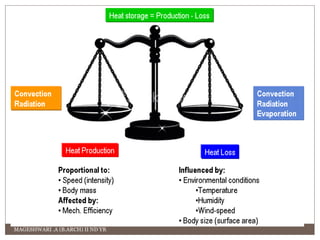
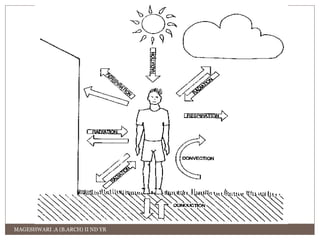
• A temperature is a numerical measure of hot and cold. Its 
measurement is by detection of heat radiation, particle 
velocity, kinetic energy, or most commonly, by the bulk 
behavior of a thermometric material. 
• It may be calibrated in any of various temperature 
scales, Celsius, Fahrenheit, Kelvin, etc. 
MAGESHWARI .A (B.ARCH) II ND YR
5 . DEFINE THE TERM “PRECIPITATION” 
• precipitation is any product of the condensation of atmospheric water 
vapour that falls under gravity. 
• The main forms of precipitation include drizzle, rain, sleet, snow, 
graupel and hail. 
6. DEFINE THE TERM “ LATITUDE” 
• Latitude is the distance of a location from the equator. 
• The hottest temperatures on Earth are found near the equator. 
This is because the sun shines directly on it for more hours 
during the year than anywhere else. 
• As you move further away from the equator towards the poles, 
less sun is received during the year and the temperature 
become colder. 
MAGESHWARI .A (B.ARCH) II ND YR
7 . WHAT IS MEANT BY ALTITUDE ..? 
• Altitude is the height you are above sea level. 
• The higher up you are the lower the temperature will be. 
• This is because air that is higher up is less dense than it is at lower 
altitudes and air temperature depends on its density. 
• As a general rule for every 1,000m higher you go the temperature 
will drop by 6.5 °C. 
MAGESHWARI .A (B.ARCH) II ND YR
8 .DEFINE “ WIND” 
• Wind is the flow of gases on a large scale. 
• On the surface of the Earth, wind consists of the bulk movement 
of air. 
9 . DEFINE “ ELEVATION” 
The elevation of a geographic location is its height above or below a 
fixed reference point . 
10 . DEFINE ATMOSPHERIC PRESSURE 
Atmospheric pressure is the force per unit area exerted on a 
surface by the weight of air above that surface in the atmosphere 
of Earth 
MAGESHWARI .A (B.ARCH) II ND YR
11. DEFINE HUMIDITY 
• Humidity is the level of water in the air, the more water vapour in the 
air the higher the humidity. 
• If the humidity level exceeds the amount of water air can hold 
condensation occurs forming dew if it's warm or frost if it's cold. 
• Humidity varies with temperature and is measured in percentage 
12 . WHAT ARE OCEAN CURRENTS..? 
• Currents are driven by the prevailing winds passing over the 
surface of the ocean. 
• Therefore winds blowing from tropical areas bring warm currents 
and vice versa. 
MAGESHWARI .A (B.ARCH) II ND YR
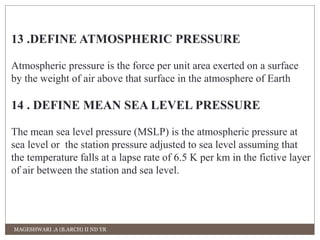
13 .DEFINE ATMOSPHERIC PRESSURE 
Atmospheric pressure is the force per unit area exerted on a surface 
by the weight of air above that surface in the atmosphere of Earth 
14 . DEFINE MEAN SEA LEVEL PRESSURE 
The mean sea level pressure (MSLP) is the atmospheric pressure at 
sea level or the station pressure adjusted to sea level assuming that 
the temperature falls at a lapse rate of 6.5 K per km in the fictive layer 
of air between the station and sea level. 
MAGESHWARI .A (B.ARCH) II ND YR
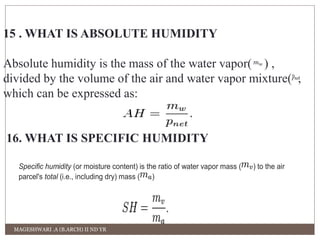
15 . WHAT IS ABSOLUTE HUMIDITY 
Absolute humidity is the mass of the water vapor( ) , 
divided by the volume of the air and water vapor mixture( , 
which can be expressed as: 
16. WHAT IS SPECIFIC HUMIDITY 
Specific humidity (or moisture content) is the ratio of water vapor mass ( ) to the air 
parcel's total (i.e., including dry) mass ( ) 
MAGESHWARI .A (B.ARCH) II ND YR
17 . DEFINE RELATIVE HUMIDITY 
The relative humidity of an air-water mixture is defined as the ratio of the partial pressure of 
water vapor (H2O) in the mixture to the saturated vapor pressure of water at a 
given temperature. Thus the relative humidity of air is a function of both water content and 
temperature. 
Relative humidity is normally expressed as a percentage and is calculated by using the following 
equation:[4] 
MAGESHWARI .A (B.ARCH) II ND YR
18 . DEFINE THERMAL COMFORT 
• Thermal comfort is the condition of mind that expresses satisfaction 
with the thermal environment and is assessed by subjective 
evaluation 
• Maintaining this standard of thermal comfort for occupants of 
buildings or other enclosures is one of the important goals 
of HVAC (heating, ventilation, and air conditioning) design 
engineers. 
• 19 . WHAT DO YOU MEAN BY CLOTHING 
INSULATION 
• The amount of thermal insulation worn by a person has a substantial 
impact on thermal comfort, because it influences the heat loss and 
consequently the thermal balance. 
• Layers of insulating clothing prevent heat loss and can either help 
keep a person warm or lead to overheating. 
• Generally, the thicker the garment is, the greater insulating ability 
MAGESHWARI .A (B.ARCH) II ND YR
20 .DEFINE MEAN RADIANT TEMPERATURE 
The radiant temperature is related to the amount of radiant heat 
transferred from a surface, and it depends on the material’s ability 
to absorb or emit heat, or its emissivity 
21. DEFINE EFFECTIVE TEMPERATURE 
• The effective temperature of a body such as a star or planet is 
the temperature of a black body that would emit the same total 
amount of electromagnetic radiation. 
• Effective temperature is often used as an estimate of a body's 
temperature when the body's emissivity curve is not known. 
MAGESHWARI .A (B.ARCH) II ND YR
22. WHAT ARE THE FACTORS THAT AFFECT 
THERMAL COMFORT 
Environmental factors: 
• Air temperature 
• Radiant temperature 
• Air velocity 
• Humidity 
Personal factors: 
• Clothing Insulation 
• Metabolic heat 
MAGESHWARI .A (B.ARCH) II ND YR
23. DEFINE AIR TEMPERATURE ? 
This is the temperature of the air surrounding the body. It is 
usually given in degrees Celsius (°C) or degrees Fahrenheit 
(°F). 
24 . EXPLAIN METABOLISM 
• metabolism is the set of life-sustaining chemical 
transformations within the cells of livingorganisms. 
• These enzyme-catalyzed reactions allow organisms to grow 
and reproduce, maintain their structures, and respond to their 
environments. 
• The word metabolism can also refer to all chemical reactions 
that occur in living organisms, including digestion and the 
transport of substances into and between different cells 
MAGESHWARI .A (B.ARCH) II ND YR
• 25 .DEFINE ACCLIMATIZATION 
• acclimatization is the process in which an individual organism 
adjusts to a gradual change in its environment (such as a change 
in temperature, humidity, photoperiod, or pH), allowing it to 
maintain performance across a range of environmental 
conditions. 
• Acclimatization occurs in a short period of time (days to weeks), 
and within the organism's lifetime (compare to adaptation). 
• 26 .WHAT IS PERSPIRATION 
• Perspiration (sweating, transpiration, or diaphoresis) is the 
production of fluids secreted by the sweat glands in the skin 
ofmammals.[1] 
• MAGESHWARI Two types .A (B.ARCH) of sweat II ND YR 
glands can be found in humans: eccrine 
glands and apocrine glands. The eccrine sweat glands are
26 .WHAT IS PERSPIRATION 
• Perspiration (sweating, transpiration, or diaphoresis) is the 
production of fluids secreted by the sweat glands in the skin of 
mammals. 
• Two types of sweat glands can be found in humans: eccrine 
glands and apocrine glands. The eccrine sweat glands are 
distributed over much of the body. 
27 . WHAT DO YOU MEAN BY SOLAR CONSTANT 
The intensity of radiation reaching the upper surface of the 
atmosphere is called as solar constant 
MAGESHWARI .A (B.ARCH) II ND YR
28.EXPLAIN EARTH’S ROTATION AXIS 
• The earth rotates around its own axis at each rotation 24 
hours per day 
• The axis of rotation is tilted to the plane of vertical orbit at 
an angle of 66.5° to the normal and the direction of axis is a 
constant 
• Maximum intensity of radiation is received on a plane 
normal to the direction of inclination 
29 .STATE COSINE LAW 
Cosine law states that the intensity on a tilted surface equals 
in normal intensity times the cosine of angle of incidence 
MAGESHWARI .A (B.ARCH) II ND YR
30 . WHAT IS A PHOTON 
Each molecule of particle coming out from the sun is called as 
photon 
31 . WHAT IS “ ITCZ “ 
ITCZ – INTER TROPICAL CONVERGANCE ZONE 
• The area where the air rises , where the northerly and southerly winds 
meets , a tropical flaunt is formed 
• This area experiences either calm conditions or only light breezes of 
irregular directions and is referred ( doldrums ) 
MAGESHWARI .A (B.ARCH) II ND YR
32.WHAT ARE POLAR WINDS ? 
• The air at the surface moves from the coldest to the slightly 
warmer regions away from the poles 
• The air lags behind the rotating earth as it moves from the poles 
• The northerly is deflected into north easterly and southerly is 
deflected into south easterly 
• 33 . DEFINE HEAT 
• Heat is a form of energy appearing as molecular moment in 
substances or as radiant heat , or a certain wavelength bond of 
electromagnetic radiation in space 
• It is measured in joules 
MAGESHWARI .A (B.ARCH) II ND YR
34 .WHAT DO YOU MEAN BY SPECIFIC HEAT OF 
A SUBSTANCE 
It is the amount of heat energy necessary to cause unit temperature 
,increase a unit mass of substance 
It is measured in J/kg/℃ 
The higher the specific heat of a substance the more heat will absorb 
for a given increase in temperature 
35 . WHAT IS LATENT HEAT 
It is the amount of heat energy absorbed by the unit mass of 
substance at change of state, without any change in temperature 
MAGESHWARI .A (B.ARCH) II ND YR
36 . DEFINE ENERGY 
The capacity to do work is called as energy . It is usually 
expressed in calories 
37 . WHAT IS THERMAL CAPACITY 
Thermal capacity of a body is product o mass and specific heat 
of the material . 
It is measured as the amount of heat required to cause unit 
temperature increase of the body. Its unit is J/℃ 
38 .WHAT IS CALORIFIC VALUE 
Calorific value is the amount of heat released by unit mass of a 
fuel or food material by its complete combustion 
It is measure I J/kg or J/cal 
MAGESHWARI .A (B.ARCH) II ND YR
39 . WHAT IS CONDUCTION 
The transfer of energy between objects that are in physical contact. 
Thermal conductivity is the property of a material to conduct heat 
and evaluated primarily in terms of Fourier's Law for heat 
conduction. 
40 . WHAT IS CONVECTION 
The transfer of energy between an object and its environment, due 
to fluid motion. The average temperature, is a reference for 
evaluating properties related to convective heat transfer. 
41 . WHAT IS RADIATION 
The transfer of energy from the movement of charged particles 
within atoms is converted to electromagnetic radiation. 
MAGESHWARI .A (B.ARCH) II ND YR

Climate and built environment

  • 1.
    CLIMATE AND BUILT ENVIRONMENT
  • 2.
     UNIT ICLIMATE AND HUMAN COMFORT  Factors that determine climate of a place – Components of Climate – Climate classifications for  building designers in tropics – Climate characteristics. Human body heat balance – Human body  heat loss – Effects of climatic factors on human body heat loss – Effective temperature – Human  thermal comfort – Use of C.Mahony’s tables. MAGESHWARI .A (B.ARCH) II ND YR
  • 3.
    1 . DEFINETHE TERM “ CLIMATE “ Climate is a measure of the average pattern of variation in temperature, humidity, atmospheric pressure, wind, precipitation, atmospheric particle count and other meteorological variables in a given region over long periods of time 2 . HOW DOES CLIMATE DIFFER FROM WEATHER . Climate is different from weather, in that weather only describes the short-term conditions of these variables in a given region. MAGESHWARI .A (B.ARCH) II ND YR
  • 4.
    3 .DEFINE “WEATHER” Weather is the state of the atmosphere, to the degree that it is hot or cold, wet or dry, calm or stormy, clear or cloudy. Weather, seen from an anthropological perspective, is something all humans in the world constantly experience through their senses, at least while being outside MAGESHWARI .A (B.ARCH) II ND YR
  • 5.
    4. WHAT ARETHE FACTORS THAT DETERMINE THE CLIMATE OF A PLACE The factors that determine climate of a place are temperature, precipitation, altitude, location, latitude, tilt of the axis, surface currents, winds, and elevation. 5. DEFINE THE TERM “ TEMPERATURE” • A temperature is a numerical measure of hot and cold. Its measurement is by detection of heat radiation, particle velocity, kinetic energy, or most commonly, by the bulk behavior of a thermometric material. • It may be calibrated in any of various temperature scales, Celsius, Fahrenheit, Kelvin, etc. MAGESHWARI .A (B.ARCH) II ND YR
  • 6.
    5 . DEFINETHE TERM “PRECIPITATION” • precipitation is any product of the condensation of atmospheric water vapour that falls under gravity. • The main forms of precipitation include drizzle, rain, sleet, snow, graupel and hail. 6. DEFINE THE TERM “ LATITUDE” • Latitude is the distance of a location from the equator. • The hottest temperatures on Earth are found near the equator. This is because the sun shines directly on it for more hours during the year than anywhere else. • As you move further away from the equator towards the poles, less sun is received during the year and the temperature become colder. MAGESHWARI .A (B.ARCH) II ND YR
  • 7.
    7 . WHATIS MEANT BY ALTITUDE ..? • Altitude is the height you are above sea level. • The higher up you are the lower the temperature will be. • This is because air that is higher up is less dense than it is at lower altitudes and air temperature depends on its density. • As a general rule for every 1,000m higher you go the temperature will drop by 6.5 °C. MAGESHWARI .A (B.ARCH) II ND YR
  • 8.
    8 .DEFINE “WIND” • Wind is the flow of gases on a large scale. • On the surface of the Earth, wind consists of the bulk movement of air. 9 . DEFINE “ ELEVATION” The elevation of a geographic location is its height above or below a fixed reference point . 10 . DEFINE ATMOSPHERIC PRESSURE Atmospheric pressure is the force per unit area exerted on a surface by the weight of air above that surface in the atmosphere of Earth MAGESHWARI .A (B.ARCH) II ND YR
  • 9.
    11. DEFINE HUMIDITY • Humidity is the level of water in the air, the more water vapour in the air the higher the humidity. • If the humidity level exceeds the amount of water air can hold condensation occurs forming dew if it's warm or frost if it's cold. • Humidity varies with temperature and is measured in percentage 12 . WHAT ARE OCEAN CURRENTS..? • Currents are driven by the prevailing winds passing over the surface of the ocean. • Therefore winds blowing from tropical areas bring warm currents and vice versa. MAGESHWARI .A (B.ARCH) II ND YR
  • 10.
    13 .DEFINE ATMOSPHERICPRESSURE Atmospheric pressure is the force per unit area exerted on a surface by the weight of air above that surface in the atmosphere of Earth 14 . DEFINE MEAN SEA LEVEL PRESSURE The mean sea level pressure (MSLP) is the atmospheric pressure at sea level or the station pressure adjusted to sea level assuming that the temperature falls at a lapse rate of 6.5 K per km in the fictive layer of air between the station and sea level. MAGESHWARI .A (B.ARCH) II ND YR
  • 11.
    15 . WHATIS ABSOLUTE HUMIDITY Absolute humidity is the mass of the water vapor( ) , divided by the volume of the air and water vapor mixture( , which can be expressed as: 16. WHAT IS SPECIFIC HUMIDITY Specific humidity (or moisture content) is the ratio of water vapor mass ( ) to the air parcel's total (i.e., including dry) mass ( ) MAGESHWARI .A (B.ARCH) II ND YR
  • 12.
    17 . DEFINERELATIVE HUMIDITY The relative humidity of an air-water mixture is defined as the ratio of the partial pressure of water vapor (H2O) in the mixture to the saturated vapor pressure of water at a given temperature. Thus the relative humidity of air is a function of both water content and temperature. Relative humidity is normally expressed as a percentage and is calculated by using the following equation:[4] MAGESHWARI .A (B.ARCH) II ND YR
  • 13.
    18 . DEFINETHERMAL COMFORT • Thermal comfort is the condition of mind that expresses satisfaction with the thermal environment and is assessed by subjective evaluation • Maintaining this standard of thermal comfort for occupants of buildings or other enclosures is one of the important goals of HVAC (heating, ventilation, and air conditioning) design engineers. • 19 . WHAT DO YOU MEAN BY CLOTHING INSULATION • The amount of thermal insulation worn by a person has a substantial impact on thermal comfort, because it influences the heat loss and consequently the thermal balance. • Layers of insulating clothing prevent heat loss and can either help keep a person warm or lead to overheating. • Generally, the thicker the garment is, the greater insulating ability MAGESHWARI .A (B.ARCH) II ND YR
  • 14.
    20 .DEFINE MEANRADIANT TEMPERATURE The radiant temperature is related to the amount of radiant heat transferred from a surface, and it depends on the material’s ability to absorb or emit heat, or its emissivity 21. DEFINE EFFECTIVE TEMPERATURE • The effective temperature of a body such as a star or planet is the temperature of a black body that would emit the same total amount of electromagnetic radiation. • Effective temperature is often used as an estimate of a body's temperature when the body's emissivity curve is not known. MAGESHWARI .A (B.ARCH) II ND YR
  • 15.
    22. WHAT ARETHE FACTORS THAT AFFECT THERMAL COMFORT Environmental factors: • Air temperature • Radiant temperature • Air velocity • Humidity Personal factors: • Clothing Insulation • Metabolic heat MAGESHWARI .A (B.ARCH) II ND YR
  • 16.
    23. DEFINE AIRTEMPERATURE ? This is the temperature of the air surrounding the body. It is usually given in degrees Celsius (°C) or degrees Fahrenheit (°F). 24 . EXPLAIN METABOLISM • metabolism is the set of life-sustaining chemical transformations within the cells of livingorganisms. • These enzyme-catalyzed reactions allow organisms to grow and reproduce, maintain their structures, and respond to their environments. • The word metabolism can also refer to all chemical reactions that occur in living organisms, including digestion and the transport of substances into and between different cells MAGESHWARI .A (B.ARCH) II ND YR
  • 17.
    • 25 .DEFINEACCLIMATIZATION • acclimatization is the process in which an individual organism adjusts to a gradual change in its environment (such as a change in temperature, humidity, photoperiod, or pH), allowing it to maintain performance across a range of environmental conditions. • Acclimatization occurs in a short period of time (days to weeks), and within the organism's lifetime (compare to adaptation). • 26 .WHAT IS PERSPIRATION • Perspiration (sweating, transpiration, or diaphoresis) is the production of fluids secreted by the sweat glands in the skin ofmammals.[1] • MAGESHWARI Two types .A (B.ARCH) of sweat II ND YR glands can be found in humans: eccrine glands and apocrine glands. The eccrine sweat glands are
  • 18.
    26 .WHAT ISPERSPIRATION • Perspiration (sweating, transpiration, or diaphoresis) is the production of fluids secreted by the sweat glands in the skin of mammals. • Two types of sweat glands can be found in humans: eccrine glands and apocrine glands. The eccrine sweat glands are distributed over much of the body. 27 . WHAT DO YOU MEAN BY SOLAR CONSTANT The intensity of radiation reaching the upper surface of the atmosphere is called as solar constant MAGESHWARI .A (B.ARCH) II ND YR
  • 19.
    28.EXPLAIN EARTH’S ROTATIONAXIS • The earth rotates around its own axis at each rotation 24 hours per day • The axis of rotation is tilted to the plane of vertical orbit at an angle of 66.5° to the normal and the direction of axis is a constant • Maximum intensity of radiation is received on a plane normal to the direction of inclination 29 .STATE COSINE LAW Cosine law states that the intensity on a tilted surface equals in normal intensity times the cosine of angle of incidence MAGESHWARI .A (B.ARCH) II ND YR
  • 20.
    30 . WHATIS A PHOTON Each molecule of particle coming out from the sun is called as photon 31 . WHAT IS “ ITCZ “ ITCZ – INTER TROPICAL CONVERGANCE ZONE • The area where the air rises , where the northerly and southerly winds meets , a tropical flaunt is formed • This area experiences either calm conditions or only light breezes of irregular directions and is referred ( doldrums ) MAGESHWARI .A (B.ARCH) II ND YR
  • 21.
    32.WHAT ARE POLARWINDS ? • The air at the surface moves from the coldest to the slightly warmer regions away from the poles • The air lags behind the rotating earth as it moves from the poles • The northerly is deflected into north easterly and southerly is deflected into south easterly • 33 . DEFINE HEAT • Heat is a form of energy appearing as molecular moment in substances or as radiant heat , or a certain wavelength bond of electromagnetic radiation in space • It is measured in joules MAGESHWARI .A (B.ARCH) II ND YR
  • 22.
    34 .WHAT DOYOU MEAN BY SPECIFIC HEAT OF A SUBSTANCE It is the amount of heat energy necessary to cause unit temperature ,increase a unit mass of substance It is measured in J/kg/℃ The higher the specific heat of a substance the more heat will absorb for a given increase in temperature 35 . WHAT IS LATENT HEAT It is the amount of heat energy absorbed by the unit mass of substance at change of state, without any change in temperature MAGESHWARI .A (B.ARCH) II ND YR
  • 23.
    36 . DEFINEENERGY The capacity to do work is called as energy . It is usually expressed in calories 37 . WHAT IS THERMAL CAPACITY Thermal capacity of a body is product o mass and specific heat of the material . It is measured as the amount of heat required to cause unit temperature increase of the body. Its unit is J/℃ 38 .WHAT IS CALORIFIC VALUE Calorific value is the amount of heat released by unit mass of a fuel or food material by its complete combustion It is measure I J/kg or J/cal MAGESHWARI .A (B.ARCH) II ND YR
  • 24.
  • 25.
  • 26.
    39 . WHATIS CONDUCTION The transfer of energy between objects that are in physical contact. Thermal conductivity is the property of a material to conduct heat and evaluated primarily in terms of Fourier's Law for heat conduction. 40 . WHAT IS CONVECTION The transfer of energy between an object and its environment, due to fluid motion. The average temperature, is a reference for evaluating properties related to convective heat transfer. 41 . WHAT IS RADIATION The transfer of energy from the movement of charged particles within atoms is converted to electromagnetic radiation. MAGESHWARI .A (B.ARCH) II ND YR