Annual Plans-Middle-
Ministry of National Education 1
Democratic and Popular Republic of Algeria
Ministry of National Education
General Inspectorate of Pedagogy Direction of the Fundamental Teaching
YEARLY PLANS
ENGLISH
GRADE :1
MIDDLE SCHOOL
September2018
Annual Plans-Middle-
Ministry of National Education 2
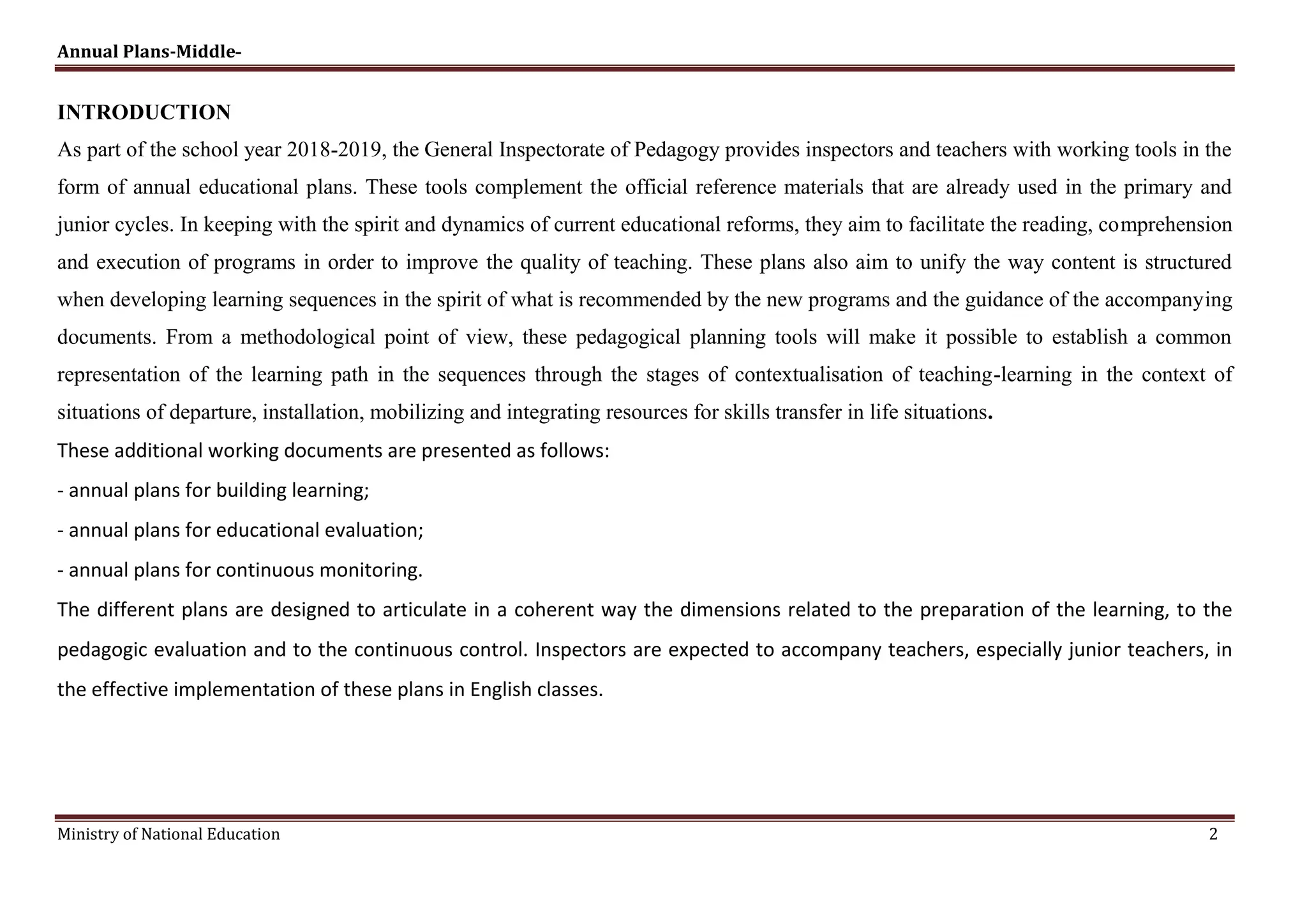
INTRODUCTION
As part of the school year 2018-2019, the General Inspectorate of Pedagogy provides inspectors and teachers with working tools in the
form of annual educational plans. These tools complement the official reference materials that are already used in the primary and
junior cycles. In keeping with the spirit and dynamics of current educational reforms, they aim to facilitate the reading, comprehension
and execution of programs in order to improve the quality of teaching. These plans also aim to unify the way content is structured
when developing learning sequences in the spirit of what is recommended by the new programs and the guidance of the accompanying
documents. From a methodological point of view, these pedagogical planning tools will make it possible to establish a common
representation of the learning path in the sequences through the stages of contextualisation of teaching-learning in the context of
situations of departure, installation, mobilizing and integrating resources for skills transfer in life situations.
These additional working documents are presented as follows:
- annual plans for building learning;
- annual plans for educational evaluation;
- annual plans for continuous monitoring.
The different plans are designed to articulate in a coherent way the dimensions related to the preparation of the learning, to the
pedagogic evaluation and to the continuous control. Inspectors are expected to accompany teachers, especially junior teachers, in
the effective implementation of these plans in English classes.
Annual Plans-Middle-
Ministry of National Education 3
Methodological note
The results of the national consultation on assessment presented at the national conference held on April 29th ,2017, highlighted the
need to review the current assessment practices. A necessity reinforced by the field follow-up reports of the inspectors, which revealed
imbalances in the implementation of the curricula due to ineffective reading and associated interpretations. This fact has prompted the
General Inspectorate of Pedagogy to provide practitioners with tools that illustrate the vision, dispel misinterpretations and allow for
educational performance improvement, which is one of the axes of the reform namely the training of trainers and professionalization
of the main actors of the education system.
The tools designed by the General Inspectorate of Pedagogy include: the annual learning plan, the annual pedagogic assessment plan
and the annual continuous assessment plan for each of the subjects of primary and middle school education in the key stages
concerned by the implementation of the re-written curriculum.
1-The annual learning plan
The annual learning plan is a comprehensive plan of a program of study within an educational project that aims to achieve the global
competence of a learning level on the basis of the target competency stated for each domain ( oral interaction, interpretation of oral
and written messages and production of oral and written messages) and through an integrated set of learning sections.
Each plan starts from the target competency to achieve ; its development is carried out through a problem-solving situation in its
general context that the learner may encounter in his or her school or social life and a set of partial situations conducive to integration
and potential remediation. The plan also contains instructions from the “support document” and the “teacher’s guide” and the
estimated time to devote to the learning section to ensure an adequate implementation of this latter.
2-The annual pedagogic assessment plan
The annual pedagogic assessment plan is a plan that synchronizes the learning implementation process with the verification of the
competency development. It starts from the target competency, which is framed by standards that include the three following aspects:
knowledge, methodology and values. These standards allow for both learning assessment and assessment of the learner’s effort and
offer opportunity to provide learners with objective and constructive feedback.
Annual Plans-Middle-
Ministry of National Education 4
YEARLY LEARNING PLAN
KEY STAGE ONE (MS1)
Annual Plans-Middle-
Ministry of National Education 5
Exit Profile: At the end of level 1 ( 1st year middle school), the learner will be able to interact, interpret and produce short oral and written messages texts of
descriptive type, using written, visual or oral supports, in meaningful situations of communication related to his environment and interests. The learner can:
-Understand simple messages related to concrete situations, his/her immediate environment and needs.
-Ask and answer simple questions about topics related to their age and interest provided that the other person speaks clearly and is prepared to help
-Use very basic phrases, short sentences to talk and write about personal experiences (family likes…)
VALUES
National identity: The learner can use the markers
of his identity when introducing himself to others:
name, nationality , language, religion , flag,
national currency ...
National conscience: He can speak about our
school days, weekend and national public holidays
(historic, religious, etc)
Citizenship :He shows respect for the
environment and protects it continually
Openness to the world : He is keen on learning
about others’ markers of identity
CROSS-CURRICULAR COMPETENCES
1.Intellectual competency/The learner can :understand and interpret verbal and non-verbal messages-
solve problem situations using a variety of communication means- show creativity when producing
oral and written messages - show some degree of autonomy in all areas of learning
2.methodological competency : The learner can: work in pairs or in groups- use strategies for listening and
interpreting oral discourse-develop effective study methods , mobilize his resources efficiently and manage his
time rationally- use information and communication technology whenever he needs it for learning and research-
evaluate himself and his peers
3.communicative competency: The learner can: use dramatization and role-play to communicate appropriately-
use information and communication technology such as blogs, websites page, discussion forums , platforms to
interact with learners of other cultures-use dramatization and role-play to communicate appropriately-use
information and communication technology such as blogs, websites page, discussion forums , platforms to interact
with learners of other cultures-process digital data
4.personal and social competencies : He is aware of his role and others' role in the development of projects*He
is keen on promoting the work of his peers*He respects our national values and behaves consistently*He is honest
and accountable for his work and respects others work*He asserts his personal identity and behaves with self-
confidence*He socializes through oral or written exchanges* He develops attitudes of solidarity
Domains Oral- Written – Both
Target competencies
In meaningful communicative situations related to his/ her interests, based on written, visual or audio supports, the
learner will be able to interact and produce short and simple descriptive messages/texts orally.
In meaningful communicative situations related to his/her environment and interests, based on written, visual or
audio supports, the learner will be able to interpret short and simple descriptive messages/texts orally and in
written.
In meaningful communicative situations related to his/her environment and interests, based on written, visual or
audio supports, the learner will be able to produce short and simple written descriptive messages/texts .
Annual Plans-Middle-
Ministry of National Education 6
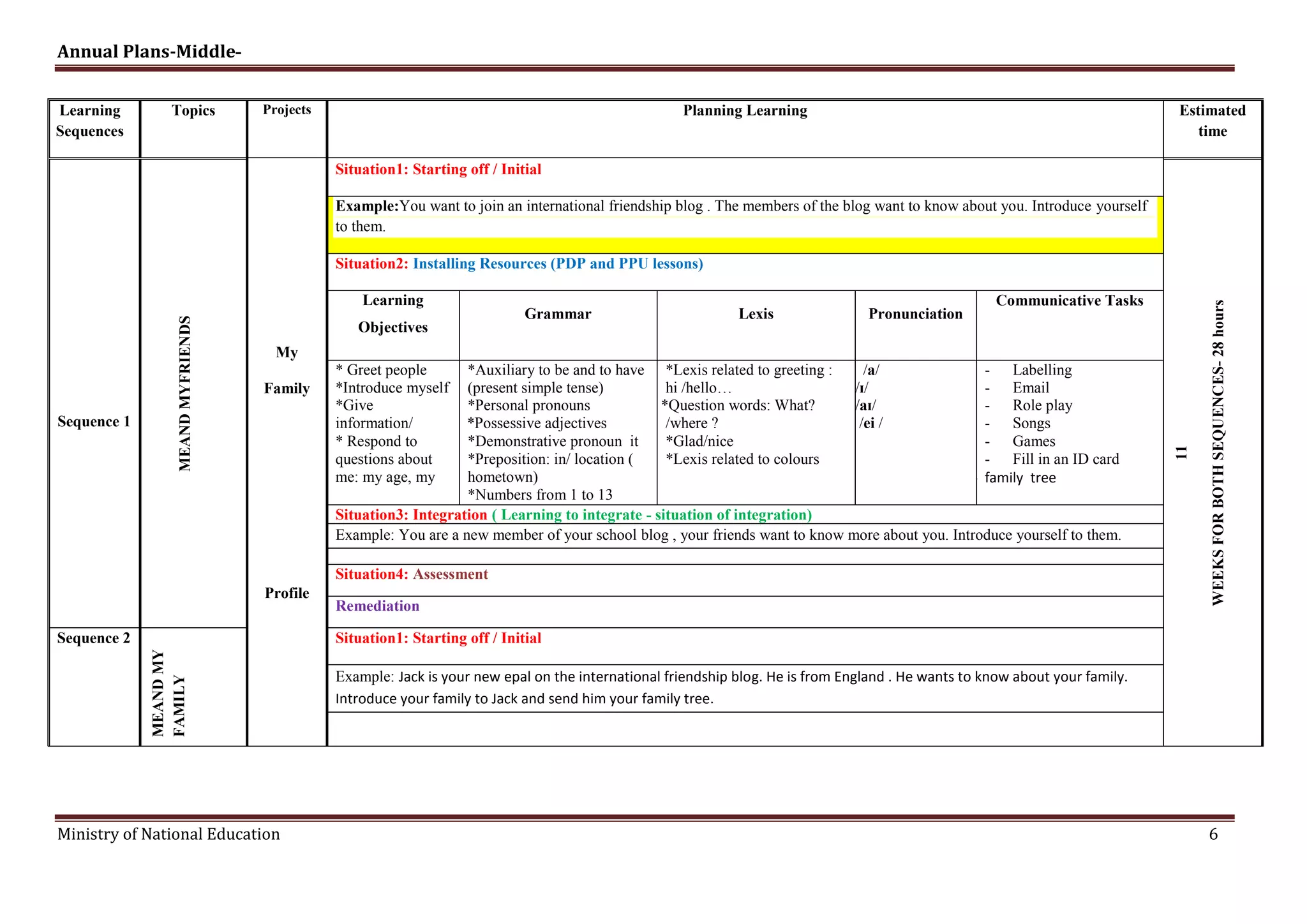
Learning
Sequences
Topics Projects Planning Learning Estimated
time
Sequence 1
MEANDMYFRIENDS
My
Family
Profile
Situation1: Starting off / Initial
11
WEEKSFORBOTHSEQUENCES-28hours
Example:You want to join an international friendship blog . The members of the blog want to know about you. Introduce yourself
to them.
Situation2: Installing Resources (PDP and PPU lessons)
Learning
Objectives
Grammar Lexis Pronunciation
Communicative Tasks
* Greet people
*Introduce myself
*Give
information/
* Respond to
questions about
me: my age, my
*Auxiliary to be and to have
(present simple tense)
*Personal pronouns
*Possessive adjectives
*Demonstrative pronoun it
*Preposition: in/ location (
hometown)
*Numbers from 1 to 13
*Lexis related to greeting :
hi /hello…
*Question words: What?
/where ?
*Glad/nice
*Lexis related to colours
/a/
/ɪ/
/aɪ/
/ei /
- Labelling
- Email
- Role play
- Songs
- Games
- Fill in an ID card
- family tree
Situation3: Integration ( Learning to integrate - situation of integration)
Example: You are a new member of your school blog , your friends want to know more about you. Introduce yourself to them.
Situation4: Assessment
Remediation
Sequence 2
MEANDMY
FAMILY
Situation1: Starting off / Initial
Example: Jack is your new epal on the international friendship blog. He is from England . He wants to know about your family.
Introduce your family to Jack and send him your family tree.
Annual Plans-Middle-
Ministry of National Education 7
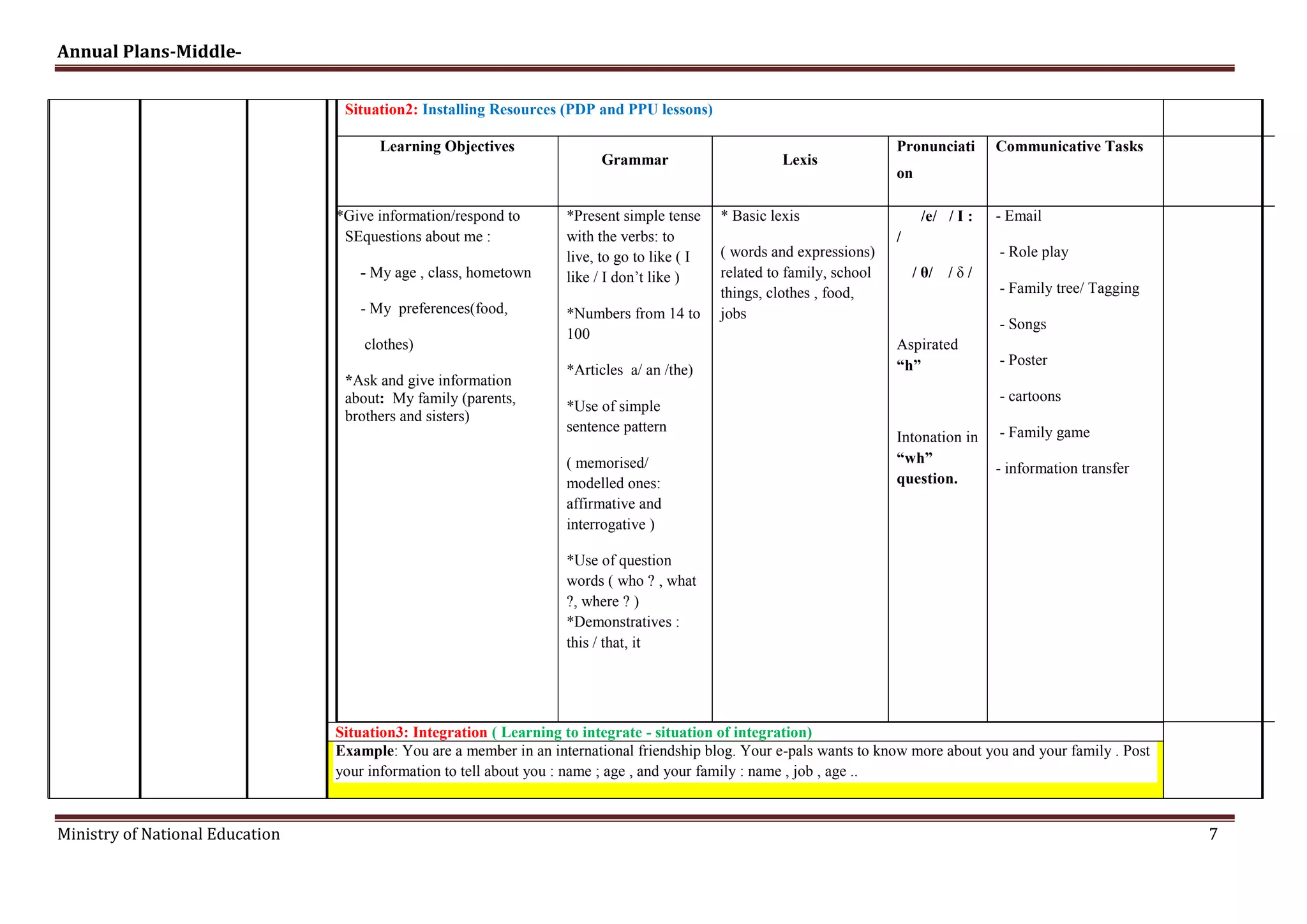
Situation2: Installing Resources (PDP and PPU lessons)
Learning Objectives
Grammar Lexis
Pronunciati
on
Communicative Tasks
*Give information/respond to
SEquestions about me :
- My age , class, hometown
- My preferences(food,
clothes)
*Ask and give information
about: My family (parents,
brothers and sisters)
*Present simple tense
with the verbs: to
live, to go to like ( I
like / I don’t like )
*Numbers from 14 to
100
*Articles a/ an /the)
*Use of simple
sentence pattern
( memorised/
modelled ones:
affirmative and
interrogative )
*Use of question
words ( who ? , what
?, where ? )
*Demonstratives :
this / that, it
* Basic lexis
( words and expressions)
related to family, school
things, clothes , food,
jobs
/e/ / I :
/
/ θ/ / δ /
Aspirated
“h”
Intonation in
“wh”
question.
- Email
- Role play
- Family tree/ Tagging
- Songs
- Poster
- cartoons
- Family game
- information transfer
-
Situation3: Integration ( Learning to integrate - situation of integration)
Example: You are a member in an international friendship blog. Your e-pals wants to know more about you and your family . Post
your information to tell about you : name ; age , and your family : name , job , age ..
Annual Plans-Middle-
Ministry of National Education 8
Situation4: Assessment
Remediation
Sequence 3 ME
AND MY
DAILY
ACTIVITIE
S
My
school
presentat
ion
Situation1: Starting off / Initial
10weeksforbothsequences-25hours
Example: You received a message from your e-pal Jack . He tells you about his leisure activities . He wants to know about your
leisure activities .
Send him a reply and tell him about your leisure activities at week ends.
Situation2: Installing Resources (PDP and PPU lessons)
Learning Objectives Grammar Lexis Pronunciation
Communicative
Tasks
*Tell the time
*Talk about daily
activities
*Talk about leisure
activities at school
*Discourse markers : today,
every…, now
*The present simple tense with
concrete , routine actions
*Wh’ questions ,yes / no
questions
*Lexis related to
daily activities ,
digital time , leisure
activities
The pronunciation
of :
/h/,/s/ , /z/ ,/ɪz/
- Role play
- Games
- Email
- Songs
- Interview
Situation3: Integration ( Learning to integrate - situation of integration)
Example: You are back to school after the week-end and you want to know about your friend’s leisure activities. Ask your friend
about his week-end leisure activities and write about them.
Situation4: Assessment
Remediation
Annual Plans-Middle-
Ministry of National Education 9
Sequence 4
ME
ANDMYSCHOOL
Situation1: Starting off / Initial
Example:You have rights and duties at school . You want to remind your mates about them . Write a poster of your rights and
duties and publish it on your school blog.
Situation2: Installing Resources (PDP and PPU lessons)
Learning Objectives Grammar Lexis Pronunciation
Communicative
Tasks
* Introduce myself
* Give
information/
respond to
questions about
me: my age, my
class and
my hometown.
*Ask about a new
friend’s name
* Prepositions of location : from ..
to, on, at near , under
*Prepositions of time: in
(the morning ); at ( time); on +
day
*The present continuous tense
with concrete actions in progress
*Lexis related to
school / hobbies/
*Basic lexis
( words and
expressions/
formulaic language)
: polite forms /
greetings../ school
regulations
*Pronunciation of
: /ŋ / , /g/ , /j/ ,
/ʤ/ , /ʒ/
- Labelling
- Email
- Role play
- Songs
- games
Situation3: Integration ( Learning to integrate - situation of integration)
Example: Pupils have rights and duties in their school. Your teacher wantsyou to design a poster of rights and duties .
Situation4: Assessment
Remediation
Annual Plans-Middle-
Ministry of National Education 10
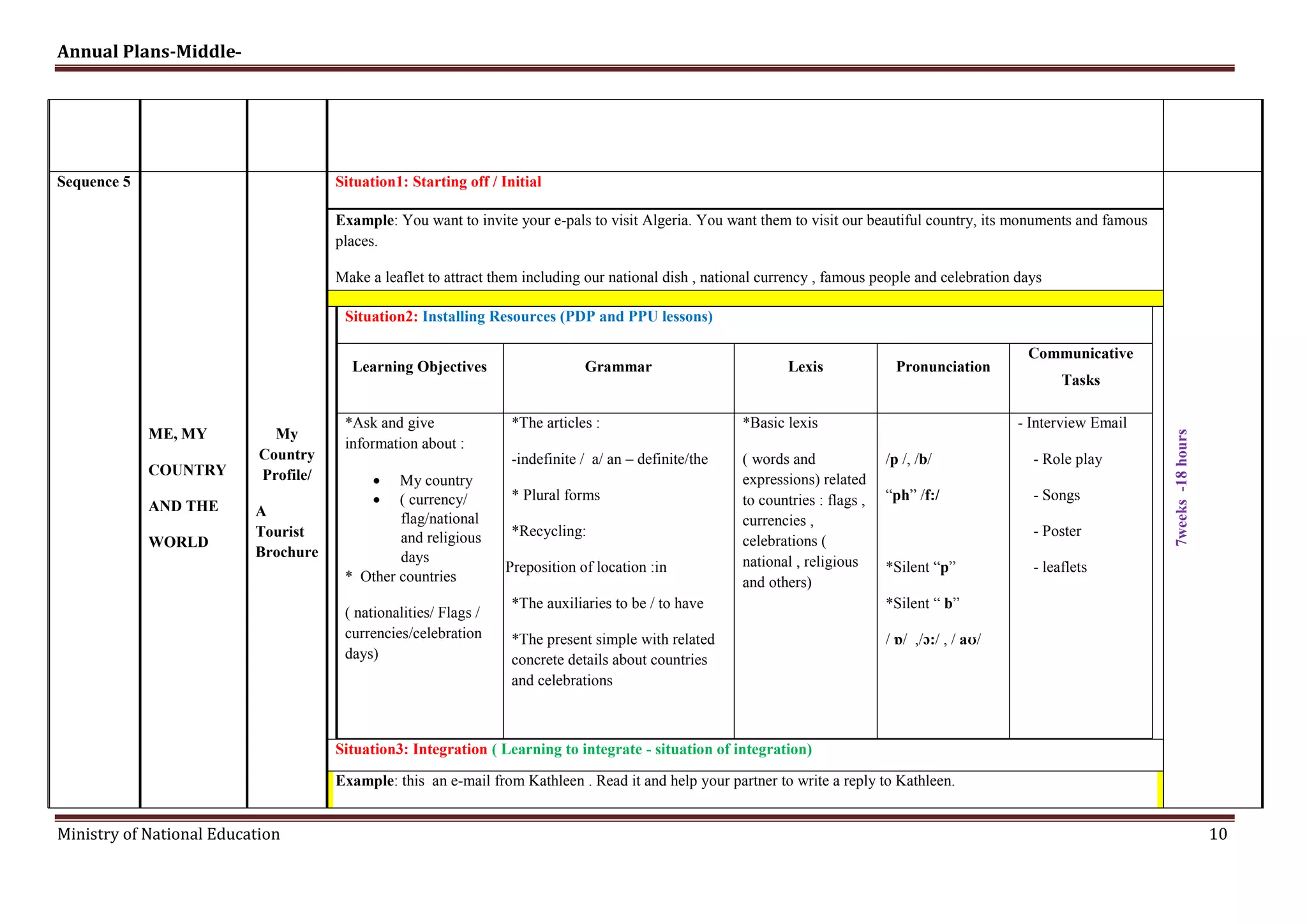
Sequence 5
ME, MY
COUNTRY
AND THE
WORLD
My
Country
Profile/
A
Tourist
Brochure
Situation1: Starting off / Initial
7weeks-18hours
Example: You want to invite your e-pals to visit Algeria. You want them to visit our beautiful country, its monuments and famous
places.
Make a leaflet to attract them including our national dish , national currency , famous people and celebration days
Situation2: Installing Resources (PDP and PPU lessons)
Learning Objectives Grammar Lexis Pronunciation
Communicative
Tasks
*Ask and give
information about :
 My country
 ( currency/
flag/national
and religious
days
* Other countries
( nationalities/ Flags /
currencies/celebration
days)
*The articles :
-indefinite / a/ an – definite/the
* Plural forms
*Recycling:
Preposition of location :in
*The auxiliaries to be / to have
*The present simple with related
concrete details about countries
and celebrations
*Basic lexis
( words and
expressions) related
to countries : flags ,
currencies ,
celebrations (
national , religious
and others)
/p /, /b/
“ph” /f:/
*Silent “p”
*Silent “ b”
/ ɒ/ ,/ɔ:/ , / aʊ/
- Interview Email
- Role play
- Songs
- Poster
- leaflets
Situation3: Integration ( Learning to integrate - situation of integration)
Example: this an e-mail from Kathleen . Read it and help your partner to write a reply to Kathleen.
Annual Plans-Middle-
Ministry of National Education 11
YEARLY PLAN OF ASSESSMENT
KEY STAGE ONE (MS1)
 Give them an e-mail
Situation4: Assessment
Annual Plans-Middle-
Ministry of National Education 12
PERIODS DOMAINS TARGET COMPETENCIES DESCRIPTORS OF IMPLEMENTATION
FIRST
TERM
Oral interaction
In a situation of meaningful communication, the
learner will be able to interact and produce
orally very short messages/texts of descriptive
types using written, visual or oral support.
- Can:
*Greet people, introduce himself/herself,
* Respond to questions about himself/herself : name, age, class , hometown, preferences
(food and clothes),family
*Ask about a new friend’s name
Interpretation of oral
and written messages
In a situation of meaningful communication, the
learner will be able to interpret very short oral
or written messages / texts of descriptive type
using written, visual or oral support.
- Can:
* Interpret significant details in a conversation and in simple short texts on topics dealt
with in the previous domain
*understand short texts with illustrations (audio or visual: picture, graph, map, etc.)
Production of oral
and written messages
In a situation of meaningful communication, the
learner will be able to produce very short oral
or written messages / texts of descriptive type
using written, visual or oral support .
- Can:
*Give information/respond to questions about himself/ herself : age, class, family
( parents, brothers sisters) etc. using simple phrases and sentences
* fill out a form and give simple details
*Maintain a conversation with an interlocutor
SECOND
TERM
Oral interaction
In a situation of meaningful communication, the
learner will be able to interact and produce
orally very short messages/texts of descriptive
types using written, visual or oral support.
- Can:
*Tell the time
*Talk about daily activities
*Talk about leisure activities at school
Annual Plans-Middle-
Ministry of National Education 13
Interpretation of oral
and written messages
In a situation of meaningful communication, the
learner will be able to interpret very short oral
or written messages / texts of descriptive type
using written, visual or oral support.
- can :
*understand significant details in a conversation and in short texts dealing with topics
dealt with in the previous domain
*use paraphrases to make himself understood
Production of oral
and written messages
In a situation of meaningful communication, the
learner will be able to produce very short oral
or written messages / texts of descriptive type
using written, visual or oral support .
- can :
* write about his preferences, daily activities , leisure activities , etc. on a
postcard or in an email using short phrases and sentences (subject + verb + object)
THIRD
TERM
Oral interaction
In a situation of meaningful communication, the
learner will be able to interact and produce
orally very short messages/texts of descriptive
types using written, visual or oral support.
- Can:
*ask and give information about:
- Algeria ( currency/ flag/national and religious days
- Other countries ( nationalities/ Flags / currencies/celebration days)
Interpretation of oral
and written messages
In a situation of meaningful communication, the
learner will be able to interpret very short oral
or written messages / texts of descriptive type
using written, visual or oral support.
- Can:
* understand very short dialogues on familiar subjects ( the ones dealt with in the previous
domain)
* understand short texts with illustrations (audio or visual: picture, graph, map, etc.)
Production of oral
and written messages
In a situation of meaningful communication, the
learner will be able to produce very short oral
or written messages / texts of descriptive type
using written, visual or oral support .
- Can :
* write a simple message on a postcard or in an email about Algeria using
*short phrases with simple vocabulary Transform messages from verbal to nonverbal and
vise versa
Annual Plans-Middle-
Ministry of National Education 14
ONGOING ASSESSMENT PLAN
KEY STAGE ONE (MS1)
gradetermweekdomainSequenceTargeted learnings for assessementremarks
Annual Plans-Middle-
Ministry of National Education 15
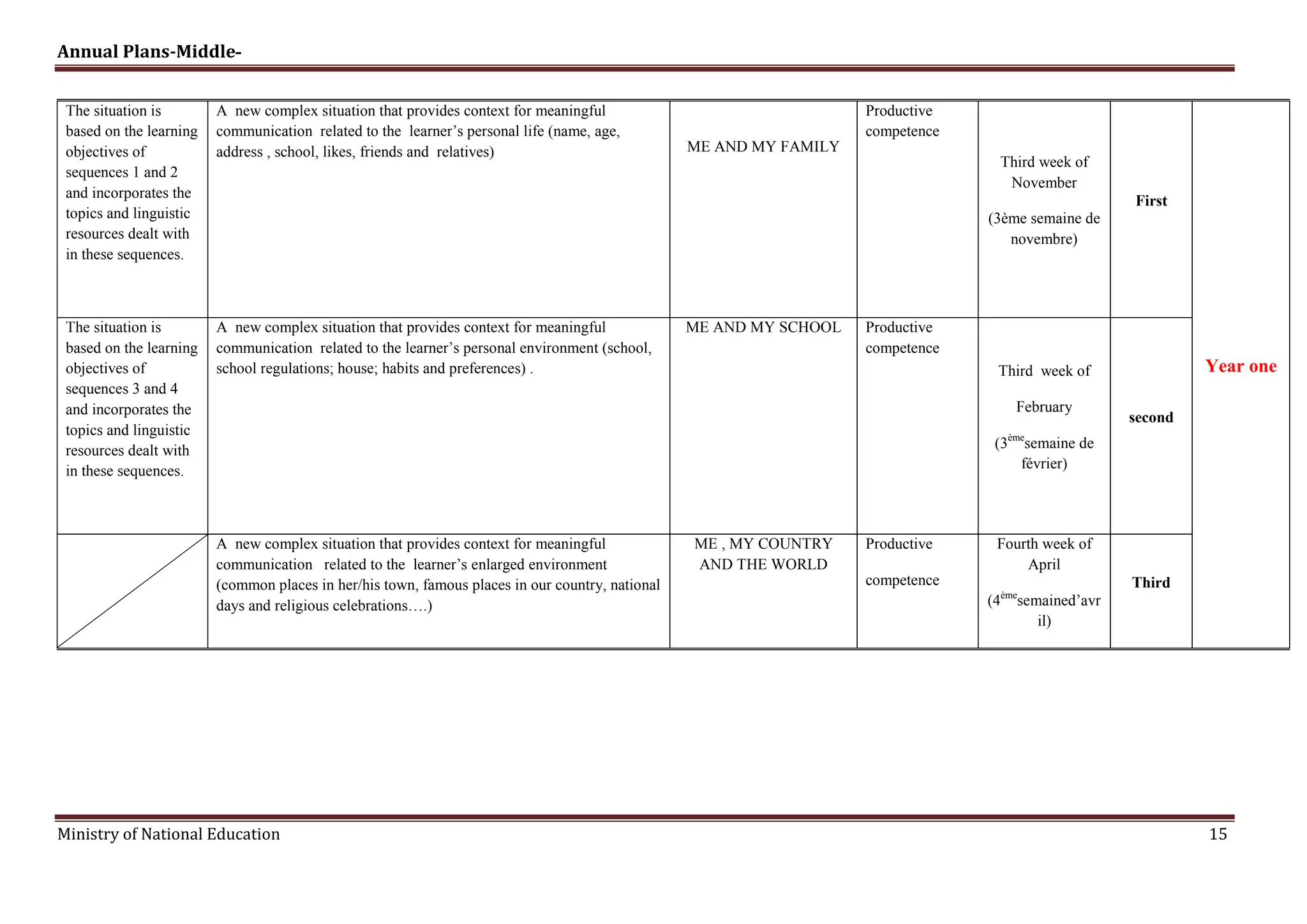
Year one
First
Third week of
November
(3ème semaine de
novembre)
Productive
competence
ME AND MY FAMILY
A new complex situation that provides context for meaningful
communication related to the learner’s personal life (name, age,
address , school, likes, friends and relatives)
The situation is
based on the learning
objectives of
sequences 1 and 2
and incorporates the
topics and linguistic
resources dealt with
in these sequences.
second
Third week of
February
(3ème
semaine de
février)
Productive
competence
ME AND MY SCHOOLA new complex situation that provides context for meaningful
communication related to the learner’s personal environment (school,
school regulations; house; habits and preferences) .
The situation is
based on the learning
objectives of
sequences 3 and 4
and incorporates the
topics and linguistic
resources dealt with
in these sequences.
Third
Fourth week of
April
(4ème
semained’avr
il)
Productive
competence
ME , MY COUNTRY
AND THE WORLD
A new complex situation that provides context for meaningful
communication related to the learner’s enlarged environment
(common places in her/his town, famous places in our country, national
days and religious celebrations….)

1 am

  • 1.
    Annual Plans-Middle- Ministry ofNational Education 1 Democratic and Popular Republic of Algeria Ministry of National Education General Inspectorate of Pedagogy Direction of the Fundamental Teaching YEARLY PLANS ENGLISH GRADE :1 MIDDLE SCHOOL September2018
  • 2.
    Annual Plans-Middle- Ministry ofNational Education 2 INTRODUCTION As part of the school year 2018-2019, the General Inspectorate of Pedagogy provides inspectors and teachers with working tools in the form of annual educational plans. These tools complement the official reference materials that are already used in the primary and junior cycles. In keeping with the spirit and dynamics of current educational reforms, they aim to facilitate the reading, comprehension and execution of programs in order to improve the quality of teaching. These plans also aim to unify the way content is structured when developing learning sequences in the spirit of what is recommended by the new programs and the guidance of the accompanying documents. From a methodological point of view, these pedagogical planning tools will make it possible to establish a common representation of the learning path in the sequences through the stages of contextualisation of teaching-learning in the context of situations of departure, installation, mobilizing and integrating resources for skills transfer in life situations. These additional working documents are presented as follows: - annual plans for building learning; - annual plans for educational evaluation; - annual plans for continuous monitoring. The different plans are designed to articulate in a coherent way the dimensions related to the preparation of the learning, to the pedagogic evaluation and to the continuous control. Inspectors are expected to accompany teachers, especially junior teachers, in the effective implementation of these plans in English classes.
  • 3.
    Annual Plans-Middle- Ministry ofNational Education 3 Methodological note The results of the national consultation on assessment presented at the national conference held on April 29th ,2017, highlighted the need to review the current assessment practices. A necessity reinforced by the field follow-up reports of the inspectors, which revealed imbalances in the implementation of the curricula due to ineffective reading and associated interpretations. This fact has prompted the General Inspectorate of Pedagogy to provide practitioners with tools that illustrate the vision, dispel misinterpretations and allow for educational performance improvement, which is one of the axes of the reform namely the training of trainers and professionalization of the main actors of the education system. The tools designed by the General Inspectorate of Pedagogy include: the annual learning plan, the annual pedagogic assessment plan and the annual continuous assessment plan for each of the subjects of primary and middle school education in the key stages concerned by the implementation of the re-written curriculum. 1-The annual learning plan The annual learning plan is a comprehensive plan of a program of study within an educational project that aims to achieve the global competence of a learning level on the basis of the target competency stated for each domain ( oral interaction, interpretation of oral and written messages and production of oral and written messages) and through an integrated set of learning sections. Each plan starts from the target competency to achieve ; its development is carried out through a problem-solving situation in its general context that the learner may encounter in his or her school or social life and a set of partial situations conducive to integration and potential remediation. The plan also contains instructions from the “support document” and the “teacher’s guide” and the estimated time to devote to the learning section to ensure an adequate implementation of this latter. 2-The annual pedagogic assessment plan The annual pedagogic assessment plan is a plan that synchronizes the learning implementation process with the verification of the competency development. It starts from the target competency, which is framed by standards that include the three following aspects: knowledge, methodology and values. These standards allow for both learning assessment and assessment of the learner’s effort and offer opportunity to provide learners with objective and constructive feedback.
  • 4.
    Annual Plans-Middle- Ministry ofNational Education 4 YEARLY LEARNING PLAN KEY STAGE ONE (MS1)
  • 5.
    Annual Plans-Middle- Ministry ofNational Education 5 Exit Profile: At the end of level 1 ( 1st year middle school), the learner will be able to interact, interpret and produce short oral and written messages texts of descriptive type, using written, visual or oral supports, in meaningful situations of communication related to his environment and interests. The learner can: -Understand simple messages related to concrete situations, his/her immediate environment and needs. -Ask and answer simple questions about topics related to their age and interest provided that the other person speaks clearly and is prepared to help -Use very basic phrases, short sentences to talk and write about personal experiences (family likes…) VALUES National identity: The learner can use the markers of his identity when introducing himself to others: name, nationality , language, religion , flag, national currency ... National conscience: He can speak about our school days, weekend and national public holidays (historic, religious, etc) Citizenship :He shows respect for the environment and protects it continually Openness to the world : He is keen on learning about others’ markers of identity CROSS-CURRICULAR COMPETENCES 1.Intellectual competency/The learner can :understand and interpret verbal and non-verbal messages- solve problem situations using a variety of communication means- show creativity when producing oral and written messages - show some degree of autonomy in all areas of learning 2.methodological competency : The learner can: work in pairs or in groups- use strategies for listening and interpreting oral discourse-develop effective study methods , mobilize his resources efficiently and manage his time rationally- use information and communication technology whenever he needs it for learning and research- evaluate himself and his peers 3.communicative competency: The learner can: use dramatization and role-play to communicate appropriately- use information and communication technology such as blogs, websites page, discussion forums , platforms to interact with learners of other cultures-use dramatization and role-play to communicate appropriately-use information and communication technology such as blogs, websites page, discussion forums , platforms to interact with learners of other cultures-process digital data 4.personal and social competencies : He is aware of his role and others' role in the development of projects*He is keen on promoting the work of his peers*He respects our national values and behaves consistently*He is honest and accountable for his work and respects others work*He asserts his personal identity and behaves with self- confidence*He socializes through oral or written exchanges* He develops attitudes of solidarity Domains Oral- Written – Both Target competencies In meaningful communicative situations related to his/ her interests, based on written, visual or audio supports, the learner will be able to interact and produce short and simple descriptive messages/texts orally. In meaningful communicative situations related to his/her environment and interests, based on written, visual or audio supports, the learner will be able to interpret short and simple descriptive messages/texts orally and in written. In meaningful communicative situations related to his/her environment and interests, based on written, visual or audio supports, the learner will be able to produce short and simple written descriptive messages/texts .
  • 6.
    Annual Plans-Middle- Ministry ofNational Education 6 Learning Sequences Topics Projects Planning Learning Estimated time Sequence 1 MEANDMYFRIENDS My Family Profile Situation1: Starting off / Initial 11 WEEKSFORBOTHSEQUENCES-28hours Example:You want to join an international friendship blog . The members of the blog want to know about you. Introduce yourself to them. Situation2: Installing Resources (PDP and PPU lessons) Learning Objectives Grammar Lexis Pronunciation Communicative Tasks * Greet people *Introduce myself *Give information/ * Respond to questions about me: my age, my *Auxiliary to be and to have (present simple tense) *Personal pronouns *Possessive adjectives *Demonstrative pronoun it *Preposition: in/ location ( hometown) *Numbers from 1 to 13 *Lexis related to greeting : hi /hello… *Question words: What? /where ? *Glad/nice *Lexis related to colours /a/ /ɪ/ /aɪ/ /ei / - Labelling - Email - Role play - Songs - Games - Fill in an ID card - family tree Situation3: Integration ( Learning to integrate - situation of integration) Example: You are a new member of your school blog , your friends want to know more about you. Introduce yourself to them. Situation4: Assessment Remediation Sequence 2 MEANDMY FAMILY Situation1: Starting off / Initial Example: Jack is your new epal on the international friendship blog. He is from England . He wants to know about your family. Introduce your family to Jack and send him your family tree.
  • 7.
    Annual Plans-Middle- Ministry ofNational Education 7 Situation2: Installing Resources (PDP and PPU lessons) Learning Objectives Grammar Lexis Pronunciati on Communicative Tasks *Give information/respond to SEquestions about me : - My age , class, hometown - My preferences(food, clothes) *Ask and give information about: My family (parents, brothers and sisters) *Present simple tense with the verbs: to live, to go to like ( I like / I don’t like ) *Numbers from 14 to 100 *Articles a/ an /the) *Use of simple sentence pattern ( memorised/ modelled ones: affirmative and interrogative ) *Use of question words ( who ? , what ?, where ? ) *Demonstratives : this / that, it * Basic lexis ( words and expressions) related to family, school things, clothes , food, jobs /e/ / I : / / θ/ / δ / Aspirated “h” Intonation in “wh” question. - Email - Role play - Family tree/ Tagging - Songs - Poster - cartoons - Family game - information transfer - Situation3: Integration ( Learning to integrate - situation of integration) Example: You are a member in an international friendship blog. Your e-pals wants to know more about you and your family . Post your information to tell about you : name ; age , and your family : name , job , age ..
  • 8.
    Annual Plans-Middle- Ministry ofNational Education 8 Situation4: Assessment Remediation Sequence 3 ME AND MY DAILY ACTIVITIE S My school presentat ion Situation1: Starting off / Initial 10weeksforbothsequences-25hours Example: You received a message from your e-pal Jack . He tells you about his leisure activities . He wants to know about your leisure activities . Send him a reply and tell him about your leisure activities at week ends. Situation2: Installing Resources (PDP and PPU lessons) Learning Objectives Grammar Lexis Pronunciation Communicative Tasks *Tell the time *Talk about daily activities *Talk about leisure activities at school *Discourse markers : today, every…, now *The present simple tense with concrete , routine actions *Wh’ questions ,yes / no questions *Lexis related to daily activities , digital time , leisure activities The pronunciation of : /h/,/s/ , /z/ ,/ɪz/ - Role play - Games - Email - Songs - Interview Situation3: Integration ( Learning to integrate - situation of integration) Example: You are back to school after the week-end and you want to know about your friend’s leisure activities. Ask your friend about his week-end leisure activities and write about them. Situation4: Assessment Remediation
  • 9.
    Annual Plans-Middle- Ministry ofNational Education 9 Sequence 4 ME ANDMYSCHOOL Situation1: Starting off / Initial Example:You have rights and duties at school . You want to remind your mates about them . Write a poster of your rights and duties and publish it on your school blog. Situation2: Installing Resources (PDP and PPU lessons) Learning Objectives Grammar Lexis Pronunciation Communicative Tasks * Introduce myself * Give information/ respond to questions about me: my age, my class and my hometown. *Ask about a new friend’s name * Prepositions of location : from .. to, on, at near , under *Prepositions of time: in (the morning ); at ( time); on + day *The present continuous tense with concrete actions in progress *Lexis related to school / hobbies/ *Basic lexis ( words and expressions/ formulaic language) : polite forms / greetings../ school regulations *Pronunciation of : /ŋ / , /g/ , /j/ , /ʤ/ , /ʒ/ - Labelling - Email - Role play - Songs - games Situation3: Integration ( Learning to integrate - situation of integration) Example: Pupils have rights and duties in their school. Your teacher wantsyou to design a poster of rights and duties . Situation4: Assessment Remediation
  • 10.
    Annual Plans-Middle- Ministry ofNational Education 10 Sequence 5 ME, MY COUNTRY AND THE WORLD My Country Profile/ A Tourist Brochure Situation1: Starting off / Initial 7weeks-18hours Example: You want to invite your e-pals to visit Algeria. You want them to visit our beautiful country, its monuments and famous places. Make a leaflet to attract them including our national dish , national currency , famous people and celebration days Situation2: Installing Resources (PDP and PPU lessons) Learning Objectives Grammar Lexis Pronunciation Communicative Tasks *Ask and give information about :  My country  ( currency/ flag/national and religious days * Other countries ( nationalities/ Flags / currencies/celebration days) *The articles : -indefinite / a/ an – definite/the * Plural forms *Recycling: Preposition of location :in *The auxiliaries to be / to have *The present simple with related concrete details about countries and celebrations *Basic lexis ( words and expressions) related to countries : flags , currencies , celebrations ( national , religious and others) /p /, /b/ “ph” /f:/ *Silent “p” *Silent “ b” / ɒ/ ,/ɔ:/ , / aʊ/ - Interview Email - Role play - Songs - Poster - leaflets Situation3: Integration ( Learning to integrate - situation of integration) Example: this an e-mail from Kathleen . Read it and help your partner to write a reply to Kathleen.
  • 11.
    Annual Plans-Middle- Ministry ofNational Education 11 YEARLY PLAN OF ASSESSMENT KEY STAGE ONE (MS1)  Give them an e-mail Situation4: Assessment
  • 12.
    Annual Plans-Middle- Ministry ofNational Education 12 PERIODS DOMAINS TARGET COMPETENCIES DESCRIPTORS OF IMPLEMENTATION FIRST TERM Oral interaction In a situation of meaningful communication, the learner will be able to interact and produce orally very short messages/texts of descriptive types using written, visual or oral support. - Can: *Greet people, introduce himself/herself, * Respond to questions about himself/herself : name, age, class , hometown, preferences (food and clothes),family *Ask about a new friend’s name Interpretation of oral and written messages In a situation of meaningful communication, the learner will be able to interpret very short oral or written messages / texts of descriptive type using written, visual or oral support. - Can: * Interpret significant details in a conversation and in simple short texts on topics dealt with in the previous domain *understand short texts with illustrations (audio or visual: picture, graph, map, etc.) Production of oral and written messages In a situation of meaningful communication, the learner will be able to produce very short oral or written messages / texts of descriptive type using written, visual or oral support . - Can: *Give information/respond to questions about himself/ herself : age, class, family ( parents, brothers sisters) etc. using simple phrases and sentences * fill out a form and give simple details *Maintain a conversation with an interlocutor SECOND TERM Oral interaction In a situation of meaningful communication, the learner will be able to interact and produce orally very short messages/texts of descriptive types using written, visual or oral support. - Can: *Tell the time *Talk about daily activities *Talk about leisure activities at school
  • 13.
    Annual Plans-Middle- Ministry ofNational Education 13 Interpretation of oral and written messages In a situation of meaningful communication, the learner will be able to interpret very short oral or written messages / texts of descriptive type using written, visual or oral support. - can : *understand significant details in a conversation and in short texts dealing with topics dealt with in the previous domain *use paraphrases to make himself understood Production of oral and written messages In a situation of meaningful communication, the learner will be able to produce very short oral or written messages / texts of descriptive type using written, visual or oral support . - can : * write about his preferences, daily activities , leisure activities , etc. on a postcard or in an email using short phrases and sentences (subject + verb + object) THIRD TERM Oral interaction In a situation of meaningful communication, the learner will be able to interact and produce orally very short messages/texts of descriptive types using written, visual or oral support. - Can: *ask and give information about: - Algeria ( currency/ flag/national and religious days - Other countries ( nationalities/ Flags / currencies/celebration days) Interpretation of oral and written messages In a situation of meaningful communication, the learner will be able to interpret very short oral or written messages / texts of descriptive type using written, visual or oral support. - Can: * understand very short dialogues on familiar subjects ( the ones dealt with in the previous domain) * understand short texts with illustrations (audio or visual: picture, graph, map, etc.) Production of oral and written messages In a situation of meaningful communication, the learner will be able to produce very short oral or written messages / texts of descriptive type using written, visual or oral support . - Can : * write a simple message on a postcard or in an email about Algeria using *short phrases with simple vocabulary Transform messages from verbal to nonverbal and vise versa
  • 14.
    Annual Plans-Middle- Ministry ofNational Education 14 ONGOING ASSESSMENT PLAN KEY STAGE ONE (MS1) gradetermweekdomainSequenceTargeted learnings for assessementremarks
  • 15.
    Annual Plans-Middle- Ministry ofNational Education 15 Year one First Third week of November (3ème semaine de novembre) Productive competence ME AND MY FAMILY A new complex situation that provides context for meaningful communication related to the learner’s personal life (name, age, address , school, likes, friends and relatives) The situation is based on the learning objectives of sequences 1 and 2 and incorporates the topics and linguistic resources dealt with in these sequences. second Third week of February (3ème semaine de février) Productive competence ME AND MY SCHOOLA new complex situation that provides context for meaningful communication related to the learner’s personal environment (school, school regulations; house; habits and preferences) . The situation is based on the learning objectives of sequences 3 and 4 and incorporates the topics and linguistic resources dealt with in these sequences. Third Fourth week of April (4ème semained’avr il) Productive competence ME , MY COUNTRY AND THE WORLD A new complex situation that provides context for meaningful communication related to the learner’s enlarged environment (common places in her/his town, famous places in our country, national days and religious celebrations….)