
International English Language Testing
System
… a landmark @ IELTS
A milestone @ your success of IELTS ..for
landing you at your dream destination..
Kiwi and Maple
 overcome the special challenges of the IELTS
listening module
 strengthen your IELTS reading and writing skills
 handle the IELTS speaking module with
confidence and ease
 master the support skills which influence your
IELTS scores
 upgrade your scores through the use of select
vocabulary / expressions
 choose between taking the TOEFL or the IELTS
exams
 select the best IELTS books and resources
available for self-study
 ... and lots more!
 IELTS -International English Language Testing
System. It is an English language proficiency
exam which measures the ability of test-takers
to communicate in the four basic language skills:
listening, reading, writing, and speaking.
 The IELTS is managed by three main institutions:
the British Council, IDP: IELTS Australia and the
University of Cambridge ESOL Examinations
(Cambridge ESOL). This is important to
understand in order to prepare for what is
essentially an examination of British and not
American English.
 The Academic IELTS exam is generally used
to determine whether candidates are
qualified to enroll in undergraduate and
graduate academic programs where English is
the medium of instruction.
 The General IELTS exam focuses on basic
survival skills in social and educational
contexts. It is generally requested for
candidates applying for immigration, working
in certain professions, or studying at a non-
degree level.
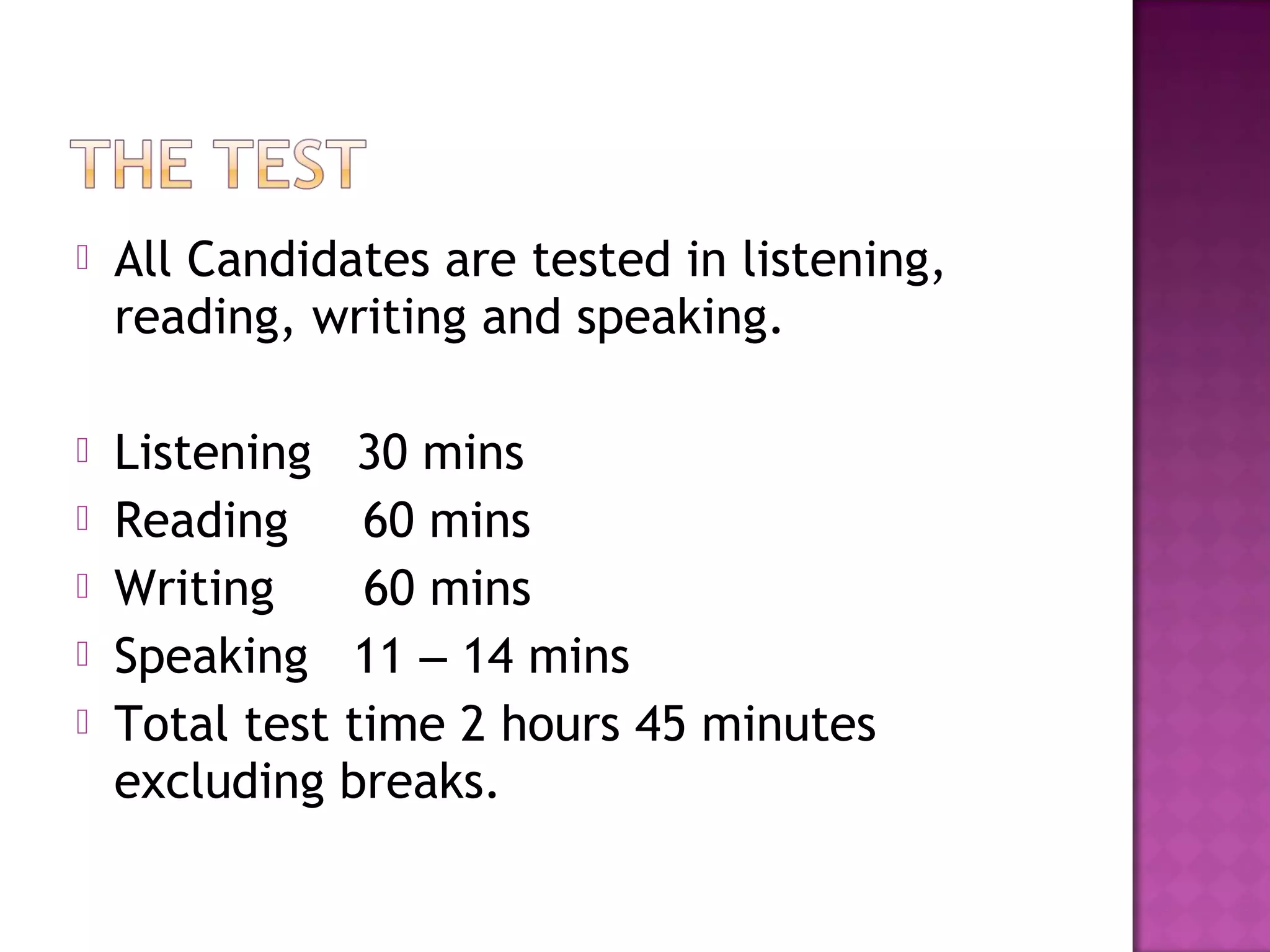
 All Candidates are tested in listening,
reading, writing and speaking.
 Listening 30 mins
 Reading 60 mins
 Writing 60 mins
 Speaking 11 – 14 mins
 Total test time 2 hours 45 minutes
excluding breaks.
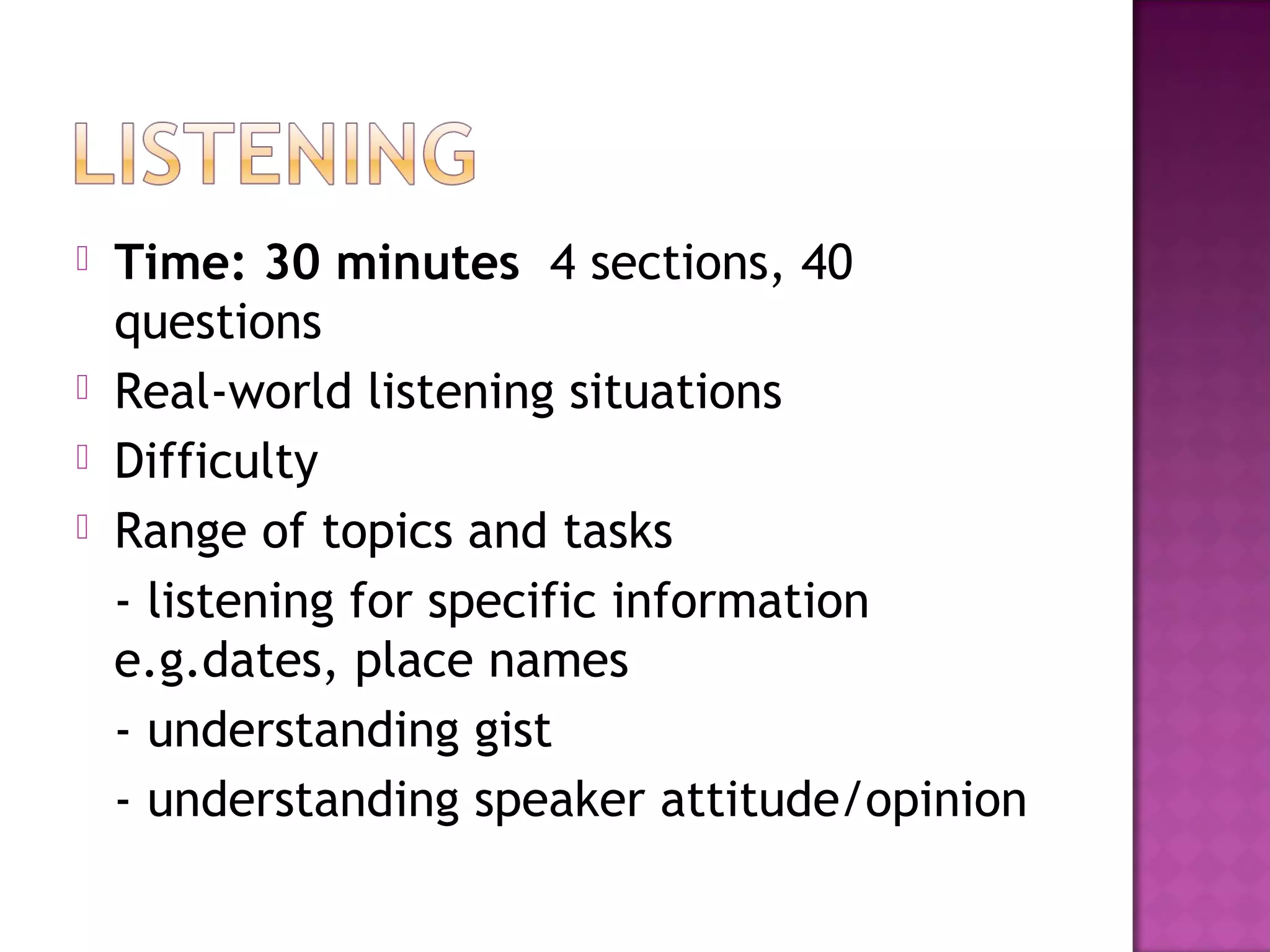
 Time: 30 minutes 4 sections, 40
questions
 Real-world listening situations
 Difficulty
 Range of topics and tasks
- listening for specific information
e.g.dates, place names
- understanding gist
- understanding speaker attitude/opinion
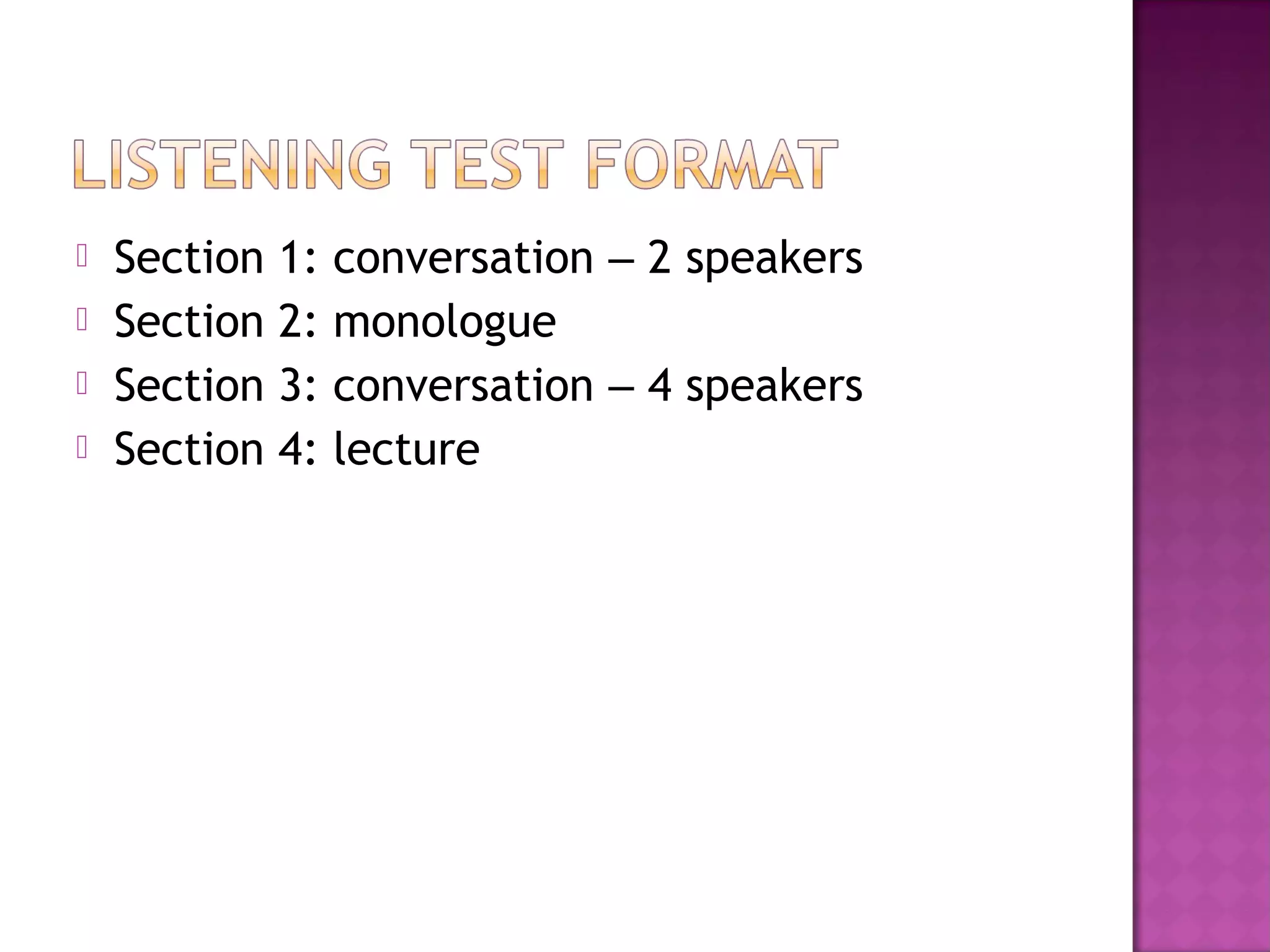
 Section 1: conversation – 2 speakers
 Section 2: monologue
 Section 3: conversation – 4 speakers
 Section 4: lecture
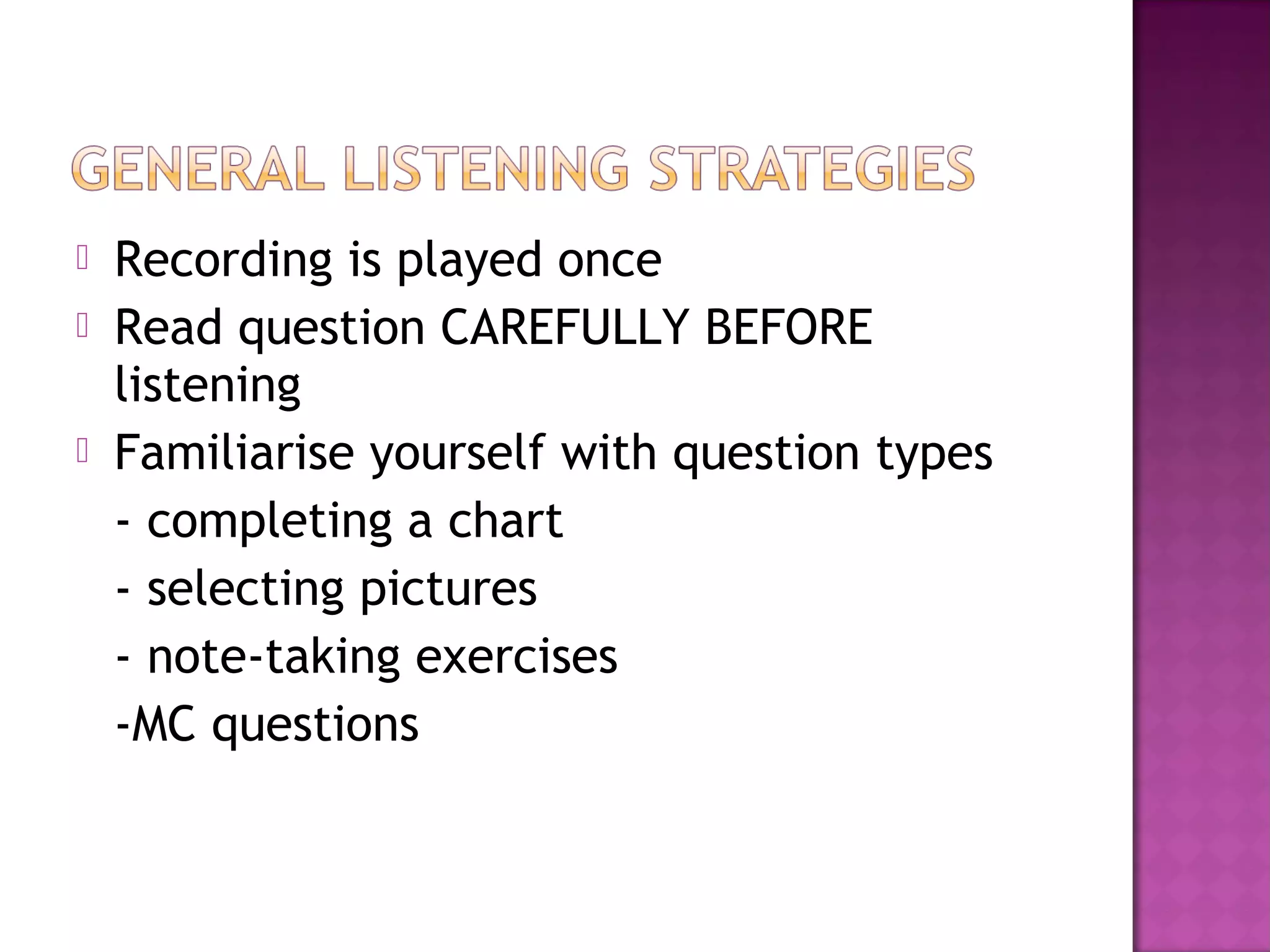
 Recording is played once
 Read question CAREFULLY BEFORE
listening
 Familiarise yourself with question types
- completing a chart
- selecting pictures
- note-taking exercises
-MC questions
 Time: 60 minutes 3 reading passages,
totally 40 questions
 Texts are taken from books, magazines,
journals and newspapers
 Question types
- find detailed information
- identify attitudes and views
- complete a diagram
 Identify reading skills being tested
 Practise these skills
 Time: 60 minutes 2 tasks
 Task 1(20mins): descriptive report of a table
or diagram, 150 words
 Task 2(40 mins):250 word essay in response
to an opinion or a problem.
 Discuss issues, construct an argument and
use the appropriate tone and register.
 Read the question carefully
 Familiarise yourself with descriptions of data
– in newspapers, textbooks
 Practise formulating your own ideas on topics
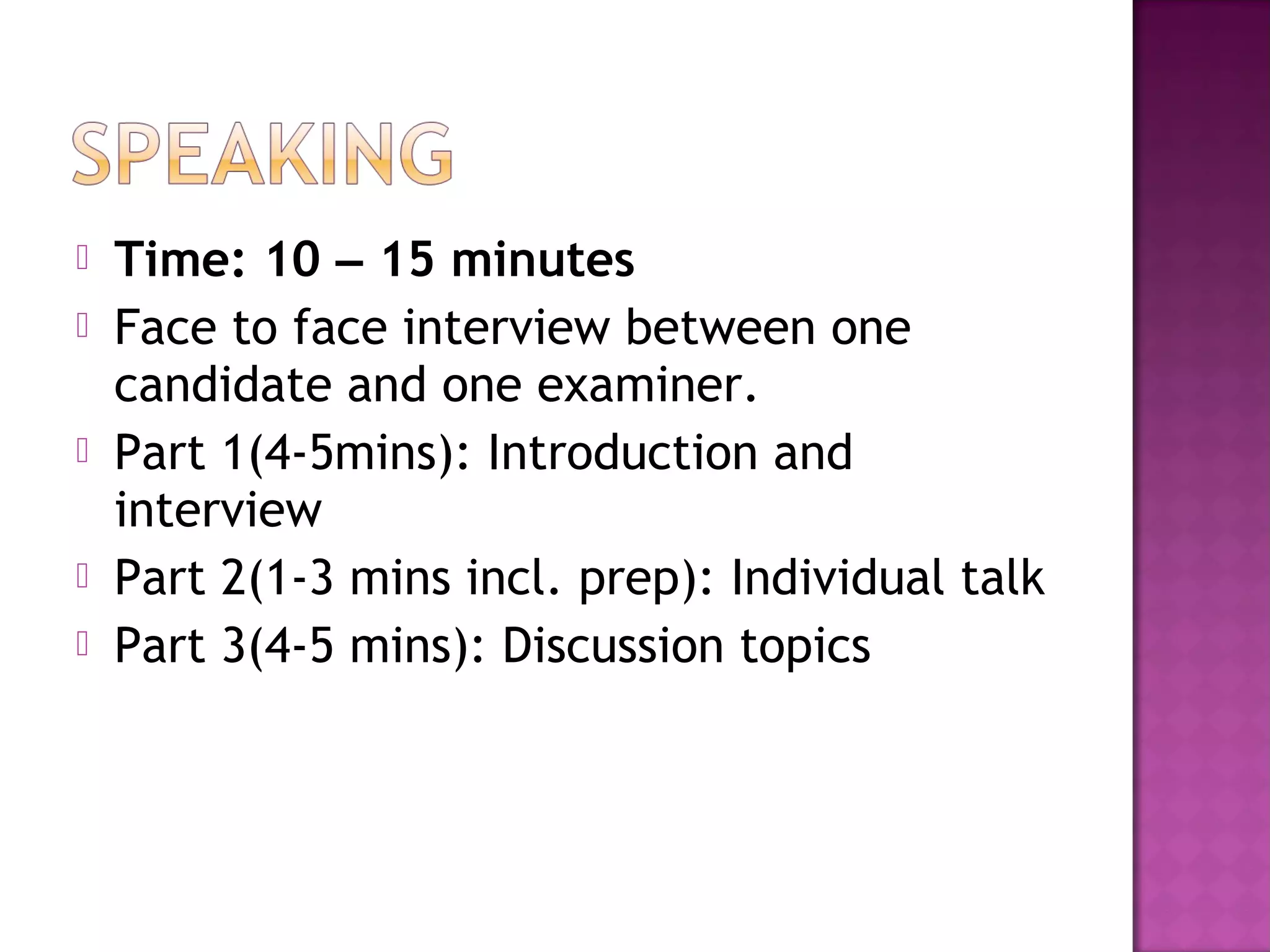
 Time: 10 – 15 minutes
 Face to face interview between one
candidate and one examiner.
 Part 1(4-5mins): Introduction and
interview
 Part 2(1-3 mins incl. prep): Individual talk
 Part 3(4-5 mins): Discussion topics
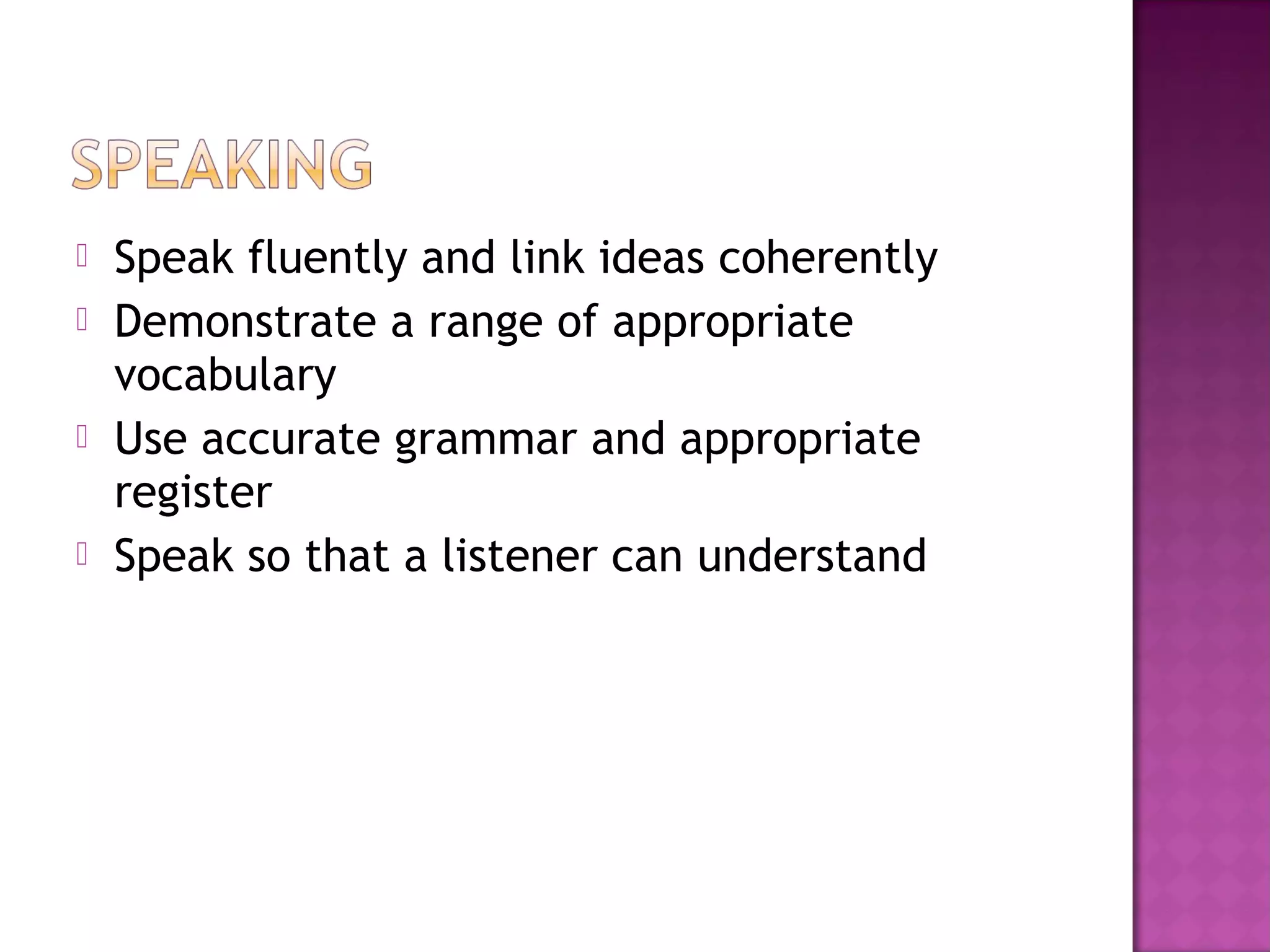
 Speak fluently and link ideas coherently
 Demonstrate a range of appropriate
vocabulary
 Use accurate grammar and appropriate
register
 Speak so that a listener can understand
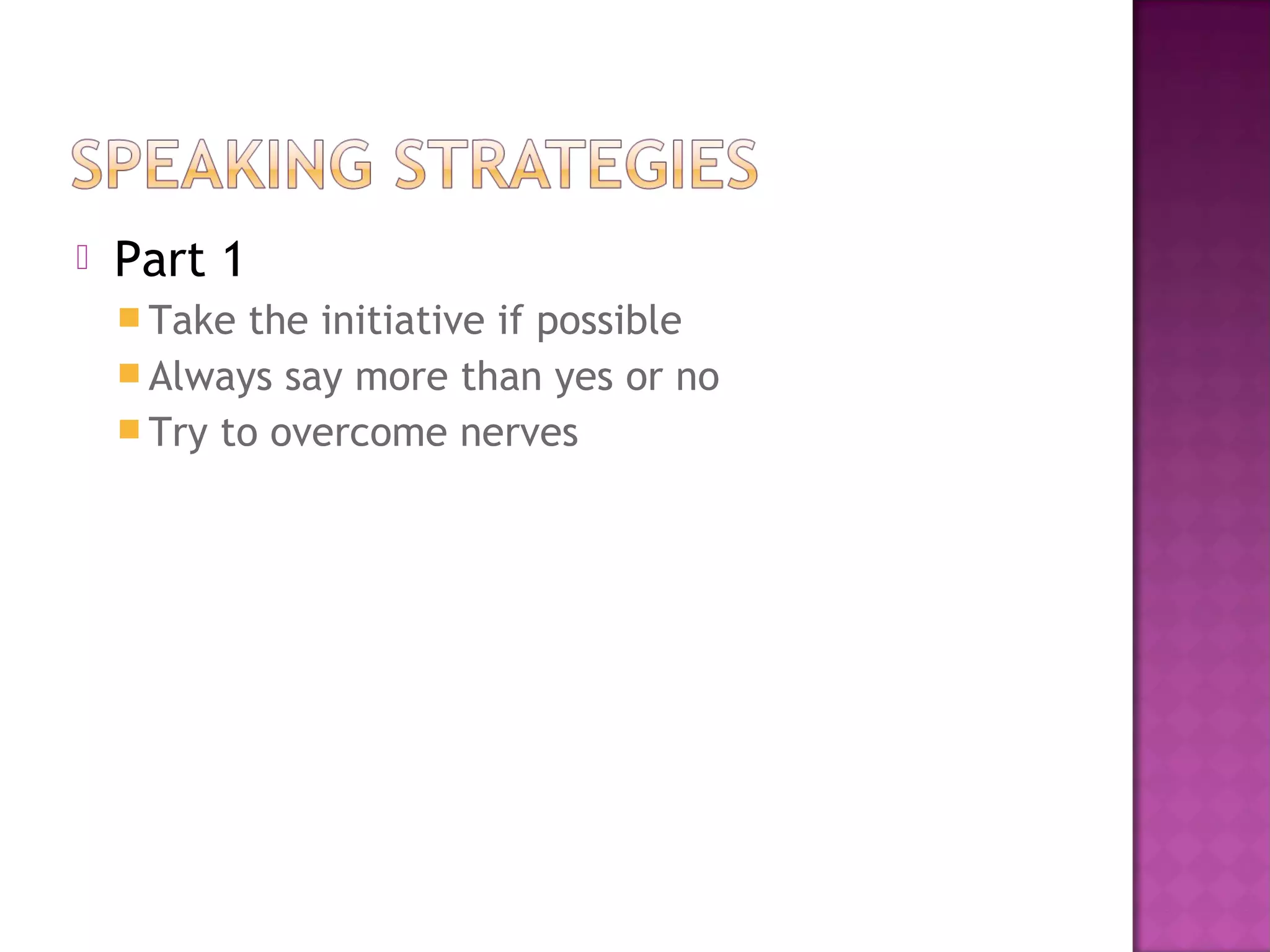
 Part 1
 Take the initiative if possible
 Always say more than yes or no
 Try to overcome nerves
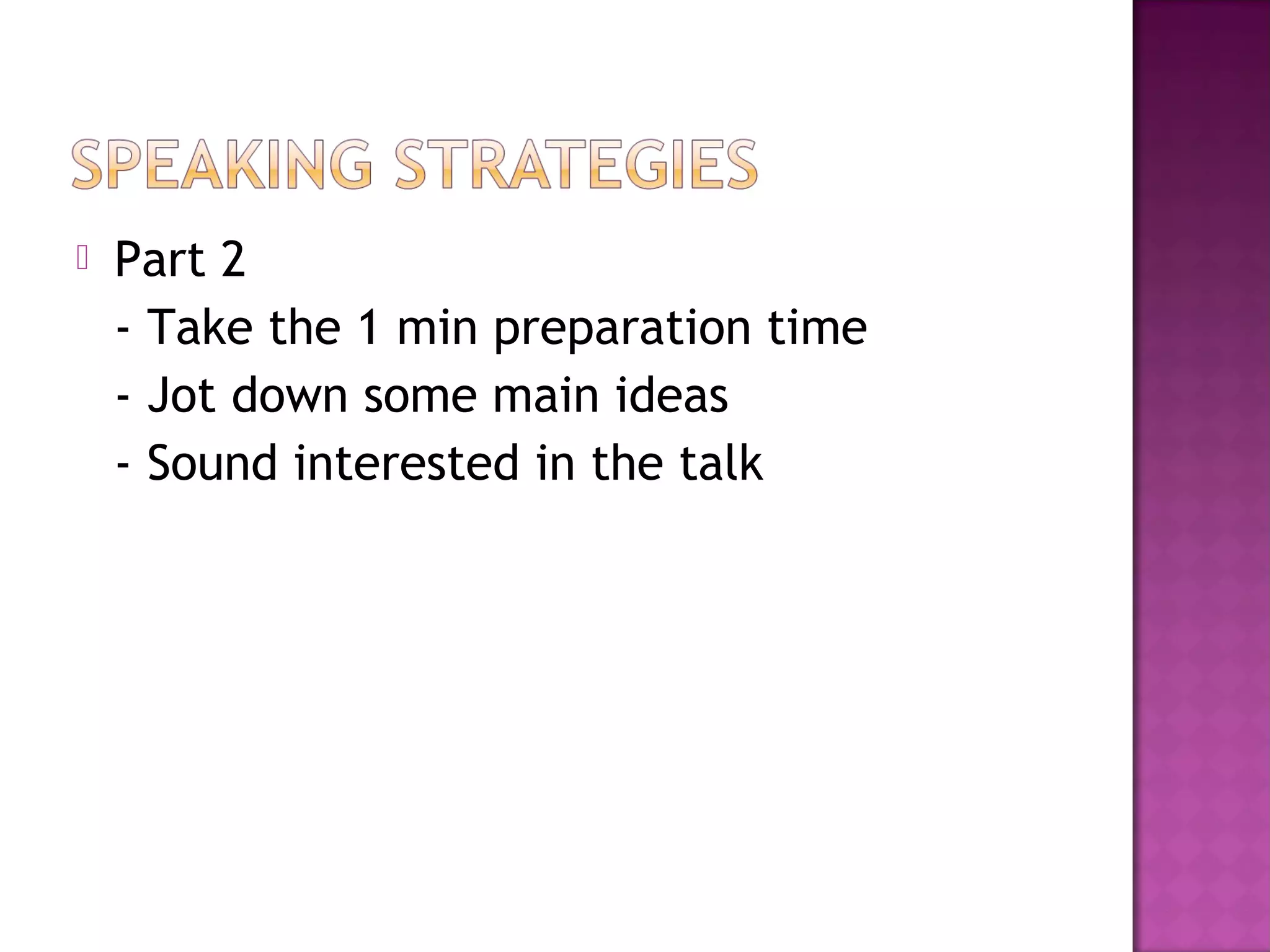
 Part 2
- Take the 1 min preparation time
- Jot down some main ideas
- Sound interested in the talk
 Part 3
- Give informed responses
- Demonstrate your control of the
language
- Attempt to express abstract ideas
- Support your opinions
- Show that you are willing to provide
extended replies
 IELTS provides a profile of a candidate’s
ability to use English
 Candidates receive a score on a Band Scale
from 1-9
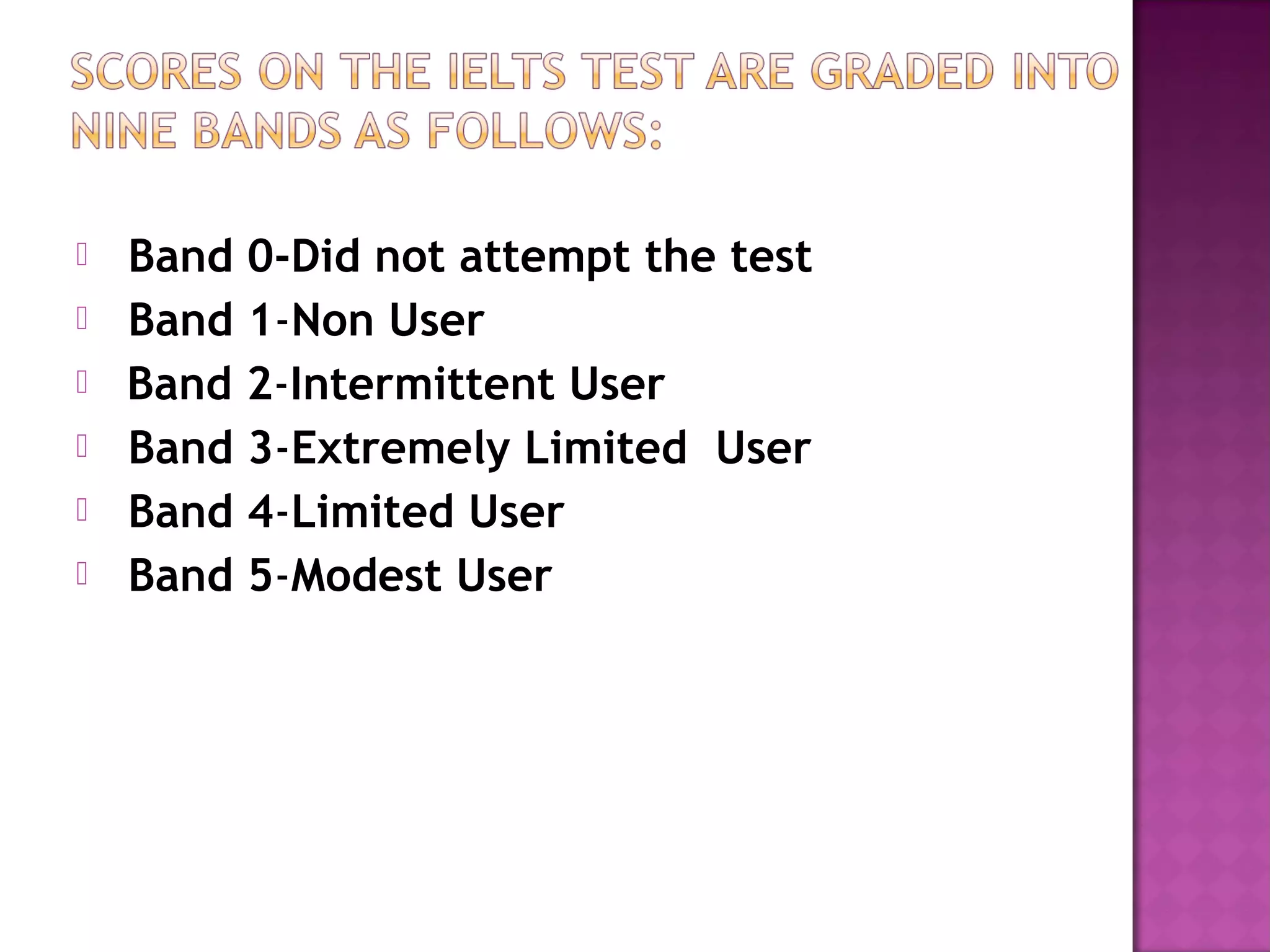
 Band 0-Did not attempt the test  
 Band 1-Non User  
  Band 2-Intermittent User  
 Band 3-Extremely Limited User 
 Band 4-Limited User  
 Band 5-Modest User  
 Band 6-Competent User  
 Has generally effective command of the language
despite some inaccuracies, inappropriacies and
misunderstandings. Can use and understand fairly
complex language, particularly in familiar
situations.
 Band 7-Good User  
 Band 8-Very Good User  
 Band 9 -Expert User  
 Familiarising with the test.
 Practise
 Time Management
 Score much better….

Ielts overview presentation

  • 1.
  • 2.
    … a landmark@ IELTS A milestone @ your success of IELTS ..for landing you at your dream destination.. Kiwi and Maple
  • 3.
     overcome thespecial challenges of the IELTS listening module  strengthen your IELTS reading and writing skills  handle the IELTS speaking module with confidence and ease  master the support skills which influence your IELTS scores  upgrade your scores through the use of select vocabulary / expressions  choose between taking the TOEFL or the IELTS exams  select the best IELTS books and resources available for self-study  ... and lots more!
  • 4.
     IELTS -InternationalEnglish Language Testing System. It is an English language proficiency exam which measures the ability of test-takers to communicate in the four basic language skills: listening, reading, writing, and speaking.  The IELTS is managed by three main institutions: the British Council, IDP: IELTS Australia and the University of Cambridge ESOL Examinations (Cambridge ESOL). This is important to understand in order to prepare for what is essentially an examination of British and not American English.
  • 5.
     The AcademicIELTS exam is generally used to determine whether candidates are qualified to enroll in undergraduate and graduate academic programs where English is the medium of instruction.  The General IELTS exam focuses on basic survival skills in social and educational contexts. It is generally requested for candidates applying for immigration, working in certain professions, or studying at a non- degree level.
  • 6.
     All Candidatesare tested in listening, reading, writing and speaking.  Listening 30 mins  Reading 60 mins  Writing 60 mins  Speaking 11 – 14 mins  Total test time 2 hours 45 minutes excluding breaks.
  • 7.
     Time: 30minutes 4 sections, 40 questions  Real-world listening situations  Difficulty  Range of topics and tasks - listening for specific information e.g.dates, place names - understanding gist - understanding speaker attitude/opinion
  • 8.
     Section 1:conversation – 2 speakers  Section 2: monologue  Section 3: conversation – 4 speakers  Section 4: lecture
  • 9.
     Recording isplayed once  Read question CAREFULLY BEFORE listening  Familiarise yourself with question types - completing a chart - selecting pictures - note-taking exercises -MC questions
  • 10.
     Time: 60minutes 3 reading passages, totally 40 questions  Texts are taken from books, magazines, journals and newspapers  Question types - find detailed information - identify attitudes and views - complete a diagram
  • 11.
     Identify readingskills being tested  Practise these skills
  • 12.
     Time: 60minutes 2 tasks  Task 1(20mins): descriptive report of a table or diagram, 150 words  Task 2(40 mins):250 word essay in response to an opinion or a problem.  Discuss issues, construct an argument and use the appropriate tone and register.
  • 13.
     Read thequestion carefully  Familiarise yourself with descriptions of data – in newspapers, textbooks  Practise formulating your own ideas on topics
  • 14.
     Time: 10– 15 minutes  Face to face interview between one candidate and one examiner.  Part 1(4-5mins): Introduction and interview  Part 2(1-3 mins incl. prep): Individual talk  Part 3(4-5 mins): Discussion topics
  • 15.
     Speak fluentlyand link ideas coherently  Demonstrate a range of appropriate vocabulary  Use accurate grammar and appropriate register  Speak so that a listener can understand
  • 16.
     Part 1 Take the initiative if possible  Always say more than yes or no  Try to overcome nerves
  • 17.
     Part 2 -Take the 1 min preparation time - Jot down some main ideas - Sound interested in the talk
  • 18.
     Part 3 -Give informed responses - Demonstrate your control of the language - Attempt to express abstract ideas - Support your opinions - Show that you are willing to provide extended replies
  • 19.
     IELTS providesa profile of a candidate’s ability to use English  Candidates receive a score on a Band Scale from 1-9
  • 20.
     Band 0-Didnot attempt the test    Band 1-Non User     Band 2-Intermittent User    Band 3-Extremely Limited User   Band 4-Limited User    Band 5-Modest User  
  • 21.
     Band 6-CompetentUser    Has generally effective command of the language despite some inaccuracies, inappropriacies and misunderstandings. Can use and understand fairly complex language, particularly in familiar situations.
  • 22.
     Band 7-GoodUser    Band 8-Very Good User    Band 9 -Expert User  
  • 23.
     Familiarising withthe test.  Practise  Time Management  Score much better….