Supply Chain Management

Supply Chain Drivers and Obstacles

3-1
Outline
•
•
•
•
•
•
•
•
•

Drivers of supply chain performance
A framework for structuring drivers
Facilities
Inventory
Transportation
Information
Sourcing
Pricing
Obstacles to achieving fit
3-2
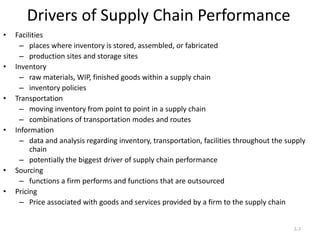
Drivers of Supply Chain Performance
•

•

•

•

•

•

Facilities
– places where inventory is stored, assembled, or fabricated
– production sites and storage sites
Inventory
– raw materials, WIP, finished goods within a supply chain
– inventory policies
Transportation
– moving inventory from point to point in a supply chain
– combinations of transportation modes and routes
Information
– data and analysis regarding inventory, transportation, facilities throughout the supply
chain
– potentially the biggest driver of supply chain performance
Sourcing
– functions a firm performs and functions that are outsourced
Pricing
– Price associated with goods and services provided by a firm to the supply chain

3-3
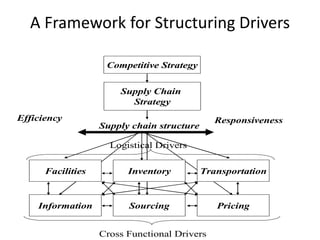
A Framework for Structuring Drivers
Competitive Strategy
Supply Chain
Strategy
Efficiency

Responsiveness

Supply chain structure
Logistical Drivers

Facilities

Inventory

Transportation

Information

Sourcing

Pricing

Cross Functional Drivers

3-4
Facilities
It is the place where utility is added to convert the inputs ( to
outputs) for instance inventory is either processed to
another form or stored before being transported or
delivered to the next partner of the chain . A facility of a SC
may be factory warehouse or a retail store. Decisions
regarding the location of the facilities (plant), their capacity
and the flexibility of the facilities have a major impact on
the performance of the SC for Ex. An automobile firm can
locate its spare parts distributors and service centers close
to customers to increase responsiveness at the cost of
efficiency .On, the contrary, fewer spare parts distributors
and service centers may increase the efficiency of the SC
network at the cost of its responsiveness
3-5
Facilities
• Role in the supply chain
– the “where” of the supply chain
– manufacturing or storage (warehouses)

• Role in the competitive strategy
– economies of scale (efficiency priority)
– larger number of smaller facilities (responsiveness
priority)

• Example : Toyota and Honda
• Components of facilities decisions
3-6
Components of Facilities Decisions
• Location
– centralization (efficiency) vs. decentralization
(responsiveness)
– other factors to consider (e.g., proximity to customers)

• Capacity (flexibility versus efficiency)
• Manufacturing methodology (product focused
versus process focused)
• Warehousing methodology (SKU storage, job lot
storage, cross-docking)
• Overall trade-off: Responsiveness versus efficiency
3-7
Facility –Related Metrics
• A manager should track the following facility related metrics
that influence SC performance
They are
• Capacity
• Utilization
• Theoretical flow/cycle time of production
• Actual flow cycle time
• Flow time efficiency
• Product Variety
• Volume contribution of top 20% SKU’s and customers
• Processing/Set up/down/idle time
• Average production Batch Size
• Production Service level

3-8
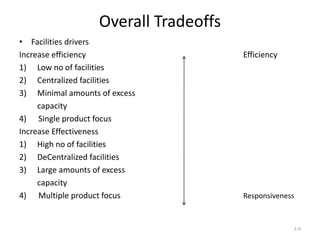
Overall Tradeoffs
• Facilities drivers
Increase efficiency
1) Low no of facilities
2) Centralized facilities
3) Minimal amounts of excess
capacity
4) Single product focus
Increase Effectiveness
1) High no of facilities
2) DeCentralized facilities
3) Large amounts of excess
capacity
4) Multiple product focus

Efficiency

Responsiveness

3-9
Inventory
• All raw materials ,WIP and finished goods within a SC
are referred to as inventory , any change in inventory
policies can greatly effect the efficiency and
responsiveness of the SC. Decisions such as how
much to store and where to store (in the firm’s
premises or warehouse or at the retailer’s premises)
For Ex. A retailer can quickly meet a customer
demand by a maintaining a large inventory of an
item but it will increase the retailer’s cost ,thereby
affecting its efficiency even though the
responsiveness has increased. On the contrary,
reducing inventory will increase the retailer’s
efficiency but will affect its responsiveness
3-10
Inventory

• Role in the supply chain
• Role in the competitive
strategy
• Components of inventory
decisions
3-11
Inventory: Role in the Supply Chain
• Inventory exists because of a mismatch between
supply and demand
• Source of cost and influence on responsiveness
• Impact on
– material flow time: time elapsed between when material
enters the supply chain to when it exits the supply chain
– throughput
• rate at which sales to end consumers occur
• I = RT (Little’s Law)
• I = inventory; R = throughput; T = flow time
Example
• Inventory and throughput are “synonymous” in a supply chain
3-12
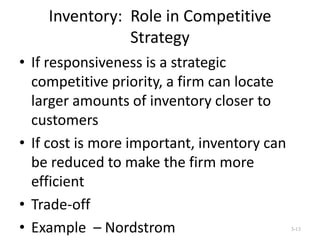
Inventory: Role in Competitive
Strategy
• If responsiveness is a strategic
competitive priority, a firm can locate
larger amounts of inventory closer to
customers
• If cost is more important, inventory can
be reduced to make the firm more
efficient
• Trade-off
• Example – Nordstrom

3-13
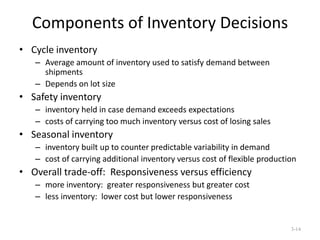
Components of Inventory Decisions
• Cycle inventory
– Average amount of inventory used to satisfy demand between
shipments
– Depends on lot size

• Safety inventory
– inventory held in case demand exceeds expectations
– costs of carrying too much inventory versus cost of losing sales

• Seasonal inventory
– inventory built up to counter predictable variability in demand
– cost of carrying additional inventory versus cost of flexible production

• Overall trade-off: Responsiveness versus efficiency
– more inventory: greater responsiveness but greater cost
– less inventory: lower cost but lower responsiveness

3-14
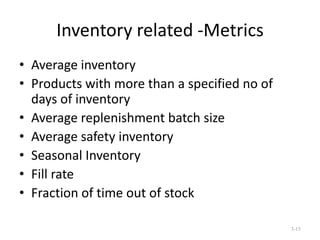
Inventory related -Metrics
• Average inventory
• Products with more than a specified no of
days of inventory
• Average replenishment batch size
• Average safety inventory
• Seasonal Inventory
• Fill rate
• Fraction of time out of stock
3-15
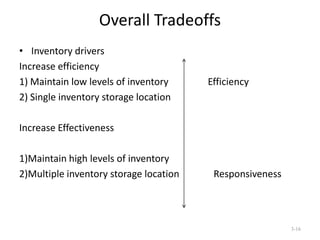
Overall Tradeoffs
• Inventory drivers
Increase efficiency
1) Maintain low levels of inventory
2) Single inventory storage location

Efficiency

Increase Effectiveness
1)Maintain high levels of inventory
2)Multiple inventory storage location

Responsiveness

3-16
Transportation

• Role in the supply chain
• Role in the competitive
strategy
• Components of transportation
decisions
3-17
Transportation: Role in
the Supply Chain

• Moves the product between stages
in the supply chain
• Impact on responsiveness and
efficiency
• Faster transportation allows greater
responsiveness but lower efficiency
• Also affects inventory and facilities
3-18
Transportation
• Inventory has to be moved from point to point
in the SC using transportation facilities taking
the form of many combinations of
modes(multi modal) and routes, each having
its own performance characteristics .
• The responsiveness and efficiency of the SC is
significantly affected by the choice of
transportation modes and routes (affecting
the speed and cost of transportation).
3-19
Transportation
• Hence decisions regarding issues related
to how to move a product from one
location to another and by what mode of
transportation that are usually trade-off
decisions. It is necessary to evaluate
economies on one hand and desired level
of customer on the other. It is concerned
with movement of the product between
different stages of the SC.
3-20
Transportation:
Role in the Competitive Strategy
• If responsiveness is a strategic competitive
priority, then faster transportation modes can
provide greater responsiveness to customers
who are willing to pay for it
• Can also use slower transportation modes for
customers whose priority is price (cost)
• Can also consider both inventory and
transportation to find the right balance
• Example 3.3: Laura Ashley
3-21
Components of
Transportation Decisions
• Mode of transportation:
– air, truck, rail, ship, pipeline, electronic transportation
– vary in cost, speed, size of shipment, flexibility

• Route and network selection
– route: path along which a product is shipped
– network: collection of locations and routes

• In-house or outsource
• Overall trade-off: Responsiveness versus
efficiency
3-22
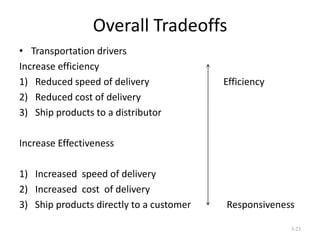
Overall Tradeoffs
• Transportation drivers
Increase efficiency
1) Reduced speed of delivery
2) Reduced cost of delivery
3) Ship products to a distributor

Efficiency

Increase Effectiveness
1) Increased speed of delivery
2) Increased cost of delivery
3) Ship products directly to a customer

Responsiveness
3-23
Information: Role in
the Supply Chain
• The connection between the various
stages in the supply chain – allows
coordination between stages
• Crucial to daily operation of each
stage in a supply chain – e.g.,
production scheduling, inventory
levels
3-24
Information
• Information consist of data and analysis regarding
inventory , facilities ( location, capacity etc) ,
transportation and customers through out the SC.
Information affects each of the other drivers and
hence is the biggest driver of the SC performance.
The information is helpful in making the SC more
efficient and responsive at the same time for Ex.
Information regarding the demand pattern results
in the more accurate forecast of demand, which in
turn will enable a firm to produce the required
quantity of the product at the right time to meet
customer demand .This makes the SC more
responsive and yet efficient.
3-25
Information

• Role in the supply chain
• Role in the competitive
strategy
• Components of information
decisions
3-26
Information:
Role in the Competitive Strategy
• Allows supply chain to become more efficient
and more responsive at the same time
(reduces the need for a trade-off)
• Information technology
• What information is most valuable?
• Example : Andersen Windows
• Example : Dell

3-27
Components of Information Decisions

• Push (MRP) versus pull (demand information
transmitted quickly throughout the supply chain)
• Coordination and information sharing
• Forecasting and aggregate planning
• Enabling technologies
–
–
–
–

EDI
Internet
ERP systems
Supply Chain Management software

• Overall trade-off: Responsiveness versus
efficiency
3-28
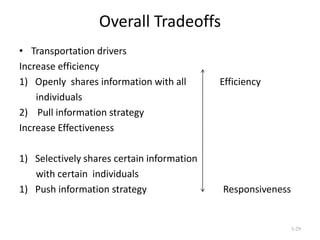
Overall Tradeoffs
• Transportation drivers
Increase efficiency
1) Openly shares information with all
individuals
2) Pull information strategy
Increase Effectiveness
1) Selectively shares certain information
with certain individuals
1) Push information strategy

Efficiency

Responsiveness

3-29
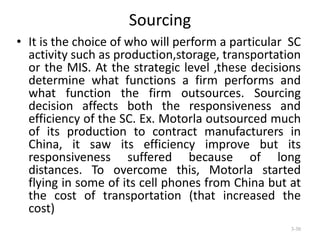
Sourcing
• It is the choice of who will perform a particular SC
activity such as production,storage, transportation
or the MIS. At the strategic level ,these decisions
determine what functions a firm performs and
what function the firm outsources. Sourcing
decision affects both the responsiveness and
efficiency of the SC. Ex. Motorla outsourced much
of its production to contract manufacturers in
China, it saw its efficiency improve but its
responsiveness suffered because of long
distances. To overcome this, Motorla started
flying in some of its cell phones from China but at
the cost of transportation (that increased the
cost)
3-30
Sourcing

• Role in the supply chain
• Role in the competitive
strategy
• Components of sourcing
decisions
3-31
Sourcing: Role inthe Supply Chain
• Set of business processes
required to purchase goods and
services in a supply chain
• Supplier selection, single vs.
multiple suppliers, contract
negotiation
3-32
Sourcing:
Role in the Competitive Strategy
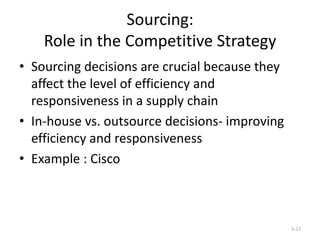
• Sourcing decisions are crucial because they
affect the level of efficiency and
responsiveness in a supply chain
• In-house vs. outsource decisions- improving
efficiency and responsiveness
• Example : Cisco

3-33
Components of Sourcing Decisions
•
•
•
•

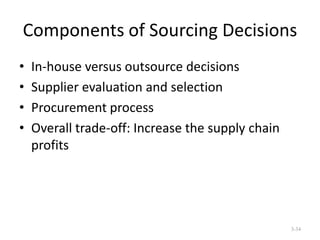
In-house versus outsource decisions
Supplier evaluation and selection
Procurement process
Overall trade-off: Increase the supply chain
profits

3-34
Overall Tradeoffs
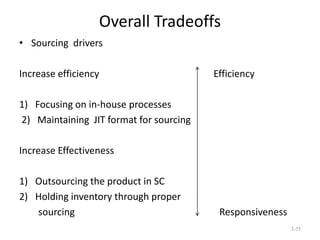
• Sourcing drivers
Increase efficiency

Efficiency

1) Focusing on in-house processes
2) Maintaining JIT format for sourcing
Increase Effectiveness
1) Outsourcing the product in SC
2) Holding inventory through proper
sourcing

Responsiveness
3-35
Pricing
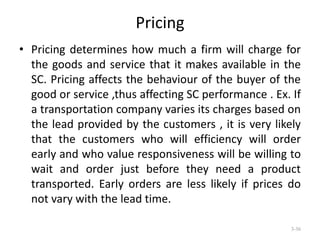
• Pricing determines how much a firm will charge for
the goods and service that it makes available in the
SC. Pricing affects the behaviour of the buyer of the
good or service ,thus affecting SC performance . Ex. If
a transportation company varies its charges based on
the lead provided by the customers , it is very likely
that the customers who will efficiency will order
early and who value responsiveness will be willing to
wait and order just before they need a product
transported. Early orders are less likely if prices do
not vary with the lead time.
3-36
Pricing

• Role in the supply chain
• Role in the competitive
strategy
• Components of pricing
decisions
3-37
Pricing: Role in the Supply Chain

• Pricing determines the amount
to charge customers in a
supply chain
• Pricing strategies can be used
to match demand and supply
3-38
Pricing:
Role in the Competitive Strategy
• Firms can utilize optimal pricing
strategies to improve efficiency and
responsiveness
• Low price and low product
availability; vary prices by response
times
• Example : Amazon
3-39
Components of Pricing Decisions
• Pricing and economies of scale
• Everyday low pricing versus high-low
pricing
• Fixed price versus menu pricing
• Overall trade-off: Increase the firm
profits
3-40
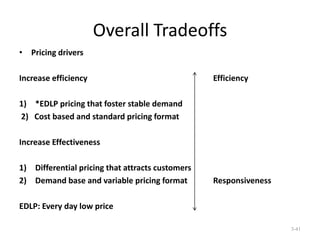
Overall Tradeoffs
• Pricing drivers
Increase efficiency

Efficiency

1) *EDLP pricing that foster stable demand
2) Cost based and standard pricing format
Increase Effectiveness
1) Differential pricing that attracts customers
2) Demand base and variable pricing format

Responsiveness

EDLP: Every day low price
3-41
•
•
•
•
•
•
•

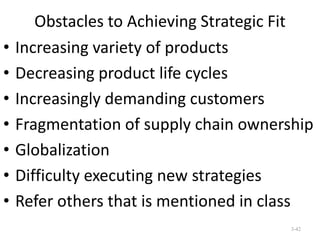
Obstacles to Achieving Strategic Fit
Increasing variety of products
Decreasing product life cycles
Increasingly demanding customers
Fragmentation of supply chain ownership
Globalization
Difficulty executing new strategies
Refer others that is mentioned in class
3-42
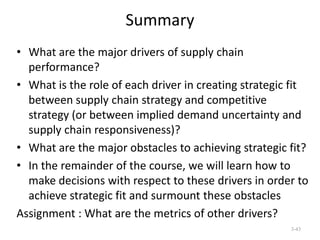
Summary
• What are the major drivers of supply chain
performance?
• What is the role of each driver in creating strategic fit
between supply chain strategy and competitive
strategy (or between implied demand uncertainty and
supply chain responsiveness)?
• What are the major obstacles to achieving strategic fit?
• In the remainder of the course, we will learn how to
make decisions with respect to these drivers in order to
achieve strategic fit and surmount these obstacles
Assignment : What are the metrics of other drivers?
3-43

Ssscmmodule 1-4th sem

  • 1.
    Supply Chain Management SupplyChain Drivers and Obstacles 3-1
  • 2.
    Outline • • • • • • • • • Drivers of supplychain performance A framework for structuring drivers Facilities Inventory Transportation Information Sourcing Pricing Obstacles to achieving fit 3-2
  • 3.
    Drivers of SupplyChain Performance • • • • • • Facilities – places where inventory is stored, assembled, or fabricated – production sites and storage sites Inventory – raw materials, WIP, finished goods within a supply chain – inventory policies Transportation – moving inventory from point to point in a supply chain – combinations of transportation modes and routes Information – data and analysis regarding inventory, transportation, facilities throughout the supply chain – potentially the biggest driver of supply chain performance Sourcing – functions a firm performs and functions that are outsourced Pricing – Price associated with goods and services provided by a firm to the supply chain 3-3
  • 4.
    A Framework forStructuring Drivers Competitive Strategy Supply Chain Strategy Efficiency Responsiveness Supply chain structure Logistical Drivers Facilities Inventory Transportation Information Sourcing Pricing Cross Functional Drivers 3-4
  • 5.
    Facilities It is theplace where utility is added to convert the inputs ( to outputs) for instance inventory is either processed to another form or stored before being transported or delivered to the next partner of the chain . A facility of a SC may be factory warehouse or a retail store. Decisions regarding the location of the facilities (plant), their capacity and the flexibility of the facilities have a major impact on the performance of the SC for Ex. An automobile firm can locate its spare parts distributors and service centers close to customers to increase responsiveness at the cost of efficiency .On, the contrary, fewer spare parts distributors and service centers may increase the efficiency of the SC network at the cost of its responsiveness 3-5
  • 6.
    Facilities • Role inthe supply chain – the “where” of the supply chain – manufacturing or storage (warehouses) • Role in the competitive strategy – economies of scale (efficiency priority) – larger number of smaller facilities (responsiveness priority) • Example : Toyota and Honda • Components of facilities decisions 3-6
  • 7.
    Components of FacilitiesDecisions • Location – centralization (efficiency) vs. decentralization (responsiveness) – other factors to consider (e.g., proximity to customers) • Capacity (flexibility versus efficiency) • Manufacturing methodology (product focused versus process focused) • Warehousing methodology (SKU storage, job lot storage, cross-docking) • Overall trade-off: Responsiveness versus efficiency 3-7
  • 8.
    Facility –Related Metrics •A manager should track the following facility related metrics that influence SC performance They are • Capacity • Utilization • Theoretical flow/cycle time of production • Actual flow cycle time • Flow time efficiency • Product Variety • Volume contribution of top 20% SKU’s and customers • Processing/Set up/down/idle time • Average production Batch Size • Production Service level 3-8
  • 9.
    Overall Tradeoffs • Facilitiesdrivers Increase efficiency 1) Low no of facilities 2) Centralized facilities 3) Minimal amounts of excess capacity 4) Single product focus Increase Effectiveness 1) High no of facilities 2) DeCentralized facilities 3) Large amounts of excess capacity 4) Multiple product focus Efficiency Responsiveness 3-9
  • 10.
    Inventory • All rawmaterials ,WIP and finished goods within a SC are referred to as inventory , any change in inventory policies can greatly effect the efficiency and responsiveness of the SC. Decisions such as how much to store and where to store (in the firm’s premises or warehouse or at the retailer’s premises) For Ex. A retailer can quickly meet a customer demand by a maintaining a large inventory of an item but it will increase the retailer’s cost ,thereby affecting its efficiency even though the responsiveness has increased. On the contrary, reducing inventory will increase the retailer’s efficiency but will affect its responsiveness 3-10
  • 11.
    Inventory • Role inthe supply chain • Role in the competitive strategy • Components of inventory decisions 3-11
  • 12.
    Inventory: Role inthe Supply Chain • Inventory exists because of a mismatch between supply and demand • Source of cost and influence on responsiveness • Impact on – material flow time: time elapsed between when material enters the supply chain to when it exits the supply chain – throughput • rate at which sales to end consumers occur • I = RT (Little’s Law) • I = inventory; R = throughput; T = flow time Example • Inventory and throughput are “synonymous” in a supply chain 3-12
  • 13.
    Inventory: Role inCompetitive Strategy • If responsiveness is a strategic competitive priority, a firm can locate larger amounts of inventory closer to customers • If cost is more important, inventory can be reduced to make the firm more efficient • Trade-off • Example – Nordstrom 3-13
  • 14.
    Components of InventoryDecisions • Cycle inventory – Average amount of inventory used to satisfy demand between shipments – Depends on lot size • Safety inventory – inventory held in case demand exceeds expectations – costs of carrying too much inventory versus cost of losing sales • Seasonal inventory – inventory built up to counter predictable variability in demand – cost of carrying additional inventory versus cost of flexible production • Overall trade-off: Responsiveness versus efficiency – more inventory: greater responsiveness but greater cost – less inventory: lower cost but lower responsiveness 3-14
  • 15.
    Inventory related -Metrics •Average inventory • Products with more than a specified no of days of inventory • Average replenishment batch size • Average safety inventory • Seasonal Inventory • Fill rate • Fraction of time out of stock 3-15
  • 16.
    Overall Tradeoffs • Inventorydrivers Increase efficiency 1) Maintain low levels of inventory 2) Single inventory storage location Efficiency Increase Effectiveness 1)Maintain high levels of inventory 2)Multiple inventory storage location Responsiveness 3-16
  • 17.
    Transportation • Role inthe supply chain • Role in the competitive strategy • Components of transportation decisions 3-17
  • 18.
    Transportation: Role in theSupply Chain • Moves the product between stages in the supply chain • Impact on responsiveness and efficiency • Faster transportation allows greater responsiveness but lower efficiency • Also affects inventory and facilities 3-18
  • 19.
    Transportation • Inventory hasto be moved from point to point in the SC using transportation facilities taking the form of many combinations of modes(multi modal) and routes, each having its own performance characteristics . • The responsiveness and efficiency of the SC is significantly affected by the choice of transportation modes and routes (affecting the speed and cost of transportation). 3-19
  • 20.
    Transportation • Hence decisionsregarding issues related to how to move a product from one location to another and by what mode of transportation that are usually trade-off decisions. It is necessary to evaluate economies on one hand and desired level of customer on the other. It is concerned with movement of the product between different stages of the SC. 3-20
  • 21.
    Transportation: Role in theCompetitive Strategy • If responsiveness is a strategic competitive priority, then faster transportation modes can provide greater responsiveness to customers who are willing to pay for it • Can also use slower transportation modes for customers whose priority is price (cost) • Can also consider both inventory and transportation to find the right balance • Example 3.3: Laura Ashley 3-21
  • 22.
    Components of Transportation Decisions •Mode of transportation: – air, truck, rail, ship, pipeline, electronic transportation – vary in cost, speed, size of shipment, flexibility • Route and network selection – route: path along which a product is shipped – network: collection of locations and routes • In-house or outsource • Overall trade-off: Responsiveness versus efficiency 3-22
  • 23.
    Overall Tradeoffs • Transportationdrivers Increase efficiency 1) Reduced speed of delivery 2) Reduced cost of delivery 3) Ship products to a distributor Efficiency Increase Effectiveness 1) Increased speed of delivery 2) Increased cost of delivery 3) Ship products directly to a customer Responsiveness 3-23
  • 24.
    Information: Role in theSupply Chain • The connection between the various stages in the supply chain – allows coordination between stages • Crucial to daily operation of each stage in a supply chain – e.g., production scheduling, inventory levels 3-24
  • 25.
    Information • Information consistof data and analysis regarding inventory , facilities ( location, capacity etc) , transportation and customers through out the SC. Information affects each of the other drivers and hence is the biggest driver of the SC performance. The information is helpful in making the SC more efficient and responsive at the same time for Ex. Information regarding the demand pattern results in the more accurate forecast of demand, which in turn will enable a firm to produce the required quantity of the product at the right time to meet customer demand .This makes the SC more responsive and yet efficient. 3-25
  • 26.
    Information • Role inthe supply chain • Role in the competitive strategy • Components of information decisions 3-26
  • 27.
    Information: Role in theCompetitive Strategy • Allows supply chain to become more efficient and more responsive at the same time (reduces the need for a trade-off) • Information technology • What information is most valuable? • Example : Andersen Windows • Example : Dell 3-27
  • 28.
    Components of InformationDecisions • Push (MRP) versus pull (demand information transmitted quickly throughout the supply chain) • Coordination and information sharing • Forecasting and aggregate planning • Enabling technologies – – – – EDI Internet ERP systems Supply Chain Management software • Overall trade-off: Responsiveness versus efficiency 3-28
  • 29.
    Overall Tradeoffs • Transportationdrivers Increase efficiency 1) Openly shares information with all individuals 2) Pull information strategy Increase Effectiveness 1) Selectively shares certain information with certain individuals 1) Push information strategy Efficiency Responsiveness 3-29
  • 30.
    Sourcing • It isthe choice of who will perform a particular SC activity such as production,storage, transportation or the MIS. At the strategic level ,these decisions determine what functions a firm performs and what function the firm outsources. Sourcing decision affects both the responsiveness and efficiency of the SC. Ex. Motorla outsourced much of its production to contract manufacturers in China, it saw its efficiency improve but its responsiveness suffered because of long distances. To overcome this, Motorla started flying in some of its cell phones from China but at the cost of transportation (that increased the cost) 3-30
  • 31.
    Sourcing • Role inthe supply chain • Role in the competitive strategy • Components of sourcing decisions 3-31
  • 32.
    Sourcing: Role intheSupply Chain • Set of business processes required to purchase goods and services in a supply chain • Supplier selection, single vs. multiple suppliers, contract negotiation 3-32
  • 33.
    Sourcing: Role in theCompetitive Strategy • Sourcing decisions are crucial because they affect the level of efficiency and responsiveness in a supply chain • In-house vs. outsource decisions- improving efficiency and responsiveness • Example : Cisco 3-33
  • 34.
    Components of SourcingDecisions • • • • In-house versus outsource decisions Supplier evaluation and selection Procurement process Overall trade-off: Increase the supply chain profits 3-34
  • 35.
    Overall Tradeoffs • Sourcingdrivers Increase efficiency Efficiency 1) Focusing on in-house processes 2) Maintaining JIT format for sourcing Increase Effectiveness 1) Outsourcing the product in SC 2) Holding inventory through proper sourcing Responsiveness 3-35
  • 36.
    Pricing • Pricing determineshow much a firm will charge for the goods and service that it makes available in the SC. Pricing affects the behaviour of the buyer of the good or service ,thus affecting SC performance . Ex. If a transportation company varies its charges based on the lead provided by the customers , it is very likely that the customers who will efficiency will order early and who value responsiveness will be willing to wait and order just before they need a product transported. Early orders are less likely if prices do not vary with the lead time. 3-36
  • 37.
    Pricing • Role inthe supply chain • Role in the competitive strategy • Components of pricing decisions 3-37
  • 38.
    Pricing: Role inthe Supply Chain • Pricing determines the amount to charge customers in a supply chain • Pricing strategies can be used to match demand and supply 3-38
  • 39.
    Pricing: Role in theCompetitive Strategy • Firms can utilize optimal pricing strategies to improve efficiency and responsiveness • Low price and low product availability; vary prices by response times • Example : Amazon 3-39
  • 40.
    Components of PricingDecisions • Pricing and economies of scale • Everyday low pricing versus high-low pricing • Fixed price versus menu pricing • Overall trade-off: Increase the firm profits 3-40
  • 41.
    Overall Tradeoffs • Pricingdrivers Increase efficiency Efficiency 1) *EDLP pricing that foster stable demand 2) Cost based and standard pricing format Increase Effectiveness 1) Differential pricing that attracts customers 2) Demand base and variable pricing format Responsiveness EDLP: Every day low price 3-41
  • 42.
    • • • • • • • Obstacles to AchievingStrategic Fit Increasing variety of products Decreasing product life cycles Increasingly demanding customers Fragmentation of supply chain ownership Globalization Difficulty executing new strategies Refer others that is mentioned in class 3-42
  • 43.
    Summary • What arethe major drivers of supply chain performance? • What is the role of each driver in creating strategic fit between supply chain strategy and competitive strategy (or between implied demand uncertainty and supply chain responsiveness)? • What are the major obstacles to achieving strategic fit? • In the remainder of the course, we will learn how to make decisions with respect to these drivers in order to achieve strategic fit and surmount these obstacles Assignment : What are the metrics of other drivers? 3-43