Biology and Human Concerns
                               09/18/09 – Notes

Hydrogen – one electron. Simplest element.
Two hydrogen atoms = helium. Add another = lithium. Become larger and
heavier.
--complete outer shells make elements more stable. This can occur by losing or
gaining electrons to have eight electrons in the shell.
--single positive or single negative charge is common.

The only place this can happen is in cores of stars like the sun. When the stars
explode, all of the elements enter the outside space, and then travel throughout
the universe, and to the Earth. Carbon, oxygen, nitrogen molecules in our bodies
were all created in stars—and are now part of our cells.

Chemical Bonds
-Covalent Bonds
-Nonpolar and Polar Covalent Bonds
-Ionic Bonds
-Hydrogen Bonds

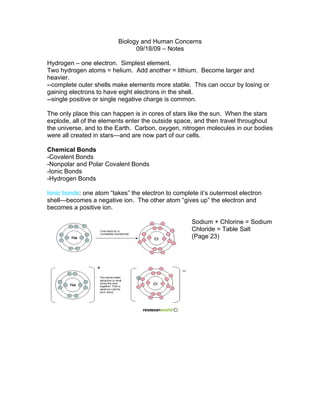
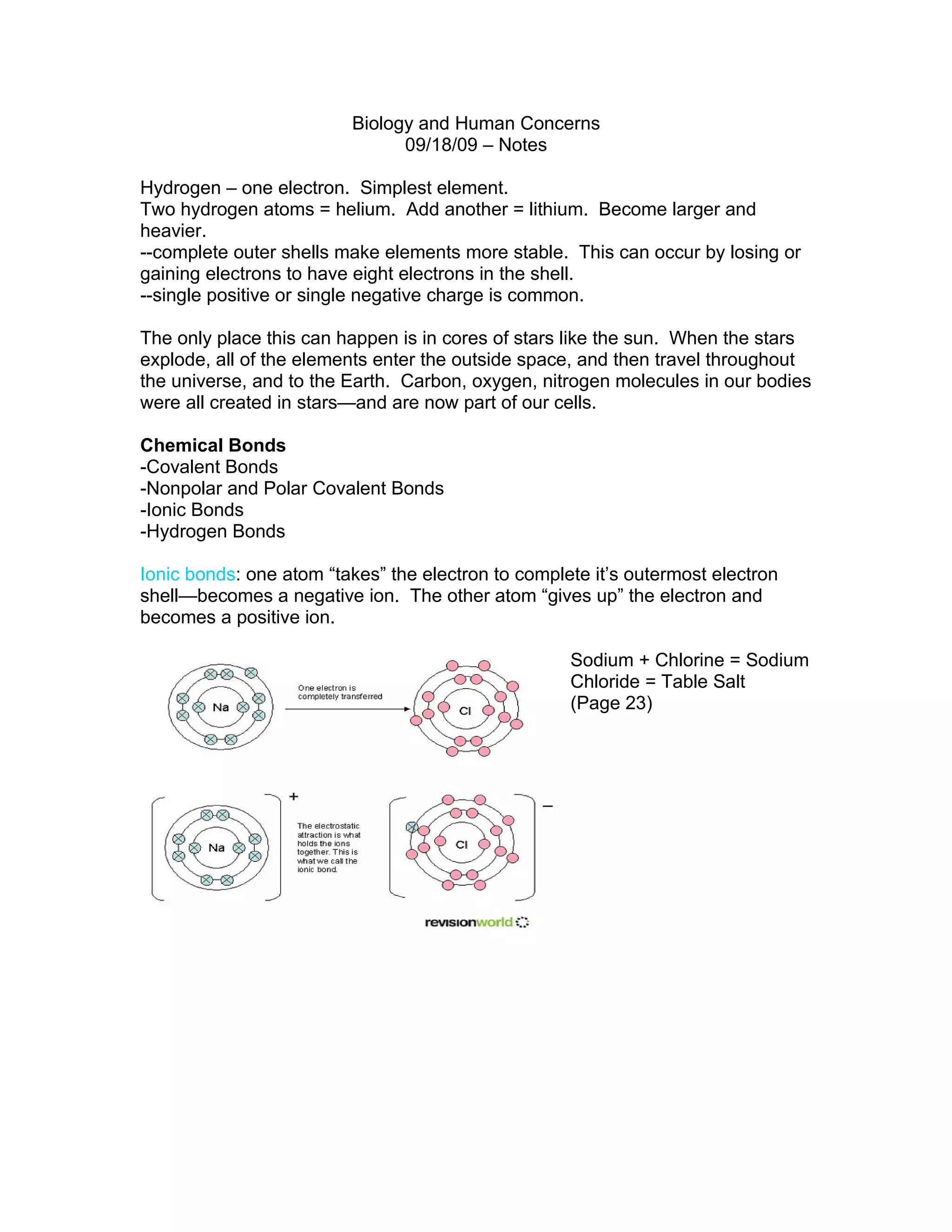
Ionic bonds: one atom “takes” the electron to complete it’s outermost electron
shell—becomes a negative ion. The other atom “gives up” the electron and
becomes a positive ion.

                                                    Sodium + Chlorine = Sodium
                                                    Chloride = Table Salt
                                                    (Page 23)
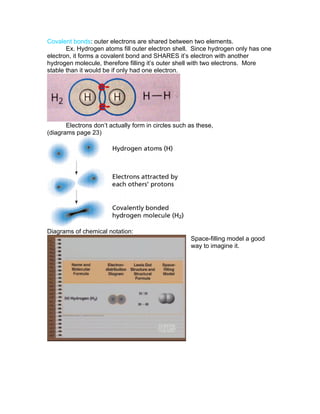
Covalent bonds: outer electrons are shared between two elements.
       Ex. Hydrogen atoms fill outer electron shell. Since hydrogen only has one
electron, it forms a covalent bond and SHARES it’s electron with another
hydrogen molecule, therefore filling it’s outer shell with two electrons. More
stable than it would be if only had one electron.


       Electrons don’t actually form in circles such as these,
(diagrams page 23)


Diagrams of chemical notation:
                                                     Space-filling model a good
                                                     way to imagine it.
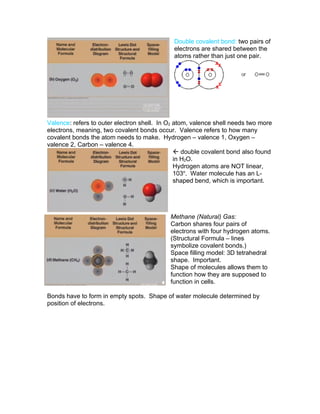
Double covalent bond: two pairs of
                                             electrons are shared between the
                                             atoms rather than just one pair.


Valence: refers to outer electron shell. In O2 atom, valence shell needs two more
electrons, meaning, two covalent bonds occur. Valence refers to how many
covalent bonds the atom needs to make. Hydrogen – valence 1, Oxygen –
valence 2, Carbon – valence 4.
                                                double covalent bond also found
                                               in H2O.
                                               Hydrogen atoms are NOT linear,
                                               103o. Water molecule has an L-
                                               shaped bend, which is important.


                                            Methane (Natural) Gas:
                                            Carbon shares four pairs of
                                            electrons with four hydrogen atoms.
                                            (Structural Formula – lines
                                            symbolize covalent bonds.)
                                            Space filling model: 3D tetrahedral
                                            shape. Important.
                                            Shape of molecules allows them to
                                            function how they are supposed to
                                            function in cells.

Bonds have to form in empty spots. Shape of water molecule determined by
position of electrons.
Non Polar Covalent Bonds:
-Bond where the electrons are shared equally between the two atoms of a similar
electronegativity.

Polar Covaent bonds
-The more electronegative nucleus attracts the electron pair
-Therefore, that end of the bond becomes slightly negative.
-bond between atoms that are different in electro-negativity.
       Ex. Water. Because of its polarity and bend, water has special “emergent”
properties that the elements would not have alone

Hydrogen bonds
       -The slightly positive end of one polar molecule (usually H), attracts the
negative end of another polar molecule.
       -These are very weak bonds.

09 18 09 Notes

  • 1.
    Biology and HumanConcerns 09/18/09 – Notes Hydrogen – one electron. Simplest element. Two hydrogen atoms = helium. Add another = lithium. Become larger and heavier. --complete outer shells make elements more stable. This can occur by losing or gaining electrons to have eight electrons in the shell. --single positive or single negative charge is common. The only place this can happen is in cores of stars like the sun. When the stars explode, all of the elements enter the outside space, and then travel throughout the universe, and to the Earth. Carbon, oxygen, nitrogen molecules in our bodies were all created in stars—and are now part of our cells. Chemical Bonds -Covalent Bonds -Nonpolar and Polar Covalent Bonds -Ionic Bonds -Hydrogen Bonds Ionic bonds: one atom “takes” the electron to complete it’s outermost electron shell—becomes a negative ion. The other atom “gives up” the electron and becomes a positive ion. Sodium + Chlorine = Sodium Chloride = Table Salt (Page 23)
  • 2.
    Covalent bonds: outerelectrons are shared between two elements. Ex. Hydrogen atoms fill outer electron shell. Since hydrogen only has one electron, it forms a covalent bond and SHARES it’s electron with another hydrogen molecule, therefore filling it’s outer shell with two electrons. More stable than it would be if only had one electron. Electrons don’t actually form in circles such as these, (diagrams page 23) Diagrams of chemical notation: Space-filling model a good way to imagine it.
  • 3.
    Double covalent bond:two pairs of electrons are shared between the atoms rather than just one pair. Valence: refers to outer electron shell. In O2 atom, valence shell needs two more electrons, meaning, two covalent bonds occur. Valence refers to how many covalent bonds the atom needs to make. Hydrogen – valence 1, Oxygen – valence 2, Carbon – valence 4.  double covalent bond also found in H2O. Hydrogen atoms are NOT linear, 103o. Water molecule has an L- shaped bend, which is important. Methane (Natural) Gas: Carbon shares four pairs of electrons with four hydrogen atoms. (Structural Formula – lines symbolize covalent bonds.) Space filling model: 3D tetrahedral shape. Important. Shape of molecules allows them to function how they are supposed to function in cells. Bonds have to form in empty spots. Shape of water molecule determined by position of electrons.
  • 4.
    Non Polar CovalentBonds: -Bond where the electrons are shared equally between the two atoms of a similar electronegativity. Polar Covaent bonds -The more electronegative nucleus attracts the electron pair -Therefore, that end of the bond becomes slightly negative. -bond between atoms that are different in electro-negativity. Ex. Water. Because of its polarity and bend, water has special “emergent” properties that the elements would not have alone Hydrogen bonds -The slightly positive end of one polar molecule (usually H), attracts the negative end of another polar molecule. -These are very weak bonds.