Data structures &
representations
mquartulli@vicomtech.org
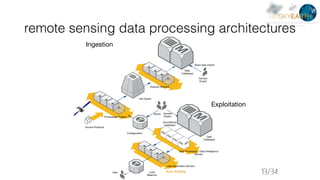
remote sensing data processing architectures
Job Queue
Analysis Workers
Data
Catalogue
Processing Workers
Auto Scaling
Ingestion
Data
Catalogue
Exploitation
Annotations
Catalogue
User Application Servers
Load
Balancer
User
Source Products
Domain
Expert
Configuration
Admin
Domain
Expert
direct data import
Data Processing / Data Intelligence
Servers
13/34
Hadoop Cluster computing
[Lisa Vaas 2016]
Spark cluster computing
[Hitesh Dharmdasani, “Python and Bigdata - An Introduction to Spark (PySpark)”]
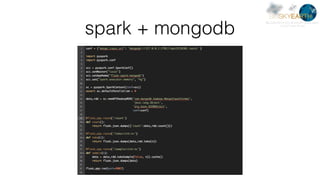
spark + mongodb
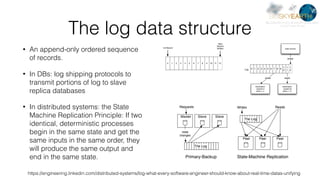
The log data structure
• An append-only ordered sequence
of records.
• In DBs: log shipping protocols to
transmit portions of log to slave
replica databases
• In distributed systems: the State
Machine Replication Principle: If two
identical, deterministic processes
begin in the same state and get the
same inputs in the same order, they
will produce the same output and
end in the same state.
https://engineering.linkedin.com/distributed-systems/log-what-every-software-engineer-should-know-about-real-time-datas-unifying
Why database management systems
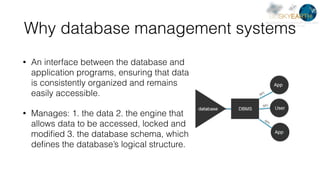
• An interface between the database and
application programs, ensuring that data
is consistently organized and remains
easily accessible.
• Manages: 1. the data 2. the engine that
allows data to be accessed, locked and
modified 3. the database schema, which
defines the database’s logical structure.
Why database management systems
• Provides:
• Data abstraction and independence; Data security; A locking mechanism for concurrent access;
• An efficient handler to balance the needs of multiple applications using the same data;
• The ability to swiftly recover from crashes and errors, including restartability and recoverability;
• Robust data integrity capabilities; Logging and auditing of activity;
• Simple access using a standard application programming interface (API);
• Uniform administration procedures for data.
• Question:
• Does your application need all this? Typically yes if concurrent insert/update accesses, distributed
reads…
History
• 1960s: Navigational DBs
• 1970s-1980s: SQL, normalisation and OLTP, transactions
• 1990s: object oriented DBs and OLAP, warehousing
• 2000s: NoSQL and the CAP theorem
• 2010s: newSQL, graph DBs, Big Data
Databases: a user’s view
• SQL and ACID: Atomicity, Consistency, Isolation, and Durability
• Variety and NoSQL: MongoDB
• Volume and NoSQL: HBase, Cassandra
• Velocity and NoSQL: MonetDB, KairosDB
• NoSQL: bad at relationships —> Graph DBs: Neo4J
• The CAP theorem: Consistency, Availability, Partition tolerance
SQL vs NoSQL
[Lisa Vaas 2016]
DB indices
• Objective: sub-linear search (e.g. O(logN), O(1))
• E.g. bitmaps, keys/pointers to records, keys/pointers to blocks, 

reverse indices.
• Implementations in terms of (balanced) trees, hashes, B+trees.
• Types:
• non-clustered: logical order only, multiple indices possible
• clustered: physical order too for efficiency,

a single clustered index per table.
KD Trees
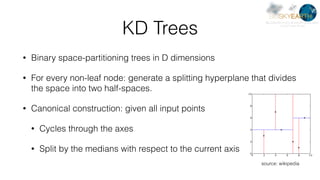
• Binary space-partitioning trees in D dimensions
• For every non-leaf node: generate a splitting hyperplane that divides
the space into two half-spaces.
• Canonical construction: given all input points
• Cycles through the axes
• Split by the medians with respect to the current axis
source: wikipedia
LSH
• Locality-Sensitive Hashing: maximize probability of collision —
similar items end up in same bucket.
• Applications in near-duplicate detection and “fingerprinting”,
similarity nearest neighbor search, hierarchical clustering.
• E.g. by random projection: use a random hyperplane to hash
vectors.
Inverted indices
• Forward index: document —> content
• Inverted index: content —> document / location
• Record level, “Word” level
• Allows fast search (increases insertion cost!): queries can be
resolved by jumping to the “word” id in the inverted index.
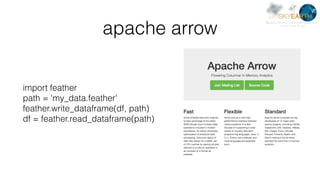
apache arrow
import feather
path = 'my_data.feather'
feather.write_dataframe(df, path)
df = feather.read_dataframe(path)
Google Earth Engine
• A Short Intro by Kersten Clauss…
• Question: how would you replicate what’s under the hood?
18
data	acquisition	&	management
GeoEuskadi	satellite	image	services	
• linked	open	data	management	infrastructure	
• public	sources:	Landsat	y	Copernicus	Sentinel	1-2
19
data	processing
map	update	by

distributed	analysis

of	25cm-

regional-scale

ortho-imagery
Lozano	Silva,	J.;	Aginako	Bengoa,	N.;	Quartulli,	M.;	Olaizola,	I.G.;	Zulueta,	E.,	"Web-Based	
Supervised	Thematic	Mapping,"	in	Selected	Topics	in	Applied	Earth	Observations	and	
Remote	Sensing,	IEEE	Journal	of	,	vol.8,	no.5,	pp.2165-2176,	May	2015
20
data	processing	–	example	video
image search: iqcbm
Index management system
Data input
Column-based DB
User interface
Analysis & processing
Image
analysis
• with DLR IMF BW

• search by compression

in compressed streams

• dynamic taxonomies

• corel 10k
iqcbm: geoeye
semantic label and these labels are stored into the database as part of the patch
information.
In the following, the results of different queries using the CBIR-FCD and TerraSAR-X
images are described.
TELEIOS FP7-257662
7. Applicable and Reference Documents
7.1. Applicable Documents
Document Title
Internal
Referenc
e
Katrin Molch et al., (2010). “Naming Convention for Image Patches”. [RI- 1]
N. Ritter and M. Ruth, (1995) “GeoTIFF Format Specification GeoTIFF”,
Revision 1.0, Version 1.8.1.
[RI- 2]
Robert M Haralick, K Shanmugam, Its'hak Dinstein (1973). "Textural Features
for Image Classification". IEEE Transactions on Systems, Man, and
Cybernetics, SMC-3 (6): 610–621.
[RI- 3]
The GLCM Tutorial
http://www.fp.ucalgary.ca/mhallbey/tutorial.htm
[RI-4]
H.G. Feichtinger, Th. Strohmer (1998). "Gabor Analysis and Algorithms",
Birkhäuser.
[RI-5]
B.S. Manjunath, W.Y. Ma (1996). “Texture features for browsing and retrieval
of image data”. IEEE Transactions on Pattern Analysis and Machine
Intelligence, 18 (8): 837–842.
[RI-6]
A. Popescu, I. Gavat, M. Datcu (2008). "Complex SAR image characterization
using space variant spectral analysis". IEEE Radar Conference, 1-4.
[RI-7]
T. Li, M. Ogihara (2006). “Towards Intelligent Music Information Retrieval”.
IEEE Transactions on Multimedia, 8(3), 564-574.
[RI-8]
A. Croisier, D. Esteban, C. Galand (1976). "Perfect channel splitting by use of
interpolation / decimation / tree decomposition techniques". International Conf.
on information Science and Systems, Patras, Greece: 443-446.
[RI-9]
P.P Vaidyananthan (1987). “Quadrature Mirror Filter Banks, M-Band
Extensions and Perfect-Reconstruction Techniques”. IEEE ASSP Magazine, 4
(3): 4-20.
[RI-10]
23
iqcbm: digitalglobe
TELEIOS FP7-257662
7. Applicable and Reference Documents
7.1. Applicable Documents
Document Title
Internal
Referenc
e
Katrin Molch et al., (2010). “Naming Convention for Image Patches”. [RI- 1]
N. Ritter and M. Ruth, (1995) “GeoTIFF Format Specification GeoTIFF”,
Revision 1.0, Version 1.8.1.
[RI- 2]
Robert M Haralick, K Shanmugam, Its'hak Dinstein (1973). "Textural Features
for Image Classification". IEEE Transactions on Systems, Man, and
Cybernetics, SMC-3 (6): 610–621.
[RI- 3]
The GLCM Tutorial
http://www.fp.ucalgary.ca/mhallbey/tutorial.htm
[RI-4]
H.G. Feichtinger, Th. Strohmer (1998). "Gabor Analysis and Algorithms",
Birkhäuser.
[RI-5]
B.S. Manjunath, W.Y. Ma (1996). “Texture features for browsing and retrieval
of image data”. IEEE Transactions on Pattern Analysis and Machine
Intelligence, 18 (8): 837–842.
[RI-6]
A. Popescu, I. Gavat, M. Datcu (2008). "Complex SAR image characterization
using space variant spectral analysis". IEEE Radar Conference, 1-4.
[RI-7]
T. Li, M. Ogihara (2006). “Towards Intelligent Music Information Retrieval”.
IEEE Transactions on Multimedia, 8(3), 564-574.
[RI-8]
A. Croisier, D. Esteban, C. Galand (1976). "Perfect channel splitting by use of
interpolation / decimation / tree decomposition techniques". International Conf.
on information Science and Systems, Patras, Greece: 443-446.
[RI-9]
P.P Vaidyananthan (1987). “Quadrature Mirror Filter Banks, M-Band
Extensions and Perfect-Reconstruction Techniques”. IEEE ASSP Magazine, 4
(3): 4-20.
[RI-10]
24
.76
.69
.79
.90
.95
.99
TELEIOS FP7-257662
7. Applicable and Reference Documents
7.1. Applicable Documents
Document Title
Internal
Referenc
e
Katrin Molch et al., (2010). “Naming Convention for Image Patches”. [RI- 1]
N. Ritter and M. Ruth, (1995) “GeoTIFF Format Specification GeoTIFF”,
Revision 1.0, Version 1.8.1.
[RI- 2]
Robert M Haralick, K Shanmugam, Its'hak Dinstein (1973). "Textural Features
for Image Classification". IEEE Transactions on Systems, Man, and
Cybernetics, SMC-3 (6): 610–621.
[RI- 3]
The GLCM Tutorial
http://www.fp.ucalgary.ca/mhallbey/tutorial.htm
[RI-4]
H.G. Feichtinger, Th. Strohmer (1998). "Gabor Analysis and Algorithms",
Birkhäuser.
[RI-5]
B.S. Manjunath, W.Y. Ma (1996). “Texture features for browsing and retrieval
of image data”. IEEE Transactions on Pattern Analysis and Machine
Intelligence, 18 (8): 837–842.
[RI-6]
A. Popescu, I. Gavat, M. Datcu (2008). "Complex SAR image characterization
using space variant spectral analysis". IEEE Radar Conference, 1-4.
[RI-7]
T. Li, M. Ogihara (2006). “Towards Intelligent Music Information Retrieval”.
IEEE Transactions on Multimedia, 8(3), 564-574.
[RI-8]
A. Croisier, D. Esteban, C. Galand (1976). "Perfect channel splitting by use of
interpolation / decimation / tree decomposition techniques". International Conf.
on information Science and Systems, Patras, Greece: 443-446.
[RI-9]
P.P Vaidyananthan (1987). “Quadrature Mirror Filter Banks, M-Band
Extensions and Perfect-Reconstruction Techniques”. IEEE ASSP Magazine, 4
(3): 4-20.
[RI-10]
normalized distance from query
25
iqcbm: terrasar-x
TELEIOS FP7-257662
7. Applicable and Reference Documents
7.1. Applicable Documents
Document Title
Internal
Referenc
e
Katrin Molch et al., (2010). “Naming Convention for Image Patches”. [RI- 1]
N. Ritter and M. Ruth, (1995) “GeoTIFF Format Specification GeoTIFF”,
Revision 1.0, Version 1.8.1.
[RI- 2]
Robert M Haralick, K Shanmugam, Its'hak Dinstein (1973). "Textural Features
for Image Classification". IEEE Transactions on Systems, Man, and
Cybernetics, SMC-3 (6): 610–621.
[RI- 3]
The GLCM Tutorial
http://www.fp.ucalgary.ca/mhallbey/tutorial.htm
[RI-4]
H.G. Feichtinger, Th. Strohmer (1998). "Gabor Analysis and Algorithms",
Birkhäuser.
[RI-5]
B.S. Manjunath, W.Y. Ma (1996). “Texture features for browsing and retrieval
of image data”. IEEE Transactions on Pattern Analysis and Machine
Intelligence, 18 (8): 837–842.
[RI-6]
A. Popescu, I. Gavat, M. Datcu (2008). "Complex SAR image characterization
using space variant spectral analysis". IEEE Radar Conference, 1-4.
[RI-7]
T. Li, M. Ogihara (2006). “Towards Intelligent Music Information Retrieval”.
IEEE Transactions on Multimedia, 8(3), 564-574.
[RI-8]
A. Croisier, D. Esteban, C. Galand (1976). "Perfect channel splitting by use of
interpolation / decimation / tree decomposition techniques". International Conf.
on information Science and Systems, Patras, Greece: 443-446.
[RI-9]
P.P Vaidyananthan (1987). “Quadrature Mirror Filter Banks, M-Band
Extensions and Perfect-Reconstruction Techniques”. IEEE ASSP Magazine, 4
(3): 4-20.
[RI-10]
26
iqcbm: terrasar-x
TELEIOS FP7-257662
7. Applicable and Reference Documents
7.1. Applicable Documents
Document Title
Internal
Referenc
e
Katrin Molch et al., (2010). “Naming Convention for Image Patches”. [RI- 1]
N. Ritter and M. Ruth, (1995) “GeoTIFF Format Specification GeoTIFF”,
Revision 1.0, Version 1.8.1.
[RI- 2]
Robert M Haralick, K Shanmugam, Its'hak Dinstein (1973). "Textural Features
for Image Classification". IEEE Transactions on Systems, Man, and
Cybernetics, SMC-3 (6): 610–621.
[RI- 3]
The GLCM Tutorial
http://www.fp.ucalgary.ca/mhallbey/tutorial.htm
[RI-4]
H.G. Feichtinger, Th. Strohmer (1998). "Gabor Analysis and Algorithms",
Birkhäuser.
[RI-5]
B.S. Manjunath, W.Y. Ma (1996). “Texture features for browsing and retrieval
of image data”. IEEE Transactions on Pattern Analysis and Machine
Intelligence, 18 (8): 837–842.
[RI-6]
A. Popescu, I. Gavat, M. Datcu (2008). "Complex SAR image characterization
using space variant spectral analysis". IEEE Radar Conference, 1-4.
[RI-7]
T. Li, M. Ogihara (2006). “Towards Intelligent Music Information Retrieval”.
IEEE Transactions on Multimedia, 8(3), 564-574.
[RI-8]
A. Croisier, D. Esteban, C. Galand (1976). "Perfect channel splitting by use of
interpolation / decimation / tree decomposition techniques". International Conf.
on information Science and Systems, Patras, Greece: 443-446.
[RI-9]
P.P Vaidyananthan (1987). “Quadrature Mirror Filter Banks, M-Band
Extensions and Perfect-Reconstruction Techniques”. IEEE ASSP Magazine, 4
(3): 4-20.
[RI-10]
27
experiment: tsx
iqcbm: terrasar-x
D3.1 KDD concepts and methods proposal: report & design recommendations 96
The patches were annotated with a semantic label by using the Search Engine based on
SVM tool and user supervision previously presented in section 5.1. The semantic labels
associated to the selected classes were previously described in Table 5.
In the following, we present some examples of retrieving TerraSAR-X structures using
both images. Table 11 displays the query images and the 20 top retrieved images. Some
quality metrics (Precision and Recall) were computed from these results and they are
summarized in Table 12.
Query
images
Retrieved images
Class9
Class6
Class7
Class36
TELEIOS FP7-257662
Class20
Class31
Class28
Class32
Table 11: Results of the queries based on image content using CBIR-FCD as data
mining tool.
Table 12 shows the precision and recall for the classes and the query time in seconds
needed for searching and retrieving the results.
Table 12: Precision and recall of the semantic classes using query based on content
and the query time.
Class Precision
(%)
Recall
(%)
Query time
(sec)
Class1 5,36 5,17 0.32882
Class2 10,71 10,34 0.318238
Class3 5,36 5,17 0.235323
Class4 7,14 6,90 0.107209
TELEIOS FP7-257662
7. Applicable and Reference Documents
7.1. Applicable Documents
Document Title
Internal
Referenc
e
Katrin Molch et al., (2010). “Naming Convention for Image Patches”. [RI- 1]
N. Ritter and M. Ruth, (1995) “GeoTIFF Format Specification GeoTIFF”,
Revision 1.0, Version 1.8.1.
[RI- 2]
Robert M Haralick, K Shanmugam, Its'hak Dinstein (1973). "Textural Features
for Image Classification". IEEE Transactions on Systems, Man, and
Cybernetics, SMC-3 (6): 610–621.
[RI- 3]
The GLCM Tutorial
http://www.fp.ucalgary.ca/mhallbey/tutorial.htm
[RI-4]
H.G. Feichtinger, Th. Strohmer (1998). "Gabor Analysis and Algorithms",
Birkhäuser.
[RI-5]
B.S. Manjunath, W.Y. Ma (1996). “Texture features for browsing and retrieval
of image data”. IEEE Transactions on Pattern Analysis and Machine
Intelligence, 18 (8): 837–842.
[RI-6]
A. Popescu, I. Gavat, M. Datcu (2008). "Complex SAR image characterization
using space variant spectral analysis". IEEE Radar Conference, 1-4.
[RI-7]
T. Li, M. Ogihara (2006). “Towards Intelligent Music Information Retrieval”.
IEEE Transactions on Multimedia, 8(3), 564-574.
[RI-8]
A. Croisier, D. Esteban, C. Galand (1976). "Perfect channel splitting by use of
interpolation / decimation / tree decomposition techniques". International Conf.
on information Science and Systems, Patras, Greece: 443-446.
[RI-9]
P.P Vaidyananthan (1987). “Quadrature Mirror Filter Banks, M-Band
Extensions and Perfect-Reconstruction Techniques”. IEEE ASSP Magazine, 4
(3): 4-20.
[RI-10]
TELEIOS KDD concepts and methods proposal: report & design recommendations

Corneliu Octavian Dumitru, Daniela Espinoza Molina, Shiyong Cui, Jagmal Singh, Marco Quartulli, Mihai Datcu 

2011, FP7 TELEIOS Tech Report
29
interactive	web-based	data	retrieval
web-based		
interactive

classification	

of	image	content

07 data structures_and_representations

  • 1.
  • 2.
    remote sensing dataprocessing architectures Job Queue Analysis Workers Data Catalogue Processing Workers Auto Scaling Ingestion Data Catalogue Exploitation Annotations Catalogue User Application Servers Load Balancer User Source Products Domain Expert Configuration Admin Domain Expert direct data import Data Processing / Data Intelligence Servers 13/34
  • 3.
  • 4.
    Spark cluster computing [HiteshDharmdasani, “Python and Bigdata - An Introduction to Spark (PySpark)”]
  • 5.
  • 6.
    The log datastructure • An append-only ordered sequence of records. • In DBs: log shipping protocols to transmit portions of log to slave replica databases • In distributed systems: the State Machine Replication Principle: If two identical, deterministic processes begin in the same state and get the same inputs in the same order, they will produce the same output and end in the same state. https://engineering.linkedin.com/distributed-systems/log-what-every-software-engineer-should-know-about-real-time-datas-unifying
  • 7.
    Why database managementsystems • An interface between the database and application programs, ensuring that data is consistently organized and remains easily accessible. • Manages: 1. the data 2. the engine that allows data to be accessed, locked and modified 3. the database schema, which defines the database’s logical structure.
  • 8.
    Why database managementsystems • Provides: • Data abstraction and independence; Data security; A locking mechanism for concurrent access; • An efficient handler to balance the needs of multiple applications using the same data; • The ability to swiftly recover from crashes and errors, including restartability and recoverability; • Robust data integrity capabilities; Logging and auditing of activity; • Simple access using a standard application programming interface (API); • Uniform administration procedures for data. • Question: • Does your application need all this? Typically yes if concurrent insert/update accesses, distributed reads…
  • 9.
    History • 1960s: NavigationalDBs • 1970s-1980s: SQL, normalisation and OLTP, transactions • 1990s: object oriented DBs and OLAP, warehousing • 2000s: NoSQL and the CAP theorem • 2010s: newSQL, graph DBs, Big Data
  • 10.
    Databases: a user’sview • SQL and ACID: Atomicity, Consistency, Isolation, and Durability • Variety and NoSQL: MongoDB • Volume and NoSQL: HBase, Cassandra • Velocity and NoSQL: MonetDB, KairosDB • NoSQL: bad at relationships —> Graph DBs: Neo4J • The CAP theorem: Consistency, Availability, Partition tolerance
  • 11.
  • 12.
    DB indices • Objective:sub-linear search (e.g. O(logN), O(1)) • E.g. bitmaps, keys/pointers to records, keys/pointers to blocks, 
 reverse indices. • Implementations in terms of (balanced) trees, hashes, B+trees. • Types: • non-clustered: logical order only, multiple indices possible • clustered: physical order too for efficiency,
 a single clustered index per table.
  • 13.
    KD Trees • Binaryspace-partitioning trees in D dimensions • For every non-leaf node: generate a splitting hyperplane that divides the space into two half-spaces. • Canonical construction: given all input points • Cycles through the axes • Split by the medians with respect to the current axis source: wikipedia
  • 14.
    LSH • Locality-Sensitive Hashing:maximize probability of collision — similar items end up in same bucket. • Applications in near-duplicate detection and “fingerprinting”, similarity nearest neighbor search, hierarchical clustering. • E.g. by random projection: use a random hyperplane to hash vectors.
  • 15.
    Inverted indices • Forwardindex: document —> content • Inverted index: content —> document / location • Record level, “Word” level • Allows fast search (increases insertion cost!): queries can be resolved by jumping to the “word” id in the inverted index.
  • 16.
    apache arrow import feather path= 'my_data.feather' feather.write_dataframe(df, path) df = feather.read_dataframe(path)
  • 17.
    Google Earth Engine •A Short Intro by Kersten Clauss… • Question: how would you replicate what’s under the hood?
  • 18.
  • 19.
  • 20.
  • 21.
    image search: iqcbm Indexmanagement system Data input Column-based DB User interface Analysis & processing Image analysis • with DLR IMF BW • search by compression
 in compressed streams • dynamic taxonomies • corel 10k
  • 22.
    iqcbm: geoeye semantic labeland these labels are stored into the database as part of the patch information. In the following, the results of different queries using the CBIR-FCD and TerraSAR-X images are described. TELEIOS FP7-257662 7. Applicable and Reference Documents 7.1. Applicable Documents Document Title Internal Referenc e Katrin Molch et al., (2010). “Naming Convention for Image Patches”. [RI- 1] N. Ritter and M. Ruth, (1995) “GeoTIFF Format Specification GeoTIFF”, Revision 1.0, Version 1.8.1. [RI- 2] Robert M Haralick, K Shanmugam, Its'hak Dinstein (1973). "Textural Features for Image Classification". IEEE Transactions on Systems, Man, and Cybernetics, SMC-3 (6): 610–621. [RI- 3] The GLCM Tutorial http://www.fp.ucalgary.ca/mhallbey/tutorial.htm [RI-4] H.G. Feichtinger, Th. Strohmer (1998). "Gabor Analysis and Algorithms", Birkhäuser. [RI-5] B.S. Manjunath, W.Y. Ma (1996). “Texture features for browsing and retrieval of image data”. IEEE Transactions on Pattern Analysis and Machine Intelligence, 18 (8): 837–842. [RI-6] A. Popescu, I. Gavat, M. Datcu (2008). "Complex SAR image characterization using space variant spectral analysis". IEEE Radar Conference, 1-4. [RI-7] T. Li, M. Ogihara (2006). “Towards Intelligent Music Information Retrieval”. IEEE Transactions on Multimedia, 8(3), 564-574. [RI-8] A. Croisier, D. Esteban, C. Galand (1976). "Perfect channel splitting by use of interpolation / decimation / tree decomposition techniques". International Conf. on information Science and Systems, Patras, Greece: 443-446. [RI-9] P.P Vaidyananthan (1987). “Quadrature Mirror Filter Banks, M-Band Extensions and Perfect-Reconstruction Techniques”. IEEE ASSP Magazine, 4 (3): 4-20. [RI-10]
  • 23.
    23 iqcbm: digitalglobe TELEIOS FP7-257662 7.Applicable and Reference Documents 7.1. Applicable Documents Document Title Internal Referenc e Katrin Molch et al., (2010). “Naming Convention for Image Patches”. [RI- 1] N. Ritter and M. Ruth, (1995) “GeoTIFF Format Specification GeoTIFF”, Revision 1.0, Version 1.8.1. [RI- 2] Robert M Haralick, K Shanmugam, Its'hak Dinstein (1973). "Textural Features for Image Classification". IEEE Transactions on Systems, Man, and Cybernetics, SMC-3 (6): 610–621. [RI- 3] The GLCM Tutorial http://www.fp.ucalgary.ca/mhallbey/tutorial.htm [RI-4] H.G. Feichtinger, Th. Strohmer (1998). "Gabor Analysis and Algorithms", Birkhäuser. [RI-5] B.S. Manjunath, W.Y. Ma (1996). “Texture features for browsing and retrieval of image data”. IEEE Transactions on Pattern Analysis and Machine Intelligence, 18 (8): 837–842. [RI-6] A. Popescu, I. Gavat, M. Datcu (2008). "Complex SAR image characterization using space variant spectral analysis". IEEE Radar Conference, 1-4. [RI-7] T. Li, M. Ogihara (2006). “Towards Intelligent Music Information Retrieval”. IEEE Transactions on Multimedia, 8(3), 564-574. [RI-8] A. Croisier, D. Esteban, C. Galand (1976). "Perfect channel splitting by use of interpolation / decimation / tree decomposition techniques". International Conf. on information Science and Systems, Patras, Greece: 443-446. [RI-9] P.P Vaidyananthan (1987). “Quadrature Mirror Filter Banks, M-Band Extensions and Perfect-Reconstruction Techniques”. IEEE ASSP Magazine, 4 (3): 4-20. [RI-10]
  • 24.
    24 .76 .69 .79 .90 .95 .99 TELEIOS FP7-257662 7. Applicableand Reference Documents 7.1. Applicable Documents Document Title Internal Referenc e Katrin Molch et al., (2010). “Naming Convention for Image Patches”. [RI- 1] N. Ritter and M. Ruth, (1995) “GeoTIFF Format Specification GeoTIFF”, Revision 1.0, Version 1.8.1. [RI- 2] Robert M Haralick, K Shanmugam, Its'hak Dinstein (1973). "Textural Features for Image Classification". IEEE Transactions on Systems, Man, and Cybernetics, SMC-3 (6): 610–621. [RI- 3] The GLCM Tutorial http://www.fp.ucalgary.ca/mhallbey/tutorial.htm [RI-4] H.G. Feichtinger, Th. Strohmer (1998). "Gabor Analysis and Algorithms", Birkhäuser. [RI-5] B.S. Manjunath, W.Y. Ma (1996). “Texture features for browsing and retrieval of image data”. IEEE Transactions on Pattern Analysis and Machine Intelligence, 18 (8): 837–842. [RI-6] A. Popescu, I. Gavat, M. Datcu (2008). "Complex SAR image characterization using space variant spectral analysis". IEEE Radar Conference, 1-4. [RI-7] T. Li, M. Ogihara (2006). “Towards Intelligent Music Information Retrieval”. IEEE Transactions on Multimedia, 8(3), 564-574. [RI-8] A. Croisier, D. Esteban, C. Galand (1976). "Perfect channel splitting by use of interpolation / decimation / tree decomposition techniques". International Conf. on information Science and Systems, Patras, Greece: 443-446. [RI-9] P.P Vaidyananthan (1987). “Quadrature Mirror Filter Banks, M-Band Extensions and Perfect-Reconstruction Techniques”. IEEE ASSP Magazine, 4 (3): 4-20. [RI-10] normalized distance from query
  • 25.
    25 iqcbm: terrasar-x TELEIOS FP7-257662 7.Applicable and Reference Documents 7.1. Applicable Documents Document Title Internal Referenc e Katrin Molch et al., (2010). “Naming Convention for Image Patches”. [RI- 1] N. Ritter and M. Ruth, (1995) “GeoTIFF Format Specification GeoTIFF”, Revision 1.0, Version 1.8.1. [RI- 2] Robert M Haralick, K Shanmugam, Its'hak Dinstein (1973). "Textural Features for Image Classification". IEEE Transactions on Systems, Man, and Cybernetics, SMC-3 (6): 610–621. [RI- 3] The GLCM Tutorial http://www.fp.ucalgary.ca/mhallbey/tutorial.htm [RI-4] H.G. Feichtinger, Th. Strohmer (1998). "Gabor Analysis and Algorithms", Birkhäuser. [RI-5] B.S. Manjunath, W.Y. Ma (1996). “Texture features for browsing and retrieval of image data”. IEEE Transactions on Pattern Analysis and Machine Intelligence, 18 (8): 837–842. [RI-6] A. Popescu, I. Gavat, M. Datcu (2008). "Complex SAR image characterization using space variant spectral analysis". IEEE Radar Conference, 1-4. [RI-7] T. Li, M. Ogihara (2006). “Towards Intelligent Music Information Retrieval”. IEEE Transactions on Multimedia, 8(3), 564-574. [RI-8] A. Croisier, D. Esteban, C. Galand (1976). "Perfect channel splitting by use of interpolation / decimation / tree decomposition techniques". International Conf. on information Science and Systems, Patras, Greece: 443-446. [RI-9] P.P Vaidyananthan (1987). “Quadrature Mirror Filter Banks, M-Band Extensions and Perfect-Reconstruction Techniques”. IEEE ASSP Magazine, 4 (3): 4-20. [RI-10]
  • 26.
    26 iqcbm: terrasar-x TELEIOS FP7-257662 7.Applicable and Reference Documents 7.1. Applicable Documents Document Title Internal Referenc e Katrin Molch et al., (2010). “Naming Convention for Image Patches”. [RI- 1] N. Ritter and M. Ruth, (1995) “GeoTIFF Format Specification GeoTIFF”, Revision 1.0, Version 1.8.1. [RI- 2] Robert M Haralick, K Shanmugam, Its'hak Dinstein (1973). "Textural Features for Image Classification". IEEE Transactions on Systems, Man, and Cybernetics, SMC-3 (6): 610–621. [RI- 3] The GLCM Tutorial http://www.fp.ucalgary.ca/mhallbey/tutorial.htm [RI-4] H.G. Feichtinger, Th. Strohmer (1998). "Gabor Analysis and Algorithms", Birkhäuser. [RI-5] B.S. Manjunath, W.Y. Ma (1996). “Texture features for browsing and retrieval of image data”. IEEE Transactions on Pattern Analysis and Machine Intelligence, 18 (8): 837–842. [RI-6] A. Popescu, I. Gavat, M. Datcu (2008). "Complex SAR image characterization using space variant spectral analysis". IEEE Radar Conference, 1-4. [RI-7] T. Li, M. Ogihara (2006). “Towards Intelligent Music Information Retrieval”. IEEE Transactions on Multimedia, 8(3), 564-574. [RI-8] A. Croisier, D. Esteban, C. Galand (1976). "Perfect channel splitting by use of interpolation / decimation / tree decomposition techniques". International Conf. on information Science and Systems, Patras, Greece: 443-446. [RI-9] P.P Vaidyananthan (1987). “Quadrature Mirror Filter Banks, M-Band Extensions and Perfect-Reconstruction Techniques”. IEEE ASSP Magazine, 4 (3): 4-20. [RI-10]
  • 27.
  • 28.
    iqcbm: terrasar-x D3.1 KDDconcepts and methods proposal: report & design recommendations 96 The patches were annotated with a semantic label by using the Search Engine based on SVM tool and user supervision previously presented in section 5.1. The semantic labels associated to the selected classes were previously described in Table 5. In the following, we present some examples of retrieving TerraSAR-X structures using both images. Table 11 displays the query images and the 20 top retrieved images. Some quality metrics (Precision and Recall) were computed from these results and they are summarized in Table 12. Query images Retrieved images Class9 Class6 Class7 Class36 TELEIOS FP7-257662 Class20 Class31 Class28 Class32 Table 11: Results of the queries based on image content using CBIR-FCD as data mining tool. Table 12 shows the precision and recall for the classes and the query time in seconds needed for searching and retrieving the results. Table 12: Precision and recall of the semantic classes using query based on content and the query time. Class Precision (%) Recall (%) Query time (sec) Class1 5,36 5,17 0.32882 Class2 10,71 10,34 0.318238 Class3 5,36 5,17 0.235323 Class4 7,14 6,90 0.107209 TELEIOS FP7-257662 7. Applicable and Reference Documents 7.1. Applicable Documents Document Title Internal Referenc e Katrin Molch et al., (2010). “Naming Convention for Image Patches”. [RI- 1] N. Ritter and M. Ruth, (1995) “GeoTIFF Format Specification GeoTIFF”, Revision 1.0, Version 1.8.1. [RI- 2] Robert M Haralick, K Shanmugam, Its'hak Dinstein (1973). "Textural Features for Image Classification". IEEE Transactions on Systems, Man, and Cybernetics, SMC-3 (6): 610–621. [RI- 3] The GLCM Tutorial http://www.fp.ucalgary.ca/mhallbey/tutorial.htm [RI-4] H.G. Feichtinger, Th. Strohmer (1998). "Gabor Analysis and Algorithms", Birkhäuser. [RI-5] B.S. Manjunath, W.Y. Ma (1996). “Texture features for browsing and retrieval of image data”. IEEE Transactions on Pattern Analysis and Machine Intelligence, 18 (8): 837–842. [RI-6] A. Popescu, I. Gavat, M. Datcu (2008). "Complex SAR image characterization using space variant spectral analysis". IEEE Radar Conference, 1-4. [RI-7] T. Li, M. Ogihara (2006). “Towards Intelligent Music Information Retrieval”. IEEE Transactions on Multimedia, 8(3), 564-574. [RI-8] A. Croisier, D. Esteban, C. Galand (1976). "Perfect channel splitting by use of interpolation / decimation / tree decomposition techniques". International Conf. on information Science and Systems, Patras, Greece: 443-446. [RI-9] P.P Vaidyananthan (1987). “Quadrature Mirror Filter Banks, M-Band Extensions and Perfect-Reconstruction Techniques”. IEEE ASSP Magazine, 4 (3): 4-20. [RI-10] TELEIOS KDD concepts and methods proposal: report & design recommendations Corneliu Octavian Dumitru, Daniela Espinoza Molina, Shiyong Cui, Jagmal Singh, Marco Quartulli, Mihai Datcu 
 2011, FP7 TELEIOS Tech Report
  • 29.