nonSQL databases
     alexey gaziev
RDBMS


• Great for many apps
• Shortcomings
  • Scalability
  • Flexibility
Other DBMS

• Flat file
• Hierarchical
• Network
• Document-oriented
• Object-oriented
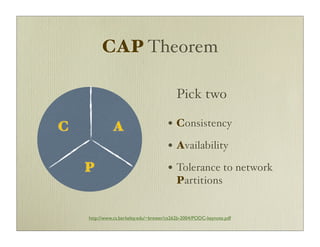
CAP Theorem

                                          Pick two

С             A                        • Consistency
                                       • Availability
    P                                  • Tolerance to network
                                          Partitions


    http://www.cs.berkeley.edu/~brewer/cs262b-2004/PODC-keynote.pdf
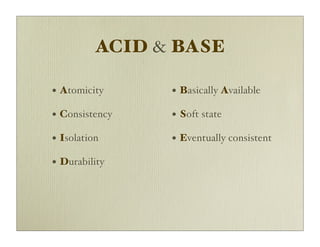
ACID & BASE

• Atomicity     • Basically Available
• Consistency   • Soft state
• Isolation     • Eventually consistent
• Durability
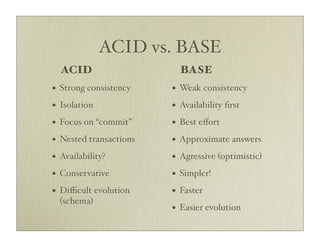
ACID vs. BASE
    ACID                      BASE
•   Strong consistency    •   Weak consistency

•   Isolation             •   Availability first

•   Focus on “commit”     •   Best effort

•   Nested transactions   •   Approximate answers

•   Availability?         •   Agressive (optimistic)

•   Conservative          •   Simpler!

•   Difficult evolution     •   Faster
    (schema)
                          •   Easier evolution
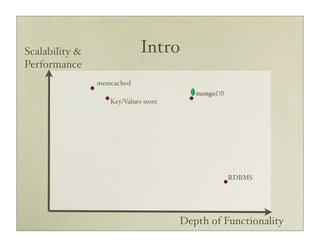
Scalability &                Intro
Performance
                memcached

                   Key/Values store


                                                RDBMS


                                      Depth of Functionality
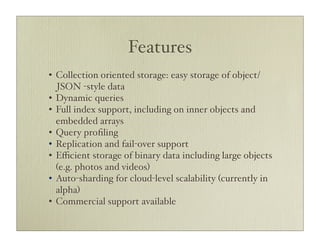
Features
• Collection oriented storage: easy storage of object/
  JSON -style data
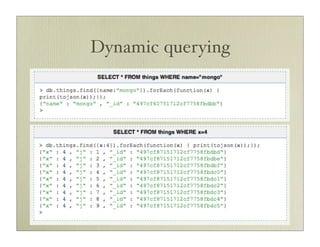
• Dynamic queries
• Full index support, including on inner objects and
  embedded arrays
• Query profiling
• Replication and fail-over support
• Efficient storage of binary data including large objects
  (e.g. photos and videos)
• Auto-sharding for cloud-level scalability (currently in
  alpha)
• Commercial support available
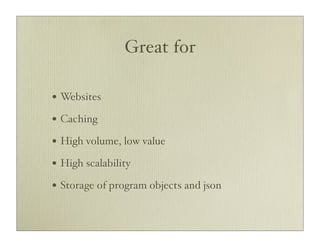
Great for

• Websites
• Caching
• High volume, low value
• High scalability
• Storage of program objects and json
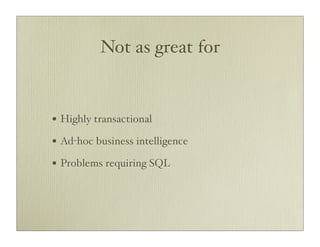
Not as great for


• Highly transactional
• Ad-hoc business intelligence
• Problems requiring SQL
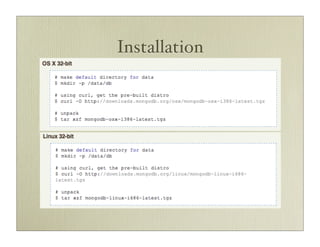
Installation
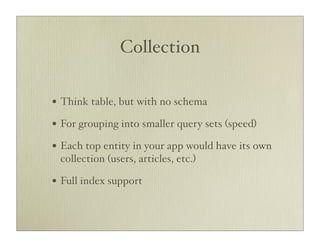
Collection

• Think table, but with no schema
• For grouping into smaller query sets (speed)
• Each top entity in your app would have its own
 collection (users, articles, etc.)

• Full index support
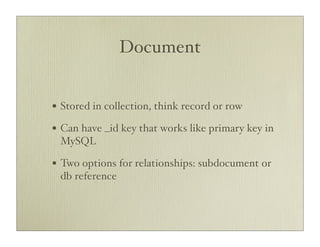
Document


• Stored in collection, think record or row
• Can have _id key that works like primary key in
 MySQL

• Two options for relationships: subdocument or
 db reference
Storage (BSON)

{ author: 'joe',
  created: Date('03-28-2009'),
  title: 'Yet another blog post',
  text: 'Here is the text...',
  tags: [ 'example', 'joe' ],
  comments: [ { author: 'jim', comment: 'I disagree' },
           { author: 'nancy', comment: 'Good post' }
  ]
}
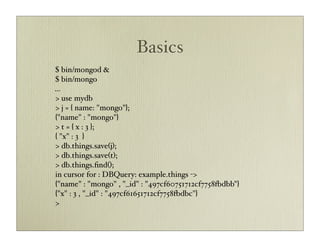
Basics
$ bin/mongod &
$ bin/mongo
...
> use mydb
> j = { name: "mongo"};
{"name" : "mongo"}
> t = { x : 3 };
{ "x" : 3 }
> db.things.save(j);
> db.things.save(t);
> db.things.find();
in cursor for : DBQuery: example.things ->
{"name" : "mongo" , "_id" : "497cf60751712cf7758+dbb"}
{"x" : 3 , "_id" : "497cf61651712cf7758+dbc"}
>
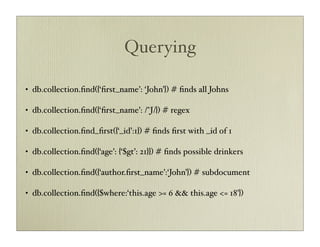
Querying

•   db.collection.find({‘first_name’: ‘John’}) # finds all Johns

•   db.collection.find({‘first_name’: /^J/}) # regex

•   db.collection.find_first({‘_id’:1}) # finds first with _id of 1

•   db.collection.find({‘age’: {‘$gt’: 21}}) # finds possible drinkers

•   db.collection.find({‘author.first_name’:‘John’}) # subdocument

•   db.collection.find({$where:‘this.age >= 6 && this.age <= 18’})
Querying 2

•   $in, $nin, $all, $ne, $gt, $gte, $lt, $lte, $size, $where

•   :fields (like :select in active record)

•   :limit, :offset for pagination

•   :sort ascending or descending [[‘foo’, 1], [‘bar’, -1]]

•   count and group (uses map/reduce)
Dynamic querying
Ruby support

• mongo-ruby-driver
  • Pure Ruby, with optional C extension
• MongoRecord
  • ORM like functionality
• Other mappers
Ruby basics
• Connect:
  • db = Mongo.new.db(‘my-database’)
  • coll = db.collection(‘players’)
• Insert:
  • coll.insert (“name” => “mike”, “age” => ...
• Query:
  • coll.find (“age” => 35)
Grid FS


• File storage in MongoDB

• IO-like API for Ruby
Other cool stuff


• Capped collections
• Upserts
• Multikeys
Resources
• http://spitfiresky.com/blog/recap-of-my-sdruby-
 presentation-on-mongodb.html

• http://railstips.org/2009/6/3/what-if-a-key-
 value-store-mated-with-a-relational-database-
 system

• http://www.mongodb.org/display/DOCS/
 Production+Deployments

• http://www.mongohq.com/home
Resources 2


• http://api.mongodb.org/ruby/0.15.1/index.html
• http://www.engineyard.com/blog/2009/
 mongodb-a-light-in-the-darkness-key-value-
 stores-part-5

• http://queue.acm.org/detail.cfm?id=1394128
thanks!

MongoDB

  • 1.
    nonSQL databases alexey gaziev
  • 2.
    RDBMS • Great formany apps • Shortcomings • Scalability • Flexibility
  • 3.
    Other DBMS • Flatfile • Hierarchical • Network • Document-oriented • Object-oriented
  • 4.
    CAP Theorem Pick two С A • Consistency • Availability P • Tolerance to network Partitions http://www.cs.berkeley.edu/~brewer/cs262b-2004/PODC-keynote.pdf
  • 5.
    ACID & BASE •Atomicity • Basically Available • Consistency • Soft state • Isolation • Eventually consistent • Durability
  • 6.
    ACID vs. BASE ACID BASE • Strong consistency • Weak consistency • Isolation • Availability first • Focus on “commit” • Best effort • Nested transactions • Approximate answers • Availability? • Agressive (optimistic) • Conservative • Simpler! • Difficult evolution • Faster (schema) • Easier evolution
  • 8.
    Scalability & Intro Performance memcached Key/Values store RDBMS Depth of Functionality
  • 9.
    Features • Collection orientedstorage: easy storage of object/ JSON -style data • Dynamic queries • Full index support, including on inner objects and embedded arrays • Query profiling • Replication and fail-over support • Efficient storage of binary data including large objects (e.g. photos and videos) • Auto-sharding for cloud-level scalability (currently in alpha) • Commercial support available
  • 10.
    Great for • Websites •Caching • High volume, low value • High scalability • Storage of program objects and json
  • 11.
    Not as greatfor • Highly transactional • Ad-hoc business intelligence • Problems requiring SQL
  • 12.
  • 13.
    Collection • Think table,but with no schema • For grouping into smaller query sets (speed) • Each top entity in your app would have its own collection (users, articles, etc.) • Full index support
  • 14.
    Document • Stored incollection, think record or row • Can have _id key that works like primary key in MySQL • Two options for relationships: subdocument or db reference
  • 15.
    Storage (BSON) { author:'joe', created: Date('03-28-2009'), title: 'Yet another blog post', text: 'Here is the text...', tags: [ 'example', 'joe' ], comments: [ { author: 'jim', comment: 'I disagree' }, { author: 'nancy', comment: 'Good post' } ] }
  • 16.
    Basics $ bin/mongod & $bin/mongo ... > use mydb > j = { name: "mongo"}; {"name" : "mongo"} > t = { x : 3 }; { "x" : 3 } > db.things.save(j); > db.things.save(t); > db.things.find(); in cursor for : DBQuery: example.things -> {"name" : "mongo" , "_id" : "497cf60751712cf7758+dbb"} {"x" : 3 , "_id" : "497cf61651712cf7758+dbc"} >
  • 17.
    Querying • db.collection.find({‘first_name’: ‘John’}) # finds all Johns • db.collection.find({‘first_name’: /^J/}) # regex • db.collection.find_first({‘_id’:1}) # finds first with _id of 1 • db.collection.find({‘age’: {‘$gt’: 21}}) # finds possible drinkers • db.collection.find({‘author.first_name’:‘John’}) # subdocument • db.collection.find({$where:‘this.age >= 6 && this.age <= 18’})
  • 18.
    Querying 2 • $in, $nin, $all, $ne, $gt, $gte, $lt, $lte, $size, $where • :fields (like :select in active record) • :limit, :offset for pagination • :sort ascending or descending [[‘foo’, 1], [‘bar’, -1]] • count and group (uses map/reduce)
  • 19.
  • 20.
    Ruby support • mongo-ruby-driver • Pure Ruby, with optional C extension • MongoRecord • ORM like functionality • Other mappers
  • 21.
    Ruby basics • Connect: • db = Mongo.new.db(‘my-database’) • coll = db.collection(‘players’) • Insert: • coll.insert (“name” => “mike”, “age” => ... • Query: • coll.find (“age” => 35)
  • 22.
    Grid FS • Filestorage in MongoDB • IO-like API for Ruby
  • 23.
    Other cool stuff •Capped collections • Upserts • Multikeys
  • 24.
    Resources • http://spitfiresky.com/blog/recap-of-my-sdruby- presentation-on-mongodb.html •http://railstips.org/2009/6/3/what-if-a-key- value-store-mated-with-a-relational-database- system • http://www.mongodb.org/display/DOCS/ Production+Deployments • http://www.mongohq.com/home
  • 25.
    Resources 2 • http://api.mongodb.org/ruby/0.15.1/index.html •http://www.engineyard.com/blog/2009/ mongodb-a-light-in-the-darkness-key-value- stores-part-5 • http://queue.acm.org/detail.cfm?id=1394128
  • 26.