МОДЕЛЬ ПРОГРАММЫ В ВИДЕ
       МНОГОПОТОЧНОГО
 СТОХАСТИЧЕСКОГО АВТОМАТА И ЕЕ
        ЭКВИВАЛЕНТНОЕ
  ПРЕОБРАЗОВАНИЕ В МОДЕЛЬ НА
        ЯЗЫКЕ PROMELA

  MODEL OF A PROGRAM AS MULTI-
 THREADED STOCHASTIC AUTOMATON
       AND ITS EQUIVALENT
TRANSFORMATION TO PROMELA MODEL
     International Workshop on Program Understanding


                           Staroletov Sergey, Altai STU
Model based developing and testing

                       Model based developing – is a
                       modern technology to developing software
                       which are firstly focuses on the model
                       developing, not on algorithmic and computation
                       concepts


Model based testing – technology of
software testing bases on
comparation the model and system
under test during the work, generation
test cases by the model,and changing
the system to the model for studying its
properties.
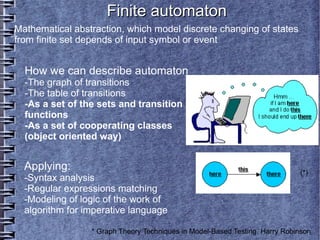
Finite automaton
Mathematical abstraction, which model discrete changing of states
from finite set depends of input symbol or event


  How we can describe automaton
  -The graph of transitions
  -The table of transitions
  -As a set of the sets and transition
  functions
  -As a set of cooperating classes
  (object oriented way)


  Applying:                                                                  (*)
  -Syntax analysis
  -Regular expressions matching
  -Modeling of logic of the work of
  algorithm for imperative language

                 * Graph Theory Techniques in Model-Based Testing. Harry Robinson
Windows Workflow foundation
Projecting the program on the basis of assigning states
Object oriented realization of finite automaton
“Switch-technology”
“Automaton programming”

 Example of control program
 terminal for payments
 (course work)
Extending of finite automaton
                 Why to extend finite automaton?

     Model is bigger and complex=> describe the system more adequate
     => we can study more properties of a model
●   Kripke structure
Extend of automaton by adding the set of atomic predicates
Which are true in states
Applying: backend в ModelChecking
●   Probability automaton
Extend of automaton with adding transitions with probabilities
Applying: modeling of users's work
Extended automaton with support of events, messaging, threading and
●

blocking common resourses.
Author's extend for modeling component of modern interoperable system
for low level of abstraction
Author's model features
- Following to principles MDD and MBT
- Extended finite automaton as a model of
component of system, our extends includes
multi-threading, sending and receiving the
messages,blocking and unblocking common
resourses
- The system is set of automatons, each of them
modeling component of the system
- Possibility to object-oriented realization of
automaton to projecting program firstly based of
The states
- Designed for testing.
Предлагаемая модель в виде
состояний, переходов и операций

                    A=( S ,Trans ,Op ) ,
where
S - the set of states, allocated by developer;
Trans=S  S× E * - mapping, it defines the transition
with possibility of events generation;
 E - set of events, is defined by state to which
transition are performed, and its probability of
occurrence;
                                                       *
Op={ fork , join , send , receive , block , unblock }×E - set
of operations in extended automaton discussed below
with possible related events.
Operations
                        We staying in the state. We can
                        (with some probability)


  Make transition to another state

                                Or apply the operation

Create the thread : P×S  S×T 
                fork                  


    Wait the thread join : P× S×T ×S ×T   S ×T
                                             parent   fin   slave
                                                                    
                                                                        parent


              Send the message                  send : S×T ×P S × Msg∨E

                     Wait for a message receive : S×T ×P× Msg  S∨ E
  Block the common resourse               block : S ×T × N ×P× Res S ×1×Res ∨ E

             Unblock the common unblock : S×1× Res×P  S ×N ×Res ∨ E
                                           resource
Object-oriented model on Java
Why we need that model?
Describe states, operations and transitions as classes.
Model = interoperation of objects with given attributes

The interoperational logic already been realized in classes,
The business logic implements as call of user code
in states, transitions and operations and interfaces for this have been
descibed.
                                   Features;
                                   - States with user's code
                                   - Transitions with probabilities),by guard or as
                                   written in user code
                                   - Applying operations in states
                                   - Self system to sending-receiving messages
                                   And resource blocking
                                   - Mapping model threads to Java threads
                                   -Support of distributive work with network
                                   through XML-RPC
Object-oriented model on Java
public static void main(String[] args) {
         //Создать список компонентов
         List<Component> components=new LinkedList<Component>() ;
         //Создать состояния, зададим их параметры позже
         State state1=new State(),state2=new State(),state3=new State(),state4=new State(),state5=new State() ;
         //Создать компонент
         Component component1=new Component() ;
         //Создать переход в состояние state2, без событий с вероятностью 1.0
         Transition transition12=new Transition(state2, null, 1.0, "transition 1->2");
         //Задать параметры состояния: главный поток компонента, название-state1
         //нет подавтомата, начальное состояние=true, конечное состояние=false
         //переходы из состояния- transition12, операций из состояния нет.
         state1.setParams(component1.getMainThread(),"state1", null, true, false, new Transition[] { transition12}, null) ;
//Задать код, выполняющийся в состоянии state1
     state1.setCode(new IStateCodeExecutor() {
                 @Override
                 public void execute(Component currentComponent,
                                Thread currentThread, State currentState) {
                 System.out.println("Зашли в состояние "+currentState.getName()) ;
                 }
                 },
                 new IStateCodeExecutor() {
                 public void execute(Component currentComponent,
                                Thread currentThread, State currentState) {
                 System.out.println("Выходим из состояния "+currentState.getName()) ;
                 }}) ;
//в state2: fork и создание потока с первоначальным состоянием state3, и
//продолжением главного потока в state5
         //Создать подавтомат для потока с первоначальным состоянием state3
         //и заключительным в state4
         SubAutomaton subAutomatonThread2=new SubAutomaton("thread_subautomaton", state3, new State[]{state4},null) ;
         //создать описание потока thread2, с подавтоматом subAutomatonThread2
         //и предком в виде главного потока компонента
         dissertation.Thread thread2=new dissertation.Thread("thread2", subAutomatonThread2,component1.getMainThread()) ;
         //создать операцию Fork (создание потоков) для потока thread2 c переходом //основного потока в состояние state5
после создания без событий с           //вероятностью 1.0
         Fork operationForkState2=new Fork(new dissertation.Thread[] {thread2}, null,1.0,state5) ;
         //установить параметры для state2- передать туда операцию создания потока
         state2.setParams(component1.getMainThread(),"state2", null, false, false, null, new Operations[] {operationForkState2}) ;
                 ...
         //Установить состояния для компонента
XML description of a model
We can describe model as XML tags

By XML description from attribute or graphical editor we cancreate
graphic notation and generate object oriented automaton
code on Java
Abstract state machines
                                      ASM defines by alphabet  (consists of name of functions), initial state (initial
                               value of a function), transition rules and initial rule.
                               Transition rules defined as:
                                  1.   f  s 1 ... s n :=t - in the next state the value of function        f on the set of arguments
                                        s 1 ... s n is assigned to t .
                                  2. P seq Q - rule       P is running after rule Q .
                                  3. P par Q - rules        P and Q is running in parallel.
                                  4. if  then P else Q - if =true , proceed to run P , else proceed to run Q .
                                  5. let x =t in P - assign the t value to local variable x                  and proceed to run   P
                                     (area of existence x after running P is ended).
                                  6. forall x with  do P - proceed to run P in parallel for all x , satisfies  (area of
                                     existence x after running P is ended).
                                  7. choose x with fi do P - choose x satisfies  non-determinately and proceed to
                                     run P .
                                  8. skip - empty rule.
                                  9.   r t 1 ... t n  - call of the rule r with parameters t 1 ... t n .

  Theorem: Every parallel algorithm is behaviorally equivalent to
  an ASM *
  With using ASM theory we can prove that our object-oriented
  automaton Java model can model a wide set of algorithms
  included parallel and distributive algorithms with finite number
  of processes.
  Proof: By developing interpreter for ASM machine
*Blass,A. Abstract State Machines Capture Parallel Algorithms: Correction and Extension / Andreas Blass, University of Michigan,
Yuri Gurevich, Microsoft Research- http://www.math.lsa.umich.edu/~ablass/corr-final.pdf
Model checking approach
               applying to our model
Model checking is a static verifying method to check model behavior.

Popular, powerful and highly documented tool that's providing
model checking approach is SPIN.

SPIN uses special functional language called 'Promela*' as an input
model language.


  * Concise Promela Reference/ Rob Gerth, 1997. http://spinroot.com/spin/Man/Quick.html
Model checking approach
           applying to our model
SPIN modes:

- Random model activity simulation
Resolve non-determinism as given seed value
- Interactive simulation
Ask user for the choice for non-determinism
- Guided simulation
Re-simulate previous stored simulation or contra-primer
by LTL check
- LTL(Linear time temporal logic) predicate check
Temporal logic is logic with time, is used to
ask model to check that's value of predicate with desired
variables is true in all states(“globally”) or some predicate
is true at least in one state than another predicate is true.
Check result: proof that's all ok or return trace with
                               :
contra-primer
Model checking approach
            applying to our model
Research result: for our automaton stochastic model
exists equivalent Promela model

Testing process:

                                                Testing environment
  XML model                        Temporal logic predicate   Verification results
                   Promela model
Object oriented                                      Spin verifier
    model


Now we go dip into building Promela model from our model
with states, transitions and operations.
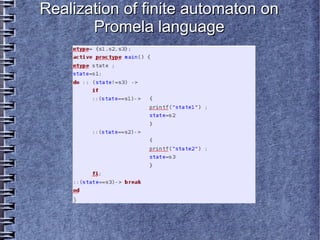
Realization of finite automaton on
       Promela language
Non-deterministic transitions


Improving adequacy: if we have transition with
probability we can generate that count of the same
lines with state changing to make correct probability of
transition by the probability definition
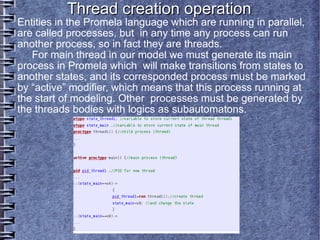
Thread creation operation
Entities in the Promela language which are running in parallel,
are called processes, but in any time any process can run
another process, so in fact they are threads.
   For main thread in our model we must generate its main
process in Promela which will make transitions from states to
another states, and its corresponded process must be marked
by “active” modifier, which means that this process running at
the start of modeling. Other processes must be generated by
the threads bodies with logics as subautomatons.
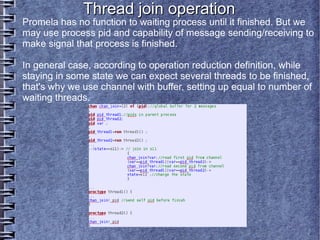
Thread join operation
Promela has no function to waiting process until it finished. But we
may use process pid and capability of message sending/receiving to
make signal that process is finished.

In general case, according to operation reduction definition, while
staying in some state we can expect several threads to be finished,
that's why we use channel with buffer, setting up equal to number of
waiting threads.
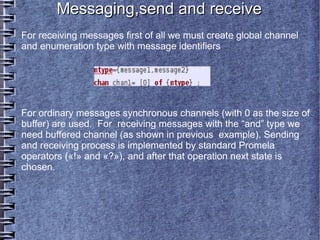
Messaging,send and receive
For receiving messages first of all we must create global channel
and enumeration type with message identifiers


For ordinary messages synchronous channels (with 0 as the size of
buffer) are used. For receiving messages with the “and” type we
need buffered channel (as shown in previous example). Sending
and receiving process is implemented by standard Promela
operators («!» and «?»), and after that operation next state is
chosen.
Blocking and unblocking resource
Assume global variable as shared resource. Due to Plomela language this
expression
(r==0)
at r≠0 stopped current process until r will not be 0 as a result of another
process that changed this value. BlockResource and UnblockResource are
based on that expression.
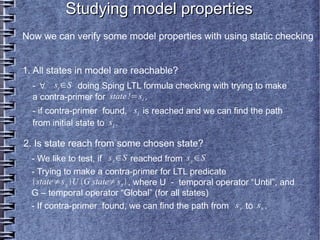
Studying model properties
Now we can verify some model properties with using static checking


1. All states in model are reachable?
  - ∀ si ∈S doing Sping LTL formula checking with trying to make
  a contra-primer for state !=si .
  - if contra-primer found, si is reached and we can find the path
  from initial state to si .

2. Is state reach from some chosen state?
  - We like to test, if s x ∈S reached from s y ∈S
  - Trying to make a contra-primer for LTL predicate
  state≠s y U G state≠s x  , where U - temporal operator “Until”, аnd
  G – temporal operator “Global” (for all states)
  - If contra-primer found, we can find the path from s y to s x .
Studying model properties


Connectivity point – user's made set of linked sets of states
from one automaton/subautomaton/thread body to another
set of states. cp∈CP : { s A1 , s A2 ,... s An } ↔{ s B1 , s B2 ,... s Bm } .
Checking of connectivity points is verifying LTL predicate
G (( state A == s A1 || state A == s A2 ||...|| state A == s An ) ->
( state B == s B1 || state B == s B2 ||...|| state B == s Bm )).
Testing artifacts
Message chart digram   Stack of transitions, operations and errors


                                    Computed probabilities
МОДЕЛЬ ПРОГРАММЫ В ВИДЕ
       МНОГОПОТОЧНОГО
 СТОХАСТИЧЕСКОГО АВТОМАТА И ЕЕ
        ЭКВИВАЛЕНТНОЕ
  ПРЕОБРАЗОВАНИЕ В МОДЕЛЬ НА
        ЯЗЫКЕ PROMELA

          Q/A session
  MODEL OF A PROGRAM AS MULTI-
 THREADED STOCHASTIC AUTOMATON
       AND ITS EQUIVALENT
TRANSFORMATION TO PROMELA MODEL
     International Workshop on Program Understanding
                           Staroletov Sergey, Altai STU

MODEL OF A PROGRAM AS MULTITHREADED STOCHASTIC AUTOMATON AND ITS EQUIVALENT TRANSFORMATION TO PROMELA MODEL

  • 1.
    МОДЕЛЬ ПРОГРАММЫ ВВИДЕ МНОГОПОТОЧНОГО СТОХАСТИЧЕСКОГО АВТОМАТА И ЕЕ ЭКВИВАЛЕНТНОЕ ПРЕОБРАЗОВАНИЕ В МОДЕЛЬ НА ЯЗЫКЕ PROMELA MODEL OF A PROGRAM AS MULTI- THREADED STOCHASTIC AUTOMATON AND ITS EQUIVALENT TRANSFORMATION TO PROMELA MODEL International Workshop on Program Understanding Staroletov Sergey, Altai STU
  • 2.
    Model based developingand testing Model based developing – is a modern technology to developing software which are firstly focuses on the model developing, not on algorithmic and computation concepts Model based testing – technology of software testing bases on comparation the model and system under test during the work, generation test cases by the model,and changing the system to the model for studying its properties.
  • 3.
    Finite automaton Mathematical abstraction,which model discrete changing of states from finite set depends of input symbol or event How we can describe automaton -The graph of transitions -The table of transitions -As a set of the sets and transition functions -As a set of cooperating classes (object oriented way) Applying: (*) -Syntax analysis -Regular expressions matching -Modeling of logic of the work of algorithm for imperative language * Graph Theory Techniques in Model-Based Testing. Harry Robinson
  • 4.
    Windows Workflow foundation Projectingthe program on the basis of assigning states Object oriented realization of finite automaton “Switch-technology” “Automaton programming” Example of control program terminal for payments (course work)
  • 5.
    Extending of finiteautomaton Why to extend finite automaton? Model is bigger and complex=> describe the system more adequate => we can study more properties of a model ● Kripke structure Extend of automaton by adding the set of atomic predicates Which are true in states Applying: backend в ModelChecking ● Probability automaton Extend of automaton with adding transitions with probabilities Applying: modeling of users's work Extended automaton with support of events, messaging, threading and ● blocking common resourses. Author's extend for modeling component of modern interoperable system for low level of abstraction
  • 6.
    Author's model features -Following to principles MDD and MBT - Extended finite automaton as a model of component of system, our extends includes multi-threading, sending and receiving the messages,blocking and unblocking common resourses - The system is set of automatons, each of them modeling component of the system - Possibility to object-oriented realization of automaton to projecting program firstly based of The states - Designed for testing.
  • 7.
    Предлагаемая модель ввиде состояний, переходов и операций A=( S ,Trans ,Op ) , where S - the set of states, allocated by developer; Trans=S  S× E * - mapping, it defines the transition with possibility of events generation; E - set of events, is defined by state to which transition are performed, and its probability of occurrence; * Op={ fork , join , send , receive , block , unblock }×E - set of operations in extended automaton discussed below with possible related events.
  • 8.
    Operations We staying in the state. We can (with some probability) Make transition to another state Or apply the operation Create the thread : P×S  S×T  fork  Wait the thread join : P× S×T ×S ×T   S ×T parent fin slave  parent Send the message send : S×T ×P S × Msg∨E Wait for a message receive : S×T ×P× Msg  S∨ E Block the common resourse block : S ×T × N ×P× Res S ×1×Res ∨ E Unblock the common unblock : S×1× Res×P  S ×N ×Res ∨ E resource
  • 9.
    Object-oriented model onJava Why we need that model? Describe states, operations and transitions as classes. Model = interoperation of objects with given attributes The interoperational logic already been realized in classes, The business logic implements as call of user code in states, transitions and operations and interfaces for this have been descibed. Features; - States with user's code - Transitions with probabilities),by guard or as written in user code - Applying operations in states - Self system to sending-receiving messages And resource blocking - Mapping model threads to Java threads -Support of distributive work with network through XML-RPC
  • 10.
    Object-oriented model onJava public static void main(String[] args) { //Создать список компонентов List<Component> components=new LinkedList<Component>() ; //Создать состояния, зададим их параметры позже State state1=new State(),state2=new State(),state3=new State(),state4=new State(),state5=new State() ; //Создать компонент Component component1=new Component() ; //Создать переход в состояние state2, без событий с вероятностью 1.0 Transition transition12=new Transition(state2, null, 1.0, "transition 1->2"); //Задать параметры состояния: главный поток компонента, название-state1 //нет подавтомата, начальное состояние=true, конечное состояние=false //переходы из состояния- transition12, операций из состояния нет. state1.setParams(component1.getMainThread(),"state1", null, true, false, new Transition[] { transition12}, null) ; //Задать код, выполняющийся в состоянии state1 state1.setCode(new IStateCodeExecutor() { @Override public void execute(Component currentComponent, Thread currentThread, State currentState) { System.out.println("Зашли в состояние "+currentState.getName()) ; } }, new IStateCodeExecutor() { public void execute(Component currentComponent, Thread currentThread, State currentState) { System.out.println("Выходим из состояния "+currentState.getName()) ; }}) ; //в state2: fork и создание потока с первоначальным состоянием state3, и //продолжением главного потока в state5 //Создать подавтомат для потока с первоначальным состоянием state3 //и заключительным в state4 SubAutomaton subAutomatonThread2=new SubAutomaton("thread_subautomaton", state3, new State[]{state4},null) ; //создать описание потока thread2, с подавтоматом subAutomatonThread2 //и предком в виде главного потока компонента dissertation.Thread thread2=new dissertation.Thread("thread2", subAutomatonThread2,component1.getMainThread()) ; //создать операцию Fork (создание потоков) для потока thread2 c переходом //основного потока в состояние state5 после создания без событий с //вероятностью 1.0 Fork operationForkState2=new Fork(new dissertation.Thread[] {thread2}, null,1.0,state5) ; //установить параметры для state2- передать туда операцию создания потока state2.setParams(component1.getMainThread(),"state2", null, false, false, null, new Operations[] {operationForkState2}) ; ... //Установить состояния для компонента
  • 11.
    XML description ofa model We can describe model as XML tags By XML description from attribute or graphical editor we cancreate graphic notation and generate object oriented automaton code on Java
  • 12.
    Abstract state machines ASM defines by alphabet  (consists of name of functions), initial state (initial value of a function), transition rules and initial rule. Transition rules defined as: 1. f  s 1 ... s n :=t - in the next state the value of function f on the set of arguments s 1 ... s n is assigned to t . 2. P seq Q - rule P is running after rule Q . 3. P par Q - rules P and Q is running in parallel. 4. if  then P else Q - if =true , proceed to run P , else proceed to run Q . 5. let x =t in P - assign the t value to local variable x and proceed to run P (area of existence x after running P is ended). 6. forall x with  do P - proceed to run P in parallel for all x , satisfies  (area of existence x after running P is ended). 7. choose x with fi do P - choose x satisfies  non-determinately and proceed to run P . 8. skip - empty rule. 9. r t 1 ... t n  - call of the rule r with parameters t 1 ... t n . Theorem: Every parallel algorithm is behaviorally equivalent to an ASM * With using ASM theory we can prove that our object-oriented automaton Java model can model a wide set of algorithms included parallel and distributive algorithms with finite number of processes. Proof: By developing interpreter for ASM machine *Blass,A. Abstract State Machines Capture Parallel Algorithms: Correction and Extension / Andreas Blass, University of Michigan, Yuri Gurevich, Microsoft Research- http://www.math.lsa.umich.edu/~ablass/corr-final.pdf
  • 13.
    Model checking approach applying to our model Model checking is a static verifying method to check model behavior. Popular, powerful and highly documented tool that's providing model checking approach is SPIN. SPIN uses special functional language called 'Promela*' as an input model language. * Concise Promela Reference/ Rob Gerth, 1997. http://spinroot.com/spin/Man/Quick.html
  • 14.
    Model checking approach applying to our model SPIN modes: - Random model activity simulation Resolve non-determinism as given seed value - Interactive simulation Ask user for the choice for non-determinism - Guided simulation Re-simulate previous stored simulation or contra-primer by LTL check - LTL(Linear time temporal logic) predicate check Temporal logic is logic with time, is used to ask model to check that's value of predicate with desired variables is true in all states(“globally”) or some predicate is true at least in one state than another predicate is true. Check result: proof that's all ok or return trace with : contra-primer
  • 15.
    Model checking approach applying to our model Research result: for our automaton stochastic model exists equivalent Promela model Testing process: Testing environment XML model Temporal logic predicate Verification results Promela model Object oriented Spin verifier model Now we go dip into building Promela model from our model with states, transitions and operations.
  • 16.
    Realization of finiteautomaton on Promela language
  • 17.
    Non-deterministic transitions Improving adequacy:if we have transition with probability we can generate that count of the same lines with state changing to make correct probability of transition by the probability definition
  • 18.
    Thread creation operation Entitiesin the Promela language which are running in parallel, are called processes, but in any time any process can run another process, so in fact they are threads. For main thread in our model we must generate its main process in Promela which will make transitions from states to another states, and its corresponded process must be marked by “active” modifier, which means that this process running at the start of modeling. Other processes must be generated by the threads bodies with logics as subautomatons.
  • 19.
    Thread join operation Promelahas no function to waiting process until it finished. But we may use process pid and capability of message sending/receiving to make signal that process is finished. In general case, according to operation reduction definition, while staying in some state we can expect several threads to be finished, that's why we use channel with buffer, setting up equal to number of waiting threads.
  • 20.
    Messaging,send and receive Forreceiving messages first of all we must create global channel and enumeration type with message identifiers For ordinary messages synchronous channels (with 0 as the size of buffer) are used. For receiving messages with the “and” type we need buffered channel (as shown in previous example). Sending and receiving process is implemented by standard Promela operators («!» and «?»), and after that operation next state is chosen.
  • 21.
    Blocking and unblockingresource Assume global variable as shared resource. Due to Plomela language this expression (r==0) at r≠0 stopped current process until r will not be 0 as a result of another process that changed this value. BlockResource and UnblockResource are based on that expression.
  • 22.
    Studying model properties Nowwe can verify some model properties with using static checking 1. All states in model are reachable? - ∀ si ∈S doing Sping LTL formula checking with trying to make a contra-primer for state !=si . - if contra-primer found, si is reached and we can find the path from initial state to si . 2. Is state reach from some chosen state? - We like to test, if s x ∈S reached from s y ∈S - Trying to make a contra-primer for LTL predicate state≠s y U G state≠s x  , where U - temporal operator “Until”, аnd G – temporal operator “Global” (for all states) - If contra-primer found, we can find the path from s y to s x .
  • 23.
    Studying model properties Connectivitypoint – user's made set of linked sets of states from one automaton/subautomaton/thread body to another set of states. cp∈CP : { s A1 , s A2 ,... s An } ↔{ s B1 , s B2 ,... s Bm } . Checking of connectivity points is verifying LTL predicate G (( state A == s A1 || state A == s A2 ||...|| state A == s An ) -> ( state B == s B1 || state B == s B2 ||...|| state B == s Bm )).
  • 24.
    Testing artifacts Message chartdigram Stack of transitions, operations and errors Computed probabilities
  • 25.
    МОДЕЛЬ ПРОГРАММЫ ВВИДЕ МНОГОПОТОЧНОГО СТОХАСТИЧЕСКОГО АВТОМАТА И ЕЕ ЭКВИВАЛЕНТНОЕ ПРЕОБРАЗОВАНИЕ В МОДЕЛЬ НА ЯЗЫКЕ PROMELA Q/A session MODEL OF A PROGRAM AS MULTI- THREADED STOCHASTIC AUTOMATON AND ITS EQUIVALENT TRANSFORMATION TO PROMELA MODEL International Workshop on Program Understanding Staroletov Sergey, Altai STU