Development of a Global
Vulnerability Database
Vitor Silva, Seismic Risk Coordinator
On behalf of the risk team
April 2017 – Pavia, Italy
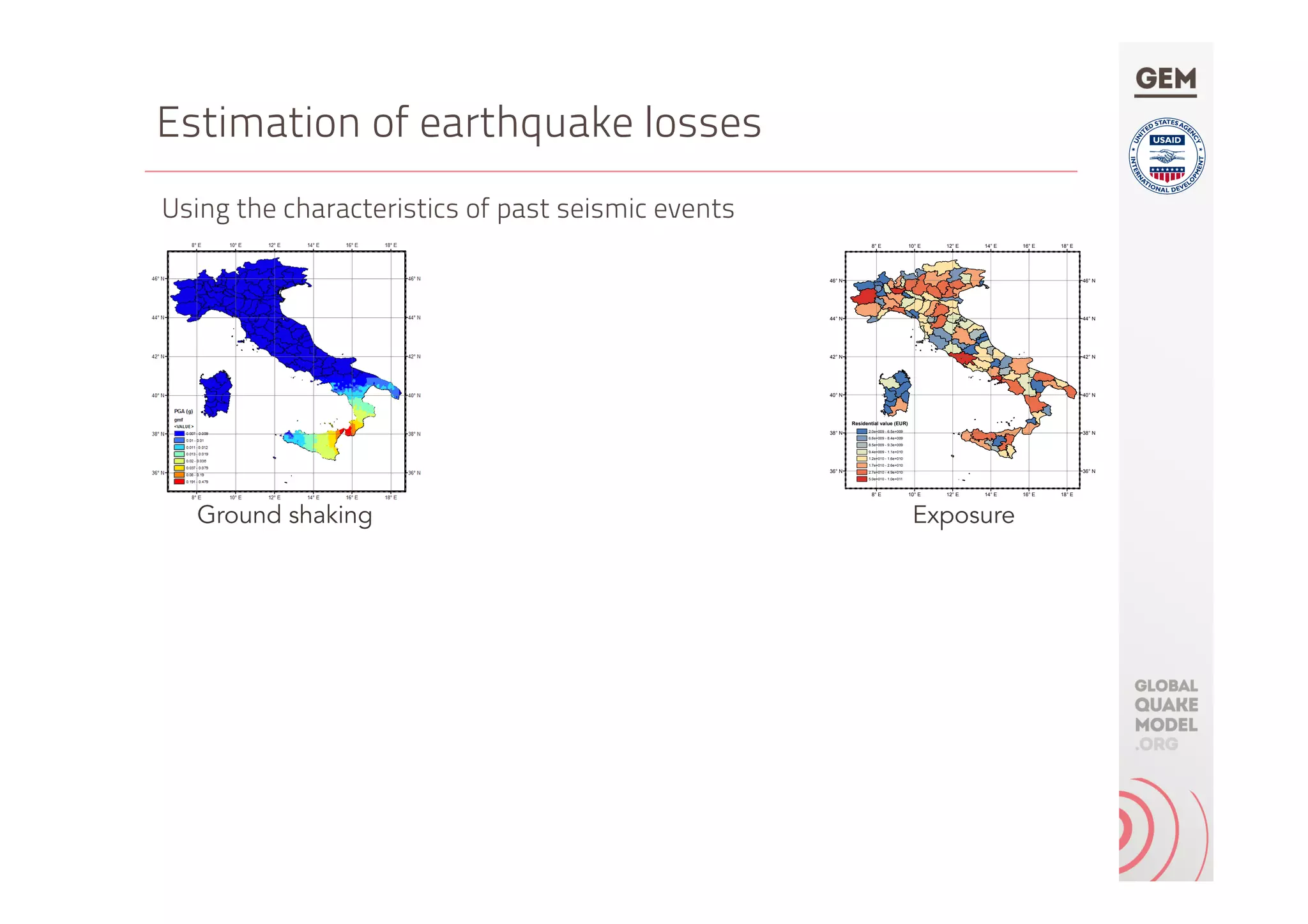
Estimation of earthquake losses
Using the characteristics of past seismic events
18° E
18° E
16° E
16° E
14° E
14° E
12° E
12° E
10° E
10° E
8° E
8° E
46° N 46° N
44° N 44° N
42° N 42° N
40° N 40° N
38° N 38° N
36° N 36° N
Residential value (EUR)
2.0e+009 - 6.5e+009
6.6e+009 - 8.4e+009
8.5e+009 - 9.3e+009
9.4e+009 - 1.1e+010
1.2e+010 - 1.6e+010
1.7e+010 - 2.6e+010
2.7e+010 - 4.9e+010
5.0e+010 - 1.0e+011
Ground shaking Exposure
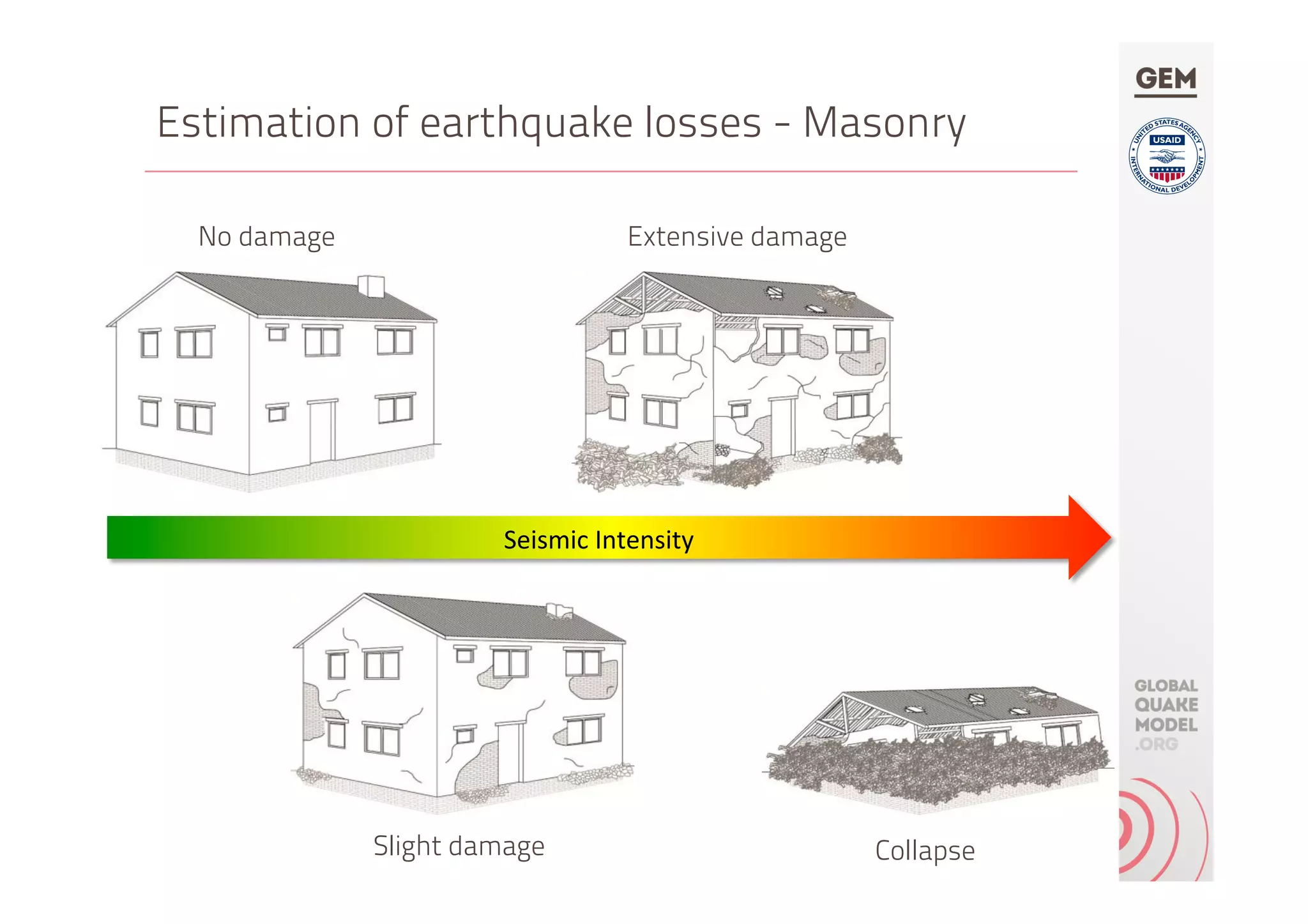
Estimation of earthquake losses - Masonry
No damage
Seismic	Intensity	
Extensive damage
Slight damage Collapse
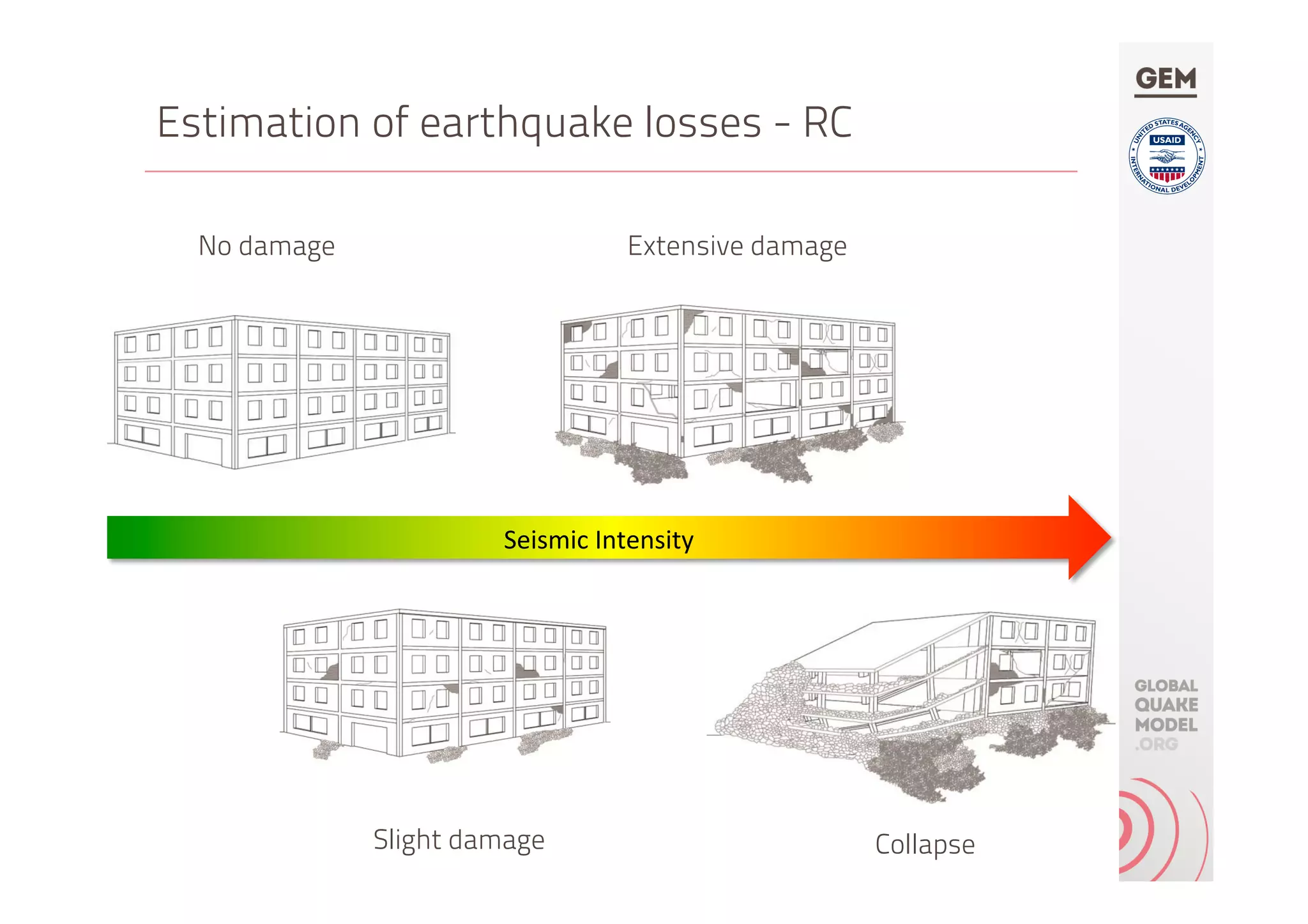
Estimation of earthquake losses - RC
No damage
Seismic	Intensity	
Extensive damage
Slight damage Collapse
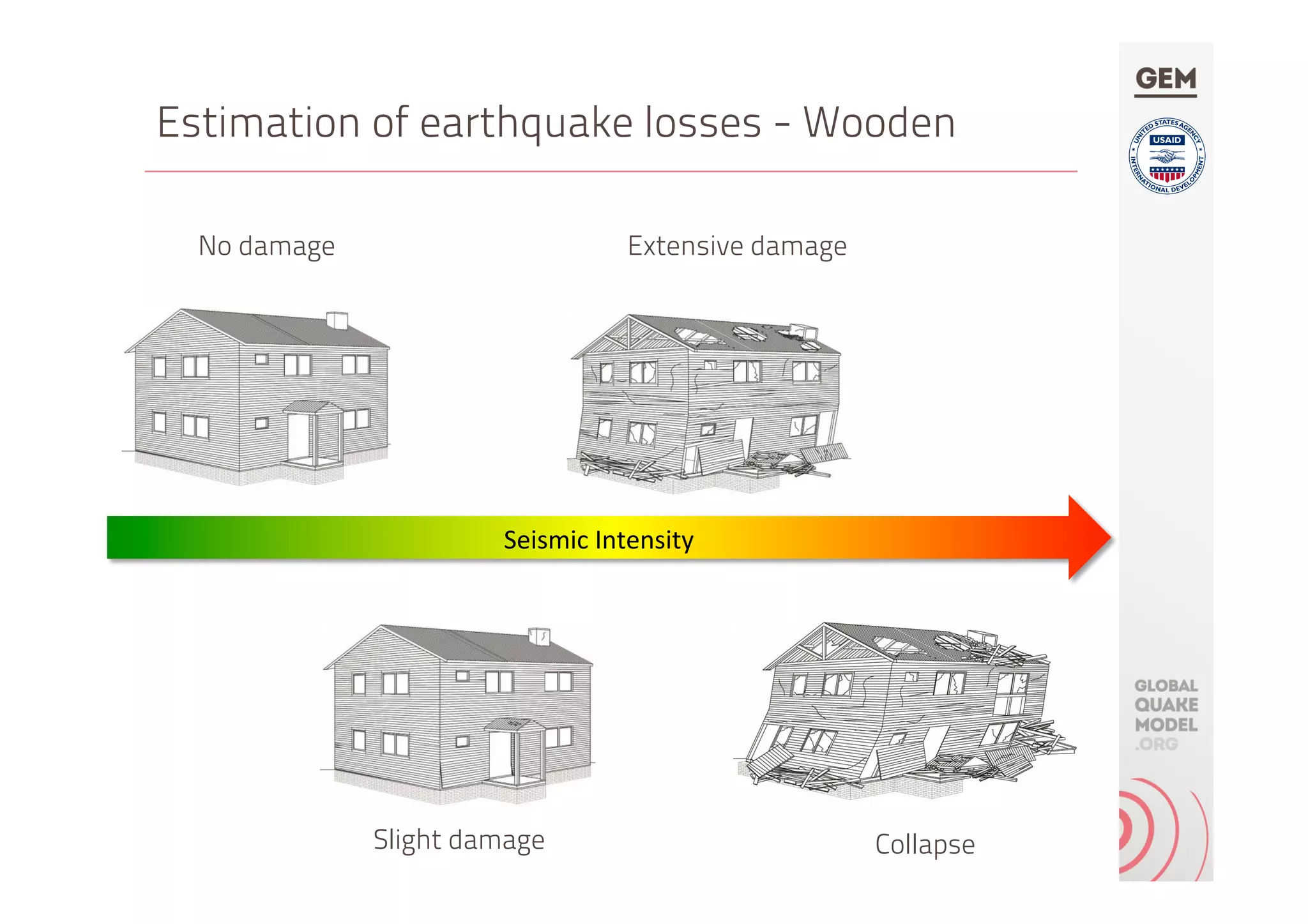
Estimation of earthquake losses - Wooden
No damage
Seismic	Intensity	
Extensive damage
Slight damage Collapse
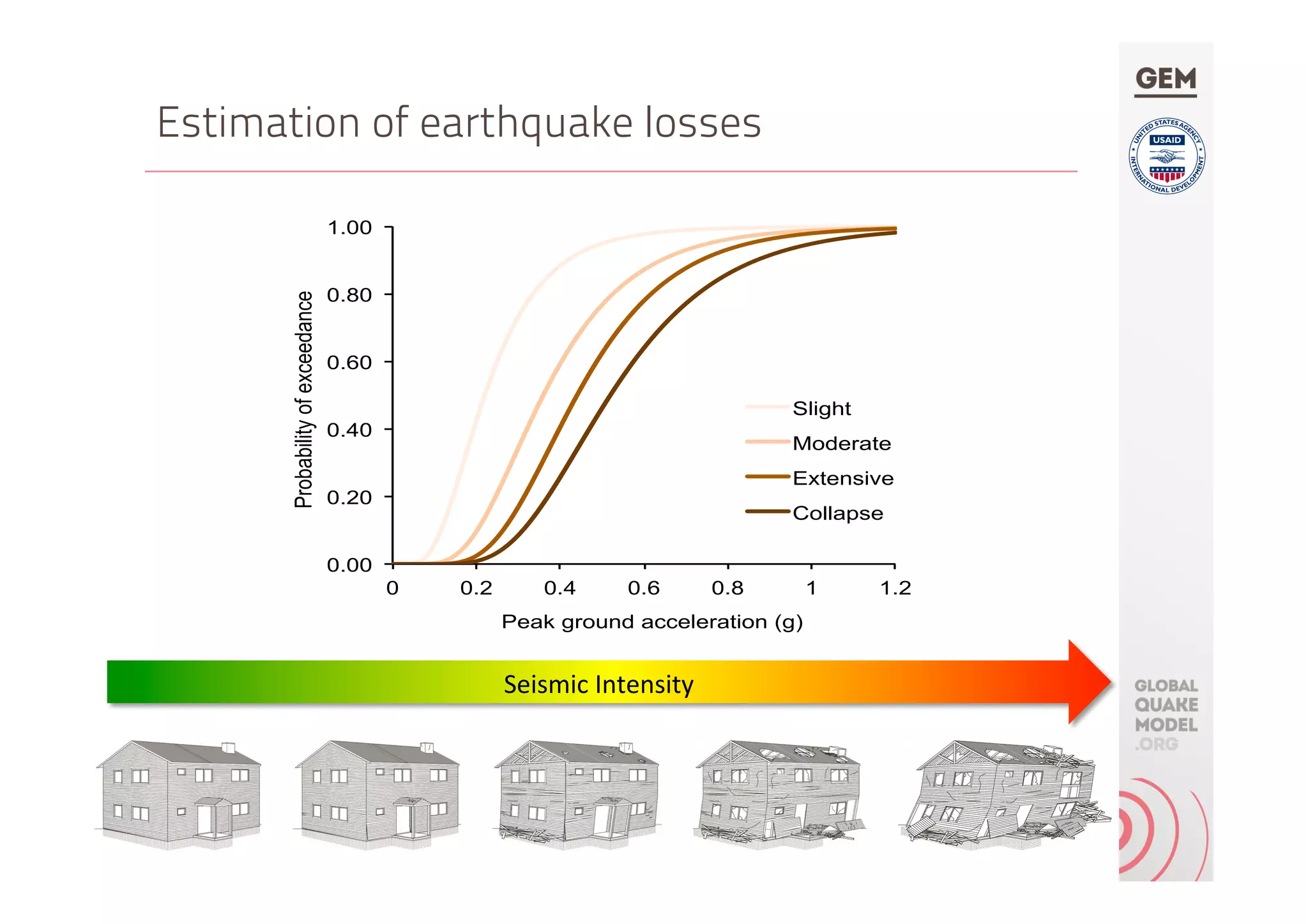
Estimation of earthquake losses
Seismic	Intensity	
0.00
0.20
0.40
0.60
0.80
1.00
0 0.2 0.4 0.6 0.8 1 1.2
Probabilityofexceedance
Peak ground acceleration (g)
Slight
Moderate
Extensive
Collapse
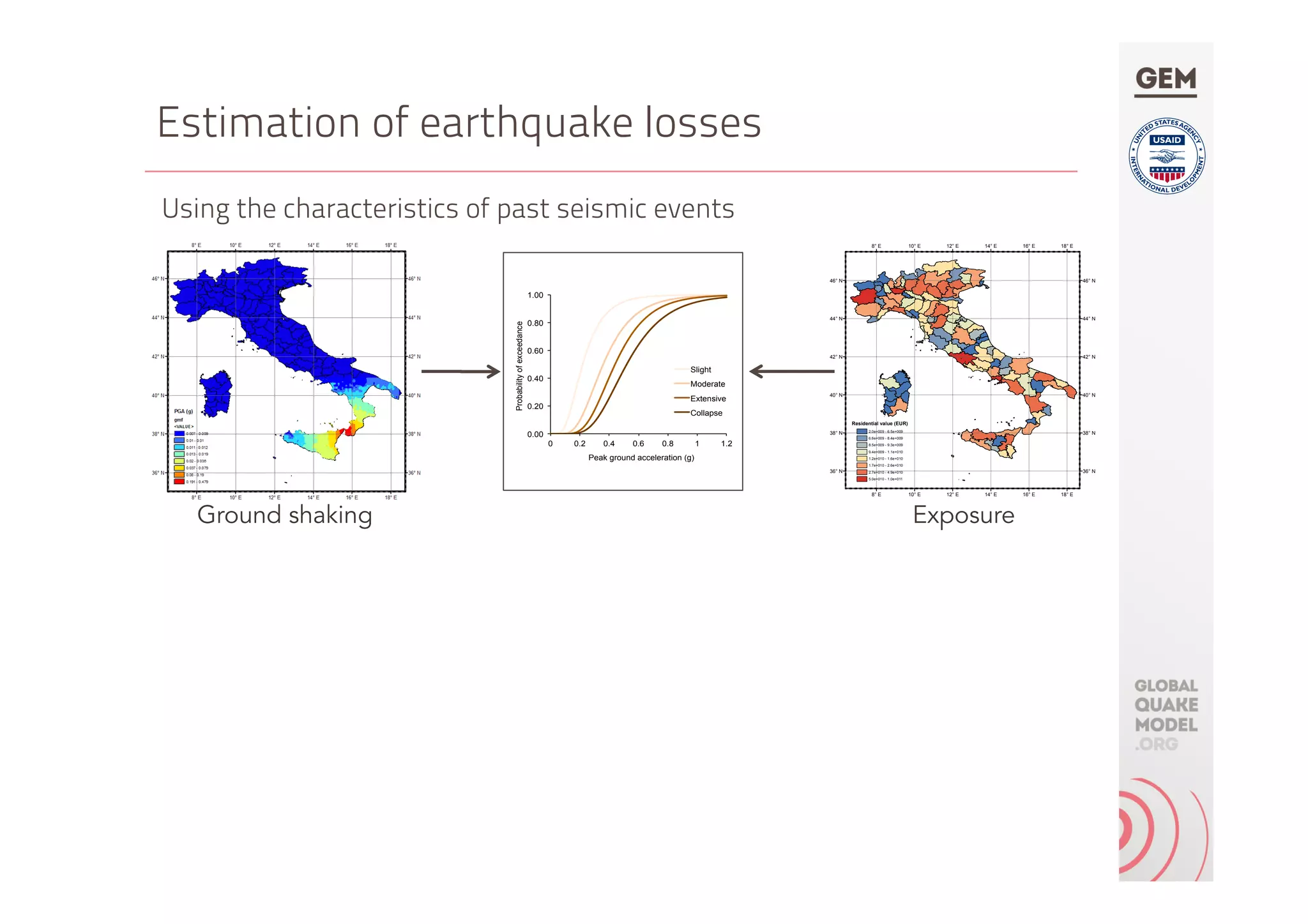
Estimation of earthquake losses
Using the characteristics of past seismic events
18° E
18° E
16° E
16° E
14° E
14° E
12° E
12° E
10° E
10° E
8° E
8° E
46° N 46° N
44° N 44° N
42° N 42° N
40° N 40° N
38° N 38° N
36° N 36° N
Residential value (EUR)
2.0e+009 - 6.5e+009
6.6e+009 - 8.4e+009
8.5e+009 - 9.3e+009
9.4e+009 - 1.1e+010
1.2e+010 - 1.6e+010
1.7e+010 - 2.6e+010
2.7e+010 - 4.9e+010
5.0e+010 - 1.0e+011
0.00
0.20
0.40
0.60
0.80
1.00
0 0.2 0.4 0.6 0.8 1 1.2
Probabilityofexceedance
Peak ground acceleration (g)
Slight
Moderate
Extensive
Collapse
Ground shaking Exposure
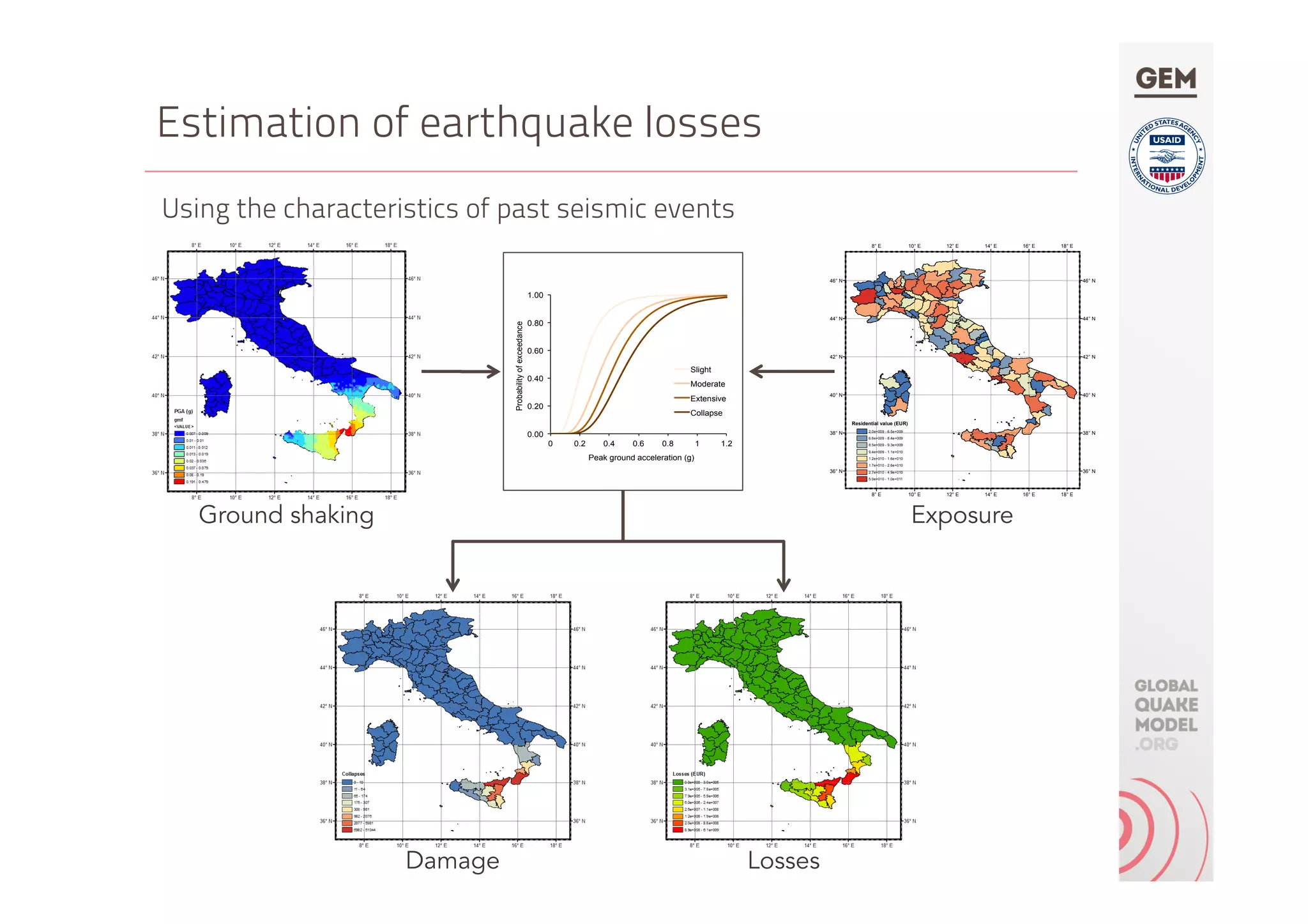
Estimation of earthquake losses
Using the characteristics of past seismic events
18° E
18° E
16° E
16° E
14° E
14° E
12° E
12° E
10° E
10° E
8° E
8° E
46° N 46° N
44° N 44° N
42° N 42° N
40° N 40° N
38° N 38° N
36° N 36° N
Residential value (EUR)
2.0e+009 - 6.5e+009
6.6e+009 - 8.4e+009
8.5e+009 - 9.3e+009
9.4e+009 - 1.1e+010
1.2e+010 - 1.6e+010
1.7e+010 - 2.6e+010
2.7e+010 - 4.9e+010
5.0e+010 - 1.0e+011
Ground shaking Exposure
0.00
0.20
0.40
0.60
0.80
1.00
0 0.2 0.4 0.6 0.8 1 1.2
Probabilityofexceedance
Peak ground acceleration (g)
Slight
Moderate
Extensive
Collapse
LossesDamage
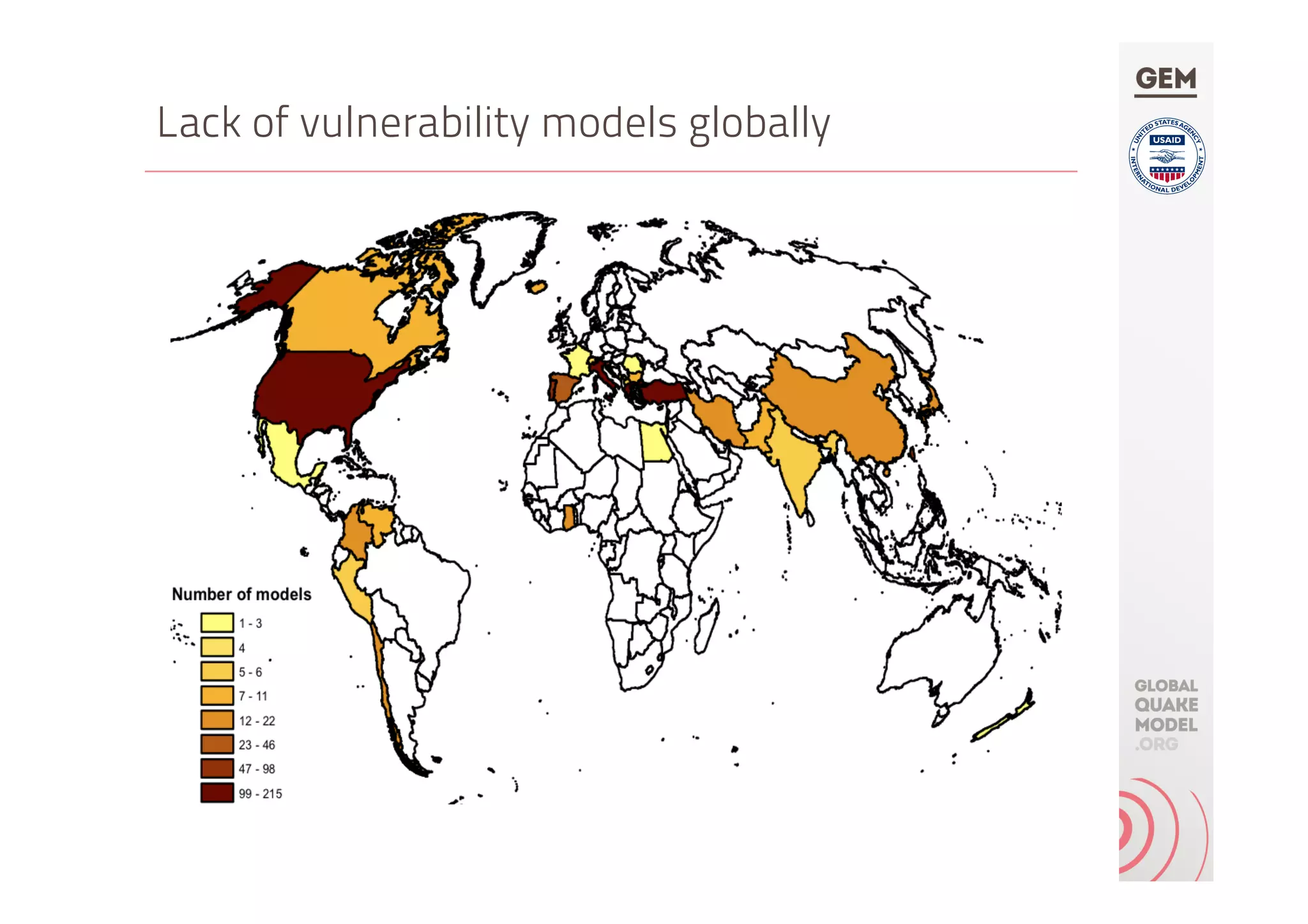
Lack of vulnerability models globally
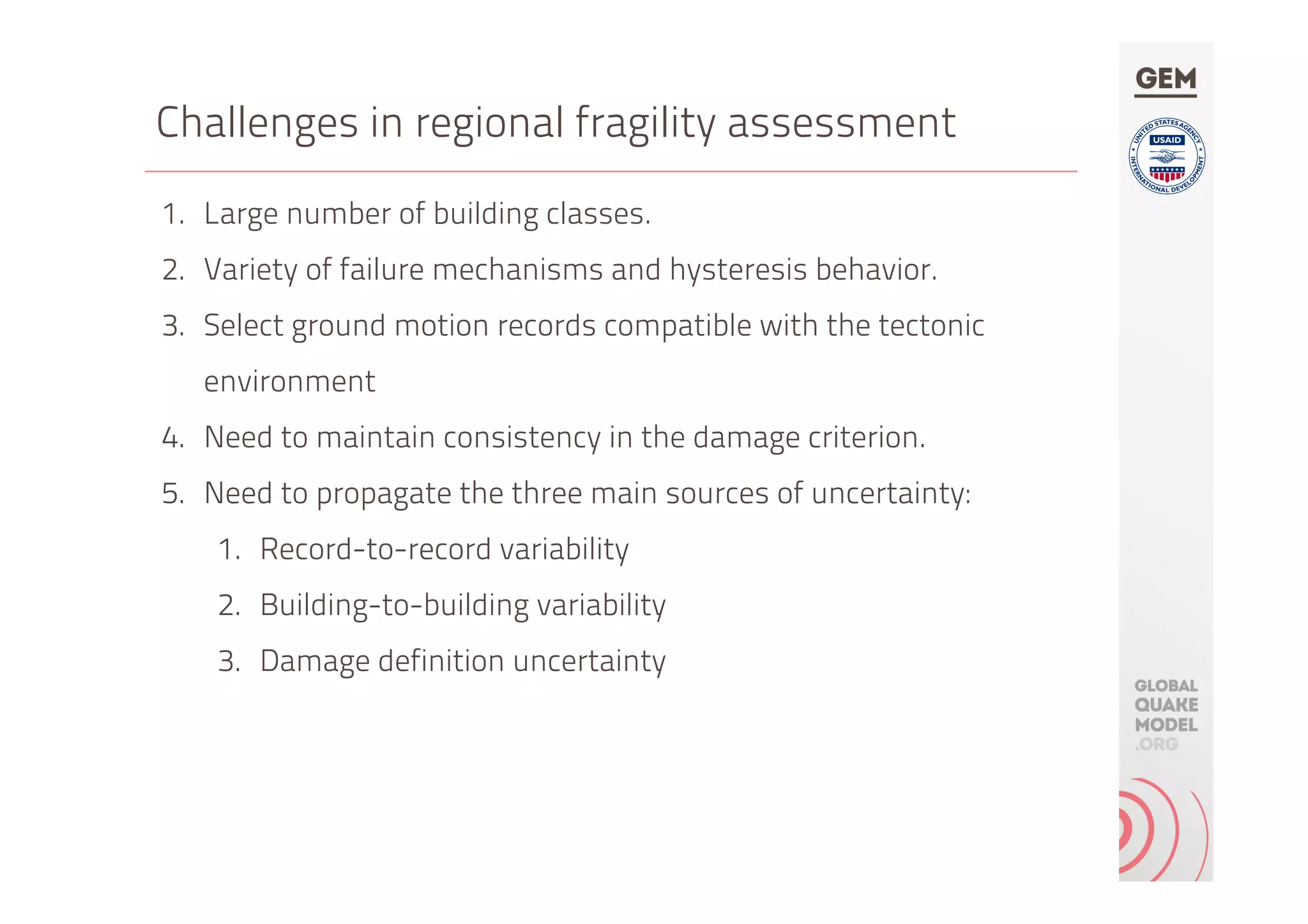
Challenges in regional fragility assessment
1.  Large number of building classes.
2.  Variety of failure mechanisms and hysteresis behavior.
3.  Select ground motion records compatible with the tectonic
environment
4.  Need to maintain consistency in the damage criterion.
5.  Need to propagate the three main sources of uncertainty:
1.  Record-to-record variability
2.  Building-to-building variability
3.  Damage definition uncertainty
Collection of building data
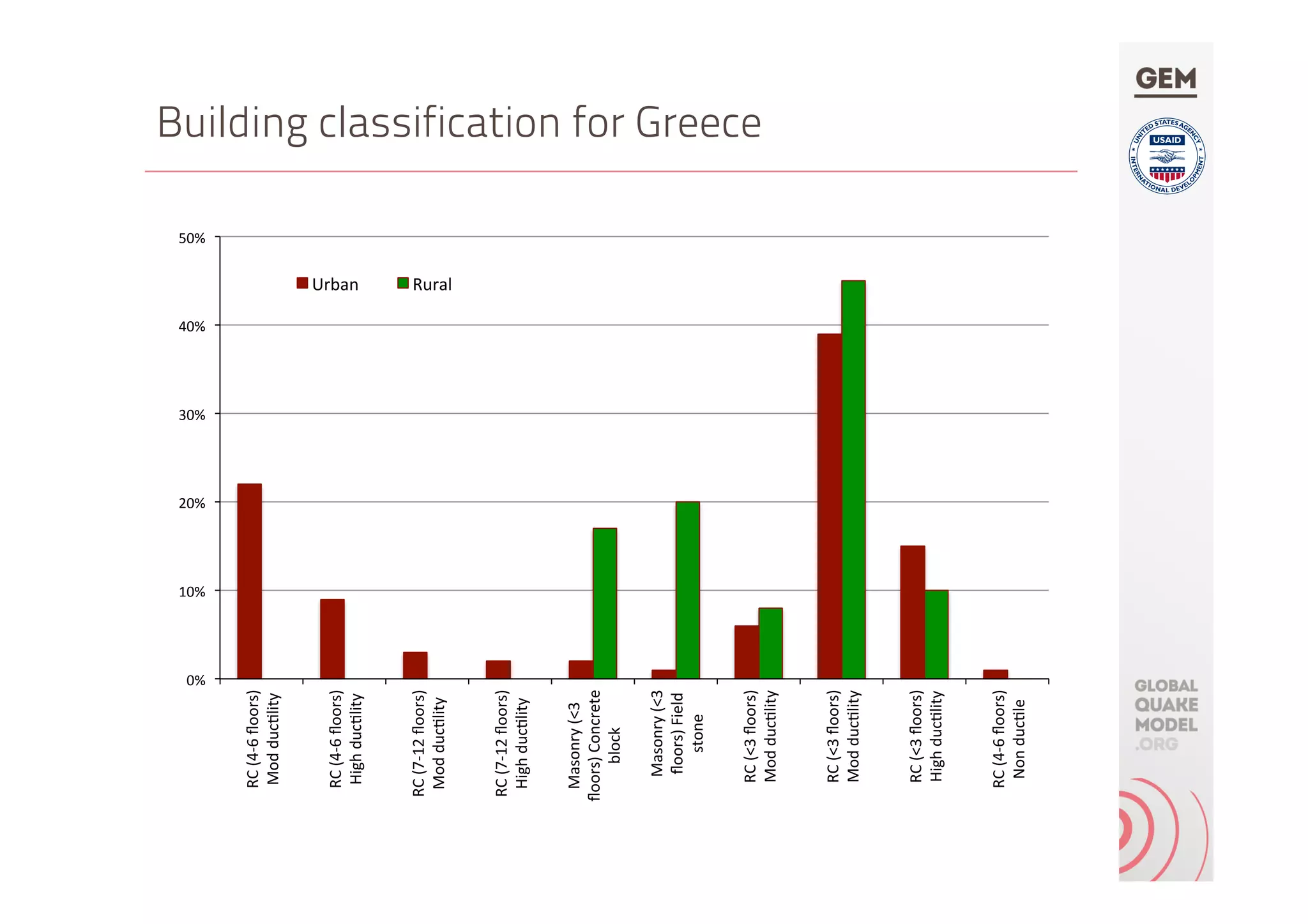
Building classification for Greece
0%	
10%	
20%	
30%	
40%	
50%	
RC	(4-6	floors)	
Mod	duc?lity	
RC	(4-6	floors)	
High	duc?lity	
RC	(7-12	floors)	
Mod	duc?lity	
RC	(7-12	floors)	
High	duc?lity	
Masonry	(<3	
floors)	Concrete	
block	
Masonry	(<3	
floors)	Field	
stone	
RC	(<3	floors)	
Mod	duc?lity	
RC	(<3	floors)	
Mod	duc?lity	
RC	(<3	floors)	
High	duc?lity	
RC	(4-6	floors)	
Non	duc?le	
Urban	 Rural
Chile
USA
Mexico
Costa Rica
Ecuador
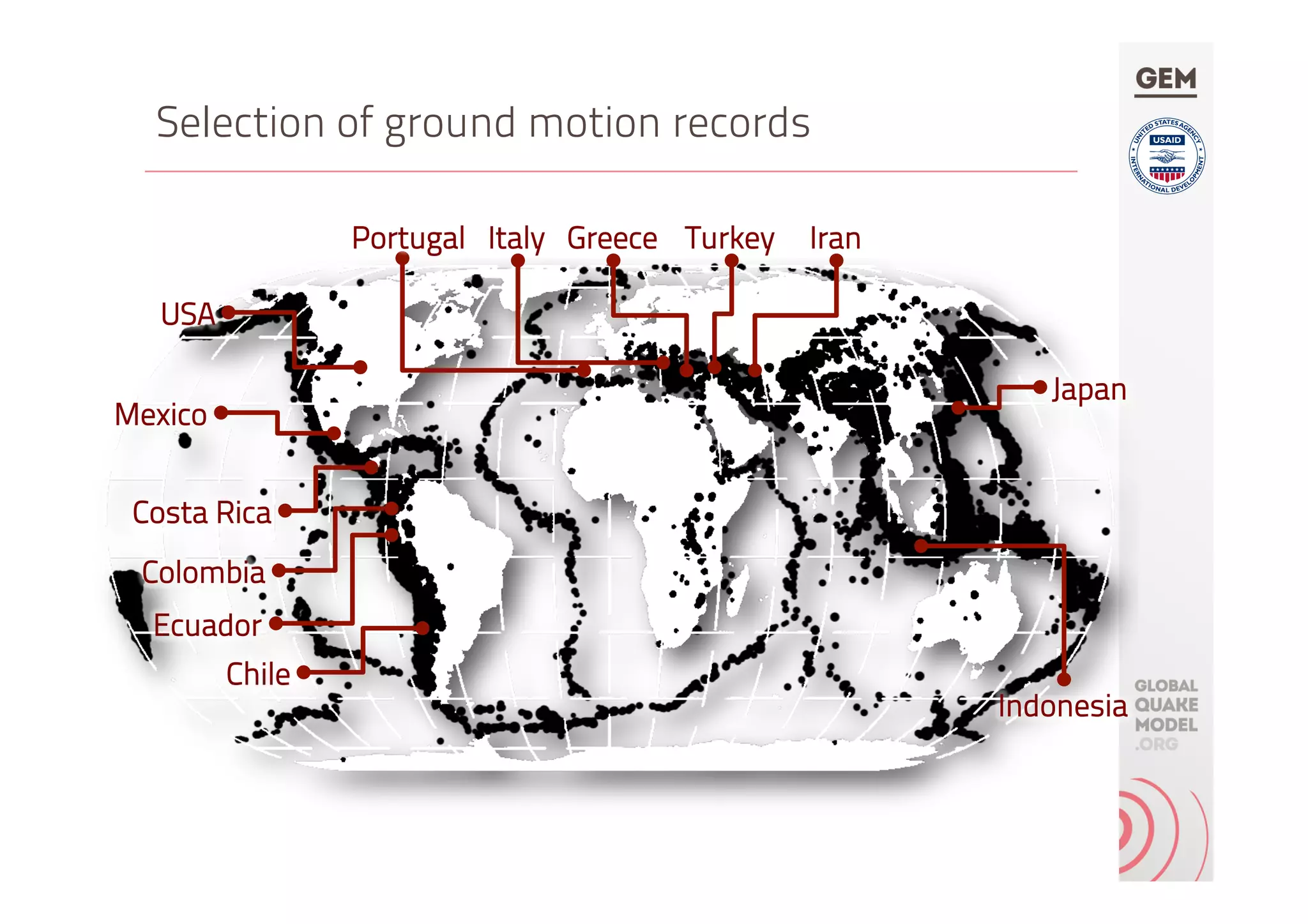
Portugal Italy TurkeyGreece Iran
Japan
Selection of ground motion records
Indonesia
Colombia
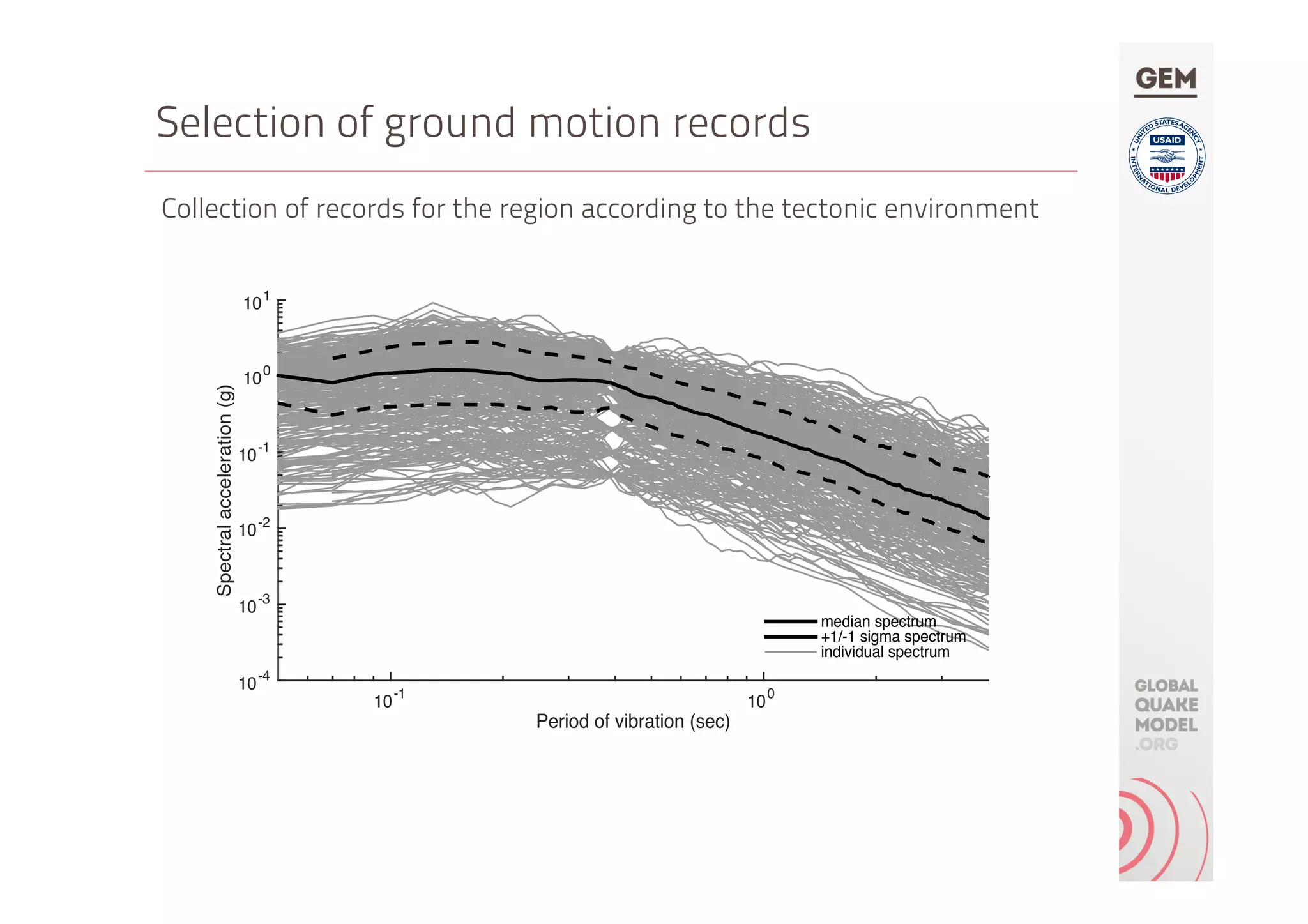
Selection of ground motion records
Collection of records for the region according to the tectonic environment
Period of vibration (sec)
10
-1
10
0
Spectralacceleration(g)
10
-4
10
-3
10
-2
10
-1
10
0
10
1
median spectrum
+1/-1 sigma spectrum
individual spectrum
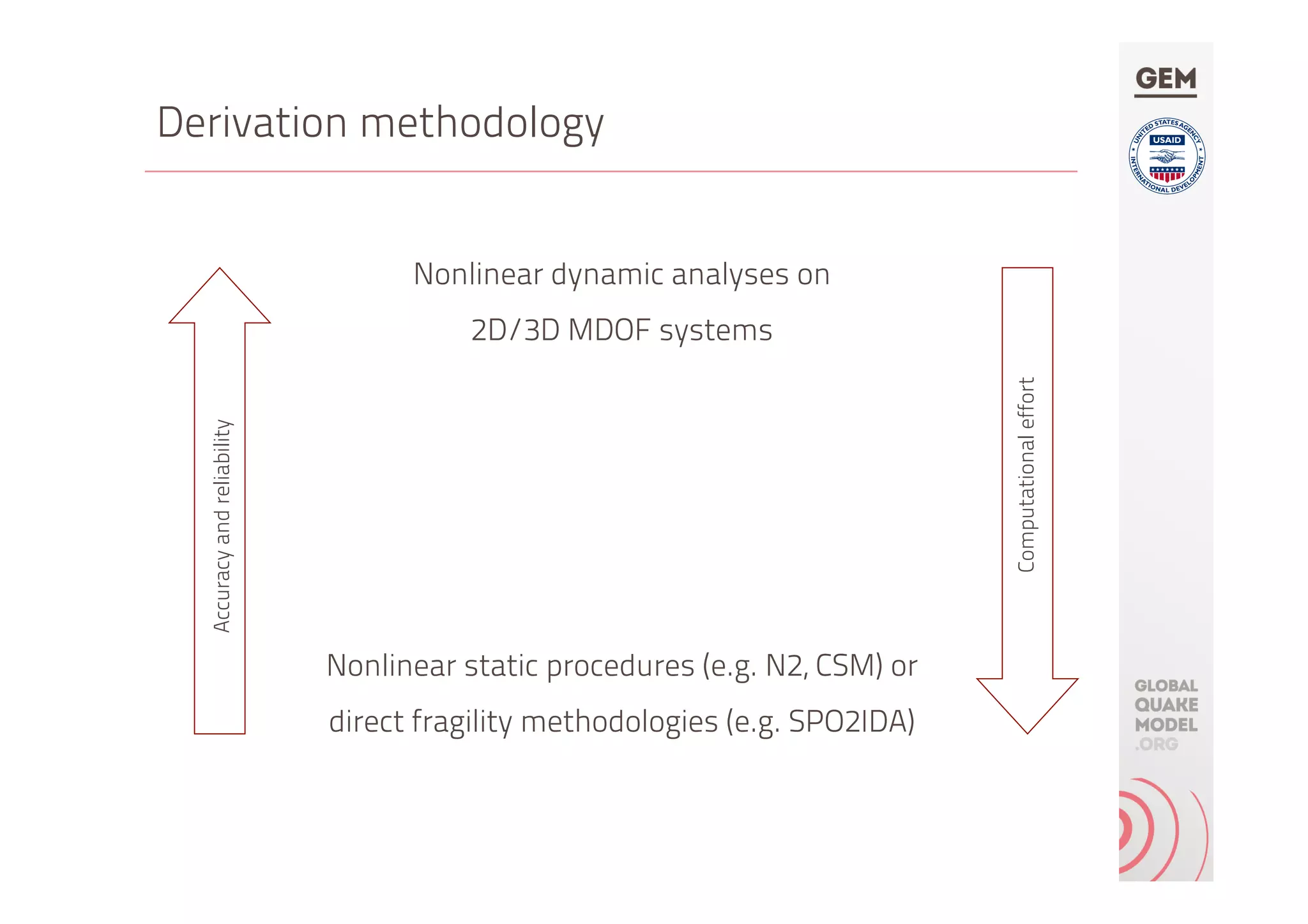
Derivation methodology
Nonlinear dynamic analyses on
2D/3D MDOF systems
Nonlinear static procedures (e.g. N2, CSM) or
direct fragility methodologies (e.g. SPO2IDA)
Accuracyandreliability
Computationaleffort
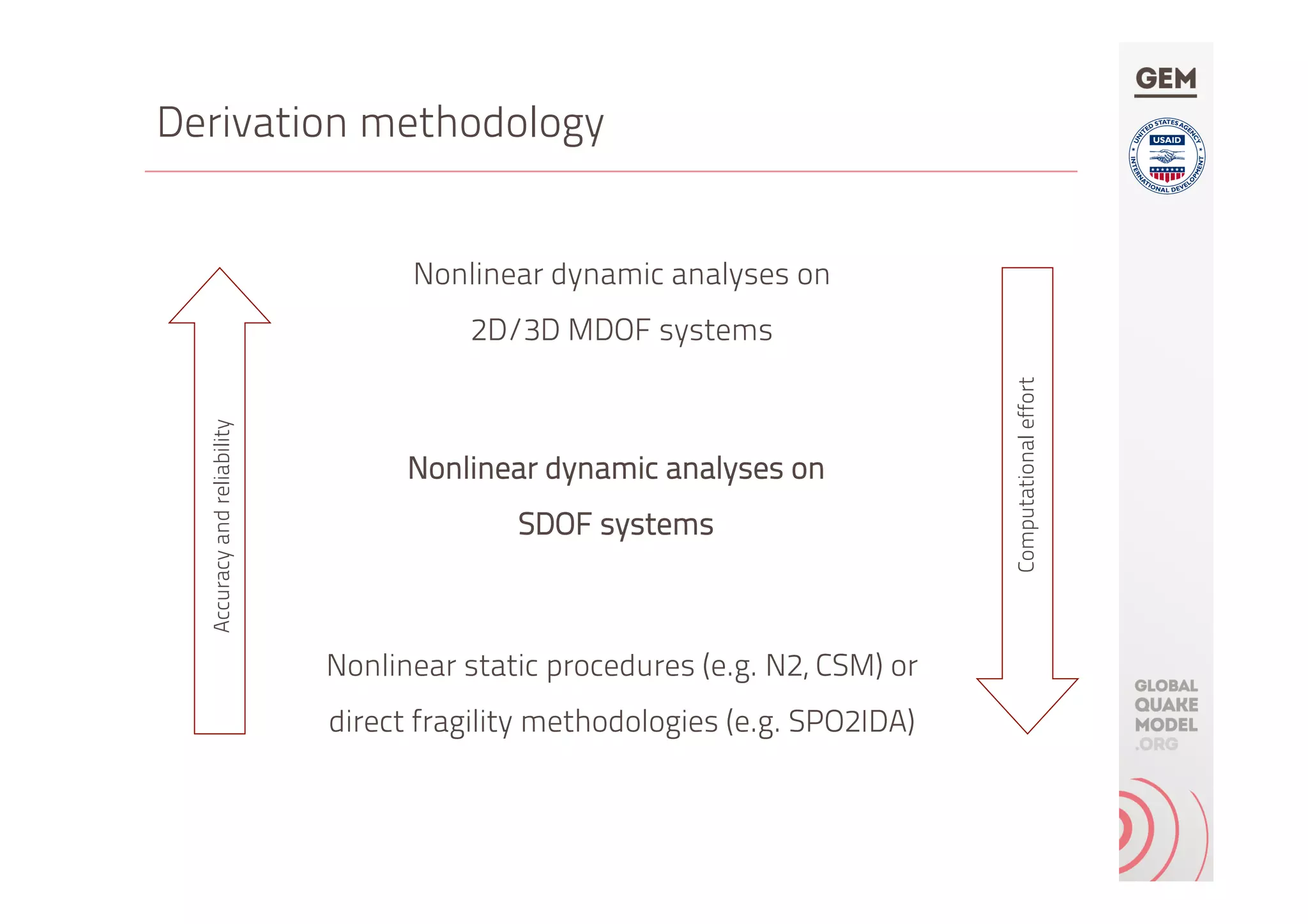
Derivation methodology
Nonlinear dynamic analyses on
2D/3D MDOF systems
Nonlinear static procedures (e.g. N2, CSM) or
direct fragility methodologies (e.g. SPO2IDA)
Accuracyandreliability
Computationaleffort
Nonlinear dynamic analyses on
SDOF systems
MDOF
Simplification of 3D or 2D structures into a SDOF
he equivalent SDOF system can be either elastic or inelastic de-
ending on the chosen inelastic analysis method (see Section
.1.3).
he computation of the pushover curve and the subsequent deter-
mination of the properties of the equivalent SDOF system are thor-
ughly discussed in Section 7.2.
Global deformations ∆
Detailed
model
Static force
sing monotonically
m*
h*k*
Equivalent SDOF
system
0
1
2
3
0.0 0.1 0.2 0.3
Global deformation ∆ [m]
HorizontalforceV[MN]
ushover curve“
linear, inelastic
ormation relationship
ndamentals of Seismic Design”
Substitute SDoF structure
Effective displacement
(design displacement)
Effective mass
Effective height ( ) ( )¦¦
==
∆∆=
n
i
ii
n
i
iiie
mHmH
11
/
( ) ( )¦¦
==
∆∆=∆
n
i
ii
n
i
iid
mm
11
2
/
( ) d
n
i
iie
mm ∆∆= ¦
=
/
1
He
me
He
me ∆d
∆i
∆i-1
∆3
∆2
∆1
He
me
He
me ∆d
∆i
∆i-1
∆3
∆2
∆1
Cours
SDOF
Definition of structural models for vulnerability analysis
−0.25 −0.2 −0.15 −0.1 −0.05 0 0.05 0.1 0.15 0.2 0.25
−0.5
−0.4
−0.3
−0.2
−0.1
0
0.1
0.2
0.3
0.4
0.5
Sd [m]
Sa[g]
sdof
pinching4
Hysteresis model
Definition of structural models for vulnerability analysis
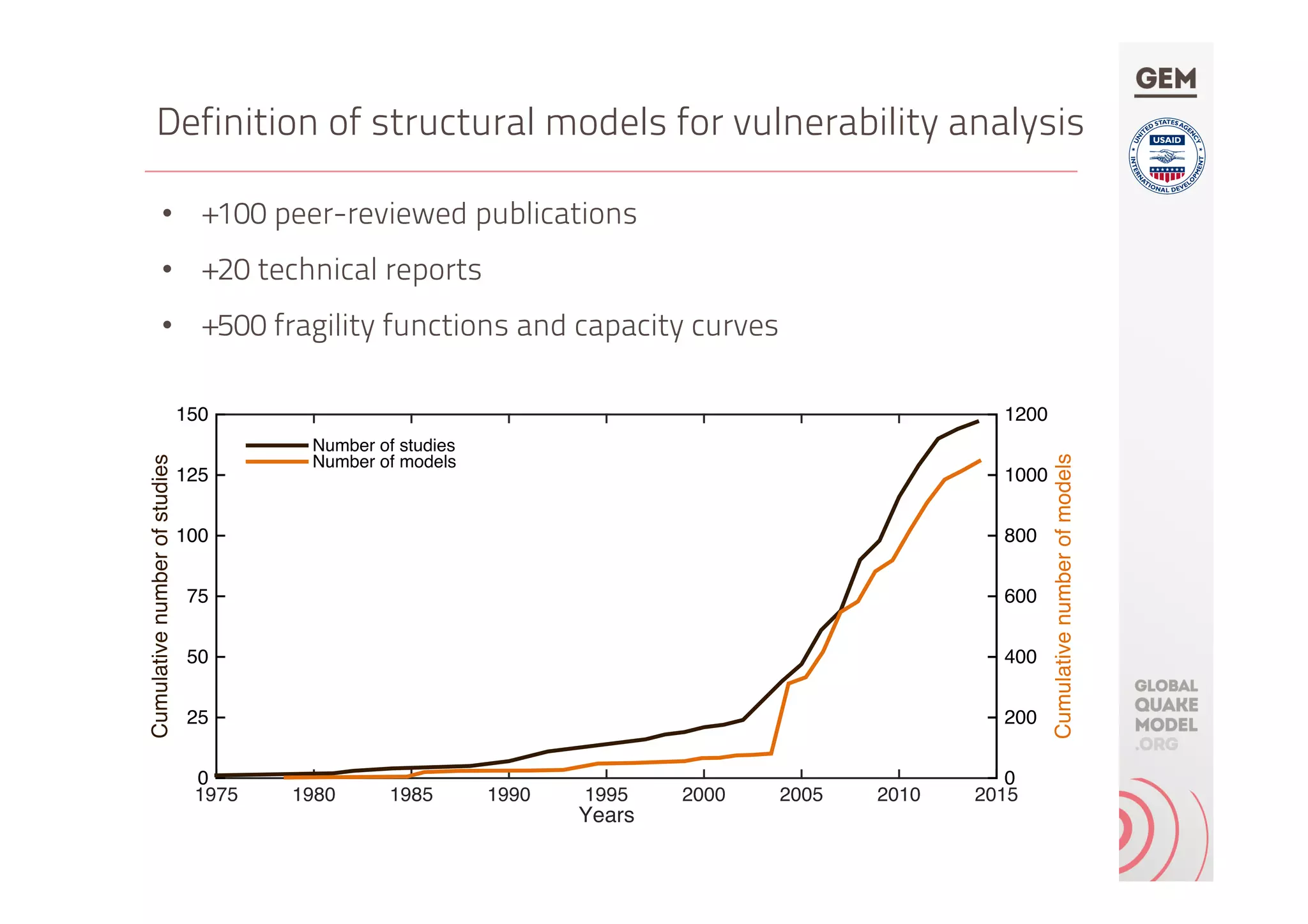
•  +100 peer-reviewed publications
•  +20 technical reports
•  +500 fragility functions and capacity curves
Years
1975 1980 1985 1990 1995 2000 2005 2010 2015
Cumulativenumberofstudies
0
25
50
75
100
125
150
Cumulativenumberofmodels
0
200
400
600
800
1000
1200
Number of studies
Number of models
Definition of structural models for vulnerability analysis
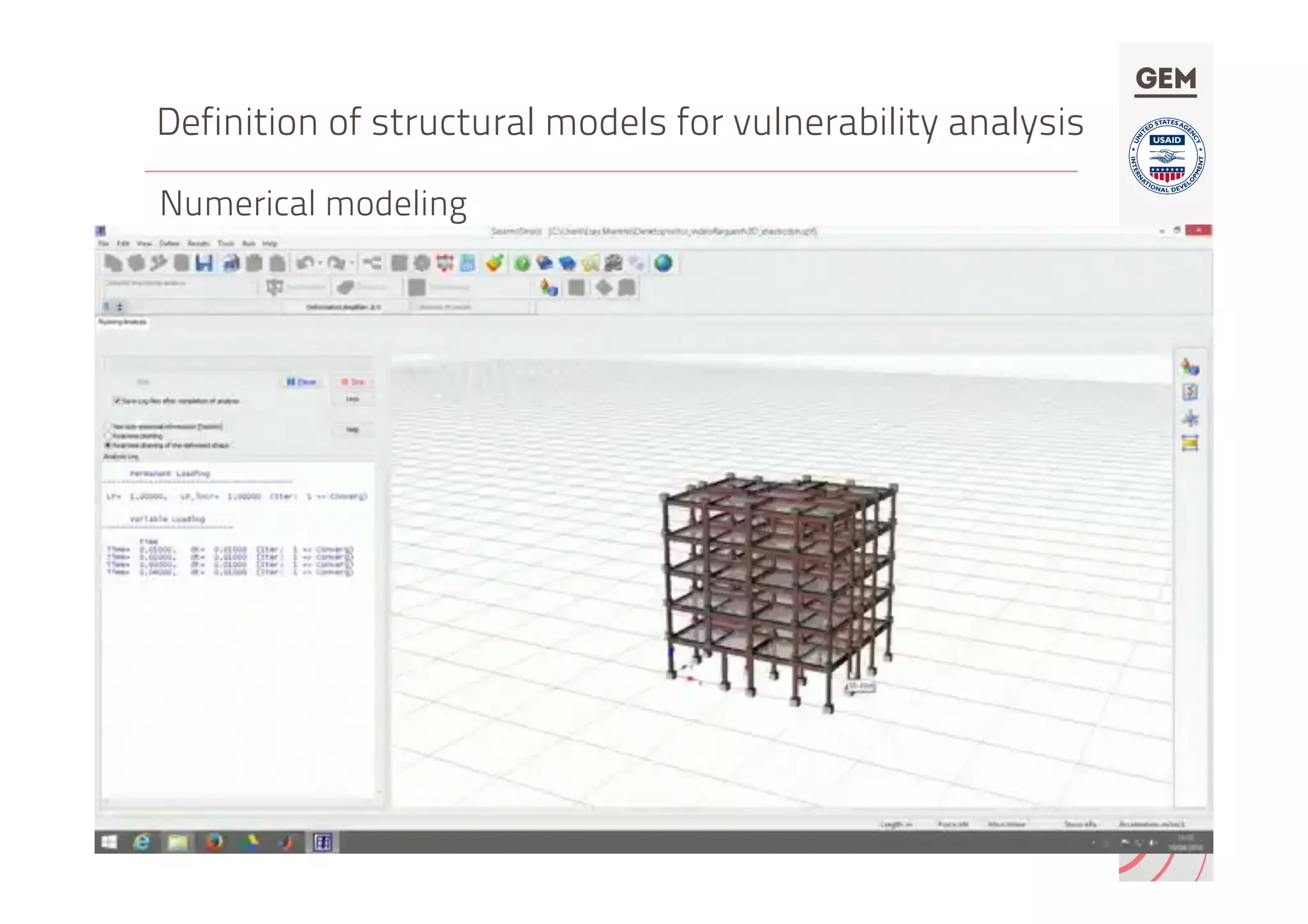
Numerical modeling
Definition of structural models for vulnerability analysis
Experimental tests
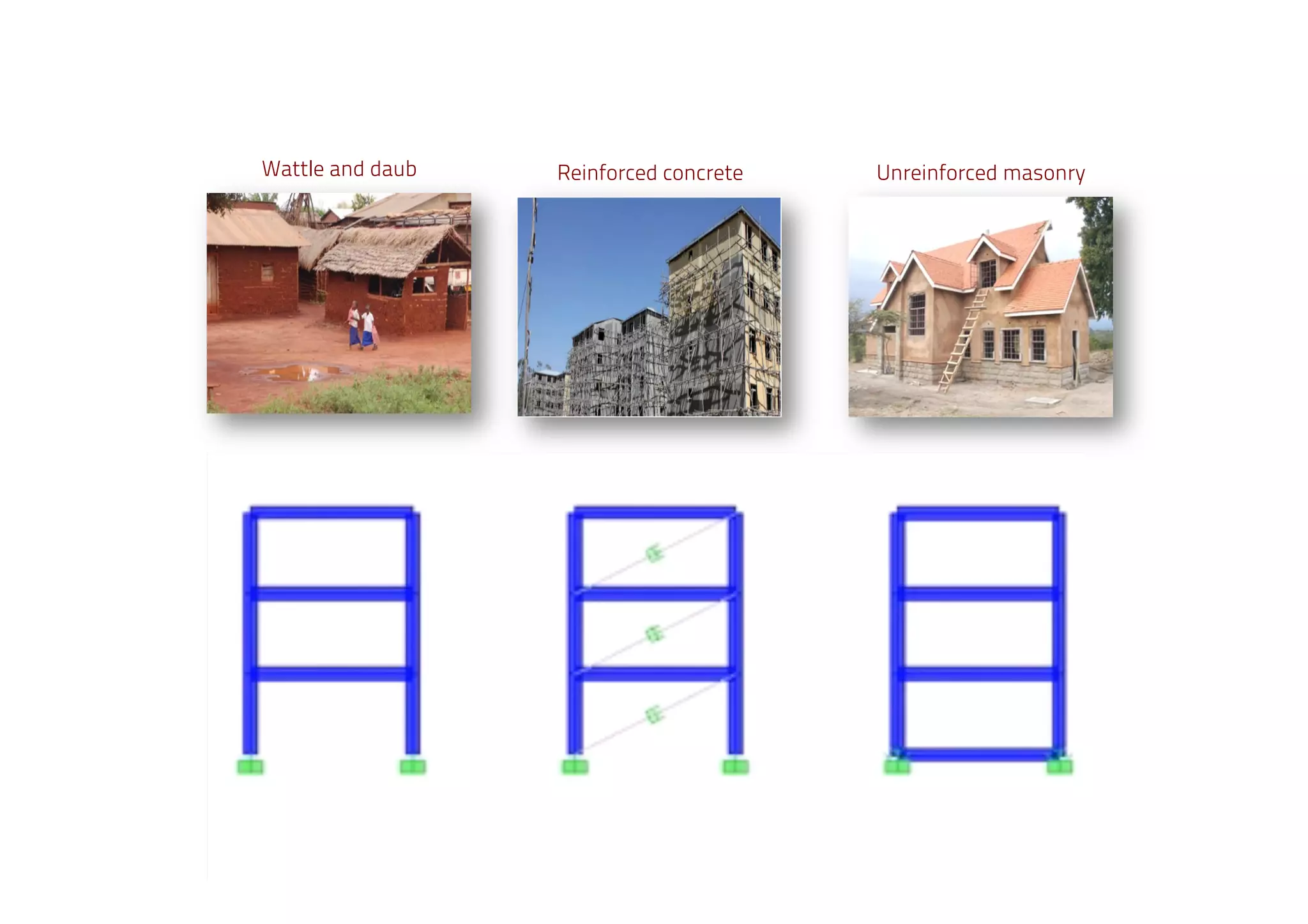
Unreinforced masonryReinforced concreteWattle and daub
Derivation of Fragility/Vulnerability functions
Ground motion
records
Single degree of
freedom systems
Period of vibration (sec)
10
-1
10
0
Spectralacceleration(g)
10
-4
10
-3
10
-2
10
-1
10
0
101
median spectrum
+1/-1 sigma spectrum
individual spectrum
Spectral displacement (m)
0 0.1 0.2 0.3 0.4 0.5
Spectralacceleration(g)
0
0.1
0.2
0.3
0.4
0.5
0.6
0.7
0.8
0.9
median curve
+1/-1 sigma curve
sampled curve
Risk Modelers
Toolkit
Spectral acceleration at 0.3 s [g]
0 0.2 0.4 0.6 0.8 1 1.2
Probabilityofexceedance
0
0.1
0.2
0.3
0.4
0.5
0.6
0.7
0.8
0.9
1
Limit state 1
Limit state 2
Limit state 3
Limit state 4
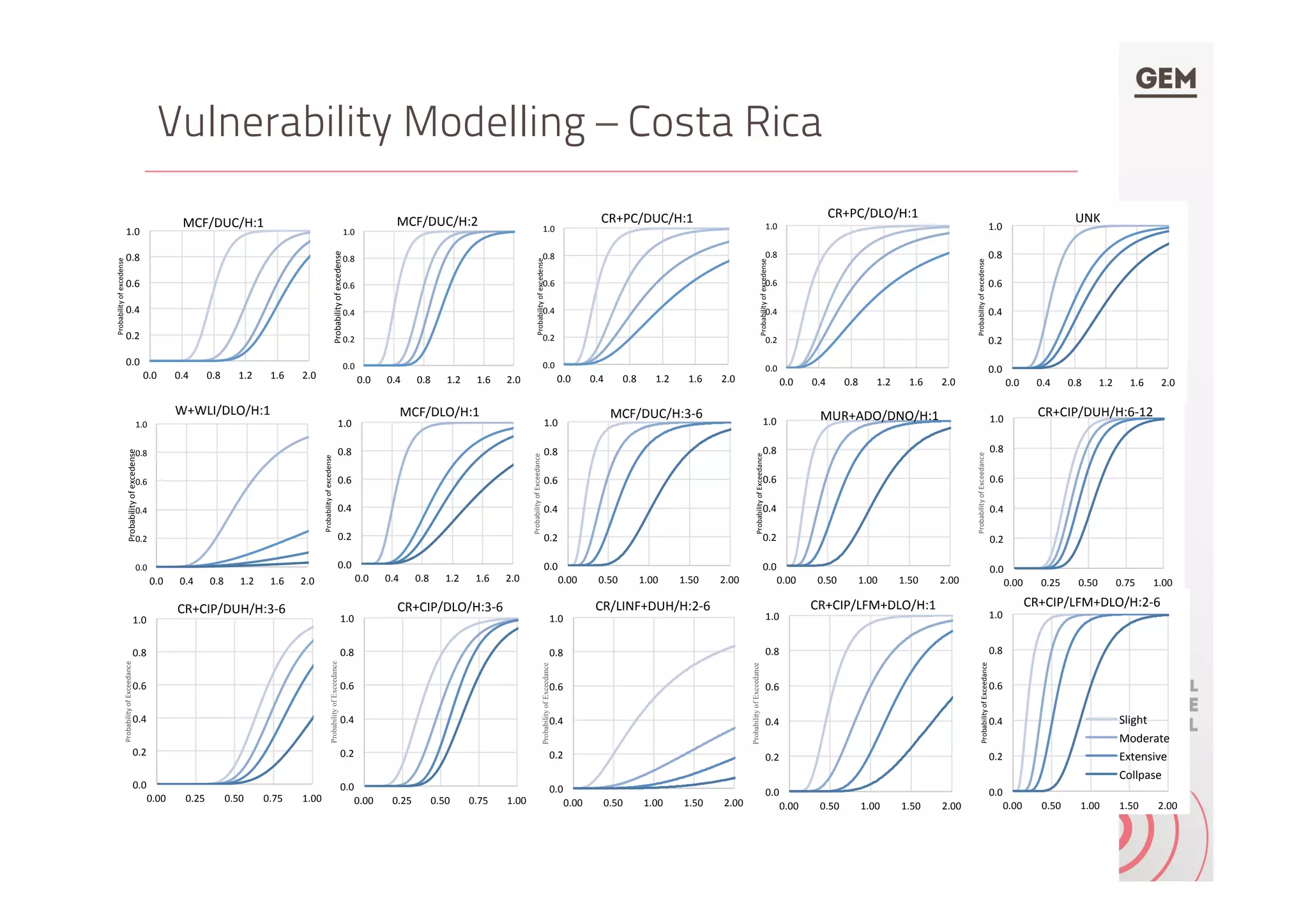
Vulnerability Modelling – Costa Rica
0.0	
0.2	
0.4	
0.6	
0.8	
1.0	
0.0	 0.4	 0.8	 1.2	 1.6	 2.0	
Probability	of	excedense		
MCF/DUC/H:1	
0.0	
0.2	
0.4	
0.6	
0.8	
1.0	
0.0	 0.4	 0.8	 1.2	 1.6	 2.0	
Probability	of	excedense		
MCF/DUC/H:2	
0.0	
0.2	
0.4	
0.6	
0.8	
1.0	
0.0	 0.4	 0.8	 1.2	 1.6	 2.0	
Probability	of	excedense		
CR+PC/DUC/H:1	
0.0	
0.2	
0.4	
0.6	
0.8	
1.0	
0.0	 0.4	 0.8	 1.2	 1.6	 2.0	
Probability	of	excedense		
CR+PC/DLO/H:1	
0.0	
0.2	
0.4	
0.6	
0.8	
1.0	
0.0	 0.4	 0.8	 1.2	 1.6	 2.0	
Probability	of	excedense		
W+WLI/DLO/H:1	
0.0	
0.2	
0.4	
0.6	
0.8	
1.0	
0.0	 0.4	 0.8	 1.2	 1.6	 2.0	
Probability	of	excedense		
MCF/DLO/H:1	
0.0	
0.2	
0.4	
0.6	
0.8	
1.0	
0.0	 0.4	 0.8	 1.2	 1.6	 2.0	
Probability	of	excedense		
UNK	
0.0	
0.2	
0.4	
0.6	
0.8	
1.0	
0.00	 0.50	 1.00	 1.50	 2.00	
Probability	of	Exceedance	
MCF/DUC/H:3-6	
0.0	
0.2	
0.4	
0.6	
0.8	
1.0	
0.00	 0.50	 1.00	 1.50	 2.00	
Probability	of	Exceedance	
MUR+ADO/DNO/H:1	
0.0	
0.2	
0.4	
0.6	
0.8	
1.0	
0.00	 0.25	 0.50	 0.75	 1.00	
Probability	of	Exceedance	
CR+CIP/DUH/H:6-12
0.0	
0.2	
0.4	
0.6	
0.8	
1.0	
0.00	 0.25	 0.50	 0.75	 1.00	
Probability	of	Exceedance	
CR+CIP/DUH/H:3-6		
0.0	
0.2	
0.4	
0.6	
0.8	
1.0	
0.00	 0.25	 0.50	 0.75	 1.00	
ProbabilityofExceedance
CR+CIP/DLO/H:3-6	
0.0	
0.2	
0.4	
0.6	
0.8	
1.0	
0.00	 0.50	 1.00	 1.50	 2.00	
ProbabilityofExceedance
CR/LINF+DUH/H:2-6	
0.0	
0.2	
0.4	
0.6	
0.8	
1.0	
0.00	 0.50	 1.00	 1.50	 2.00	
ProbabilityofExceedance
CR+CIP/LFM+DLO/H:1		
0.0	
0.2	
0.4	
0.6	
0.8	
1.0	
0.00	 0.50	 1.00	 1.50	 2.00	
Probability	of	Exceedance	
CR+CIP/LFM+DLO/H:2-6	
Slight	
Moderate	
Extensive	
Collpase
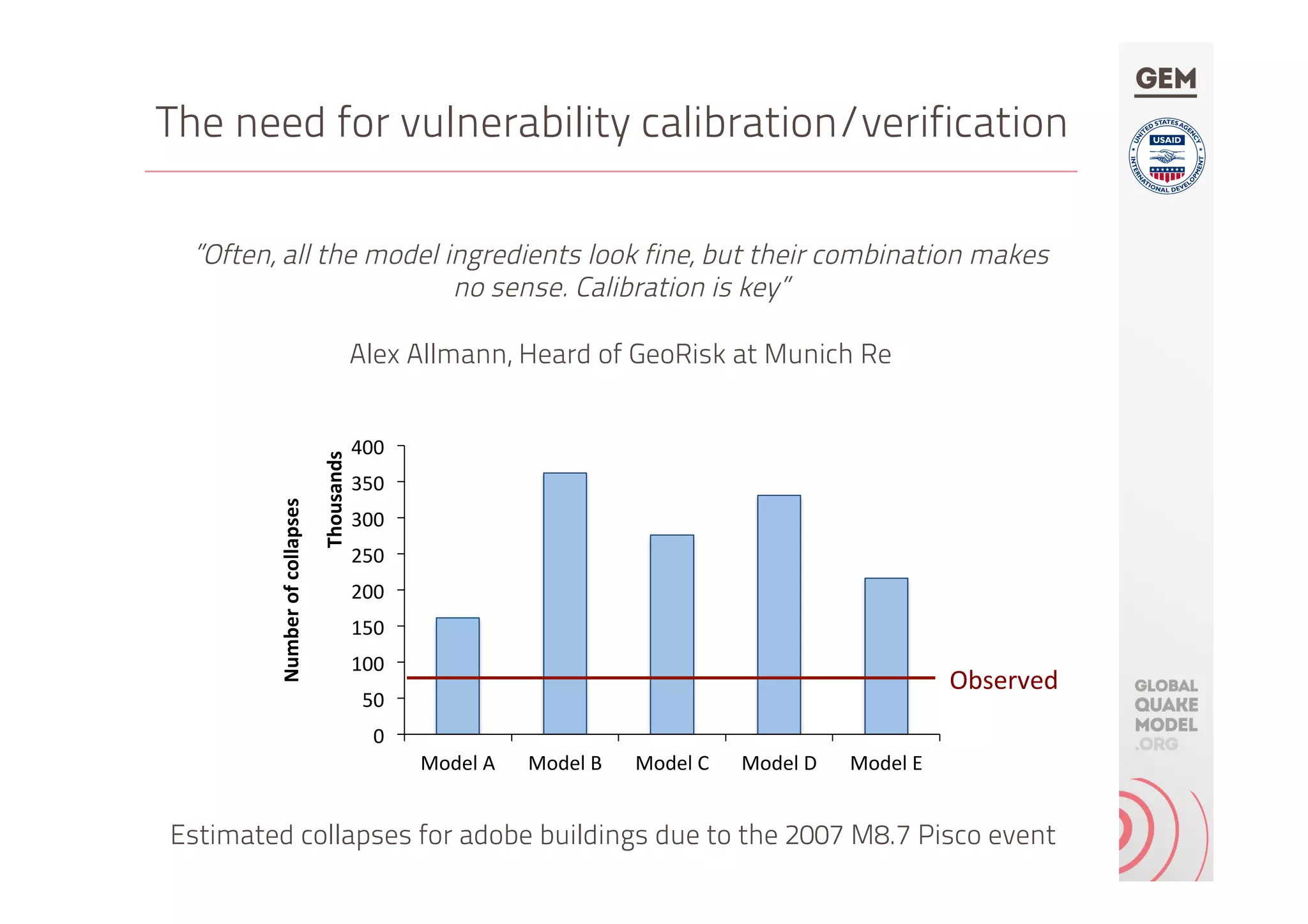
The need for vulnerability calibration/verification
”Often, all the model ingredients look fine, but their combination makes
no sense. Calibration is key”
Alex Allmann, Heard of GeoRisk at Munich Re
0	
50	
100	
150	
200	
250	
300	
350	
400	
Model	A	 Model	B	 Model	C	 Model	D	 Model	E	
Number	of	collapses	
Thousands	
Observed	
Estimated collapses for adobe buildings due to the 2007 M8.7 Pisco event
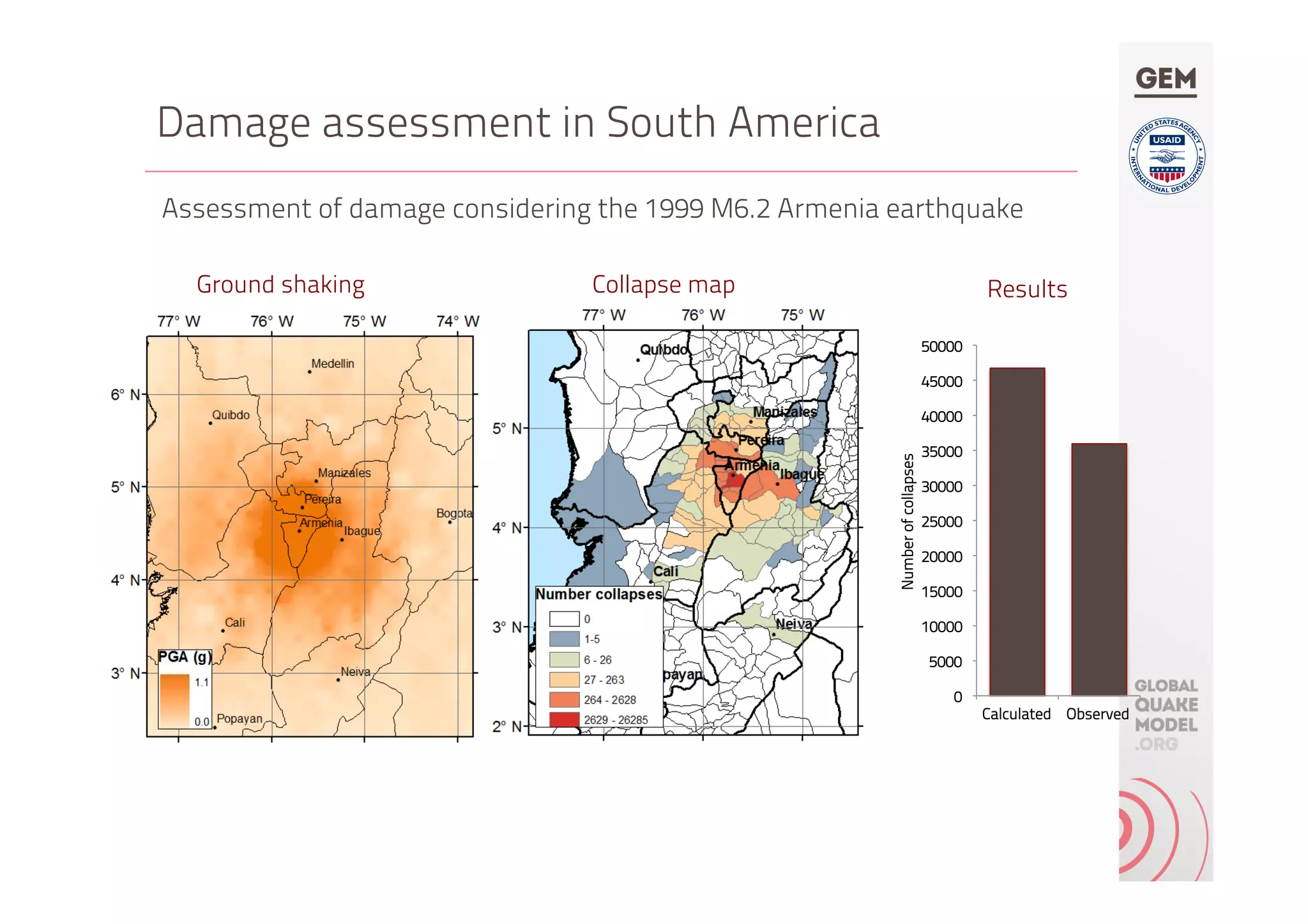
Damage assessment in South America
Assessment of damage considering the 1999 M6.2 Armenia earthquake
0
5000
10000
15000
20000
25000
30000
35000
40000
45000
50000
Calculated Observed
Numberofcollapses
Ground shaking Collapse map Results
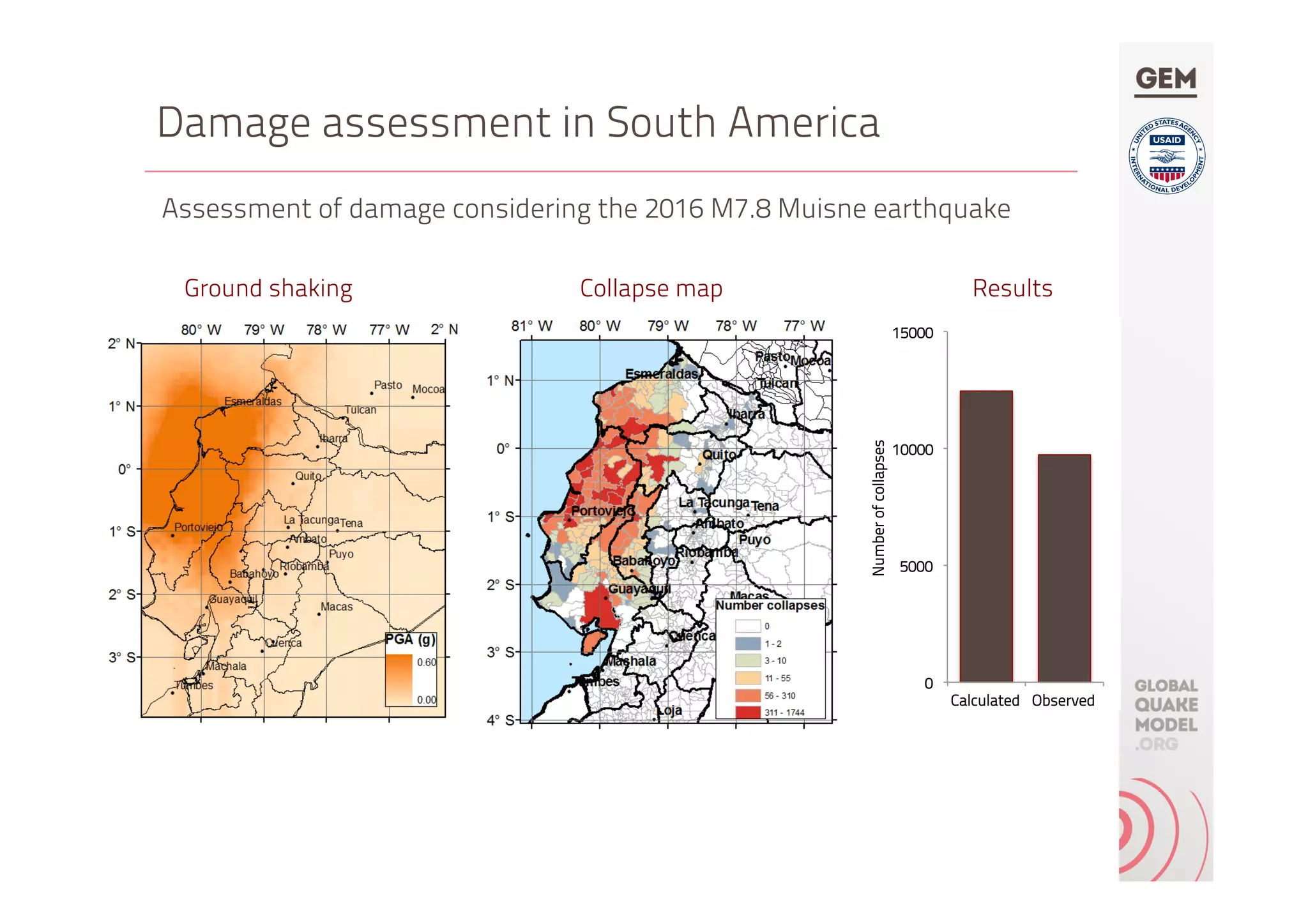
Damage assessment in South America
Assessment of damage considering the 2016 M7.8 Muisne earthquake
Ground shaking Collapse map Results
0
5000
10000
15000
Calculated Observed
Numberofcollapses
The need for vulnerability calibration/verification
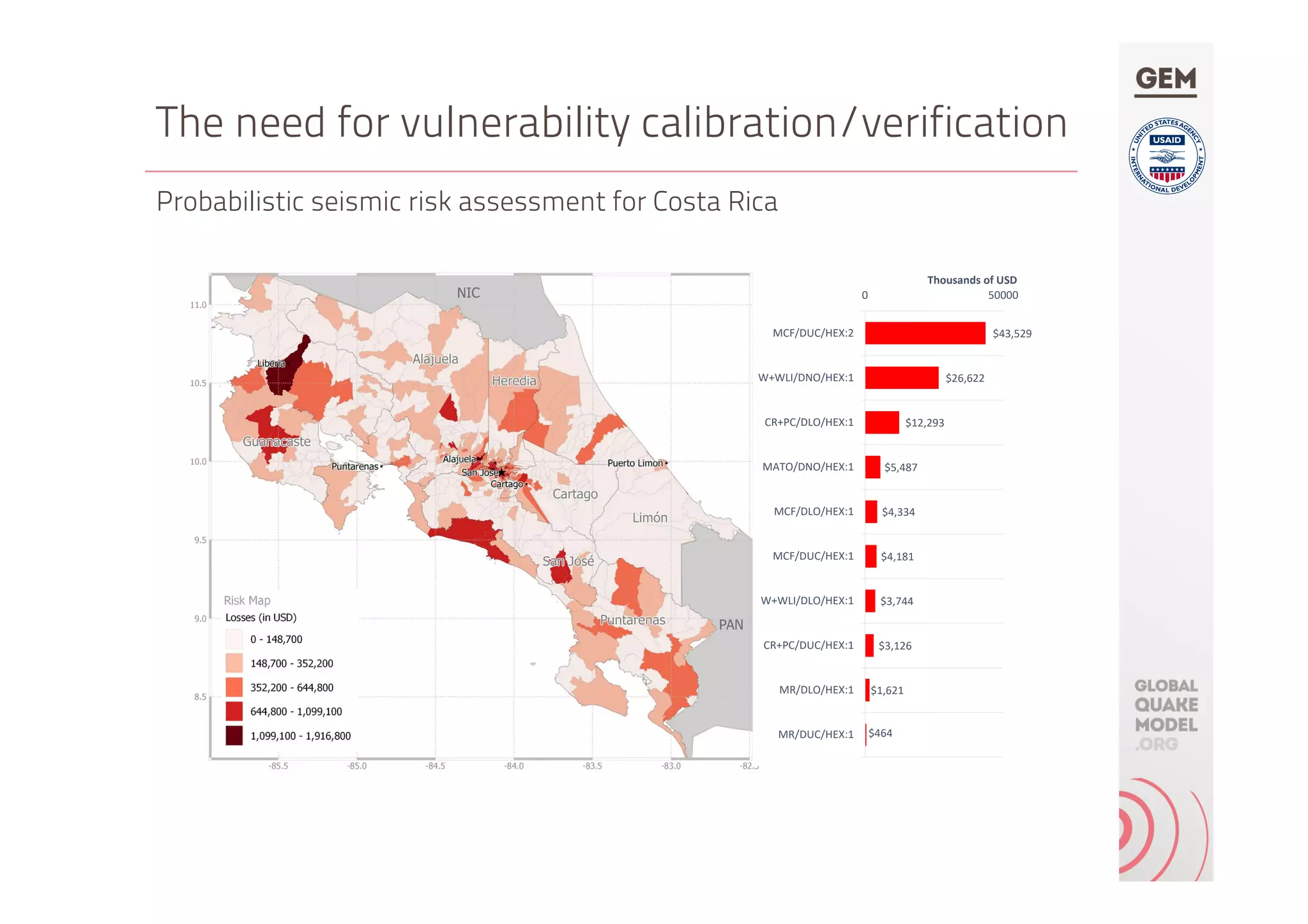
Probabilistic seismic risk assessment for Costa Rica
$43,529 
$26,622 
$12,293 
$5,487 
$4,334 
$4,181 
$3,744 
$3,126 
$1,621 
$464 
MCF/DUC/HEX:2
W+WLI/DNO/HEX:1
CR+PC/DLO/HEX:1
MATO/DNO/HEX:1
MCF/DLO/HEX:1
MCF/DUC/HEX:1
W+WLI/DLO/HEX:1
CR+PC/DUC/HEX:1
MR/DLO/HEX:1
MR/DUC/HEX:1
0 50000
Thousands of USD
The need for vulnerability calibration/verification
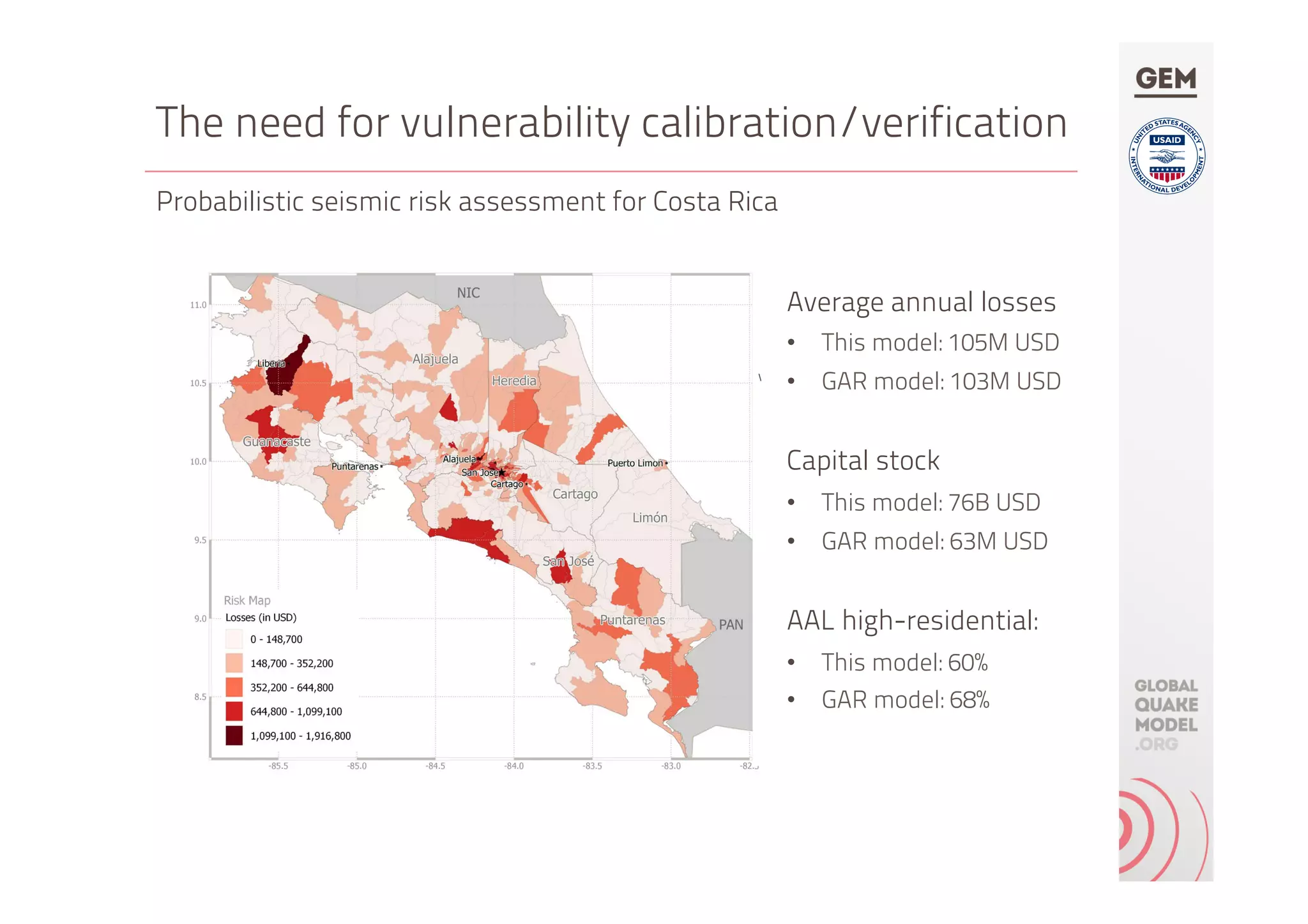
Average annual losses
•  This model: 105M USD
•  GAR model: 103M USD
Capital stock
•  This model: 76B USD
•  GAR model: 63M USD
AAL high-residential:
•  This model: 60%
•  GAR model: 68%
$43,529 
$26,622 
$12,293 
$5,487 
$4,334 
$4,181 
$3,744 
$3,126 
$1,621 
$464 
MCF/DUC/HEX:2
W+WLI/DNO/HEX:1
CR+PC/DLO/HEX:1
MATO/DNO/HEX:1
MCF/DLO/HEX:1
MCF/DUC/HEX:1
W+WLI/DLO/HEX:1
CR+PC/DUC/HEX:1
MR/DLO/HEX:1
MR/DUC/HEX:1
0 50000
Thousands of USD
Probabilistic seismic risk assessment for Costa Rica
What about the regions with no damage data?
A probabilistic approach can be explored
Collection of existing fragility and vulnerability models
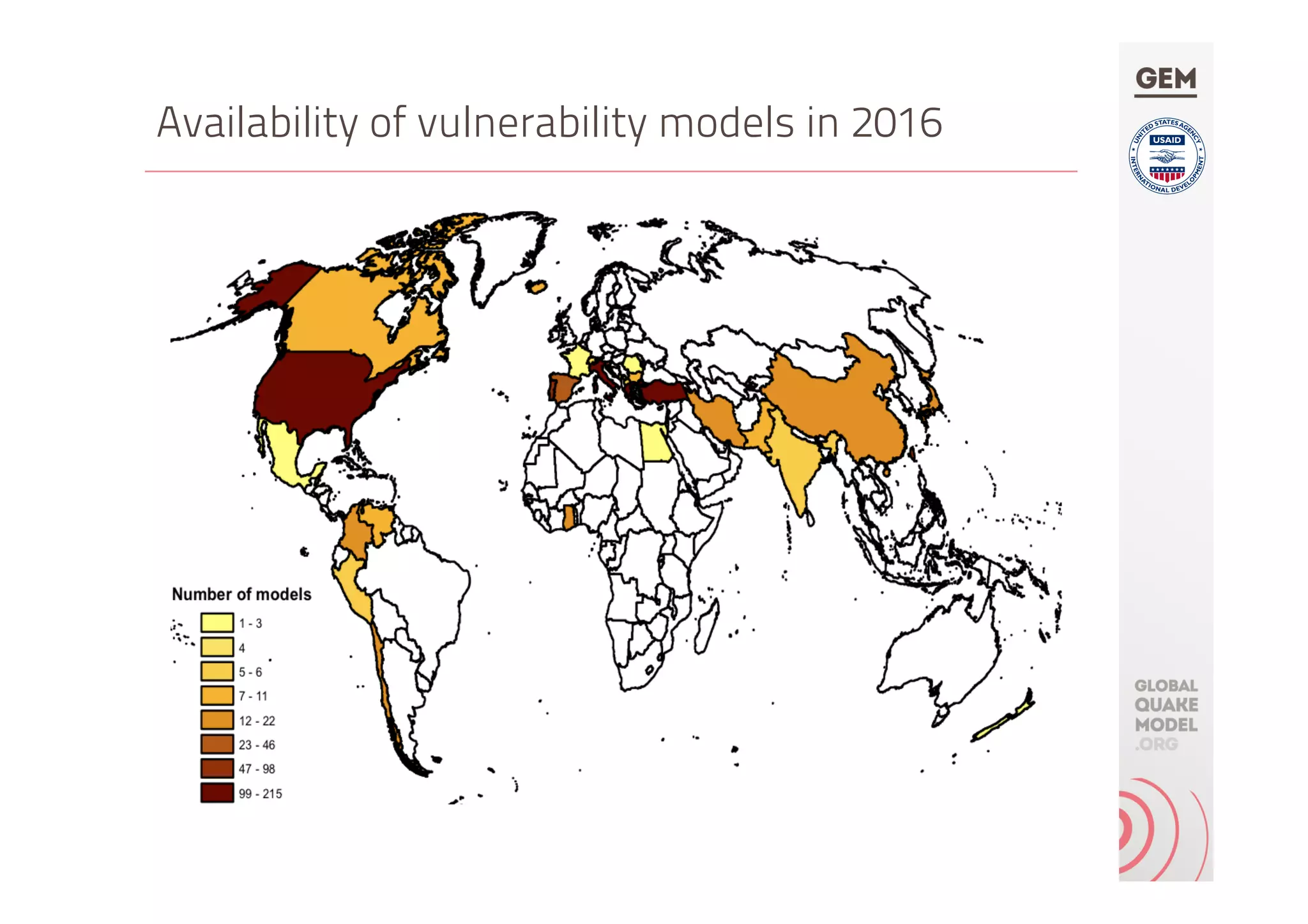
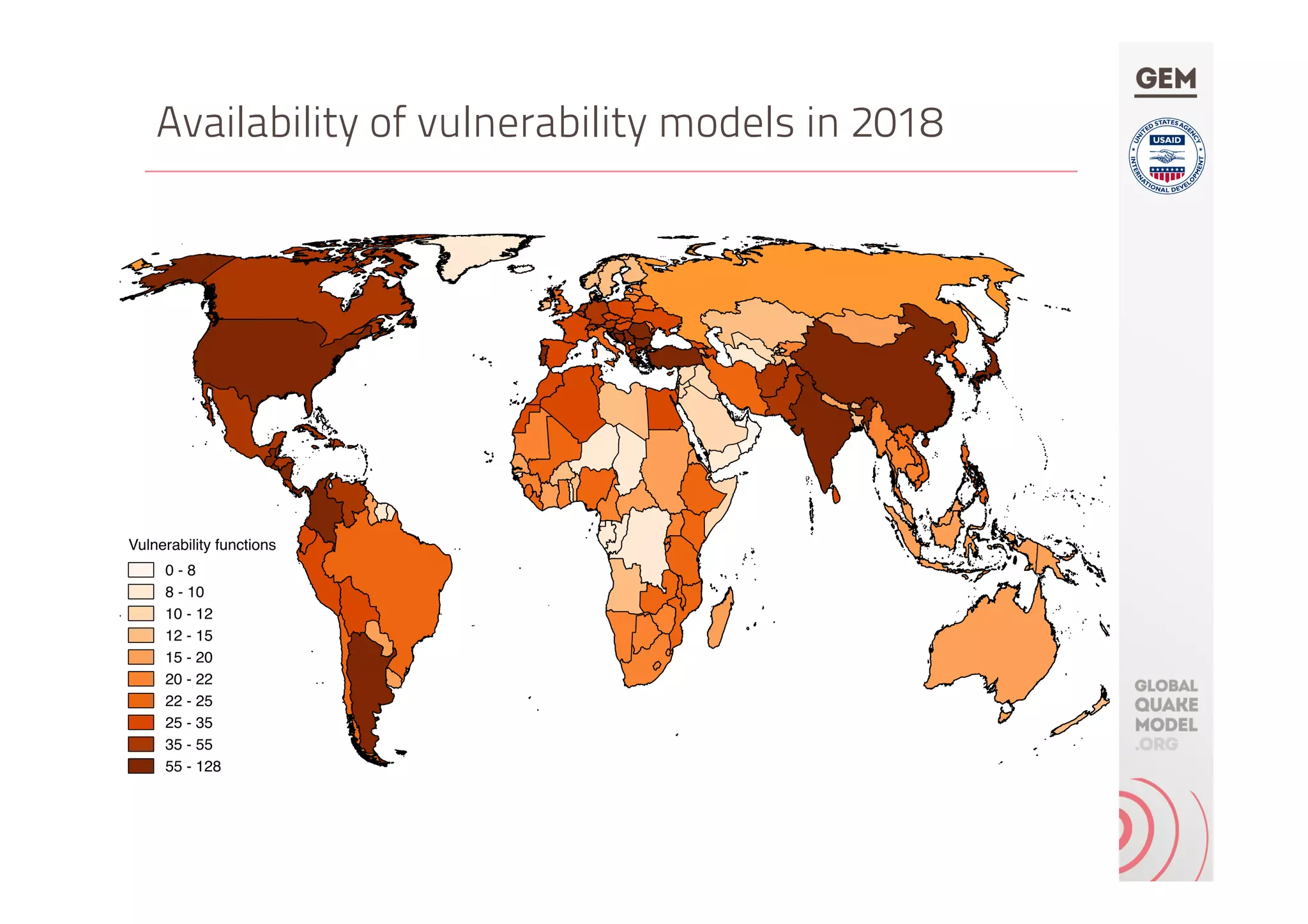
Availability of vulnerability models in 2016
Availability of vulnerability models in 2018
Muchas gracias!

05 ccara vulnerability

  • 1.
    Development of aGlobal Vulnerability Database Vitor Silva, Seismic Risk Coordinator On behalf of the risk team April 2017 – Pavia, Italy
  • 2.
    Estimation of earthquakelosses Using the characteristics of past seismic events 18° E 18° E 16° E 16° E 14° E 14° E 12° E 12° E 10° E 10° E 8° E 8° E 46° N 46° N 44° N 44° N 42° N 42° N 40° N 40° N 38° N 38° N 36° N 36° N Residential value (EUR) 2.0e+009 - 6.5e+009 6.6e+009 - 8.4e+009 8.5e+009 - 9.3e+009 9.4e+009 - 1.1e+010 1.2e+010 - 1.6e+010 1.7e+010 - 2.6e+010 2.7e+010 - 4.9e+010 5.0e+010 - 1.0e+011 Ground shaking Exposure
  • 3.
    Estimation of earthquakelosses - Masonry No damage Seismic Intensity Extensive damage Slight damage Collapse
  • 4.
    Estimation of earthquakelosses - RC No damage Seismic Intensity Extensive damage Slight damage Collapse
  • 5.
    Estimation of earthquakelosses - Wooden No damage Seismic Intensity Extensive damage Slight damage Collapse
  • 6.
    Estimation of earthquakelosses Seismic Intensity 0.00 0.20 0.40 0.60 0.80 1.00 0 0.2 0.4 0.6 0.8 1 1.2 Probabilityofexceedance Peak ground acceleration (g) Slight Moderate Extensive Collapse
  • 7.
    Estimation of earthquakelosses Using the characteristics of past seismic events 18° E 18° E 16° E 16° E 14° E 14° E 12° E 12° E 10° E 10° E 8° E 8° E 46° N 46° N 44° N 44° N 42° N 42° N 40° N 40° N 38° N 38° N 36° N 36° N Residential value (EUR) 2.0e+009 - 6.5e+009 6.6e+009 - 8.4e+009 8.5e+009 - 9.3e+009 9.4e+009 - 1.1e+010 1.2e+010 - 1.6e+010 1.7e+010 - 2.6e+010 2.7e+010 - 4.9e+010 5.0e+010 - 1.0e+011 0.00 0.20 0.40 0.60 0.80 1.00 0 0.2 0.4 0.6 0.8 1 1.2 Probabilityofexceedance Peak ground acceleration (g) Slight Moderate Extensive Collapse Ground shaking Exposure
  • 8.
    Estimation of earthquakelosses Using the characteristics of past seismic events 18° E 18° E 16° E 16° E 14° E 14° E 12° E 12° E 10° E 10° E 8° E 8° E 46° N 46° N 44° N 44° N 42° N 42° N 40° N 40° N 38° N 38° N 36° N 36° N Residential value (EUR) 2.0e+009 - 6.5e+009 6.6e+009 - 8.4e+009 8.5e+009 - 9.3e+009 9.4e+009 - 1.1e+010 1.2e+010 - 1.6e+010 1.7e+010 - 2.6e+010 2.7e+010 - 4.9e+010 5.0e+010 - 1.0e+011 Ground shaking Exposure 0.00 0.20 0.40 0.60 0.80 1.00 0 0.2 0.4 0.6 0.8 1 1.2 Probabilityofexceedance Peak ground acceleration (g) Slight Moderate Extensive Collapse LossesDamage
  • 9.
    Lack of vulnerabilitymodels globally
  • 10.
    Challenges in regionalfragility assessment 1.  Large number of building classes. 2.  Variety of failure mechanisms and hysteresis behavior. 3.  Select ground motion records compatible with the tectonic environment 4.  Need to maintain consistency in the damage criterion. 5.  Need to propagate the three main sources of uncertainty: 1.  Record-to-record variability 2.  Building-to-building variability 3.  Damage definition uncertainty
  • 11.
  • 12.
    Building classification forGreece 0% 10% 20% 30% 40% 50% RC (4-6 floors) Mod duc?lity RC (4-6 floors) High duc?lity RC (7-12 floors) Mod duc?lity RC (7-12 floors) High duc?lity Masonry (<3 floors) Concrete block Masonry (<3 floors) Field stone RC (<3 floors) Mod duc?lity RC (<3 floors) Mod duc?lity RC (<3 floors) High duc?lity RC (4-6 floors) Non duc?le Urban Rural
  • 13.
    Chile USA Mexico Costa Rica Ecuador Portugal ItalyTurkeyGreece Iran Japan Selection of ground motion records Indonesia Colombia
  • 14.
    Selection of groundmotion records Collection of records for the region according to the tectonic environment Period of vibration (sec) 10 -1 10 0 Spectralacceleration(g) 10 -4 10 -3 10 -2 10 -1 10 0 10 1 median spectrum +1/-1 sigma spectrum individual spectrum
  • 15.
    Derivation methodology Nonlinear dynamicanalyses on 2D/3D MDOF systems Nonlinear static procedures (e.g. N2, CSM) or direct fragility methodologies (e.g. SPO2IDA) Accuracyandreliability Computationaleffort
  • 16.
    Derivation methodology Nonlinear dynamicanalyses on 2D/3D MDOF systems Nonlinear static procedures (e.g. N2, CSM) or direct fragility methodologies (e.g. SPO2IDA) Accuracyandreliability Computationaleffort Nonlinear dynamic analyses on SDOF systems
  • 17.
    MDOF Simplification of 3Dor 2D structures into a SDOF he equivalent SDOF system can be either elastic or inelastic de- ending on the chosen inelastic analysis method (see Section .1.3). he computation of the pushover curve and the subsequent deter- mination of the properties of the equivalent SDOF system are thor- ughly discussed in Section 7.2. Global deformations ∆ Detailed model Static force sing monotonically m* h*k* Equivalent SDOF system 0 1 2 3 0.0 0.1 0.2 0.3 Global deformation ∆ [m] HorizontalforceV[MN] ushover curve“ linear, inelastic ormation relationship ndamentals of Seismic Design” Substitute SDoF structure Effective displacement (design displacement) Effective mass Effective height ( ) ( )¦¦ == ∆∆= n i ii n i iiie mHmH 11 / ( ) ( )¦¦ == ∆∆=∆ n i ii n i iid mm 11 2 / ( ) d n i iie mm ∆∆= ¦ = / 1 He me He me ∆d ∆i ∆i-1 ∆3 ∆2 ∆1 He me He me ∆d ∆i ∆i-1 ∆3 ∆2 ∆1 Cours SDOF Definition of structural models for vulnerability analysis −0.25 −0.2 −0.15 −0.1 −0.05 0 0.05 0.1 0.15 0.2 0.25 −0.5 −0.4 −0.3 −0.2 −0.1 0 0.1 0.2 0.3 0.4 0.5 Sd [m] Sa[g] sdof pinching4 Hysteresis model
  • 18.
    Definition of structuralmodels for vulnerability analysis •  +100 peer-reviewed publications •  +20 technical reports •  +500 fragility functions and capacity curves Years 1975 1980 1985 1990 1995 2000 2005 2010 2015 Cumulativenumberofstudies 0 25 50 75 100 125 150 Cumulativenumberofmodels 0 200 400 600 800 1000 1200 Number of studies Number of models
  • 19.
    Definition of structuralmodels for vulnerability analysis Numerical modeling
  • 20.
    Definition of structuralmodels for vulnerability analysis Experimental tests
  • 21.
  • 22.
    Derivation of Fragility/Vulnerabilityfunctions Ground motion records Single degree of freedom systems Period of vibration (sec) 10 -1 10 0 Spectralacceleration(g) 10 -4 10 -3 10 -2 10 -1 10 0 101 median spectrum +1/-1 sigma spectrum individual spectrum Spectral displacement (m) 0 0.1 0.2 0.3 0.4 0.5 Spectralacceleration(g) 0 0.1 0.2 0.3 0.4 0.5 0.6 0.7 0.8 0.9 median curve +1/-1 sigma curve sampled curve Risk Modelers Toolkit Spectral acceleration at 0.3 s [g] 0 0.2 0.4 0.6 0.8 1 1.2 Probabilityofexceedance 0 0.1 0.2 0.3 0.4 0.5 0.6 0.7 0.8 0.9 1 Limit state 1 Limit state 2 Limit state 3 Limit state 4
  • 24.
    Vulnerability Modelling –Costa Rica 0.0 0.2 0.4 0.6 0.8 1.0 0.0 0.4 0.8 1.2 1.6 2.0 Probability of excedense MCF/DUC/H:1 0.0 0.2 0.4 0.6 0.8 1.0 0.0 0.4 0.8 1.2 1.6 2.0 Probability of excedense MCF/DUC/H:2 0.0 0.2 0.4 0.6 0.8 1.0 0.0 0.4 0.8 1.2 1.6 2.0 Probability of excedense CR+PC/DUC/H:1 0.0 0.2 0.4 0.6 0.8 1.0 0.0 0.4 0.8 1.2 1.6 2.0 Probability of excedense CR+PC/DLO/H:1 0.0 0.2 0.4 0.6 0.8 1.0 0.0 0.4 0.8 1.2 1.6 2.0 Probability of excedense W+WLI/DLO/H:1 0.0 0.2 0.4 0.6 0.8 1.0 0.0 0.4 0.8 1.2 1.6 2.0 Probability of excedense MCF/DLO/H:1 0.0 0.2 0.4 0.6 0.8 1.0 0.0 0.4 0.8 1.2 1.6 2.0 Probability of excedense UNK 0.0 0.2 0.4 0.6 0.8 1.0 0.00 0.50 1.00 1.50 2.00 Probability of Exceedance MCF/DUC/H:3-6 0.0 0.2 0.4 0.6 0.8 1.0 0.00 0.50 1.00 1.50 2.00 Probability of Exceedance MUR+ADO/DNO/H:1 0.0 0.2 0.4 0.6 0.8 1.0 0.00 0.25 0.50 0.75 1.00 Probability of Exceedance CR+CIP/DUH/H:6-12 0.0 0.2 0.4 0.6 0.8 1.0 0.00 0.25 0.50 0.75 1.00 Probability of Exceedance CR+CIP/DUH/H:3-6 0.0 0.2 0.4 0.6 0.8 1.0 0.00 0.25 0.50 0.75 1.00 ProbabilityofExceedance CR+CIP/DLO/H:3-6 0.0 0.2 0.4 0.6 0.8 1.0 0.00 0.50 1.00 1.50 2.00 ProbabilityofExceedance CR/LINF+DUH/H:2-6 0.0 0.2 0.4 0.6 0.8 1.0 0.00 0.50 1.00 1.50 2.00 ProbabilityofExceedance CR+CIP/LFM+DLO/H:1 0.0 0.2 0.4 0.6 0.8 1.0 0.00 0.50 1.00 1.50 2.00 Probability of Exceedance CR+CIP/LFM+DLO/H:2-6 Slight Moderate Extensive Collpase
  • 25.
    The need forvulnerability calibration/verification ”Often, all the model ingredients look fine, but their combination makes no sense. Calibration is key” Alex Allmann, Heard of GeoRisk at Munich Re 0 50 100 150 200 250 300 350 400 Model A Model B Model C Model D Model E Number of collapses Thousands Observed Estimated collapses for adobe buildings due to the 2007 M8.7 Pisco event
  • 26.
    Damage assessment inSouth America Assessment of damage considering the 1999 M6.2 Armenia earthquake 0 5000 10000 15000 20000 25000 30000 35000 40000 45000 50000 Calculated Observed Numberofcollapses Ground shaking Collapse map Results
  • 27.
    Damage assessment inSouth America Assessment of damage considering the 2016 M7.8 Muisne earthquake Ground shaking Collapse map Results 0 5000 10000 15000 Calculated Observed Numberofcollapses
  • 28.
    The need forvulnerability calibration/verification Probabilistic seismic risk assessment for Costa Rica $43,529  $26,622  $12,293  $5,487  $4,334  $4,181  $3,744  $3,126  $1,621  $464  MCF/DUC/HEX:2 W+WLI/DNO/HEX:1 CR+PC/DLO/HEX:1 MATO/DNO/HEX:1 MCF/DLO/HEX:1 MCF/DUC/HEX:1 W+WLI/DLO/HEX:1 CR+PC/DUC/HEX:1 MR/DLO/HEX:1 MR/DUC/HEX:1 0 50000 Thousands of USD
  • 29.
    The need forvulnerability calibration/verification Average annual losses •  This model: 105M USD •  GAR model: 103M USD Capital stock •  This model: 76B USD •  GAR model: 63M USD AAL high-residential: •  This model: 60% •  GAR model: 68% $43,529  $26,622  $12,293  $5,487  $4,334  $4,181  $3,744  $3,126  $1,621  $464  MCF/DUC/HEX:2 W+WLI/DNO/HEX:1 CR+PC/DLO/HEX:1 MATO/DNO/HEX:1 MCF/DLO/HEX:1 MCF/DUC/HEX:1 W+WLI/DLO/HEX:1 CR+PC/DUC/HEX:1 MR/DLO/HEX:1 MR/DUC/HEX:1 0 50000 Thousands of USD Probabilistic seismic risk assessment for Costa Rica
  • 30.
    What about theregions with no damage data? A probabilistic approach can be explored
  • 31.
    Collection of existingfragility and vulnerability models
  • 32.
  • 33.
  • 34.