International Research Journal of Engineering and Technology (IRJET) e-ISSN: 2395-0056
Volume: 05 Issue: 10 | Oct 2018 www.irjet.net p-ISSN: 2395-0072
© 2018, IRJET | Impact Factor value: 7.211 | ISO 9001:2008 Certified Journal | Page 712
Probabilistic Risk Analysis of Seismic Irregular RC Structure Using
Fragility Curve
D. Kesavan Periyasamy1, Dr.R. Ponnudurai2
1PG Structural Engineering student, Department of Civil Engineering, Thiagarajar College of Engineering,
Madurai, Tamilnadu, India
2Assistant Professor, Department of Civil Engineering, Thiagarajar College of Engineering, Madurai,
Tamilnadu, India
---------------------------------------------------------------------***---------------------------------------------------------------------
Abstract - Most of the structures are designed for the vertical
load only. If the structures are design with consideration of
horizontal load (Seismic Load), it will expensive more than
designed structure considering vertical load. So far as
Probabilistic Risk Analysis has not been widely used for
building Frames. Fragility Curve is an effective tool for
vulnerability assessment of the structural system because it is
estimate the Probability of failure vs Ground motion
Parameter (Peak Ground Acceleration). Fragility Curve
assessing Pre-earthquake disaster planning as well as post-
earthquake recovery and retrofitting programs. In this paper
Fragility curve plot for the irregular shaped structure in plan.
Due to the asymmetric of the structure property of the
structure change with respect to the geometry. So that
Probabilistic risk analysis was taken considering both
direction of irregular structure separately by using fragility
curve.
Key Words: Asymmetric RC Structure, Probabilistic Risk
Analysis, Probability of Damage, Peak Ground Acceleration,
Fragility curve.
1. INTRODUCTION
Reliability analysis of structures estimating the
probabilities of a structure under various loading (seismic)
for its intended period of use. Safety and reliability are both
different concept. Safety is a more traditional concept, while
reliability is a relatively new one and which means a
probabilistic meaning to the traditional concept. Likewise
risk analysis and reliability analysis of structures are
simultaneously used to express their probabilities offailure.
However, they are not actually one and the same thing. Risk
analysis of structures is an extension of the reliability
analysis to include the consequences of failure. Fragility
analysis is used in connection with the seismic reliability or
risk analysis of structures. Fragility analysis is aimed at
finding the probability of failure of structures for various
levels of PGA at the site and is closer to the seismic risk
analysis of structures.
Fragility curve considered Uncertainty of
earthquake, Uncertainties associated with seismic hazard
estimates, Uncertainty of ground motion input, Uncertainty
of modeling of structures. Uncertainty of analysis and
Uncertainty of material property. Gerardo M. Verderame et
at al., taken the Case study for various Building after the
earthquake of Emilia. 5 different cases of building is taken
for the analysis. Fragility Curve assessing Pre-earthquake
disaster planning as well as post- earthquake recovery and
retrofitting programs. The variation of the damage cause by
the Change of PGA in the surface of the Earth[8].
Z.A. Lubkowski et at al., derived the relationship
between Ss and s1 by using PGA. In this study PSHA of India
also taken so no modification taken for the Empirical
Equation[9]. Spectral acceleration canbeobtainedbyS1and
SS parameter with respect to Euro Code. By using the
spectral acceleration the fragility curve can be plotted and
Seismic Hazard response spectrum curve can be plot by the
empirical value.
C. M. Ravi Kumar et at al.,proposedMethodologyfor
Probabilistic Seismic Risk Evaluation of Building Structure
Based on Pushover Analysis[11], which talks about Indian
provision defines three types of soil i.e. hard soil, medium
soil and soft soil based only on standard penetration test
(SPT) N value. The standard penetration test has many
limitations. It is difficult to determine the appropriate value
of N for layered soil and soil profiles can and will have large
variations for given region. Because of the limitations of this
method, it is best to use the shear wave velocity as a
supplement for the standard penetration test N values.
Develop an analytical fragility estimates to quantify the
seismic vulnerability of RC frame building. Prathibha S.
Shetty et at al., estimates the fragility of Rc Building Using
Etabs. Fragility curve can be plotted by using Bi linear
Capacity spectrum. Damage state occur by Bilinear Capacity
spectrum curve Variables. Fragility Curve shall be plotted
with more accuracy by considering other uncertainty apart
from push over analysis. By this method fragility curve shall
be plotted for pre-existing as well as designed structure by
only using Push over analysis.
2. DESCRIPTION OF MODEL
Four story (G+3) geometric irregular RC framed
structure was made up with Structural Analysis Software
shown in Fig1 which consist of M25 grade concrete and
Fe415 steel are used throughout the structure. Cross
sectional dimensions of beams 0.3mx0.45m. Cross sectional
dimensions of column 0.3mx0.3m with 9 bars of 12mm dia
bar and Slab thickness is 0.18m. Floor to Floor height of 3m,
Length of the each bay is 6m, Live load of 4 kN/m2 on all
floors. Dead Load of thestructureautomaticallycalculatedby
International Research Journal of Engineering and Technology (IRJET) e-ISSN: 2395-0056
Volume: 05 Issue: 10 | Oct 2018 www.irjet.net p-ISSN: 2395-0072
© 2018, IRJET | Impact Factor value: 7.211 | ISO 9001:2008 Certified Journal | Page 713
25 kN/m3 density of reinforced cement concrete in addition
to the dead load of the beam, column, and slab.
Fig -1: Plan of Irregular Structure
Stiffness of beam, column and slab are separately
calculated then convert the 3D structure into 2D framed
model. Stiffness of 2D frame is shown in Fig 2 which was
consideration of elevation about X direction.
 k1=k2=k3=k4=k5=k6=k7=k8=k9=k10=k11=k12=k1
3=k14=k15= 22.5kN/m
 k16=k17=k18=k19=k20=k21=k22=k23=k24=k25=
k26=k27=k28=k29=k30=k31=k32=k33=k34=k35=
k36=12.5kN/m
 k37=k38=k39=k40=k41=k42=k43=k44=k45=k46=
k47=k48= 324.675kN/m
 k49=k50=k51=k52=k53=k54=k55=k56=k57=k58=
k59=k60=k61=k62=k63=k64=k65=k66=k67=k68=
k69=k70=k71=k72=k73=k74=k75=k76=k77=k78=
k79=k80=k81=k82=k83=k84=170.775kN/m
Fig -2: Elevation (X Direction)
Stiffness of 2D frame is shown in Fig 2 which was
consideration of elevation about Y direction.
 k1=k2=k3=k4=k5=k6=k7=k8=k9=k10=k11=k12=k1
3=k14=k15=k16= 10 kN/m
 k17=k18=k19=k20=k21=k22=k23=k24=k25=k26=
k27=k28=k29=k30=k31=k32=k33=k34=k35=k36=
22.5kN/m
 k37=k38=k39=k40=k41=k42=k43=k44=k45=k46=
k47=k48= k49=k50=k51=k52=132.3 kN/m
 k53=k54=k55=k56=k57=k58=k59=k60=k61=k62=
k63=k64=k65=k66=k67=k68=k69=k70=k71=k72=
k73=k74=k75=k76=k77=k78=k79=k80=k81=k82=
k83=k84= 324.675 kN/m
Fig -3: Elevation (Y Direction)
3. DEVELOPMENT OF FRAGILITY CURVE
3.1 Calculation of weight of the Structure
Weight of the beam at each floor =2075kN
Weight of the slab at each floor =7125kN
Weight of the column at each floor=384.75kN
Weight of Live Load at each floor =6336kN
Weight of wall at each floor =883.2kN
Total Weight at First Floor =16803.95kN
Total Weight at Second Floor =16803.95kN
Total Weight at Third Floor =16803.95kN
Total Weight at Fourth Floor =9833.975kN
Total Weight of the structure =60245.825kN
3.2 Calculation of Spectral Acceleration by PGA
Z.A. Lubkowski derived the relationship betweenSs
and S1 by using PGA[9]. In this study PSHA of India also
taken so no modification taken for the Empirical Equation.
Spectral acceleration can be obtained by S1 and SS
parameter with respect to Euro Code. The structure is
considered located in Zone A.
SS = PGA (0.3386 PGA + 2.1696)
S1 = PGA (0.5776 PGA + 0.5967)
Table -1: Spectral Acceleration
PGA
(g)
SS S1 SDS SD1 Sa(
%g)
Sa50 Sa84
0 0 0 0 0 0 0 0
0.05 0.11 0.03 0.06 0.02 0.05 0.02 0.04
0.1 0.22 0.07 0.12 0.03 0.10 0.05 0.08
0.15 0.33 0.10 0.18 0.05 0.15 0.08 0.13
0.2 0.45 0.14 0.24 0.08 0.20 0.10 0.17
0.25 0.56 0.19 0.30 0.10 0.26 0.13 0.22
0.3 0.68 0.23 0.36 0.12 0.31 0.16 0.26
0.35 0.80 0.28 0.43 0.15 0.37 0.18 0.31
0.4 0.92 0.33 0.49 0.18 0.42 0.21 0.35
0.45 1.04 0.39 0.56 0.21 0.23 0.24 0.40
0.5 1.17 0.44 0.62 0.24 0.26 0.27 0.45
0.55 1.30 0.50 0.69 0.27 0.30 0.30 0.50
0.6 1.42 0.57 0.76 0.30 0.33 0.33 0.55
0.65 1.55 0.63 0.83 0.34 0.37 0.36 0.61
0.7 1.68 0.70 0.90 0.37 0.41 0.39 0.66
International Research Journal of Engineering and Technology (IRJET) e-ISSN: 2395-0056
Volume: 05 Issue: 10 | Oct 2018 www.irjet.net p-ISSN: 2395-0072
© 2018, IRJET | Impact Factor value: 7.211 | ISO 9001:2008 Certified Journal | Page 714
3.3 Calculating Plastic Hinge point by Pushover Analysis
The irregular structures modelled and performed
pushover analysis using software. Pushover analysis
performed over both X and Y Direction.
Fig -4: Pushover Analysis in X direction
Fig -5: Pushover Analysis in Y direction
3.4 Calculation of Force at Each Floor
Considering the zone factor 0.16, Response
Reduction Factor 3 and Importance Factor as 1.5 then found
the Force at each floor by adopting method of seismic
coefficient specified in IS 1893 part I.
Table -2: Base Shear
PGA(g) Ah50 Ah84 Vb50(KN) Vb84(KN)
0 0 0 0 0
0.05 0.01 0.02 603.69 1014.19
0.1 0.02 0.03 1220.18 2049.91
0.15 0.03 0.05 1849.49 3107.15
0.2 0.04 0.07 2491.62 4185.91
0.25 0.05 0.09 3146.55 5286.21
0.3 0.06 0.11 3814.30 6408.02
0.35 0.07 0.13 4494.86 7551.36
0.4 0.09 0.14 5188.23 8716.23
0.45 0.10 0.16 5894.42 9902.62
0.5 0.11 0.18 6613.41 11110.54
0.55 0.12 0.20 7345.22 12339.98
0.6 0.13 0.23 8089.85 13590.94
0.65 0.15 0.25 8847.28 14863.43
0.7 0.16 0.27 9617.53 16157.45
Table -3: Seismic Coefficient
Floor
Number
Height
(m)
Wi Wihi
2 Wihi
2/
∑ Wihi
2
1 3 16803.95 151235.6 0.0428
2 6 16803.95 604942.2 0.1712
3 9 16803.95 1361120 0.3852
4 12 9833.975 1416092 0.4007
The outer dimension of structure along X and Y
direction are same hence force at each floor can be same for
both direction.
Table -4: Force at Each Floor
3.5 Calculation of uncertainty Parameters
In this paper Simplified Probabilistic Risk Analysis
of Structures (made by Shinozuka et al) method has been
adopted[7]. And considered complete failure mechanism
PGA
(g)
Force in Each floor due to Sa50 (KN)
P1 P2 P3 P4
0 0.00 0.00 0.00 0.00
0.05 25.84 103.36 232.55 241.94
0.1 52.23 208.90 470.03 489.02
0.15 79.16 316.65 712.45 741.23
0.2 106.65 426.58 959.81 998.57
0.25 134.68 538.71 1212.10 1261.06
0.3 163.26 653.03 1469.33 1528.67
0.35 192.39 769.55 1731.49 1801.42
0.4 222.07 888.26 1998.59 2079.31
0.45 252.29 1009.17 2270.62 2362.33
0.5 283.07 1132.26 2547.59 2650.48
0.55 314.39 1257.55 2829.50 2943.77
0.6 346.26 1385.04 3116.34 3242.20
0.65 378.68 1514.72 3408.11 3545.76
0.7 411.65 1646.59 3704.83 3854.46
PGA
(g)
Force in Each floor due to Sa84 (KN)
P1 P2 P3 P4
0 0 0 0 0
0.05 43.41 173.64 390.68 406.46
0.1 87.74 350.96 789.66 821.55
0.15 132.99 531.97 1196.92 1245.26
0.2 179.17 716.66 1612.48 1677.61
0.25 226.26 905.04 2036.33 2118.57
0.3 274.28 1097.1 2468.47 2568.17
0.35 323.21 1292.85 2908.91 3026.39
0.4 373.07 1492.28 3357.63 3493.24
0.45 423.85 1695.4 3814.65 3968.71
0.5 475.55 1902.2 4279.96 4452.81
0.55 528.18 2112.69 4753.56 4945.54
0.6 581.72 2326.86 5235.45 5446.9
0.65 636.18 2544.72 5725.63 5956.88
0.7 691.57 2766.27 6224.11 6475.49
International Research Journal of Engineering and Technology (IRJET) e-ISSN: 2395-0056
Volume: 05 Issue: 10 | Oct 2018 www.irjet.net p-ISSN: 2395-0072
© 2018, IRJET | Impact Factor value: 7.211 | ISO 9001:2008 Certified Journal | Page 715
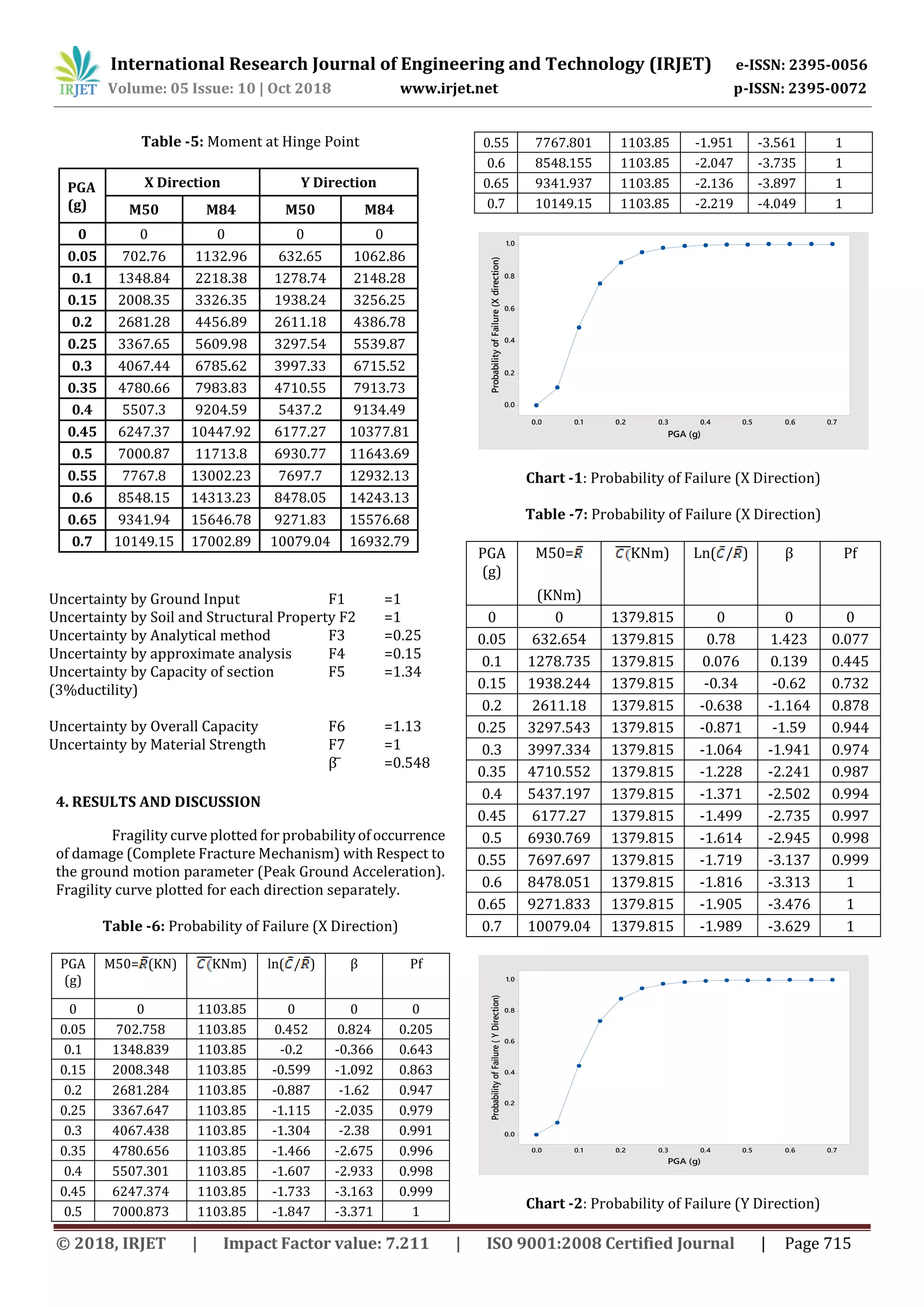
Table -5: Moment at Hinge Point
Uncertainty by Ground Input F1 =1
Uncertainty by Soil and Structural Property F2 =1
Uncertainty by Analytical method F3 =0.25
Uncertainty by approximate analysis F4 =0.15
Uncertainty by Capacity of section F5 =1.34
(3%ductility)
Uncertainty by Overall Capacity F6 =1.13
Uncertainty by Material Strength F7 =1
=0.548
4. RESULTS AND DISCUSSION
Fragility curve plotted for probabilityofoccurrence
of damage (Complete Fracture Mechanism) with Respect to
the ground motion parameter (Peak Ground Acceleration).
Fragility curve plotted for each direction separately.
Table -6: Probability of Failure (X Direction)
PGA
(g)
M50= (KN) KNm) ln( / ) Pf
0 0 1103.85 0 0 0
0.05 702.758 1103.85 0.452 0.824 0.205
0.1 1348.839 1103.85 -0.2 -0.366 0.643
0.15 2008.348 1103.85 -0.599 -1.092 0.863
0.2 2681.284 1103.85 -0.887 -1.62 0.947
0.25 3367.647 1103.85 -1.115 -2.035 0.979
0.3 4067.438 1103.85 -1.304 -2.38 0.991
0.35 4780.656 1103.85 -1.466 -2.675 0.996
0.4 5507.301 1103.85 -1.607 -2.933 0.998
0.45 6247.374 1103.85 -1.733 -3.163 0.999
0.5 7000.873 1103.85 -1.847 -3.371 1
0.55 7767.801 1103.85 -1.951 -3.561 1
0.6 8548.155 1103.85 -2.047 -3.735 1
0.65 9341.937 1103.85 -2.136 -3.897 1
0.7 10149.15 1103.85 -2.219 -4.049 1
0.70.60.50.40.30.20.10.0
1.0
0.8
0.6
0.4
0.2
0.0
PGA (g)
ProbabilityofFailure(Xdirection)
Scatterplot of pfx vs pga
Chart -1: Probability of Failure (X Direction)
Table -7: Probability of Failure (X Direction)
PGA
(g)
M50=
(KNm)
KNm) Ln( / ) Pf
0 0 1379.815 0 0 0
0.05 632.654 1379.815 0.78 1.423 0.077
0.1 1278.735 1379.815 0.076 0.139 0.445
0.15 1938.244 1379.815 -0.34 -0.62 0.732
0.2 2611.18 1379.815 -0.638 -1.164 0.878
0.25 3297.543 1379.815 -0.871 -1.59 0.944
0.3 3997.334 1379.815 -1.064 -1.941 0.974
0.35 4710.552 1379.815 -1.228 -2.241 0.987
0.4 5437.197 1379.815 -1.371 -2.502 0.994
0.45 6177.27 1379.815 -1.499 -2.735 0.997
0.5 6930.769 1379.815 -1.614 -2.945 0.998
0.55 7697.697 1379.815 -1.719 -3.137 0.999
0.6 8478.051 1379.815 -1.816 -3.313 1
0.65 9271.833 1379.815 -1.905 -3.476 1
0.7 10079.04 1379.815 -1.989 -3.629 1
0.70.60.50.40.30.20.10.0
1.0
0.8
0.6
0.4
0.2
0.0
PGA (g)
ProbabilityofFailure(YDirection)
Chart -2: Probability of Failure (Y Direction)
PGA
(g)
X Direction Y Direction
M50 M84 M50 M84
0 0 0 0 0
0.05 702.76 1132.96 632.65 1062.86
0.1 1348.84 2218.38 1278.74 2148.28
0.15 2008.35 3326.35 1938.24 3256.25
0.2 2681.28 4456.89 2611.18 4386.78
0.25 3367.65 5609.98 3297.54 5539.87
0.3 4067.44 6785.62 3997.33 6715.52
0.35 4780.66 7983.83 4710.55 7913.73
0.4 5507.3 9204.59 5437.2 9134.49
0.45 6247.37 10447.92 6177.27 10377.81
0.5 7000.87 11713.8 6930.77 11643.69
0.55 7767.8 13002.23 7697.7 12932.13
0.6 8548.15 14313.23 8478.05 14243.13
0.65 9341.94 15646.78 9271.83 15576.68
0.7 10149.15 17002.89 10079.04 16932.79
International Research Journal of Engineering and Technology (IRJET) e-ISSN: 2395-0056
Volume: 05 Issue: 10 | Oct 2018 www.irjet.net p-ISSN: 2395-0072
© 2018, IRJET | Impact Factor value: 7.211 | ISO 9001:2008 Certified Journal | Page 716
5. CONCLUSIONS
In this paper, fragility curves are plotted for
asymmetric concretemomentresistingframestructures and
following conclusion can be stated
 Probability of failure can be calculated for both
direction (X direction and Y direction) in the
asymmetric RC structure because probability of
failure varying with respect to geometrical
asymmetry.
 By using Probabilistic Risk analysis we can connect
the Probability of damage to the Ground motion
Parameters such as Peak Ground Acceleration
(PGA), Peak Ground Velocity (PGV) and Peak
ground displacement (PGD).
 When the PGA exceeds 0.3g, the above seismic
irregular structurewill more probablyfailure(more
than 80%).
 In this analysis 7 combination of uncertainty was
used, hence the probability of failure was more
accurate.
 By using the Probabilistic Risk Analysis in the
existing structure we can predicttheamountofPGA
which causes the structure Failure.
 Probability of the damage slightly lesser in Y
direction, because moment of inertia is greater in Y
direction.
REFERENCES
[1] Datta, T. K. (2010). Seismic Analysis of Structures. John
Wiley & Sons (Asia) Pte Ltd, Singapore.
[2] IS 1893 (Part 1) (2002). Indian Standard Criteria for
Earthquake Resistant Design of Structures, (fifth
revision). Indian Standard Institute, New Delhi, India.
[3] ATC-40. (1996). Seismic Evaluation and Retrofit of
Concrete Buildings. Applied Technology Council, 555.
Twin Dolphin Drive, Suite 550 Redwood City,California.
[4] FEMA 356. (2000). Pre-standard and Commentary on
the Guidelines for the Seismic Rehabilitation of
Buildings, American Society of Civil Engineers, USA.
[5] FEMA 440. (2005). Improvement of Nonlinear Static
Seismic Analysis Procedures. Department of Homeland
Security, Federal Emergency Management Agency,
Washington, D.C., U.S.A.
[6] HAZUS MH-MR5 Technical and User’s Manual. (2003).
Federal Emergency Management Agency, Washington
DC, USA.
[7] Shinozuka, M., Mizutani, M., Takeda, M., and Kai, Y.
(1989) A Seismic PRA Procedure in Japan and its
Application to a Building PerformanceSafetyEstimation
Part 3-Estimation of Building and Equipment
Performance Safety. Proceedings of ICOSAR 1989, San
Francisco, USA, pp. 637–644.
[8] Gerardo M. Verderame, PaoloRicci,Flavia DeLuca,Carlo
Del Gaudio, Maria Teresa De Risi (2015) Damage
scenarios for RC buildings duringthe2012Emilia (Italy)
earthquake in Elsevier Soil Dynamics and Earthquake
Engineering.
[9] Gerardo M. Verderame, PaoloRicci,Flavia DeLuca,Carlo
Del Gaudio, Maria Teresa De Risi , Deriving SS and S1
Parameters from PGA Maps in World Conference in
Earthquake Engineering.
[10] Thomas, P., Wong, I and Abrahamson, N. (2010).
Verification of Probabilistic Seismic Hazard Analysis
Computer Programs. PEER Report 2010/106, Pacific
Earthquake Engineering Research Center, College of
Engineering, University of California, Berkeley.
[11] C. M. Ravi Kumar, K. S. Babu Narayan, Reddy D. Venkat
Article(2014),Methodology for Probabilistic Seismic
Risk Evaluation ofBuildingStructureBasedonPushover
Analysis in Architectural Design.
BIOGRAPHIES
D. Kesavan Periyasamy student of
post graduate in M.E Structural
Engineering from Thiagarajar
College of Engineering, Madurai,
India. Had completed under
graduation B.E. in Civil Engineering
from Holycross Engineering College
in 2017, Tuticorin, India.
Dr.R.Ponnudurai is working as
Assistant Professor at Thiagarajar
College of Engineering, Madurai,
India. Had completed B.E Civil
Engineering,, M.E Structural
(Fracture mechanics) at MS
University, Baroda, India and Ph.D
from Anna university, Chennai,India.

IRJET- Probabilistic Risk Analysis of Seismic Irregular RC Structure using Fragility Curve

  • 1.
    International Research Journalof Engineering and Technology (IRJET) e-ISSN: 2395-0056 Volume: 05 Issue: 10 | Oct 2018 www.irjet.net p-ISSN: 2395-0072 © 2018, IRJET | Impact Factor value: 7.211 | ISO 9001:2008 Certified Journal | Page 712 Probabilistic Risk Analysis of Seismic Irregular RC Structure Using Fragility Curve D. Kesavan Periyasamy1, Dr.R. Ponnudurai2 1PG Structural Engineering student, Department of Civil Engineering, Thiagarajar College of Engineering, Madurai, Tamilnadu, India 2Assistant Professor, Department of Civil Engineering, Thiagarajar College of Engineering, Madurai, Tamilnadu, India ---------------------------------------------------------------------***--------------------------------------------------------------------- Abstract - Most of the structures are designed for the vertical load only. If the structures are design with consideration of horizontal load (Seismic Load), it will expensive more than designed structure considering vertical load. So far as Probabilistic Risk Analysis has not been widely used for building Frames. Fragility Curve is an effective tool for vulnerability assessment of the structural system because it is estimate the Probability of failure vs Ground motion Parameter (Peak Ground Acceleration). Fragility Curve assessing Pre-earthquake disaster planning as well as post- earthquake recovery and retrofitting programs. In this paper Fragility curve plot for the irregular shaped structure in plan. Due to the asymmetric of the structure property of the structure change with respect to the geometry. So that Probabilistic risk analysis was taken considering both direction of irregular structure separately by using fragility curve. Key Words: Asymmetric RC Structure, Probabilistic Risk Analysis, Probability of Damage, Peak Ground Acceleration, Fragility curve. 1. INTRODUCTION Reliability analysis of structures estimating the probabilities of a structure under various loading (seismic) for its intended period of use. Safety and reliability are both different concept. Safety is a more traditional concept, while reliability is a relatively new one and which means a probabilistic meaning to the traditional concept. Likewise risk analysis and reliability analysis of structures are simultaneously used to express their probabilities offailure. However, they are not actually one and the same thing. Risk analysis of structures is an extension of the reliability analysis to include the consequences of failure. Fragility analysis is used in connection with the seismic reliability or risk analysis of structures. Fragility analysis is aimed at finding the probability of failure of structures for various levels of PGA at the site and is closer to the seismic risk analysis of structures. Fragility curve considered Uncertainty of earthquake, Uncertainties associated with seismic hazard estimates, Uncertainty of ground motion input, Uncertainty of modeling of structures. Uncertainty of analysis and Uncertainty of material property. Gerardo M. Verderame et at al., taken the Case study for various Building after the earthquake of Emilia. 5 different cases of building is taken for the analysis. Fragility Curve assessing Pre-earthquake disaster planning as well as post- earthquake recovery and retrofitting programs. The variation of the damage cause by the Change of PGA in the surface of the Earth[8]. Z.A. Lubkowski et at al., derived the relationship between Ss and s1 by using PGA. In this study PSHA of India also taken so no modification taken for the Empirical Equation[9]. Spectral acceleration canbeobtainedbyS1and SS parameter with respect to Euro Code. By using the spectral acceleration the fragility curve can be plotted and Seismic Hazard response spectrum curve can be plot by the empirical value. C. M. Ravi Kumar et at al.,proposedMethodologyfor Probabilistic Seismic Risk Evaluation of Building Structure Based on Pushover Analysis[11], which talks about Indian provision defines three types of soil i.e. hard soil, medium soil and soft soil based only on standard penetration test (SPT) N value. The standard penetration test has many limitations. It is difficult to determine the appropriate value of N for layered soil and soil profiles can and will have large variations for given region. Because of the limitations of this method, it is best to use the shear wave velocity as a supplement for the standard penetration test N values. Develop an analytical fragility estimates to quantify the seismic vulnerability of RC frame building. Prathibha S. Shetty et at al., estimates the fragility of Rc Building Using Etabs. Fragility curve can be plotted by using Bi linear Capacity spectrum. Damage state occur by Bilinear Capacity spectrum curve Variables. Fragility Curve shall be plotted with more accuracy by considering other uncertainty apart from push over analysis. By this method fragility curve shall be plotted for pre-existing as well as designed structure by only using Push over analysis. 2. DESCRIPTION OF MODEL Four story (G+3) geometric irregular RC framed structure was made up with Structural Analysis Software shown in Fig1 which consist of M25 grade concrete and Fe415 steel are used throughout the structure. Cross sectional dimensions of beams 0.3mx0.45m. Cross sectional dimensions of column 0.3mx0.3m with 9 bars of 12mm dia bar and Slab thickness is 0.18m. Floor to Floor height of 3m, Length of the each bay is 6m, Live load of 4 kN/m2 on all floors. Dead Load of thestructureautomaticallycalculatedby
  • 2.
    International Research Journalof Engineering and Technology (IRJET) e-ISSN: 2395-0056 Volume: 05 Issue: 10 | Oct 2018 www.irjet.net p-ISSN: 2395-0072 © 2018, IRJET | Impact Factor value: 7.211 | ISO 9001:2008 Certified Journal | Page 713 25 kN/m3 density of reinforced cement concrete in addition to the dead load of the beam, column, and slab. Fig -1: Plan of Irregular Structure Stiffness of beam, column and slab are separately calculated then convert the 3D structure into 2D framed model. Stiffness of 2D frame is shown in Fig 2 which was consideration of elevation about X direction.  k1=k2=k3=k4=k5=k6=k7=k8=k9=k10=k11=k12=k1 3=k14=k15= 22.5kN/m  k16=k17=k18=k19=k20=k21=k22=k23=k24=k25= k26=k27=k28=k29=k30=k31=k32=k33=k34=k35= k36=12.5kN/m  k37=k38=k39=k40=k41=k42=k43=k44=k45=k46= k47=k48= 324.675kN/m  k49=k50=k51=k52=k53=k54=k55=k56=k57=k58= k59=k60=k61=k62=k63=k64=k65=k66=k67=k68= k69=k70=k71=k72=k73=k74=k75=k76=k77=k78= k79=k80=k81=k82=k83=k84=170.775kN/m Fig -2: Elevation (X Direction) Stiffness of 2D frame is shown in Fig 2 which was consideration of elevation about Y direction.  k1=k2=k3=k4=k5=k6=k7=k8=k9=k10=k11=k12=k1 3=k14=k15=k16= 10 kN/m  k17=k18=k19=k20=k21=k22=k23=k24=k25=k26= k27=k28=k29=k30=k31=k32=k33=k34=k35=k36= 22.5kN/m  k37=k38=k39=k40=k41=k42=k43=k44=k45=k46= k47=k48= k49=k50=k51=k52=132.3 kN/m  k53=k54=k55=k56=k57=k58=k59=k60=k61=k62= k63=k64=k65=k66=k67=k68=k69=k70=k71=k72= k73=k74=k75=k76=k77=k78=k79=k80=k81=k82= k83=k84= 324.675 kN/m Fig -3: Elevation (Y Direction) 3. DEVELOPMENT OF FRAGILITY CURVE 3.1 Calculation of weight of the Structure Weight of the beam at each floor =2075kN Weight of the slab at each floor =7125kN Weight of the column at each floor=384.75kN Weight of Live Load at each floor =6336kN Weight of wall at each floor =883.2kN Total Weight at First Floor =16803.95kN Total Weight at Second Floor =16803.95kN Total Weight at Third Floor =16803.95kN Total Weight at Fourth Floor =9833.975kN Total Weight of the structure =60245.825kN 3.2 Calculation of Spectral Acceleration by PGA Z.A. Lubkowski derived the relationship betweenSs and S1 by using PGA[9]. In this study PSHA of India also taken so no modification taken for the Empirical Equation. Spectral acceleration can be obtained by S1 and SS parameter with respect to Euro Code. The structure is considered located in Zone A. SS = PGA (0.3386 PGA + 2.1696) S1 = PGA (0.5776 PGA + 0.5967) Table -1: Spectral Acceleration PGA (g) SS S1 SDS SD1 Sa( %g) Sa50 Sa84 0 0 0 0 0 0 0 0 0.05 0.11 0.03 0.06 0.02 0.05 0.02 0.04 0.1 0.22 0.07 0.12 0.03 0.10 0.05 0.08 0.15 0.33 0.10 0.18 0.05 0.15 0.08 0.13 0.2 0.45 0.14 0.24 0.08 0.20 0.10 0.17 0.25 0.56 0.19 0.30 0.10 0.26 0.13 0.22 0.3 0.68 0.23 0.36 0.12 0.31 0.16 0.26 0.35 0.80 0.28 0.43 0.15 0.37 0.18 0.31 0.4 0.92 0.33 0.49 0.18 0.42 0.21 0.35 0.45 1.04 0.39 0.56 0.21 0.23 0.24 0.40 0.5 1.17 0.44 0.62 0.24 0.26 0.27 0.45 0.55 1.30 0.50 0.69 0.27 0.30 0.30 0.50 0.6 1.42 0.57 0.76 0.30 0.33 0.33 0.55 0.65 1.55 0.63 0.83 0.34 0.37 0.36 0.61 0.7 1.68 0.70 0.90 0.37 0.41 0.39 0.66
  • 3.
    International Research Journalof Engineering and Technology (IRJET) e-ISSN: 2395-0056 Volume: 05 Issue: 10 | Oct 2018 www.irjet.net p-ISSN: 2395-0072 © 2018, IRJET | Impact Factor value: 7.211 | ISO 9001:2008 Certified Journal | Page 714 3.3 Calculating Plastic Hinge point by Pushover Analysis The irregular structures modelled and performed pushover analysis using software. Pushover analysis performed over both X and Y Direction. Fig -4: Pushover Analysis in X direction Fig -5: Pushover Analysis in Y direction 3.4 Calculation of Force at Each Floor Considering the zone factor 0.16, Response Reduction Factor 3 and Importance Factor as 1.5 then found the Force at each floor by adopting method of seismic coefficient specified in IS 1893 part I. Table -2: Base Shear PGA(g) Ah50 Ah84 Vb50(KN) Vb84(KN) 0 0 0 0 0 0.05 0.01 0.02 603.69 1014.19 0.1 0.02 0.03 1220.18 2049.91 0.15 0.03 0.05 1849.49 3107.15 0.2 0.04 0.07 2491.62 4185.91 0.25 0.05 0.09 3146.55 5286.21 0.3 0.06 0.11 3814.30 6408.02 0.35 0.07 0.13 4494.86 7551.36 0.4 0.09 0.14 5188.23 8716.23 0.45 0.10 0.16 5894.42 9902.62 0.5 0.11 0.18 6613.41 11110.54 0.55 0.12 0.20 7345.22 12339.98 0.6 0.13 0.23 8089.85 13590.94 0.65 0.15 0.25 8847.28 14863.43 0.7 0.16 0.27 9617.53 16157.45 Table -3: Seismic Coefficient Floor Number Height (m) Wi Wihi 2 Wihi 2/ ∑ Wihi 2 1 3 16803.95 151235.6 0.0428 2 6 16803.95 604942.2 0.1712 3 9 16803.95 1361120 0.3852 4 12 9833.975 1416092 0.4007 The outer dimension of structure along X and Y direction are same hence force at each floor can be same for both direction. Table -4: Force at Each Floor 3.5 Calculation of uncertainty Parameters In this paper Simplified Probabilistic Risk Analysis of Structures (made by Shinozuka et al) method has been adopted[7]. And considered complete failure mechanism PGA (g) Force in Each floor due to Sa50 (KN) P1 P2 P3 P4 0 0.00 0.00 0.00 0.00 0.05 25.84 103.36 232.55 241.94 0.1 52.23 208.90 470.03 489.02 0.15 79.16 316.65 712.45 741.23 0.2 106.65 426.58 959.81 998.57 0.25 134.68 538.71 1212.10 1261.06 0.3 163.26 653.03 1469.33 1528.67 0.35 192.39 769.55 1731.49 1801.42 0.4 222.07 888.26 1998.59 2079.31 0.45 252.29 1009.17 2270.62 2362.33 0.5 283.07 1132.26 2547.59 2650.48 0.55 314.39 1257.55 2829.50 2943.77 0.6 346.26 1385.04 3116.34 3242.20 0.65 378.68 1514.72 3408.11 3545.76 0.7 411.65 1646.59 3704.83 3854.46 PGA (g) Force in Each floor due to Sa84 (KN) P1 P2 P3 P4 0 0 0 0 0 0.05 43.41 173.64 390.68 406.46 0.1 87.74 350.96 789.66 821.55 0.15 132.99 531.97 1196.92 1245.26 0.2 179.17 716.66 1612.48 1677.61 0.25 226.26 905.04 2036.33 2118.57 0.3 274.28 1097.1 2468.47 2568.17 0.35 323.21 1292.85 2908.91 3026.39 0.4 373.07 1492.28 3357.63 3493.24 0.45 423.85 1695.4 3814.65 3968.71 0.5 475.55 1902.2 4279.96 4452.81 0.55 528.18 2112.69 4753.56 4945.54 0.6 581.72 2326.86 5235.45 5446.9 0.65 636.18 2544.72 5725.63 5956.88 0.7 691.57 2766.27 6224.11 6475.49
  • 4.
    International Research Journalof Engineering and Technology (IRJET) e-ISSN: 2395-0056 Volume: 05 Issue: 10 | Oct 2018 www.irjet.net p-ISSN: 2395-0072 © 2018, IRJET | Impact Factor value: 7.211 | ISO 9001:2008 Certified Journal | Page 715 Table -5: Moment at Hinge Point Uncertainty by Ground Input F1 =1 Uncertainty by Soil and Structural Property F2 =1 Uncertainty by Analytical method F3 =0.25 Uncertainty by approximate analysis F4 =0.15 Uncertainty by Capacity of section F5 =1.34 (3%ductility) Uncertainty by Overall Capacity F6 =1.13 Uncertainty by Material Strength F7 =1 =0.548 4. RESULTS AND DISCUSSION Fragility curve plotted for probabilityofoccurrence of damage (Complete Fracture Mechanism) with Respect to the ground motion parameter (Peak Ground Acceleration). Fragility curve plotted for each direction separately. Table -6: Probability of Failure (X Direction) PGA (g) M50= (KN) KNm) ln( / ) Pf 0 0 1103.85 0 0 0 0.05 702.758 1103.85 0.452 0.824 0.205 0.1 1348.839 1103.85 -0.2 -0.366 0.643 0.15 2008.348 1103.85 -0.599 -1.092 0.863 0.2 2681.284 1103.85 -0.887 -1.62 0.947 0.25 3367.647 1103.85 -1.115 -2.035 0.979 0.3 4067.438 1103.85 -1.304 -2.38 0.991 0.35 4780.656 1103.85 -1.466 -2.675 0.996 0.4 5507.301 1103.85 -1.607 -2.933 0.998 0.45 6247.374 1103.85 -1.733 -3.163 0.999 0.5 7000.873 1103.85 -1.847 -3.371 1 0.55 7767.801 1103.85 -1.951 -3.561 1 0.6 8548.155 1103.85 -2.047 -3.735 1 0.65 9341.937 1103.85 -2.136 -3.897 1 0.7 10149.15 1103.85 -2.219 -4.049 1 0.70.60.50.40.30.20.10.0 1.0 0.8 0.6 0.4 0.2 0.0 PGA (g) ProbabilityofFailure(Xdirection) Scatterplot of pfx vs pga Chart -1: Probability of Failure (X Direction) Table -7: Probability of Failure (X Direction) PGA (g) M50= (KNm) KNm) Ln( / ) Pf 0 0 1379.815 0 0 0 0.05 632.654 1379.815 0.78 1.423 0.077 0.1 1278.735 1379.815 0.076 0.139 0.445 0.15 1938.244 1379.815 -0.34 -0.62 0.732 0.2 2611.18 1379.815 -0.638 -1.164 0.878 0.25 3297.543 1379.815 -0.871 -1.59 0.944 0.3 3997.334 1379.815 -1.064 -1.941 0.974 0.35 4710.552 1379.815 -1.228 -2.241 0.987 0.4 5437.197 1379.815 -1.371 -2.502 0.994 0.45 6177.27 1379.815 -1.499 -2.735 0.997 0.5 6930.769 1379.815 -1.614 -2.945 0.998 0.55 7697.697 1379.815 -1.719 -3.137 0.999 0.6 8478.051 1379.815 -1.816 -3.313 1 0.65 9271.833 1379.815 -1.905 -3.476 1 0.7 10079.04 1379.815 -1.989 -3.629 1 0.70.60.50.40.30.20.10.0 1.0 0.8 0.6 0.4 0.2 0.0 PGA (g) ProbabilityofFailure(YDirection) Chart -2: Probability of Failure (Y Direction) PGA (g) X Direction Y Direction M50 M84 M50 M84 0 0 0 0 0 0.05 702.76 1132.96 632.65 1062.86 0.1 1348.84 2218.38 1278.74 2148.28 0.15 2008.35 3326.35 1938.24 3256.25 0.2 2681.28 4456.89 2611.18 4386.78 0.25 3367.65 5609.98 3297.54 5539.87 0.3 4067.44 6785.62 3997.33 6715.52 0.35 4780.66 7983.83 4710.55 7913.73 0.4 5507.3 9204.59 5437.2 9134.49 0.45 6247.37 10447.92 6177.27 10377.81 0.5 7000.87 11713.8 6930.77 11643.69 0.55 7767.8 13002.23 7697.7 12932.13 0.6 8548.15 14313.23 8478.05 14243.13 0.65 9341.94 15646.78 9271.83 15576.68 0.7 10149.15 17002.89 10079.04 16932.79
  • 5.
    International Research Journalof Engineering and Technology (IRJET) e-ISSN: 2395-0056 Volume: 05 Issue: 10 | Oct 2018 www.irjet.net p-ISSN: 2395-0072 © 2018, IRJET | Impact Factor value: 7.211 | ISO 9001:2008 Certified Journal | Page 716 5. CONCLUSIONS In this paper, fragility curves are plotted for asymmetric concretemomentresistingframestructures and following conclusion can be stated  Probability of failure can be calculated for both direction (X direction and Y direction) in the asymmetric RC structure because probability of failure varying with respect to geometrical asymmetry.  By using Probabilistic Risk analysis we can connect the Probability of damage to the Ground motion Parameters such as Peak Ground Acceleration (PGA), Peak Ground Velocity (PGV) and Peak ground displacement (PGD).  When the PGA exceeds 0.3g, the above seismic irregular structurewill more probablyfailure(more than 80%).  In this analysis 7 combination of uncertainty was used, hence the probability of failure was more accurate.  By using the Probabilistic Risk Analysis in the existing structure we can predicttheamountofPGA which causes the structure Failure.  Probability of the damage slightly lesser in Y direction, because moment of inertia is greater in Y direction. REFERENCES [1] Datta, T. K. (2010). Seismic Analysis of Structures. John Wiley & Sons (Asia) Pte Ltd, Singapore. [2] IS 1893 (Part 1) (2002). Indian Standard Criteria for Earthquake Resistant Design of Structures, (fifth revision). Indian Standard Institute, New Delhi, India. [3] ATC-40. (1996). Seismic Evaluation and Retrofit of Concrete Buildings. Applied Technology Council, 555. Twin Dolphin Drive, Suite 550 Redwood City,California. [4] FEMA 356. (2000). Pre-standard and Commentary on the Guidelines for the Seismic Rehabilitation of Buildings, American Society of Civil Engineers, USA. [5] FEMA 440. (2005). Improvement of Nonlinear Static Seismic Analysis Procedures. Department of Homeland Security, Federal Emergency Management Agency, Washington, D.C., U.S.A. [6] HAZUS MH-MR5 Technical and User’s Manual. (2003). Federal Emergency Management Agency, Washington DC, USA. [7] Shinozuka, M., Mizutani, M., Takeda, M., and Kai, Y. (1989) A Seismic PRA Procedure in Japan and its Application to a Building PerformanceSafetyEstimation Part 3-Estimation of Building and Equipment Performance Safety. Proceedings of ICOSAR 1989, San Francisco, USA, pp. 637–644. [8] Gerardo M. Verderame, PaoloRicci,Flavia DeLuca,Carlo Del Gaudio, Maria Teresa De Risi (2015) Damage scenarios for RC buildings duringthe2012Emilia (Italy) earthquake in Elsevier Soil Dynamics and Earthquake Engineering. [9] Gerardo M. Verderame, PaoloRicci,Flavia DeLuca,Carlo Del Gaudio, Maria Teresa De Risi , Deriving SS and S1 Parameters from PGA Maps in World Conference in Earthquake Engineering. [10] Thomas, P., Wong, I and Abrahamson, N. (2010). Verification of Probabilistic Seismic Hazard Analysis Computer Programs. PEER Report 2010/106, Pacific Earthquake Engineering Research Center, College of Engineering, University of California, Berkeley. [11] C. M. Ravi Kumar, K. S. Babu Narayan, Reddy D. Venkat Article(2014),Methodology for Probabilistic Seismic Risk Evaluation ofBuildingStructureBasedonPushover Analysis in Architectural Design. BIOGRAPHIES D. Kesavan Periyasamy student of post graduate in M.E Structural Engineering from Thiagarajar College of Engineering, Madurai, India. Had completed under graduation B.E. in Civil Engineering from Holycross Engineering College in 2017, Tuticorin, India. Dr.R.Ponnudurai is working as Assistant Professor at Thiagarajar College of Engineering, Madurai, India. Had completed B.E Civil Engineering,, M.E Structural (Fracture mechanics) at MS University, Baroda, India and Ph.D from Anna university, Chennai,India.