Improved Drift Assessment Approach for
Steel Moment Frames under
Realistic Earthquake Loading
BORJAN PETRESKI, MIHAIL GAREVSKI
OPENSEES DAYS EUROPE 2017,
1ST EUROPEAN CONFERENCE ON OPENSEES,
PORTO, PORTUGAL, 19–20 JUNE 2017
University of Ss. Cyril and Methodius - Skopje
Institute of Earthquake Engineering and
Engineering Seismology - IZIIS
Eurocode Steel Structural
Types
Concentrically Braced Frames Eccentrically Braced Frames
OpenSees Days Europe 2017, 1st European Conference on OpenSees, Porto, Portugal, 19–20 June 2017
Eurocode Steel Structural
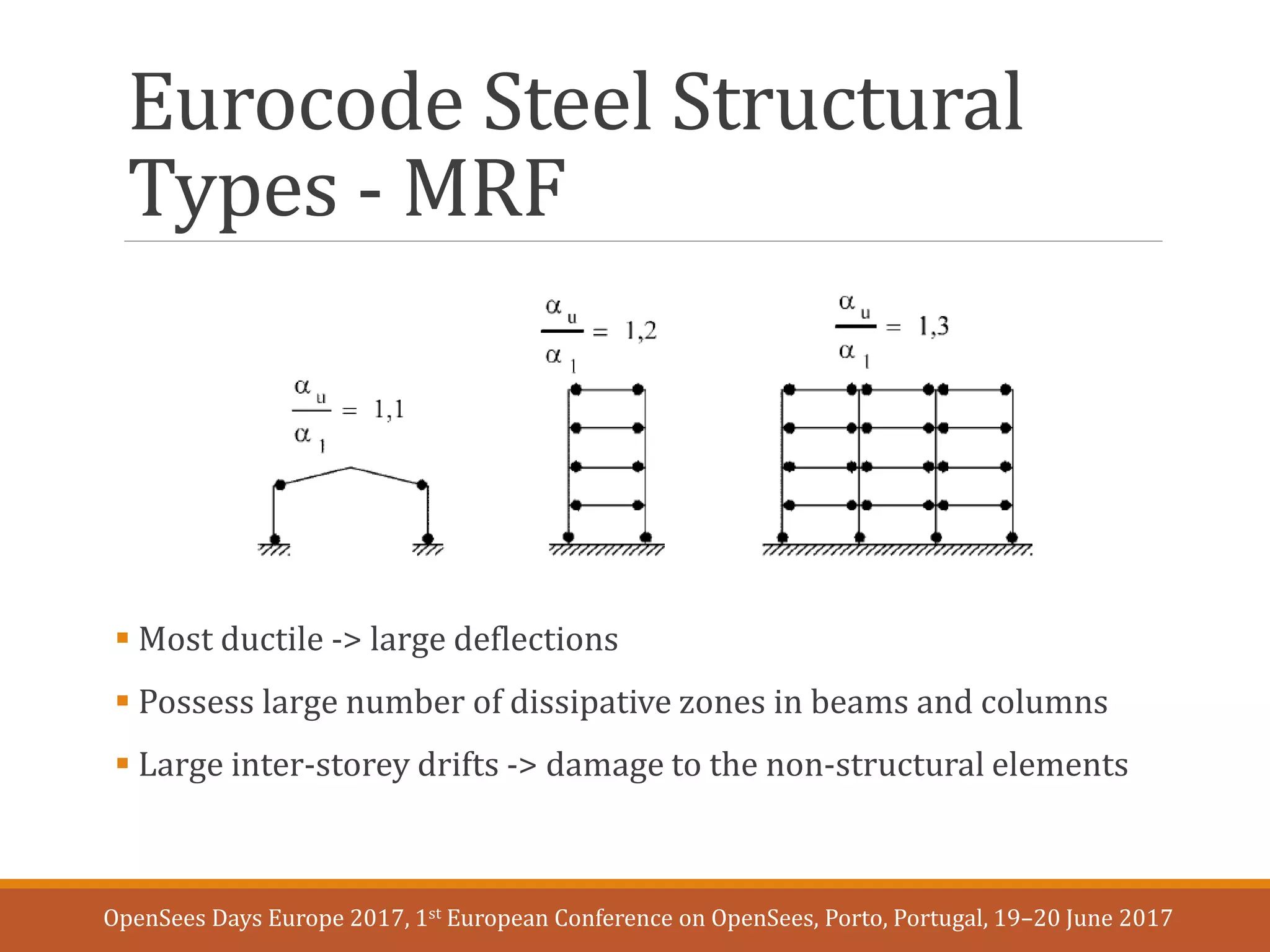
Types - MRF
 Most ductile -> large deflections
 Possess large number of dissipative zones in beams and columns
 Large inter-storey drifts -> damage to the non-structural elements
OpenSees Days Europe 2017, 1st European Conference on OpenSees, Porto, Portugal, 19–20 June 2017
Eurocode Steel Structural
Types - MRF
 One research suggests that “EC8 requirements for drift - a lot more
rigorous than the provisions in other earthquake design codes -
stability factor (θ). It can often govern the design, resulting in over-
strength which reduces the ductility demand of the structure and
affects the loads acting on it, especially if a high ductility factor is
adopted” - Elghazouli (2010)
 Another implies that “EC8 provisions are highly conservative while
the US provisions seem to under-predict the global and maximum drift
modification factors. Also, an oversimplified nature of drift demand
criteria is adopted in the design codes, particularly in the European
codes of practice” - Kumar (2013)
Conclusion: Significant enhancement - by adopting improved models
that can capture the influence of the key structural and loading
characteristics
OpenSees Days Europe 2017, 1st European Conference on OpenSees, Porto, Portugal, 19–20 June 2017
Plasticity modelling
approaches
Distributed plasticity Lumped plasticity
Image source: Deierlein, Reinhorn & Willford, 2010
OpenSees Days Europe 2017, 1st European Conference on OpenSees, Porto, Portugal, 19–20 June 2017
Performance based
assessment
Scenario based
•Medium hazard scenario – Type 1,
Soil C - EC8 design spectrum, PGA
= 0.25g
•High hazard scenario –Type 1, Soil
C - EC8 design spectrum, PGA =
0.35g
Intensity based
•100% - design level earthquake
(Limit State of Significant Damage)
•175% - near collapse level
earthquake (Limit State of Near
Collapse)
•350% - 2 x LS of NC
OpenSees Days Europe 2017, 1st European Conference on OpenSees, Porto, Portugal, 19–20 June 2017
Structural characteristics
3 bays x 6 metres
HFS = 4.5m, HOS = 3.5m
Rigid joints
S355, γov =1.25, E = 210 GPa,
ν = 0.3, 0.25% strain hardening
q = 6.5
OpenSees Days Europe 2017, 1st European Conference on OpenSees, Porto, Portugal, 19–20 June 2017
Modified Ibarra –
Krawinkler model
Image source: Lignos & Krawinkler, 2010
OpenSees Days Europe 2017, 1st European Conference on OpenSees, Porto, Portugal, 19–20 June 2017
Rigid vs. Hysteretic plastic
hinges
OpenSees Days Europe 2017, 1st European Conference on OpenSees, Porto, Portugal, 19–20 June 2017
Floor drift demands (MH)
Model Total frame drift (%) Total frame displacement (m)
Distributed 1.19921857 0.264
Lumped 1.24870571 0.275
Model Total frame drift (%) Total frame displacement (m)
Distributed 0.89700814 0.197
Lumped 0.94172257 0.207
OpenSees Days Europe 2017, 1st European Conference on OpenSees, Porto, Portugal, 19–20 June 2017
Floor drift demands (MH)
Model Total frame drift (%) Total frame displacement (m)
Distributed 2.71226000 0.597
Lumped 3.02523857 0.666
OpenSees Days Europe 2017, 1st European Conference on OpenSees, Porto, Portugal, 19–20 June 2017
Residual drift demands
(MH)
OpenSees Days Europe 2017, 1st European Conference on OpenSees, Porto, Portugal, 19–20 June 2017
Residual drift demands
(MH)
OpenSees Days Europe 2017, 1st European Conference on OpenSees, Porto, Portugal, 19–20 June 2017
Floor drift demands (HH)
Model Total frame drift (%) Total frame displacement (m)
Distributed 1.00233800 0.221
Lumped 1.08395857 0.238
Model Total frame drift (%) Total frame displacement (m)
Distributed 1.58467571 0.349
Lumped 1.63203286 0.359
OpenSees Days Europe 2017, 1st European Conference on OpenSees, Porto, Portugal, 19–20 June 2017
Floor drift demands (HH)
Model Total frame drift (%) Total frame displacement (m)
Distributed 2.79344400 0.615
Lumped 3.04388600 0.670
OpenSees Days Europe 2017, 1st European Conference on OpenSees, Porto, Portugal, 19–20 June 2017
Residual drift demands (HH)
OpenSees Days Europe 2017, 1st European Conference on OpenSees, Porto, Portugal, 19–20 June 2017
Residual drift demands (HH)
OpenSees Days Europe 2017, 1st European Conference on OpenSees, Porto, Portugal, 19–20 June 2017
Conclusions
In general, the lumped plasticity model experiences greater drift
demand
Main difference - at greater levels of inelasticity (3% roof drift)
Compliance of the models with previous study parameters and
design codes
General compliance with previous research regarding the
distribution over height
Lumped model tends to match the distributed model’s response at
lower intensity levels and deviates from it largely after the
deterioration of the material takes place
OpenSees Days Europe 2017, 1st European Conference on OpenSees, Porto, Portugal, 19–20 June 2017
References
ATC. (2011) Seismic Performance Assessment of Buildings, 90% Draft. ATC-58-1
Deierlein, G. G., Reinhorn, A. M. & Willford, M. R. (2010) Nonlinear structural analysis for seismic
design
Elghazouli, A. (2010) Assessment of European seismic design procedures for steel framed
structures
Geschwindner, L. F. (2002) A practical look at frame analysis, stability and leaning columns
Gupta, A. & Krawinkler, H. (1999) Seismic Demands for the Performance Evaluation of Steel
Moment Resisting Frame Structures
Ibarra, L. F. & Krawinkler, H. (2005) Global collapse of frame structures under seismic excitations
Ibarra, L. F., Medina, R. A. & Krawinkler, H. (2005) Hysteretic models that incorporate strength
and stiffness deterioration
Kumar, M., Stafford, P. & Elghazouli, A. (2013) Influence of ground motion characteristics on drift
demands in steel moment frames designed to Eurocode 8
Lignos, D. G. & Krawinkler, H. (2012) Development and utilization of structural component
databases for performance-based earthquake engineering.
Lignos, D. G. & Krawinkler, H. (2010) Deterioration modeling of steel components in support of
collapse prediction of steel moment frames under earthquake loading
OpenSees Days Europe 2017, 1st European Conference on OpenSees, Porto, Portugal, 19–20 June 2017

Improved drift assessment approach for steel moment frames under realistic earthquake loading

  • 1.
    Improved Drift AssessmentApproach for Steel Moment Frames under Realistic Earthquake Loading BORJAN PETRESKI, MIHAIL GAREVSKI OPENSEES DAYS EUROPE 2017, 1ST EUROPEAN CONFERENCE ON OPENSEES, PORTO, PORTUGAL, 19–20 JUNE 2017 University of Ss. Cyril and Methodius - Skopje Institute of Earthquake Engineering and Engineering Seismology - IZIIS
  • 2.
    Eurocode Steel Structural Types ConcentricallyBraced Frames Eccentrically Braced Frames OpenSees Days Europe 2017, 1st European Conference on OpenSees, Porto, Portugal, 19–20 June 2017
  • 3.
    Eurocode Steel Structural Types- MRF  Most ductile -> large deflections  Possess large number of dissipative zones in beams and columns  Large inter-storey drifts -> damage to the non-structural elements OpenSees Days Europe 2017, 1st European Conference on OpenSees, Porto, Portugal, 19–20 June 2017
  • 4.
    Eurocode Steel Structural Types- MRF  One research suggests that “EC8 requirements for drift - a lot more rigorous than the provisions in other earthquake design codes - stability factor (θ). It can often govern the design, resulting in over- strength which reduces the ductility demand of the structure and affects the loads acting on it, especially if a high ductility factor is adopted” - Elghazouli (2010)  Another implies that “EC8 provisions are highly conservative while the US provisions seem to under-predict the global and maximum drift modification factors. Also, an oversimplified nature of drift demand criteria is adopted in the design codes, particularly in the European codes of practice” - Kumar (2013) Conclusion: Significant enhancement - by adopting improved models that can capture the influence of the key structural and loading characteristics OpenSees Days Europe 2017, 1st European Conference on OpenSees, Porto, Portugal, 19–20 June 2017
  • 5.
    Plasticity modelling approaches Distributed plasticityLumped plasticity Image source: Deierlein, Reinhorn & Willford, 2010 OpenSees Days Europe 2017, 1st European Conference on OpenSees, Porto, Portugal, 19–20 June 2017
  • 6.
    Performance based assessment Scenario based •Mediumhazard scenario – Type 1, Soil C - EC8 design spectrum, PGA = 0.25g •High hazard scenario –Type 1, Soil C - EC8 design spectrum, PGA = 0.35g Intensity based •100% - design level earthquake (Limit State of Significant Damage) •175% - near collapse level earthquake (Limit State of Near Collapse) •350% - 2 x LS of NC OpenSees Days Europe 2017, 1st European Conference on OpenSees, Porto, Portugal, 19–20 June 2017
  • 7.
    Structural characteristics 3 baysx 6 metres HFS = 4.5m, HOS = 3.5m Rigid joints S355, γov =1.25, E = 210 GPa, ν = 0.3, 0.25% strain hardening q = 6.5 OpenSees Days Europe 2017, 1st European Conference on OpenSees, Porto, Portugal, 19–20 June 2017
  • 8.
    Modified Ibarra – Krawinklermodel Image source: Lignos & Krawinkler, 2010 OpenSees Days Europe 2017, 1st European Conference on OpenSees, Porto, Portugal, 19–20 June 2017
  • 9.
    Rigid vs. Hystereticplastic hinges OpenSees Days Europe 2017, 1st European Conference on OpenSees, Porto, Portugal, 19–20 June 2017
  • 10.
    Floor drift demands(MH) Model Total frame drift (%) Total frame displacement (m) Distributed 1.19921857 0.264 Lumped 1.24870571 0.275 Model Total frame drift (%) Total frame displacement (m) Distributed 0.89700814 0.197 Lumped 0.94172257 0.207 OpenSees Days Europe 2017, 1st European Conference on OpenSees, Porto, Portugal, 19–20 June 2017
  • 11.
    Floor drift demands(MH) Model Total frame drift (%) Total frame displacement (m) Distributed 2.71226000 0.597 Lumped 3.02523857 0.666 OpenSees Days Europe 2017, 1st European Conference on OpenSees, Porto, Portugal, 19–20 June 2017
  • 12.
    Residual drift demands (MH) OpenSeesDays Europe 2017, 1st European Conference on OpenSees, Porto, Portugal, 19–20 June 2017
  • 13.
    Residual drift demands (MH) OpenSeesDays Europe 2017, 1st European Conference on OpenSees, Porto, Portugal, 19–20 June 2017
  • 14.
    Floor drift demands(HH) Model Total frame drift (%) Total frame displacement (m) Distributed 1.00233800 0.221 Lumped 1.08395857 0.238 Model Total frame drift (%) Total frame displacement (m) Distributed 1.58467571 0.349 Lumped 1.63203286 0.359 OpenSees Days Europe 2017, 1st European Conference on OpenSees, Porto, Portugal, 19–20 June 2017
  • 15.
    Floor drift demands(HH) Model Total frame drift (%) Total frame displacement (m) Distributed 2.79344400 0.615 Lumped 3.04388600 0.670 OpenSees Days Europe 2017, 1st European Conference on OpenSees, Porto, Portugal, 19–20 June 2017
  • 16.
    Residual drift demands(HH) OpenSees Days Europe 2017, 1st European Conference on OpenSees, Porto, Portugal, 19–20 June 2017
  • 17.
    Residual drift demands(HH) OpenSees Days Europe 2017, 1st European Conference on OpenSees, Porto, Portugal, 19–20 June 2017
  • 18.
    Conclusions In general, thelumped plasticity model experiences greater drift demand Main difference - at greater levels of inelasticity (3% roof drift) Compliance of the models with previous study parameters and design codes General compliance with previous research regarding the distribution over height Lumped model tends to match the distributed model’s response at lower intensity levels and deviates from it largely after the deterioration of the material takes place OpenSees Days Europe 2017, 1st European Conference on OpenSees, Porto, Portugal, 19–20 June 2017
  • 19.
    References ATC. (2011) SeismicPerformance Assessment of Buildings, 90% Draft. ATC-58-1 Deierlein, G. G., Reinhorn, A. M. & Willford, M. R. (2010) Nonlinear structural analysis for seismic design Elghazouli, A. (2010) Assessment of European seismic design procedures for steel framed structures Geschwindner, L. F. (2002) A practical look at frame analysis, stability and leaning columns Gupta, A. & Krawinkler, H. (1999) Seismic Demands for the Performance Evaluation of Steel Moment Resisting Frame Structures Ibarra, L. F. & Krawinkler, H. (2005) Global collapse of frame structures under seismic excitations Ibarra, L. F., Medina, R. A. & Krawinkler, H. (2005) Hysteretic models that incorporate strength and stiffness deterioration Kumar, M., Stafford, P. & Elghazouli, A. (2013) Influence of ground motion characteristics on drift demands in steel moment frames designed to Eurocode 8 Lignos, D. G. & Krawinkler, H. (2012) Development and utilization of structural component databases for performance-based earthquake engineering. Lignos, D. G. & Krawinkler, H. (2010) Deterioration modeling of steel components in support of collapse prediction of steel moment frames under earthquake loading OpenSees Days Europe 2017, 1st European Conference on OpenSees, Porto, Portugal, 19–20 June 2017