Caribbean and Central American
Seismic Risk Assessment Project
March 21, 2018
Santo Domingo, República
Alejandro Calderón, MSc.
•  unique approach
•  cohesive pathway 
•  actionable solutions
Scientific
Framework
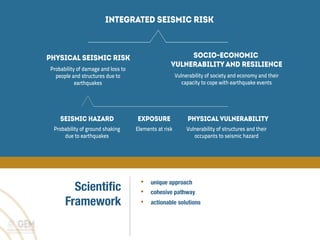
INTEGRATED SEISMIC RISK
PHYSICAL SEISMIC RISK
Probability of damage and loss to
people and structures due to
earthquakes
EXPOSURE
Elements at risk
PHYSICAL VULNERABILITY
Vulnerability of structures and their
occupants to seismic hazard
SEISMIC HAZARD
Probability of ground shaking
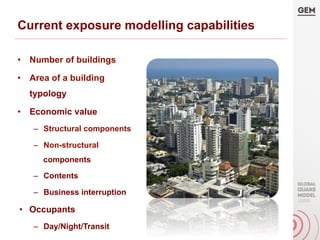
due to earthquakes
SOCIO-ECONOMIC
VULNERABILITY AND RESILIENCE
Vulnerability of society and economy and their
capacity to cope with earthquake events
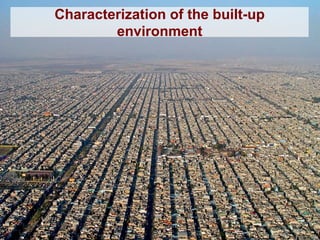
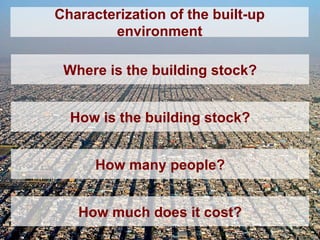
Characterization of the built-up
environment
How is the building stock?
How many people?
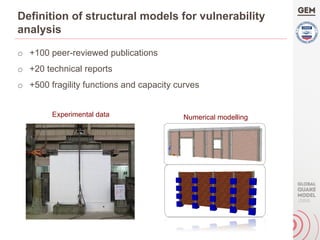
How much does it cost?
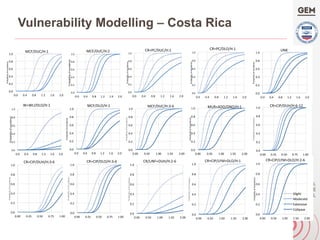
Where is the building stock?
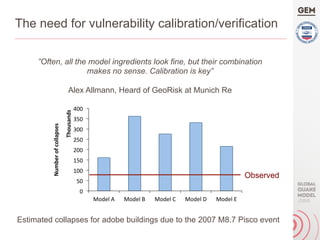
Characterization of the built-up
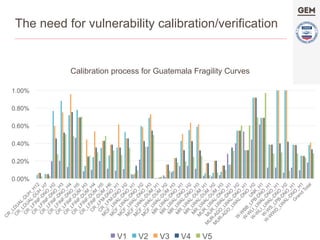
environment
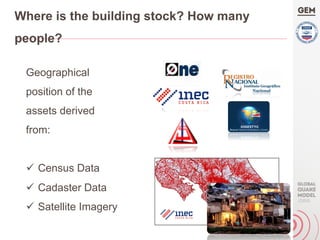
Where is the building stock? How many
people?
Geographical
position of the
assets derived
from:
ü  Census Data
ü  Cadaster Data
ü  Satellite Imagery
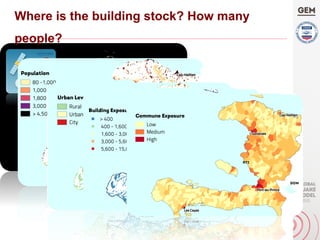
Where is the building stock? How many
people?
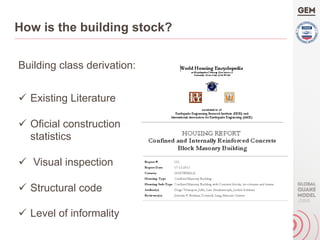
How is the building stock?
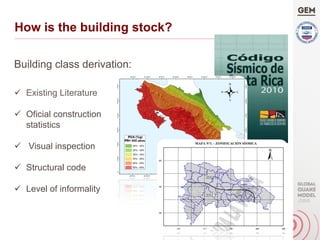
Building class derivation:
ü  Existing Literature
ü  Oficial construction
statistics
ü  Visual inspection
ü  Structural code
ü  Level of informality
How is the building stock?
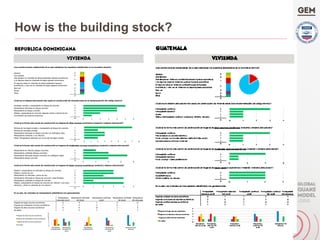
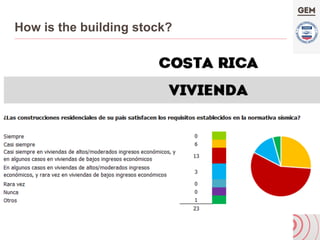
¿Las construcciones residenciales de su país satisfacen los requisitos establecidos en la normativa sísmica?
Siempre 0
Casi siempre 0
5
12
Rara vez 0
Nunca 0
Otros 0
17
¿Cuál era el sistema estructural más usado en construcción de vivienda antes de la implementación del código sísmico?
Hormigón armado y mampostería en bloque de concreto 5
Mampostería reforzada en bloque concreto 4
Mampostería en bloque concreto 4
Madera, mampostería en concreto (algunas veces) y techos de zinc 2
Combinación de todas las anteriores 1
16
¿Cuál es la forma más común de construcción en hogares de altos recursos económicos (material y sistema estructural)?
Pórticos de hormigón armado y mampostería de bloque de concreto 7
Pórticos de hormigón armado 2
Mampostería reforzada en bloque concreto con diafragma rígico 3
Mampostería confinada y con refuerzo 3
Mixto: Mampostería reforzada con muros de hormigón armado 2
17
¿Cuál es la forma más común de construcción en hogares de moderados recursos económicos (material y sistema estructural)?
Mampostería sin reforzar (bloque concreto) 2
Mampostería confinada (bloque concreto) 4
Mampostería reforzada (bloque concreto) con diafragma rígido 7
Mampostería bloque concreto 4
17
¿Cuál es la forma más común de construcción en hogares de bajos recursos económicos (material y sistema estructural)?
Madera y mampostería no reforzada en bloque de concreto 3
Madera y techos de zinc 3
Mampostería no reforzada y techo de zinc 2
Mampostería reforzada en bloque de concreto y losas flexibles 4
Mampostería confinada en bloque de concreto 1
4
17
En su país, las viviendas en mampostería (albañilería) son generalmente
Mampostería
reforzada dúctil
Mampostería
NO reforzada
Hogares de bajos recursos económicos 0 8 1 9 12
Hogares de moderados recursos económicos 7 4 4 6 1
Hogares de altos recursos económicos 8 0 10 1 0
No aplica 2 5 2 1 4
República Dominicana
VIVIENDA
Casi siempre en viviendas de altos/moderados ingresos económicos,
y en algunos casos en viviendas de bajos ingresos económicos
En algunos casos en viviendas de altos/moderados ingresos
económicos, y rara vez en viviendas de bajos ingresos económicos
Mampostería reforzada
NO dúctil
Mampostería confinada
dúctil
Mampostería confinada
NO dúctil
Madera, mampostería en bloque de concreto (sin reforzar o con poco
refuerzo), y techo en planchas de zinc (alucin)
0 1 2 3 4 5 6 7 8
0 1 2 3 4 5 6
0 2 4 6 8
0 1 2 3 4 5
0
2
4
6
8
10
12
14
Mampostería
reforzada dúctil
Mampostería
reforzada NO
dúctil
Mampostería
confinada dúctil
Mampostería
confinada NO
dúctil
Mampostería NO
reforzada
Hogares de bajos recursos económicos
Hogares de moderados recursos económicos
Hogares de altos recursos económicos
No aplica
How is the building stock?
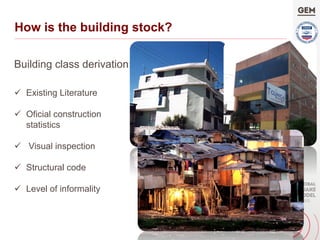
Building class derivation:
ü  Existing Literature
ü  Oficial construction
statistics
ü  Visual inspection
ü  Structural code
ü  Level of informality
How is the building stock?
Building class derivation:
ü  Existing Literature
ü  Oficial construction
statistics
ü  Visual inspection
ü  Structural code
ü  Level of informality
How is the building stock?
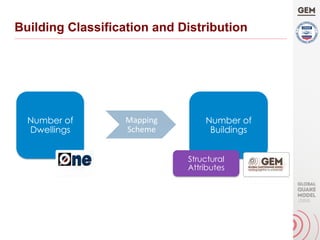
Number of
Dwellings
Number of
Buildings
Mapping	
Scheme	
Structural
Attributes
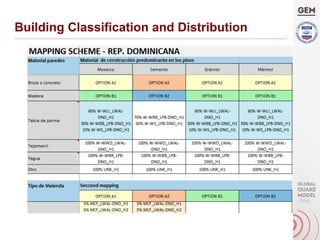
Building Classification and Distribution
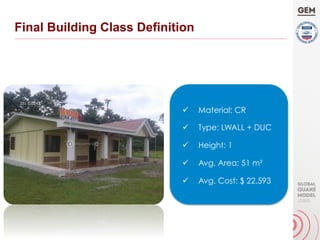
Final Building Class Definition
ü  Material: CR
ü  Type: LWALL + DUC
ü  Height: 1
ü  Avg. Area: 51 m²
ü  Avg. Cost: $ 22,593
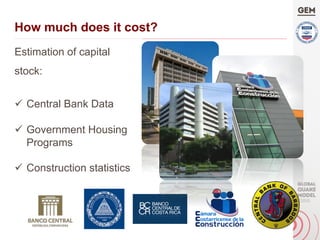
Estimation of capital
stock:
ü  Central Bank Data
ü  Government Housing
Programs
ü  Construction statistics
How much does it cost?
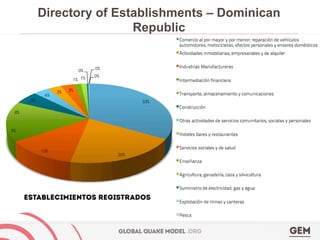
Building Inventories:
Residencial – Comercial - Industrial
Directory of Establishments – Dominican
Republic
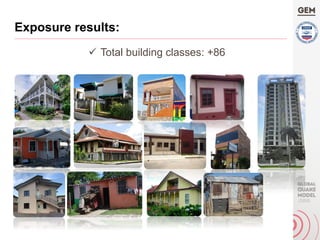
Exposure results:
ü  Total building classes: +86
•  Number of buildings
•  Area of a building
typology
•  Economic value
–  Structural components
–  Non-structural
components
–  Contents
–  Business interruption
•  Occupants
–  Day/Night/Transit
Current exposure modelling capabilities
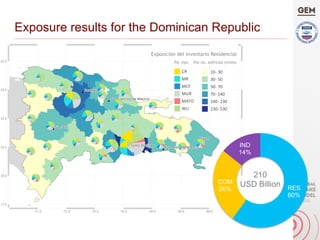
Exposure results for the Dominican Republic
RES
60%
COM
26%
IND
14%
210
USD Billion
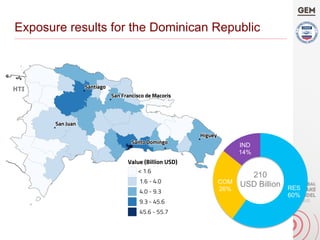
RES
60%
COM
26%
IND
14%
210
USD Billion
Exposure results for the Dominican Republic
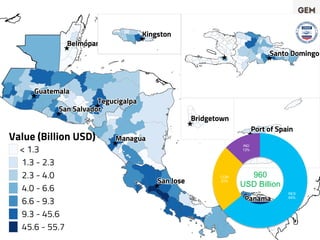
Exposure Results for the Dominican Republic
RES
64%
COM
23%
IND
13%
960
USD Billion
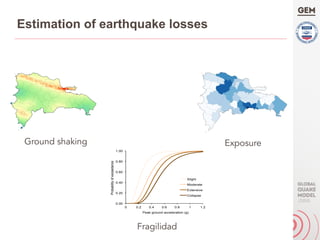
Ground shaking Exposure
0.00
0.20
0.40
0.60
0.80
1.00
0 0.2 0.4 0.6 0.8 1 1.2
Probabilityofexceedance
Peak ground acceleration (g)
Slight
Moderate
Extensive
Collapse
Fragilidad
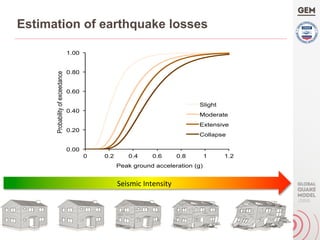
Estimation of earthquake losses
Seismic	Intensity	
0.00
0.20
0.40
0.60
0.80
1.00
0 0.2 0.4 0.6 0.8 1 1.2
Probabilityofexceedance
Peak ground acceleration (g)
Slight
Moderate
Extensive
Collapse
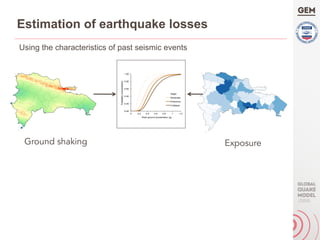
Estimation of earthquake losses
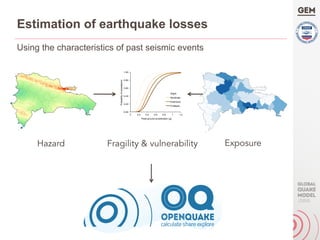
Using the characteristics of past seismic events
0.00
0.20
0.40
0.60
0.80
1.00
0 0.2 0.4 0.6 0.8 1 1.2
Probabilityofexceedance
Peak ground acceleration (g)
Slight
Moderate
Extensive
Collapse
Ground shaking Exposure
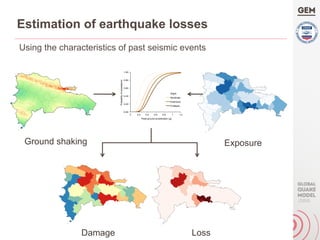
Estimation of earthquake losses
Using the characteristics of past seismic events
0.00
0.20
0.40
0.60
0.80
1.00
0 0.2 0.4 0.6 0.8 1 1.2
Probabilityofexceedance
Peak ground acceleration (g)
Slight
Moderate
Extensive
Collapse
Ground shaking Exposure
Damage Loss
MDOF
Simplification of 3D or 2D structures into a SDOF
lent SDOF system can be either elastic or inelastic de-
n the chosen inelastic analysis method (see Section
tation of the pushover curve and the subsequent deter-
the properties of the equivalent SDOF system are thor-
cussed in Section 7.2.
bal deformations ∆
Detailed
model
nically
m*
h*k*
Equivalent SDOF
system
0
1
2
3
0.0 0.1 0.2 0.3
Global deformation ∆ [m]
HorizontalforceV[MN]
ve“
stic
ationship
ntals of Seismic Design”
Substitute SDoF structure
ive displacement
gn displacement)
ive mass
ive height ( ) ( )¦¦ ∆∆=
n
ii
n
iiie
mHmH /
( ) ( )¦¦
==
∆∆=∆
n
i
ii
n
i
iid
mm
11
2
/
( ) d
n
i
iie
mm ∆∆= ¦
=
/
1
He
me
He
me ∆d
∆i
∆i-1
∆3
∆2
∆1
He
me
He
me ∆d
∆i
∆i-1
∆3
∆2
∆1
SDOF
Definition of structural models for vulnerability
analysis
−0.25 −0.2 −0.15 −0.1 −0.05 0 0.05 0.1 0.15 0.2 0.25
−0.5
−0.4
−0.3
−0.2
−0.1
0
0.1
0.2
0.3
0.4
0.5
Sd [m]
Sa[g]
sdof
pinching4
Hysteresis model
o  +100 peer-reviewed publications
o  +20 technical reports
o  +500 fragility functions and capacity curves
Definition of structural models for vulnerability
analysis
Experimental data Numerical modelling
Vulnerability Modelling – Costa Rica
0.0	
0.2	
0.4	
0.6	
0.8	
1.0	
0.0	 0.4	 0.8	 1.2	 1.6	 2.0	
Probability	of	excedense		
MCF/DUC/H:1	
0.0	
0.2	
0.4	
0.6	
0.8	
1.0	
0.0	 0.4	 0.8	 1.2	 1.6	 2.0	
Probability	of	excedense		
MCF/DUC/H:2	
0.0	
0.2	
0.4	
0.6	
0.8	
1.0	
0.0	 0.4	 0.8	 1.2	 1.6	 2.0	
Probability	of	excedense		
CR+PC/DUC/H:1	
0.0	
0.2	
0.4	
0.6	
0.8	
1.0	
0.0	 0.4	 0.8	 1.2	 1.6	 2.0	
Probability	of	excedense		
CR+PC/DLO/H:1	
0.0	
0.2	
0.4	
0.6	
0.8	
1.0	
0.0	 0.4	 0.8	 1.2	 1.6	 2.0	
Probability	of	excedense		
W+WLI/DLO/H:1	
0.0	
0.2	
0.4	
0.6	
0.8	
1.0	
0.0	 0.4	 0.8	 1.2	 1.6	 2.0	
Probability	of	excedense		
MCF/DLO/H:1	
0.0	
0.2	
0.4	
0.6	
0.8	
1.0	
0.0	 0.4	 0.8	 1.2	 1.6	 2.0	
Probability	of	excedense		
UNK	
0.0	
0.2	
0.4	
0.6	
0.8	
1.0	
0.00	 0.50	 1.00	 1.50	 2.00	
Probability	of	Exceedance	
MCF/DUC/H:3-6	
0.0	
0.2	
0.4	
0.6	
0.8	
1.0	
0.00	 0.50	 1.00	 1.50	 2.00	
Probability	of	Exceedance	
MUR+ADO/DNO/H:1	
0.0	
0.2	
0.4	
0.6	
0.8	
1.0	
0.00	 0.25	 0.50	 0.75	 1.00	
Probability	of	Exceedance	
CR+CIP/DUH/H:6-12
0.0	
0.2	
0.4	
0.6	
0.8	
1.0	
0.00	 0.25	 0.50	 0.75	 1.00	
Probability	of	Exceedance	
CR+CIP/DUH/H:3-6		
0.0	
0.2	
0.4	
0.6	
0.8	
1.0	
0.00	 0.25	 0.50	 0.75	 1.00	
ProbabilityofExceedance
CR+CIP/DLO/H:3-6	
0.0	
0.2	
0.4	
0.6	
0.8	
1.0	
0.00	 0.50	 1.00	 1.50	 2.00	
ProbabilityofExceedance
CR/LINF+DUH/H:2-6	
0.0	
0.2	
0.4	
0.6	
0.8	
1.0	
0.00	 0.50	 1.00	 1.50	 2.00	
ProbabilityofExceedance
CR+CIP/LFM+DLO/H:1		
0.0	
0.2	
0.4	
0.6	
0.8	
1.0	
0.00	 0.50	 1.00	 1.50	 2.00	
Probability	of	Exceedance	
CR+CIP/LFM+DLO/H:2-6	
Slight	
Moderate	
Extensive	
Collpase
The need for vulnerability calibration/verification
”Often, all the model ingredients look fine, but their combination
makes no sense. Calibration is key”
Alex Allmann, Heard of GeoRisk at Munich Re
0	
50	
100	
150	
200	
250	
300	
350	
400	
Model	A	 Model	B	 Model	C	 Model	D	 Model	E	
Number	of	collapses	
Thousands	
Observed
Estimated collapses for adobe buildings due to the 2007 M8.7 Pisco event
Calibration process for Guatemala Fragility Curves
0.00%
0.20%
0.40%
0.60%
0.80%
1.00%
V1 V2 V3 V4 V5
The need for vulnerability calibration/verification
Using the characteristics of past seismic events
0.00
0.20
0.40
0.60
0.80
1.00
0 0.2 0.4 0.6 0.8 1 1.2
Probabilityofexceedance
Peak ground acceleration (g)
Slight
Moderate
Extensive
Collapse
Hazard ExposureFragility & vulnerability
Estimation of earthquake losses
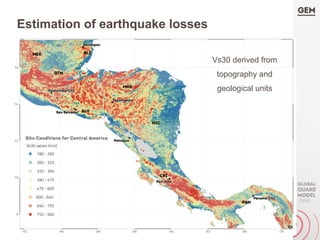
Vs30 derived from
topography and
geological units
Estimation of earthquake losses
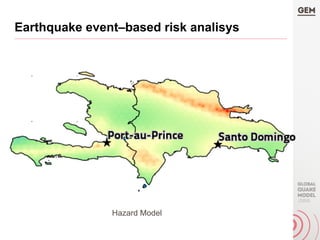
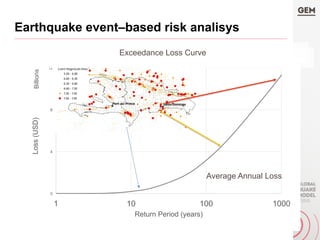
Earthquake event–based risk analisys
Hazard Model
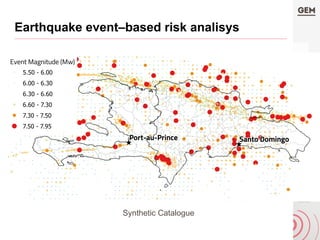
Synthetic Catalogue
Earthquake event–based risk analisys
0
4
8
12
1 10 100 1000
Loss(USD)Billions
Return Period (years)
Average Annual Loss
Exceedance Loss Curve
Earthquake event–based risk analisys
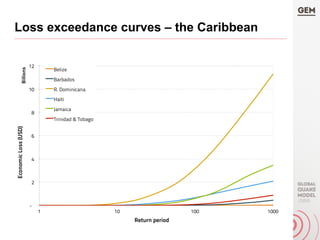
Loss exceedance curves – the Caribbean
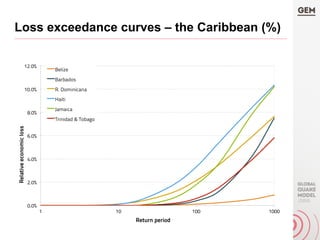
Loss exceedance curves – the Caribbean (%)
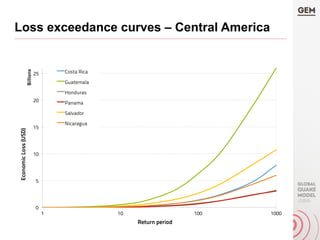
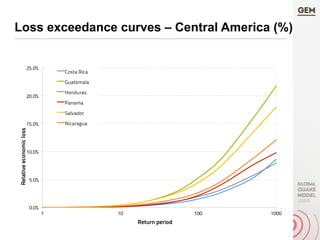
Loss exceedance curves – Central America
Loss exceedance curves – Central America (%)
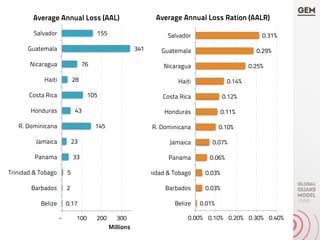
Average Annual Losses
0.01%
0.03%
0.03%
0.06%
0.07%
0.10%
0.11%
0.12%
0.14%
0.25%
0.29%
0.31%
0.00% 0.10% 0.20% 0.30% 0.40%
Belize
Barbados
Trinidad & Tobago
Panama
Jamaica
R. Dominicana
Honduras
Costa Rica
Haiti
Nicaragua
Guatemala
Salvador
Average Annual Loss Ration (AALR)
0.17
2
5
33
23
145
43
105
28
76
341
155
- 100 200 300
Belize
Barbados
Trinidad & Tobago
Panama
Jamaica
R. Dominicana
Honduras
Costa Rica
Haiti
Nicaragua
Guatemala
Salvador
Millions
Average Annual Loss (AAL)
Event–Based Results
0.00%
0.20%
0.40%
0.60%
0.80%
1.00%
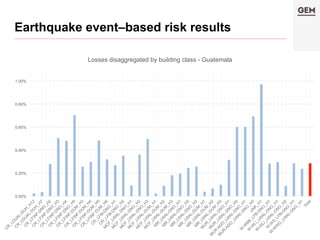
Losses disaggregated by building class - Guatemala
Earthquake event–based risk results
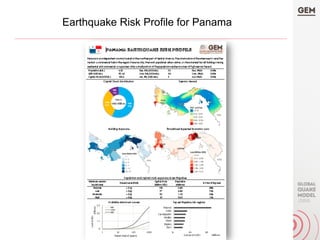
Earthquake Risk Profile for Panama
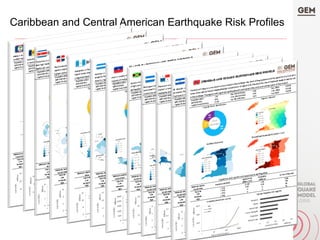
Caribbean and Central American Earthquake Risk Profiles
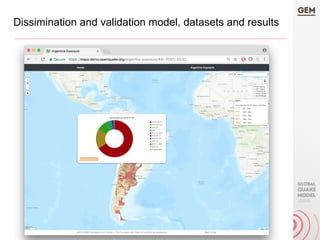
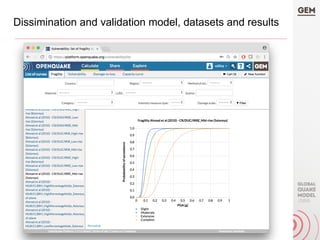
Dissimination and validation model, datasets and results
Muchas gracias

02 ccara risk

  • 1.
    Caribbean and CentralAmerican Seismic Risk Assessment Project March 21, 2018 Santo Domingo, República Alejandro Calderón, MSc.
  • 3.
    •  unique approach • cohesive pathway •  actionable solutions Scientific Framework INTEGRATED SEISMIC RISK PHYSICAL SEISMIC RISK Probability of damage and loss to people and structures due to earthquakes EXPOSURE Elements at risk PHYSICAL VULNERABILITY Vulnerability of structures and their occupants to seismic hazard SEISMIC HAZARD Probability of ground shaking due to earthquakes SOCIO-ECONOMIC VULNERABILITY AND RESILIENCE Vulnerability of society and economy and their capacity to cope with earthquake events
  • 4.
    Characterization of thebuilt-up environment
  • 5.
    How is thebuilding stock? How many people? How much does it cost? Where is the building stock? Characterization of the built-up environment
  • 6.
    Where is thebuilding stock? How many people? Geographical position of the assets derived from: ü  Census Data ü  Cadaster Data ü  Satellite Imagery
  • 7.
    Where is thebuilding stock? How many people?
  • 8.
    How is thebuilding stock? Building class derivation: ü  Existing Literature ü  Oficial construction statistics ü  Visual inspection ü  Structural code ü  Level of informality
  • 9.
    How is thebuilding stock?
  • 10.
    How is thebuilding stock? ¿Las construcciones residenciales de su país satisfacen los requisitos establecidos en la normativa sísmica? Siempre 0 Casi siempre 0 5 12 Rara vez 0 Nunca 0 Otros 0 17 ¿Cuál era el sistema estructural más usado en construcción de vivienda antes de la implementación del código sísmico? Hormigón armado y mampostería en bloque de concreto 5 Mampostería reforzada en bloque concreto 4 Mampostería en bloque concreto 4 Madera, mampostería en concreto (algunas veces) y techos de zinc 2 Combinación de todas las anteriores 1 16 ¿Cuál es la forma más común de construcción en hogares de altos recursos económicos (material y sistema estructural)? Pórticos de hormigón armado y mampostería de bloque de concreto 7 Pórticos de hormigón armado 2 Mampostería reforzada en bloque concreto con diafragma rígico 3 Mampostería confinada y con refuerzo 3 Mixto: Mampostería reforzada con muros de hormigón armado 2 17 ¿Cuál es la forma más común de construcción en hogares de moderados recursos económicos (material y sistema estructural)? Mampostería sin reforzar (bloque concreto) 2 Mampostería confinada (bloque concreto) 4 Mampostería reforzada (bloque concreto) con diafragma rígido 7 Mampostería bloque concreto 4 17 ¿Cuál es la forma más común de construcción en hogares de bajos recursos económicos (material y sistema estructural)? Madera y mampostería no reforzada en bloque de concreto 3 Madera y techos de zinc 3 Mampostería no reforzada y techo de zinc 2 Mampostería reforzada en bloque de concreto y losas flexibles 4 Mampostería confinada en bloque de concreto 1 4 17 En su país, las viviendas en mampostería (albañilería) son generalmente Mampostería reforzada dúctil Mampostería NO reforzada Hogares de bajos recursos económicos 0 8 1 9 12 Hogares de moderados recursos económicos 7 4 4 6 1 Hogares de altos recursos económicos 8 0 10 1 0 No aplica 2 5 2 1 4 República Dominicana VIVIENDA Casi siempre en viviendas de altos/moderados ingresos económicos, y en algunos casos en viviendas de bajos ingresos económicos En algunos casos en viviendas de altos/moderados ingresos económicos, y rara vez en viviendas de bajos ingresos económicos Mampostería reforzada NO dúctil Mampostería confinada dúctil Mampostería confinada NO dúctil Madera, mampostería en bloque de concreto (sin reforzar o con poco refuerzo), y techo en planchas de zinc (alucin) 0 1 2 3 4 5 6 7 8 0 1 2 3 4 5 6 0 2 4 6 8 0 1 2 3 4 5 0 2 4 6 8 10 12 14 Mampostería reforzada dúctil Mampostería reforzada NO dúctil Mampostería confinada dúctil Mampostería confinada NO dúctil Mampostería NO reforzada Hogares de bajos recursos económicos Hogares de moderados recursos económicos Hogares de altos recursos económicos No aplica
  • 11.
    How is thebuilding stock?
  • 12.
    How is thebuilding stock?
  • 13.
    Building class derivation: ü Existing Literature ü  Oficial construction statistics ü  Visual inspection ü  Structural code ü  Level of informality How is the building stock?
  • 14.
    Building class derivation: ü Existing Literature ü  Oficial construction statistics ü  Visual inspection ü  Structural code ü  Level of informality How is the building stock?
  • 15.
  • 16.
  • 17.
    Final Building ClassDefinition ü  Material: CR ü  Type: LWALL + DUC ü  Height: 1 ü  Avg. Area: 51 m² ü  Avg. Cost: $ 22,593
  • 18.
    Estimation of capital stock: ü Central Bank Data ü  Government Housing Programs ü  Construction statistics How much does it cost?
  • 19.
  • 20.
    Directory of Establishments– Dominican Republic
  • 21.
    Exposure results: ü  Totalbuilding classes: +86
  • 22.
    •  Number ofbuildings •  Area of a building typology •  Economic value –  Structural components –  Non-structural components –  Contents –  Business interruption •  Occupants –  Day/Night/Transit Current exposure modelling capabilities
  • 23.
    Exposure results forthe Dominican Republic RES 60% COM 26% IND 14% 210 USD Billion
  • 24.
  • 25.
    Exposure Results forthe Dominican Republic RES 64% COM 23% IND 13% 960 USD Billion
  • 26.
    Ground shaking Exposure 0.00 0.20 0.40 0.60 0.80 1.00 00.2 0.4 0.6 0.8 1 1.2 Probabilityofexceedance Peak ground acceleration (g) Slight Moderate Extensive Collapse Fragilidad Estimation of earthquake losses
  • 27.
    Seismic Intensity 0.00 0.20 0.40 0.60 0.80 1.00 0 0.2 0.40.6 0.8 1 1.2 Probabilityofexceedance Peak ground acceleration (g) Slight Moderate Extensive Collapse Estimation of earthquake losses
  • 28.
    Using the characteristicsof past seismic events 0.00 0.20 0.40 0.60 0.80 1.00 0 0.2 0.4 0.6 0.8 1 1.2 Probabilityofexceedance Peak ground acceleration (g) Slight Moderate Extensive Collapse Ground shaking Exposure Estimation of earthquake losses
  • 29.
    Estimation of earthquakelosses Using the characteristics of past seismic events 0.00 0.20 0.40 0.60 0.80 1.00 0 0.2 0.4 0.6 0.8 1 1.2 Probabilityofexceedance Peak ground acceleration (g) Slight Moderate Extensive Collapse Ground shaking Exposure Damage Loss
  • 30.
    MDOF Simplification of 3Dor 2D structures into a SDOF lent SDOF system can be either elastic or inelastic de- n the chosen inelastic analysis method (see Section tation of the pushover curve and the subsequent deter- the properties of the equivalent SDOF system are thor- cussed in Section 7.2. bal deformations ∆ Detailed model nically m* h*k* Equivalent SDOF system 0 1 2 3 0.0 0.1 0.2 0.3 Global deformation ∆ [m] HorizontalforceV[MN] ve“ stic ationship ntals of Seismic Design” Substitute SDoF structure ive displacement gn displacement) ive mass ive height ( ) ( )¦¦ ∆∆= n ii n iiie mHmH / ( ) ( )¦¦ == ∆∆=∆ n i ii n i iid mm 11 2 / ( ) d n i iie mm ∆∆= ¦ = / 1 He me He me ∆d ∆i ∆i-1 ∆3 ∆2 ∆1 He me He me ∆d ∆i ∆i-1 ∆3 ∆2 ∆1 SDOF Definition of structural models for vulnerability analysis −0.25 −0.2 −0.15 −0.1 −0.05 0 0.05 0.1 0.15 0.2 0.25 −0.5 −0.4 −0.3 −0.2 −0.1 0 0.1 0.2 0.3 0.4 0.5 Sd [m] Sa[g] sdof pinching4 Hysteresis model
  • 31.
    o  +100 peer-reviewedpublications o  +20 technical reports o  +500 fragility functions and capacity curves Definition of structural models for vulnerability analysis Experimental data Numerical modelling
  • 32.
    Vulnerability Modelling –Costa Rica 0.0 0.2 0.4 0.6 0.8 1.0 0.0 0.4 0.8 1.2 1.6 2.0 Probability of excedense MCF/DUC/H:1 0.0 0.2 0.4 0.6 0.8 1.0 0.0 0.4 0.8 1.2 1.6 2.0 Probability of excedense MCF/DUC/H:2 0.0 0.2 0.4 0.6 0.8 1.0 0.0 0.4 0.8 1.2 1.6 2.0 Probability of excedense CR+PC/DUC/H:1 0.0 0.2 0.4 0.6 0.8 1.0 0.0 0.4 0.8 1.2 1.6 2.0 Probability of excedense CR+PC/DLO/H:1 0.0 0.2 0.4 0.6 0.8 1.0 0.0 0.4 0.8 1.2 1.6 2.0 Probability of excedense W+WLI/DLO/H:1 0.0 0.2 0.4 0.6 0.8 1.0 0.0 0.4 0.8 1.2 1.6 2.0 Probability of excedense MCF/DLO/H:1 0.0 0.2 0.4 0.6 0.8 1.0 0.0 0.4 0.8 1.2 1.6 2.0 Probability of excedense UNK 0.0 0.2 0.4 0.6 0.8 1.0 0.00 0.50 1.00 1.50 2.00 Probability of Exceedance MCF/DUC/H:3-6 0.0 0.2 0.4 0.6 0.8 1.0 0.00 0.50 1.00 1.50 2.00 Probability of Exceedance MUR+ADO/DNO/H:1 0.0 0.2 0.4 0.6 0.8 1.0 0.00 0.25 0.50 0.75 1.00 Probability of Exceedance CR+CIP/DUH/H:6-12 0.0 0.2 0.4 0.6 0.8 1.0 0.00 0.25 0.50 0.75 1.00 Probability of Exceedance CR+CIP/DUH/H:3-6 0.0 0.2 0.4 0.6 0.8 1.0 0.00 0.25 0.50 0.75 1.00 ProbabilityofExceedance CR+CIP/DLO/H:3-6 0.0 0.2 0.4 0.6 0.8 1.0 0.00 0.50 1.00 1.50 2.00 ProbabilityofExceedance CR/LINF+DUH/H:2-6 0.0 0.2 0.4 0.6 0.8 1.0 0.00 0.50 1.00 1.50 2.00 ProbabilityofExceedance CR+CIP/LFM+DLO/H:1 0.0 0.2 0.4 0.6 0.8 1.0 0.00 0.50 1.00 1.50 2.00 Probability of Exceedance CR+CIP/LFM+DLO/H:2-6 Slight Moderate Extensive Collpase
  • 33.
    The need forvulnerability calibration/verification ”Often, all the model ingredients look fine, but their combination makes no sense. Calibration is key” Alex Allmann, Heard of GeoRisk at Munich Re 0 50 100 150 200 250 300 350 400 Model A Model B Model C Model D Model E Number of collapses Thousands Observed Estimated collapses for adobe buildings due to the 2007 M8.7 Pisco event
  • 34.
    Calibration process forGuatemala Fragility Curves 0.00% 0.20% 0.40% 0.60% 0.80% 1.00% V1 V2 V3 V4 V5 The need for vulnerability calibration/verification
  • 35.
    Using the characteristicsof past seismic events 0.00 0.20 0.40 0.60 0.80 1.00 0 0.2 0.4 0.6 0.8 1 1.2 Probabilityofexceedance Peak ground acceleration (g) Slight Moderate Extensive Collapse Hazard ExposureFragility & vulnerability Estimation of earthquake losses
  • 36.
    Vs30 derived from topographyand geological units Estimation of earthquake losses
  • 37.
    Earthquake event–based riskanalisys Hazard Model
  • 38.
  • 39.
    0 4 8 12 1 10 1001000 Loss(USD)Billions Return Period (years) Average Annual Loss Exceedance Loss Curve Earthquake event–based risk analisys
  • 40.
    Loss exceedance curves– the Caribbean
  • 41.
    Loss exceedance curves– the Caribbean (%)
  • 42.
    Loss exceedance curves– Central America
  • 43.
    Loss exceedance curves– Central America (%)
  • 44.
    Average Annual Losses 0.01% 0.03% 0.03% 0.06% 0.07% 0.10% 0.11% 0.12% 0.14% 0.25% 0.29% 0.31% 0.00%0.10% 0.20% 0.30% 0.40% Belize Barbados Trinidad & Tobago Panama Jamaica R. Dominicana Honduras Costa Rica Haiti Nicaragua Guatemala Salvador Average Annual Loss Ration (AALR) 0.17 2 5 33 23 145 43 105 28 76 341 155 - 100 200 300 Belize Barbados Trinidad & Tobago Panama Jamaica R. Dominicana Honduras Costa Rica Haiti Nicaragua Guatemala Salvador Millions Average Annual Loss (AAL)
  • 45.
  • 46.
    0.00% 0.20% 0.40% 0.60% 0.80% 1.00% Losses disaggregated bybuilding class - Guatemala Earthquake event–based risk results
  • 47.
  • 48.
    Caribbean and CentralAmerican Earthquake Risk Profiles
  • 49.
    Dissimination and validationmodel, datasets and results
  • 50.
    Dissimination and validationmodel, datasets and results
  • 51.