International Research Journal of Engineering and Technology (IRJET) e-ISSN: 2395 -0056
Volume: 04 Issue: 03 | Mar -2017 www.irjet.net p-ISSN: 2395-0072
© 2017, IRJET | Impact Factor value: 5.181 | ISO 9001:2008 Certified Journal | Page 1885
A REVIEW ON EARTHQUAKE VULNERABILITY ASSESSMENT
Nalina Kishore1, CK Prasad Varma Thampan2
1PG Student, Department of Civil Engineering, NSS College of Engineering, Palakkad, Kerala, India
2Professer, Department of Civil Engineering, NSS College of Engineering, Palakkad, Kerala, India
---------------------------------------------------------------------***---------------------------------------------------------------------
Abstract – Majority of human beings live in earthquake
prone areas. Earthquake causes significant loss of life and
damage of property every year. It is required to identify the
damage of a structure caused due to varying ground motion
intensities. This identification results will help an engineer to
take necessary action against the after-effects of an
earthquake. The vulnerability of a structure has to be found
out under various groundmotion intensity measures(IM)such
as Peak Ground Acceleration (PGA). Fromthis, fragilitycurves
can be developed. Fragility analysis is a probabilistic
approach, which is commonly used now-a-days. As per this
method, different Damage states (DS) have to be defined and
then probable damage of the structure in connection with the
IM can be found. Fragility curves are generated from multiple
Incremental Dynamic Analysis or IDA curves with the help of
traditional curve fitting technique.
Key Words: Fragility curve, Incremental Dynamic Analysis,
Base isolation, Non linear dynamic analysis, Damage state.
1. INTRODUCTION
Earthquakes are one of the most hazardous natural
disasters that attack human and cause large damages
especially in regions which is defined as high-seismic zone
by geologists. Majority of human beings live in earthquake
prone areas. Various seismic analysis approaches were
proposed including both static and dynamic methods.
Although seismology has been continuously advancing
during the century, it is impossible to predict future
earthquakes’ severity and time of attacking. Therefore
previous earthquake data are still widely used to analyze
buildings resulting in buildings for future earthquakes.
Already constructed buildings may collapse under future
earthquakes.
Due to the difficulties in predictingearthquakesand
its random nature, various probabilistic analyses were
proposed in analyzing building seismic responses. In
addition to uncertainties in seismic loads, uncertainties
associated with building material, design process, building
geometry, and construction will also lead to the use of
probability to predict building responses.
Fragility analysis is a probabilistic method which
shows the probability of exceeding a certain damage level.
This technique is commonly used in order to evaluate the
earthquake vulnerability assessment of various structures.
Fragility curve is a statistical tool used for the vulnerability
assessment and it gives the probability of building damage
level under different ground motion intensities. This
assessment is generally used in disaster mitigation fields.
The main objective of this paper is to review the
development of fragility curve, especiallyanalytical, tostudy
earthquake vulnerability of a structure. Alsothispapergives
an overview about IDA which is used toanalyzethebehavior
of structure under various ground motion intensities.
2. THEORETICAL BACKGROUND
Earthquake effects of general type buildings are
predicted with the help of some functions such as loss and
damage functions. But these functions may not be useful for
some kind of specific buildings. The development of the
above mentioned functions are easy only if the user is an
engineer experienced in non- linear analysis field. Indisaster
mitigation field, user must create various functions that can
be used for both specific and individual type buildings.
2.1 Fragility Curve
A fragility analysis is widely used for hazard
assessment and earthquake vulnerability assessment of
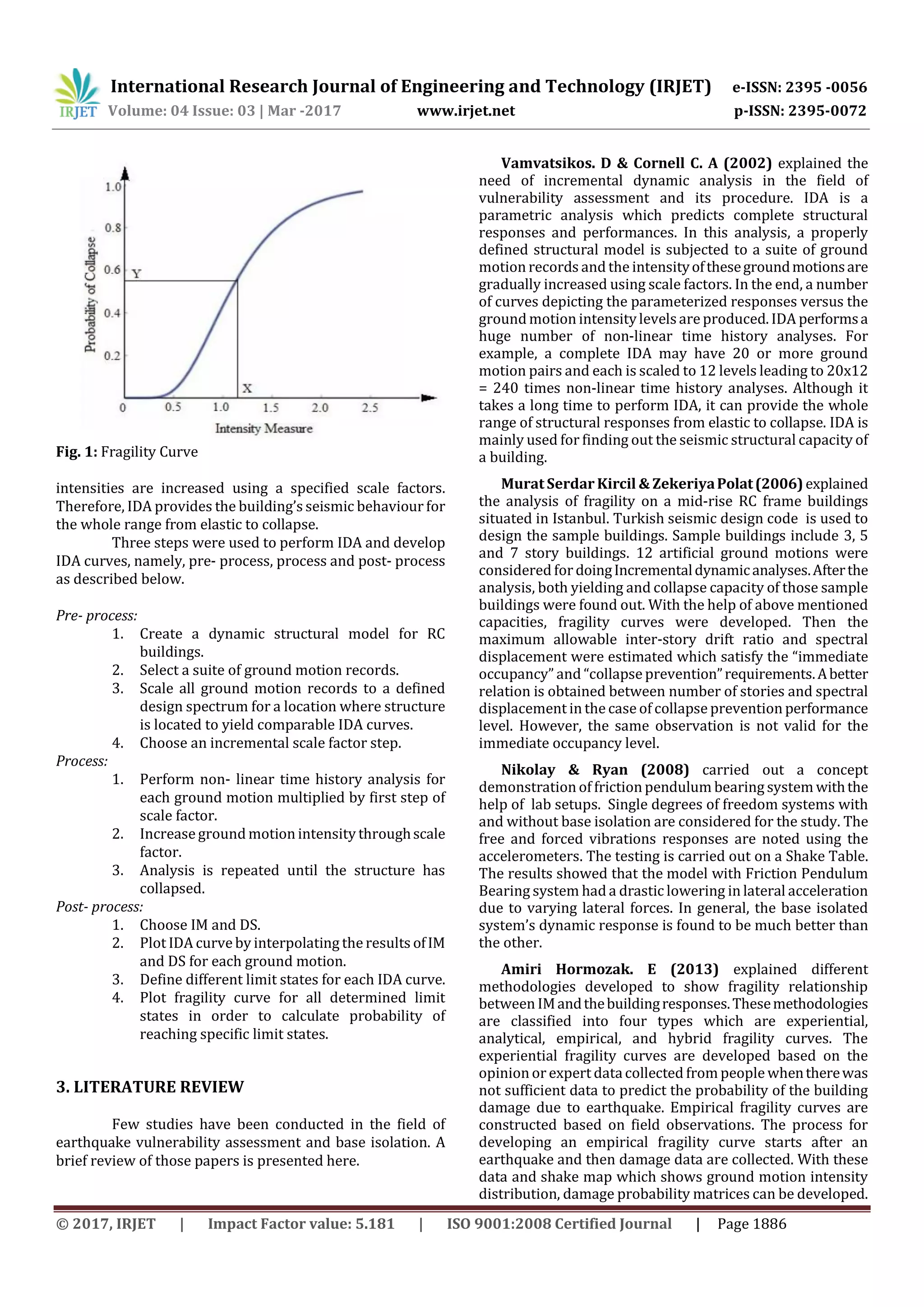
various structures . The fragility curve is a statistical tool
showing the probability of exceeding certaindamagestateas
a function of intensity measure(IM). It is developed from
multiple IDA curves. Commonly used IMs are Spectral
acceleration (Sa), Spectral displacement (Sd), Peak Ground
Acceleration(PGA), Peak Ground Velocity (PGV)etc.Figure1
shows a typical fragility curve with PGA along x-axis and
probability of failure along y-axis. A point in the curve
represents the exceeding probability of damage state at a
given intensity measure. These damage states can be lateral
drift, base shear, story drift etc. The function,whichisusedto
generate fragility curve for a building,isgenerallyfoundtobe
log-normal functions.
2.2Incremental Dynamic Analysis (IDA)
IDA is a computational analysis method of
earthquake engineering to study the behavior of structure
under seismic loads. Simulated building seismic responses
obtained from IDA are represented by IDA curves that
require a series of non- linear time history analysis with a
suite of ground motions, during which the ground motion
International Research Journal of Engineering and Technology (IRJET) e-ISSN: 2395 -0056
Volume: 04 Issue: 03 | Mar -2017 www.irjet.net p-ISSN: 2395-0072
© 2017, IRJET | Impact Factor value: 5.181 | ISO 9001:2008 Certified Journal | Page 1886
Fig. 1: Fragility Curve
intensities are increased using a specified scale factors.
Therefore, IDA provides the building’s seismic behaviour for
the whole range from elastic to collapse.
Three steps were used to perform IDA and develop
IDA curves, namely, pre- process, process and post- process
as described below.
Pre- process:
1. Create a dynamic structural model for RC
buildings.
2. Select a suite of ground motion records.
3. Scale all ground motion records to a defined
design spectrum for a location where structure
is located to yield comparable IDA curves.
4. Choose an incremental scale factor step.
Process:
1. Perform non- linear time history analysis for
each ground motion multiplied by first step of
scale factor.
2. Increase ground motion intensity throughscale
factor.
3. Analysis is repeated until the structure has
collapsed.
Post- process:
1. Choose IM and DS.
2. Plot IDA curve by interpolating the results ofIM
and DS for each ground motion.
3. Define different limit states for each IDA curve.
4. Plot fragility curve for all determined limit
states in order to calculate probability of
reaching specific limit states.
3. LITERATURE REVIEW
Few studies have been conducted in the field of
earthquake vulnerability assessment and base isolation. A
brief review of those papers is presented here.
Vamvatsikos. D & Cornell C. A (2002) explained the
need of incremental dynamic analysis in the field of
vulnerability assessment and its procedure. IDA is a
parametric analysis which predicts complete structural
responses and performances. In this analysis, a properly
defined structural model is subjected to a suite of ground
motion records and the intensityofthesegroundmotionsare
gradually increased using scale factors. In the end, a number
of curves depicting the parameterized responses versus the
ground motion intensitylevelsare produced. IDA performsa
huge number of non-linear time history analyses. For
example, a complete IDA may have 20 or more ground
motion pairs and each is scaled to 12 levels leading to 20x12
= 240 times non-linear time history analyses. Although it
takes a long time to perform IDA, it can provide the whole
range of structural responses from elastic to collapse. IDA is
mainly used for finding out the seismic structural capacity of
a building.
Murat Serdar Kircil & ZekeriyaPolat(2006)explained
the analysis of fragility on a mid-rise RC frame buildings
situated in Istanbul. Turkish seismic design code is used to
design the sample buildings. Sample buildings include 3, 5
and 7 story buildings. 12 artificial ground motions were
considered fordoingIncrementaldynamicanalyses.Afterthe
analysis, both yielding and collapse capacity of those sample
buildings were found out. With the help of above mentioned
capacities, fragility curves were developed. Then the
maximum allowable inter-story drift ratio and spectral
displacement were estimated which satisfy the “immediate
occupancy” and “collapse prevention”requirements.Abetter
relation is obtained between number of stories and spectral
displacement in the case of collapse prevention performance
level. However, the same observation is not valid for the
immediate occupancy level.
Nikolay & Ryan (2008) carried out a concept
demonstration of friction pendulum bearing system withthe
help of lab setups. Single degrees of freedom systems with
and without base isolation are considered for the study. The
free and forced vibrations responses are noted using the
accelerometers. The testing is carried out on a Shake Table.
The results showed that the model with Friction Pendulum
Bearing system had a drastic lowering in lateral acceleration
due to varying lateral forces. In general, the base isolated
system’s dynamic response is found to be much better than
the other.
Amiri Hormozak. E (2013) explained different
methodologies developed to show fragility relationship
between IMandthebuildingresponses.Thesemethodologies
are classified into four types which are experiential,
analytical, empirical, and hybrid fragility curves. The
experiential fragility curves are developed based on the
opinion or expert datacollected from people whentherewas
not sufficient data to predict the probability of the building
damage due to earthquake. Empirical fragility curves are
constructed based on field observations. The process for
developing an empirical fragility curve starts after an
earthquake and then damage data are collected. With these
data and shake map which shows ground motion intensity
distribution, damage probability matrices can be developed.
International Research Journal of Engineering and Technology (IRJET) e-ISSN: 2395 -0056
Volume: 04 Issue: 03 | Mar -2017 www.irjet.net p-ISSN: 2395-0072
© 2017, IRJET | Impact Factor value: 5.181 | ISO 9001:2008 Certified Journal | Page 1887
Analytical fragility curve is more common than the other
curves which use numerical simulation to predict damage
distributions. For complex buildings, analytical method is
adopted to create fragility curves. Hybrid fragility curve is
developed based on a combination of experiential, empirical
and analytical method and it gives more realistic fragility
curve.
Luigi Petti et al (2013) investigated seismic behavior of
base isolated structures with friction pendulum slide
bearings devicessubjected tonear fault eventscharacterized
by significant vertical groundmotioncomponents.Theyhave
studied the effects of vertical components on seismic
response using non-linear dynamic analysis by considering
two near-fault seismic events. The results showed that the
base shear increases linearly with vertical seismic motion.
But the relative displacements are not highly influenced by
the vertical ground motion.
Chandak. N. R (2013) was presented a work related to
the effect of base isolation on the response of RC Building.
The six storey building is analyzed with rubber isolating
device and by providing frictionpendulumisolationdeviceat
its base. The analysis was done by using response spectrum
analysis. Here, the design spectra recommended by Indian
Standard Code IS 1893-2002 (part-I) and Euro Code 8 are
considered for comparison. The main objective of this study
is to investigatethe differences caused by the use of different
codes in the dynamic analysis of multistoried RC building
along with fixed and isolated base condition. Two different
floor plans that are symmetric (SB) and unsymmetric (UB)
with torsional irregularity are taken as sample building. To
evaluate the seismic response of the buildings, elastic
analysis is performed using the computerprogramSAP2000.
Results obtained from the work showed that there is
reduction of base shear, storey drift, storey shear,torqueand
increment in thestoreydisplacement.Itisalsoobservedfrom
the comparative study that the building response with
isolated base is very less to that of building with fixed base in
all the cases and IS code depict higher values in all the cases
with and without isolation, when compared to that of Euro
code.
Bhatti. A. Q, Varum. H & Zeeshan Alam (2013)
investigated seismicvulnerabilityassessmentandevaluation
on a high rise building in Islamabad in order to proposebasic
guidelines and suggestions for PakistanCode. Itisaimedthat
the document will work as a guideline source for the seismic
evaluation, calculation and assessment of strength, behavior
and expected performance and also the safety of already
existing buildings. Modal analysis was carried out using
ETABS. Different mode shapes for different time periods, T,
for the existing building was analyzed. At last, the paper
concluded that the Dynamic analysis generally gives lower
forces hence the computation is rewardedbyaccurateresult.
The responseismoresensitivetoindividualcharacteristicsof
strong motion record hence as more as possible number of
records shall be used for time history analysis.
Shah. N. N & Tande. S. N (2014) showed that all the
seismic analysis approaches cannot analyze all buildings
except for the detailed non-linear dynamic analysis. For
instance, ELF is only suitable for determine seismic forces of
regular buildings up to 90 m highand located in seismiczone
I and II, while dynamic analyses such as nonlinear time
history analysis can be applied to both regular and irregular
buildings in the seismic zone IV and V.
Bakhshi. A & Mostafavi. S.A. (2014) explained the
usefulness to assess the effect of base isolation systems on
the structural performance of RC structure through
probabilistic methods such as developing fragility curves.
They considered three 2-D reinforced concrete moment-
resisting frame structures with different heights such as 3, 7,
12 stories. The structures were rehabilitated using Lead
Rubber Bearing (LRB) isolators based on FEMA 356
instructions. Seismic and structural uncertaintiesweretaken
into account through modeling different material properties
as random variables. By comparing these fragility curves it
was concluded that isolators are a good retrofit method that
can decrease the vulnerability of RC buildings. In addition by
assessing the effect of being the earthquake near to source it
was found that these were more vulnerable for isolated
buildings whereas forfar-field events,itwasfoundtobezero.
Ashish. R. Akhare & Tejas. R.Wankhade (2014)
considered a G+12 story hospital building and conducted a
comparison on the effect of earthquake using various base
isolation systems on these building. They have considered
High density rubber bearing (HDRB) and friction pendulum
as isolation devices. The non-linear time history analysis is
carried out by considering El-Centro time history data.
Comparison between the fixed base and the base isolated
structure is carried out and the parameters such as base
shear, mode period, storey displacement, storey drift and
storey accelerationarecomparedusingSAP2000.Theresults
of the research show that the responseofthestructurecanbe
reduced by the use of High Density Rubber Bearing (HDRB)
and Friction Pendulum System (FPS) isolators. Thus base
isolation technique has proved to be a reliable method of
earthquake resistant design.
Dhawade. S. M (2014) conducted a comparative study
for seismic performance of base isolated & fixed based RC
Frame Structure. A G+14 storied frame structure is taken to
compare the seismic effect of fixed base structure with
respect to isolated structure. The G+14 storied frame
structure is design with base isolation by using the ETAB
software. High Damping Rubber Bearing (HDRB) is used as
an isolator having efficient results for frame structure over
the fixed base structure than any other isolation system. The
report concluded that the very less values come for lateral
loads by using High Damping Rubber Bearing. It has high
flexibility and energy absorbing capacity, so that during an
earthquake, when the ground vibrates strongly then only
moderatemotions are induced withinthestructureitself.Itis
also observed that when increasing the numberofstoriesthe
variation of maximum displacement of stories will be
somehow considerable. And thus it is concluded that the
performance of isolated structure is efficient in the
earthquake prone areas.
Marco Vona (2014) explained a procedure to develop
analytical fragility curves for Moment Resisting Frame
International Research Journal of Engineering and Technology (IRJET) e-ISSN: 2395 -0056
Volume: 04 Issue: 03 | Mar -2017 www.irjet.net p-ISSN: 2395-0072
© 2017, IRJET | Impact Factor value: 5.181 | ISO 9001:2008 Certified Journal | Page 1888
ReinforcedConcretebuildings.Theinvestigatedbuildingscan
be considered low-engineered buildings, using no seismic
codes or old seismic codes. The seismic capacity of the
selected models representing the existing RC buildings has
been evaluated through non-linear dynamic simulations.
Seismic response has been analyzed, considering various
response parameters, such as ductility demands and Inter-
storey Drift Ratio (IDR). It is concluded that defining an
accurate tool for seismic reduction strategies is essential for
accurate structural performance analysis.
Aiswarya S & Nandita Mohan(2014)conductedastudy
on the generation of fragility curves for a five-story
reinforced concrete (RC) flat-slab building structure. For the
development of fragility curves a set of earthquake records
were selected from PEER data base. Inelastic time history
analysis was performed to analyze the structuresubjectedto
the earthquake records in terms of spectral acceleration in
ETABS. The fragility curves developed from this study were
used to compare the seismic performance of retrofitted and
un-retrofitted structure. From the study, theyconcludedthat
the flat slab systems are more vulnerable to seismic hazard
because of their insufficient lateral resistance and undesired
performance at high levels of seismic demand. Based on this
they proposed the retrofitting technique like inclusion of
shear wall and studied its effect using the fragility curve.
Tarannum Yasmin et al (2015) reviewed the
importance of fragilityanalysis using existingmethodologies
and focuses on their key features highlightingthelimitations.
The paper suggests the way for selection of appropriate
assessment method for seismic vulnerability assessment of
existing buildings. Through the review it is observed that in
most of the vulnerability assessmentmethods,significanceof
elements such as staircases and lift shafts has not been
considered. Therefore, there is need for further research
required to develop experimental methods considering the
changes in stiffness and overall resistance of buildings. The
document outlined that while selecting a particular
methodology one should taken into account the type of
building/structure, availability of expertise, availability of
ground motion data, and availability of previous earthquake
damage records etc.
Sumit. A. Patel etal(2016)conductedafragilityanalysis
of high-rise building structures using ETABS software. They
have developed fragility curves for the building with X-
bracing, V-bracing. The fragility curves developedintermsof
PGA for Limit state: slight, Moderate, major and collapse in
lognormal distribution. Resultsshowedthattheprobabilities
of damage of structure for repairable, damage state in
medium soil consider decreases as we shift from the Bare to
X-bracing structureand further increasefromX-bracingtoV-
bracing structure in various stories. From Non-linear static
analysis, generations of hinges in X-bracing are less than V-
bracing and Bare structure. So, X- bracing works very
effectively in earthquake loading.
4. SUMMERY AND CONCLUSIONS
Afterreviewingsomeoftheliteratureworks
done by different scholars and researchers in the
development of fragility curves, it is understoodthatfragility
curve is found to be an efficient tool for studying the
vulnerability of a structure under various strong ground
motions. While in the development of fragility curves,
analyticalapproach is most common and thus widely usedin
various studies. Also fragility curves are generated from
multiple Incremental Dynamic Analysis or IDA curves with
the help of traditional curve fitting technique. Since it is a
tedious and time consuming process, further studies are
recommended in this area.
Also while analyzing the papers, it is noticed that
major studies were done only up to mid-rise buildings and a
limited number of studies were conducted on high- rise
buildings. Thus a study in the field of vulnerability
assessment on a high-rise building is highly recommended.
Installation of different base isolators helps to safe
guard the building when different ground motion intensities
hit the building. The papers outlined that Friction Pendulum
Bearing System (FPS)reduces the storey drift of the building
under varying ground intensity motions, especiallywhenthe
number of storeys increases.
While keeping all those in mind, an effective study can be
done mainly concentrating on earthquake vulnerability
assessment of a high- rise RC building with Friction
Pendulum System (FPS) as the main base isolator.
REFERENCES
[1] Aiswarya S, Nandita Mohan. (2014), “Vulnerability
Analysis by the Development of Fragility Curves”, IOSR
Journal of Mechanical and Civil Engineering (IOSR-
JMCE), Vol.2, pp. 33-40.
[2] Amiri Hormozak E. (2013), “Analytical fragility curves
for horizontally curved steel girderhighway bridges”,
(Doctoral dissertation), University of Nevada, Reno.
[3] Ashish R. Akhare, Tejas R.Wankhade. (2014), “Seismic
performance of RC structure using different base
isolator”, IJESRT International Journal of Engineering
Sciences & Research Technology, pp. 724-729.
[4] Bakhshi A & Mostafavi S.A.(2014), “Development of
fragility curves for base isolated RC structures”,
Proceedings of the 9th International Conference on
Structural Dynamics, EURODYN.
[5] Bhatti A. Q, Varum H & Zeeshan Alam. (2013), “Seismic
vulnerability assessment and evaluation on a high rise
building in Islamabad”, Journal of Asian Earth Sciences,
42:3,468-478.
[6] Chandak N. R.(2013), “Effect of base isolation on the
response of RC Building”, Journal of Civil Engineering
Research, Vol. 3,No. 4, pp. 135-142.
[7] Dhawade S. M.(2014),“Comparative Study for Seismic
Performance of BaseIsolated & Fixed Based RC Frame
Structure”, International Journal of Civil Engineering
Research, Vol. 5, No. 2 (2014), pp. 183-190.
International Research Journal of Engineering and Technology (IRJET) e-ISSN: 2395 -0056
Volume: 04 Issue: 03 | Mar -2017 www.irjet.net p-ISSN: 2395-0072
© 2017, IRJET | Impact Factor value: 5.181 | ISO 9001:2008 Certified Journal | Page 1889
[8] Luigi Petti.(2013),“Modelling and analysis of base
isolated structures with Friction Pendulum System
considering near fault events”, Open Journal of Civil
Engineering, 3, 86-93.
[9] Marco Vona.(2014),“Fragility curves of existing RC
buildings based on specific structural performance
levels”, Open Journal of Civil Engineering,Vol.4,pp.120-
134, May.
[10] Murat Serdar Kircil, Zekeriya Polat. (2006), “Fragility
analysis of mid-rise R/C frame buildings”, Engineering
Structures 28 (2006) 1335–1345.
[11] Nikolay Kravchuk, Ryan Colquhoun.(2008),
“Development of a Friction PendulumBearing Base
Isolation SystemforEarthquakeEngineeringEducation”,
Proceedings of the 2008 American Society for
Engineering Education Pacific Southwest
AnnualConference.
[12] Shah N. N & Tande S. N.(2014), “Study of the stiffening
systems for seismic loads in multi storied
building”,International Journal of Engineering Science
&Technology, 6(6).
[13] Sumit.A.Patel, A.R.Darji. (2016), “Fragility analysis of
high-rise building structure”,Journal of Emerging
Technologies and Innovative Research (JETIR), Volume
3, Issue 7.
[14] TarannumYasmin, Ajay Chourasia.(2015), “Fragility
analysis for seismic vulnerability assessment of
buildings: a review”, International Research Journal of
Engineering and Technology (IRJET), Volume: 02 Issue:
06.
[15] Vamvatsikos D, Cornell C. A. (2002), “Incremental
Dynamic Analysis”, Submitted to Earthquake
Engineering and Structural Dynamics, John Wiley &
Sons, Ltd.

A Review on Earthquake Vulnerability Assessment

  • 1.
    International Research Journalof Engineering and Technology (IRJET) e-ISSN: 2395 -0056 Volume: 04 Issue: 03 | Mar -2017 www.irjet.net p-ISSN: 2395-0072 © 2017, IRJET | Impact Factor value: 5.181 | ISO 9001:2008 Certified Journal | Page 1885 A REVIEW ON EARTHQUAKE VULNERABILITY ASSESSMENT Nalina Kishore1, CK Prasad Varma Thampan2 1PG Student, Department of Civil Engineering, NSS College of Engineering, Palakkad, Kerala, India 2Professer, Department of Civil Engineering, NSS College of Engineering, Palakkad, Kerala, India ---------------------------------------------------------------------***--------------------------------------------------------------------- Abstract – Majority of human beings live in earthquake prone areas. Earthquake causes significant loss of life and damage of property every year. It is required to identify the damage of a structure caused due to varying ground motion intensities. This identification results will help an engineer to take necessary action against the after-effects of an earthquake. The vulnerability of a structure has to be found out under various groundmotion intensity measures(IM)such as Peak Ground Acceleration (PGA). Fromthis, fragilitycurves can be developed. Fragility analysis is a probabilistic approach, which is commonly used now-a-days. As per this method, different Damage states (DS) have to be defined and then probable damage of the structure in connection with the IM can be found. Fragility curves are generated from multiple Incremental Dynamic Analysis or IDA curves with the help of traditional curve fitting technique. Key Words: Fragility curve, Incremental Dynamic Analysis, Base isolation, Non linear dynamic analysis, Damage state. 1. INTRODUCTION Earthquakes are one of the most hazardous natural disasters that attack human and cause large damages especially in regions which is defined as high-seismic zone by geologists. Majority of human beings live in earthquake prone areas. Various seismic analysis approaches were proposed including both static and dynamic methods. Although seismology has been continuously advancing during the century, it is impossible to predict future earthquakes’ severity and time of attacking. Therefore previous earthquake data are still widely used to analyze buildings resulting in buildings for future earthquakes. Already constructed buildings may collapse under future earthquakes. Due to the difficulties in predictingearthquakesand its random nature, various probabilistic analyses were proposed in analyzing building seismic responses. In addition to uncertainties in seismic loads, uncertainties associated with building material, design process, building geometry, and construction will also lead to the use of probability to predict building responses. Fragility analysis is a probabilistic method which shows the probability of exceeding a certain damage level. This technique is commonly used in order to evaluate the earthquake vulnerability assessment of various structures. Fragility curve is a statistical tool used for the vulnerability assessment and it gives the probability of building damage level under different ground motion intensities. This assessment is generally used in disaster mitigation fields. The main objective of this paper is to review the development of fragility curve, especiallyanalytical, tostudy earthquake vulnerability of a structure. Alsothispapergives an overview about IDA which is used toanalyzethebehavior of structure under various ground motion intensities. 2. THEORETICAL BACKGROUND Earthquake effects of general type buildings are predicted with the help of some functions such as loss and damage functions. But these functions may not be useful for some kind of specific buildings. The development of the above mentioned functions are easy only if the user is an engineer experienced in non- linear analysis field. Indisaster mitigation field, user must create various functions that can be used for both specific and individual type buildings. 2.1 Fragility Curve A fragility analysis is widely used for hazard assessment and earthquake vulnerability assessment of various structures . The fragility curve is a statistical tool showing the probability of exceeding certaindamagestateas a function of intensity measure(IM). It is developed from multiple IDA curves. Commonly used IMs are Spectral acceleration (Sa), Spectral displacement (Sd), Peak Ground Acceleration(PGA), Peak Ground Velocity (PGV)etc.Figure1 shows a typical fragility curve with PGA along x-axis and probability of failure along y-axis. A point in the curve represents the exceeding probability of damage state at a given intensity measure. These damage states can be lateral drift, base shear, story drift etc. The function,whichisusedto generate fragility curve for a building,isgenerallyfoundtobe log-normal functions. 2.2Incremental Dynamic Analysis (IDA) IDA is a computational analysis method of earthquake engineering to study the behavior of structure under seismic loads. Simulated building seismic responses obtained from IDA are represented by IDA curves that require a series of non- linear time history analysis with a suite of ground motions, during which the ground motion
  • 2.
    International Research Journalof Engineering and Technology (IRJET) e-ISSN: 2395 -0056 Volume: 04 Issue: 03 | Mar -2017 www.irjet.net p-ISSN: 2395-0072 © 2017, IRJET | Impact Factor value: 5.181 | ISO 9001:2008 Certified Journal | Page 1886 Fig. 1: Fragility Curve intensities are increased using a specified scale factors. Therefore, IDA provides the building’s seismic behaviour for the whole range from elastic to collapse. Three steps were used to perform IDA and develop IDA curves, namely, pre- process, process and post- process as described below. Pre- process: 1. Create a dynamic structural model for RC buildings. 2. Select a suite of ground motion records. 3. Scale all ground motion records to a defined design spectrum for a location where structure is located to yield comparable IDA curves. 4. Choose an incremental scale factor step. Process: 1. Perform non- linear time history analysis for each ground motion multiplied by first step of scale factor. 2. Increase ground motion intensity throughscale factor. 3. Analysis is repeated until the structure has collapsed. Post- process: 1. Choose IM and DS. 2. Plot IDA curve by interpolating the results ofIM and DS for each ground motion. 3. Define different limit states for each IDA curve. 4. Plot fragility curve for all determined limit states in order to calculate probability of reaching specific limit states. 3. LITERATURE REVIEW Few studies have been conducted in the field of earthquake vulnerability assessment and base isolation. A brief review of those papers is presented here. Vamvatsikos. D & Cornell C. A (2002) explained the need of incremental dynamic analysis in the field of vulnerability assessment and its procedure. IDA is a parametric analysis which predicts complete structural responses and performances. In this analysis, a properly defined structural model is subjected to a suite of ground motion records and the intensityofthesegroundmotionsare gradually increased using scale factors. In the end, a number of curves depicting the parameterized responses versus the ground motion intensitylevelsare produced. IDA performsa huge number of non-linear time history analyses. For example, a complete IDA may have 20 or more ground motion pairs and each is scaled to 12 levels leading to 20x12 = 240 times non-linear time history analyses. Although it takes a long time to perform IDA, it can provide the whole range of structural responses from elastic to collapse. IDA is mainly used for finding out the seismic structural capacity of a building. Murat Serdar Kircil & ZekeriyaPolat(2006)explained the analysis of fragility on a mid-rise RC frame buildings situated in Istanbul. Turkish seismic design code is used to design the sample buildings. Sample buildings include 3, 5 and 7 story buildings. 12 artificial ground motions were considered fordoingIncrementaldynamicanalyses.Afterthe analysis, both yielding and collapse capacity of those sample buildings were found out. With the help of above mentioned capacities, fragility curves were developed. Then the maximum allowable inter-story drift ratio and spectral displacement were estimated which satisfy the “immediate occupancy” and “collapse prevention”requirements.Abetter relation is obtained between number of stories and spectral displacement in the case of collapse prevention performance level. However, the same observation is not valid for the immediate occupancy level. Nikolay & Ryan (2008) carried out a concept demonstration of friction pendulum bearing system withthe help of lab setups. Single degrees of freedom systems with and without base isolation are considered for the study. The free and forced vibrations responses are noted using the accelerometers. The testing is carried out on a Shake Table. The results showed that the model with Friction Pendulum Bearing system had a drastic lowering in lateral acceleration due to varying lateral forces. In general, the base isolated system’s dynamic response is found to be much better than the other. Amiri Hormozak. E (2013) explained different methodologies developed to show fragility relationship between IMandthebuildingresponses.Thesemethodologies are classified into four types which are experiential, analytical, empirical, and hybrid fragility curves. The experiential fragility curves are developed based on the opinion or expert datacollected from people whentherewas not sufficient data to predict the probability of the building damage due to earthquake. Empirical fragility curves are constructed based on field observations. The process for developing an empirical fragility curve starts after an earthquake and then damage data are collected. With these data and shake map which shows ground motion intensity distribution, damage probability matrices can be developed.
  • 3.
    International Research Journalof Engineering and Technology (IRJET) e-ISSN: 2395 -0056 Volume: 04 Issue: 03 | Mar -2017 www.irjet.net p-ISSN: 2395-0072 © 2017, IRJET | Impact Factor value: 5.181 | ISO 9001:2008 Certified Journal | Page 1887 Analytical fragility curve is more common than the other curves which use numerical simulation to predict damage distributions. For complex buildings, analytical method is adopted to create fragility curves. Hybrid fragility curve is developed based on a combination of experiential, empirical and analytical method and it gives more realistic fragility curve. Luigi Petti et al (2013) investigated seismic behavior of base isolated structures with friction pendulum slide bearings devicessubjected tonear fault eventscharacterized by significant vertical groundmotioncomponents.Theyhave studied the effects of vertical components on seismic response using non-linear dynamic analysis by considering two near-fault seismic events. The results showed that the base shear increases linearly with vertical seismic motion. But the relative displacements are not highly influenced by the vertical ground motion. Chandak. N. R (2013) was presented a work related to the effect of base isolation on the response of RC Building. The six storey building is analyzed with rubber isolating device and by providing frictionpendulumisolationdeviceat its base. The analysis was done by using response spectrum analysis. Here, the design spectra recommended by Indian Standard Code IS 1893-2002 (part-I) and Euro Code 8 are considered for comparison. The main objective of this study is to investigatethe differences caused by the use of different codes in the dynamic analysis of multistoried RC building along with fixed and isolated base condition. Two different floor plans that are symmetric (SB) and unsymmetric (UB) with torsional irregularity are taken as sample building. To evaluate the seismic response of the buildings, elastic analysis is performed using the computerprogramSAP2000. Results obtained from the work showed that there is reduction of base shear, storey drift, storey shear,torqueand increment in thestoreydisplacement.Itisalsoobservedfrom the comparative study that the building response with isolated base is very less to that of building with fixed base in all the cases and IS code depict higher values in all the cases with and without isolation, when compared to that of Euro code. Bhatti. A. Q, Varum. H & Zeeshan Alam (2013) investigated seismicvulnerabilityassessmentandevaluation on a high rise building in Islamabad in order to proposebasic guidelines and suggestions for PakistanCode. Itisaimedthat the document will work as a guideline source for the seismic evaluation, calculation and assessment of strength, behavior and expected performance and also the safety of already existing buildings. Modal analysis was carried out using ETABS. Different mode shapes for different time periods, T, for the existing building was analyzed. At last, the paper concluded that the Dynamic analysis generally gives lower forces hence the computation is rewardedbyaccurateresult. The responseismoresensitivetoindividualcharacteristicsof strong motion record hence as more as possible number of records shall be used for time history analysis. Shah. N. N & Tande. S. N (2014) showed that all the seismic analysis approaches cannot analyze all buildings except for the detailed non-linear dynamic analysis. For instance, ELF is only suitable for determine seismic forces of regular buildings up to 90 m highand located in seismiczone I and II, while dynamic analyses such as nonlinear time history analysis can be applied to both regular and irregular buildings in the seismic zone IV and V. Bakhshi. A & Mostafavi. S.A. (2014) explained the usefulness to assess the effect of base isolation systems on the structural performance of RC structure through probabilistic methods such as developing fragility curves. They considered three 2-D reinforced concrete moment- resisting frame structures with different heights such as 3, 7, 12 stories. The structures were rehabilitated using Lead Rubber Bearing (LRB) isolators based on FEMA 356 instructions. Seismic and structural uncertaintiesweretaken into account through modeling different material properties as random variables. By comparing these fragility curves it was concluded that isolators are a good retrofit method that can decrease the vulnerability of RC buildings. In addition by assessing the effect of being the earthquake near to source it was found that these were more vulnerable for isolated buildings whereas forfar-field events,itwasfoundtobezero. Ashish. R. Akhare & Tejas. R.Wankhade (2014) considered a G+12 story hospital building and conducted a comparison on the effect of earthquake using various base isolation systems on these building. They have considered High density rubber bearing (HDRB) and friction pendulum as isolation devices. The non-linear time history analysis is carried out by considering El-Centro time history data. Comparison between the fixed base and the base isolated structure is carried out and the parameters such as base shear, mode period, storey displacement, storey drift and storey accelerationarecomparedusingSAP2000.Theresults of the research show that the responseofthestructurecanbe reduced by the use of High Density Rubber Bearing (HDRB) and Friction Pendulum System (FPS) isolators. Thus base isolation technique has proved to be a reliable method of earthquake resistant design. Dhawade. S. M (2014) conducted a comparative study for seismic performance of base isolated & fixed based RC Frame Structure. A G+14 storied frame structure is taken to compare the seismic effect of fixed base structure with respect to isolated structure. The G+14 storied frame structure is design with base isolation by using the ETAB software. High Damping Rubber Bearing (HDRB) is used as an isolator having efficient results for frame structure over the fixed base structure than any other isolation system. The report concluded that the very less values come for lateral loads by using High Damping Rubber Bearing. It has high flexibility and energy absorbing capacity, so that during an earthquake, when the ground vibrates strongly then only moderatemotions are induced withinthestructureitself.Itis also observed that when increasing the numberofstoriesthe variation of maximum displacement of stories will be somehow considerable. And thus it is concluded that the performance of isolated structure is efficient in the earthquake prone areas. Marco Vona (2014) explained a procedure to develop analytical fragility curves for Moment Resisting Frame
  • 4.
    International Research Journalof Engineering and Technology (IRJET) e-ISSN: 2395 -0056 Volume: 04 Issue: 03 | Mar -2017 www.irjet.net p-ISSN: 2395-0072 © 2017, IRJET | Impact Factor value: 5.181 | ISO 9001:2008 Certified Journal | Page 1888 ReinforcedConcretebuildings.Theinvestigatedbuildingscan be considered low-engineered buildings, using no seismic codes or old seismic codes. The seismic capacity of the selected models representing the existing RC buildings has been evaluated through non-linear dynamic simulations. Seismic response has been analyzed, considering various response parameters, such as ductility demands and Inter- storey Drift Ratio (IDR). It is concluded that defining an accurate tool for seismic reduction strategies is essential for accurate structural performance analysis. Aiswarya S & Nandita Mohan(2014)conductedastudy on the generation of fragility curves for a five-story reinforced concrete (RC) flat-slab building structure. For the development of fragility curves a set of earthquake records were selected from PEER data base. Inelastic time history analysis was performed to analyze the structuresubjectedto the earthquake records in terms of spectral acceleration in ETABS. The fragility curves developed from this study were used to compare the seismic performance of retrofitted and un-retrofitted structure. From the study, theyconcludedthat the flat slab systems are more vulnerable to seismic hazard because of their insufficient lateral resistance and undesired performance at high levels of seismic demand. Based on this they proposed the retrofitting technique like inclusion of shear wall and studied its effect using the fragility curve. Tarannum Yasmin et al (2015) reviewed the importance of fragilityanalysis using existingmethodologies and focuses on their key features highlightingthelimitations. The paper suggests the way for selection of appropriate assessment method for seismic vulnerability assessment of existing buildings. Through the review it is observed that in most of the vulnerability assessmentmethods,significanceof elements such as staircases and lift shafts has not been considered. Therefore, there is need for further research required to develop experimental methods considering the changes in stiffness and overall resistance of buildings. The document outlined that while selecting a particular methodology one should taken into account the type of building/structure, availability of expertise, availability of ground motion data, and availability of previous earthquake damage records etc. Sumit. A. Patel etal(2016)conductedafragilityanalysis of high-rise building structures using ETABS software. They have developed fragility curves for the building with X- bracing, V-bracing. The fragility curves developedintermsof PGA for Limit state: slight, Moderate, major and collapse in lognormal distribution. Resultsshowedthattheprobabilities of damage of structure for repairable, damage state in medium soil consider decreases as we shift from the Bare to X-bracing structureand further increasefromX-bracingtoV- bracing structure in various stories. From Non-linear static analysis, generations of hinges in X-bracing are less than V- bracing and Bare structure. So, X- bracing works very effectively in earthquake loading. 4. SUMMERY AND CONCLUSIONS Afterreviewingsomeoftheliteratureworks done by different scholars and researchers in the development of fragility curves, it is understoodthatfragility curve is found to be an efficient tool for studying the vulnerability of a structure under various strong ground motions. While in the development of fragility curves, analyticalapproach is most common and thus widely usedin various studies. Also fragility curves are generated from multiple Incremental Dynamic Analysis or IDA curves with the help of traditional curve fitting technique. Since it is a tedious and time consuming process, further studies are recommended in this area. Also while analyzing the papers, it is noticed that major studies were done only up to mid-rise buildings and a limited number of studies were conducted on high- rise buildings. Thus a study in the field of vulnerability assessment on a high-rise building is highly recommended. Installation of different base isolators helps to safe guard the building when different ground motion intensities hit the building. The papers outlined that Friction Pendulum Bearing System (FPS)reduces the storey drift of the building under varying ground intensity motions, especiallywhenthe number of storeys increases. While keeping all those in mind, an effective study can be done mainly concentrating on earthquake vulnerability assessment of a high- rise RC building with Friction Pendulum System (FPS) as the main base isolator. REFERENCES [1] Aiswarya S, Nandita Mohan. (2014), “Vulnerability Analysis by the Development of Fragility Curves”, IOSR Journal of Mechanical and Civil Engineering (IOSR- JMCE), Vol.2, pp. 33-40. [2] Amiri Hormozak E. (2013), “Analytical fragility curves for horizontally curved steel girderhighway bridges”, (Doctoral dissertation), University of Nevada, Reno. [3] Ashish R. Akhare, Tejas R.Wankhade. (2014), “Seismic performance of RC structure using different base isolator”, IJESRT International Journal of Engineering Sciences & Research Technology, pp. 724-729. [4] Bakhshi A & Mostafavi S.A.(2014), “Development of fragility curves for base isolated RC structures”, Proceedings of the 9th International Conference on Structural Dynamics, EURODYN. [5] Bhatti A. Q, Varum H & Zeeshan Alam. (2013), “Seismic vulnerability assessment and evaluation on a high rise building in Islamabad”, Journal of Asian Earth Sciences, 42:3,468-478. [6] Chandak N. R.(2013), “Effect of base isolation on the response of RC Building”, Journal of Civil Engineering Research, Vol. 3,No. 4, pp. 135-142. [7] Dhawade S. M.(2014),“Comparative Study for Seismic Performance of BaseIsolated & Fixed Based RC Frame Structure”, International Journal of Civil Engineering Research, Vol. 5, No. 2 (2014), pp. 183-190.
  • 5.
    International Research Journalof Engineering and Technology (IRJET) e-ISSN: 2395 -0056 Volume: 04 Issue: 03 | Mar -2017 www.irjet.net p-ISSN: 2395-0072 © 2017, IRJET | Impact Factor value: 5.181 | ISO 9001:2008 Certified Journal | Page 1889 [8] Luigi Petti.(2013),“Modelling and analysis of base isolated structures with Friction Pendulum System considering near fault events”, Open Journal of Civil Engineering, 3, 86-93. [9] Marco Vona.(2014),“Fragility curves of existing RC buildings based on specific structural performance levels”, Open Journal of Civil Engineering,Vol.4,pp.120- 134, May. [10] Murat Serdar Kircil, Zekeriya Polat. (2006), “Fragility analysis of mid-rise R/C frame buildings”, Engineering Structures 28 (2006) 1335–1345. [11] Nikolay Kravchuk, Ryan Colquhoun.(2008), “Development of a Friction PendulumBearing Base Isolation SystemforEarthquakeEngineeringEducation”, Proceedings of the 2008 American Society for Engineering Education Pacific Southwest AnnualConference. [12] Shah N. N & Tande S. N.(2014), “Study of the stiffening systems for seismic loads in multi storied building”,International Journal of Engineering Science &Technology, 6(6). [13] Sumit.A.Patel, A.R.Darji. (2016), “Fragility analysis of high-rise building structure”,Journal of Emerging Technologies and Innovative Research (JETIR), Volume 3, Issue 7. [14] TarannumYasmin, Ajay Chourasia.(2015), “Fragility analysis for seismic vulnerability assessment of buildings: a review”, International Research Journal of Engineering and Technology (IRJET), Volume: 02 Issue: 06. [15] Vamvatsikos D, Cornell C. A. (2002), “Incremental Dynamic Analysis”, Submitted to Earthquake Engineering and Structural Dynamics, John Wiley & Sons, Ltd.