Unit 1, Chapter2
CPO Science
Foundations of Physics
Unit 1: Measurement and Motion
 2.1 Distance and Length
 2.2 Time
 2.3 Mass, Matterand the Atom
Chapter2: Measurement and Units
Chapter2 Objectives
1. Express lengths in metric and English units.
2. Convert distances between different units.
3. Calculate the surface area and volume of simple
shapes.
4. Describe time intervals in hours, minutes, and
seconds.
5. Convert time in mixed units to time in seconds.
6. Describe two effects you feel every day that are
created by mass.
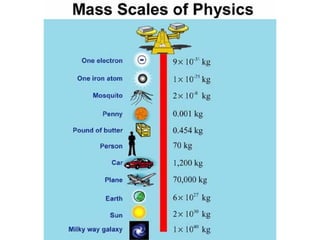
7. Describe the mass of objects in grams and
kilograms.
8. Use scientific notation to represent large and small
numbers.
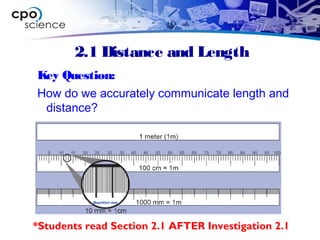
2.1 Distance and Length
Key Question:
How do we accurately communicate length and
distance?
*Students read Section 2.1 AFTER Investigation 2.1
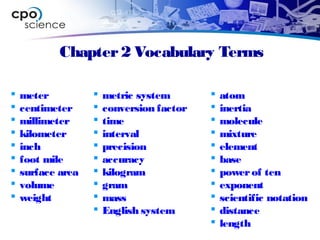
Chapter2 Vocabulary Terms
 meter
 centimeter
 millimeter
 kilometer
 inch
 foot mile
 surface area
 volume
 weight
 metric system
 conversion factor
 time
 interval
 precision
 accuracy
 kilogram
 gram
 mass
 English system
 atom
 inertia
 molecule
 mixture
 element
 base
 powerof ten
 exponent
 scientific notation
 distance
 length
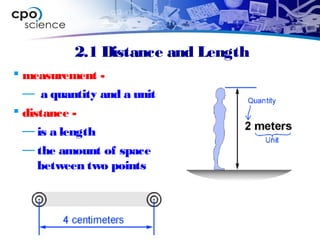
2.1 Distance and Length
 measurement -
— a quantity and a unit
 distance -
— is a length
— the amount of space
between two points
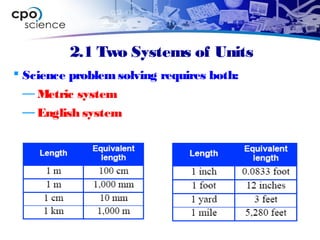
2.1 Two Systems of Units
 Science problemsolving requires both:
— Metric system
— English system
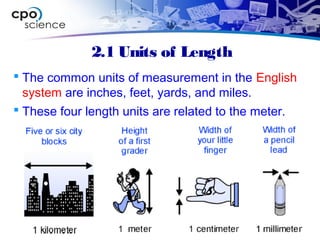
2.1 Units of Length
 The common units of measurement in the English
system are inches, feet, yards, and miles.
 These four length units are related to the meter.
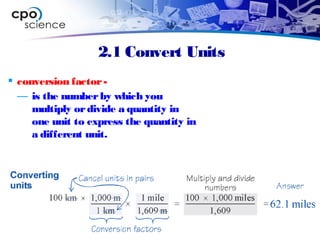
 conversion factor-
— is the numberby which you
multiply ordivide a quantity in
one unit to express the quantity in
a different unit.
2.1 Convert Units
2.1 Convert length
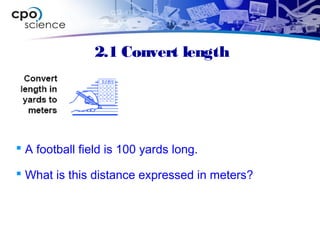
 A football field is 100 yards long.
 What is this distance expressed in meters?
2.1 Surface Area vs. Volume
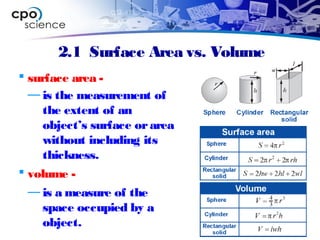
 surface area -
— is the measurement of
the extent of an
object’s surface orarea
without including its
thickness.
 volume -
— is a measure of the
space occupied by a
object.
2.1 Calculate surface area and volume
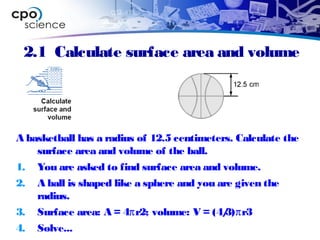
A basketball has a radius of 12.5 centimeters. Calculate the
surface area and volume of the ball.
1. You are asked to find surface area and volume.
2. A ball is shaped like a sphere and you are given the
radius.
3. Surface area: A = 4πr2; volume: V = (4/3)πr3
4. Solve...
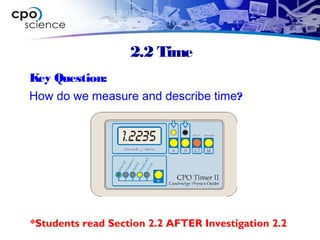
2.2 Time
Key Question:
How do we measure and describe time?
*Students read Section 2.2 AFTER Investigation 2.2
2.2 Time
 Two ways to thinkabout time:
— What time is it?
3 P.M. Eastern Time on April 21, 2004,
— How much time has passed?
3 hr: 44 min: 25 sec.
 A quantity of time is often called a time interval.
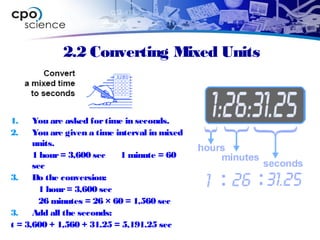
2.2 Converting Mixed Units
1. You are asked fortime in seconds.
2. You are given a time interval in mixed
units.
1 hour= 3,600 sec 1 minute = 60
sec
3. Do the conversion:
1 hour= 3,600 sec
26 minutes = 26 × 60 = 1,560 sec
3. Add all the seconds:
t = 3,600 + 1,560 + 31.25 = 5,191.25 sec
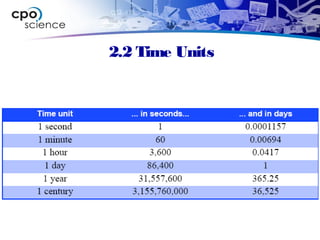
2.2 Time Units
2.2 Accuracy and Precision
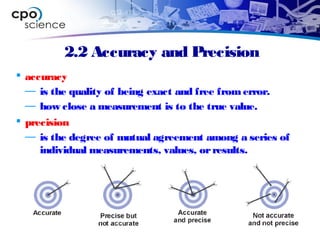
 accuracy
— is the quality of being exact and free fromerror.
— how close a measurement is to the true value.
 precision
— is the degree of mutual agreement among a series of
individual measurements, values, orresults.
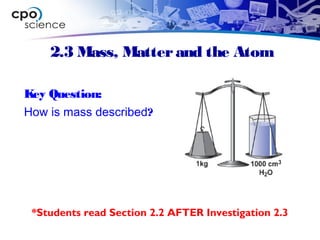
2.3 Mass, Matterand the Atom
Key Question:
How is mass described?
*Students read Section 2.2 AFTER Investigation 2.3
2.3 Mass, Matterand the Atom
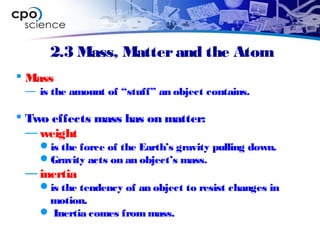
 Mass
— is the amount of “stuff” an object contains.
 Two effects mass has on matter:
— weight
is the force of the Earth’s gravity pulling down.
Gravity acts on an object’s mass.
— inertia
is the tendency of an object to resist changes in
motion.
 Inertia comes frommass.
2.3 Measuring Mass
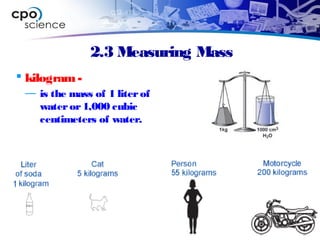
 kilogram-
— is the mass of 1 literof
wateror1,000 cubic
centimeters of water.
2.3 Scientific Notation
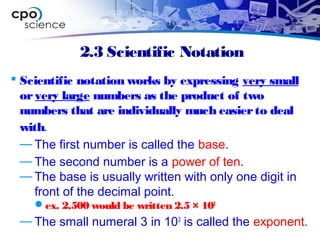
 Scientific notation works by expressing very small
orvery large numbers as the product of two
numbers that are individually much easierto deal
with.
— The first number is called the base.
— The second number is a power of ten.
— The base is usually written with only one digit in
front of the decimal point.
ex. 2,500 would be written 2.5 × 10³
— The small numeral 3 in 103
is called the exponent.
2.3 Mass, Matterand the Atom
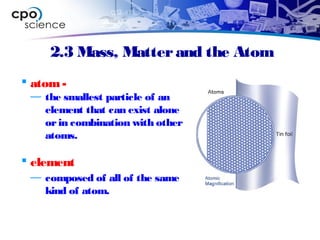
 atom-
— the smallest particle of an
element that can exist alone
orin combination with other
atoms.
 element
— composed of all of the same
kind of atom.
2.3 Mass, Matterand the Atom
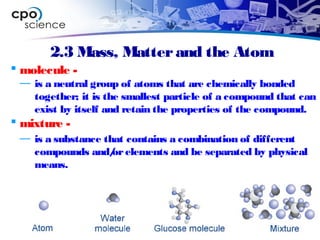
 molecule -
— is a neutral group of atoms that are chemically bonded
together; it is the smallest particle of a compound that can
exist by itself and retain the properties of the compound.
 mixture -
— is a substance that contains a combination of different
compounds and/orelements and be separated by physical
means.
2.3 Mass, Matterand the Atom
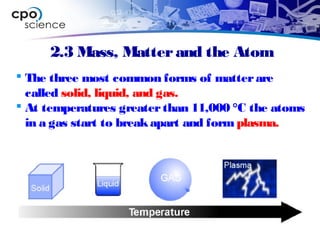
 The three most common forms of matterare
called solid, liquid, and gas.
 At temperatures greaterthan 11,000 °C the atoms
in a gas start to breakapart and formplasma.
2.3 Mass, Matterand the Atom
 Solids - Atoms in a solid stay togetherbecause the energy
peratom is too low to breakthe bonds between atoms.
 Liquids- Liquids flow because atoms have enough energy
to move around by temporarily breaking and reforming
bonds with neighboring atoms.
 Gases- Gas atoms have enough energy to completely break
bonds with each other.
 Plasma- In plasma, matterbecomes ionized as electrons
are broken loose from atoms.
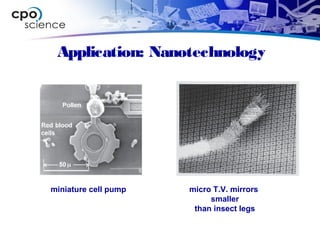
Application: Nanotechnology
miniature cell pump micro T.V. mirrors
smaller
than insect legs

032216 physics chpt2_week2

  • 1.
    Unit 1, Chapter2 CPOScience Foundations of Physics
  • 2.
    Unit 1: Measurementand Motion  2.1 Distance and Length  2.2 Time  2.3 Mass, Matterand the Atom Chapter2: Measurement and Units
  • 3.
    Chapter2 Objectives 1. Expresslengths in metric and English units. 2. Convert distances between different units. 3. Calculate the surface area and volume of simple shapes. 4. Describe time intervals in hours, minutes, and seconds. 5. Convert time in mixed units to time in seconds. 6. Describe two effects you feel every day that are created by mass. 7. Describe the mass of objects in grams and kilograms. 8. Use scientific notation to represent large and small numbers.
  • 4.
    2.1 Distance andLength Key Question: How do we accurately communicate length and distance? *Students read Section 2.1 AFTER Investigation 2.1
  • 5.
    Chapter2 Vocabulary Terms meter  centimeter  millimeter  kilometer  inch  foot mile  surface area  volume  weight  metric system  conversion factor  time  interval  precision  accuracy  kilogram  gram  mass  English system  atom  inertia  molecule  mixture  element  base  powerof ten  exponent  scientific notation  distance  length
  • 6.
    2.1 Distance andLength  measurement - — a quantity and a unit  distance - — is a length — the amount of space between two points
  • 7.
    2.1 Two Systemsof Units  Science problemsolving requires both: — Metric system — English system
  • 8.
    2.1 Units ofLength  The common units of measurement in the English system are inches, feet, yards, and miles.  These four length units are related to the meter.
  • 9.
     conversion factor- —is the numberby which you multiply ordivide a quantity in one unit to express the quantity in a different unit. 2.1 Convert Units
  • 10.
    2.1 Convert length A football field is 100 yards long.  What is this distance expressed in meters?
  • 11.
    2.1 Surface Areavs. Volume  surface area - — is the measurement of the extent of an object’s surface orarea without including its thickness.  volume - — is a measure of the space occupied by a object.
  • 12.
    2.1 Calculate surfacearea and volume A basketball has a radius of 12.5 centimeters. Calculate the surface area and volume of the ball. 1. You are asked to find surface area and volume. 2. A ball is shaped like a sphere and you are given the radius. 3. Surface area: A = 4πr2; volume: V = (4/3)πr3 4. Solve...
  • 13.
    2.2 Time Key Question: Howdo we measure and describe time? *Students read Section 2.2 AFTER Investigation 2.2
  • 14.
    2.2 Time  Twoways to thinkabout time: — What time is it? 3 P.M. Eastern Time on April 21, 2004, — How much time has passed? 3 hr: 44 min: 25 sec.  A quantity of time is often called a time interval.
  • 15.
    2.2 Converting MixedUnits 1. You are asked fortime in seconds. 2. You are given a time interval in mixed units. 1 hour= 3,600 sec 1 minute = 60 sec 3. Do the conversion: 1 hour= 3,600 sec 26 minutes = 26 × 60 = 1,560 sec 3. Add all the seconds: t = 3,600 + 1,560 + 31.25 = 5,191.25 sec
  • 16.
  • 17.
    2.2 Accuracy andPrecision  accuracy — is the quality of being exact and free fromerror. — how close a measurement is to the true value.  precision — is the degree of mutual agreement among a series of individual measurements, values, orresults.
  • 18.
    2.3 Mass, Matterandthe Atom Key Question: How is mass described? *Students read Section 2.2 AFTER Investigation 2.3
  • 19.
    2.3 Mass, Matterandthe Atom  Mass — is the amount of “stuff” an object contains.  Two effects mass has on matter: — weight is the force of the Earth’s gravity pulling down. Gravity acts on an object’s mass. — inertia is the tendency of an object to resist changes in motion.  Inertia comes frommass.
  • 20.
    2.3 Measuring Mass kilogram- — is the mass of 1 literof wateror1,000 cubic centimeters of water.
  • 21.
    2.3 Scientific Notation Scientific notation works by expressing very small orvery large numbers as the product of two numbers that are individually much easierto deal with. — The first number is called the base. — The second number is a power of ten. — The base is usually written with only one digit in front of the decimal point. ex. 2,500 would be written 2.5 × 10³ — The small numeral 3 in 103 is called the exponent.
  • 22.
    2.3 Mass, Matterandthe Atom  atom- — the smallest particle of an element that can exist alone orin combination with other atoms.  element — composed of all of the same kind of atom.
  • 23.
    2.3 Mass, Matterandthe Atom  molecule - — is a neutral group of atoms that are chemically bonded together; it is the smallest particle of a compound that can exist by itself and retain the properties of the compound.  mixture - — is a substance that contains a combination of different compounds and/orelements and be separated by physical means.
  • 24.
    2.3 Mass, Matterandthe Atom  The three most common forms of matterare called solid, liquid, and gas.  At temperatures greaterthan 11,000 °C the atoms in a gas start to breakapart and formplasma.
  • 26.
    2.3 Mass, Matterandthe Atom  Solids - Atoms in a solid stay togetherbecause the energy peratom is too low to breakthe bonds between atoms.  Liquids- Liquids flow because atoms have enough energy to move around by temporarily breaking and reforming bonds with neighboring atoms.  Gases- Gas atoms have enough energy to completely break bonds with each other.  Plasma- In plasma, matterbecomes ionized as electrons are broken loose from atoms.
  • 27.
    Application: Nanotechnology miniature cellpump micro T.V. mirrors smaller than insect legs

Editor's Notes

  • #11 1) You are given distance in yards. 2) You are asked to find distance in meters. 3) 1 yard = 3 feet, 1 foot = 0.3048 meters 4) Solve: 100 yards = 3 feet/1 yard x .3048 m/1 foot = 91.4 m
  • #13 1) You are asked to find surface area and volume. 2) A ball is shaped like a sphere and you are given the radius. 3) Surface area: A = 4 π r2; volume: V = (4/3) π r3 4) Solve: A= 4 (3.14)(12.5)2 = 1,963 cm2 V = (4/3)(3.14)(12.5)3 = 8,181 cm3