Measurement
Chapter 1
Copyright © 2014 John Wiley & Sons, Inc. All rights reserved.
1-1 Measuring Things, Including Lengths
1.01 Identify the base
quantities in the SI system.
1.02 Name the most frequently
used prefixes for SI units.
1.03 Change units (here for
length, area, and volume) by
using chain-link conversions.
1.04 Explain that the meter is
defined in terms of the speed
of light in a vacuum.
Learning Objectives
© 2014 John Wiley & Sons, Inc. All rights reserved.
1-1 Measuring Things, Including Lengths
 Physics and engineering are based on the precise
measurement of physical quantities
 Therefore, we need:
1. Rules for measurement and comparison
2. Units for measurement
 A unit:
 Is the unique name assigned to the measure of a quantity
(mass, time, length, pressure, etc.)
 Corresponds to a standard, a physical quantity with value
1.0 unit (e.g. 1.0 meter = distance traveled by light in a
vacuum over a certain fraction of a second)
© 2014 John Wiley & Sons, Inc. All rights reserved.
1-1 Measuring Things, Including Lengths
 There are many different physical quantities, but not
all are independent: distance vs. speed (distance/time)
 Base quantities:
 Are seven fundamental quantities such as length, time
 Three are needed for mechanics: length, time, mass
 All have been assigned standards
 Are used to define all other physical quantities
 Base standards must be:
 Accessible, so precise measurements can be taken
 Invariable, so measurements do not change over time
© 2014 John Wiley & Sons, Inc. All rights reserved.
1-1 Measuring Things, Including Lengths
 SI units (the metric system) form the International
System of Units
 SI base units include
 Meters (length)
 Seconds (time)
 Kilograms (mass)
 SI has many derived units, which are written in terms
of base units
 Joules (work-energy): 1 J = 1 kg m2/s2
 Watts (power): 1 W = 1 J/s = 1 kg m2/s3
© 2014 John Wiley & Sons, Inc. All rights reserved.
1-1 Measuring Things, Including Lengths
 Scientific notation employs powers of 10 to write
large or small numbers
 A conversion factor is
 A ratio of units that is equal to 1
 Used to convert between units
 Units obey the same algebraic rules as variables and numbers
© 2014 John Wiley & Sons, Inc. All rights reserved.
1-1 Measuring Things, Including Lengths
 Needs for accuracy in science have driven changes in
the standards for units
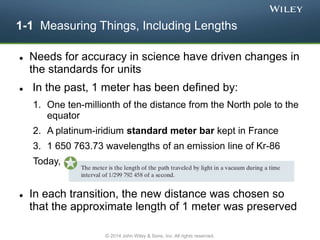
 In the past, 1 meter has been defined by:
1. One ten-millionth of the distance from the North pole to the
equator
2. A platinum-iridium standard meter bar kept in France
3. 1 650 763.73 wavelengths of an emission line of Kr-86
Today,
 In each transition, the new distance was chosen so
that the approximate length of 1 meter was preserved
© 2014 John Wiley & Sons, Inc. All rights reserved.
1-1 Measuring Things, Including Lengths
 Significant figures are meaningful digits
 Generally, round to the least number of significant
figures of the given data
 25 x 18 → 2 significant figures; 25 x 18975 → still 2
 Round up for 5+ (13.5 → 14, but 13.4 → 13)
 Significant figures are not decimal places
 0.00356 has 5 decimal places, 3 significant figures
 In general, trailing zeros are not significant
In other words, 3000 may have 4 significant figures
but usually 3000 will have only 1 significant figure!
When in doubt, use scientific notation 3.000 x 10³ or 3 x 10³
© 2014 John Wiley & Sons, Inc. All rights reserved.
1-1 Measuring Things, Including Lengths
Examples Chain-link conversions:
o 1.3 km x (1000 m)/(1 km) = 1300 m = 1.3 x 10³
o 0.8 km x (1000 m)/(1 km) x (100 cm)/(1 m) = 80 000 cm
= 8 x 10⁴
o 2845 mm x (1 m)/(1000 mm) x (3.281 ft)/(1 m) = 9.334 ft
© 2014 John Wiley & Sons, Inc. All rights reserved.
1-2 Time
1.05 Change units for time
using chain-link conversions.
1.06 Use various measures of
time, such as for motion or as
measured on different
clocks.1
Learning Objectives
© 2014 John Wiley & Sons, Inc. All rights reserved.
1-2 Time
 Any standard of time needs to be able to answer:
o When did a thing happen?
o What was its duration?
 Times follow the same conversion process as lengths
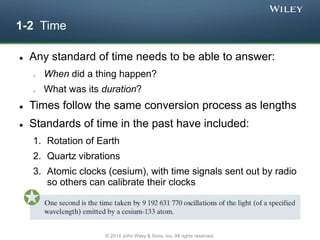
 Standards of time in the past have included:
1. Rotation of Earth
2. Quartz vibrations
3. Atomic clocks (cesium), with time signals sent out by radio
so others can calibrate their clocks
© 2014 John Wiley & Sons, Inc. All rights reserved.
1-2 Time
 The variation in the length of a day as measured by an
atomic clock:
Figure 1-2
 The vertical scale here
amounts to only 3 ms, or
0.003 s.
 This shows the precision
of atomic clocks, and the
relative imprecision of
Earth's rotation (affected
by tides, winds)
© 2014 John Wiley & Sons, Inc. All rights reserved.
1-3 Mass
1.07 Change units for mass
using chain-link conversions.
1.08 Relate density to mass
and volume when the mass
is uniformly distributed.
Learning Objectives
© 2014 John Wiley & Sons, Inc. All rights reserved.
1-3 Mass
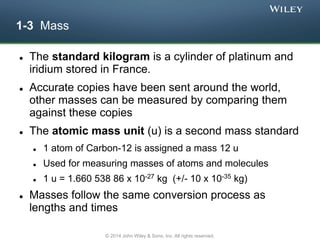
 The standard kilogram is a cylinder of platinum and
iridium stored in France.
 Accurate copies have been sent around the world,
other masses can be measured by comparing them
against these copies
 The atomic mass unit (u) is a second mass standard
 1 atom of Carbon-12 is assigned a mass 12 u
 Used for measuring masses of atoms and molecules
 1 u = 1.660 538 86 x 10-27 kg (+/- 10 x 10-35 kg)
 Masses follow the same conversion process as
lengths and times
© 2014 John Wiley & Sons, Inc. All rights reserved.
1-3 Mass
 Mass per unit volume is called density
Eq. (1-8)
Examples Calculate . . .
o Density of material: (18 kg) / (0.032 m3) = 560 kg/m3
o Mass of object: (380 kg/m3) x (0.0040 m3) = 1.5 kg
o Volume of object: (250 kg) / (1280 kg/m3) = 0.20 m3
© 2014 John Wiley & Sons, Inc. All rights reserved.
Measurement
 Defined by relationships to
base quantities
 Each defined by a standard,
and given a unit
SI Units
 International System of Units
 Each base unit has an
accessible standard of
measurement
Length
 Meter is defined by the
distance traveled by light in a
vacuum in a specified time
interval
Changing Units
 Use chain-link conversions
 Write conversion factors as
unity
 Manipulate units as algebraic
quantities
1 Summary
© 2014 John Wiley & Sons, Inc. All rights reserved.
Time
 Second is defined in terms of
oscillations of light emitted by a
cesium-133 source
 Atomic clocks are used as the
time standard
Mass
 Kilogram is defined in terms of
a platinum-iridium standard
mass
 Atomic-scale masses are
measured in u, defined as
mass of a carbon-12 atom
Density
 Mass/volume
Eq. (1-8)
1 Summary
© 2014 John Wiley & Sons, Inc. All rights reserved.
Problems
1. Until 1883, every city and town in the United States kept its own local time.
Today, travelers reset their watches only when the time change equals 1.0 h.
How far, on the average, must you travel in degrees of longitude between the
time-zone boundaries at which your watch must be reset by 1.0 h? (Hint:
Earth rotates 360° in about 24 h.)
Solution:
Since a change of longitude equal to 360° corresponds to a 24 hour
change, then one expects to change longitude by
360
24
= 15°
before
resetting one's watch by 1.0 h.
© 2014 John Wiley & Sons, Inc. All rights reserved.
Problems
2. Earth is approximately a sphere of radius 𝟔. 𝟑𝟕 × 𝟏𝟎𝟔𝒎. What are (a) its
circumference in kilometers, (b) its surface area in square kilometers,
and (c) its volume in cubic kilometers?
© 2014 John Wiley & Sons, Inc. All rights reserved.
Problems
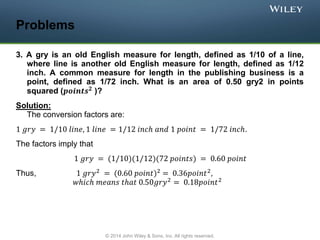
3. A gry is an old English measure for length, defined as 1/10 of a line,
where line is another old English measure for length, defined as 1/12
inch. A common measure for length in the publishing business is a
point, defined as 1/72 inch. What is an area of 0.50 gry2 in points
squared (𝒑𝒐𝒊𝒏𝒕𝒔𝟐 )?
Solution:
The conversion factors are:
1 𝑔𝑟𝑦 = 1/10 𝑙𝑖𝑛𝑒, 1 𝑙𝑖𝑛𝑒 = 1/12 𝑖𝑛𝑐ℎ 𝑎𝑛𝑑 1 𝑝𝑜𝑖𝑛𝑡 = 1/72 𝑖𝑛𝑐ℎ.
The factors imply that
1 𝑔𝑟𝑦 = (1/10)(1/12)(72 𝑝𝑜𝑖𝑛𝑡𝑠) = 0.60 𝑝𝑜𝑖𝑛𝑡
Thus, 1 𝑔𝑟𝑦2
= (0.60 𝑝𝑜𝑖𝑛𝑡)2
= 0.36𝑝𝑜𝑖𝑛𝑡2
,
𝑤ℎ𝑖𝑐ℎ 𝑚𝑒𝑎𝑛𝑠 𝑡ℎ𝑎𝑡 0.50𝑔𝑟𝑦2 = 0.18𝑝𝑜𝑖𝑛𝑡2
© 2014 John Wiley & Sons, Inc. All rights reserved.
Problems
4. Antarctica is roughly semicircular, with a radius of 2000 km (Fig. 1-5). The
average thickness of its ice cover is 3000 m. How many cubic centimeters
of ice does Antarctica contain? (Ignore the curvature of Earth.)
Solution: The volume of ice is given by the product of the semicircular surface area
and the thickness. The area of the semicircle is 𝑨 =
𝝅𝒓𝟐
𝟐
, where r is the radius.
Therefore, the volume is 𝑽 = 𝑨 =
𝝅𝒓𝟐
𝟐
𝒁,
© 2014 John Wiley & Sons, Inc. All rights reserved.
Problems
5. For about 10 years after the French Revolution, the French government
attempted to base measures of time on multiples of ten: One week
consisted of 10 days, one day consisted of 10 hours, one hour consisted
of 100 minutes, and one minute consisted of 100 seconds. What are the
ratios of (a) the French decimal week to the standard week and (b) the
French decimal second to the standard second?
Solution:
(a) Presuming that a French decimal day is equivalent to a regular day, then the
ratio of weeks is simply 10/7 or (to 3 significant figures) 1.43.
(b) In a regular day, there are 86400 seconds, but in the French system described
in the problem, there would be 105 seconds. The ratio is therefore 0.864.
© 2014 John Wiley & Sons, Inc. All rights reserved.
Problems
6.The fastest growing plant on record is a Hesperoyucca whipplei that
grew 3.7 m in 14 days. What was its growth rate in micrometers per
second?
Solution:
A day is equivalent to 86400 seconds and a meter is equivalent to a million
micrometers, so
7. A lecture period (50 min) is close to 1 microcentury. (a) How long is a
microcentury in minutes? (b) find the percentage difference from the
approximation using
% 𝑑𝑖𝑓𝑓𝑒𝑟𝑒𝑛𝑐𝑒 =
𝑎𝑐𝑡𝑢𝑎𝑙 − 𝑎𝑝𝑝𝑟𝑜𝑥𝑖𝑚𝑎𝑡𝑖𝑜𝑛
𝑎𝑐𝑡𝑢𝑎𝑙
∗ 100
© 2014 John Wiley & Sons, Inc. All rights reserved.

Engineering Physics Lec 01 ch01-10e.pptx

  • 1.
    Measurement Chapter 1 Copyright ©2014 John Wiley & Sons, Inc. All rights reserved.
  • 2.
    1-1 Measuring Things,Including Lengths 1.01 Identify the base quantities in the SI system. 1.02 Name the most frequently used prefixes for SI units. 1.03 Change units (here for length, area, and volume) by using chain-link conversions. 1.04 Explain that the meter is defined in terms of the speed of light in a vacuum. Learning Objectives © 2014 John Wiley & Sons, Inc. All rights reserved.
  • 3.
    1-1 Measuring Things,Including Lengths  Physics and engineering are based on the precise measurement of physical quantities  Therefore, we need: 1. Rules for measurement and comparison 2. Units for measurement  A unit:  Is the unique name assigned to the measure of a quantity (mass, time, length, pressure, etc.)  Corresponds to a standard, a physical quantity with value 1.0 unit (e.g. 1.0 meter = distance traveled by light in a vacuum over a certain fraction of a second) © 2014 John Wiley & Sons, Inc. All rights reserved.
  • 4.
    1-1 Measuring Things,Including Lengths  There are many different physical quantities, but not all are independent: distance vs. speed (distance/time)  Base quantities:  Are seven fundamental quantities such as length, time  Three are needed for mechanics: length, time, mass  All have been assigned standards  Are used to define all other physical quantities  Base standards must be:  Accessible, so precise measurements can be taken  Invariable, so measurements do not change over time © 2014 John Wiley & Sons, Inc. All rights reserved.
  • 5.
    1-1 Measuring Things,Including Lengths  SI units (the metric system) form the International System of Units  SI base units include  Meters (length)  Seconds (time)  Kilograms (mass)  SI has many derived units, which are written in terms of base units  Joules (work-energy): 1 J = 1 kg m2/s2  Watts (power): 1 W = 1 J/s = 1 kg m2/s3 © 2014 John Wiley & Sons, Inc. All rights reserved.
  • 6.
    1-1 Measuring Things,Including Lengths  Scientific notation employs powers of 10 to write large or small numbers  A conversion factor is  A ratio of units that is equal to 1  Used to convert between units  Units obey the same algebraic rules as variables and numbers © 2014 John Wiley & Sons, Inc. All rights reserved.
  • 7.
    1-1 Measuring Things,Including Lengths  Needs for accuracy in science have driven changes in the standards for units  In the past, 1 meter has been defined by: 1. One ten-millionth of the distance from the North pole to the equator 2. A platinum-iridium standard meter bar kept in France 3. 1 650 763.73 wavelengths of an emission line of Kr-86 Today,  In each transition, the new distance was chosen so that the approximate length of 1 meter was preserved © 2014 John Wiley & Sons, Inc. All rights reserved.
  • 8.
    1-1 Measuring Things,Including Lengths  Significant figures are meaningful digits  Generally, round to the least number of significant figures of the given data  25 x 18 → 2 significant figures; 25 x 18975 → still 2  Round up for 5+ (13.5 → 14, but 13.4 → 13)  Significant figures are not decimal places  0.00356 has 5 decimal places, 3 significant figures  In general, trailing zeros are not significant In other words, 3000 may have 4 significant figures but usually 3000 will have only 1 significant figure! When in doubt, use scientific notation 3.000 x 10³ or 3 x 10³ © 2014 John Wiley & Sons, Inc. All rights reserved.
  • 9.
    1-1 Measuring Things,Including Lengths Examples Chain-link conversions: o 1.3 km x (1000 m)/(1 km) = 1300 m = 1.3 x 10³ o 0.8 km x (1000 m)/(1 km) x (100 cm)/(1 m) = 80 000 cm = 8 x 10⁴ o 2845 mm x (1 m)/(1000 mm) x (3.281 ft)/(1 m) = 9.334 ft © 2014 John Wiley & Sons, Inc. All rights reserved.
  • 10.
    1-2 Time 1.05 Changeunits for time using chain-link conversions. 1.06 Use various measures of time, such as for motion or as measured on different clocks.1 Learning Objectives © 2014 John Wiley & Sons, Inc. All rights reserved.
  • 11.
    1-2 Time  Anystandard of time needs to be able to answer: o When did a thing happen? o What was its duration?  Times follow the same conversion process as lengths  Standards of time in the past have included: 1. Rotation of Earth 2. Quartz vibrations 3. Atomic clocks (cesium), with time signals sent out by radio so others can calibrate their clocks © 2014 John Wiley & Sons, Inc. All rights reserved.
  • 12.
    1-2 Time  Thevariation in the length of a day as measured by an atomic clock: Figure 1-2  The vertical scale here amounts to only 3 ms, or 0.003 s.  This shows the precision of atomic clocks, and the relative imprecision of Earth's rotation (affected by tides, winds) © 2014 John Wiley & Sons, Inc. All rights reserved.
  • 13.
    1-3 Mass 1.07 Changeunits for mass using chain-link conversions. 1.08 Relate density to mass and volume when the mass is uniformly distributed. Learning Objectives © 2014 John Wiley & Sons, Inc. All rights reserved.
  • 14.
    1-3 Mass  Thestandard kilogram is a cylinder of platinum and iridium stored in France.  Accurate copies have been sent around the world, other masses can be measured by comparing them against these copies  The atomic mass unit (u) is a second mass standard  1 atom of Carbon-12 is assigned a mass 12 u  Used for measuring masses of atoms and molecules  1 u = 1.660 538 86 x 10-27 kg (+/- 10 x 10-35 kg)  Masses follow the same conversion process as lengths and times © 2014 John Wiley & Sons, Inc. All rights reserved.
  • 15.
    1-3 Mass  Massper unit volume is called density Eq. (1-8) Examples Calculate . . . o Density of material: (18 kg) / (0.032 m3) = 560 kg/m3 o Mass of object: (380 kg/m3) x (0.0040 m3) = 1.5 kg o Volume of object: (250 kg) / (1280 kg/m3) = 0.20 m3 © 2014 John Wiley & Sons, Inc. All rights reserved.
  • 16.
    Measurement  Defined byrelationships to base quantities  Each defined by a standard, and given a unit SI Units  International System of Units  Each base unit has an accessible standard of measurement Length  Meter is defined by the distance traveled by light in a vacuum in a specified time interval Changing Units  Use chain-link conversions  Write conversion factors as unity  Manipulate units as algebraic quantities 1 Summary © 2014 John Wiley & Sons, Inc. All rights reserved.
  • 17.
    Time  Second isdefined in terms of oscillations of light emitted by a cesium-133 source  Atomic clocks are used as the time standard Mass  Kilogram is defined in terms of a platinum-iridium standard mass  Atomic-scale masses are measured in u, defined as mass of a carbon-12 atom Density  Mass/volume Eq. (1-8) 1 Summary © 2014 John Wiley & Sons, Inc. All rights reserved.
  • 18.
    Problems 1. Until 1883,every city and town in the United States kept its own local time. Today, travelers reset their watches only when the time change equals 1.0 h. How far, on the average, must you travel in degrees of longitude between the time-zone boundaries at which your watch must be reset by 1.0 h? (Hint: Earth rotates 360° in about 24 h.) Solution: Since a change of longitude equal to 360° corresponds to a 24 hour change, then one expects to change longitude by 360 24 = 15° before resetting one's watch by 1.0 h. © 2014 John Wiley & Sons, Inc. All rights reserved.
  • 19.
    Problems 2. Earth isapproximately a sphere of radius 𝟔. 𝟑𝟕 × 𝟏𝟎𝟔𝒎. What are (a) its circumference in kilometers, (b) its surface area in square kilometers, and (c) its volume in cubic kilometers? © 2014 John Wiley & Sons, Inc. All rights reserved.
  • 20.
    Problems 3. A gryis an old English measure for length, defined as 1/10 of a line, where line is another old English measure for length, defined as 1/12 inch. A common measure for length in the publishing business is a point, defined as 1/72 inch. What is an area of 0.50 gry2 in points squared (𝒑𝒐𝒊𝒏𝒕𝒔𝟐 )? Solution: The conversion factors are: 1 𝑔𝑟𝑦 = 1/10 𝑙𝑖𝑛𝑒, 1 𝑙𝑖𝑛𝑒 = 1/12 𝑖𝑛𝑐ℎ 𝑎𝑛𝑑 1 𝑝𝑜𝑖𝑛𝑡 = 1/72 𝑖𝑛𝑐ℎ. The factors imply that 1 𝑔𝑟𝑦 = (1/10)(1/12)(72 𝑝𝑜𝑖𝑛𝑡𝑠) = 0.60 𝑝𝑜𝑖𝑛𝑡 Thus, 1 𝑔𝑟𝑦2 = (0.60 𝑝𝑜𝑖𝑛𝑡)2 = 0.36𝑝𝑜𝑖𝑛𝑡2 , 𝑤ℎ𝑖𝑐ℎ 𝑚𝑒𝑎𝑛𝑠 𝑡ℎ𝑎𝑡 0.50𝑔𝑟𝑦2 = 0.18𝑝𝑜𝑖𝑛𝑡2 © 2014 John Wiley & Sons, Inc. All rights reserved.
  • 21.
    Problems 4. Antarctica isroughly semicircular, with a radius of 2000 km (Fig. 1-5). The average thickness of its ice cover is 3000 m. How many cubic centimeters of ice does Antarctica contain? (Ignore the curvature of Earth.) Solution: The volume of ice is given by the product of the semicircular surface area and the thickness. The area of the semicircle is 𝑨 = 𝝅𝒓𝟐 𝟐 , where r is the radius. Therefore, the volume is 𝑽 = 𝑨 = 𝝅𝒓𝟐 𝟐 𝒁, © 2014 John Wiley & Sons, Inc. All rights reserved.
  • 22.
    Problems 5. For about10 years after the French Revolution, the French government attempted to base measures of time on multiples of ten: One week consisted of 10 days, one day consisted of 10 hours, one hour consisted of 100 minutes, and one minute consisted of 100 seconds. What are the ratios of (a) the French decimal week to the standard week and (b) the French decimal second to the standard second? Solution: (a) Presuming that a French decimal day is equivalent to a regular day, then the ratio of weeks is simply 10/7 or (to 3 significant figures) 1.43. (b) In a regular day, there are 86400 seconds, but in the French system described in the problem, there would be 105 seconds. The ratio is therefore 0.864. © 2014 John Wiley & Sons, Inc. All rights reserved.
  • 23.
    Problems 6.The fastest growingplant on record is a Hesperoyucca whipplei that grew 3.7 m in 14 days. What was its growth rate in micrometers per second? Solution: A day is equivalent to 86400 seconds and a meter is equivalent to a million micrometers, so 7. A lecture period (50 min) is close to 1 microcentury. (a) How long is a microcentury in minutes? (b) find the percentage difference from the approximation using % 𝑑𝑖𝑓𝑓𝑒𝑟𝑒𝑛𝑐𝑒 = 𝑎𝑐𝑡𝑢𝑎𝑙 − 𝑎𝑝𝑝𝑟𝑜𝑥𝑖𝑚𝑎𝑡𝑖𝑜𝑛 𝑎𝑐𝑡𝑢𝑎𝑙 ∗ 100 © 2014 John Wiley & Sons, Inc. All rights reserved.