Emanuele Della Valle [email_address] http://emanueledellavalle.org   Querying the Semantic Web with SPARQL
Share, Remix, Reuse — Legally This work is licensed under the Creative Commons Attribution 3.0 Unported License.  Your are free: to Share  — to copy, distribute and transmit the work to Remix  — to adapt the work Under the following conditions Attribution  — You must attribute the work by inserting “ © applied-semantic-web.org” at the end of each reused slide a credits slide stating “These slides are partially based on “Querying the Semantic Web with SPARQL” by Emanuele Della Valle  http://applied-semantic-web.org/2010/03/05_SPARQL.ppt   To view a copy of this license, visit  http://creativecommons.org/licenses/by/3.0/
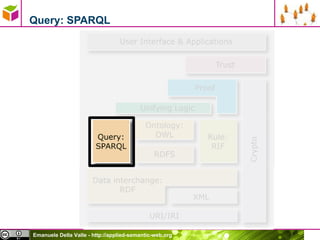
Query: SPARQL
SPARQL in a nutshell  What is SPARQL? SPARQL  is the query language of the Semantic Web stays for  S PARQL  P rotocol  a nd  R DF  Q uery  L anguage A Query Language ...: Find names and websites of contributors to  PlanetRDF :  PREFIX foaf: <http://xmlns.com/foaf/0.1/>  SELECT ?name ?website  FROM <http://planetrdf.com/bloggers.rdf>  WHERE { ?person foaf:weblog ?website ;   foaf:name ?name .    ?website a foaf:Document }  ... and a Protocol. http://.../qps?  query-lang=http://www.w3.org/TR/rdf-sparql-query/ &graph-id=http://planetrdf.com/bloggers.rdf &query=PREFIX foaf: <http://xmlns.com/foaf/0.1/...
SPARQL in a nutshell  Why SPARQL? SPARQL let us  Pull values from structured and semi-structured data represented in RDF Explore RDF data by querying unknown relationships Perform complex joins of disparate RDF repositories in a single query Transform RDF data from one vocabulary to another Develop higher-level cross-platform application
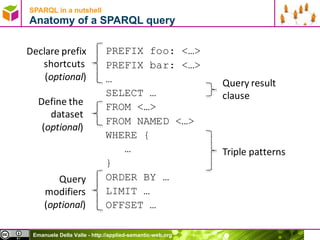
SPARQL in a nutshell  Anatomy of a SPARQL query
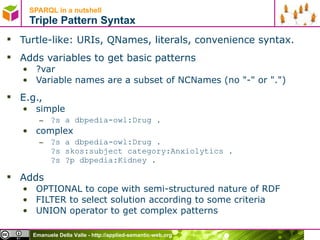
SPARQL in a nutshell  Triple Pattern Syntax Turtle-like: URIs, QNames, literals, convenience syntax. Adds variables to get basic patterns  ?var Variable names are a subset of NCNames (no &quot;-&quot; or &quot;.&quot;) E.g.,  simple ?s a dbpedia-owl:Drug . complex ?s a dbpedia-owl:Drug . ?s skos:subject category:Anxiolytics . ?s ?p dbpedia:Kidney .  Adds  OPTIONAL to cope with semi-structured nature of RDF FILTER to select solution according to some criteria UNION operator to get complex patterns
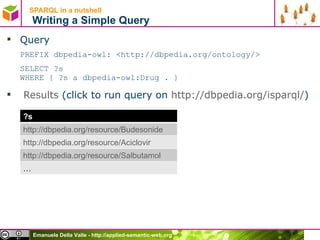
SPARQL in a nutshell   Writing a Simple Query Query PREFIX dbpedia-owl: <http://dbpedia.org/ontology/>  SELECT ?s  WHERE { ?s a dbpedia-owl:Drug . } Results  (click to run query on  http://dbpedia.org/isparql/ ) ?s http://dbpedia.org/resource/Budesonide   http://dbpedia.org/resource/Aciclovir http://dbpedia.org/resource/Salbutamol   …
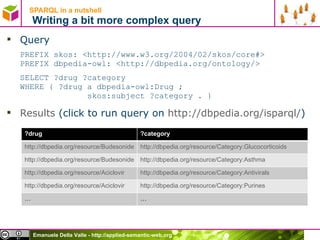
SPARQL in a nutshell   Writing a bit more complex query Query PREFIX skos: <http://www.w3.org/2004/02/skos/core#> PREFIX dbpedia-owl: <http://dbpedia.org/ontology/> SELECT ?drug ?category  WHERE { ?drug a dbpedia-owl:Drug ;   skos:subject ?category . } Results  (click to run query on  http://dbpedia.org/isparql/ ) ?drug ?category http://dbpedia.org/resource/Budesonide   http://dbpedia.org/resource/Category:Glucocorticoids   http://dbpedia.org/resource/Budesonide   http://dbpedia.org/resource/Category:Asthma   http://dbpedia.org/resource/Aciclovir http://dbpedia.org/resource/Category:Antivirals   http://dbpedia.org/resource/Aciclovir http://dbpedia.org/resource/Category:Purines   … …
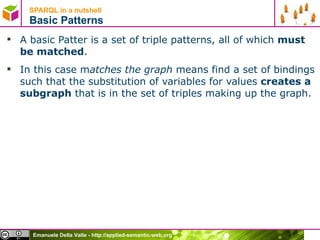
SPARQL in a nutshell  Basic Patterns A basic Patter is a set of triple patterns, all of which  must be matched . In this case m atches the graph  means find a set of bindings such that the substitution of variables for values  creates a subgraph  that is in the set of triples making up the graph.
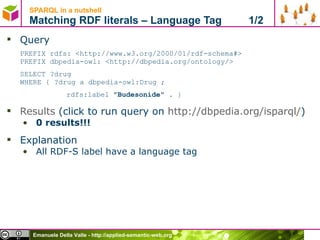
SPARQL in a nutshell  Matching RDF literals – Language Tag  1/2 Query PREFIX rdfs: <http://www.w3.org/2000/01/rdf-schema#> PREFIX dbpedia-owl: <http://dbpedia.org/ontology/> SELECT ?drug  WHERE { ?drug a dbpedia-owl:Drug ; rdfs:label  &quot;Budesonide&quot;  . } Results  (click to run query on  http://dbpedia.org/isparql/ ) 0 results!!! Explanation All RDF-S label have a language tag
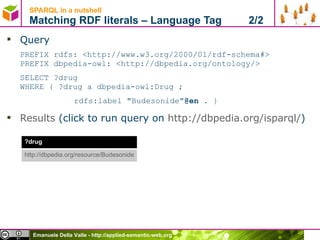
SPARQL in a nutshell  Matching RDF literals – Language Tag  2/2 Query PREFIX rdfs: <http://www.w3.org/2000/01/rdf-schema#> PREFIX dbpedia-owl: <http://dbpedia.org/ontology/> SELECT ?drug  WHERE { ?drug a dbpedia-owl:Drug ; rdfs:label &quot;Budesonide&quot; @en  . } Results  (click to run query on  http://dbpedia.org/isparql/ ) ?drug http://dbpedia.org/resource/Budesonide
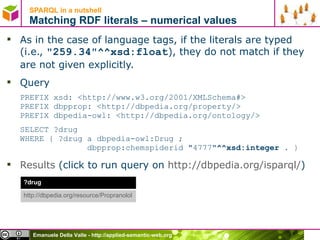
SPARQL in a nutshell  Matching RDF literals – numerical values As in the case of language tags, if the literals are typed (i.e.,  &quot;259.34&quot;^^xsd:float ), they do not match if they are not given explicitly. Query PREFIX xsd: <http://www.w3.org/2001/XMLSchema#> PREFIX dbpprop: <http://dbpedia.org/property/> PREFIX dbpedia-owl: <http://dbpedia.org/ontology/> SELECT ?drug  WHERE { ?drug a dbpedia-owl:Drug ;   dbpprop:chemspiderid &quot;4777&quot; ^^xsd:integer  . } Results  (click to run query on  http://dbpedia.org/isparql/ ) ?drug http://dbpedia.org/resource/Propranolol
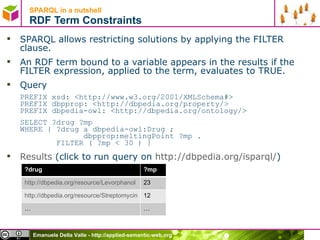
SPARQL in a nutshell  RDF Term Constraints SPARQL allows restricting solutions by applying the FILTER clause.  An RDF term bound to a variable appears in the results if the FILTER expression, applied to the term, evaluates to TRUE.  Query PREFIX xsd: <http://www.w3.org/2001/XMLSchema#> PREFIX dbpprop: <http://dbpedia.org/property/> PREFIX dbpedia-owl: <http://dbpedia.org/ontology/> SELECT ?drug ?mp WHERE { ?drug a dbpedia-owl:Drug ;   dbpprop:meltingPoint ?mp .   FILTER ( ?mp < 30 ) } Results  (click to run query on  http://dbpedia.org/isparql/ )   ?drug ?mp http://dbpedia.org/resource/Levorphanol   23 http://dbpedia.org/resource/Streptomycin   12 … …
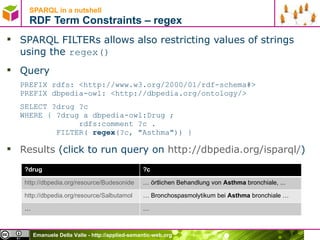
SPARQL in a nutshell  RDF Term Constraints – regex SPARQL FILTERs allows also restricting values of strings using the  regex() Query PREFIX rdfs: <http://www.w3.org/2000/01/rdf-schema#> PREFIX dbpedia-owl: <http://dbpedia.org/ontology/> SELECT ?drug ?c WHERE { ?drug a dbpedia-owl:Drug ;   rdfs:comment ?c .   FILTER(  regex (?c, &quot;Asthma&quot;)) } Results  (click to run query on  http://dbpedia.org/isparql/ ) ?drug ?c http://dbpedia.org/resource/Budesonide   …  örtlichen Behandlung von  Asthma  bronchiale, ... http://dbpedia.org/resource/Salbutamol   …  Bronchospasmolytikum bei  Asthma  bronchiale … … …
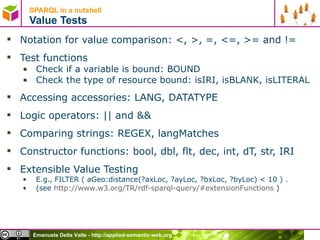
SPARQL in a nutshell  Value Tests Notation for value comparison: <, >, =, <=, >= and !=  Test functions Check if a variable is bound: BOUND Check the type of resource bound: isIRI, isBLANK, isLITERAL Accessing accessories: LANG, DATATYPE Logic operators: || and && Comparing strings: REGEX, langMatches Constructor functions: bool, dbl, flt, dec, int, dT, str, IRI Extensible Value Testing E.g., FILTER ( aGeo:distance(?axLoc, ?ayLoc, ?bxLoc, ?byLoc) < 10 ) .  (see  http://www.w3.org/TR/rdf-sparql-query/#extensionFunctions  )
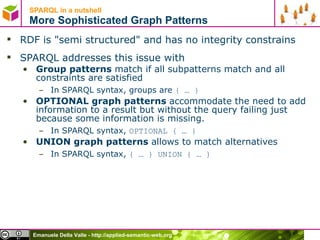
SPARQL in a nutshell  More Sophisticated Graph Patterns RDF is &quot;semi structured&quot; and has no integrity constrains SPARQL addresses this issue with Group patterns  match if all subpatterns match and all constraints are satisfied In SPARQL syntax, groups are  { … } OPTIONAL graph patterns  accommodate the need to add information to a result but without the query failing just because some information is missing. In SPARQL syntax,  OPTIONAL { … } UNION graph patterns  allows to match alternatives  In SPARQL syntax,  { … } UNION { … }
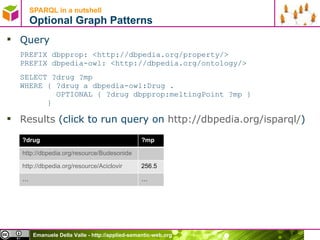
SPARQL in a nutshell  Optional Graph Patterns Query PREFIX dbpprop: <http://dbpedia.org/property/> PREFIX dbpedia-owl: <http://dbpedia.org/ontology/> SELECT ?drug ?mp WHERE { ?drug a dbpedia-owl:Drug .   OPTIONAL { ?drug dbpprop:meltingPoint ?mp }   } Results  (click to run query on  http://dbpedia.org/isparql/ ) ?drug ?mp http://dbpedia.org/resource/Budesonide   http://dbpedia.org/resource/Aciclovir   256.5 … …
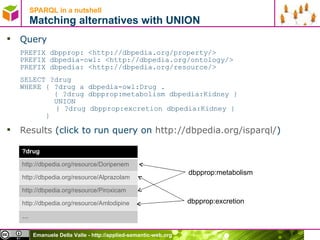
SPARQL in a nutshell  Matching alternatives with UNION Query PREFIX dbpprop: <http://dbpedia.org/property/> PREFIX dbpedia-owl: <http://dbpedia.org/ontology/> PREFIX dbpedia: <http://dbpedia.org/resource/> SELECT ?drug  WHERE { ?drug a dbpedia-owl:Drug .   { ?drug dbpprop:metabolism dbpedia:Kidney }   UNION   { ?drug dbpprop:excretion dbpedia:Kidney }   } Results  (click to run query on  http://dbpedia.org/isparql/ ) dbpprop:metabolism dbpprop:excretion ?drug http://dbpedia.org/resource/Doripenem   http://dbpedia.org/resource/Alprazolam   http://dbpedia.org/resource/Piroxicam   http://dbpedia.org/resource/Amlodipine   …
SPARQL in a nutshell  Defining the Dataset with the FROM clause A SPARQL query may  specify the dataset to be used for matching  by using  the FROM clause and  the FROM NAMED clause Ex. PREFIX rdfs:<http://www.w3.org/2000/01/rdf-schema#>  PREFIX skos: <http://www.w3.org/2004/02/skos/core#> SELECT ?label ?graph  FROM <http://dbpedia.org/resource/Category:Anxiolytics> FROM NAMED <http://dbpedia.org/resource/Propranolol> WHERE {    ?s rdfs:label ?label .   GRAPH ?graph { ?graph skos:subject ?s .  } } Results below are very different from  those  of the same query without FROM clauses ?label  ?graph [email_address] http://dbpedia.org/resource/Propranolol
SPARQL in a nutshell  A difficult to solve problem 1/3 Image you don’t know dbpedia SPARQL endpoint, you discovered using  Sindice  the graph  http://dbpedia.org/resource/ Category:Anxiolytics  and you want to get the rdfs:labels of the anxiolytics.  If you write the query PREFIX rdfs:<http://www.w3.org/2000/01/rdf-schema#> PREFIX skos: <http://www.w3.org/2004/02/skos/core#> PREFIX dbp-cat: <http://dbpedia.org/resource/Category:> SELECT ?label  FROM <http://dbpedia.org/resource/Category:Anxiolytics> WHERE {   ?s skos:subject dbp-cat:Anxiolytics .    ?s rdfs:label ?label . }  You get no results because the labels are in different graphs such as http://dbpedia.org/resource/Alprazolam   […] http://dbpedia.org/resource/ZK-93423
SPARQL in a nutshell  A difficult to solve problem 2/3 A solution is writing the query PREFIX rdfs:<http://www.w3.org/2000/01/rdf-schema#> PREFIX skos: <http://www.w3.org/2004/02/skos/core#> PREFIX dbp-cat: <http://dbpedia.org/resource/Category:> SELECT ?label  FROM <http://dbpedia.org/resource/Category:Anxiolytics> FROM <http://dbpedia.org/resource/Alprazolam> FROM […] FROM <http://dbpedia.org/resource/ZK-93423> WHERE {   ?s skos:subject dbp-cat:Anxiolytics .    ?s rdfs:label ?label . }  But this means knowing the answer already
SPARQL in a nutshell  A difficult to solve problem 3/3 The  Semantic Web Client  provides a solution to the problem by dynamically retrieving information from the Semantic Web It dereferences HTTP URIs,  It follows rdfs:seeAlso links, and  it queries the  Sindice  search engine. Querying the Semantic Web with the following query … PREFIX rdfs:<http://www.w3.org/2000/01/rdf-schema#> PREFIX skos: <http://www.w3.org/2004/02/skos/core#> PREFIX dbp-cat: <http://dbpedia.org/resource/Category:> SELECT ?label  WHERE {   ?s skos:subject dbp-cat:Anxiolytics .    ?s rdfs:label ?label . }  …  gives the correct results even if no FROM clause is given and no specific SPARQL endpoint is used.
SPARQL in a nutshell  Result Forms Besides selecting tables of values, SPARQL allows three other types of queries: ASK - returns a boolean answering, does the query have any results? CONSTRUCT - uses variable bindings to return new RDF triples DESCRIBE - returns server-determined RDF about the queried resources SELECT and ASK results can be returned as XML or JSON.  CONSTRUCT and DESCRIBE results can be returned via any RDF serialization (e.g. RDF/XML or Turtle).
SPARQL in a nutshell  SPARQL Resources SPARQL Frequently Asked Questions http://thefigtrees.net/lee/sw/sparql-faq SPARQL implementations - community maintained list of open-source and commercial SPARQL engines http://esw.w3.org/topic/SparqlImplementations   Public SPARQL endpoints - community maintained list http://esw.w3.org/topic/SparqlEndpoints   SPARQL extensions - collection of SPARQL extensions implemented in various SPARQL engines http://esw.w3.org/topic/SPARQL/Extensions
Emanuele Della Valle [email_address] http://emanueledellavalle.org   Querying the Semantic Web with SPARQL

Querying the Semantic Web with SPARQL

  • 1.
    Emanuele Della Valle[email_address] http://emanueledellavalle.org Querying the Semantic Web with SPARQL
  • 2.
    Share, Remix, Reuse— Legally This work is licensed under the Creative Commons Attribution 3.0 Unported License. Your are free: to Share — to copy, distribute and transmit the work to Remix — to adapt the work Under the following conditions Attribution — You must attribute the work by inserting “ © applied-semantic-web.org” at the end of each reused slide a credits slide stating “These slides are partially based on “Querying the Semantic Web with SPARQL” by Emanuele Della Valle http://applied-semantic-web.org/2010/03/05_SPARQL.ppt To view a copy of this license, visit http://creativecommons.org/licenses/by/3.0/
  • 3.
  • 4.
    SPARQL in anutshell What is SPARQL? SPARQL is the query language of the Semantic Web stays for S PARQL P rotocol a nd R DF Q uery L anguage A Query Language ...: Find names and websites of contributors to PlanetRDF : PREFIX foaf: <http://xmlns.com/foaf/0.1/> SELECT ?name ?website FROM <http://planetrdf.com/bloggers.rdf> WHERE { ?person foaf:weblog ?website ; foaf:name ?name . ?website a foaf:Document } ... and a Protocol. http://.../qps? query-lang=http://www.w3.org/TR/rdf-sparql-query/ &graph-id=http://planetrdf.com/bloggers.rdf &query=PREFIX foaf: <http://xmlns.com/foaf/0.1/...
  • 5.
    SPARQL in anutshell Why SPARQL? SPARQL let us Pull values from structured and semi-structured data represented in RDF Explore RDF data by querying unknown relationships Perform complex joins of disparate RDF repositories in a single query Transform RDF data from one vocabulary to another Develop higher-level cross-platform application
  • 6.
    SPARQL in anutshell Anatomy of a SPARQL query
  • 7.
    SPARQL in anutshell Triple Pattern Syntax Turtle-like: URIs, QNames, literals, convenience syntax. Adds variables to get basic patterns ?var Variable names are a subset of NCNames (no &quot;-&quot; or &quot;.&quot;) E.g., simple ?s a dbpedia-owl:Drug . complex ?s a dbpedia-owl:Drug . ?s skos:subject category:Anxiolytics . ?s ?p dbpedia:Kidney . Adds OPTIONAL to cope with semi-structured nature of RDF FILTER to select solution according to some criteria UNION operator to get complex patterns
  • 8.
    SPARQL in anutshell Writing a Simple Query Query PREFIX dbpedia-owl: <http://dbpedia.org/ontology/> SELECT ?s WHERE { ?s a dbpedia-owl:Drug . } Results (click to run query on http://dbpedia.org/isparql/ ) ?s http://dbpedia.org/resource/Budesonide http://dbpedia.org/resource/Aciclovir http://dbpedia.org/resource/Salbutamol …
  • 9.
    SPARQL in anutshell Writing a bit more complex query Query PREFIX skos: <http://www.w3.org/2004/02/skos/core#> PREFIX dbpedia-owl: <http://dbpedia.org/ontology/> SELECT ?drug ?category WHERE { ?drug a dbpedia-owl:Drug ; skos:subject ?category . } Results (click to run query on http://dbpedia.org/isparql/ ) ?drug ?category http://dbpedia.org/resource/Budesonide http://dbpedia.org/resource/Category:Glucocorticoids http://dbpedia.org/resource/Budesonide http://dbpedia.org/resource/Category:Asthma http://dbpedia.org/resource/Aciclovir http://dbpedia.org/resource/Category:Antivirals http://dbpedia.org/resource/Aciclovir http://dbpedia.org/resource/Category:Purines … …
  • 10.
    SPARQL in anutshell Basic Patterns A basic Patter is a set of triple patterns, all of which must be matched . In this case m atches the graph means find a set of bindings such that the substitution of variables for values creates a subgraph that is in the set of triples making up the graph.
  • 11.
    SPARQL in anutshell Matching RDF literals – Language Tag 1/2 Query PREFIX rdfs: <http://www.w3.org/2000/01/rdf-schema#> PREFIX dbpedia-owl: <http://dbpedia.org/ontology/> SELECT ?drug WHERE { ?drug a dbpedia-owl:Drug ; rdfs:label &quot;Budesonide&quot; . } Results (click to run query on http://dbpedia.org/isparql/ ) 0 results!!! Explanation All RDF-S label have a language tag
  • 12.
    SPARQL in anutshell Matching RDF literals – Language Tag 2/2 Query PREFIX rdfs: <http://www.w3.org/2000/01/rdf-schema#> PREFIX dbpedia-owl: <http://dbpedia.org/ontology/> SELECT ?drug WHERE { ?drug a dbpedia-owl:Drug ; rdfs:label &quot;Budesonide&quot; @en . } Results (click to run query on http://dbpedia.org/isparql/ ) ?drug http://dbpedia.org/resource/Budesonide
  • 13.
    SPARQL in anutshell Matching RDF literals – numerical values As in the case of language tags, if the literals are typed (i.e., &quot;259.34&quot;^^xsd:float ), they do not match if they are not given explicitly. Query PREFIX xsd: <http://www.w3.org/2001/XMLSchema#> PREFIX dbpprop: <http://dbpedia.org/property/> PREFIX dbpedia-owl: <http://dbpedia.org/ontology/> SELECT ?drug WHERE { ?drug a dbpedia-owl:Drug ; dbpprop:chemspiderid &quot;4777&quot; ^^xsd:integer . } Results (click to run query on http://dbpedia.org/isparql/ ) ?drug http://dbpedia.org/resource/Propranolol
  • 14.
    SPARQL in anutshell RDF Term Constraints SPARQL allows restricting solutions by applying the FILTER clause. An RDF term bound to a variable appears in the results if the FILTER expression, applied to the term, evaluates to TRUE. Query PREFIX xsd: <http://www.w3.org/2001/XMLSchema#> PREFIX dbpprop: <http://dbpedia.org/property/> PREFIX dbpedia-owl: <http://dbpedia.org/ontology/> SELECT ?drug ?mp WHERE { ?drug a dbpedia-owl:Drug ; dbpprop:meltingPoint ?mp . FILTER ( ?mp < 30 ) } Results (click to run query on http://dbpedia.org/isparql/ ) ?drug ?mp http://dbpedia.org/resource/Levorphanol 23 http://dbpedia.org/resource/Streptomycin 12 … …
  • 15.
    SPARQL in anutshell RDF Term Constraints – regex SPARQL FILTERs allows also restricting values of strings using the regex() Query PREFIX rdfs: <http://www.w3.org/2000/01/rdf-schema#> PREFIX dbpedia-owl: <http://dbpedia.org/ontology/> SELECT ?drug ?c WHERE { ?drug a dbpedia-owl:Drug ; rdfs:comment ?c . FILTER( regex (?c, &quot;Asthma&quot;)) } Results (click to run query on http://dbpedia.org/isparql/ ) ?drug ?c http://dbpedia.org/resource/Budesonide … örtlichen Behandlung von Asthma bronchiale, ... http://dbpedia.org/resource/Salbutamol … Bronchospasmolytikum bei Asthma bronchiale … … …
  • 16.
    SPARQL in anutshell Value Tests Notation for value comparison: <, >, =, <=, >= and != Test functions Check if a variable is bound: BOUND Check the type of resource bound: isIRI, isBLANK, isLITERAL Accessing accessories: LANG, DATATYPE Logic operators: || and && Comparing strings: REGEX, langMatches Constructor functions: bool, dbl, flt, dec, int, dT, str, IRI Extensible Value Testing E.g., FILTER ( aGeo:distance(?axLoc, ?ayLoc, ?bxLoc, ?byLoc) < 10 ) . (see http://www.w3.org/TR/rdf-sparql-query/#extensionFunctions )
  • 17.
    SPARQL in anutshell More Sophisticated Graph Patterns RDF is &quot;semi structured&quot; and has no integrity constrains SPARQL addresses this issue with Group patterns match if all subpatterns match and all constraints are satisfied In SPARQL syntax, groups are { … } OPTIONAL graph patterns accommodate the need to add information to a result but without the query failing just because some information is missing. In SPARQL syntax, OPTIONAL { … } UNION graph patterns allows to match alternatives In SPARQL syntax, { … } UNION { … }
  • 18.
    SPARQL in anutshell Optional Graph Patterns Query PREFIX dbpprop: <http://dbpedia.org/property/> PREFIX dbpedia-owl: <http://dbpedia.org/ontology/> SELECT ?drug ?mp WHERE { ?drug a dbpedia-owl:Drug . OPTIONAL { ?drug dbpprop:meltingPoint ?mp } } Results (click to run query on http://dbpedia.org/isparql/ ) ?drug ?mp http://dbpedia.org/resource/Budesonide http://dbpedia.org/resource/Aciclovir 256.5 … …
  • 19.
    SPARQL in anutshell Matching alternatives with UNION Query PREFIX dbpprop: <http://dbpedia.org/property/> PREFIX dbpedia-owl: <http://dbpedia.org/ontology/> PREFIX dbpedia: <http://dbpedia.org/resource/> SELECT ?drug WHERE { ?drug a dbpedia-owl:Drug . { ?drug dbpprop:metabolism dbpedia:Kidney } UNION { ?drug dbpprop:excretion dbpedia:Kidney } } Results (click to run query on http://dbpedia.org/isparql/ ) dbpprop:metabolism dbpprop:excretion ?drug http://dbpedia.org/resource/Doripenem http://dbpedia.org/resource/Alprazolam http://dbpedia.org/resource/Piroxicam http://dbpedia.org/resource/Amlodipine …
  • 20.
    SPARQL in anutshell Defining the Dataset with the FROM clause A SPARQL query may specify the dataset to be used for matching by using the FROM clause and the FROM NAMED clause Ex. PREFIX rdfs:<http://www.w3.org/2000/01/rdf-schema#> PREFIX skos: <http://www.w3.org/2004/02/skos/core#> SELECT ?label ?graph FROM <http://dbpedia.org/resource/Category:Anxiolytics> FROM NAMED <http://dbpedia.org/resource/Propranolol> WHERE { ?s rdfs:label ?label . GRAPH ?graph { ?graph skos:subject ?s . } } Results below are very different from those of the same query without FROM clauses ?label ?graph [email_address] http://dbpedia.org/resource/Propranolol
  • 21.
    SPARQL in anutshell A difficult to solve problem 1/3 Image you don’t know dbpedia SPARQL endpoint, you discovered using Sindice the graph http://dbpedia.org/resource/ Category:Anxiolytics and you want to get the rdfs:labels of the anxiolytics. If you write the query PREFIX rdfs:<http://www.w3.org/2000/01/rdf-schema#> PREFIX skos: <http://www.w3.org/2004/02/skos/core#> PREFIX dbp-cat: <http://dbpedia.org/resource/Category:> SELECT ?label FROM <http://dbpedia.org/resource/Category:Anxiolytics> WHERE { ?s skos:subject dbp-cat:Anxiolytics . ?s rdfs:label ?label . } You get no results because the labels are in different graphs such as http://dbpedia.org/resource/Alprazolam […] http://dbpedia.org/resource/ZK-93423
  • 22.
    SPARQL in anutshell A difficult to solve problem 2/3 A solution is writing the query PREFIX rdfs:<http://www.w3.org/2000/01/rdf-schema#> PREFIX skos: <http://www.w3.org/2004/02/skos/core#> PREFIX dbp-cat: <http://dbpedia.org/resource/Category:> SELECT ?label FROM <http://dbpedia.org/resource/Category:Anxiolytics> FROM <http://dbpedia.org/resource/Alprazolam> FROM […] FROM <http://dbpedia.org/resource/ZK-93423> WHERE { ?s skos:subject dbp-cat:Anxiolytics . ?s rdfs:label ?label . } But this means knowing the answer already
  • 23.
    SPARQL in anutshell A difficult to solve problem 3/3 The Semantic Web Client provides a solution to the problem by dynamically retrieving information from the Semantic Web It dereferences HTTP URIs, It follows rdfs:seeAlso links, and it queries the Sindice search engine. Querying the Semantic Web with the following query … PREFIX rdfs:<http://www.w3.org/2000/01/rdf-schema#> PREFIX skos: <http://www.w3.org/2004/02/skos/core#> PREFIX dbp-cat: <http://dbpedia.org/resource/Category:> SELECT ?label WHERE { ?s skos:subject dbp-cat:Anxiolytics . ?s rdfs:label ?label . } … gives the correct results even if no FROM clause is given and no specific SPARQL endpoint is used.
  • 24.
    SPARQL in anutshell Result Forms Besides selecting tables of values, SPARQL allows three other types of queries: ASK - returns a boolean answering, does the query have any results? CONSTRUCT - uses variable bindings to return new RDF triples DESCRIBE - returns server-determined RDF about the queried resources SELECT and ASK results can be returned as XML or JSON. CONSTRUCT and DESCRIBE results can be returned via any RDF serialization (e.g. RDF/XML or Turtle).
  • 25.
    SPARQL in anutshell SPARQL Resources SPARQL Frequently Asked Questions http://thefigtrees.net/lee/sw/sparql-faq SPARQL implementations - community maintained list of open-source and commercial SPARQL engines http://esw.w3.org/topic/SparqlImplementations Public SPARQL endpoints - community maintained list http://esw.w3.org/topic/SparqlEndpoints SPARQL extensions - collection of SPARQL extensions implemented in various SPARQL engines http://esw.w3.org/topic/SPARQL/Extensions
  • 26.
    Emanuele Della Valle[email_address] http://emanueledellavalle.org Querying the Semantic Web with SPARQL

Editor's Notes

  • #8 PREFIX skos: &lt;http://www.w3.org/2004/02/skos/core#&gt; PREFIX dbpedia: &lt;http://dbpedia.org/resource/&gt; PREFIX dbpedia-owl: &lt;http://dbpedia.org/ontology/&gt; PREFIX category: &lt;http://dbpedia.org/resource/Category:&gt; select ?s ?p where { ?s a dbpedia-owl:Drug ; skos:subject category:Anxiolytics ; ?p dbpedia:Kidney . } http://dbpedia.org/isparql/view/?query=PREFIX%20skos%3A%20%3Chttp%3A%2F%2Fwww.w3.org%2F2004%2F02%2Fskos%2Fcore%23%3E%0APREFIX%20dbpedia%3A%20%3Chttp%3A%2F%2Fdbpedia.org%2Fresource%2F%3E%20%0APREFIX%20dbpedia-owl%3A%20%3Chttp%3A%2F%2Fdbpedia.org%2Fontology%2F%3E%20%0APREFIX%20category%3A%20%3Chttp%3A%2F%2Fdbpedia.org%2Fresource%2FCategory%3A%3E%20%0A%0Aselect%20%3Fs%20%3Fp%20%0Awhere%20%7B%20%3Fs%20a%20dbpedia-owl%3ADrug%20%3B%0A%20%20%20%20%20%20%20%20skos%3Asubject%20category%3AAnxiolytics%20%3B%0A%20%20%20%20%20%20%20%20%3Fp%20dbpedia%3AKidney%20.%20%7D%0A%20&amp;endpoint=/sparql&amp;maxrows=50&amp;default-graph-uri=http://dbpedia.org