Linked Data &
Semantic Web
Technology
The Semantic Web
Part 10. SPARQL
Dr. Myungjin Lee
Linked Data & Semantic Web Technology
Query Language
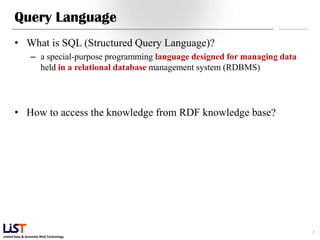
• What is SQL (Structured Query Language)?
– a special-purpose programming language designed for managing data
held in a relational database management system (RDBMS)
• How to access the knowledge from RDF knowledge base?
2
Linked Data & Semantic Web Technology
SPARQL
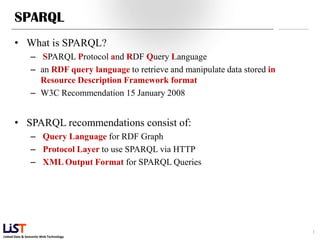
• What is SPARQL?
– SPARQL Protocol and RDF Query Language
– an RDF query language to retrieve and manipulate data stored in
Resource Description Framework format
– W3C Recommendation 15 January 2008
• SPARQL recommendations consist of:
– Query Language for RDF Graph
– Protocol Layer to use SPARQL via HTTP
– XML Output Format for SPARQL Queries
3
Linked Data & Semantic Web Technology
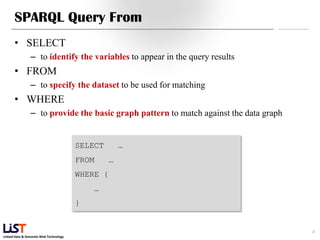
SPARQL Query From
• SELECT
– to identify the variables to appear in the query results
• FROM
– to specify the dataset to be used for matching
• WHERE
– to provide the basic graph pattern to match against the data graph
4
SELECT …
FROM …
WHERE {
…
}
Linked Data & Semantic Web Technology
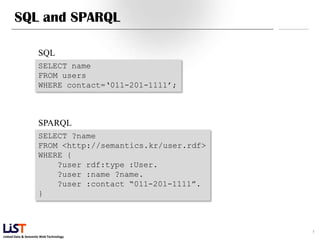
SQL and SPARQL
5
SELECT name
FROM users
WHERE contact=„011-201-1111‟;
SELECT ?name
FROM <http://semantics.kr/user.rdf>
WHERE {
?user rdf:type :User.
?user :name ?name.
?user :contact “011-201-1111”.
}
SQL
SPARQL
Linked Data & Semantic Web Technology
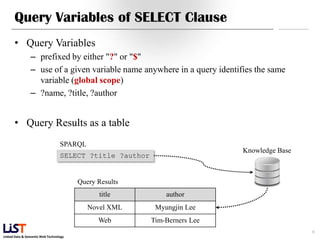
Query Variables of SELECT Clause
• Query Variables
– prefixed by either "?" or "$"
– use of a given variable name anywhere in a query identifies the same
variable (global scope)
– ?name, ?title, ?author
• Query Results as a table
6
SELECT ?title ?author
title author
Novel XML Myungjin Lee
Web Tim-Berners Lee
SPARQL
Query Results
Knowledge Base
Linked Data & Semantic Web Technology
Pattern of WHERE Clause
• Triple Pattern
– written as a whitespace-separated list of a subject, predicate and
object
• Graph Pattern
– a set of triple patterns
• WHERE Clause of SPARQL
– based on RDF Turtle serialization and graph pattern matching
7
Linked Data & Semantic Web Technology
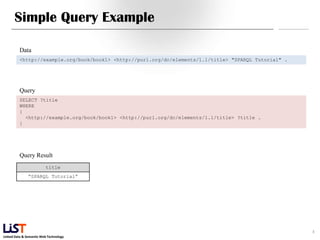
Simple Query Example
8
Data
<http://example.org/book/book1> <http://purl.org/dc/elements/1.1/title> "SPARQL Tutorial" .
Query
SELECT ?title
WHERE
{
<http://example.org/book/book1> <http://purl.org/dc/elements/1.1/title> ?title .
}
Query Result
title
“SPARQL Tutorial”
Linked Data & Semantic Web Technology
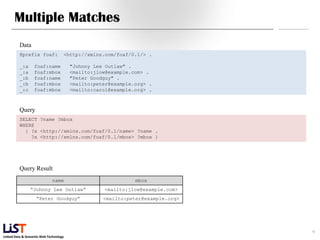
Multiple Matches
9
Data
@prefix foaf: <http://xmlns.com/foaf/0.1/> .
_:a foaf:name "Johnny Lee Outlaw" .
_:a foaf:mbox <mailto:jlow@example.com> .
_:b foaf:name "Peter Goodguy" .
_:b foaf:mbox <mailto:peter@example.org> .
_:c foaf:mbox <mailto:carol@example.org> .
Query
SELECT ?name ?mbox
WHERE
{ ?x <http://xmlns.com/foaf/0.1/name> ?name .
?x <http://xmlns.com/foaf/0.1/mbox> ?mbox }
Query Result
name mbox
“Johnny Lee Outlaw” <mailto:jlow@example.com>
“Peter Goodguy” <mailto:peter@example.org>
Linked Data & Semantic Web Technology
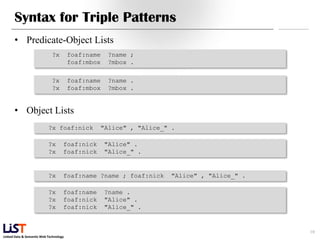
Syntax for Triple Patterns
• Predicate-Object Lists
• Object Lists
10
?x foaf:name ?name ;
foaf:mbox ?mbox .
?x foaf:name ?name .
?x foaf:mbox ?mbox .
?x foaf:nick "Alice" , "Alice_" .
?x foaf:nick "Alice" .
?x foaf:nick "Alice_" .
?x foaf:name ?name ; foaf:nick "Alice" , "Alice_" .
?x foaf:name ?name .
?x foaf:nick "Alice" .
?x foaf:nick "Alice_" .
Linked Data & Semantic Web Technology
Syntax for Triple Patterns
• rdf:type
– the keyword "a" can be used as a predicate in a triple pattern
– an alternative for the IRI
http://www.w3.org/1999/02/22-rdf-syntax-ns#type
11
?x a :Class1 .
[ a :appClass ] :p "v" .
?x rdf:type :Class1 .
_:b0 rdf:type :appClass .
_:b0 :p "v" .
Linked Data & Semantic Web Technology
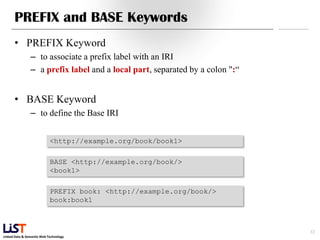
PREFIX and BASE Keywords
• PREFIX Keyword
– to associate a prefix label with an IRI
– a prefix label and a local part, separated by a colon ":“
• BASE Keyword
– to define the Base IRI
12
<http://example.org/book/book1>
BASE <http://example.org/book/>
<book1>
PREFIX book: <http://example.org/book/>
book:book1
Linked Data & Semantic Web Technology
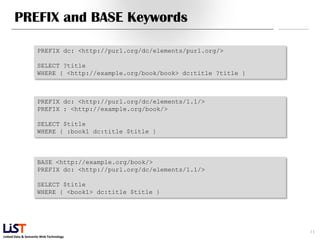
PREFIX and BASE Keywords
13
PREFIX dc: <http://purl.org/dc/elements/purl.org/>
SELECT ?title
WHERE { <http://example.org/book/book> dc:title ?title }
PREFIX dc: <http://purl.org/dc/elements/1.1/>
PREFIX : <http://example.org/book/>
SELECT $title
WHERE { :book1 dc:title $title }
BASE <http://example.org/book/>
PREFIX dc: <http://purl.org/dc/elements/1.1/>
SELECT $title
WHERE { <book1> dc:title $title }
Linked Data & Semantic Web Technology
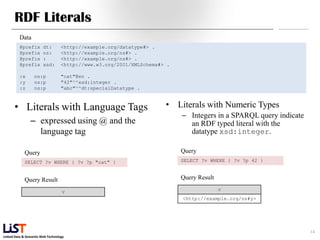
• Literals with Language Tags
– expressed using @ and the
language tag
• Literals with Numeric Types
– Integers in a SPARQL query indicate
an RDF typed literal with the
datatype xsd:integer.
RDF Literals
14
Data
@prefix dt: <http://example.org/datatype#> .
@prefix ns: <http://example.org/ns#> .
@prefix : <http://example.org/ns#> .
@prefix xsd: <http://www.w3.org/2001/XMLSchema#> .
:x ns:p "cat"@en .
:y ns:p "42"^^xsd:integer .
:z ns:p "abc"^^dt:specialDatatype .
Query
SELECT ?v WHERE { ?v ?p "cat" }
Query Result
v
Query
SELECT ?v WHERE { ?v ?p 42 }
Query Result
v
<http://example.org/ns#y>
Linked Data & Semantic Web Technology
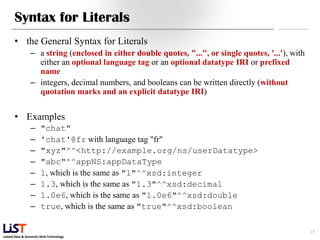
Syntax for Literals
• the General Syntax for Literals
– a string (enclosed in either double quotes, "...", or single quotes, '...'), with
either an optional language tag or an optional datatype IRI or prefixed
name
– integers, decimal numbers, and booleans can be written directly (without
quotation marks and an explicit datatype IRI)
• Examples
– "chat"
– 'chat'@fr with language tag "fr"
– "xyz"^^<http://example.org/ns/userDatatype>
– "abc"^^appNS:appDataType
– 1, which is the same as "1"^^xsd:integer
– 1.3, which is the same as "1.3"^^xsd:decimal
– 1.0e6, which is the same as "1.0e6"^^xsd:double
– true, which is the same as "true"^^xsd:boolean
15
Linked Data & Semantic Web Technology
RDF Term Constraints
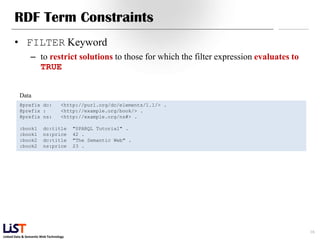
• FILTER Keyword
– to restrict solutions to those for which the filter expression evaluates to
TRUE
16
Data
@prefix dc: <http://purl.org/dc/elements/1.1/> .
@prefix : <http://example.org/book/> .
@prefix ns: <http://example.org/ns#> .
:book1 dc:title "SPARQL Tutorial" .
:book1 ns:price 42 .
:book2 dc:title "The Semantic Web" .
:book2 ns:price 23 .
Linked Data & Semantic Web Technology
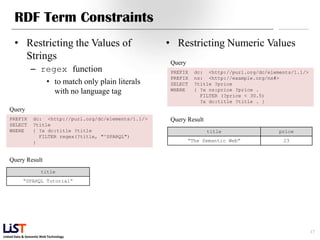
• Restricting the Values of
Strings
– regex function
• to match only plain literals
with no language tag
• Restricting Numeric Values
RDF Term Constraints
17
Query
PREFIX dc: <http://purl.org/dc/elements/1.1/>
SELECT ?title
WHERE { ?x dc:title ?title
FILTER regex(?title, "^SPARQL")
}
Query Result
title
“SPARQL Tutorial”
Query
PREFIX dc: <http://purl.org/dc/elements/1.1/>
PREFIX ns: <http://example.org/ns#>
SELECT ?title ?price
WHERE { ?x ns:price ?price .
FILTER (?price < 30.5)
?x dc:title ?title . }
Query Result
title price
“The Semantic Web” 23
Linked Data & Semantic Web Technology
Optional Pattern Matching
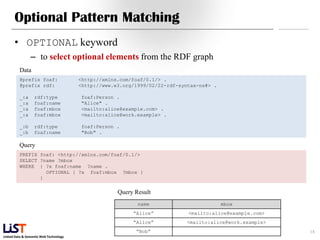
• OPTIONAL keyword
– to select optional elements from the RDF graph
18
Data
@prefix foaf: <http://xmlns.com/foaf/0.1/> .
@prefix rdf: <http://www.w3.org/1999/02/22-rdf-syntax-ns#> .
_:a rdf:type foaf:Person .
_:a foaf:name "Alice" .
_:a foaf:mbox <mailto:alice@example.com> .
_:a foaf:mbox <mailto:alice@work.example> .
_:b rdf:type foaf:Person .
_:b foaf:name "Bob" .
Query
PREFIX foaf: <http://xmlns.com/foaf/0.1/>
SELECT ?name ?mbox
WHERE { ?x foaf:name ?name .
OPTIONAL { ?x foaf:mbox ?mbox }
}
Query Result
name mbox
“Alice” <mailto:alice@example.com>
“Alice” <mailto:alice@work.example>
“Bob”
Linked Data & Semantic Web Technology
Matching Alternatives
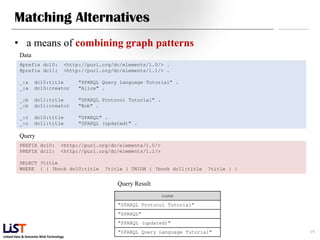
• a means of combining graph patterns
19
Data
@prefix dc10: <http://purl.org/dc/elements/1.0/> .
@prefix dc11: <http://purl.org/dc/elements/1.1/> .
_:a dc10:title "SPARQL Query Language Tutorial" .
_:a dc10:creator "Alice" .
_:b dc11:title "SPARQL Protocol Tutorial" .
_:b dc11:creator "Bob" .
_:c dc10:title "SPARQL" .
_:c dc11:title "SPARQL (updated)" .
Query
PREFIX dc10: <http://purl.org/dc/elements/1.0/>
PREFIX dc11: <http://purl.org/dc/elements/1.1/>
SELECT ?title
WHERE { { ?book dc10:title ?title } UNION { ?book dc11:title ?title } }
Query Result
name
"SPARQL Protocol Tutorial"
"SPARQL"
"SPARQL (updated)"
"SPARQL Query Language Tutorial"
Linked Data & Semantic Web Technology
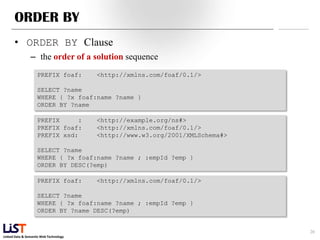
ORDER BY
• ORDER BY Clause
– the order of a solution sequence
20
PREFIX foaf: <http://xmlns.com/foaf/0.1/>
SELECT ?name
WHERE { ?x foaf:name ?name }
ORDER BY ?name
PREFIX : <http://example.org/ns#>
PREFIX foaf: <http://xmlns.com/foaf/0.1/>
PREFIX xsd: <http://www.w3.org/2001/XMLSchema#>
SELECT ?name
WHERE { ?x foaf:name ?name ; :empId ?emp }
ORDER BY DESC(?emp)
PREFIX foaf: <http://xmlns.com/foaf/0.1/>
SELECT ?name
WHERE { ?x foaf:name ?name ; :empId ?emp }
ORDER BY ?name DESC(?emp)
Linked Data & Semantic Web Technology
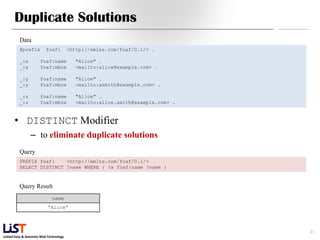
Duplicate Solutions
• DISTINCT Modifier
– to eliminate duplicate solutions
21
Data
@prefix foaf: <http://xmlns.com/foaf/0.1/> .
_:x foaf:name "Alice" .
_:x foaf:mbox <mailto:alice@example.com> .
_:y foaf:name "Alice" .
_:y foaf:mbox <mailto:asmith@example.com> .
_:z foaf:name "Alice" .
_:z foaf:mbox <mailto:alice.smith@example.com> .
Query
PREFIX foaf: <http://xmlns.com/foaf/0.1/>
SELECT DISTINCT ?name WHERE { ?x foaf:name ?name }
Query Result
name
“Alice”
Linked Data & Semantic Web Technology
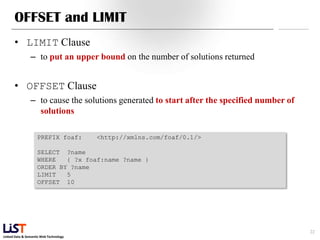
OFFSET and LIMIT
• LIMIT Clause
– to put an upper bound on the number of solutions returned
• OFFSET Clause
– to cause the solutions generated to start after the specified number of
solutions
22
PREFIX foaf: <http://xmlns.com/foaf/0.1/>
SELECT ?name
WHERE { ?x foaf:name ?name }
ORDER BY ?name
LIMIT 5
OFFSET 10
Linked Data & Semantic Web Technology
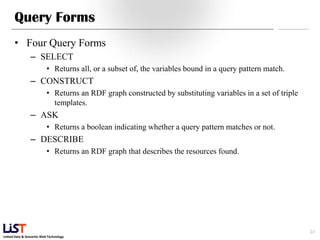
Query Forms
• Four Query Forms
– SELECT
• Returns all, or a subset of, the variables bound in a query pattern match.
– CONSTRUCT
• Returns an RDF graph constructed by substituting variables in a set of triple
templates.
– ASK
• Returns a boolean indicating whether a query pattern matches or not.
– DESCRIBE
• Returns an RDF graph that describes the resources found.
23
Linked Data & Semantic Web Technology
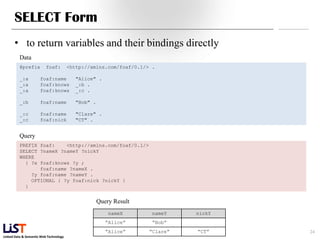
SELECT Form
• to return variables and their bindings directly
24
Data
@prefix foaf: <http://xmlns.com/foaf/0.1/> .
_:a foaf:name "Alice" .
_:a foaf:knows _:b .
_:a foaf:knows _:c .
_:b foaf:name "Bob" .
_:c foaf:name "Clare" .
_:c foaf:nick "CT" .
Query
PREFIX foaf: <http://xmlns.com/foaf/0.1/>
SELECT ?nameX ?nameY ?nickY
WHERE
{ ?x foaf:knows ?y ;
foaf:name ?nameX .
?y foaf:name ?nameY .
OPTIONAL { ?y foaf:nick ?nickY }
}
Query Result
nameX nameY nickY
“Alice” “Bob”
“Alice” “Clare” “CT”
Linked Data & Semantic Web Technology
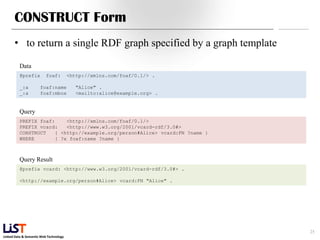
CONSTRUCT Form
• to return a single RDF graph specified by a graph template
25
Data
@prefix foaf: <http://xmlns.com/foaf/0.1/> .
_:a foaf:name "Alice" .
_:a foaf:mbox <mailto:alice@example.org> .
Query
PREFIX foaf: <http://xmlns.com/foaf/0.1/>
PREFIX vcard: <http://www.w3.org/2001/vcard-rdf/3.0#>
CONSTRUCT { <http://example.org/person#Alice> vcard:FN ?name }
WHERE { ?x foaf:name ?name }
Query Result
@prefix vcard: <http://www.w3.org/2001/vcard-rdf/3.0#> .
<http://example.org/person#Alice> vcard:FN "Alice" .
Linked Data & Semantic Web Technology
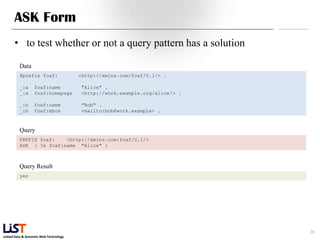
ASK Form
• to test whether or not a query pattern has a solution
26
Data
@prefix foaf: <http://xmlns.com/foaf/0.1/> .
_:a foaf:name "Alice" .
_:a foaf:homepage <http://work.example.org/alice/> .
_:b foaf:name "Bob" .
_:b foaf:mbox <mailto:bob@work.example> .
Query
PREFIX foaf: <http://xmlns.com/foaf/0.1/>
ASK { ?x foaf:name "Alice" }
Query Result
yes
Linked Data & Semantic Web Technology
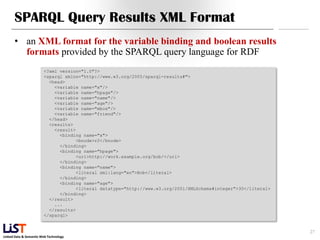
SPARQL Query Results XML Format
• an XML format for the variable binding and boolean results
formats provided by the SPARQL query language for RDF
27
<?xml version="1.0"?>
<sparql xmlns="http://www.w3.org/2005/sparql-results#">
<head>
<variable name="x"/>
<variable name="hpage"/>
<variable name="name"/>
<variable name="age"/>
<variable name="mbox"/>
<variable name="friend"/>
</head>
<results>
<result>
<binding name="x">
<bnode>r2</bnode>
</binding>
<binding name="hpage">
<uri>http://work.example.org/bob/</uri>
</binding>
<binding name="name">
<literal xml:lang="en">Bob</literal>
</binding>
<binding name="age">
<literal datatype="http://www.w3.org/2001/XMLSchema#integer">30</literal>
</binding>
</result>
...
</results>
</sparql>
Linked Data & Semantic Web Technology
SPARQL Query Results XML Format
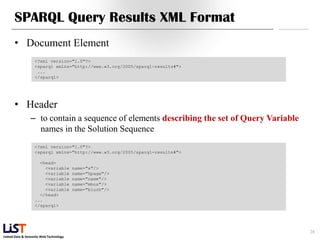
• Document Element
• Header
– to contain a sequence of elements describing the set of Query Variable
names in the Solution Sequence
28
<?xml version="1.0"?>
<sparql xmlns="http://www.w3.org/2005/sparql-results#">
...
</sparql>
<?xml version="1.0"?>
<sparql xmlns="http://www.w3.org/2005/sparql-results#">
<head>
<variable name="x"/>
<variable name="hpage"/>
<variable name="name"/>
<variable name="mbox"/>
<variable name="blurb"/>
</head>
...
</sparql>
Linked Data & Semantic Web Technology
SPARQL Query Results XML Format
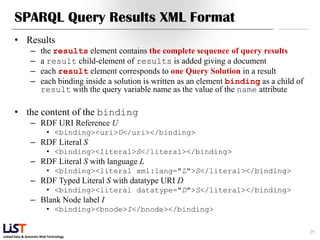
• Results
– the results element contains the complete sequence of query results
– a result child-element of results is added giving a document
– each result element corresponds to one Query Solution in a result
– each binding inside a solution is written as an element binding as a child of
result with the query variable name as the value of the name attribute
• the content of the binding
– RDF URI Reference U
• <binding><uri>U</uri></binding>
– RDF Literal S
• <binding><literal>S</literal></binding>
– RDF Literal S with language L
• <binding><literal xml:lang="L">S</literal></binding>
– RDF Typed Literal S with datatype URI D
• <binding><literal datatype="D">S</literal></binding>
– Blank Node label I
• <binding><bnode>I</bnode></binding>
29
Linked Data & Semantic Web Technology
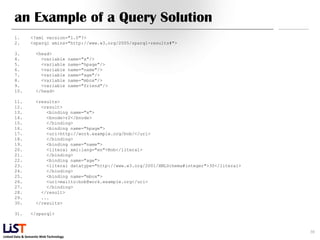
an Example of a Query Solution
1. <?xml version="1.0"?>
2. <sparql xmlns="http://www.w3.org/2005/sparql-results#">
3. <head>
4. <variable name="x"/>
5. <variable name="hpage"/>
6. <variable name="name"/>
7. <variable name="age"/>
8. <variable name="mbox"/>
9. <variable name="friend"/>
10. </head>
11. <results>
12. <result>
13. <binding name="x">
14. <bnode>r2</bnode>
15. </binding>
16. <binding name="hpage">
17. <uri>http://work.example.org/bob/</uri>
18. </binding>
19. <binding name="name">
20. <literal xml:lang="en">Bob</literal>
21. </binding>
22. <binding name="age">
23. <literal datatype="http://www.w3.org/2001/XMLSchema#integer">30</literal>
24. </binding>
25. <binding name="mbox">
26. <uri>mailto:bob@work.example.org</uri>
27. </binding>
28. </result>
29. ...
30. </results>
31. </sparql>
30
Linked Data & Semantic Web Technology
SPARQL Protocol for RDF
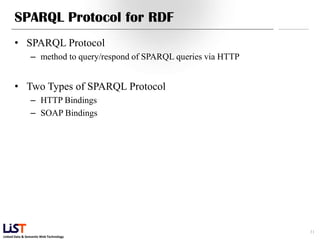
• SPARQL Protocol
– method to query/respond of SPARQL queries via HTTP
• Two Types of SPARQL Protocol
– HTTP Bindings
– SOAP Bindings
31
Linked Data & Semantic Web Technology
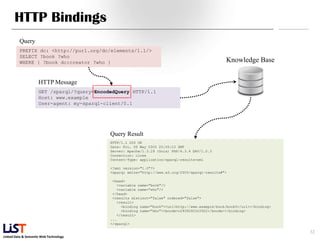
HTTP Bindings
32
Query
PREFIX dc: <http://purl.org/dc/elements/1.1/>
SELECT ?book ?who
WHERE { ?book dc:creator ?who }
Query Result
HTTP/1.1 200 OK
Date: Fri, 06 May 2005 20:55:12 GMT
Server: Apache/1.3.29 (Unix) PHP/4.3.4 DAV/1.0.3
Connection: close
Content-Type: application/sparql-results+xml
<?xml version="1.0"?>
<sparql xmlns="http://www.w3.org/2005/sparql-results#">
<head>
<variable name="book"/>
<variable name="who"/>
</head>
<results distinct="false" ordered="false">
<result>
<binding name="book"><uri>http://www.example/book/book5</uri></binding>
<binding name="who"><bnode>r29392923r2922</bnode></binding>
</result>
...
</sparql>
HTTP Message
GET /sparql/?query=EncodedQuery HTTP/1.1
Host: www.example
User-agent: my-sparql-client/0.1
Knowledge Base
Linked Data & Semantic Web Technology
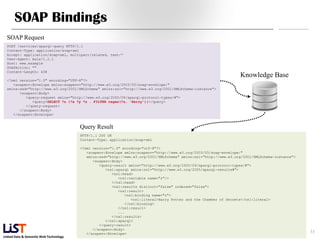
SOAP Bindings
33
Query Result
HTTP/1.1 200 OK
Content-Type: application/soap+xml
<?xml version="1.0" encoding="utf-8"?>
<soapenv:Envelope xmlns:soapenv="http://www.w3.org/2003/05/soap-envelope/"
xmlns:xsd="http://www.w3.org/2001/XMLSchema" xmlns:xsi="http://www.w3.org/2001/XMLSchema-instance">
<soapenv:Body>
<query-result xmlns="http://www.w3.org/2005/09/sparql-protocol-types/#">
<ns1:sparql xmlns:ns1="http://www.w3.org/2005/sparql-results#">
<ns1:head>
<ns1:variable name="z"/>
</ns1:head>
<ns1:results distinct="false" ordered="false">
<ns1:result>
<ns1:binding name="z">
<ns1:literal>Harry Potter and the Chamber of Secrets</ns1:literal>
</ns1:binding>
</ns1:result>
...
</ns1:results>
</ns1:sparql>
</query-result>
</soapenv:Body>
</soapenv:Envelope>
SOAP Request
POST /services/sparql-query HTTP/1.1
Content-Type: application/soap+xml
Accept: application/soap+xml, multipart/related, text/*
User-Agent: Axis/1.2.1
Host: www.example
SOAPAction: ""
Content-Length: 438
<?xml version="1.0" encoding="UTF-8"?>
<soapenv:Envelope xmlns:soapenv="http://www.w3.org/2003/05/soap-envelope/"
xmlns:xsd="http://www.w3.org/2001/XMLSchema" xmlns:xsi="http://www.w3.org/2001/XMLSchema-instance">
<soapenv:Body>
<query-request xmlns="http://www.w3.org/2005/09/sparql-protocol-types/#">
<query>SELECT ?z {?x ?y ?z . FILTER regex(?z, 'Harry')}</query>
</query-request>
</soapenv:Body>
</soapenv:Envelope>
Knowledge Base
Linked Data & Semantic Web Technology
References
• http://en.wikipedia.org/wiki/Sparql
• http://www.w3.org/TR/rdf-sparql-query/
• http://www.w3.org/TR/rdf-sparql-protocol/
• http://www.w3.org/TR/2008/REC-rdf-sparql-XMLres-20080115/
• http://www.slideshare.net/lysander07/openhpi-semweb03part1
• http://www.slideshare.net/lysander07/open-hpi-semweb03part2
• http://www.slideshare.net/lysander07/openhpi-33-how-to-query-rdfs-sparql3
• http://www.slideshare.net/fabien_gandon/sparql-in-a-nutshell
• http://www.slideshare.net/kwangsub/rdf-tutorial-sparql-20091031
34
Linked Data & Semantic Web Technology
3535
Dr. Myungjin Lee
e-Mail : mjlee@li-st.com
Twitter : http://twitter.com/MyungjinLee
Facebook : http://www.facebook.com/mjinlee
SlideShare : http://www.slideshare.net/onlyjiny/

The Semantic Web #10 - SPARQL

  • 1.
    Linked Data & SemanticWeb Technology The Semantic Web Part 10. SPARQL Dr. Myungjin Lee
  • 2.
    Linked Data &Semantic Web Technology Query Language • What is SQL (Structured Query Language)? – a special-purpose programming language designed for managing data held in a relational database management system (RDBMS) • How to access the knowledge from RDF knowledge base? 2
  • 3.
    Linked Data &Semantic Web Technology SPARQL • What is SPARQL? – SPARQL Protocol and RDF Query Language – an RDF query language to retrieve and manipulate data stored in Resource Description Framework format – W3C Recommendation 15 January 2008 • SPARQL recommendations consist of: – Query Language for RDF Graph – Protocol Layer to use SPARQL via HTTP – XML Output Format for SPARQL Queries 3
  • 4.
    Linked Data &Semantic Web Technology SPARQL Query From • SELECT – to identify the variables to appear in the query results • FROM – to specify the dataset to be used for matching • WHERE – to provide the basic graph pattern to match against the data graph 4 SELECT … FROM … WHERE { … }
  • 5.
    Linked Data &Semantic Web Technology SQL and SPARQL 5 SELECT name FROM users WHERE contact=„011-201-1111‟; SELECT ?name FROM <http://semantics.kr/user.rdf> WHERE { ?user rdf:type :User. ?user :name ?name. ?user :contact “011-201-1111”. } SQL SPARQL
  • 6.
    Linked Data &Semantic Web Technology Query Variables of SELECT Clause • Query Variables – prefixed by either "?" or "$" – use of a given variable name anywhere in a query identifies the same variable (global scope) – ?name, ?title, ?author • Query Results as a table 6 SELECT ?title ?author title author Novel XML Myungjin Lee Web Tim-Berners Lee SPARQL Query Results Knowledge Base
  • 7.
    Linked Data &Semantic Web Technology Pattern of WHERE Clause • Triple Pattern – written as a whitespace-separated list of a subject, predicate and object • Graph Pattern – a set of triple patterns • WHERE Clause of SPARQL – based on RDF Turtle serialization and graph pattern matching 7
  • 8.
    Linked Data &Semantic Web Technology Simple Query Example 8 Data <http://example.org/book/book1> <http://purl.org/dc/elements/1.1/title> "SPARQL Tutorial" . Query SELECT ?title WHERE { <http://example.org/book/book1> <http://purl.org/dc/elements/1.1/title> ?title . } Query Result title “SPARQL Tutorial”
  • 9.
    Linked Data &Semantic Web Technology Multiple Matches 9 Data @prefix foaf: <http://xmlns.com/foaf/0.1/> . _:a foaf:name "Johnny Lee Outlaw" . _:a foaf:mbox <mailto:jlow@example.com> . _:b foaf:name "Peter Goodguy" . _:b foaf:mbox <mailto:peter@example.org> . _:c foaf:mbox <mailto:carol@example.org> . Query SELECT ?name ?mbox WHERE { ?x <http://xmlns.com/foaf/0.1/name> ?name . ?x <http://xmlns.com/foaf/0.1/mbox> ?mbox } Query Result name mbox “Johnny Lee Outlaw” <mailto:jlow@example.com> “Peter Goodguy” <mailto:peter@example.org>
  • 10.
    Linked Data &Semantic Web Technology Syntax for Triple Patterns • Predicate-Object Lists • Object Lists 10 ?x foaf:name ?name ; foaf:mbox ?mbox . ?x foaf:name ?name . ?x foaf:mbox ?mbox . ?x foaf:nick "Alice" , "Alice_" . ?x foaf:nick "Alice" . ?x foaf:nick "Alice_" . ?x foaf:name ?name ; foaf:nick "Alice" , "Alice_" . ?x foaf:name ?name . ?x foaf:nick "Alice" . ?x foaf:nick "Alice_" .
  • 11.
    Linked Data &Semantic Web Technology Syntax for Triple Patterns • rdf:type – the keyword "a" can be used as a predicate in a triple pattern – an alternative for the IRI http://www.w3.org/1999/02/22-rdf-syntax-ns#type 11 ?x a :Class1 . [ a :appClass ] :p "v" . ?x rdf:type :Class1 . _:b0 rdf:type :appClass . _:b0 :p "v" .
  • 12.
    Linked Data &Semantic Web Technology PREFIX and BASE Keywords • PREFIX Keyword – to associate a prefix label with an IRI – a prefix label and a local part, separated by a colon ":“ • BASE Keyword – to define the Base IRI 12 <http://example.org/book/book1> BASE <http://example.org/book/> <book1> PREFIX book: <http://example.org/book/> book:book1
  • 13.
    Linked Data &Semantic Web Technology PREFIX and BASE Keywords 13 PREFIX dc: <http://purl.org/dc/elements/purl.org/> SELECT ?title WHERE { <http://example.org/book/book> dc:title ?title } PREFIX dc: <http://purl.org/dc/elements/1.1/> PREFIX : <http://example.org/book/> SELECT $title WHERE { :book1 dc:title $title } BASE <http://example.org/book/> PREFIX dc: <http://purl.org/dc/elements/1.1/> SELECT $title WHERE { <book1> dc:title $title }
  • 14.
    Linked Data &Semantic Web Technology • Literals with Language Tags – expressed using @ and the language tag • Literals with Numeric Types – Integers in a SPARQL query indicate an RDF typed literal with the datatype xsd:integer. RDF Literals 14 Data @prefix dt: <http://example.org/datatype#> . @prefix ns: <http://example.org/ns#> . @prefix : <http://example.org/ns#> . @prefix xsd: <http://www.w3.org/2001/XMLSchema#> . :x ns:p "cat"@en . :y ns:p "42"^^xsd:integer . :z ns:p "abc"^^dt:specialDatatype . Query SELECT ?v WHERE { ?v ?p "cat" } Query Result v Query SELECT ?v WHERE { ?v ?p 42 } Query Result v <http://example.org/ns#y>
  • 15.
    Linked Data &Semantic Web Technology Syntax for Literals • the General Syntax for Literals – a string (enclosed in either double quotes, "...", or single quotes, '...'), with either an optional language tag or an optional datatype IRI or prefixed name – integers, decimal numbers, and booleans can be written directly (without quotation marks and an explicit datatype IRI) • Examples – "chat" – 'chat'@fr with language tag "fr" – "xyz"^^<http://example.org/ns/userDatatype> – "abc"^^appNS:appDataType – 1, which is the same as "1"^^xsd:integer – 1.3, which is the same as "1.3"^^xsd:decimal – 1.0e6, which is the same as "1.0e6"^^xsd:double – true, which is the same as "true"^^xsd:boolean 15
  • 16.
    Linked Data &Semantic Web Technology RDF Term Constraints • FILTER Keyword – to restrict solutions to those for which the filter expression evaluates to TRUE 16 Data @prefix dc: <http://purl.org/dc/elements/1.1/> . @prefix : <http://example.org/book/> . @prefix ns: <http://example.org/ns#> . :book1 dc:title "SPARQL Tutorial" . :book1 ns:price 42 . :book2 dc:title "The Semantic Web" . :book2 ns:price 23 .
  • 17.
    Linked Data &Semantic Web Technology • Restricting the Values of Strings – regex function • to match only plain literals with no language tag • Restricting Numeric Values RDF Term Constraints 17 Query PREFIX dc: <http://purl.org/dc/elements/1.1/> SELECT ?title WHERE { ?x dc:title ?title FILTER regex(?title, "^SPARQL") } Query Result title “SPARQL Tutorial” Query PREFIX dc: <http://purl.org/dc/elements/1.1/> PREFIX ns: <http://example.org/ns#> SELECT ?title ?price WHERE { ?x ns:price ?price . FILTER (?price < 30.5) ?x dc:title ?title . } Query Result title price “The Semantic Web” 23
  • 18.
    Linked Data &Semantic Web Technology Optional Pattern Matching • OPTIONAL keyword – to select optional elements from the RDF graph 18 Data @prefix foaf: <http://xmlns.com/foaf/0.1/> . @prefix rdf: <http://www.w3.org/1999/02/22-rdf-syntax-ns#> . _:a rdf:type foaf:Person . _:a foaf:name "Alice" . _:a foaf:mbox <mailto:alice@example.com> . _:a foaf:mbox <mailto:alice@work.example> . _:b rdf:type foaf:Person . _:b foaf:name "Bob" . Query PREFIX foaf: <http://xmlns.com/foaf/0.1/> SELECT ?name ?mbox WHERE { ?x foaf:name ?name . OPTIONAL { ?x foaf:mbox ?mbox } } Query Result name mbox “Alice” <mailto:alice@example.com> “Alice” <mailto:alice@work.example> “Bob”
  • 19.
    Linked Data &Semantic Web Technology Matching Alternatives • a means of combining graph patterns 19 Data @prefix dc10: <http://purl.org/dc/elements/1.0/> . @prefix dc11: <http://purl.org/dc/elements/1.1/> . _:a dc10:title "SPARQL Query Language Tutorial" . _:a dc10:creator "Alice" . _:b dc11:title "SPARQL Protocol Tutorial" . _:b dc11:creator "Bob" . _:c dc10:title "SPARQL" . _:c dc11:title "SPARQL (updated)" . Query PREFIX dc10: <http://purl.org/dc/elements/1.0/> PREFIX dc11: <http://purl.org/dc/elements/1.1/> SELECT ?title WHERE { { ?book dc10:title ?title } UNION { ?book dc11:title ?title } } Query Result name "SPARQL Protocol Tutorial" "SPARQL" "SPARQL (updated)" "SPARQL Query Language Tutorial"
  • 20.
    Linked Data &Semantic Web Technology ORDER BY • ORDER BY Clause – the order of a solution sequence 20 PREFIX foaf: <http://xmlns.com/foaf/0.1/> SELECT ?name WHERE { ?x foaf:name ?name } ORDER BY ?name PREFIX : <http://example.org/ns#> PREFIX foaf: <http://xmlns.com/foaf/0.1/> PREFIX xsd: <http://www.w3.org/2001/XMLSchema#> SELECT ?name WHERE { ?x foaf:name ?name ; :empId ?emp } ORDER BY DESC(?emp) PREFIX foaf: <http://xmlns.com/foaf/0.1/> SELECT ?name WHERE { ?x foaf:name ?name ; :empId ?emp } ORDER BY ?name DESC(?emp)
  • 21.
    Linked Data &Semantic Web Technology Duplicate Solutions • DISTINCT Modifier – to eliminate duplicate solutions 21 Data @prefix foaf: <http://xmlns.com/foaf/0.1/> . _:x foaf:name "Alice" . _:x foaf:mbox <mailto:alice@example.com> . _:y foaf:name "Alice" . _:y foaf:mbox <mailto:asmith@example.com> . _:z foaf:name "Alice" . _:z foaf:mbox <mailto:alice.smith@example.com> . Query PREFIX foaf: <http://xmlns.com/foaf/0.1/> SELECT DISTINCT ?name WHERE { ?x foaf:name ?name } Query Result name “Alice”
  • 22.
    Linked Data &Semantic Web Technology OFFSET and LIMIT • LIMIT Clause – to put an upper bound on the number of solutions returned • OFFSET Clause – to cause the solutions generated to start after the specified number of solutions 22 PREFIX foaf: <http://xmlns.com/foaf/0.1/> SELECT ?name WHERE { ?x foaf:name ?name } ORDER BY ?name LIMIT 5 OFFSET 10
  • 23.
    Linked Data &Semantic Web Technology Query Forms • Four Query Forms – SELECT • Returns all, or a subset of, the variables bound in a query pattern match. – CONSTRUCT • Returns an RDF graph constructed by substituting variables in a set of triple templates. – ASK • Returns a boolean indicating whether a query pattern matches or not. – DESCRIBE • Returns an RDF graph that describes the resources found. 23
  • 24.
    Linked Data &Semantic Web Technology SELECT Form • to return variables and their bindings directly 24 Data @prefix foaf: <http://xmlns.com/foaf/0.1/> . _:a foaf:name "Alice" . _:a foaf:knows _:b . _:a foaf:knows _:c . _:b foaf:name "Bob" . _:c foaf:name "Clare" . _:c foaf:nick "CT" . Query PREFIX foaf: <http://xmlns.com/foaf/0.1/> SELECT ?nameX ?nameY ?nickY WHERE { ?x foaf:knows ?y ; foaf:name ?nameX . ?y foaf:name ?nameY . OPTIONAL { ?y foaf:nick ?nickY } } Query Result nameX nameY nickY “Alice” “Bob” “Alice” “Clare” “CT”
  • 25.
    Linked Data &Semantic Web Technology CONSTRUCT Form • to return a single RDF graph specified by a graph template 25 Data @prefix foaf: <http://xmlns.com/foaf/0.1/> . _:a foaf:name "Alice" . _:a foaf:mbox <mailto:alice@example.org> . Query PREFIX foaf: <http://xmlns.com/foaf/0.1/> PREFIX vcard: <http://www.w3.org/2001/vcard-rdf/3.0#> CONSTRUCT { <http://example.org/person#Alice> vcard:FN ?name } WHERE { ?x foaf:name ?name } Query Result @prefix vcard: <http://www.w3.org/2001/vcard-rdf/3.0#> . <http://example.org/person#Alice> vcard:FN "Alice" .
  • 26.
    Linked Data &Semantic Web Technology ASK Form • to test whether or not a query pattern has a solution 26 Data @prefix foaf: <http://xmlns.com/foaf/0.1/> . _:a foaf:name "Alice" . _:a foaf:homepage <http://work.example.org/alice/> . _:b foaf:name "Bob" . _:b foaf:mbox <mailto:bob@work.example> . Query PREFIX foaf: <http://xmlns.com/foaf/0.1/> ASK { ?x foaf:name "Alice" } Query Result yes
  • 27.
    Linked Data &Semantic Web Technology SPARQL Query Results XML Format • an XML format for the variable binding and boolean results formats provided by the SPARQL query language for RDF 27 <?xml version="1.0"?> <sparql xmlns="http://www.w3.org/2005/sparql-results#"> <head> <variable name="x"/> <variable name="hpage"/> <variable name="name"/> <variable name="age"/> <variable name="mbox"/> <variable name="friend"/> </head> <results> <result> <binding name="x"> <bnode>r2</bnode> </binding> <binding name="hpage"> <uri>http://work.example.org/bob/</uri> </binding> <binding name="name"> <literal xml:lang="en">Bob</literal> </binding> <binding name="age"> <literal datatype="http://www.w3.org/2001/XMLSchema#integer">30</literal> </binding> </result> ... </results> </sparql>
  • 28.
    Linked Data &Semantic Web Technology SPARQL Query Results XML Format • Document Element • Header – to contain a sequence of elements describing the set of Query Variable names in the Solution Sequence 28 <?xml version="1.0"?> <sparql xmlns="http://www.w3.org/2005/sparql-results#"> ... </sparql> <?xml version="1.0"?> <sparql xmlns="http://www.w3.org/2005/sparql-results#"> <head> <variable name="x"/> <variable name="hpage"/> <variable name="name"/> <variable name="mbox"/> <variable name="blurb"/> </head> ... </sparql>
  • 29.
    Linked Data &Semantic Web Technology SPARQL Query Results XML Format • Results – the results element contains the complete sequence of query results – a result child-element of results is added giving a document – each result element corresponds to one Query Solution in a result – each binding inside a solution is written as an element binding as a child of result with the query variable name as the value of the name attribute • the content of the binding – RDF URI Reference U • <binding><uri>U</uri></binding> – RDF Literal S • <binding><literal>S</literal></binding> – RDF Literal S with language L • <binding><literal xml:lang="L">S</literal></binding> – RDF Typed Literal S with datatype URI D • <binding><literal datatype="D">S</literal></binding> – Blank Node label I • <binding><bnode>I</bnode></binding> 29
  • 30.
    Linked Data &Semantic Web Technology an Example of a Query Solution 1. <?xml version="1.0"?> 2. <sparql xmlns="http://www.w3.org/2005/sparql-results#"> 3. <head> 4. <variable name="x"/> 5. <variable name="hpage"/> 6. <variable name="name"/> 7. <variable name="age"/> 8. <variable name="mbox"/> 9. <variable name="friend"/> 10. </head> 11. <results> 12. <result> 13. <binding name="x"> 14. <bnode>r2</bnode> 15. </binding> 16. <binding name="hpage"> 17. <uri>http://work.example.org/bob/</uri> 18. </binding> 19. <binding name="name"> 20. <literal xml:lang="en">Bob</literal> 21. </binding> 22. <binding name="age"> 23. <literal datatype="http://www.w3.org/2001/XMLSchema#integer">30</literal> 24. </binding> 25. <binding name="mbox"> 26. <uri>mailto:bob@work.example.org</uri> 27. </binding> 28. </result> 29. ... 30. </results> 31. </sparql> 30
  • 31.
    Linked Data &Semantic Web Technology SPARQL Protocol for RDF • SPARQL Protocol – method to query/respond of SPARQL queries via HTTP • Two Types of SPARQL Protocol – HTTP Bindings – SOAP Bindings 31
  • 32.
    Linked Data &Semantic Web Technology HTTP Bindings 32 Query PREFIX dc: <http://purl.org/dc/elements/1.1/> SELECT ?book ?who WHERE { ?book dc:creator ?who } Query Result HTTP/1.1 200 OK Date: Fri, 06 May 2005 20:55:12 GMT Server: Apache/1.3.29 (Unix) PHP/4.3.4 DAV/1.0.3 Connection: close Content-Type: application/sparql-results+xml <?xml version="1.0"?> <sparql xmlns="http://www.w3.org/2005/sparql-results#"> <head> <variable name="book"/> <variable name="who"/> </head> <results distinct="false" ordered="false"> <result> <binding name="book"><uri>http://www.example/book/book5</uri></binding> <binding name="who"><bnode>r29392923r2922</bnode></binding> </result> ... </sparql> HTTP Message GET /sparql/?query=EncodedQuery HTTP/1.1 Host: www.example User-agent: my-sparql-client/0.1 Knowledge Base
  • 33.
    Linked Data &Semantic Web Technology SOAP Bindings 33 Query Result HTTP/1.1 200 OK Content-Type: application/soap+xml <?xml version="1.0" encoding="utf-8"?> <soapenv:Envelope xmlns:soapenv="http://www.w3.org/2003/05/soap-envelope/" xmlns:xsd="http://www.w3.org/2001/XMLSchema" xmlns:xsi="http://www.w3.org/2001/XMLSchema-instance"> <soapenv:Body> <query-result xmlns="http://www.w3.org/2005/09/sparql-protocol-types/#"> <ns1:sparql xmlns:ns1="http://www.w3.org/2005/sparql-results#"> <ns1:head> <ns1:variable name="z"/> </ns1:head> <ns1:results distinct="false" ordered="false"> <ns1:result> <ns1:binding name="z"> <ns1:literal>Harry Potter and the Chamber of Secrets</ns1:literal> </ns1:binding> </ns1:result> ... </ns1:results> </ns1:sparql> </query-result> </soapenv:Body> </soapenv:Envelope> SOAP Request POST /services/sparql-query HTTP/1.1 Content-Type: application/soap+xml Accept: application/soap+xml, multipart/related, text/* User-Agent: Axis/1.2.1 Host: www.example SOAPAction: "" Content-Length: 438 <?xml version="1.0" encoding="UTF-8"?> <soapenv:Envelope xmlns:soapenv="http://www.w3.org/2003/05/soap-envelope/" xmlns:xsd="http://www.w3.org/2001/XMLSchema" xmlns:xsi="http://www.w3.org/2001/XMLSchema-instance"> <soapenv:Body> <query-request xmlns="http://www.w3.org/2005/09/sparql-protocol-types/#"> <query>SELECT ?z {?x ?y ?z . FILTER regex(?z, 'Harry')}</query> </query-request> </soapenv:Body> </soapenv:Envelope> Knowledge Base
  • 34.
    Linked Data &Semantic Web Technology References • http://en.wikipedia.org/wiki/Sparql • http://www.w3.org/TR/rdf-sparql-query/ • http://www.w3.org/TR/rdf-sparql-protocol/ • http://www.w3.org/TR/2008/REC-rdf-sparql-XMLres-20080115/ • http://www.slideshare.net/lysander07/openhpi-semweb03part1 • http://www.slideshare.net/lysander07/open-hpi-semweb03part2 • http://www.slideshare.net/lysander07/openhpi-33-how-to-query-rdfs-sparql3 • http://www.slideshare.net/fabien_gandon/sparql-in-a-nutshell • http://www.slideshare.net/kwangsub/rdf-tutorial-sparql-20091031 34
  • 35.
    Linked Data &Semantic Web Technology 3535 Dr. Myungjin Lee e-Mail : mjlee@li-st.com Twitter : http://twitter.com/MyungjinLee Facebook : http://www.facebook.com/mjinlee SlideShare : http://www.slideshare.net/onlyjiny/