where Wa is the actual work and Wrev is the reversible work for the fictitious reversible process. Second-
law efficiency is different from the adiabatic efficiency of a device introduced in Chap. 6. It is generally
higher and provides a better comparison to the ideal.
Second, irreversibility is defined as the difference between the reversible work and the actual work for
a process, or
I = Wrev − Wa ð7:3Þ
On a per-unit-mass basis,
i = wrev − wa ð7:4Þ
Both irreversibility and second-law efficiency will allow us to consider how close an actual process or
device is to the ideal. Once the irreversibilities for devices in an actual engineering system, such as a
steam power cycle, have been calculated, attempts to improve the performance of the system can be
guided by attacking the largest irreversibilities. Similarly, since the maximum possible work will be
reversible work, irreversibility can be used to evaluate the feasibility of a device. If the irreversibility
of a proposed device is less than zero, the device is not feasible. [Section 7.2 develops the concepts of
reversible work and irreversibility.]
Availability is defined as the maximum amount of reversible work that can be extracted from a
system:
É = ðWrevÞmax ð7:5Þ
or, on a per-unit-mass basis,
= ðwrevÞmax ð7:6Þ
The maximization in (7.5) and (7.6) is over the reversible path joining the prescribed initial state to a final
dead state in which system and surroundings are in equilibrium. [Section 7.3 develops the notion of
availability.]
7.2 REVERSIBLE WORK AND IRREVERSIBILITY
To obtain expressions for reversible work and irreversibility, we will consider a transient process
with specified work output and heat input and a uniform through-flow. We begin by allowing this to be
an irreversible process. Consider the control volume shown in Fig. 7-1. The first law for this control
volume can be written as
_Q − _WS = h2 +
V 2
2
2
+ gz2
!
_m2 − h1 +
V 2
1
2
+ gz1
!
_m1 + _Ec:v: ð7:7Þ
Using (6.47), with Tsurr = T0 and _Qsurr = − _Q, we may write the second law as
_Sc:v: + s2 _m2 − s1 _m1 −
_Q
T0
− _Sprod = 0 ð7:8Þ
Eliminate _Q between (7.7) and (7.8) to obtain
_WS = − _Ec:v: + T0
_Sc:v: − h2 +
V 2
2
2
+ gz2 − T0s2
!
_m2
+ h1 +
V 2
1
2
+ gz1 − T0s1
!
_m1 − T0
_Sprod
ð7:9Þ
162 REVERSIBLE WORK, IRREVERSIBILITY, AND AVAILABILITY [CHAP. 7
Since _Sprod is due to the irreversibilities, the reversible work rate is given by (7.9) when _Sprod is set equal to zero:
_Wrev = − _Ec:v: + T0
_Sc:v: − h2 +
V 2
2
2
+ gz2 − T0s2
!
_m2 + h1 +
V 2
1
2
+ gz1 − T0s1
!
_m1 ð7:10Þ
Then a time integration yields
Wrev = mi ui +
V 2
i
2
+ gzi − T0si
!
− mf uf +
V 2
f
2
+ gzf − T0sf
!" #
c:v:
:
+ m1 h1 +
V 2
1
2
+ gz1 − T0s1
!
− m2 h2 +
V 2
2
2
+ gz2 − T0s2
! ð7:11Þ
where the subscripts i and f pertain to the initial and final states of the control volume.
The actual work, if not given, can be determined from a first-law analysis:
Wa = mi ui +
V 2
i
2
+ gzi
!
− mf uf +
V 2
f
2
+ gzf
!" #
c:v:
+ m1 h1 +
V 2
1
2
+ gz1
!
− m2 h2 +
V 2
2
2
+ gz2
!
+ Q
ð7:12Þ
From (7.3), (7.11), and (7.12),
I = ðmf T0sf − miT0siÞc:v: + T0m2s2 − T0m1s1 − Q ð7:13Þ
For a steady flow with negligible changes in kinetic and potential energies, we have
_Wrev = _m½h1 − h2 + T0ðs2 − s1ÞŠ ð7:14Þ
_I = _mT0ðs2 − s1Þ + _Q ð7:15Þ
It is important to realize that the basic results of this Section—(7.11), (7.12), and (7.13)—also hold
for a system, which is nothing other than a control volume for which m1 = m2 = 0 (and thus
mi = mf = m). Because time plays no part in the thermodynamics of a system, we generally replace
the indices i and f by 1 and 2.
EXAMPLE 7.1 An ideal steam turbine is supplied with steam at 12 MPa and 700 
C, and exhausts at 0.6 MPa.
(a) Determine the reversible work and irreversibility.
(b) If the turbine has an adiabatic efficiency of 0.88, what is the reversible work, irreversibility, and second-law
efficiency?
CHAP. 7] REVERSIBLE WORK, IRREVERSIBILITY, AND AVAILABILITY 163
Fig. 7-1 The control volume used in the second-law analysis.
Solution:
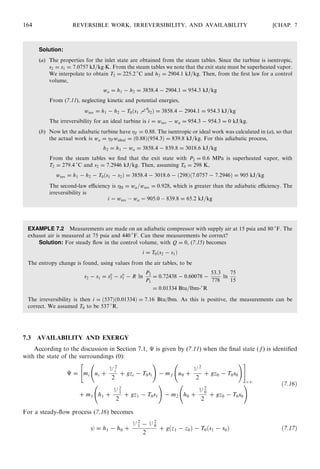
(a) The properties for the inlet state are obtained from the steam tables. Since the turbine is isentropic,
s2 = s1 = 7:0757 kJ=kgÁK. From the steam tables we note that the exit state must be superheated vapor.
We interpolate to obtain T2 = 225:2 
C and h2 = 2904:1 kJ=kg. Then, from the first law for a control
volume,
wa = h1 − h2 = 3858:4 − 2904:1 = 954:3 kJ=kg
From (7.11), neglecting kinetic and potential energies,
wrev = h1 − h2 − T0ðs1 %− s0
2Þ = 3858:4 − 2904:1 = 954:3 kJ=kg
The irreversibility for an ideal turbine is i = wrev − wa = 954:3 − 954:3 = 0 kJ/kg.
(b) Now let the adiabatic turbine have T = 0:88. The isentropic or ideal work was calculated in (a), so that
the actual work is wa = T wideal = ð0:88Þð954:3Þ = 839:8 kJ=kg. For this adiabatic process,
h2 = h1 − wa = 3858:4 − 839:8 = 3018:6 kJ=kg
From the steam tables we find that the exit state with P2 = 0:6 MPa is superheated vapor, with
T2 = 279:4 
C and s2 = 7:2946 kJ=kg. Then, assuming T0 = 298 K,
wrev = h1 − h2 − T0ðs1 − s2Þ = 3858:4 − 3018:6 − ð298Þð7:0757 − 7:2946Þ = 905 kJ=kg
The second-law efficiency is II = wa=wrev = 0:928, which is greater than the adiabatic efficiency. The
irreversibility is
i ¼ wrev À wa ¼ 905:0 À 839:8 = 65:2 kJ=kg
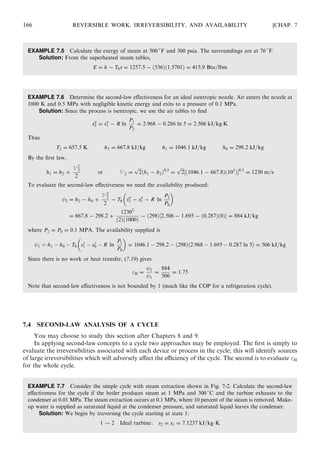
EXAMPLE 7.2 Measurements are made on an adiabatic compressor with supply air at 15 psia and 80 
F. The
exhaust air is measured at 75 psia and 440 
F. Can these measurements be correct?
Solution: For steady flow in the control volume, with Q = 0, (7.15) becomes
i = T0ðs2 − s1Þ
The entropy change is found, using values from the air tables, to be
s2 − s1 = so
2 − so
1 − R ln
P2
P1
= 0:72438 − 0:60078 −
53:3
778
ln
75
15
= 0:01334 Btu=lbm-
R
The irreversibility is then i = ð537Þð0:01334Þ = 7:16 Btu/lbm. As this is positive, the measurements can be
correct. We assumed T0 to be 537 
R.
7.3 AVAILABILITY AND EXERGY
According to the discussion in Section 7.1, É is given by (7.11) when the final state (f) is identified
with the state of the surroundings (0):
É = mi ui +
V 2
i
2
+ gzi − T0si
!
− mf u0 +
V 2
2
+ gz0 − T0s0
! #
c:v:
+ m1 h1 +
V 2
1
2
+ gz1 − T0s1
!
− m2 h0 +
V 2
0
2
+ gz0 − T0s0
! ð7:16Þ
For a steady-flow process (7.16) becomes
= h1 − h0 +
V 2
1 − V 2
0
2
+ gðz1 − z0Þ − T0ðs1 − s0Þ ð7:17Þ
164 REVERSIBLE WORK, IRREVERSIBILITY, AND AVAILABILITY [CHAP. 7
In carrying out a second-law analysis, it is often useful to define a new thermodynamic function
(analogous to enthalpy), called exergy:
E  h +
V 2
2
+ gz − T0s ð7:18Þ
Comparing (7.18) to (7.17), we see that E1 − E0 = . We interpret this equation as a work-energy
relation: the extractable specific work exactly equals the decrease in useful exergy E between the
entrance and dead states of the system. More generally, when the system passes from one state to
another, specific work in the amount −ÁE is made available.
Certain engineering devices have useful outputs or inputs that are not in the form of work; a nozzle
is an example. Consequently, we generalize the notion of second-law efficiency to that of second-law
effectiveness:
II =
ðavailability producedÞ + ðwork producedÞ + ðadjusted heat producedÞ
ðavailability suppliedÞ + ðwork usedÞ + ðadjusted heat usedÞ
ð7:19Þ
Heat to or from a device is ‘‘adjusted’’ in (7.19) on the basis of the temperature −Th:r: of the heat
reservoir which is interacting with the device:
adjusted heat = 1 −
T0
Th:r:
 
Q ð7:20Þ
EXAMPLE 7.3 Which system can do more useful work, 0.1 lbm of CO2 at 440 
F and 30 psia or 0.1 lbm of N2
at 440 
F and 30 psia?
Solution: Assuming a dead state at 77 
F (537 
R) and 14.7 psia, we use Table E-4E to calculate the
availability of the CO2:
É = m h − h0 − T0 s
1 − s
0 − R ln
P
P0
 !
=
0:1
44
 
7597:6 − 4030:2 − 537 56:070 − 51:032 − 1:986 ln
30
14:7
 !
= 3:77 Btu
Similarly, for the N2,
É = m h − h0 − T0 so
1 − so
0 − R ln
P
P0
 !
=
0:1
28
 
6268:1 − 3279:5 − ð537Þ 49:352 − 45:743 − 1:986 ln
30
14:7
 !
= 6:47 Btu
Hence, the N2 can do more useful work.
EXAMPLE 7.4 How much useful work is wasted in the condenser of a power plant which takes in steam of
quality 0.85 and 5 kPa and delivers saturated liquid at the same pressure?
Solution: The maximum specific work available at the condenser inlet is 1 = h1 − h0 − T0ðs1 − s0Þ; at
the outlet it is 2 = h2 − h0 − T0ðs2 − s0Þ. The useful work wasted is 1 − 2 = h1 − h2 − T0ðs1 − s2Þ.
From the steam tables, assuming T0 = 298 K and using the quality to find h1 and s1, we find
1 − 2 = h1 − h2 − T0ðs1 − s2Þ = 2197:2 − 136:5 − ð298Þð7:2136 − 0:4717Þ = 51:6 kJ=kg
CHAP. 7] REVERSIBLE WORK, IRREVERSIBILITY, AND AVAILABILITY 165
EXAMPLE 7.5 Calculate the exergy of steam at 500 
F and 300 psia. The surroundings are at 76 
F.
Solution: From the superheated steam tables,
E = h − T0s = 1257:5 − ð536Þð1:5701Þ = 415:9 Btu=lbm
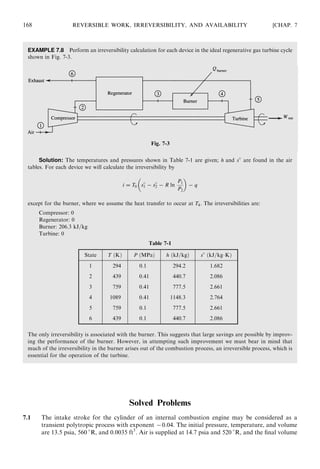
EXAMPLE 7.6 Determine the second-law effectiveness for an ideal isentropic nozzle. Air enters the nozzle at
1000 K and 0.5 MPa with negligible kinetic energy and exits to a pressure of 0.1 MPa.
Solution: Since the process is isentropic, we use the air tables to find
so
2 = so
1 − R ln
P1
P2
= 2:968 − 0:286 ln 5 = 2:506 kJ=kgÁK
Thus
T2 = 657:5 K h2 = 667:8 kJ=kg h1 = 1046:1 kJ=kg h0 = 298:2 kJ=kg
By the first law,
h1 = h2 +
V 2
2
2
or V 2 =
ffiffiffi
2
p
ðh1 − h2Þ0:5
=
ffiffiffi
2
p
½ð1046:1 − 667:8Þð103
ÞŠ0:5
= 1230 m=s
To evaluate the second-law effectiveness we need the availability produced:
2 = h2 − h0 +
V 2
2
2
− T0 so
2 − so
1 − R ln
P2
P0
 
= 667:8 − 298:2 +
12302
ð2Þð1000Þ
− ð298Þ½2:506 − 1:695 − ð0:287Þð0ÞŠ = 884 kJ=kg
where P2 = P0 = 0:1 MPA. The availability supplied is
1 ¼ h1 À h0 À T0 s
1 À s
0 À R ln
P1
P0
 
= 1046:1 À 298:2 À ð298Þð2:968 À 1:695 À 0:287 ln 5Þ = 506 kJ=kg
Since there is no work or heat transfer, (7.19) gives
II = 2
1
=
884
506
= 1:75
Note that second-law effectiveness is not bounded by 1 (much like the COP for a refrigeration cycle).
7.4 SECOND-LAW ANALYSIS OF A CYCLE
You may choose to study this section after Chapters 8 and 9.
In applying second-law concepts to a cycle two approaches may be employed. The first is simply to
evaluate the irreversibilities associated with each device or process in the cycle; this will identify sources
of large irreversibilities which will adversely affect the efficiency of the cycle. The second is to evaluate II
for the whole cycle.
EXAMPLE 7.7 Consider the simple cycle with steam extraction shown in Fig. 7-2. Calculate the second-law
effectiveness for the cycle if the boiler produces steam at 1 MPa and 300 
C and the turbine exhausts to the
condenser at 0.01 MPa. The steam extraction occurs at 0.1 MPa, where 10 percent of the steam is removed. Make-
up water is supplied as saturated liquid at the condenser pressure, and saturated liquid leaves the condenser.
Solution: We begin by traversing the cycle starting at state 1:
1 ! 2 Ideal turbine: s2 = s1 = 7:1237 kJ=kgÁK
166 REVERSIBLE WORK, IRREVERSIBILITY, AND AVAILABILITY [CHAP. 7
Comparing to sf and sg at 0.1 MPa, we have a two-phase mixture at state 2 with
x2 =
s2 − sf
sfg
= 0:96
so that h2 = hf + 0:96hfg = 2587:3 kJ/kg.
2 ! 3 Ideal turbine: s3 = s2 = 7:1237 kJ=kgÁK
Comparing to sf and sg at 0.01 MPa, we have a two-phase mixture at state 3 with
x3 =
s3 − sf
sfg
= 0:86
so that h3 = hf + 0:86hfg = 2256:9 kJ=kg. The second-law effectiveness is given by
II =
É2 + Wturb
É4 + Wpump + ½1 − ðT0=T1ÞŠQboil
The dead state for water is liquid at 100 kPa and 25 
C:
h0 = hf = 104:9 kJ=kg s0 = sf = 0:3672 kJ=kgÁK
Now the various quantities of interest may be calculated, assuming m1 = 1 kg:
É2 = m2½h2 − h0 − T0ðs2 − s0ÞŠ = ð0:1Þ½2587:3 − 104:9 − ð298Þð7:1237 − 0:3672ÞŠ = 46:89 kJ
Wturb = m1ðh1 − h2Þ + m3ðh2 − h3Þ = ð1:0Þð3051:2 − 2587:3Þ + ð0:9Þð2587:3 − 2256:9Þ = 761:3 kJ
É4 = m4½h4 − h0 − T0ðs4 − s0ÞŠ = ð0:1Þ½191:8 − 104:9 − ð298Þð0:6491 − 0:3671ÞŠ = 0:28 kJ
Wpump = m1
ÁP

= ð1:0Þ
1000 − 10
1000
 
= 0:99 kJ Qboil = m1ðh1 − h6Þ = ð1:0Þð3051:2 − 192:8Þ = 2858 kJ
whence
II =
46:89 + 761:3
0:28 + 0:99 + ð1 − 298=573Þð2858Þ
= 0:59
CHAP. 7] REVERSIBLE WORK, IRREVERSIBILITY, AND AVAILABILITY 167
Fig. 7-2
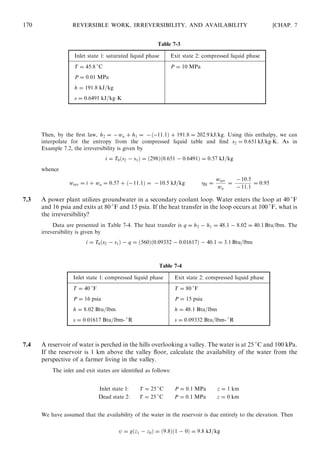
EXAMPLE 7.8 Perform an irreversibility calculation for each device in the ideal regenerative gas turbine cycle
shown in Fig. 7-3.
Solution: The temperatures and pressures shown in Table 7-1 are given; h and s
are found in the air
tables. For each device we will calculate the irreversibility by
i = T0 s
1 − s
2 − R ln
P1
P2
 
− q
except for the burner, where we assume the heat transfer to occur at T4. The irreversibilities are:
Compressor: 0
Regenerator: 0
Burner: 206.3 kJ=kg
Turbine: 0
The only irreversibility is associated with the burner. This suggests that large savings are possible by improv-
ing the performance of the burner. However, in attempting such improvement we must bear in mind that
much of the irreversibility in the burner arises out of the combustion process, an irreversible process, which is
essential for the operation of the turbine.
Solved Problems
7.1 The intake stroke for the cylinder of an internal combustion engine may be considered as a
transient polytropic process with exponent −0:04. The initial pressure, temperature, and volume
are 13.5 psia, 560 
R, and 0:0035 ft3
. Air is supplied at 14.7 psia and 520 
R, and the final volume
168 REVERSIBLE WORK, IRREVERSIBILITY, AND AVAILABILITY [CHAP. 7
Fig. 7-3
Table 7-1
State T ðKÞ P ðMPaÞ h ðkJ=kgÞ s
ðkJ=kgÁKÞ
1 294 0.1 294.2 1.682
2 439 0.41 440.7 2.086
3 759 0.41 777.5 2.661
4 1089 0.41 1148.3 2.764
5 759 0.1 777.5 2.661
6 439 0.1 440.7 2.086
and temperature are 0.025 ft3
and 520 
R. Determine the reversible work and the irreversibility
associated with the intake process.
At the various states either we are given, or the air tables provide, the values shown in Table 7-2. In the
initial state,
mi =
PiVi
RTi
=
ð13:5Þð144Þð0:0035Þ
ð53:3Þð560Þ
= 2:28 Â 10−4
lbm
The final state is produced by a polytropic process, so that
Pf = Pi
Vi
Vf
 n
= ð13:5Þ
0:0035
0:025
 −0:04
= 14:6 psia
mf =
Pf Vf
RTf
=
ð14:6Þð144Þð0:025Þ
ð53:3Þð520Þ
= 1:90 Â 10−3
lbm
From conservation of mass, m1 = mf − mi = ð1:90 Â 103
Þ − ð2:28 Â 10 −4
Þ = 1:67 Â 10−3
lbm. Only bound-
ary work is actually performed; for the polytropic process we have
Wa =
Pf Vf − PiVi
1 − n
=
½ð14:6Þð0:025Þ − ð13:5Þð0:0035ÞŠð144Þ
ð1 + 0:04Þð778Þ
= 0:057 Btu
The reversible work is given by (7.11) (neglect KE and PE, as usual):
Wrev = miðui − T0siÞ − mf ðuf − T0sf Þ + m1ðh1 − T0s1Þ
The needed values of si and sf are obtained from the ideal-gas relation
s = s
− R ln
P
P0
where P0 is some reference pressure. Normally, we do not have to worry about P0, since when we consider an
entropy change, P0 cancels. It can be shown that even for this problem it will cancel, so that
Wrev = miðui − T0s
i + T0R ln PiÞ − mf ðuf − T0s
f + T0R ln Pf Þ
+m1ðh1 − T0s
1 + T0R ln P1Þ = 0:058 Btu
and, finally, I = Wrev − Wa = 0:058 − 0:057 = 0:001 Btu.
7.2 A supply pump for a power plant takes in saturated water at 0.01 MPa and boosts its pressure to
10 MPa. The pump has an adiabatic efficiency of 0.90. Calculate the irreversibility and second-
law efficiency.
At the inlet and exit states either we are given, or the steam tables provide, the values given in Table 7-3.
The actual work is
wa =
wideal

= −
ÁP

= −
10 000 − 10
ð0:9Þð1000Þ
= −11:1 kJ=kg
CHAP. 7] REVERSIBLE WORK, IRREVERSIBILITY, AND AVAILABILITY 169
Table 7-2
Inlet State Initial State of C.V. Final State of C.V.
T1 = 520 
R Ti = 560 
R Tf = 520 
R
P1 = 14:7 psia Pi = 13:5 psia uf = 88:62 Btu=lbm
h1 = 124:27 Btu=lbm ui = 95:47 Btu=lbm s
f = 0:5917 Btu=lbm- 
R
s
1 = 0:5917 Btu=lbm-
R s
i = 0:6095 Btu=lbm- 
R Vf = 0:025 ft3
Vi = 0:0035 ft3
Then, by the first law, h2 = −wa + h1 = −ð−11:1Þ + 191:8 = 202:9 kJ/kg. Using this enthalpy, we can
interpolate for the entropy from the compressed liquid table and find s2 = 0:651 kJ/kgÁK. As in
Example 7.2, the irreversibility is given by
i = T0ðs2 − s1Þ = ð298Þð0:651 − 0:6491Þ = 0:57 kJ=kg
whence
wrev = i + wa = 0:57 + ð−11:1Þ = −10:5 kJ=kg II =
wrev
wa
=
−10:5
−11:1
= 0:95
7.3 A power plant utilizes groundwater in a secondary coolant loop. Water enters the loop at 40 
F
and 16 psia and exits at 80 
F and 15 psia. If the heat transfer in the loop occurs at 100 
F, what is
the irreversibility?
Data are presented in Table 7-4. The heat transfer is q = h2 − h1 = 48:1 − 8:02 = 40:1 Btu/lbm. The
irreversibility is given by
i = T0ðs2 − s1Þ − q = ð560Þð0:09332 − 0:01617Þ − 40:1 = 3:1 Btu=lbm
7.4 A reservoir of water is perched in the hills overlooking a valley. The water is at 25 
C and 100 kPa.
If the reservoir is 1 km above the valley floor, calculate the availability of the water from the
perspective of a farmer living in the valley.
The inlet and exit states are identified as follows:
Inlet state 1: T = 25 
C P = 0:1 MPa z = 1 km
Dead state 2: T = 25 
C P = 0:1 MPa z = 0 km
We have assumed that the availability of the water in the reservoir is due entirely to the elevation. Then
= gðz1 − z0Þ = ð9:8Þð1 − 0Þ = 9:8 kJ=kg
170 REVERSIBLE WORK, IRREVERSIBILITY, AND AVAILABILITY [CHAP. 7
Table 7-3
Inlet state 1: saturated liquid phase Exit state 2: compressed liquid phase
T = 45:8 
C P = 10 MPa
P = 0:01 MPa
h = 191:8 kJ=kg
s = 0:6491 kJ=kgÁK
Table 7-4
Inlet state 1: compressed liquid phase Exit state 2: compressed liquid phase
T = 40 
F T = 80 
F
P = 16 psia P = 15 psia
h = 8:02 Btu=lbm h = 48:1 Btu=lbm
s = 0:01617 Btu=lbm- 
R s = 0:09332 Btu=lbm- 
R
7.5 A feedwater heater extracts steam from a turbine at 600 kPa and 250 
C which it combines with
0.3 kg/s of liquid at 600 kPa and 150 
C. The exhaust is saturated liquid at 600 kPa. Determine
the second-law effectiveness of the heater.
For data, see Table 7-5. By conservation of mass, _m3 = _m1 + _m2. Then, the first law demands
_m3h3 = _m1h1 + _m2h2. Solving simultaneously for _m1 and _m3:
_m1 = 0:00504 kg=s _m3 = 0:305 kg=s
The second-law effectiveness is II = _É3=ð _É1 + _É2Þ. Taking the dead state as liquid water at 25 
C and
100 kPa, we have
h0 = 105 kJ=kg s0 = 0:3672 kJ=kgÁK
Then
_É3 = _m½h3 − h0 − T0ðs3 − s0ÞŠ = ð0:305Þ½670:6 − 105 − 298ð1:9316 − 0:3672ÞŠ = 30:33 kW
_É1 = _m1½h1 − h0 − T0ðs1 − s0ÞŠ = ð0:00504Þ½2957:2 − 105 − 298ð7:1824 − 0:3672ÞŠ = 4:14 kW
_É2 = _m2½h2 − h0 − T0ðs2 − s0ÞŠ = ð0:30Þ½632:2 − 105 − 298ð1:8422 − 0:3672ÞŠ = 23:63 kW
and
II =
30:33
4:14 + 23:63
= 1:09
7.6 Consider the ideal refrigeration cycle shown in Fig. 7-4 which utilizes R134a. The condenser
operates at 800 kPa while the evaporator operates at 120 kPa. Calculate the second-law effec-
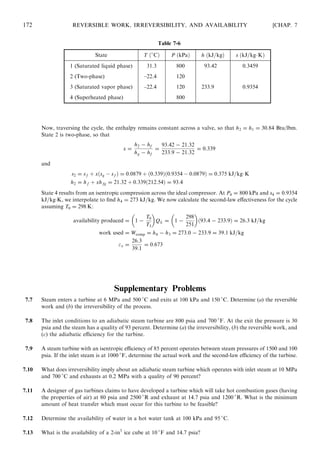
tiveness for the cycle.
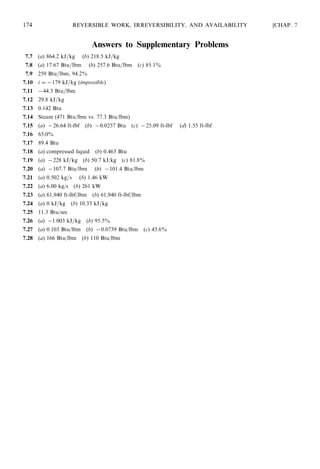
The given values and the R134a tables in Appendix D allow us to set up Table 7-6.
CHAP. 7] REVERSIBLE WORK, IRREVERSIBILITY, AND AVAILABILITY 171
Table 7-5
Inlet state 1: superheated vapor Inlet state 2: compressed liquid Exit state 3: saturated liquid
T = 250 
C T = 150 
C P = 0:6 MPa
P = 0:6 MPa P = 0:6 MPa T = 158:9 
C
h = 2957:2 h = 632:2 kJ=kg h = 670:6 kJ=kg
s = 7:1824 kJ=kgÁK s = 1:8422 kJ=kgÁK s = 1:9316 kJ=kgÁK
Fig. 7-4
Now, traversing the cycle, the enthalpy remains constant across a valve, so that h2 = h1 = 30:84 Btu/lbm.
State 2 is two-phase, so that
x =
h2 − hf
hg − hf
=
93:42 − 21:32
233:9 − 21:32
= 0:339
and
s2 = sf þ xðsg À sf Þ = 0:0879 þ ð0:339Þð0:9354 À 0:0879Þ = 0:375 kJ=kgÁK
h2 = hf þ xhfg = 21:32 þ 0:339ð212:54Þ = 93:4
State 4 results from an isentropic compression across the ideal compressor. At P4 = 800 kPa and s4 = 0:9354
kJ=kgÁK, we interpolate to find h4 = 273 kJ=kg. We now calculate the second-law effectiveness for the cycle
assuming T0 = 298 K:
availability produced = 1 −
T0
T3
 
QL = 1 −
298
251
 
ð93:4 − 233:9Þ = 26:3 kJ=kg
work used = Wcomp = h4 − h3 = 273:0 − 233:9 = 39:1 kJ=kg
 =
26:3
39:1
= 0:673
Supplementary Problems
7.7 Steam enters a turbine at 6 MPa and 500 
C and exits at 100 kPa and 150 
C. Determine (a) the reversible
work and (b) the irreversibility of the process.
7.8 The inlet conditions to an adiabatic steam turbine are 800 psia and 700 
F. At the exit the pressure is 30
psia and the steam has a quality of 93 percent. Determine (a) the irreversibility, (b) the reversible work, and
(c) the adiabatic efficiency for the turbine.
7.9 A steam turbine with an isentropic efficiency of 85 percent operates between steam pressures of 1500 and 100
psia. If the inlet steam is at 1000 
F, determine the actual work and the second-law efficiency of the turbine.
7.10 What does irreversibility imply about an adiabatic steam turbine which operates with inlet steam at 10 MPa
and 700 
C and exhausts at 0.2 MPa with a quality of 90 percent?
7.11 A designer of gas turbines claims to have developed a turbine which will take hot combustion gases (having
the properties of air) at 80 psia and 2500 
R and exhaust at 14.7 psia and 1200 
R. What is the minimum
amount of heat transfer which must occur for this turbine to be feasible?
7.12 Determine the availability of water in a hot water tank at 100 kPa and 95 
C.
7.13 What is the availability of a 2-in3
ice cube at 10 
F and 14.7 psia?
172 REVERSIBLE WORK, IRREVERSIBILITY, AND AVAILABILITY [CHAP. 7
Table 7-6
State T ð
CÞ P ðkPaÞ h ðkJ=kgÞ s ðkJ=kgÁKÞ
1 (Saturated liquid phase) 31.3 800 93.42 0.3459
2 (Two-phase) –22.4 120
3 (Saturated vapor phase) –22.4 120 233.9 0.9354
4 (Superheated phase) 800
7.14 Ideally, which fluid can do more work: air at 600 psia and 600 
F or steam at 600 psia and 600 
F?
7.15 A piston-cylinder system with air undergoes a polytropic compression with n = 1:1 from 75 
F, 15 psia, and
0.2 liter to 0.04 liter. Determine (a) actual work, (b) heat transfer, (c) reversible work, and (d) irreversibility.
7.16 Methane gas at 800 K and 3 MPa is contained in a piston-cylinder system. The system is allowed to expand
to 0.1 MPa in a polytropic process with n = 2:3. What is the second-law efficiency of the process?
7.17 Argon is contained in a sealed tank of 10 liters at 400 psia and 50 
F. What is the maximum work the argon
can do on earth at 536 
R?
7.18 A rigid tank initially contains 0.5 lbm of R134a as saturated liquid at 30 psia. It is then allowed to come to
equilibrium with its surroundings at 70 
F. Determine (a) the final state of the refrigerant and (b) the
irreversibility.
7.19 Air enters a compressor at 100 kPa and 295 K and exits at 700 kPa and 530 K with 40 kJ=kg of heat transfer
to the surroundings. Determine (a) reversible work, (b) irreversibility, and (c) second-law efficiency for the
compressor.
7.20 A compressor with an adiabatic efficiency of 90 percent intakes air at 500 
R and 15 psia and exhausts at 120
psia. Determine (a) the actual work and (b) the reversible work associated with this compressor.
7.21 The evaporator for an air-conditioning system is a heat exchanger. R134a enters at 0.05 kg=s and −20 
C as
saturated liquid and leaves as saturated vapor. Air enters at 34 
C and leaves at 18 
C. (a) What is the mass
flow rate of air? (b) What is the irreversibility rate of the evaporator?
7.22 A direct contact heat exchanger serves as the condenser for a steam power plant. Steam with quality of 50
percent at 100 kPa flows into the mixing tank at 2 kg/s. Groundwater at 10 
C and 100 kPa is available to
produce saturated liquid flowing out of the mixing tank. The mixing tank is well-insulated. Determine (a) the
mass flow rate of groundwater required and (b) the irreversibility rate.
7.23 Steam is throttled across an adiabatic valve from 250 psia and 450 
F to 60 psia. Determine (a) the reversible
work and (b) the irreversibility.
7.24 It has been proposed to utilize a nozzle in conjunction with a wind turbine system. Air enters the adiabatic
nozzle at 9 m/s, 300 K, and 120 kPa and exits at 100 m/s and 100 kPa. Determine (a) the irreversibility and
(b) the reversible work.
7.25 In the burner for a gas turbine system 0.2 lbm/sec of air at 20 psia and 900 
R is heated to 2150 
R in a
constant-pressure process while hot combustion gases (assumed to be air) are cooled from 3000 
R to
2400 
R. What is the irreversibility rate of this process?
7.26 Saturated water enters an adiabatic pump at 10 kPa and exits at 1 MPa. If the pump has an adiabatic
efficiency of 95 percent, determine (a) the reversible work and (b) the second-law efficiency.
7.27 The pressure of water is increased, by the use of a pump, from 14 to 40 psia. A rise in the water temperature
from 60 
F to 60.1 
F is observed. Determine (a) the irreversibility, (b) the reversible work, and (c) the
adiabatic efficiency of the pump.
7.28 Air at 2200 
R and 40 psia enters a gas turbine with an adiabatic efficiency of 75 percent and exhausts at 14.7
psia. Determine (a) the availability of the exhaust air and (b) the reversible work.
CHAP. 7] REVERSIBLE WORK, IRREVERSIBILITY, AND AVAILABILITY 173
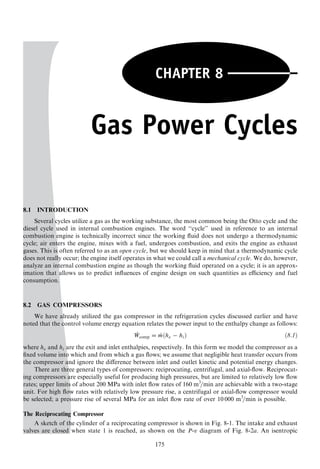
Answers to Supplementary Problems
7.7 (a) 864.2 kJ=kg (b) 218.5 kJ=kg
7.8 (a) 17.67 Btu=lbm (b) 257.6 Btu=lbm (c) 85.1%
7.9 259 Btu=lbm, 94.2%
7.10 i = −179 kJ=kg (impossible)
7.11 −44:3 Btu=lbm
7.12 29.8 kJ=kg
7.13 0.142 Btu
7.14 Steam (471 Btu/lbm vs. 77.3 Btu/lbm)
7.15 (a) −26:64 ft-lbf (b) −0:0257 Btu (c) −25:09 ft-lbf (d) 1.55 ft-lbf
7.16 65.0%
7.17 89.4 Btu
7.18 (a) compressed liquid (b) 0.463 Btu
7.19 (a) −228 kJ=kg (b) 50.7 kJ/kg (c) 81.8%
7.20 (a) −107:7 Btu/lbm (b) −101:4 Btu/lbm
7.21 (a) 0.502 kg=s (b) 1.46 kW
7.22 (a) 6.00 kg/s (b) 261 kW
7.23 (a) 61,940 ft-lbf/lbm (b) 61,940 ft-lbf/lbm
7.24 (a) 0 kJ=kg (b) 10.33 kJ=kg
7.25 11.3 Btu/sec
7.26 (a) −1:003 kJ=kg (b) 95.5%
7.27 (a) 0.103 Btu/lbm (b) −0:0739 Btu/lbm (c) 43.6%
7.28 (a) 166 Btu/lbm (b) 110 Btu/lbm
174 REVERSIBLE WORK, IRREVERSIBILITY, AND AVAILABILITY [CHAP. 7
175
CHAPTER 8
Gas Power Cycles
8.1 INTRODUCTION
Several cycles utilize a gas as the working substance, the most common being the Otto cycle and the
diesel cycle used in internal combustion engines. The word ‘‘cycle’’ used in reference to an internal
combustion engine is technically incorrect since the working fluid does not undergo a thermodynamic
cycle; air enters the engine, mixes with a fuel, undergoes combustion, and exits the engine as exhaust
gases. This is often referred to as an open cycle, but we should keep in mind that a thermodynamic cycle
does not really occur; the engine itself operates in what we could call a mechanical cycle. We do, however,
analyze an internal combustion engine as though the working fluid operated on a cycle; it is an approx-
imation that allows us to predict influences of engine design on such quantities as efficiency and fuel
consumption.
8.2 GAS COMPRESSORS
We have already utilized the gas compressor in the refrigeration cycles discussed earlier and have
noted that the control volume energy equation relates the power input to the enthalpy change as follows:
_Wcomp = _mðhe − hiÞ ð8:1Þ
where he and hi are the exit and inlet enthalpies, respectively. In this form we model the compressor as a
fixed volume into which and from which a gas flows; we assume that negligible heat transfer occurs from
the compressor and ignore the difference between inlet and outlet kinetic and potential energy changes.
There are three general types of compressors: reciprocating, centrifugal, and axial-flow. Reciprocat-
ing compressors are especially useful for producing high pressures, but are limited to relatively low flow
rates; upper limits of about 200 MPa with inlet flow rates of 160 m3
=min are achievable with a two-stage
unit. For high flow rates with relatively low pressure rise, a centrifugal or axial-flow compressor would
be selected; a pressure rise of several MPa for an inlet flow rate of over 10 000 m3
=min is possible.
The Reciprocating Compressor
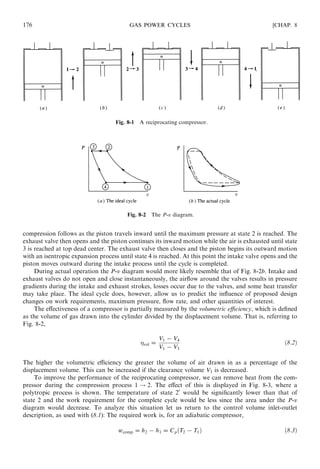
A sketch of the cylinder of a reciprocating compressor is shown in Fig. 8-1. The intake and exhaust
valves are closed when state 1 is reached, as shown on the P-v diagram of Fig. 8-2a. An isentropic
compression follows as the piston travels inward until the maximum pressure at state 2 is reached. The
exhaust valve then opens and the piston continues its inward motion while the air is exhausted until state
3 is reached at top dead center. The exhaust valve then closes and the piston begins its outward motion
with an isentropic expansion process until state 4 is reached. At this point the intake valve opens and the
piston moves outward during the intake process until the cycle is completed.
During actual operation the P-v diagram would more likely resemble that of Fig. 8-2b. Intake and
exhaust valves do not open and close instantaneously, the airflow around the valves results in pressure
gradients during the intake and exhaust strokes, losses occur due to the valves, and some heat transfer
may take place. The ideal cycle does, however, allow us to predict the influence of proposed design
changes on work requirements, maximum pressure, flow rate, and other quantities of interest.
The effectiveness of a compressor is partially measured by the volumetric efficiency, which is defined
as the volume of gas drawn into the cylinder divided by the displacement volume. That is, referring to
Fig. 8-2,
vol =
V1 − V4
V1 − V3
ð8:2Þ
The higher the volumetric efficiency the greater the volume of air drawn in as a percentage of the
displacement volume. This can be increased if the clearance volume V3 is decreased.
To improve the performance of the reciprocating compressor, we can remove heat from the com-
pressor during the compression process 1 ! 2. The effect of this is displayed in Fig. 8-3, where a
polytropic process is shown. The temperature of state 20
would be significantly lower than that of
state 2 and the work requirement for the complete cycle would be less since the area under the P-v
diagram would decrease. To analyze this situation let us return to the control volume inlet-outlet
description, as used with (8.1): The required work is, for an adiabatic compressor,
wcomp = h2 − h1 = CpðT2 − T1Þ ð8:3Þ
176 GAS POWER CYCLES [CHAP. 8
Fig. 8-2 The P-v diagram.
Fig. 8-1 A reciprocating compressor.
assuming an ideal gas with constant specific heat. For an isentropic compression between inlet and outlet
we know that
T2 = T1
P2
P1
 ðk−1Þ=k
ð8:4Þ
This allows the work to be expressed as, using Cp given in (4.30),
wcomp =
kR
k−1
T1
P2
P1
 ðk−1Þ=k
− 1
 #
ð8:5Þ
For a polytropic process we simply replace k with n and obtain
wcomp =
nR
n − 1
T1
P2
P1
 ðn−1Þ=n
− 1
 #
ð8:6Þ
The heat transfer is then found from the first law.
By external cooling, with a water jacket surrounding the compressor, the value of n when compres-
sing air can be reduced to about 1.35. This reduction from 1.4 is difficult since heat transfer must occur
from the rapidly moving air through the compressor casing to the cooling water, or from fins. This is an
ineffective process, and multistage compressors with interstage cooling are often a desirable alternative.
With a single stage and with a high P2 the outlet temperature T2 would be too high even if n could be
reduced to, say, 1.3.
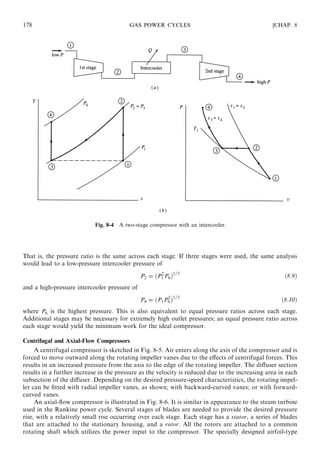
Consider a two-stage compressor with a single intercooler, as shown in Fig. 8-4a. The compression
processes are assumed to be isentropic and are shown in the T-s and P-v diagrams of Fig. 8-4b.
Referring to (8.5), the work is written as
wcomp = CpT1
P2
P1
 ðk−1Þ=k
− 1
 #
+ CpT3
P4
P3
 ðk−1Þ=k
− 1
 #
= CpT1
P2
P1
 ðk−1Þ=k
+
P4
P2
ðk−1Þ=k
− 2
 #
where we have used P2 = P3 and T1 = T3, for an ideal intercooler. To determine the intercooler pressure
P2 that minimizes the work, we let @wcomp=@P2 = 0. This gives
P2 = ðP1P4Þ1=2
or
P2
P1
=
P4
P3
ð8:8Þ
CHAP. 8] GAS POWER CYCLES 177
Fig. 8-3 Removal of heat during compression.
ð8:7Þ
That is, the pressure ratio is the same across each stage. If three stages were used, the same analysis
would lead to a low-pressure intercooler pressure of
P2 = ðP2
1 P6Þ1=3
ð8:9Þ
and a high-pressure intercooler pressure of
P4 = ðP1P2
6 Þ1=3
ð8:10Þ
where P6 is the highest pressure. This is also equivalent to equal pressure ratios across each stage.
Additional stages may be necessary for extremely high outlet pressures; an equal pressure ratio across
each stage would yield the minimum work for the ideal compressor.
Centrifugal and Axial-Flow Compressors
A centrifugal compressor is sketched in Fig. 8-5. Air enters along the axis of the compressor and is
forced to move outward along the rotating impeller vanes due to the effects of centrifugal forces. This
results in an increased pressure from the axis to the edge of the rotating impeller. The diffuser section
results in a further increase in the pressure as the velocity is reduced due to the increasing area in each
subsection of the diffuser. Depending on the desired pressure-speed characteristics, the rotating impel-
ler can be fitted with radial impeller vanes, as shown; with backward-curved vanes; or with forward-
curved vanes.
An axial-flow compressor is illustrated in Fig. 8-6. It is similar in appearance to the steam turbine
used in the Rankine power cycle. Several stages of blades are needed to provide the desired pressure
rise, with a relatively small rise occurring over each stage. Each stage has a stator, a series of blades
that are attached to the stationary housing, and a rotor. All the rotors are attached to a common
rotating shaft which utilizes the power input to the compressor. The specially designed airfoil-type
178 GAS POWER CYCLES [CHAP. 8
Fig. 8-4 A two-stage compressor with an intercooler.
blades require extreme precision in manufacturing and installation to yield the maximum possible
pressure rise while avoiding flow separation. The area through which the air passes decreases slightly
as the pressure rises due to the increased density in the higher-pressure air. In fluid mechanics the
velocity and pressure at each stage can be analyzed; in thermodynamics we are concerned only with
inlet and outlet conditions.
CHAP. 8] GAS POWER CYCLES 179
Fig. 8-5 A centrifugal compressor.
Fig. 8-6 An axial-flow compressor.
EXAMPLE 8.1 A reciprocating compressor is to deliver 20 kg=min of air at 1600 kPa. It receives atmospheric air
at 20
C. Calculate the required power if the compressor is assumed to be 90 percent efficient. No cooling is assumed.
Solution: The efficiency of the compressor is defined as
 =
isentropic work
actual work
=
h20 − h1
h2 − h1
where state 2 identifies the actual state reached and state 20
is the ideal state that could be reached with no losses.
Let us find the temperature T20 first. It is
T20 = T1 =
P2
P1
 ðk−1Þ=k
= ð293Þ
1600
100
 ð1:4−1Þ=1:4
= 647 K
Using the efficiency, we have
 =
CpðT20 − T1Þ
CpðT2 − T1Þ
or T2 = T1 +
1

ðT20 − T1Þ = 293 +
1
0:9
 
ð647 − 293Þ = 686 K
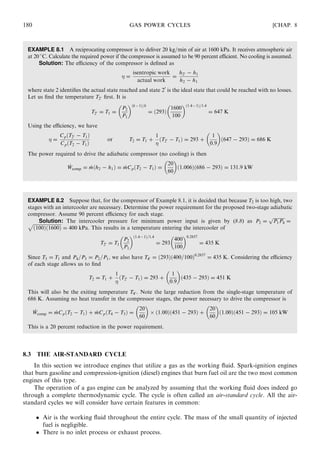
The power required to drive the adiabatic compressor (no cooling) is then
_Wcomp = _mðh2 − h1Þ = _mCpðT2 − T1Þ =
20
60
 
ð1:006Þð686 − 293Þ = 131:9 kW
EXAMPLE 8.2 Suppose that, for the compressor of Example 8.1, it is decided that because T2 is too high, two
stages with an intercooler are necessary. Determine the power requirement for the proposed two-stage adiabatic
compressor. Assume 90 percent efficiency for each stage.
Solution: The intercooler pressure for minimum power input is given by (8.8) as P2 =
ffiffiffiffiffiffiffiffiffiffi
P1P4
p
=ffiffiffiffiffiffiffiffiffiffiffiffiffiffiffiffiffiffiffiffiffiffiffiffiffi
ð100Þð1600Þ
p
= 400 kPa. This results in a temperature entering the intercooler of
T20 = T1
P2
P1
 ð1:4−1Þ=1:4
= 293
400
100
 0:2857
= 435 K
Since T3 = T1 and P4=P3 = P2=P1, we also have T40 = ð293Þð400=100Þ0:2857
= 435 K. Considering the efficiency
of each stage allows us to find
T2 = T1 +
1

ðT20 − T1Þ = 293 +
1
0:9
 
ð435 − 293Þ = 451 K
This will also be the exiting temperature T40 . Note the large reduction from the single-stage temperature of
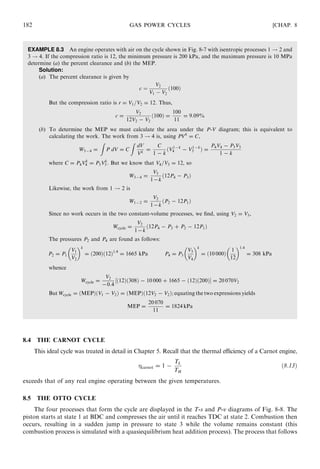
686 K. Assuming no heat transfer in the compressor stages, the power necessary to drive the compressor is
_Wcomp = _mCpðT2 − T1Þ + _mCpðT4 − T3Þ =
20
60
 
 ð1:00Þð451 − 293Þ +
20
60
 
ð1:00Þð451 − 293Þ = 105 kW
This is a 20 percent reduction in the power requirement.
8.3 THE AIR-STANDARD CYCLE
In this section we introduce engines that utilize a gas as the working fluid. Spark-ignition engines
that burn gasoline and compression-ignition (diesel) engines that burn fuel oil are the two most common
engines of this type.
The operation of a gas engine can be analyzed by assuming that the working fluid does indeed go
through a complete thermodynamic cycle. The cycle is often called an air-standard cycle. All the air-
standard cycles we will consider have certain features in common:
 Air is the working fluid throughout the entire cycle. The mass of the small quantity of injected
fuel is negligible.
 There is no inlet process or exhaust process.
180 GAS POWER CYCLES [CHAP. 8
The combustion process is replaced by a heat transfer process with energy transferred from an
external source. It may be a constant-volume process or a constant-pressure process, or a
combination.
 The exhaust process, used to restore the air to its original state, is replaced with heat transfer to
the surroundings.
 All processes are assumed to be in quasiequilibrium.
 The air is assumed to be an ideal gas with constant specific heats.
A number of the engines we will consider make use of a closed system with a piston-cylinder
arrangement, as shown in Fig. 8-7. The cycle shown on the P-v and T-s diagrams in the figure is
representative only. The diameter of the piston is called the bore, and the distance the piston travels
in one direction is the stroke. When the piston is at top dead center (TDC), the volume occupied by the
air in the cylinder is at a minimum; this volume is the clearance volume. When the piston moves to
bottom dead center (BDC), the air occupies the maximum volume. The difference between the maximum
volume and the clearance volume is the displacement volume. The clearance volume is often implicitly
presented as the percent clearance c, the ratio of the clearance volume to the displacement volume. The
compression ratio r is defined to be the ratio of the volume occupied by the air at BDC to the volume
occupied by the air at TDC, that is, referring to Fig. 8-7,
r =
V1
V2
ð8:11Þ
The mean effective pressure (MEP) is another quantity that is often used when rating piston-cylinder
engines; it is the pressure that, if acting on the piston during the power stroke, would produce an amount
of work equal to that actually done during the entire cycle. Thus,
Wcycle = ðMEPÞðVBDC − VTDCÞ ð8:12Þ
In Fig. 8-7 this means that the enclosed area of the actual cycle is equal to the area under the MEP
dotted line.
CHAP. 8] GAS POWER CYCLES 181
Fig. 8-7 A piston-cylinder engine.
EXAMPLE 8.3 An engine operates with air on the cycle shown in Fig. 8-7 with isentropic processes 1 ! 2 and
3 ! 4. If the compression ratio is 12, the minimum pressure is 200 kPa, and the maximum pressure is 10 MPa
determine (a) the percent clearance and (b) the MEP.
Solution:
(a) The percent clearance is given by
c ¼
V2
V1 À V2
ð100Þ
But the compression ratio is r = V1=V2 = 12. Thus,
c =
V2
12V2 − V2
ð100Þ =
100
11
= 9:09%
(b) To determine the MEP we must calculate the area under the P-V diagram; this is equivalent to
calculating the work. The work from 3 ! 4 is, using PVk
= C,
W3−4 =
Z
P dV = C
Z
dV
Vk
=
C
1 − k
ðV1−k
4 − V1−k
3 Þ =
P4V4 − P3V3
1 − k
where C = P4Vk
4 = P3Vk
3 . But we know that V4=V3 = 12, so
W3−4 =
V3
1−k
ð12P4 − P3Þ
Likewise, the work from 1 ! 2 is
W1−2 =
V2
1−k
ðP2 − 12P1Þ
Since no work occurs in the two constant-volume processes, we find, using V2 = V3,
Wcycle =
V2
1−k
ð12P4 − P3 + P2 − 12P1Þ
The pressures P2 and P4 are found as follows:
P2 = P1
V1
V2
 k
= ð200Þð12Þ1:4
= 1665 kPa P4 = P3
V3
V4
 k
= ð10 000Þ
1
12
 1:4
= 308 kPa
whence
Wcycle =
V2
−0:4
½ð12Þð308Þ − 10 000 + 1665 − ð12Þð200ÞŠ = 20 070V2
But Wcycle = ðMEPÞðV1 − V2Þ = ðMEPÞð12V2 − V2Þ; equating the two expressions yields
MEP =
20 070
11
= 1824 kPa
8.4 THE CARNOT CYCLE
This ideal cycle was treated in detail in Chapter 5. Recall that the thermal efficiency of a Carnot engine,
carnot = 1 −
TL
TH
ð8:13Þ
exceeds that of any real engine operating between the given temperatures.
8.5 THE OTTO CYCLE
The four processes that form the cycle are displayed in the T-s and P-v diagrams of Fig. 8-8. The
piston starts at state 1 at BDC and compresses the air until it reaches TDC at state 2. Combustion then
occurs, resulting in a sudden jump in pressure to state 3 while the volume remains constant (this
combustion process is simulated with a quasiequilibrium heat addition process). The process that follows
182 GAS POWER CYCLES [CHAP. 8
is the power stroke as the air (simulating the combustion products) expands isentropically to state 4. In
the final process heat transfer to the surroundings occurs and the cycle is completed. The spark-ignition
engine is modeled with this Otto cycle.
The thermal efficiency of the Otto cycle is found from
 =
_Wnet
_Qin
=
_Qin − _Qout
_Qin
= 1 −
_Qout
_Qin
ð8:14Þ
Noting that the two heat transfer processes occur during constant-volume processes, for which the work
is zero, there results
_Qin = _mCvðT3 − T2Þ _Qout = _mCvðT4 − T1Þ ð8:15Þ
where we have assumed each quantity to be positive. Then
 = 1 −
T4 − T1
T3 − T2
ð8:16Þ
This can be written as
 = 1 −
T1
T2
T4=T1 − 1
T3=T2 − 1
ð8:17Þ
For the isentropic processes we have
T2
T1
=
V1
V2
 k−1
and
T3
T4
=
V4
V3
 k−1
ð8:18Þ
But, using V1 = V4 and V3 = V2, we see that
T2
T1
=
T3
T4
ð8:19Þ
Thus, (8.17) gives the thermal efficiency as
 = 1 −
T1
T2
= 1 −
V2
V1
 k−1
= 1 −
1
rk−1
ð8:20Þ
CHAP. 8] GAS POWER CYCLES 183
Fig. 8-8 The Otto cycle.

Potter, merle c capitulo 8

  • 1.
    where Wa isthe actual work and Wrev is the reversible work for the fictitious reversible process. Second- law efficiency is different from the adiabatic efficiency of a device introduced in Chap. 6. It is generally higher and provides a better comparison to the ideal. Second, irreversibility is defined as the difference between the reversible work and the actual work for a process, or I = Wrev − Wa ð7:3Þ On a per-unit-mass basis, i = wrev − wa ð7:4Þ Both irreversibility and second-law efficiency will allow us to consider how close an actual process or device is to the ideal. Once the irreversibilities for devices in an actual engineering system, such as a steam power cycle, have been calculated, attempts to improve the performance of the system can be guided by attacking the largest irreversibilities. Similarly, since the maximum possible work will be reversible work, irreversibility can be used to evaluate the feasibility of a device. If the irreversibility of a proposed device is less than zero, the device is not feasible. [Section 7.2 develops the concepts of reversible work and irreversibility.] Availability is defined as the maximum amount of reversible work that can be extracted from a system: É = ðWrevÞmax ð7:5Þ or, on a per-unit-mass basis, = ðwrevÞmax ð7:6Þ The maximization in (7.5) and (7.6) is over the reversible path joining the prescribed initial state to a final dead state in which system and surroundings are in equilibrium. [Section 7.3 develops the notion of availability.] 7.2 REVERSIBLE WORK AND IRREVERSIBILITY To obtain expressions for reversible work and irreversibility, we will consider a transient process with specified work output and heat input and a uniform through-flow. We begin by allowing this to be an irreversible process. Consider the control volume shown in Fig. 7-1. The first law for this control volume can be written as _Q − _WS = h2 + V 2 2 2 + gz2 ! _m2 − h1 + V 2 1 2 + gz1 ! _m1 + _Ec:v: ð7:7Þ Using (6.47), with Tsurr = T0 and _Qsurr = − _Q, we may write the second law as _Sc:v: + s2 _m2 − s1 _m1 − _Q T0 − _Sprod = 0 ð7:8Þ Eliminate _Q between (7.7) and (7.8) to obtain _WS = − _Ec:v: + T0 _Sc:v: − h2 + V 2 2 2 + gz2 − T0s2 ! _m2 + h1 + V 2 1 2 + gz1 − T0s1 ! _m1 − T0 _Sprod ð7:9Þ 162 REVERSIBLE WORK, IRREVERSIBILITY, AND AVAILABILITY [CHAP. 7
  • 2.
    Since _Sprod isdue to the irreversibilities, the reversible work rate is given by (7.9) when _Sprod is set equal to zero: _Wrev = − _Ec:v: + T0 _Sc:v: − h2 + V 2 2 2 + gz2 − T0s2 ! _m2 + h1 + V 2 1 2 + gz1 − T0s1 ! _m1 ð7:10Þ Then a time integration yields Wrev = mi ui + V 2 i 2 + gzi − T0si ! − mf uf + V 2 f 2 + gzf − T0sf !" # c:v: : + m1 h1 + V 2 1 2 + gz1 − T0s1 ! − m2 h2 + V 2 2 2 + gz2 − T0s2 ! ð7:11Þ where the subscripts i and f pertain to the initial and final states of the control volume. The actual work, if not given, can be determined from a first-law analysis: Wa = mi ui + V 2 i 2 + gzi ! − mf uf + V 2 f 2 + gzf !" # c:v: + m1 h1 + V 2 1 2 + gz1 ! − m2 h2 + V 2 2 2 + gz2 ! + Q ð7:12Þ From (7.3), (7.11), and (7.12), I = ðmf T0sf − miT0siÞc:v: + T0m2s2 − T0m1s1 − Q ð7:13Þ For a steady flow with negligible changes in kinetic and potential energies, we have _Wrev = _m½h1 − h2 + T0ðs2 − s1ÞŠ ð7:14Þ _I = _mT0ðs2 − s1Þ + _Q ð7:15Þ It is important to realize that the basic results of this Section—(7.11), (7.12), and (7.13)—also hold for a system, which is nothing other than a control volume for which m1 = m2 = 0 (and thus mi = mf = m). Because time plays no part in the thermodynamics of a system, we generally replace the indices i and f by 1 and 2. EXAMPLE 7.1 An ideal steam turbine is supplied with steam at 12 MPa and 700 C, and exhausts at 0.6 MPa. (a) Determine the reversible work and irreversibility. (b) If the turbine has an adiabatic efficiency of 0.88, what is the reversible work, irreversibility, and second-law efficiency? CHAP. 7] REVERSIBLE WORK, IRREVERSIBILITY, AND AVAILABILITY 163 Fig. 7-1 The control volume used in the second-law analysis.
  • 3.
    Solution: (a) The propertiesfor the inlet state are obtained from the steam tables. Since the turbine is isentropic, s2 = s1 = 7:0757 kJ=kgÁK. From the steam tables we note that the exit state must be superheated vapor. We interpolate to obtain T2 = 225:2 C and h2 = 2904:1 kJ=kg. Then, from the first law for a control volume, wa = h1 − h2 = 3858:4 − 2904:1 = 954:3 kJ=kg From (7.11), neglecting kinetic and potential energies, wrev = h1 − h2 − T0ðs1 %− s0 2Þ = 3858:4 − 2904:1 = 954:3 kJ=kg The irreversibility for an ideal turbine is i = wrev − wa = 954:3 − 954:3 = 0 kJ/kg. (b) Now let the adiabatic turbine have T = 0:88. The isentropic or ideal work was calculated in (a), so that the actual work is wa = T wideal = ð0:88Þð954:3Þ = 839:8 kJ=kg. For this adiabatic process, h2 = h1 − wa = 3858:4 − 839:8 = 3018:6 kJ=kg From the steam tables we find that the exit state with P2 = 0:6 MPa is superheated vapor, with T2 = 279:4 C and s2 = 7:2946 kJ=kg. Then, assuming T0 = 298 K, wrev = h1 − h2 − T0ðs1 − s2Þ = 3858:4 − 3018:6 − ð298Þð7:0757 − 7:2946Þ = 905 kJ=kg The second-law efficiency is II = wa=wrev = 0:928, which is greater than the adiabatic efficiency. The irreversibility is i ¼ wrev À wa ¼ 905:0 À 839:8 = 65:2 kJ=kg EXAMPLE 7.2 Measurements are made on an adiabatic compressor with supply air at 15 psia and 80 F. The exhaust air is measured at 75 psia and 440 F. Can these measurements be correct? Solution: For steady flow in the control volume, with Q = 0, (7.15) becomes i = T0ðs2 − s1Þ The entropy change is found, using values from the air tables, to be s2 − s1 = so 2 − so 1 − R ln P2 P1 = 0:72438 − 0:60078 − 53:3 778 ln 75 15 = 0:01334 Btu=lbm- R The irreversibility is then i = ð537Þð0:01334Þ = 7:16 Btu/lbm. As this is positive, the measurements can be correct. We assumed T0 to be 537 R. 7.3 AVAILABILITY AND EXERGY According to the discussion in Section 7.1, É is given by (7.11) when the final state (f) is identified with the state of the surroundings (0): É = mi ui + V 2 i 2 + gzi − T0si ! − mf u0 + V 2 2 + gz0 − T0s0 ! # c:v: + m1 h1 + V 2 1 2 + gz1 − T0s1 ! − m2 h0 + V 2 0 2 + gz0 − T0s0 ! ð7:16Þ For a steady-flow process (7.16) becomes = h1 − h0 + V 2 1 − V 2 0 2 + gðz1 − z0Þ − T0ðs1 − s0Þ ð7:17Þ 164 REVERSIBLE WORK, IRREVERSIBILITY, AND AVAILABILITY [CHAP. 7
  • 4.
    In carrying outa second-law analysis, it is often useful to define a new thermodynamic function (analogous to enthalpy), called exergy: E h + V 2 2 + gz − T0s ð7:18Þ Comparing (7.18) to (7.17), we see that E1 − E0 = . We interpret this equation as a work-energy relation: the extractable specific work exactly equals the decrease in useful exergy E between the entrance and dead states of the system. More generally, when the system passes from one state to another, specific work in the amount −ÁE is made available. Certain engineering devices have useful outputs or inputs that are not in the form of work; a nozzle is an example. Consequently, we generalize the notion of second-law efficiency to that of second-law effectiveness: II = ðavailability producedÞ + ðwork producedÞ + ðadjusted heat producedÞ ðavailability suppliedÞ + ðwork usedÞ + ðadjusted heat usedÞ ð7:19Þ Heat to or from a device is ‘‘adjusted’’ in (7.19) on the basis of the temperature −Th:r: of the heat reservoir which is interacting with the device: adjusted heat = 1 − T0 Th:r: Q ð7:20Þ EXAMPLE 7.3 Which system can do more useful work, 0.1 lbm of CO2 at 440 F and 30 psia or 0.1 lbm of N2 at 440 F and 30 psia? Solution: Assuming a dead state at 77 F (537 R) and 14.7 psia, we use Table E-4E to calculate the availability of the CO2: É = m h − h0 − T0 s 1 − s 0 − R ln P P0 ! = 0:1 44 7597:6 − 4030:2 − 537 56:070 − 51:032 − 1:986 ln 30 14:7 ! = 3:77 Btu Similarly, for the N2, É = m h − h0 − T0 so 1 − so 0 − R ln P P0 ! = 0:1 28 6268:1 − 3279:5 − ð537Þ 49:352 − 45:743 − 1:986 ln 30 14:7 ! = 6:47 Btu Hence, the N2 can do more useful work. EXAMPLE 7.4 How much useful work is wasted in the condenser of a power plant which takes in steam of quality 0.85 and 5 kPa and delivers saturated liquid at the same pressure? Solution: The maximum specific work available at the condenser inlet is 1 = h1 − h0 − T0ðs1 − s0Þ; at the outlet it is 2 = h2 − h0 − T0ðs2 − s0Þ. The useful work wasted is 1 − 2 = h1 − h2 − T0ðs1 − s2Þ. From the steam tables, assuming T0 = 298 K and using the quality to find h1 and s1, we find 1 − 2 = h1 − h2 − T0ðs1 − s2Þ = 2197:2 − 136:5 − ð298Þð7:2136 − 0:4717Þ = 51:6 kJ=kg CHAP. 7] REVERSIBLE WORK, IRREVERSIBILITY, AND AVAILABILITY 165
  • 5.
    EXAMPLE 7.5 Calculatethe exergy of steam at 500 F and 300 psia. The surroundings are at 76 F. Solution: From the superheated steam tables, E = h − T0s = 1257:5 − ð536Þð1:5701Þ = 415:9 Btu=lbm EXAMPLE 7.6 Determine the second-law effectiveness for an ideal isentropic nozzle. Air enters the nozzle at 1000 K and 0.5 MPa with negligible kinetic energy and exits to a pressure of 0.1 MPa. Solution: Since the process is isentropic, we use the air tables to find so 2 = so 1 − R ln P1 P2 = 2:968 − 0:286 ln 5 = 2:506 kJ=kgÁK Thus T2 = 657:5 K h2 = 667:8 kJ=kg h1 = 1046:1 kJ=kg h0 = 298:2 kJ=kg By the first law, h1 = h2 + V 2 2 2 or V 2 = ffiffiffi 2 p ðh1 − h2Þ0:5 = ffiffiffi 2 p ½ð1046:1 − 667:8Þð103 ÞŠ0:5 = 1230 m=s To evaluate the second-law effectiveness we need the availability produced: 2 = h2 − h0 + V 2 2 2 − T0 so 2 − so 1 − R ln P2 P0 = 667:8 − 298:2 + 12302 ð2Þð1000Þ − ð298Þ½2:506 − 1:695 − ð0:287Þð0ÞŠ = 884 kJ=kg where P2 = P0 = 0:1 MPA. The availability supplied is 1 ¼ h1 À h0 À T0 s 1 À s 0 À R ln P1 P0 = 1046:1 À 298:2 À ð298Þð2:968 À 1:695 À 0:287 ln 5Þ = 506 kJ=kg Since there is no work or heat transfer, (7.19) gives II = 2 1 = 884 506 = 1:75 Note that second-law effectiveness is not bounded by 1 (much like the COP for a refrigeration cycle). 7.4 SECOND-LAW ANALYSIS OF A CYCLE You may choose to study this section after Chapters 8 and 9. In applying second-law concepts to a cycle two approaches may be employed. The first is simply to evaluate the irreversibilities associated with each device or process in the cycle; this will identify sources of large irreversibilities which will adversely affect the efficiency of the cycle. The second is to evaluate II for the whole cycle. EXAMPLE 7.7 Consider the simple cycle with steam extraction shown in Fig. 7-2. Calculate the second-law effectiveness for the cycle if the boiler produces steam at 1 MPa and 300 C and the turbine exhausts to the condenser at 0.01 MPa. The steam extraction occurs at 0.1 MPa, where 10 percent of the steam is removed. Make- up water is supplied as saturated liquid at the condenser pressure, and saturated liquid leaves the condenser. Solution: We begin by traversing the cycle starting at state 1: 1 ! 2 Ideal turbine: s2 = s1 = 7:1237 kJ=kgÁK 166 REVERSIBLE WORK, IRREVERSIBILITY, AND AVAILABILITY [CHAP. 7
  • 6.
    Comparing to sfand sg at 0.1 MPa, we have a two-phase mixture at state 2 with x2 = s2 − sf sfg = 0:96 so that h2 = hf + 0:96hfg = 2587:3 kJ/kg. 2 ! 3 Ideal turbine: s3 = s2 = 7:1237 kJ=kgÁK Comparing to sf and sg at 0.01 MPa, we have a two-phase mixture at state 3 with x3 = s3 − sf sfg = 0:86 so that h3 = hf + 0:86hfg = 2256:9 kJ=kg. The second-law effectiveness is given by II = É2 + Wturb É4 + Wpump + ½1 − ðT0=T1ÞŠQboil The dead state for water is liquid at 100 kPa and 25 C: h0 = hf = 104:9 kJ=kg s0 = sf = 0:3672 kJ=kgÁK Now the various quantities of interest may be calculated, assuming m1 = 1 kg: É2 = m2½h2 − h0 − T0ðs2 − s0ÞŠ = ð0:1Þ½2587:3 − 104:9 − ð298Þð7:1237 − 0:3672ÞŠ = 46:89 kJ Wturb = m1ðh1 − h2Þ + m3ðh2 − h3Þ = ð1:0Þð3051:2 − 2587:3Þ + ð0:9Þð2587:3 − 2256:9Þ = 761:3 kJ É4 = m4½h4 − h0 − T0ðs4 − s0ÞŠ = ð0:1Þ½191:8 − 104:9 − ð298Þð0:6491 − 0:3671ÞŠ = 0:28 kJ Wpump = m1 ÁP = ð1:0Þ 1000 − 10 1000 = 0:99 kJ Qboil = m1ðh1 − h6Þ = ð1:0Þð3051:2 − 192:8Þ = 2858 kJ whence II = 46:89 + 761:3 0:28 + 0:99 + ð1 − 298=573Þð2858Þ = 0:59 CHAP. 7] REVERSIBLE WORK, IRREVERSIBILITY, AND AVAILABILITY 167 Fig. 7-2
  • 7.
    EXAMPLE 7.8 Performan irreversibility calculation for each device in the ideal regenerative gas turbine cycle shown in Fig. 7-3. Solution: The temperatures and pressures shown in Table 7-1 are given; h and s are found in the air tables. For each device we will calculate the irreversibility by i = T0 s 1 − s 2 − R ln P1 P2 − q except for the burner, where we assume the heat transfer to occur at T4. The irreversibilities are: Compressor: 0 Regenerator: 0 Burner: 206.3 kJ=kg Turbine: 0 The only irreversibility is associated with the burner. This suggests that large savings are possible by improv- ing the performance of the burner. However, in attempting such improvement we must bear in mind that much of the irreversibility in the burner arises out of the combustion process, an irreversible process, which is essential for the operation of the turbine. Solved Problems 7.1 The intake stroke for the cylinder of an internal combustion engine may be considered as a transient polytropic process with exponent −0:04. The initial pressure, temperature, and volume are 13.5 psia, 560 R, and 0:0035 ft3 . Air is supplied at 14.7 psia and 520 R, and the final volume 168 REVERSIBLE WORK, IRREVERSIBILITY, AND AVAILABILITY [CHAP. 7 Fig. 7-3 Table 7-1 State T ðKÞ P ðMPaÞ h ðkJ=kgÞ s ðkJ=kgÁKÞ 1 294 0.1 294.2 1.682 2 439 0.41 440.7 2.086 3 759 0.41 777.5 2.661 4 1089 0.41 1148.3 2.764 5 759 0.1 777.5 2.661 6 439 0.1 440.7 2.086
  • 8.
    and temperature are0.025 ft3 and 520 R. Determine the reversible work and the irreversibility associated with the intake process. At the various states either we are given, or the air tables provide, the values shown in Table 7-2. In the initial state, mi = PiVi RTi = ð13:5Þð144Þð0:0035Þ ð53:3Þð560Þ = 2:28  10−4 lbm The final state is produced by a polytropic process, so that Pf = Pi Vi Vf n = ð13:5Þ 0:0035 0:025 −0:04 = 14:6 psia mf = Pf Vf RTf = ð14:6Þð144Þð0:025Þ ð53:3Þð520Þ = 1:90  10−3 lbm From conservation of mass, m1 = mf − mi = ð1:90  103 Þ − ð2:28  10 −4 Þ = 1:67  10−3 lbm. Only bound- ary work is actually performed; for the polytropic process we have Wa = Pf Vf − PiVi 1 − n = ½ð14:6Þð0:025Þ − ð13:5Þð0:0035ÞŠð144Þ ð1 + 0:04Þð778Þ = 0:057 Btu The reversible work is given by (7.11) (neglect KE and PE, as usual): Wrev = miðui − T0siÞ − mf ðuf − T0sf Þ + m1ðh1 − T0s1Þ The needed values of si and sf are obtained from the ideal-gas relation s = s − R ln P P0 where P0 is some reference pressure. Normally, we do not have to worry about P0, since when we consider an entropy change, P0 cancels. It can be shown that even for this problem it will cancel, so that Wrev = miðui − T0s i + T0R ln PiÞ − mf ðuf − T0s f + T0R ln Pf Þ +m1ðh1 − T0s 1 + T0R ln P1Þ = 0:058 Btu and, finally, I = Wrev − Wa = 0:058 − 0:057 = 0:001 Btu. 7.2 A supply pump for a power plant takes in saturated water at 0.01 MPa and boosts its pressure to 10 MPa. The pump has an adiabatic efficiency of 0.90. Calculate the irreversibility and second- law efficiency. At the inlet and exit states either we are given, or the steam tables provide, the values given in Table 7-3. The actual work is wa = wideal = − ÁP = − 10 000 − 10 ð0:9Þð1000Þ = −11:1 kJ=kg CHAP. 7] REVERSIBLE WORK, IRREVERSIBILITY, AND AVAILABILITY 169 Table 7-2 Inlet State Initial State of C.V. Final State of C.V. T1 = 520 R Ti = 560 R Tf = 520 R P1 = 14:7 psia Pi = 13:5 psia uf = 88:62 Btu=lbm h1 = 124:27 Btu=lbm ui = 95:47 Btu=lbm s f = 0:5917 Btu=lbm- R s 1 = 0:5917 Btu=lbm- R s i = 0:6095 Btu=lbm- R Vf = 0:025 ft3 Vi = 0:0035 ft3
  • 9.
    Then, by thefirst law, h2 = −wa + h1 = −ð−11:1Þ + 191:8 = 202:9 kJ/kg. Using this enthalpy, we can interpolate for the entropy from the compressed liquid table and find s2 = 0:651 kJ/kgÁK. As in Example 7.2, the irreversibility is given by i = T0ðs2 − s1Þ = ð298Þð0:651 − 0:6491Þ = 0:57 kJ=kg whence wrev = i + wa = 0:57 + ð−11:1Þ = −10:5 kJ=kg II = wrev wa = −10:5 −11:1 = 0:95 7.3 A power plant utilizes groundwater in a secondary coolant loop. Water enters the loop at 40 F and 16 psia and exits at 80 F and 15 psia. If the heat transfer in the loop occurs at 100 F, what is the irreversibility? Data are presented in Table 7-4. The heat transfer is q = h2 − h1 = 48:1 − 8:02 = 40:1 Btu/lbm. The irreversibility is given by i = T0ðs2 − s1Þ − q = ð560Þð0:09332 − 0:01617Þ − 40:1 = 3:1 Btu=lbm 7.4 A reservoir of water is perched in the hills overlooking a valley. The water is at 25 C and 100 kPa. If the reservoir is 1 km above the valley floor, calculate the availability of the water from the perspective of a farmer living in the valley. The inlet and exit states are identified as follows: Inlet state 1: T = 25 C P = 0:1 MPa z = 1 km Dead state 2: T = 25 C P = 0:1 MPa z = 0 km We have assumed that the availability of the water in the reservoir is due entirely to the elevation. Then = gðz1 − z0Þ = ð9:8Þð1 − 0Þ = 9:8 kJ=kg 170 REVERSIBLE WORK, IRREVERSIBILITY, AND AVAILABILITY [CHAP. 7 Table 7-3 Inlet state 1: saturated liquid phase Exit state 2: compressed liquid phase T = 45:8 C P = 10 MPa P = 0:01 MPa h = 191:8 kJ=kg s = 0:6491 kJ=kgÁK Table 7-4 Inlet state 1: compressed liquid phase Exit state 2: compressed liquid phase T = 40 F T = 80 F P = 16 psia P = 15 psia h = 8:02 Btu=lbm h = 48:1 Btu=lbm s = 0:01617 Btu=lbm- R s = 0:09332 Btu=lbm- R
  • 10.
    7.5 A feedwaterheater extracts steam from a turbine at 600 kPa and 250 C which it combines with 0.3 kg/s of liquid at 600 kPa and 150 C. The exhaust is saturated liquid at 600 kPa. Determine the second-law effectiveness of the heater. For data, see Table 7-5. By conservation of mass, _m3 = _m1 + _m2. Then, the first law demands _m3h3 = _m1h1 + _m2h2. Solving simultaneously for _m1 and _m3: _m1 = 0:00504 kg=s _m3 = 0:305 kg=s The second-law effectiveness is II = _É3=ð _É1 + _É2Þ. Taking the dead state as liquid water at 25 C and 100 kPa, we have h0 = 105 kJ=kg s0 = 0:3672 kJ=kgÁK Then _É3 = _m½h3 − h0 − T0ðs3 − s0ÞŠ = ð0:305Þ½670:6 − 105 − 298ð1:9316 − 0:3672ÞŠ = 30:33 kW _É1 = _m1½h1 − h0 − T0ðs1 − s0ÞŠ = ð0:00504Þ½2957:2 − 105 − 298ð7:1824 − 0:3672ÞŠ = 4:14 kW _É2 = _m2½h2 − h0 − T0ðs2 − s0ÞŠ = ð0:30Þ½632:2 − 105 − 298ð1:8422 − 0:3672ÞŠ = 23:63 kW and II = 30:33 4:14 + 23:63 = 1:09 7.6 Consider the ideal refrigeration cycle shown in Fig. 7-4 which utilizes R134a. The condenser operates at 800 kPa while the evaporator operates at 120 kPa. Calculate the second-law effec- tiveness for the cycle. The given values and the R134a tables in Appendix D allow us to set up Table 7-6. CHAP. 7] REVERSIBLE WORK, IRREVERSIBILITY, AND AVAILABILITY 171 Table 7-5 Inlet state 1: superheated vapor Inlet state 2: compressed liquid Exit state 3: saturated liquid T = 250 C T = 150 C P = 0:6 MPa P = 0:6 MPa P = 0:6 MPa T = 158:9 C h = 2957:2 h = 632:2 kJ=kg h = 670:6 kJ=kg s = 7:1824 kJ=kgÁK s = 1:8422 kJ=kgÁK s = 1:9316 kJ=kgÁK Fig. 7-4
  • 11.
    Now, traversing thecycle, the enthalpy remains constant across a valve, so that h2 = h1 = 30:84 Btu/lbm. State 2 is two-phase, so that x = h2 − hf hg − hf = 93:42 − 21:32 233:9 − 21:32 = 0:339 and s2 = sf þ xðsg À sf Þ = 0:0879 þ ð0:339Þð0:9354 À 0:0879Þ = 0:375 kJ=kgÁK h2 = hf þ xhfg = 21:32 þ 0:339ð212:54Þ = 93:4 State 4 results from an isentropic compression across the ideal compressor. At P4 = 800 kPa and s4 = 0:9354 kJ=kgÁK, we interpolate to find h4 = 273 kJ=kg. We now calculate the second-law effectiveness for the cycle assuming T0 = 298 K: availability produced = 1 − T0 T3 QL = 1 − 298 251 ð93:4 − 233:9Þ = 26:3 kJ=kg work used = Wcomp = h4 − h3 = 273:0 − 233:9 = 39:1 kJ=kg = 26:3 39:1 = 0:673 Supplementary Problems 7.7 Steam enters a turbine at 6 MPa and 500 C and exits at 100 kPa and 150 C. Determine (a) the reversible work and (b) the irreversibility of the process. 7.8 The inlet conditions to an adiabatic steam turbine are 800 psia and 700 F. At the exit the pressure is 30 psia and the steam has a quality of 93 percent. Determine (a) the irreversibility, (b) the reversible work, and (c) the adiabatic efficiency for the turbine. 7.9 A steam turbine with an isentropic efficiency of 85 percent operates between steam pressures of 1500 and 100 psia. If the inlet steam is at 1000 F, determine the actual work and the second-law efficiency of the turbine. 7.10 What does irreversibility imply about an adiabatic steam turbine which operates with inlet steam at 10 MPa and 700 C and exhausts at 0.2 MPa with a quality of 90 percent? 7.11 A designer of gas turbines claims to have developed a turbine which will take hot combustion gases (having the properties of air) at 80 psia and 2500 R and exhaust at 14.7 psia and 1200 R. What is the minimum amount of heat transfer which must occur for this turbine to be feasible? 7.12 Determine the availability of water in a hot water tank at 100 kPa and 95 C. 7.13 What is the availability of a 2-in3 ice cube at 10 F and 14.7 psia? 172 REVERSIBLE WORK, IRREVERSIBILITY, AND AVAILABILITY [CHAP. 7 Table 7-6 State T ð CÞ P ðkPaÞ h ðkJ=kgÞ s ðkJ=kgÁKÞ 1 (Saturated liquid phase) 31.3 800 93.42 0.3459 2 (Two-phase) –22.4 120 3 (Saturated vapor phase) –22.4 120 233.9 0.9354 4 (Superheated phase) 800
  • 12.
    7.14 Ideally, whichfluid can do more work: air at 600 psia and 600 F or steam at 600 psia and 600 F? 7.15 A piston-cylinder system with air undergoes a polytropic compression with n = 1:1 from 75 F, 15 psia, and 0.2 liter to 0.04 liter. Determine (a) actual work, (b) heat transfer, (c) reversible work, and (d) irreversibility. 7.16 Methane gas at 800 K and 3 MPa is contained in a piston-cylinder system. The system is allowed to expand to 0.1 MPa in a polytropic process with n = 2:3. What is the second-law efficiency of the process? 7.17 Argon is contained in a sealed tank of 10 liters at 400 psia and 50 F. What is the maximum work the argon can do on earth at 536 R? 7.18 A rigid tank initially contains 0.5 lbm of R134a as saturated liquid at 30 psia. It is then allowed to come to equilibrium with its surroundings at 70 F. Determine (a) the final state of the refrigerant and (b) the irreversibility. 7.19 Air enters a compressor at 100 kPa and 295 K and exits at 700 kPa and 530 K with 40 kJ=kg of heat transfer to the surroundings. Determine (a) reversible work, (b) irreversibility, and (c) second-law efficiency for the compressor. 7.20 A compressor with an adiabatic efficiency of 90 percent intakes air at 500 R and 15 psia and exhausts at 120 psia. Determine (a) the actual work and (b) the reversible work associated with this compressor. 7.21 The evaporator for an air-conditioning system is a heat exchanger. R134a enters at 0.05 kg=s and −20 C as saturated liquid and leaves as saturated vapor. Air enters at 34 C and leaves at 18 C. (a) What is the mass flow rate of air? (b) What is the irreversibility rate of the evaporator? 7.22 A direct contact heat exchanger serves as the condenser for a steam power plant. Steam with quality of 50 percent at 100 kPa flows into the mixing tank at 2 kg/s. Groundwater at 10 C and 100 kPa is available to produce saturated liquid flowing out of the mixing tank. The mixing tank is well-insulated. Determine (a) the mass flow rate of groundwater required and (b) the irreversibility rate. 7.23 Steam is throttled across an adiabatic valve from 250 psia and 450 F to 60 psia. Determine (a) the reversible work and (b) the irreversibility. 7.24 It has been proposed to utilize a nozzle in conjunction with a wind turbine system. Air enters the adiabatic nozzle at 9 m/s, 300 K, and 120 kPa and exits at 100 m/s and 100 kPa. Determine (a) the irreversibility and (b) the reversible work. 7.25 In the burner for a gas turbine system 0.2 lbm/sec of air at 20 psia and 900 R is heated to 2150 R in a constant-pressure process while hot combustion gases (assumed to be air) are cooled from 3000 R to 2400 R. What is the irreversibility rate of this process? 7.26 Saturated water enters an adiabatic pump at 10 kPa and exits at 1 MPa. If the pump has an adiabatic efficiency of 95 percent, determine (a) the reversible work and (b) the second-law efficiency. 7.27 The pressure of water is increased, by the use of a pump, from 14 to 40 psia. A rise in the water temperature from 60 F to 60.1 F is observed. Determine (a) the irreversibility, (b) the reversible work, and (c) the adiabatic efficiency of the pump. 7.28 Air at 2200 R and 40 psia enters a gas turbine with an adiabatic efficiency of 75 percent and exhausts at 14.7 psia. Determine (a) the availability of the exhaust air and (b) the reversible work. CHAP. 7] REVERSIBLE WORK, IRREVERSIBILITY, AND AVAILABILITY 173
  • 13.
    Answers to SupplementaryProblems 7.7 (a) 864.2 kJ=kg (b) 218.5 kJ=kg 7.8 (a) 17.67 Btu=lbm (b) 257.6 Btu=lbm (c) 85.1% 7.9 259 Btu=lbm, 94.2% 7.10 i = −179 kJ=kg (impossible) 7.11 −44:3 Btu=lbm 7.12 29.8 kJ=kg 7.13 0.142 Btu 7.14 Steam (471 Btu/lbm vs. 77.3 Btu/lbm) 7.15 (a) −26:64 ft-lbf (b) −0:0257 Btu (c) −25:09 ft-lbf (d) 1.55 ft-lbf 7.16 65.0% 7.17 89.4 Btu 7.18 (a) compressed liquid (b) 0.463 Btu 7.19 (a) −228 kJ=kg (b) 50.7 kJ/kg (c) 81.8% 7.20 (a) −107:7 Btu/lbm (b) −101:4 Btu/lbm 7.21 (a) 0.502 kg=s (b) 1.46 kW 7.22 (a) 6.00 kg/s (b) 261 kW 7.23 (a) 61,940 ft-lbf/lbm (b) 61,940 ft-lbf/lbm 7.24 (a) 0 kJ=kg (b) 10.33 kJ=kg 7.25 11.3 Btu/sec 7.26 (a) −1:003 kJ=kg (b) 95.5% 7.27 (a) 0.103 Btu/lbm (b) −0:0739 Btu/lbm (c) 43.6% 7.28 (a) 166 Btu/lbm (b) 110 Btu/lbm 174 REVERSIBLE WORK, IRREVERSIBILITY, AND AVAILABILITY [CHAP. 7
  • 14.
    175 CHAPTER 8 Gas PowerCycles 8.1 INTRODUCTION Several cycles utilize a gas as the working substance, the most common being the Otto cycle and the diesel cycle used in internal combustion engines. The word ‘‘cycle’’ used in reference to an internal combustion engine is technically incorrect since the working fluid does not undergo a thermodynamic cycle; air enters the engine, mixes with a fuel, undergoes combustion, and exits the engine as exhaust gases. This is often referred to as an open cycle, but we should keep in mind that a thermodynamic cycle does not really occur; the engine itself operates in what we could call a mechanical cycle. We do, however, analyze an internal combustion engine as though the working fluid operated on a cycle; it is an approx- imation that allows us to predict influences of engine design on such quantities as efficiency and fuel consumption. 8.2 GAS COMPRESSORS We have already utilized the gas compressor in the refrigeration cycles discussed earlier and have noted that the control volume energy equation relates the power input to the enthalpy change as follows: _Wcomp = _mðhe − hiÞ ð8:1Þ where he and hi are the exit and inlet enthalpies, respectively. In this form we model the compressor as a fixed volume into which and from which a gas flows; we assume that negligible heat transfer occurs from the compressor and ignore the difference between inlet and outlet kinetic and potential energy changes. There are three general types of compressors: reciprocating, centrifugal, and axial-flow. Reciprocat- ing compressors are especially useful for producing high pressures, but are limited to relatively low flow rates; upper limits of about 200 MPa with inlet flow rates of 160 m3 =min are achievable with a two-stage unit. For high flow rates with relatively low pressure rise, a centrifugal or axial-flow compressor would be selected; a pressure rise of several MPa for an inlet flow rate of over 10 000 m3 =min is possible. The Reciprocating Compressor A sketch of the cylinder of a reciprocating compressor is shown in Fig. 8-1. The intake and exhaust valves are closed when state 1 is reached, as shown on the P-v diagram of Fig. 8-2a. An isentropic
  • 15.
    compression follows asthe piston travels inward until the maximum pressure at state 2 is reached. The exhaust valve then opens and the piston continues its inward motion while the air is exhausted until state 3 is reached at top dead center. The exhaust valve then closes and the piston begins its outward motion with an isentropic expansion process until state 4 is reached. At this point the intake valve opens and the piston moves outward during the intake process until the cycle is completed. During actual operation the P-v diagram would more likely resemble that of Fig. 8-2b. Intake and exhaust valves do not open and close instantaneously, the airflow around the valves results in pressure gradients during the intake and exhaust strokes, losses occur due to the valves, and some heat transfer may take place. The ideal cycle does, however, allow us to predict the influence of proposed design changes on work requirements, maximum pressure, flow rate, and other quantities of interest. The effectiveness of a compressor is partially measured by the volumetric efficiency, which is defined as the volume of gas drawn into the cylinder divided by the displacement volume. That is, referring to Fig. 8-2, vol = V1 − V4 V1 − V3 ð8:2Þ The higher the volumetric efficiency the greater the volume of air drawn in as a percentage of the displacement volume. This can be increased if the clearance volume V3 is decreased. To improve the performance of the reciprocating compressor, we can remove heat from the com- pressor during the compression process 1 ! 2. The effect of this is displayed in Fig. 8-3, where a polytropic process is shown. The temperature of state 20 would be significantly lower than that of state 2 and the work requirement for the complete cycle would be less since the area under the P-v diagram would decrease. To analyze this situation let us return to the control volume inlet-outlet description, as used with (8.1): The required work is, for an adiabatic compressor, wcomp = h2 − h1 = CpðT2 − T1Þ ð8:3Þ 176 GAS POWER CYCLES [CHAP. 8 Fig. 8-2 The P-v diagram. Fig. 8-1 A reciprocating compressor.
  • 16.
    assuming an idealgas with constant specific heat. For an isentropic compression between inlet and outlet we know that T2 = T1 P2 P1 ðk−1Þ=k ð8:4Þ This allows the work to be expressed as, using Cp given in (4.30), wcomp = kR k−1 T1 P2 P1 ðk−1Þ=k − 1 # ð8:5Þ For a polytropic process we simply replace k with n and obtain wcomp = nR n − 1 T1 P2 P1 ðn−1Þ=n − 1 # ð8:6Þ The heat transfer is then found from the first law. By external cooling, with a water jacket surrounding the compressor, the value of n when compres- sing air can be reduced to about 1.35. This reduction from 1.4 is difficult since heat transfer must occur from the rapidly moving air through the compressor casing to the cooling water, or from fins. This is an ineffective process, and multistage compressors with interstage cooling are often a desirable alternative. With a single stage and with a high P2 the outlet temperature T2 would be too high even if n could be reduced to, say, 1.3. Consider a two-stage compressor with a single intercooler, as shown in Fig. 8-4a. The compression processes are assumed to be isentropic and are shown in the T-s and P-v diagrams of Fig. 8-4b. Referring to (8.5), the work is written as wcomp = CpT1 P2 P1 ðk−1Þ=k − 1 # + CpT3 P4 P3 ðk−1Þ=k − 1 # = CpT1 P2 P1 ðk−1Þ=k + P4 P2 ðk−1Þ=k − 2 # where we have used P2 = P3 and T1 = T3, for an ideal intercooler. To determine the intercooler pressure P2 that minimizes the work, we let @wcomp=@P2 = 0. This gives P2 = ðP1P4Þ1=2 or P2 P1 = P4 P3 ð8:8Þ CHAP. 8] GAS POWER CYCLES 177 Fig. 8-3 Removal of heat during compression. ð8:7Þ
  • 17.
    That is, thepressure ratio is the same across each stage. If three stages were used, the same analysis would lead to a low-pressure intercooler pressure of P2 = ðP2 1 P6Þ1=3 ð8:9Þ and a high-pressure intercooler pressure of P4 = ðP1P2 6 Þ1=3 ð8:10Þ where P6 is the highest pressure. This is also equivalent to equal pressure ratios across each stage. Additional stages may be necessary for extremely high outlet pressures; an equal pressure ratio across each stage would yield the minimum work for the ideal compressor. Centrifugal and Axial-Flow Compressors A centrifugal compressor is sketched in Fig. 8-5. Air enters along the axis of the compressor and is forced to move outward along the rotating impeller vanes due to the effects of centrifugal forces. This results in an increased pressure from the axis to the edge of the rotating impeller. The diffuser section results in a further increase in the pressure as the velocity is reduced due to the increasing area in each subsection of the diffuser. Depending on the desired pressure-speed characteristics, the rotating impel- ler can be fitted with radial impeller vanes, as shown; with backward-curved vanes; or with forward- curved vanes. An axial-flow compressor is illustrated in Fig. 8-6. It is similar in appearance to the steam turbine used in the Rankine power cycle. Several stages of blades are needed to provide the desired pressure rise, with a relatively small rise occurring over each stage. Each stage has a stator, a series of blades that are attached to the stationary housing, and a rotor. All the rotors are attached to a common rotating shaft which utilizes the power input to the compressor. The specially designed airfoil-type 178 GAS POWER CYCLES [CHAP. 8 Fig. 8-4 A two-stage compressor with an intercooler.
  • 18.
    blades require extremeprecision in manufacturing and installation to yield the maximum possible pressure rise while avoiding flow separation. The area through which the air passes decreases slightly as the pressure rises due to the increased density in the higher-pressure air. In fluid mechanics the velocity and pressure at each stage can be analyzed; in thermodynamics we are concerned only with inlet and outlet conditions. CHAP. 8] GAS POWER CYCLES 179 Fig. 8-5 A centrifugal compressor. Fig. 8-6 An axial-flow compressor.
  • 19.
    EXAMPLE 8.1 Areciprocating compressor is to deliver 20 kg=min of air at 1600 kPa. It receives atmospheric air at 20 C. Calculate the required power if the compressor is assumed to be 90 percent efficient. No cooling is assumed. Solution: The efficiency of the compressor is defined as = isentropic work actual work = h20 − h1 h2 − h1 where state 2 identifies the actual state reached and state 20 is the ideal state that could be reached with no losses. Let us find the temperature T20 first. It is T20 = T1 = P2 P1 ðk−1Þ=k = ð293Þ 1600 100 ð1:4−1Þ=1:4 = 647 K Using the efficiency, we have = CpðT20 − T1Þ CpðT2 − T1Þ or T2 = T1 + 1 ðT20 − T1Þ = 293 + 1 0:9 ð647 − 293Þ = 686 K The power required to drive the adiabatic compressor (no cooling) is then _Wcomp = _mðh2 − h1Þ = _mCpðT2 − T1Þ = 20 60 ð1:006Þð686 − 293Þ = 131:9 kW EXAMPLE 8.2 Suppose that, for the compressor of Example 8.1, it is decided that because T2 is too high, two stages with an intercooler are necessary. Determine the power requirement for the proposed two-stage adiabatic compressor. Assume 90 percent efficiency for each stage. Solution: The intercooler pressure for minimum power input is given by (8.8) as P2 = ffiffiffiffiffiffiffiffiffiffi P1P4 p =ffiffiffiffiffiffiffiffiffiffiffiffiffiffiffiffiffiffiffiffiffiffiffiffiffi ð100Þð1600Þ p = 400 kPa. This results in a temperature entering the intercooler of T20 = T1 P2 P1 ð1:4−1Þ=1:4 = 293 400 100 0:2857 = 435 K Since T3 = T1 and P4=P3 = P2=P1, we also have T40 = ð293Þð400=100Þ0:2857 = 435 K. Considering the efficiency of each stage allows us to find T2 = T1 + 1 ðT20 − T1Þ = 293 + 1 0:9 ð435 − 293Þ = 451 K This will also be the exiting temperature T40 . Note the large reduction from the single-stage temperature of 686 K. Assuming no heat transfer in the compressor stages, the power necessary to drive the compressor is _Wcomp = _mCpðT2 − T1Þ + _mCpðT4 − T3Þ = 20 60 Â ð1:00Þð451 − 293Þ + 20 60 ð1:00Þð451 − 293Þ = 105 kW This is a 20 percent reduction in the power requirement. 8.3 THE AIR-STANDARD CYCLE In this section we introduce engines that utilize a gas as the working fluid. Spark-ignition engines that burn gasoline and compression-ignition (diesel) engines that burn fuel oil are the two most common engines of this type. The operation of a gas engine can be analyzed by assuming that the working fluid does indeed go through a complete thermodynamic cycle. The cycle is often called an air-standard cycle. All the air- standard cycles we will consider have certain features in common: Air is the working fluid throughout the entire cycle. The mass of the small quantity of injected fuel is negligible. There is no inlet process or exhaust process. 180 GAS POWER CYCLES [CHAP. 8
  • 20.
    The combustion processis replaced by a heat transfer process with energy transferred from an external source. It may be a constant-volume process or a constant-pressure process, or a combination. The exhaust process, used to restore the air to its original state, is replaced with heat transfer to the surroundings. All processes are assumed to be in quasiequilibrium. The air is assumed to be an ideal gas with constant specific heats. A number of the engines we will consider make use of a closed system with a piston-cylinder arrangement, as shown in Fig. 8-7. The cycle shown on the P-v and T-s diagrams in the figure is representative only. The diameter of the piston is called the bore, and the distance the piston travels in one direction is the stroke. When the piston is at top dead center (TDC), the volume occupied by the air in the cylinder is at a minimum; this volume is the clearance volume. When the piston moves to bottom dead center (BDC), the air occupies the maximum volume. The difference between the maximum volume and the clearance volume is the displacement volume. The clearance volume is often implicitly presented as the percent clearance c, the ratio of the clearance volume to the displacement volume. The compression ratio r is defined to be the ratio of the volume occupied by the air at BDC to the volume occupied by the air at TDC, that is, referring to Fig. 8-7, r = V1 V2 ð8:11Þ The mean effective pressure (MEP) is another quantity that is often used when rating piston-cylinder engines; it is the pressure that, if acting on the piston during the power stroke, would produce an amount of work equal to that actually done during the entire cycle. Thus, Wcycle = ðMEPÞðVBDC − VTDCÞ ð8:12Þ In Fig. 8-7 this means that the enclosed area of the actual cycle is equal to the area under the MEP dotted line. CHAP. 8] GAS POWER CYCLES 181 Fig. 8-7 A piston-cylinder engine.
  • 21.
    EXAMPLE 8.3 Anengine operates with air on the cycle shown in Fig. 8-7 with isentropic processes 1 ! 2 and 3 ! 4. If the compression ratio is 12, the minimum pressure is 200 kPa, and the maximum pressure is 10 MPa determine (a) the percent clearance and (b) the MEP. Solution: (a) The percent clearance is given by c ¼ V2 V1 À V2 ð100Þ But the compression ratio is r = V1=V2 = 12. Thus, c = V2 12V2 − V2 ð100Þ = 100 11 = 9:09% (b) To determine the MEP we must calculate the area under the P-V diagram; this is equivalent to calculating the work. The work from 3 ! 4 is, using PVk = C, W3−4 = Z P dV = C Z dV Vk = C 1 − k ðV1−k 4 − V1−k 3 Þ = P4V4 − P3V3 1 − k where C = P4Vk 4 = P3Vk 3 . But we know that V4=V3 = 12, so W3−4 = V3 1−k ð12P4 − P3Þ Likewise, the work from 1 ! 2 is W1−2 = V2 1−k ðP2 − 12P1Þ Since no work occurs in the two constant-volume processes, we find, using V2 = V3, Wcycle = V2 1−k ð12P4 − P3 + P2 − 12P1Þ The pressures P2 and P4 are found as follows: P2 = P1 V1 V2 k = ð200Þð12Þ1:4 = 1665 kPa P4 = P3 V3 V4 k = ð10 000Þ 1 12 1:4 = 308 kPa whence Wcycle = V2 −0:4 ½ð12Þð308Þ − 10 000 + 1665 − ð12Þð200ÞŠ = 20 070V2 But Wcycle = ðMEPÞðV1 − V2Þ = ðMEPÞð12V2 − V2Þ; equating the two expressions yields MEP = 20 070 11 = 1824 kPa 8.4 THE CARNOT CYCLE This ideal cycle was treated in detail in Chapter 5. Recall that the thermal efficiency of a Carnot engine, carnot = 1 − TL TH ð8:13Þ exceeds that of any real engine operating between the given temperatures. 8.5 THE OTTO CYCLE The four processes that form the cycle are displayed in the T-s and P-v diagrams of Fig. 8-8. The piston starts at state 1 at BDC and compresses the air until it reaches TDC at state 2. Combustion then occurs, resulting in a sudden jump in pressure to state 3 while the volume remains constant (this combustion process is simulated with a quasiequilibrium heat addition process). The process that follows 182 GAS POWER CYCLES [CHAP. 8
  • 22.
    is the powerstroke as the air (simulating the combustion products) expands isentropically to state 4. In the final process heat transfer to the surroundings occurs and the cycle is completed. The spark-ignition engine is modeled with this Otto cycle. The thermal efficiency of the Otto cycle is found from = _Wnet _Qin = _Qin − _Qout _Qin = 1 − _Qout _Qin ð8:14Þ Noting that the two heat transfer processes occur during constant-volume processes, for which the work is zero, there results _Qin = _mCvðT3 − T2Þ _Qout = _mCvðT4 − T1Þ ð8:15Þ where we have assumed each quantity to be positive. Then = 1 − T4 − T1 T3 − T2 ð8:16Þ This can be written as = 1 − T1 T2 T4=T1 − 1 T3=T2 − 1 ð8:17Þ For the isentropic processes we have T2 T1 = V1 V2 k−1 and T3 T4 = V4 V3 k−1 ð8:18Þ But, using V1 = V4 and V3 = V2, we see that T2 T1 = T3 T4 ð8:19Þ Thus, (8.17) gives the thermal efficiency as = 1 − T1 T2 = 1 − V2 V1 k−1 = 1 − 1 rk−1 ð8:20Þ CHAP. 8] GAS POWER CYCLES 183 Fig. 8-8 The Otto cycle.