Shock
Dr.Indubala Maurya MD,DNB
Assistant Professor
Dept of Aanesthesia & Critical Care
MGMCRI
Introduction
 Shock can be defined as a state of inadequate
or inappropriate tissue perfusion resulting in
abnormal cellular metabolism.
 Shock is associated with anaerobic metabolism,
oxygen debt and tissue acidosis.
 Combination of hemodynamic parameters:
 MAP< 60
 SBP<90
 Clinical feature
 Abnormal lab value ( lactate > 4 mmol/L)
Types of shock
 Hypovolemic shock
 Distributive Shock
 Cardiogenic Shock
Hypovolemic shock
 Hypovolemic shock is related to decreased intravascular
volume, secondary to loss of:
 Blood (e.g. trauma)---- > Hemorrhagic shock
 Plasma (e.g. burns)
 Water and electrolytes (e.g. vomiting, diarrhoea).
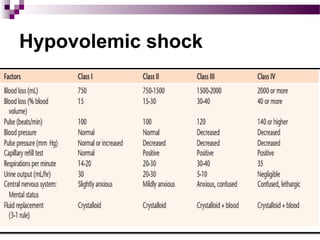
Hypovolemic shock
 Clinical feature :
Hypovolemic shock
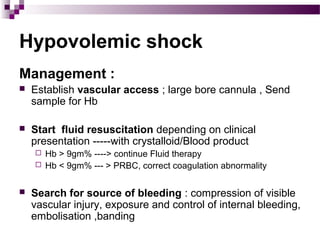
Management :
 Establish vascular access ; large bore cannula , Send
sample for Hb
 Start fluid resuscitation depending on clinical
presentation -----with crystalloid/Blood product
 Hb > 9gm% ----> continue Fluid therapy
 Hb < 9gm% --- > PRBC, correct coagulation abnormality
 Search for source of bleeding : compression of visible
vascular injury, exposure and control of internal bleeding,
embolisation ,banding
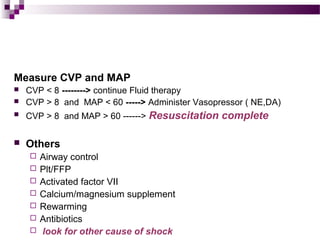
Measure CVP and MAP
 CVP < 8 --------> continue Fluid therapy
 CVP > 8 and MAP < 60 -----> Administer Vasopressor ( NE,DA)
 CVP > 8 and MAP > 60 ------> Resuscitation complete
 Others
 Airway control
 Plt/FFP
 Activated factor VII
 Calcium/magnesium supplement
 Rewarming
 Antibiotics
 look for other cause of shock
Distributive shock
e.g.
 Septic shock
 Anaphylactic shock
Septic shock
Surviving sepsis campaign 2012
Sepsis is defined as the presence of infection together with systemic
manifestations of infection.
Severe sepsis is defined as sepsis plus sepsis-induced organ
dysfunction or tissue hypo perfusion.
Sepsis-induced hypotension is defined as a systolic blood pressure
(SBP) < 90 mm Hg or mean arterial pressure (MAP) < 70 mm Hg or a SBP
decrease > 40 mm Hg or less than two standard deviations below normal
for age in the absence of other causes of hypotension
Septic shock
 Clinical feature
SBP< 90
MAP < 70
Feature of severe sepsis :
 Fever Hypothermia ,tachy,Tachypnea,Altered mental
status, Leukocytosis ,Leukopenia.
 With one or more organ involvement ( lung ,liver ,kidney )
Septic shock
Management
Goals during the first 6 hrs of resuscitation:
a) Central venous pressure 8–12 mm Hg
b) Mean arterial pressure (MAP) ≥ 65 mm Hg
c) Urine output ≥ 0.5 mL/kg/hr
d) Central venous (superior vena cava) or mixed venous
oxygen saturation 70% or 65%, respectively
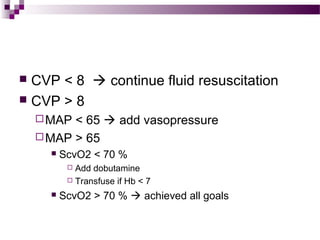
 CVP < 8  continue fluid resuscitation
 CVP > 8
MAP < 65  add vasopressure
MAP > 65
 ScvO2 < 70 %
 Add dobutamine
 Transfuse if Hb < 7
 ScvO2 > 70 %  achieved all goals
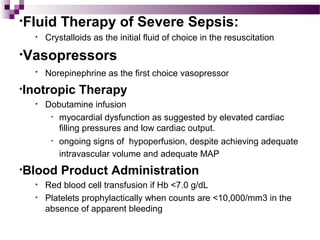
•Fluid Therapy of Severe Sepsis:
• Crystalloids as the initial fluid of choice in the resuscitation
•Vasopressors
• Norepinephrine as the first choice vasopressor
•Inotropic Therapy
• Dobutamine infusion
• myocardial dysfunction as suggested by elevated cardiac
filling pressures and low cardiac output.
• ongoing signs of hypoperfusion, despite achieving adequate
intravascular volume and adequate MAP
•Blood Product Administration
• Red blood cell transfusion if Hb <7.0 g/dL
• Platelets prophylactically when counts are <10,000/mm3 in the
absence of apparent bleeding
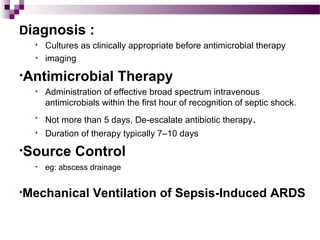
Diagnosis :
• Cultures as clinically appropriate before antimicrobial therapy
• imaging
•Antimicrobial Therapy
• Administration of effective broad spectrum intravenous
antimicrobials within the first hour of recognition of septic shock.
• Not more than 5 days, De-escalate antibiotic therapy.
• Duration of therapy typically 7–10 days
•Source Control
• eg: abscess drainage
•Mechanical Ventilation of Sepsis-Induced ARDS
Anaphylactic shock
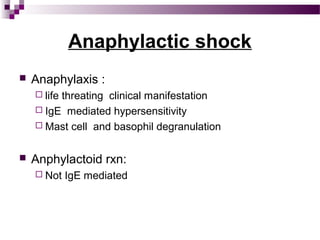
 Anaphylaxis :
 life threating clinical manifestation
 IgE mediated hypersensitivity
 Mast cell and basophil degranulation
 Anphylactoid rxn:
 Not IgE mediated
Anaphylactic shock
 Causes
 Anaphylaxis :
 Food( Nuts,egg etc)
 Antibiotics,vaccines blood n blood products,latex
 Anaphylactoid rxn
 NSAID
 Opiates
 Gamma globulin
 antisera
Anaphylactic shock
 Clinical manifestations :
 Eyes: conjuctival erthyrema, periorbital odema
 Skin: pruritus flushing urticaria angioedema
 CVS: hypotension, Tachy (Brady if severe), cardiac
arrest
 Resp: Dyspnea,wheezing,pulmonary odema
 GIT : Nausea/vomiting,Diarrohea, Abdo pain
Anaphylactic shock
 Suspected impending respiratory collapse ---->
intubate
 IM epinephrine 0.3-0.5 mg to ant/ lat thigh
 For severe symptoms poor response
 Iv bolus epinephrine 0.1-0.2 mg
 If hypotensive start fliud therapy
 if no response to above
 start iv epi infusion
 Aggressive fluid therapy
 Pt on beta blocker ----> Glucagon
 Treat all patients with Histamine 1,2 blocker
Diphenhydramine (H1)
Ranitidine (H2)
Cardiogenic shock
 Cardiogenic shock is related to ‘pump’
failure from many possible causes
 myocardial infarct ( common)
 valve dysfunction
 papillae rupture
 arrhythmias
 tamponade
 pulmonary embolus
Cardiogenic shock
 Clinical feature
SBP< 90
Sign of low cardiac output ( oliguria,poor
mental status , pulmonary odema )
 Adequate intravascular volume ( PAOP > 15
mmhg)
Cardiogenic shock
 Initial evaluation & rapid stabilization
 Immediate ECG:
 Look for evidence of AMI (ST ele , LBBB)
 Supplemental O2/mech vent
 BP support
 Dopamine
 Nor epi
Need CVP,Intra arterial blood pressure monitoring
Cardiogenic shock
 Patient with positive ECG finding :
 Immediate reperfusion therapy :
 Thrombolytic therapy
 Cardiac catheterization
 Negative ECG finding :
 Rule out mechanical cause of CS ( ECHO)
 Cardiac monitoring ( confirm cardiac etiology )
 Continued medical support (vasopressure, inotropic)
Cardiogenic shock
 In case of refractory cardiac shock
 Left venticular assist device
 Transplant
 Cradiac temponade :
 Beck’s triad ( raised jvp,muffled hreart sound,hypotension)
 Presence of pulsus paradox( insp fall in SBP>10)
 Echo finding
 Consider Subxiphoid Pericardiocentesis
Thank you

02 shock

  • 1.
    Shock Dr.Indubala Maurya MD,DNB AssistantProfessor Dept of Aanesthesia & Critical Care MGMCRI
  • 2.
    Introduction  Shock canbe defined as a state of inadequate or inappropriate tissue perfusion resulting in abnormal cellular metabolism.  Shock is associated with anaerobic metabolism, oxygen debt and tissue acidosis.
  • 3.
     Combination ofhemodynamic parameters:  MAP< 60  SBP<90  Clinical feature  Abnormal lab value ( lactate > 4 mmol/L)
  • 4.
    Types of shock Hypovolemic shock  Distributive Shock  Cardiogenic Shock
  • 5.
    Hypovolemic shock  Hypovolemicshock is related to decreased intravascular volume, secondary to loss of:  Blood (e.g. trauma)---- > Hemorrhagic shock  Plasma (e.g. burns)  Water and electrolytes (e.g. vomiting, diarrhoea).
  • 6.
  • 7.
    Hypovolemic shock Management : Establish vascular access ; large bore cannula , Send sample for Hb  Start fluid resuscitation depending on clinical presentation -----with crystalloid/Blood product  Hb > 9gm% ----> continue Fluid therapy  Hb < 9gm% --- > PRBC, correct coagulation abnormality  Search for source of bleeding : compression of visible vascular injury, exposure and control of internal bleeding, embolisation ,banding
  • 8.
    Measure CVP andMAP  CVP < 8 --------> continue Fluid therapy  CVP > 8 and MAP < 60 -----> Administer Vasopressor ( NE,DA)  CVP > 8 and MAP > 60 ------> Resuscitation complete  Others  Airway control  Plt/FFP  Activated factor VII  Calcium/magnesium supplement  Rewarming  Antibiotics  look for other cause of shock
  • 9.
    Distributive shock e.g.  Septicshock  Anaphylactic shock
  • 10.
    Septic shock Surviving sepsiscampaign 2012 Sepsis is defined as the presence of infection together with systemic manifestations of infection. Severe sepsis is defined as sepsis plus sepsis-induced organ dysfunction or tissue hypo perfusion. Sepsis-induced hypotension is defined as a systolic blood pressure (SBP) < 90 mm Hg or mean arterial pressure (MAP) < 70 mm Hg or a SBP decrease > 40 mm Hg or less than two standard deviations below normal for age in the absence of other causes of hypotension
  • 11.
    Septic shock  Clinicalfeature SBP< 90 MAP < 70 Feature of severe sepsis :  Fever Hypothermia ,tachy,Tachypnea,Altered mental status, Leukocytosis ,Leukopenia.  With one or more organ involvement ( lung ,liver ,kidney )
  • 12.
    Septic shock Management Goals duringthe first 6 hrs of resuscitation: a) Central venous pressure 8–12 mm Hg b) Mean arterial pressure (MAP) ≥ 65 mm Hg c) Urine output ≥ 0.5 mL/kg/hr d) Central venous (superior vena cava) or mixed venous oxygen saturation 70% or 65%, respectively
  • 13.
     CVP <8  continue fluid resuscitation  CVP > 8 MAP < 65  add vasopressure MAP > 65  ScvO2 < 70 %  Add dobutamine  Transfuse if Hb < 7  ScvO2 > 70 %  achieved all goals
  • 14.
    •Fluid Therapy ofSevere Sepsis: • Crystalloids as the initial fluid of choice in the resuscitation •Vasopressors • Norepinephrine as the first choice vasopressor •Inotropic Therapy • Dobutamine infusion • myocardial dysfunction as suggested by elevated cardiac filling pressures and low cardiac output. • ongoing signs of hypoperfusion, despite achieving adequate intravascular volume and adequate MAP •Blood Product Administration • Red blood cell transfusion if Hb <7.0 g/dL • Platelets prophylactically when counts are <10,000/mm3 in the absence of apparent bleeding
  • 15.
    Diagnosis : • Culturesas clinically appropriate before antimicrobial therapy • imaging •Antimicrobial Therapy • Administration of effective broad spectrum intravenous antimicrobials within the first hour of recognition of septic shock. • Not more than 5 days, De-escalate antibiotic therapy. • Duration of therapy typically 7–10 days •Source Control • eg: abscess drainage •Mechanical Ventilation of Sepsis-Induced ARDS
  • 16.
    Anaphylactic shock  Anaphylaxis:  life threating clinical manifestation  IgE mediated hypersensitivity  Mast cell and basophil degranulation  Anphylactoid rxn:  Not IgE mediated
  • 17.
    Anaphylactic shock  Causes Anaphylaxis :  Food( Nuts,egg etc)  Antibiotics,vaccines blood n blood products,latex  Anaphylactoid rxn  NSAID  Opiates  Gamma globulin  antisera
  • 18.
    Anaphylactic shock  Clinicalmanifestations :  Eyes: conjuctival erthyrema, periorbital odema  Skin: pruritus flushing urticaria angioedema  CVS: hypotension, Tachy (Brady if severe), cardiac arrest  Resp: Dyspnea,wheezing,pulmonary odema  GIT : Nausea/vomiting,Diarrohea, Abdo pain
  • 19.
    Anaphylactic shock  Suspectedimpending respiratory collapse ----> intubate  IM epinephrine 0.3-0.5 mg to ant/ lat thigh  For severe symptoms poor response  Iv bolus epinephrine 0.1-0.2 mg  If hypotensive start fliud therapy  if no response to above  start iv epi infusion  Aggressive fluid therapy  Pt on beta blocker ----> Glucagon
  • 20.
     Treat allpatients with Histamine 1,2 blocker Diphenhydramine (H1) Ranitidine (H2)
  • 21.
    Cardiogenic shock  Cardiogenicshock is related to ‘pump’ failure from many possible causes  myocardial infarct ( common)  valve dysfunction  papillae rupture  arrhythmias  tamponade  pulmonary embolus
  • 22.
    Cardiogenic shock  Clinicalfeature SBP< 90 Sign of low cardiac output ( oliguria,poor mental status , pulmonary odema )  Adequate intravascular volume ( PAOP > 15 mmhg)
  • 23.
    Cardiogenic shock  Initialevaluation & rapid stabilization  Immediate ECG:  Look for evidence of AMI (ST ele , LBBB)  Supplemental O2/mech vent  BP support  Dopamine  Nor epi Need CVP,Intra arterial blood pressure monitoring
  • 24.
    Cardiogenic shock  Patientwith positive ECG finding :  Immediate reperfusion therapy :  Thrombolytic therapy  Cardiac catheterization  Negative ECG finding :  Rule out mechanical cause of CS ( ECHO)  Cardiac monitoring ( confirm cardiac etiology )  Continued medical support (vasopressure, inotropic)
  • 25.
    Cardiogenic shock  Incase of refractory cardiac shock  Left venticular assist device  Transplant  Cradiac temponade :  Beck’s triad ( raised jvp,muffled hreart sound,hypotension)  Presence of pulsus paradox( insp fall in SBP>10)  Echo finding  Consider Subxiphoid Pericardiocentesis
  • 26.

Editor's Notes

  • #3 Shock can be defined as a state of inadequate cellular sustenance associated with inadequate or inappropriate tissue perfusion resulting in abnormal cellular metabolism. This can occur as a result of inadequate DO2, maldistribution of blood flow, a low perfusion pressure, or, as usually is the case, a combination of all three. Shock is associated with anaerobic metabolism, oxygen debt and tissue acidosis
  • #4 Clinical feature : poor MS, decresed urine out put, cold calmy skin, tachy ,
  • #5 There are many classifications of shock, some based on clinical entities and some on pathophysiology. This is somewhat unreal, as there is a large overlap between some of the groups, especially in their more severe forms and one or more processes may be involved simultaneously (Table 8.1). All forms of shock can eventually result in profound cellular dysfunction and death – so-called irreversible shock. Irreversibility is difficult to define and may depend on inappropriate management as much as on the clinical state. The following is a clinically useful initial approach to shock in association with the classical causes of shock (Table 8.1). The patient’s history is very important in determining the cause. Hypotension is often the first sign of shock. BP = cardiac output × systemic vascular resistance (SVR). Firstly, determine whether the problem is mainly one of decreased SVR or decreased cardiac output.
  • #11 Sepsis : Fever (&amp;gt; 38.3°C) Hypothermia (core temperature &amp;lt; 36°C) Heart rate &amp;gt; 90/min–1 or more than two sd above the normal value for age Tachypnea Altered mental status Leukocytosis (WBC count &amp;gt; 12,000 μL–1) Leukopenia severe sepsis : Organ dysfunction variables Arterial hypoxemia (Pao2/Fio2 &amp;lt; 300) Acute oliguria (urine output &amp;lt; 0.5 mL/kg/hr for at least 2 hrs despite adequate fluid resuscitation) Creatinine increase &amp;gt; 0.5 mg/dL or 44.2 μmol/L Coagulation abnormalities (INR &amp;gt; 1.5 or aPTT &amp;gt; 60 s) Ileus (absent bowel sounds) Thrombocytopenia (platelet count &amp;lt; 100,000 μL–1) Hyperbilirubinemia (plasma total bilirubin &amp;gt; 4 mg/dL or 70 μmol/L)
  • #20 Tell about ephinephine prepartion
  • #22 Inadeqaute circulation and comprimised organ perfusion due to cardiac dysfunction