Prin.K.M.Kundnani Pharmacy PolytechnicProf.Sunil Chavan
CELL
Cell=small chamber in jail
Diameter:2 microns – 120 microns
Average: 10-20microns
Shape: No general shape,
polyhedral or approximately box-
like shape
Shape related to function : RBC,
Muscle cell
Prof.Sunil Chavan Prin.K.M.Kundnani Pharmacy Polytechnic
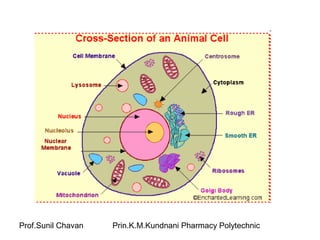
CELL
Prof.Sunil Chavan Prin.K.M.Kundnani Pharmacy Polytechnic
Prin.K.M.Kundnani Pharmacy PolytechnicProf.Sunil Chavan
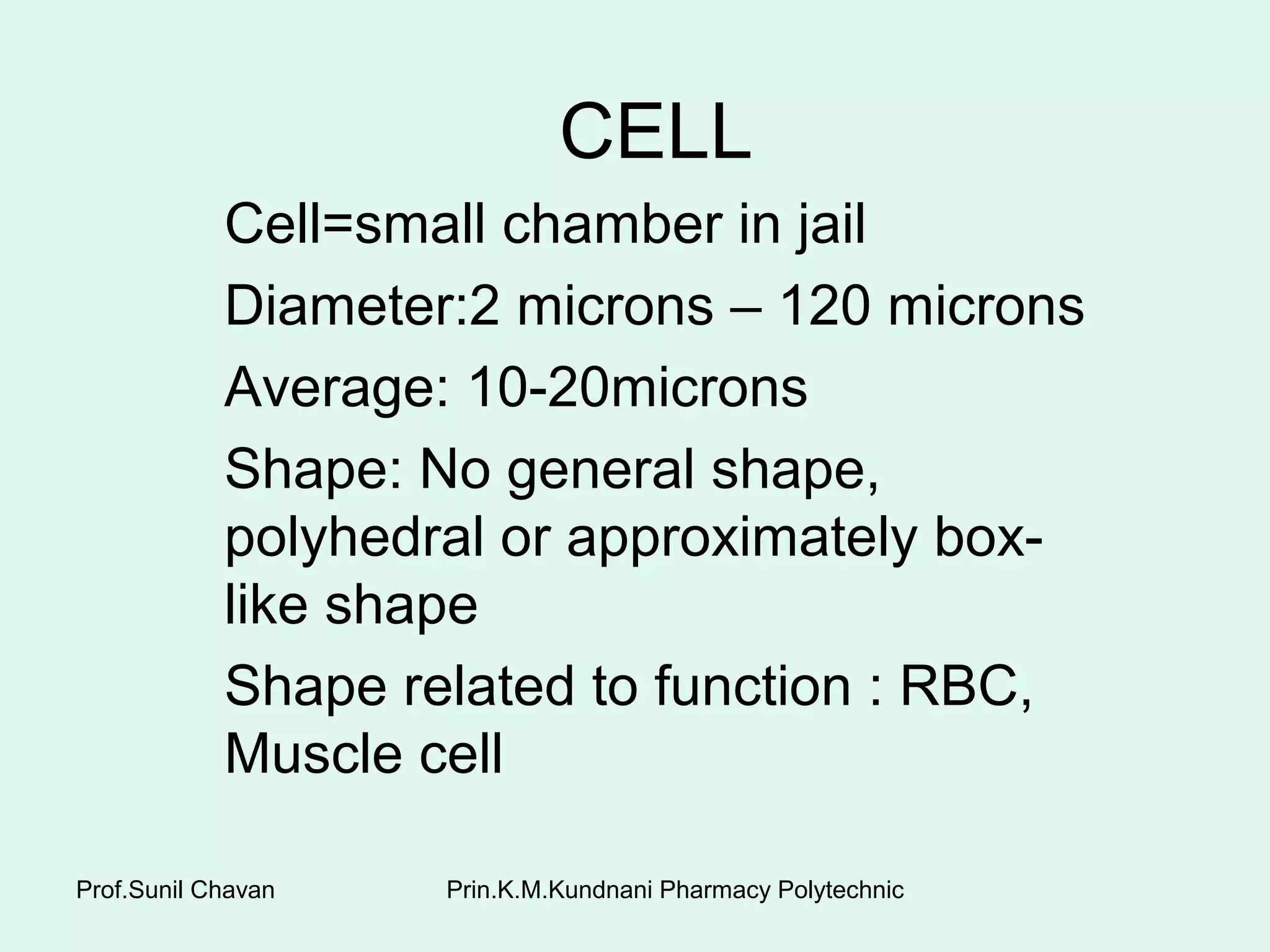
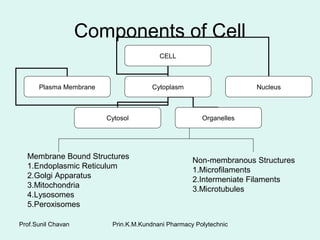
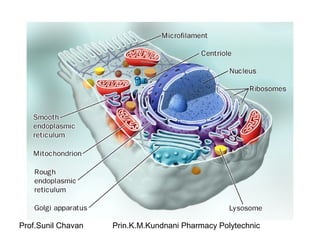
Components of Cell
Membrane Bound Structures
1.Endoplasmic Reticulum
2.Golgi Apparatus
3.Mitochondria
4.Lysosomes
5.Peroxisomes
Non-membranous Structures
1.Microfilaments
2.Intermeniate Filaments
3.Microtubules
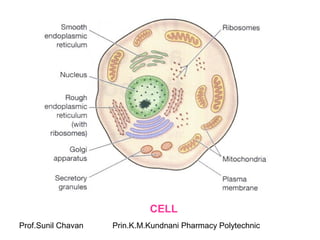
CELL
Plasma Membrane Cytoplasm Nucleus
Cytosol Organelles
Prin.K.M.Kundnani Pharmacy PolytechnicProf.Sunil Chavan
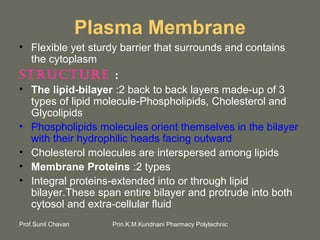
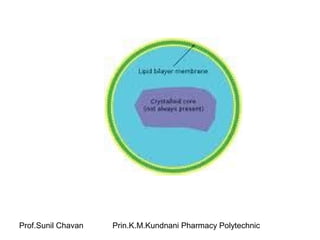
Plasma Membrane
• Flexible yet sturdy barrier that surrounds and contains
the cytoplasm
Structure :
• The lipid-bilayer :2 back to back layers made-up of 3
types of lipid molecule-Phospholipids, Cholesterol and
Glycolipids
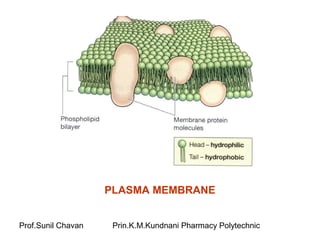
• Phospholipids molecules orient themselves in the bilayer
with their hydrophilic heads facing outward
• Cholesterol molecules are interspersed among lipids
• Membrane Proteins :2 types
• Integral proteins-extended into or through lipid
bilayer.These span entire bilayer and protrude into both
cytosol and extra-cellular fluid
Prof.Sunil Chavan Prin.K.M.Kundnani Pharmacy Polytechnic
PLASMA MEMBRANE
Prin.K.M.Kundnani Pharmacy PolytechnicProf.Sunil Chavan
• Peripheral proteins-associate more loosely with
membrane lipids or with integral proteins at inner or
outer surface of membrane
FunctionS:
1. Forms cell’s flexible but sturdy outer surface, give
definite shape
2. Separates cell’s internal environment from external
environment
3. Functions as selective barrier, that regulates the flow
of materials into and out of a cell
4. Plays key role in communication, both among cells and
between cells and their external environment
Prin.K.M.Kundnani Pharmacy PolytechnicProf.Sunil Chavan
Cytoplasm-consist of all cellular contents
between plasma membrane and the nucleus
Cytosol:
• Fluid portion that surrounds organelles
• Constitute about 55% of total cell volume
• Consists of 75-90% water and various dissolved
and suspended components. It includes
glucose, fatty acids, proteins, lipids ions, ATP
and waste products
• It is site of chemical reactions required for cell’s
existence e.g. Glycolysis
Prin.K.M.Kundnani Pharmacy PolytechnicProf.Sunil Chavan
Organelles-are specialized structures that have
characteristic shape and that performs specific function in
cellular growth, maintenance and reproduction.
CYTOSKELETON:
It is network of several different kinds of protein filaments
that extends throughout the cytosol
Functions:-1.Provides a structural framework for the cell
that helps to determine cell’s shape and to organise
cellular contents. 2.Aids movement of organelles within
cell, of chromosomes during cell division and whole cell
such as phagocytes.
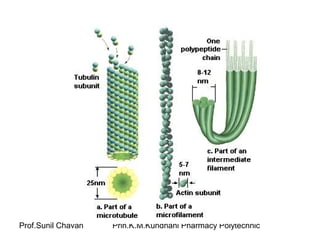
In order of increasing diameter of filamentous protein,
these are-Microfilaments, Intermediate filaments,
Microtubules
Prof.Sunil Chavan Prin.K.M.Kundnani Pharmacy Polytechnic
Prin.K.M.Kundnani Pharmacy PolytechnicProf.Sunil Chavan
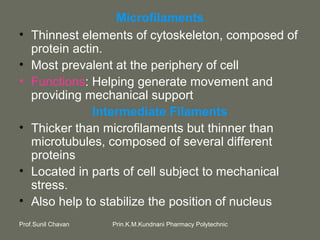
Microfilaments
• Thinnest elements of cytoskeleton, composed of
protein actin.
• Most prevalent at the periphery of cell
• Functions: Helping generate movement and
providing mechanical support
Intermediate Filaments
• Thicker than microfilaments but thinner than
microtubules, composed of several different
proteins
• Located in parts of cell subject to mechanical
stress.
• Also help to stabilize the position of nucleus
Prin.K.M.Kundnani Pharmacy PolytechnicProf.Sunil Chavan
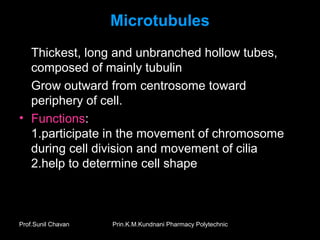
Microtubules
• Thickest, long and unbranched hollow tubes,
composed of mainly tubulin
• Grow outward from centrosome toward
periphery of cell.
• Functions:
1.participate in the movement of chromosome
during cell division and movement of cilia
2.help to determine cell shape
Prin.K.M.Kundnani Pharmacy PolytechnicProf.Sunil Chavan
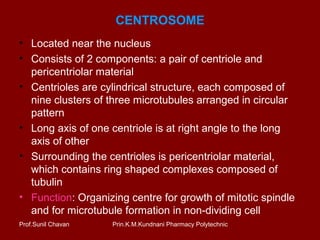
CENTROSOME
• Located near the nucleus
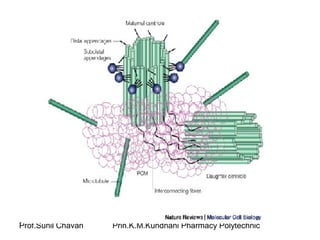
• Consists of 2 components: a pair of centriole and
pericentriolar material
• Centrioles are cylindrical structure, each composed of
nine clusters of three microtubules arranged in circular
pattern
• Long axis of one centriole is at right angle to the long
axis of other
• Surrounding the centrioles is pericentriolar material,
which contains ring shaped complexes composed of
tubulin
• Function: Organizing centre for growth of mitotic spindle
and for microtubule formation in non-dividing cell
Prof.Sunil Chavan Prin.K.M.Kundnani Pharmacy Polytechnic
Prin.K.M.Kundnani Pharmacy PolytechnicProf.Sunil Chavan
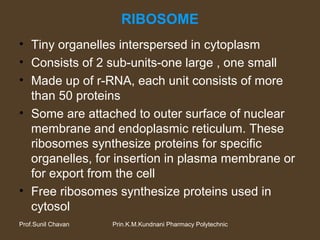
RIBOSOME
• Tiny organelles interspersed in cytoplasm
• Consists of 2 sub-units-one large , one small
• Made up of r-RNA, each unit consists of more
than 50 proteins
• Some are attached to outer surface of nuclear
membrane and endoplasmic reticulum. These
ribosomes synthesize proteins for specific
organelles, for insertion in plasma membrane or
for export from the cell
• Free ribosomes synthesize proteins used in
cytosol
Prin.K.M.Kundnani Pharmacy PolytechnicProf.Sunil Chavan
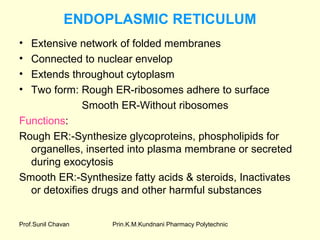
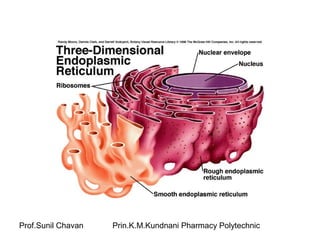
ENDOPLASMIC RETICULUM
• Extensive network of folded membranes
• Connected to nuclear envelop
• Extends throughout cytoplasm
• Two form: Rough ER-ribosomes adhere to surface
Smooth ER-Without ribosomes
Functions:
Rough ER:-Synthesize glycoproteins, phospholipids for
organelles, inserted into plasma membrane or secreted
during exocytosis
Smooth ER:-Synthesize fatty acids & steroids, Inactivates
or detoxifies drugs and other harmful substances
Prof.Sunil Chavan Prin.K.M.Kundnani Pharmacy Polytechnic
Prin.K.M.Kundnani Pharmacy PolytechnicProf.Sunil Chavan
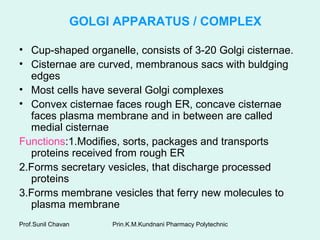
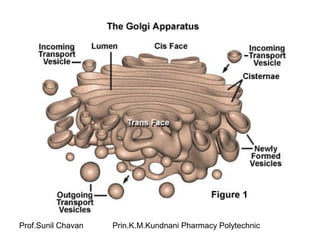
GOLGI APPARATUS / COMPLEX
• Cup-shaped organelle, consists of 3-20 Golgi cisternae.
• Cisternae are curved, membranous sacs with buldging
edges
• Most cells have several Golgi complexes
• Convex cisternae faces rough ER, concave cisternae
faces plasma membrane and in between are called
medial cisternae
Functions:1.Modifies, sorts, packages and transports
proteins received from rough ER
2.Forms secretary vesicles, that discharge processed
proteins
3.Forms membrane vesicles that ferry new molecules to
plasma membrane
Prof.Sunil Chavan Prin.K.M.Kundnani Pharmacy Polytechnic
Prin.K.M.Kundnani Pharmacy PolytechnicProf.Sunil Chavan
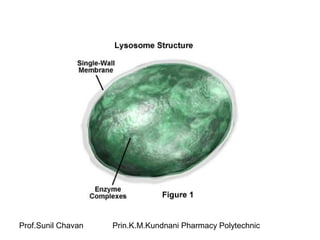
LYSOSOMES
 Membrane enclosed vesicles formed from Golgi complex
 Contains around 60 kinds of digestive & hydrolytic
enzymes
A cell may contain several hundred lysosomes
Functions:
 Digestion of substances that enter a cell via endocytosis
and transport final products of digestion into cytosol
 Digestion of worn-out organelles (autophagy)
 Digestion of entire cell in pathological conditions
 Carry out extra-cellular digestion during fertilzation
Prof.Sunil Chavan Prin.K.M.Kundnani Pharmacy Polytechnic
PEROXISOMES
• Smaller vesicles than lysosomes
• Contain several oxidases
• Abundant in liver cells
Functions:
• Metabolism-oxidation of amino acid and
fatty acids
• Oxidation of toxic substances e.g. alcohol
• Protects other parts of cell from action of
hydrogen peroxide
Prof.Sunil Chavan Prin.K.M.Kundnani Pharmacy Polytechnic
Prin.K.M.Kundnani Pharmacy PolytechnicProf.Sunil Chavan
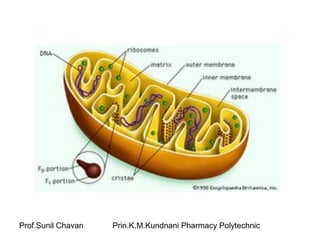
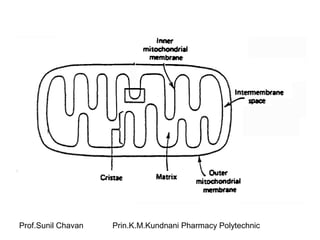
MITOCHONDRIA
 Rod or oval shaped organelles
 Usually located in the cell where energy need is
greatest
 Consists of outer and inner mitochondrial membrane
with small fluid filled space between them
 Inner membrane is folded into tubules-cristae
 Large central fluid filled cavity-matrix
Function:
Generation of ATP through the reactions of aerobic
cellular respiration
Prof.Sunil Chavan Prin.K.M.Kundnani Pharmacy Polytechnic
Prin.K.M.Kundnani Pharmacy PolytechnicProf.Sunil Chavan
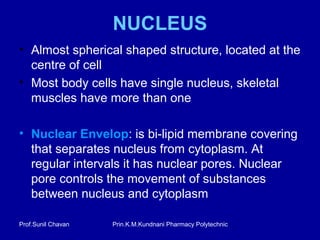
NUCLEUS
• Almost spherical shaped structure, located at the
centre of cell
• Most body cells have single nucleus, skeletal
muscles have more than one
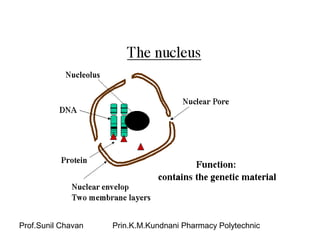
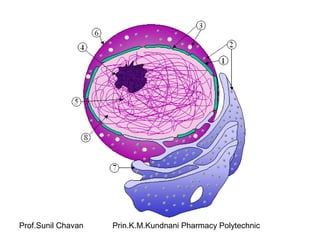
• Nuclear Envelop: is bi-lipid membrane covering
that separates nucleus from cytoplasm. At
regular intervals it has nuclear pores. Nuclear
pore controls the movement of substances
between nucleus and cytoplasm
Prof.Sunil Chavan Prin.K.M.Kundnani Pharmacy Polytechnic
Prin.K.M.Kundnani Pharmacy PolytechnicProf.Sunil Chavan
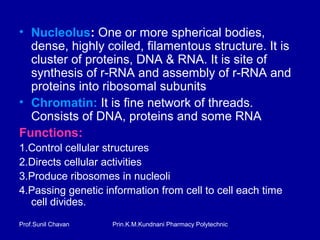
• Nucleolus: One or more spherical bodies,
dense, highly coiled, filamentous structure. It is
cluster of proteins, DNA & RNA. It is site of
synthesis of r-RNA and assembly of r-RNA and
proteins into ribosomal subunits
• Chromatin: It is fine network of threads.
Consists of DNA, proteins and some RNA
Functions:
1.Control cellular structures
2.Directs cellular activities
3.Produce ribosomes in nucleoli
4.Passing genetic information from cell to cell each time
cell divides.
Prof.Sunil Chavan Prin.K.M.Kundnani Pharmacy Polytechnic

02 cell

  • 1.
    Prin.K.M.Kundnani Pharmacy PolytechnicProf.SunilChavan CELL Cell=small chamber in jail Diameter:2 microns – 120 microns Average: 10-20microns Shape: No general shape, polyhedral or approximately box- like shape Shape related to function : RBC, Muscle cell
  • 2.
  • 3.
    Prof.Sunil Chavan Prin.K.M.KundnaniPharmacy Polytechnic CELL
  • 4.
  • 5.
    Prin.K.M.Kundnani Pharmacy PolytechnicProf.SunilChavan Components of Cell Membrane Bound Structures 1.Endoplasmic Reticulum 2.Golgi Apparatus 3.Mitochondria 4.Lysosomes 5.Peroxisomes Non-membranous Structures 1.Microfilaments 2.Intermeniate Filaments 3.Microtubules CELL Plasma Membrane Cytoplasm Nucleus Cytosol Organelles
  • 6.
    Prin.K.M.Kundnani Pharmacy PolytechnicProf.SunilChavan Plasma Membrane • Flexible yet sturdy barrier that surrounds and contains the cytoplasm Structure : • The lipid-bilayer :2 back to back layers made-up of 3 types of lipid molecule-Phospholipids, Cholesterol and Glycolipids • Phospholipids molecules orient themselves in the bilayer with their hydrophilic heads facing outward • Cholesterol molecules are interspersed among lipids • Membrane Proteins :2 types • Integral proteins-extended into or through lipid bilayer.These span entire bilayer and protrude into both cytosol and extra-cellular fluid
  • 7.
    Prof.Sunil Chavan Prin.K.M.KundnaniPharmacy Polytechnic PLASMA MEMBRANE
  • 8.
    Prin.K.M.Kundnani Pharmacy PolytechnicProf.SunilChavan • Peripheral proteins-associate more loosely with membrane lipids or with integral proteins at inner or outer surface of membrane FunctionS: 1. Forms cell’s flexible but sturdy outer surface, give definite shape 2. Separates cell’s internal environment from external environment 3. Functions as selective barrier, that regulates the flow of materials into and out of a cell 4. Plays key role in communication, both among cells and between cells and their external environment
  • 9.
    Prin.K.M.Kundnani Pharmacy PolytechnicProf.SunilChavan Cytoplasm-consist of all cellular contents between plasma membrane and the nucleus Cytosol: • Fluid portion that surrounds organelles • Constitute about 55% of total cell volume • Consists of 75-90% water and various dissolved and suspended components. It includes glucose, fatty acids, proteins, lipids ions, ATP and waste products • It is site of chemical reactions required for cell’s existence e.g. Glycolysis
  • 10.
    Prin.K.M.Kundnani Pharmacy PolytechnicProf.SunilChavan Organelles-are specialized structures that have characteristic shape and that performs specific function in cellular growth, maintenance and reproduction. CYTOSKELETON: It is network of several different kinds of protein filaments that extends throughout the cytosol Functions:-1.Provides a structural framework for the cell that helps to determine cell’s shape and to organise cellular contents. 2.Aids movement of organelles within cell, of chromosomes during cell division and whole cell such as phagocytes. In order of increasing diameter of filamentous protein, these are-Microfilaments, Intermediate filaments, Microtubules
  • 11.
  • 12.
    Prin.K.M.Kundnani Pharmacy PolytechnicProf.SunilChavan Microfilaments • Thinnest elements of cytoskeleton, composed of protein actin. • Most prevalent at the periphery of cell • Functions: Helping generate movement and providing mechanical support Intermediate Filaments • Thicker than microfilaments but thinner than microtubules, composed of several different proteins • Located in parts of cell subject to mechanical stress. • Also help to stabilize the position of nucleus
  • 13.
    Prin.K.M.Kundnani Pharmacy PolytechnicProf.SunilChavan Microtubules • Thickest, long and unbranched hollow tubes, composed of mainly tubulin • Grow outward from centrosome toward periphery of cell. • Functions: 1.participate in the movement of chromosome during cell division and movement of cilia 2.help to determine cell shape
  • 14.
    Prin.K.M.Kundnani Pharmacy PolytechnicProf.SunilChavan CENTROSOME • Located near the nucleus • Consists of 2 components: a pair of centriole and pericentriolar material • Centrioles are cylindrical structure, each composed of nine clusters of three microtubules arranged in circular pattern • Long axis of one centriole is at right angle to the long axis of other • Surrounding the centrioles is pericentriolar material, which contains ring shaped complexes composed of tubulin • Function: Organizing centre for growth of mitotic spindle and for microtubule formation in non-dividing cell
  • 15.
  • 16.
    Prin.K.M.Kundnani Pharmacy PolytechnicProf.SunilChavan RIBOSOME • Tiny organelles interspersed in cytoplasm • Consists of 2 sub-units-one large , one small • Made up of r-RNA, each unit consists of more than 50 proteins • Some are attached to outer surface of nuclear membrane and endoplasmic reticulum. These ribosomes synthesize proteins for specific organelles, for insertion in plasma membrane or for export from the cell • Free ribosomes synthesize proteins used in cytosol
  • 17.
    Prin.K.M.Kundnani Pharmacy PolytechnicProf.SunilChavan ENDOPLASMIC RETICULUM • Extensive network of folded membranes • Connected to nuclear envelop • Extends throughout cytoplasm • Two form: Rough ER-ribosomes adhere to surface Smooth ER-Without ribosomes Functions: Rough ER:-Synthesize glycoproteins, phospholipids for organelles, inserted into plasma membrane or secreted during exocytosis Smooth ER:-Synthesize fatty acids & steroids, Inactivates or detoxifies drugs and other harmful substances
  • 18.
  • 19.
    Prin.K.M.Kundnani Pharmacy PolytechnicProf.SunilChavan GOLGI APPARATUS / COMPLEX • Cup-shaped organelle, consists of 3-20 Golgi cisternae. • Cisternae are curved, membranous sacs with buldging edges • Most cells have several Golgi complexes • Convex cisternae faces rough ER, concave cisternae faces plasma membrane and in between are called medial cisternae Functions:1.Modifies, sorts, packages and transports proteins received from rough ER 2.Forms secretary vesicles, that discharge processed proteins 3.Forms membrane vesicles that ferry new molecules to plasma membrane
  • 20.
  • 21.
    Prin.K.M.Kundnani Pharmacy PolytechnicProf.SunilChavan LYSOSOMES  Membrane enclosed vesicles formed from Golgi complex  Contains around 60 kinds of digestive & hydrolytic enzymes A cell may contain several hundred lysosomes Functions:  Digestion of substances that enter a cell via endocytosis and transport final products of digestion into cytosol  Digestion of worn-out organelles (autophagy)  Digestion of entire cell in pathological conditions  Carry out extra-cellular digestion during fertilzation
  • 22.
  • 23.
    Prof.Sunil Chavan Prin.K.M.KundnaniPharmacy Polytechnic PEROXISOMES • Smaller vesicles than lysosomes • Contain several oxidases • Abundant in liver cells Functions: • Metabolism-oxidation of amino acid and fatty acids • Oxidation of toxic substances e.g. alcohol • Protects other parts of cell from action of hydrogen peroxide
  • 24.
  • 25.
    Prin.K.M.Kundnani Pharmacy PolytechnicProf.SunilChavan MITOCHONDRIA  Rod or oval shaped organelles  Usually located in the cell where energy need is greatest  Consists of outer and inner mitochondrial membrane with small fluid filled space between them  Inner membrane is folded into tubules-cristae  Large central fluid filled cavity-matrix Function: Generation of ATP through the reactions of aerobic cellular respiration
  • 26.
  • 27.
  • 28.
    Prin.K.M.Kundnani Pharmacy PolytechnicProf.SunilChavan NUCLEUS • Almost spherical shaped structure, located at the centre of cell • Most body cells have single nucleus, skeletal muscles have more than one • Nuclear Envelop: is bi-lipid membrane covering that separates nucleus from cytoplasm. At regular intervals it has nuclear pores. Nuclear pore controls the movement of substances between nucleus and cytoplasm
  • 29.
  • 30.
  • 31.
    Prin.K.M.Kundnani Pharmacy PolytechnicProf.SunilChavan • Nucleolus: One or more spherical bodies, dense, highly coiled, filamentous structure. It is cluster of proteins, DNA & RNA. It is site of synthesis of r-RNA and assembly of r-RNA and proteins into ribosomal subunits • Chromatin: It is fine network of threads. Consists of DNA, proteins and some RNA Functions: 1.Control cellular structures 2.Directs cellular activities 3.Produce ribosomes in nucleoli 4.Passing genetic information from cell to cell each time cell divides.
  • 32.
  • 33.