Sets
o A set is an unordered collection of objects.
o The objects in a set are called the elements or members of
the set S, and we say S contains its elements.
o Sets can be defined by listing their elements
e.g. S = {2, 3, 5, 7, 11, 13, 17, 19},
S = {CS1202, CS542, ERG2020, MAT141}
Sets
o Examples of discrete structures built with the help of sets:
o Counting
o Combinations
o Relations
o Graphs
Representing Sets by Properties
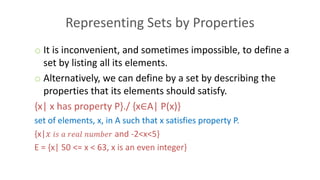
o It is inconvenient, and sometimes impossible, to define a
set by listing all its elements.
o Alternatively, we can define by a set by describing the
properties that its elements should satisfy.
{x| x has property P}./ {x∈A| P(x)}
set of elements, x, in A such that x satisfies property P.
{x|𝑥 𝑖𝑠 𝑎 𝑟𝑒𝑎𝑙 𝑛𝑢𝑚𝑏𝑒𝑟 and -2<x<5}
E = {x| 50 <= x < 63, x is an even integer}
Alternative Way of Defining Sets
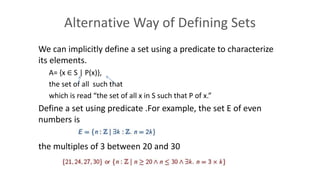
We can implicitly define a set using a predicate to characterize
its elements.
A= {x ∈ S | P(x)},
the set of all such that
which is read “the set of all x in S such that P of x.”
Define a set using predicate .For example, the set E of even
numbers is
the multiples of 3 between 20 and 30
Sets
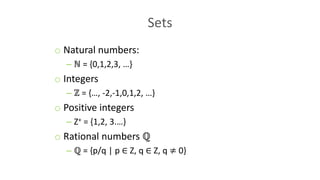
o Natural numbers:
– ℕ = {0,1,2,3, …}
o Integers
– ℤ = {…, -2,-1,0,1,2, …}
o Positive integers
– Z+ = {1,2, 3.…}
o Rational numbers ℚ
– ℚ = {p/q | p ∈ Z, q ∈ Z, q ≠ 0}
Set
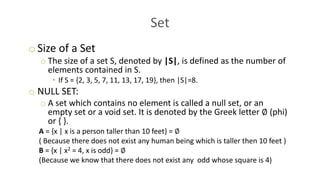
o Size of a Set
o The size of a set S, denoted by |S|, is defined as the number of
elements contained in S.
• If S = {2, 3, 5, 7, 11, 13, 17, 19}, then |S|=8.
o NULL SET:
o A set which contains no element is called a null set, or an
empty set or a void set. It is denoted by the Greek letter ∅ (phi)
or { }.
A = {x | x is a person taller than 10 feet} = ∅
( Because there does not exist any human being which is taller then 10 feet )
B = {x | x2 = 4, x is odd} = ∅
(Because we know that there does not exist any odd whose square is 4)
Set
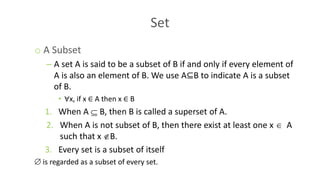
o A Subset
– A set A is said to be a subset of B if and only if every element of
A is also an element of B. We use A⊆B to indicate A is a subset
of B.
• ∀x, if x ∈ A then x ∈ B
1. When A  B, then B is called a superset of A.
2. When A is not subset of B, then there exist at least one x  A
such that x B.
3. Every set is a subset of itself
 is regarded as a subset of every set.
Set
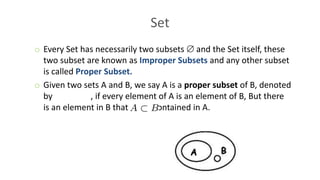
o Every Set has necessarily two subsets  and the Set itself, these
two subset are known as Improper Subsets and any other subset
is called Proper Subset.
o Given two sets A and B, we say A is a proper subset of B, denoted
by , if every element of A is an element of B, But there
is an element in B that is not contained in A.
Set Equality
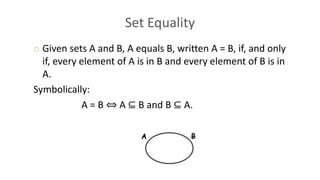
o Given sets A and B, A equals B, written A = B, if, and only
if, every element of A is in B and every element of B is in
A.
Symbolically:
A = B ⇔ A ⊆ B and B ⊆ A.
Set Equality
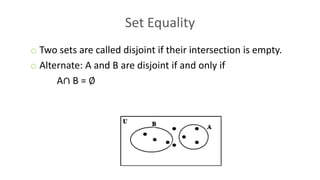
o Two sets are called disjoint if their intersection is empty.
o Alternate: A and B are disjoint if and only if
A∩ B = ∅
Defining Sets
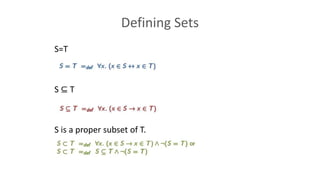
S=T
S ⊆ T
S is a proper subset of T.
Set
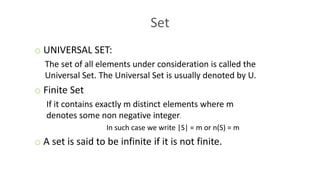
o UNIVERSAL SET:
The set of all elements under consideration is called the
Universal Set. The Universal Set is usually denoted by U.
o Finite Set
If it contains exactly m distinct elements where m
denotes some non negative integer.
In such case we write |S| = m or n(S) = m
o A set is said to be infinite if it is not finite.
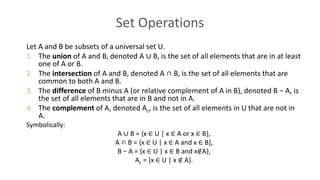
Set Operations
Let A and B be subsets of a universal set U.
1. The union of A and B, denoted A ∪ B, is the set of all elements that are in at least
one of A or B.
2. The intersection of A and B, denoted A ∩ B, is the set of all elements that are
common to both A and B.
3. The difference of B minus A (or relative complement of A in B), denoted B − A, is
the set of all elements that are in B and not in A.
4. The complement of A, denoted Ac, is the set of all elements in U that are not in
A.
Symbolically:
A ∪ B = {x ∈ U | x ∈ A or x ∈ B},
A ∩ B = {x ∈ U | x ∈ A and x ∈ B},
B − A = {x ∈ U | x ∈ B and x∉A},
Ac = {x ∈ U | x ∉ A}.
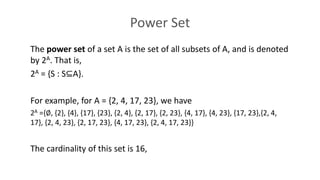
Power Set
The power set of a set A is the set of all subsets of A, and is denoted
by 2A. That is,
2A = {S : S⊆A}.
For example, for A = {2, 4, 17, 23}, we have
2A ={∅, {2}, {4}, {17}, {23}, {2, 4}, {2, 17}, {2, 23}, {4, 17}, {4, 23}, {17, 23},{2, 4,
17}, {2, 4, 23}, {2, 17, 23}, {4, 17, 23}, {2, 4, 17, 23}}
The cardinality of this set is 16,
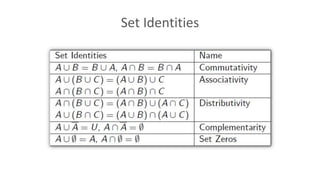
Set Identities
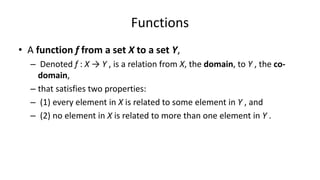
Functions
• A function f from a set X to a set Y,
– Denoted f : X → Y , is a relation from X, the domain, to Y , the co-
domain,
– that satisfies two properties:
– (1) every element in X is related to some element in Y , and
– (2) no element in X is related to more than one element in Y .
Functions
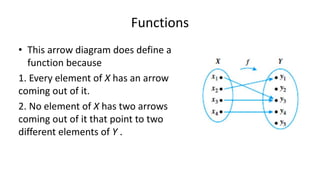
• This arrow diagram does define a
function because
1. Every element of X has an arrow
coming out of it.
2. No element of X has two arrows
coming out of it that point to two
different elements of Y .
One-to-One Functions
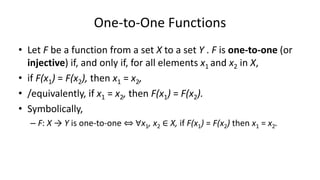
• Let F be a function from a set X to a set Y . F is one-to-one (or
injective) if, and only if, for all elements x1 and x2 in X,
• if F(x1) = F(x2), then x1 = x2,
• /equivalently, if x1 = x2, then F(x1) = F(x2).
• Symbolically,
– F: X → Y is one-to-one ⇔ ∀x1, x2 ∈ X, if F(x1) = F(x2) then x1 = x2.
On-to Functions
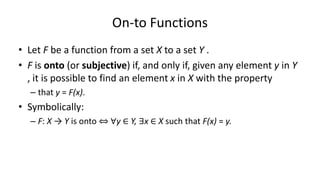
• Let F be a function from a set X to a set Y .
• F is onto (or subjective) if, and only if, given any element y in Y
, it is possible to find an element x in X with the property
– that y = F(x).
• Symbolically:
– F: X → Y is onto ⇔ ∀y ∈ Y, ∃x ∈ X such that F(x) = y.
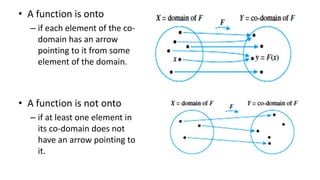
• A function is onto
– if each element of the co-
domain has an arrow
pointing to it from some
element of the domain.
• A function is not onto
– if at least one element in
its co-domain does not
have an arrow pointing to
it.

Sets

  • 2.
    Sets o A setis an unordered collection of objects. o The objects in a set are called the elements or members of the set S, and we say S contains its elements. o Sets can be defined by listing their elements e.g. S = {2, 3, 5, 7, 11, 13, 17, 19}, S = {CS1202, CS542, ERG2020, MAT141}
  • 3.
    Sets o Examples ofdiscrete structures built with the help of sets: o Counting o Combinations o Relations o Graphs
  • 4.
    Representing Sets byProperties o It is inconvenient, and sometimes impossible, to define a set by listing all its elements. o Alternatively, we can define by a set by describing the properties that its elements should satisfy. {x| x has property P}./ {x∈A| P(x)} set of elements, x, in A such that x satisfies property P. {x|𝑥 𝑖𝑠 𝑎 𝑟𝑒𝑎𝑙 𝑛𝑢𝑚𝑏𝑒𝑟 and -2<x<5} E = {x| 50 <= x < 63, x is an even integer}
  • 5.
    Alternative Way ofDefining Sets We can implicitly define a set using a predicate to characterize its elements. A= {x ∈ S | P(x)}, the set of all such that which is read “the set of all x in S such that P of x.” Define a set using predicate .For example, the set E of even numbers is the multiples of 3 between 20 and 30
  • 6.
    Sets o Natural numbers: –ℕ = {0,1,2,3, …} o Integers – ℤ = {…, -2,-1,0,1,2, …} o Positive integers – Z+ = {1,2, 3.…} o Rational numbers ℚ – ℚ = {p/q | p ∈ Z, q ∈ Z, q ≠ 0}
  • 7.
    Set o Size ofa Set o The size of a set S, denoted by |S|, is defined as the number of elements contained in S. • If S = {2, 3, 5, 7, 11, 13, 17, 19}, then |S|=8. o NULL SET: o A set which contains no element is called a null set, or an empty set or a void set. It is denoted by the Greek letter ∅ (phi) or { }. A = {x | x is a person taller than 10 feet} = ∅ ( Because there does not exist any human being which is taller then 10 feet ) B = {x | x2 = 4, x is odd} = ∅ (Because we know that there does not exist any odd whose square is 4)
  • 8.
    Set o A Subset –A set A is said to be a subset of B if and only if every element of A is also an element of B. We use A⊆B to indicate A is a subset of B. • ∀x, if x ∈ A then x ∈ B 1. When A  B, then B is called a superset of A. 2. When A is not subset of B, then there exist at least one x  A such that x B. 3. Every set is a subset of itself  is regarded as a subset of every set.
  • 9.
    Set o Every Sethas necessarily two subsets  and the Set itself, these two subset are known as Improper Subsets and any other subset is called Proper Subset. o Given two sets A and B, we say A is a proper subset of B, denoted by , if every element of A is an element of B, But there is an element in B that is not contained in A.
  • 10.
    Set Equality o Givensets A and B, A equals B, written A = B, if, and only if, every element of A is in B and every element of B is in A. Symbolically: A = B ⇔ A ⊆ B and B ⊆ A.
  • 11.
    Set Equality o Twosets are called disjoint if their intersection is empty. o Alternate: A and B are disjoint if and only if A∩ B = ∅
  • 12.
    Defining Sets S=T S ⊆T S is a proper subset of T.
  • 13.
    Set o UNIVERSAL SET: Theset of all elements under consideration is called the Universal Set. The Universal Set is usually denoted by U. o Finite Set If it contains exactly m distinct elements where m denotes some non negative integer. In such case we write |S| = m or n(S) = m o A set is said to be infinite if it is not finite.
  • 14.
    Set Operations Let Aand B be subsets of a universal set U. 1. The union of A and B, denoted A ∪ B, is the set of all elements that are in at least one of A or B. 2. The intersection of A and B, denoted A ∩ B, is the set of all elements that are common to both A and B. 3. The difference of B minus A (or relative complement of A in B), denoted B − A, is the set of all elements that are in B and not in A. 4. The complement of A, denoted Ac, is the set of all elements in U that are not in A. Symbolically: A ∪ B = {x ∈ U | x ∈ A or x ∈ B}, A ∩ B = {x ∈ U | x ∈ A and x ∈ B}, B − A = {x ∈ U | x ∈ B and x∉A}, Ac = {x ∈ U | x ∉ A}.
  • 15.
    Power Set The powerset of a set A is the set of all subsets of A, and is denoted by 2A. That is, 2A = {S : S⊆A}. For example, for A = {2, 4, 17, 23}, we have 2A ={∅, {2}, {4}, {17}, {23}, {2, 4}, {2, 17}, {2, 23}, {4, 17}, {4, 23}, {17, 23},{2, 4, 17}, {2, 4, 23}, {2, 17, 23}, {4, 17, 23}, {2, 4, 17, 23}} The cardinality of this set is 16,
  • 16.
  • 17.
    Functions • A functionf from a set X to a set Y, – Denoted f : X → Y , is a relation from X, the domain, to Y , the co- domain, – that satisfies two properties: – (1) every element in X is related to some element in Y , and – (2) no element in X is related to more than one element in Y .
  • 18.
    Functions • This arrowdiagram does define a function because 1. Every element of X has an arrow coming out of it. 2. No element of X has two arrows coming out of it that point to two different elements of Y .
  • 19.
    One-to-One Functions • LetF be a function from a set X to a set Y . F is one-to-one (or injective) if, and only if, for all elements x1 and x2 in X, • if F(x1) = F(x2), then x1 = x2, • /equivalently, if x1 = x2, then F(x1) = F(x2). • Symbolically, – F: X → Y is one-to-one ⇔ ∀x1, x2 ∈ X, if F(x1) = F(x2) then x1 = x2.
  • 20.
    On-to Functions • LetF be a function from a set X to a set Y . • F is onto (or subjective) if, and only if, given any element y in Y , it is possible to find an element x in X with the property – that y = F(x). • Symbolically: – F: X → Y is onto ⇔ ∀y ∈ Y, ∃x ∈ X such that F(x) = y.
  • 21.
    • A functionis onto – if each element of the co- domain has an arrow pointing to it from some element of the domain. • A function is not onto – if at least one element in its co-domain does not have an arrow pointing to it.