Definition of Language
•Language is a systematic way of
communication with other people
use of sounds or conventions
symbols.
4.
Importance of Language
•Language was invented to communicate
ideas to others.
• The language if mathematics was
designed:
Numbers
Sets
Functions
Perform operations
5.
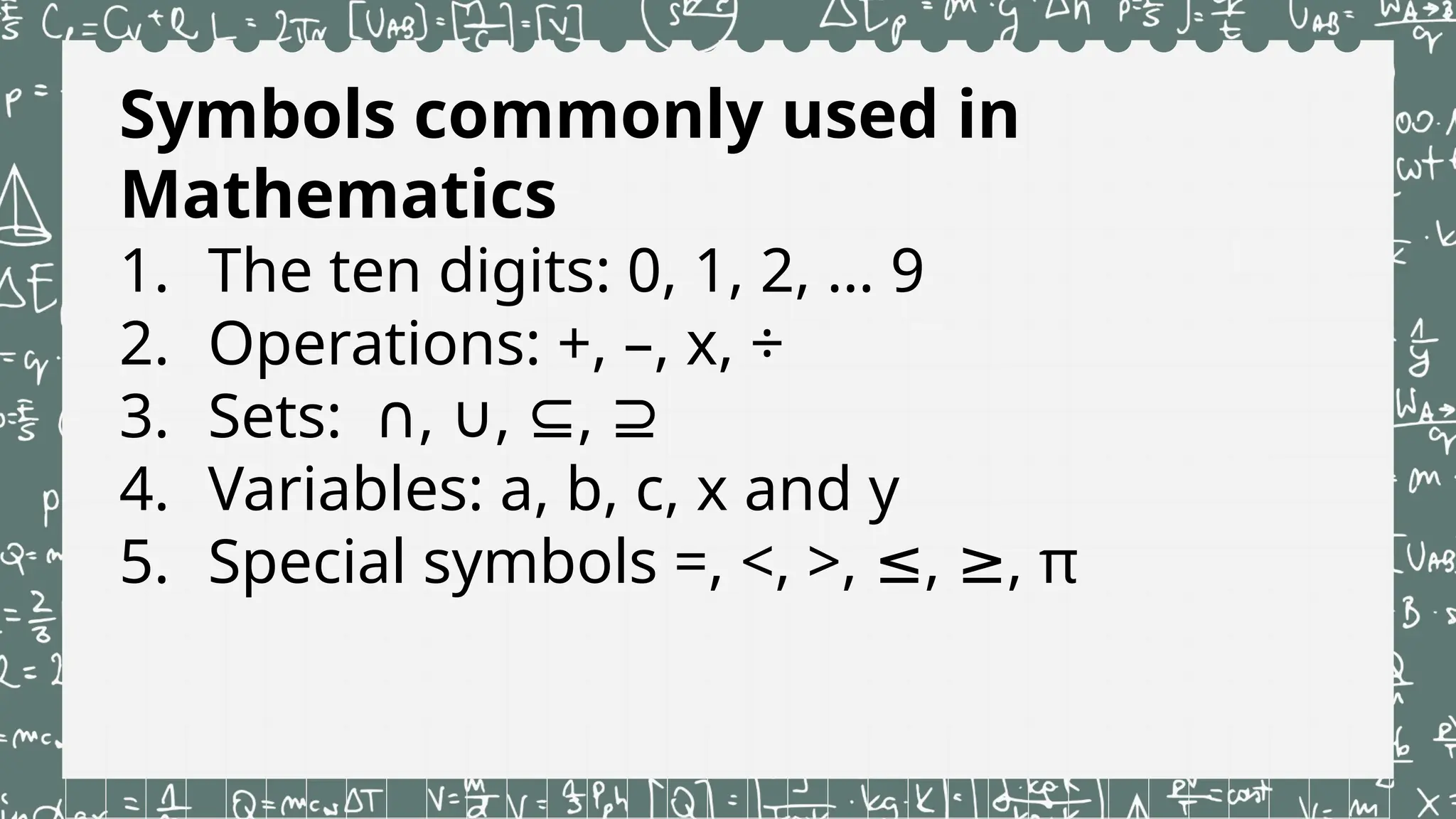
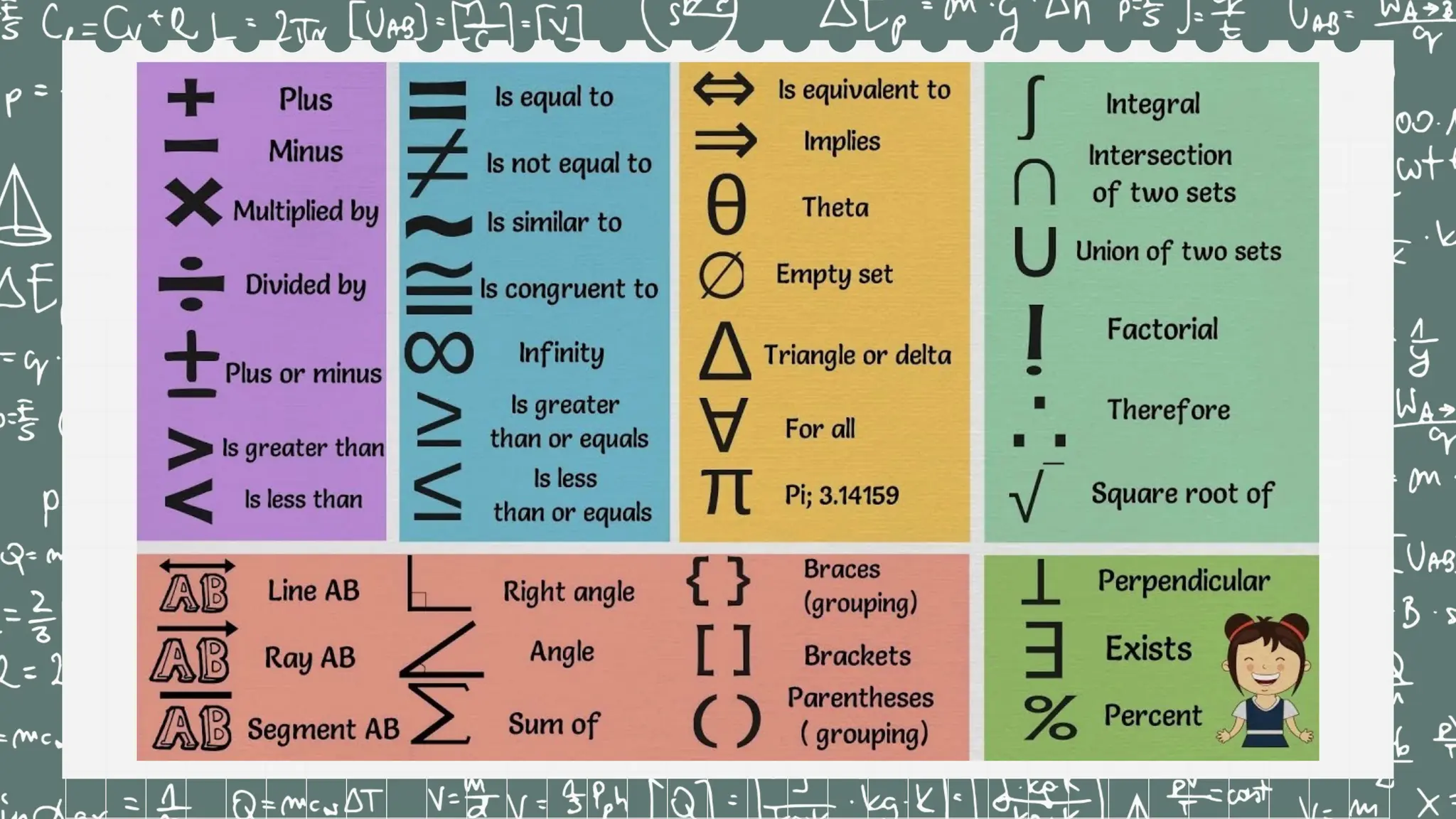
Symbols commonly usedin
Mathematics
1. The ten digits: 0, 1, 2, … 9
2. Operations: +, –, x, ÷
3. Sets: , , ,
∩ ∪ ⊆ ⊇
4. Variables: a, b, c, x and y
5. Special symbols =, <, >, , , π
≤ ≥
7.
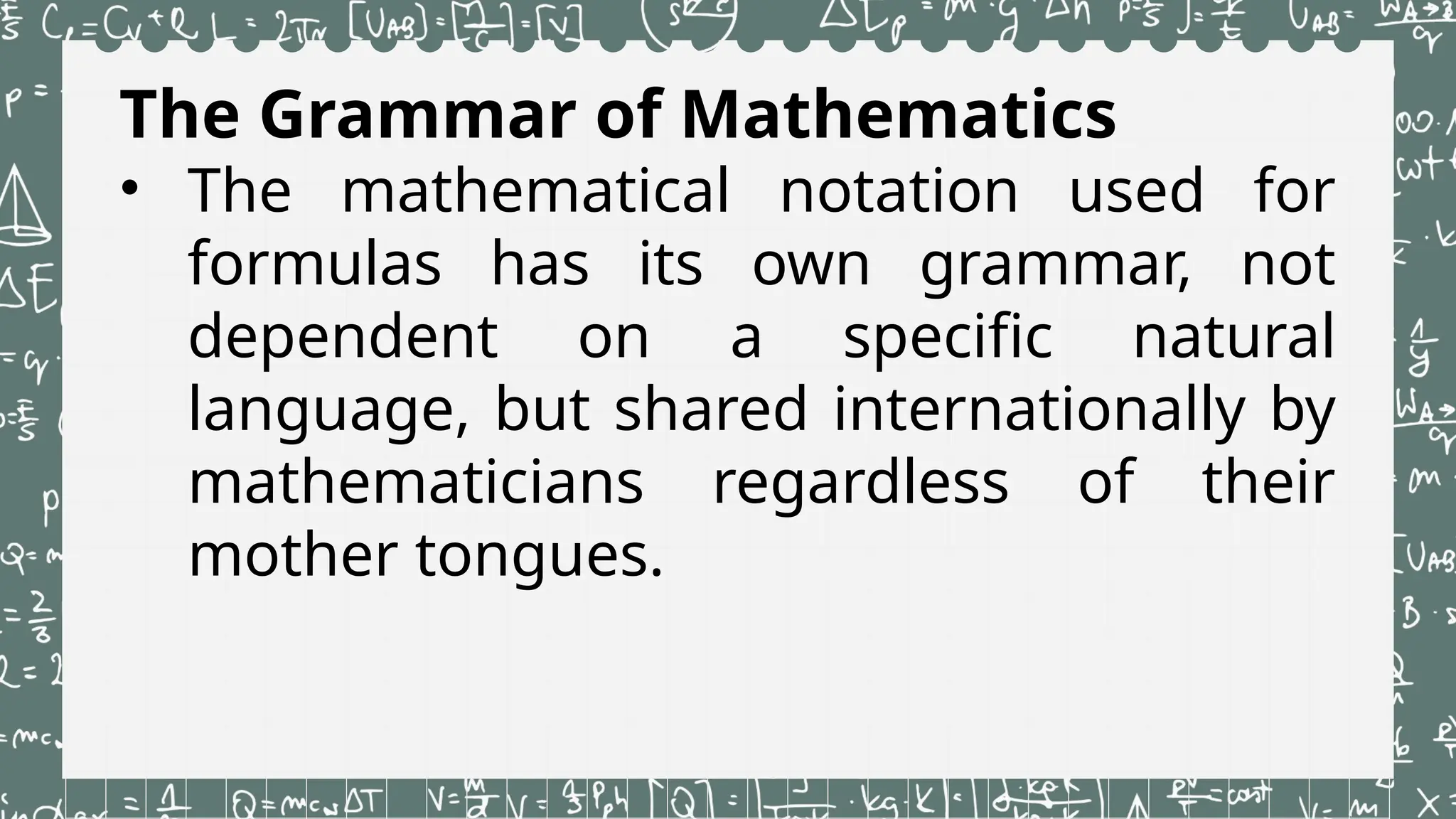
The Grammar ofMathematics
• The mathematical notation used for
formulas has its own grammar, not
dependent on a specific natural
language, but shared internationally by
mathematicians regardless of their
mother tongues.
8.
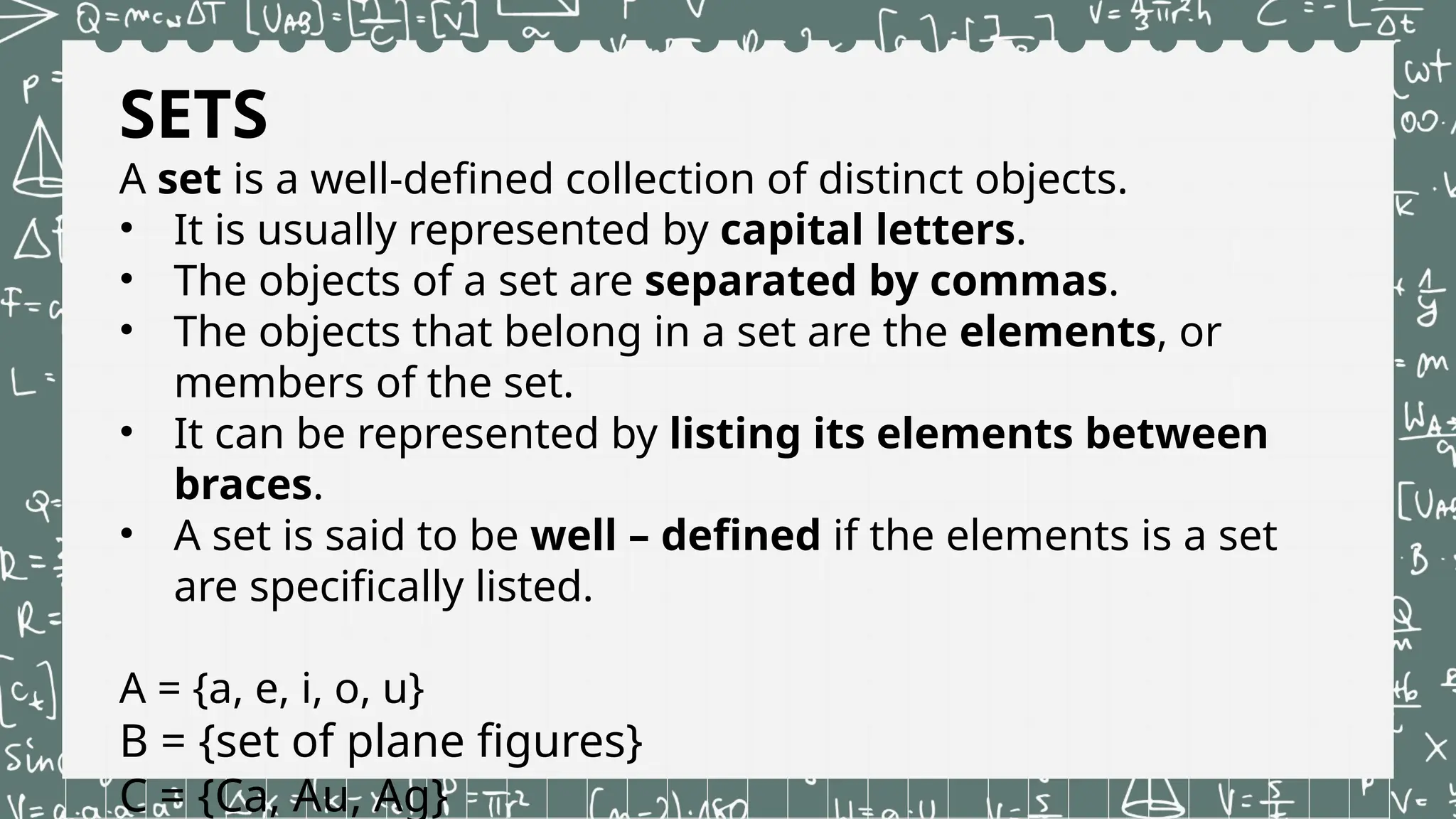
SETS
A set isa well-defined collection of distinct objects.
• It is usually represented by capital letters.
• The objects of a set are separated by commas.
• The objects that belong in a set are the elements, or
members of the set.
• It can be represented by listing its elements between
braces.
• A set is said to be well – defined if the elements is a set
are specifically listed.
A = {a, e, i, o, u}
B = {set of plane figures}
C = {Ca, Au, Ag}
9.
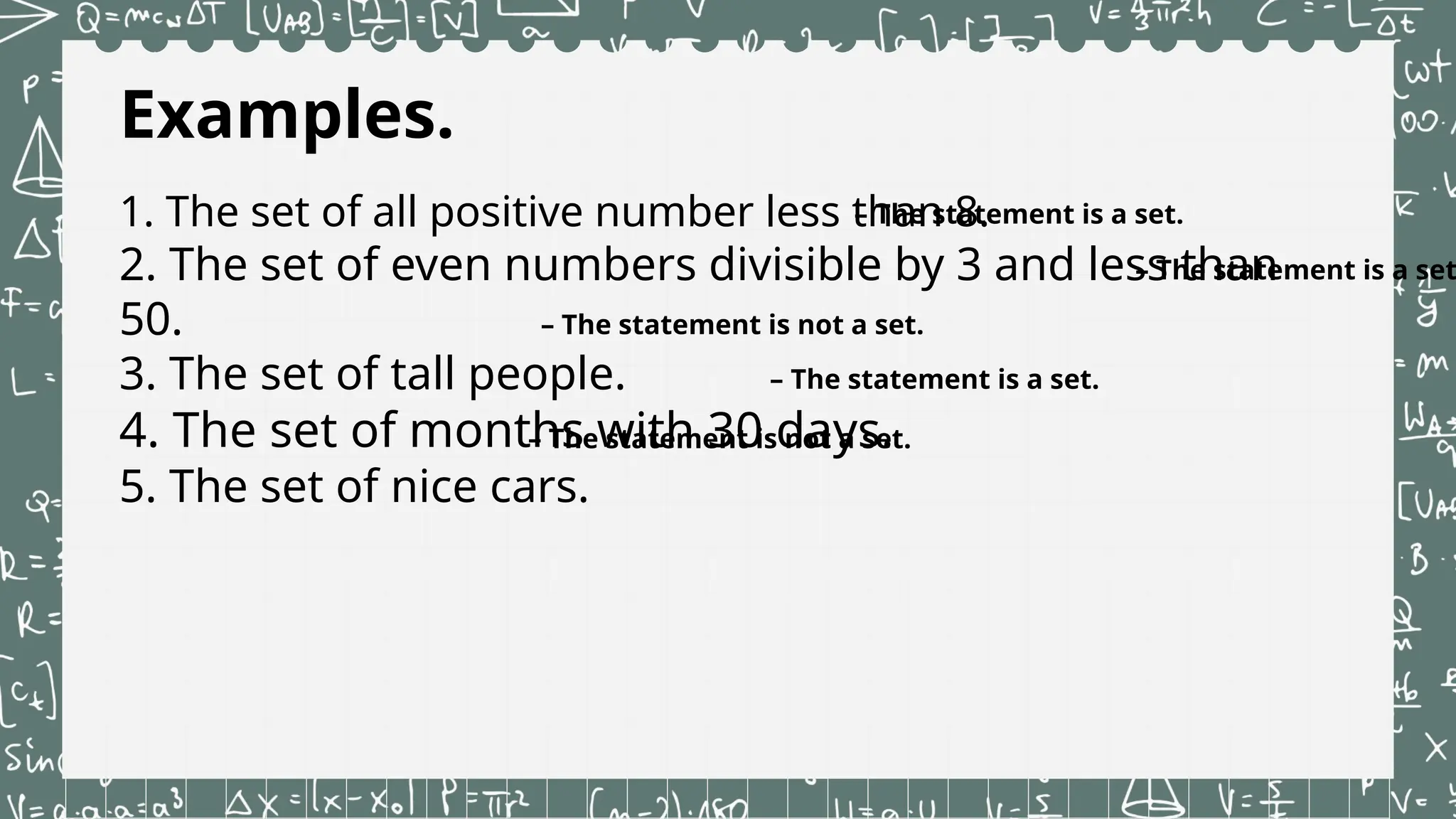
Examples.
1. The setof all positive number less than 8.
2. The set of even numbers divisible by 3 and less than
50.
3. The set of tall people.
4. The set of months with 30 days.
5. The set of nice cars.
– The statement is a set.
– The statement is a set
– The statement is not a set.
– The statement is a set.
– The statement is not a set.
10.
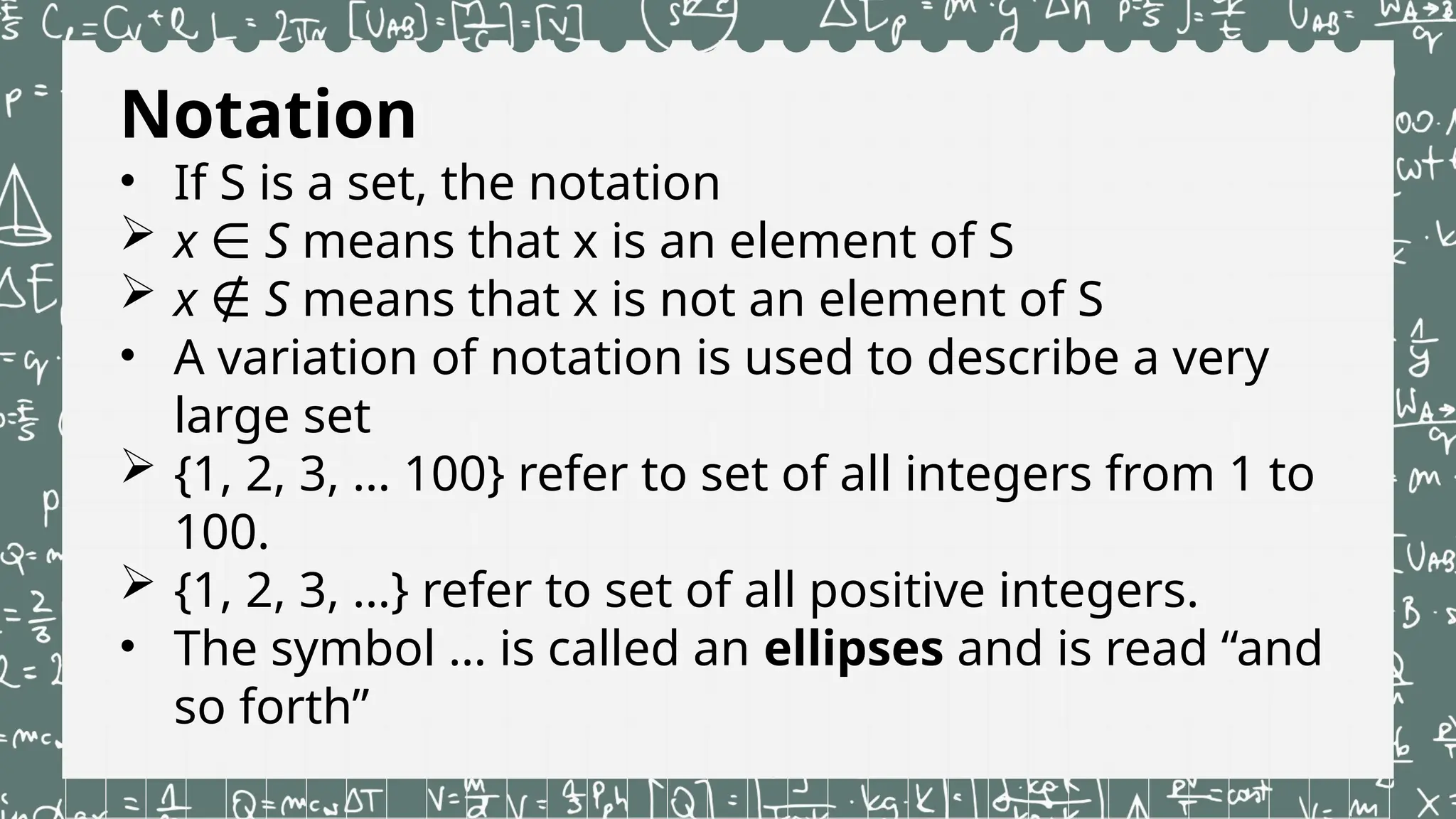
Notation
• If Sis a set, the notation
x ∈ S means that x is an element of S
x ∉ S means that x is not an element of S
• A variation of notation is used to describe a very
large set
{1, 2, 3, … 100} refer to set of all integers from 1 to
100.
{1, 2, 3, …} refer to set of all positive integers.
• The symbol … is called an ellipses and is read “and
so forth”
11.
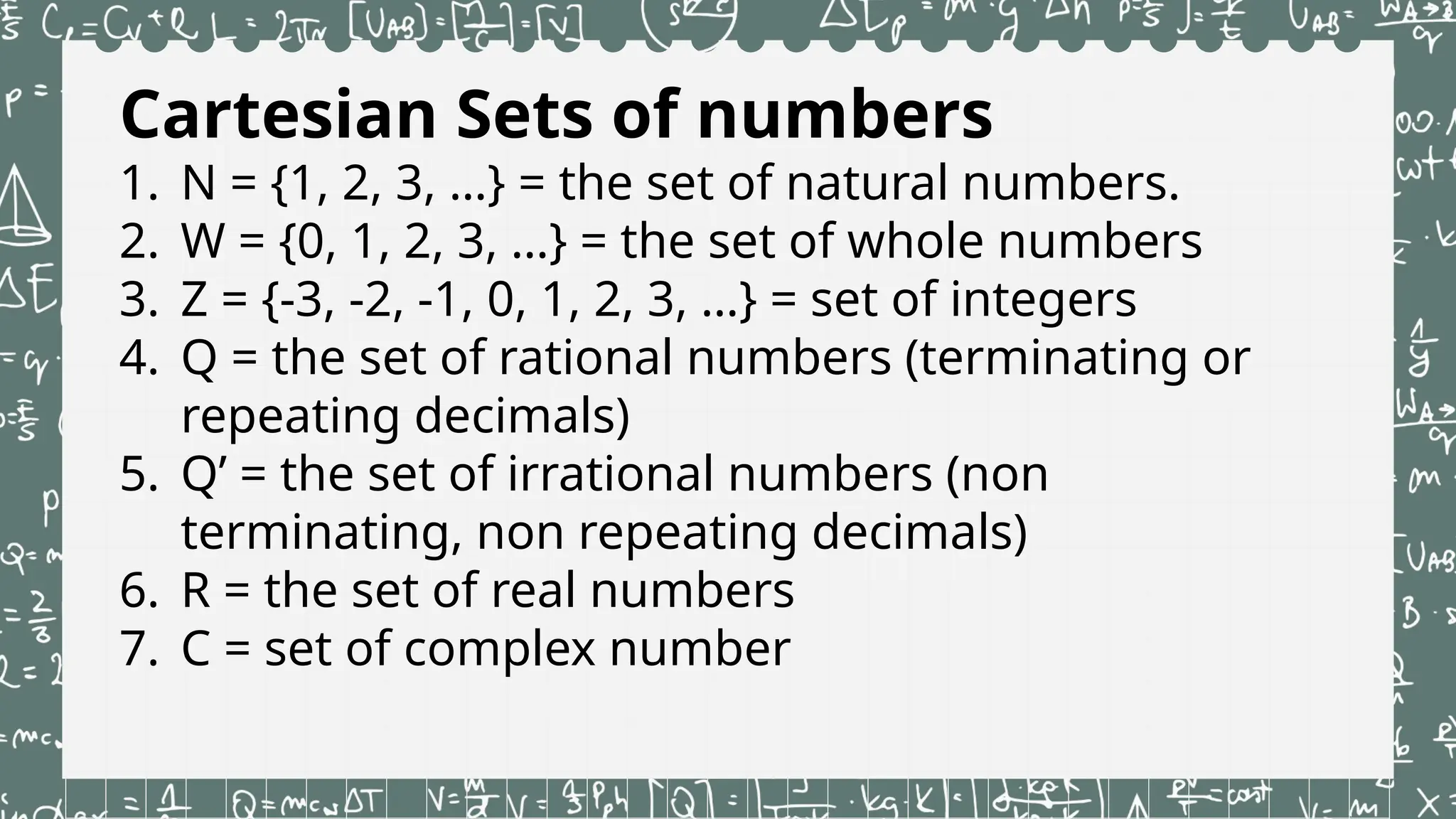
Cartesian Sets ofnumbers
1. N = {1, 2, 3, …} = the set of natural numbers.
2. W = {0, 1, 2, 3, …} = the set of whole numbers
3. Z = {-3, -2, -1, 0, 1, 2, 3, …} = set of integers
4. Q = the set of rational numbers (terminating or
repeating decimals)
5. Q’ = the set of irrational numbers (non
terminating, non repeating decimals)
6. R = the set of real numbers
7. C = set of complex number
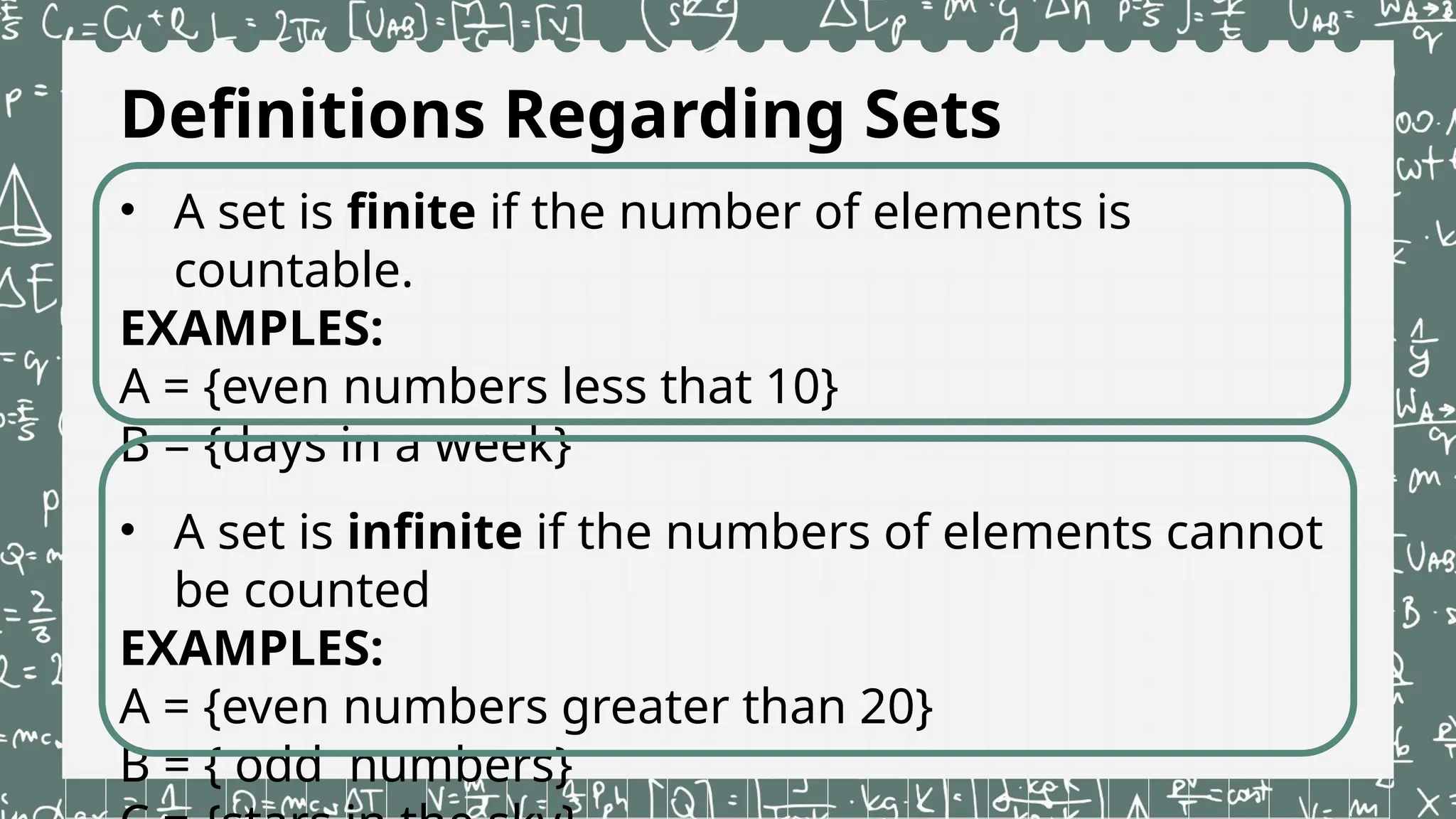
Definitions Regarding Sets
•A set is finite if the number of elements is
countable.
EXAMPLES:
A = {even numbers less that 10}
B = {days in a week}
• A set is infinite if the numbers of elements cannot
be counted
EXAMPLES:
A = {even numbers greater than 20}
B = { odd numbers}
14.
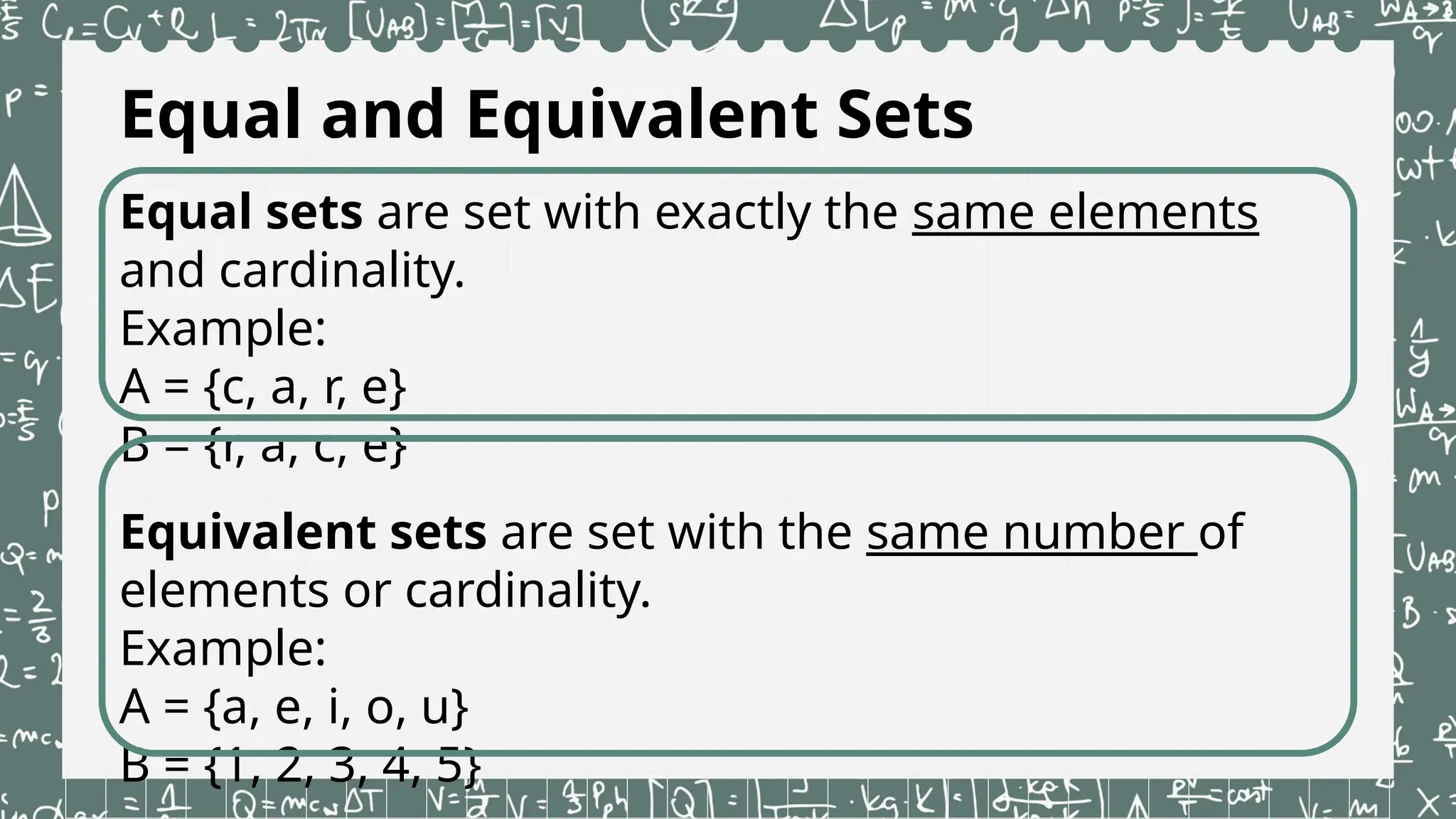
Equal and EquivalentSets
Equal sets are set with exactly the same elements
and cardinality.
Example:
A = {c, a, r, e}
B = {r, a, c, e}
Equivalent sets are set with the same number of
elements or cardinality.
Example:
A = {a, e, i, o, u}
B = {1, 2, 3, 4, 5}
15.
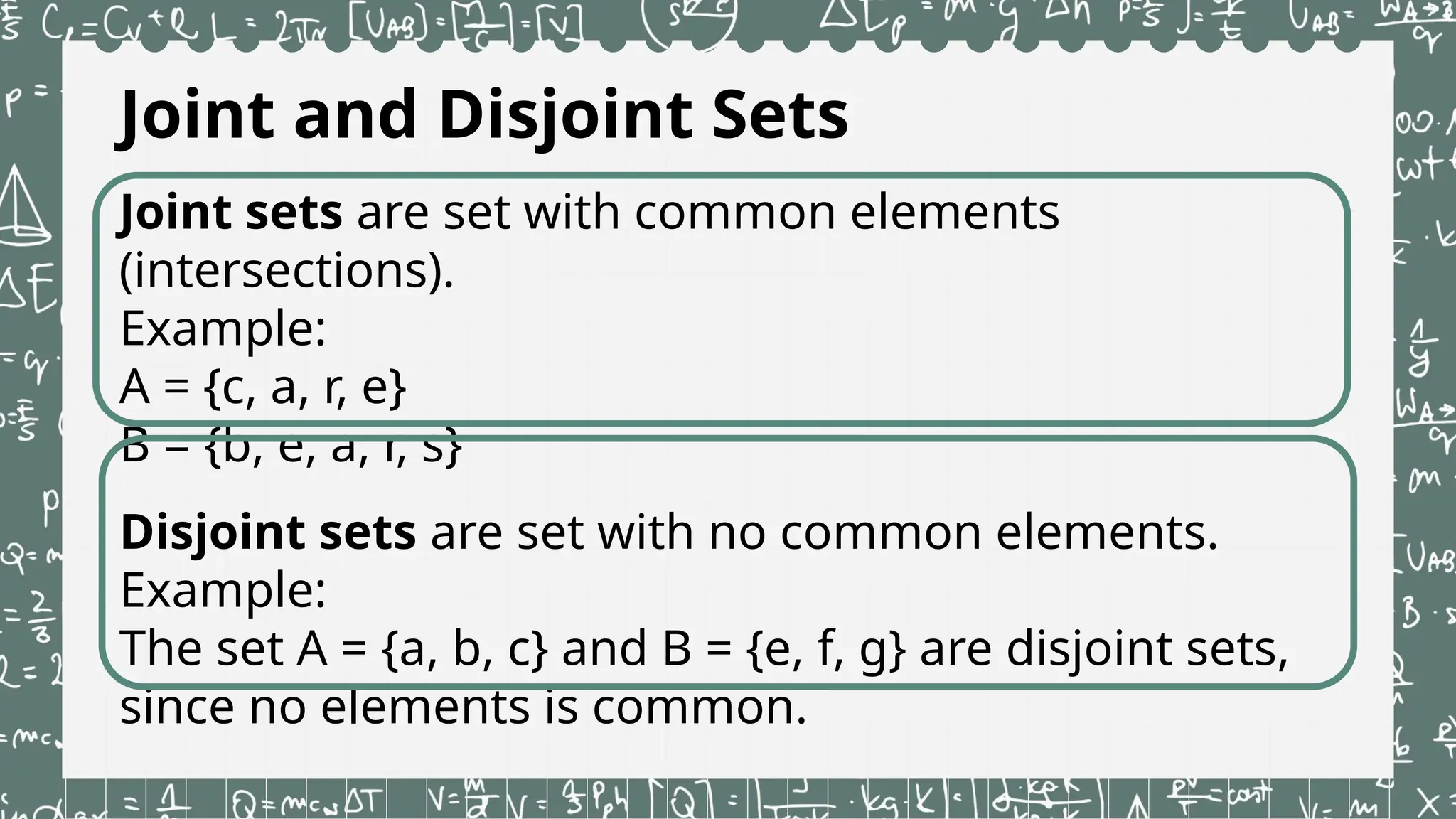
Joint and DisjointSets
Joint sets are set with common elements
(intersections).
Example:
A = {c, a, r, e}
B = {b, e, a, r, s}
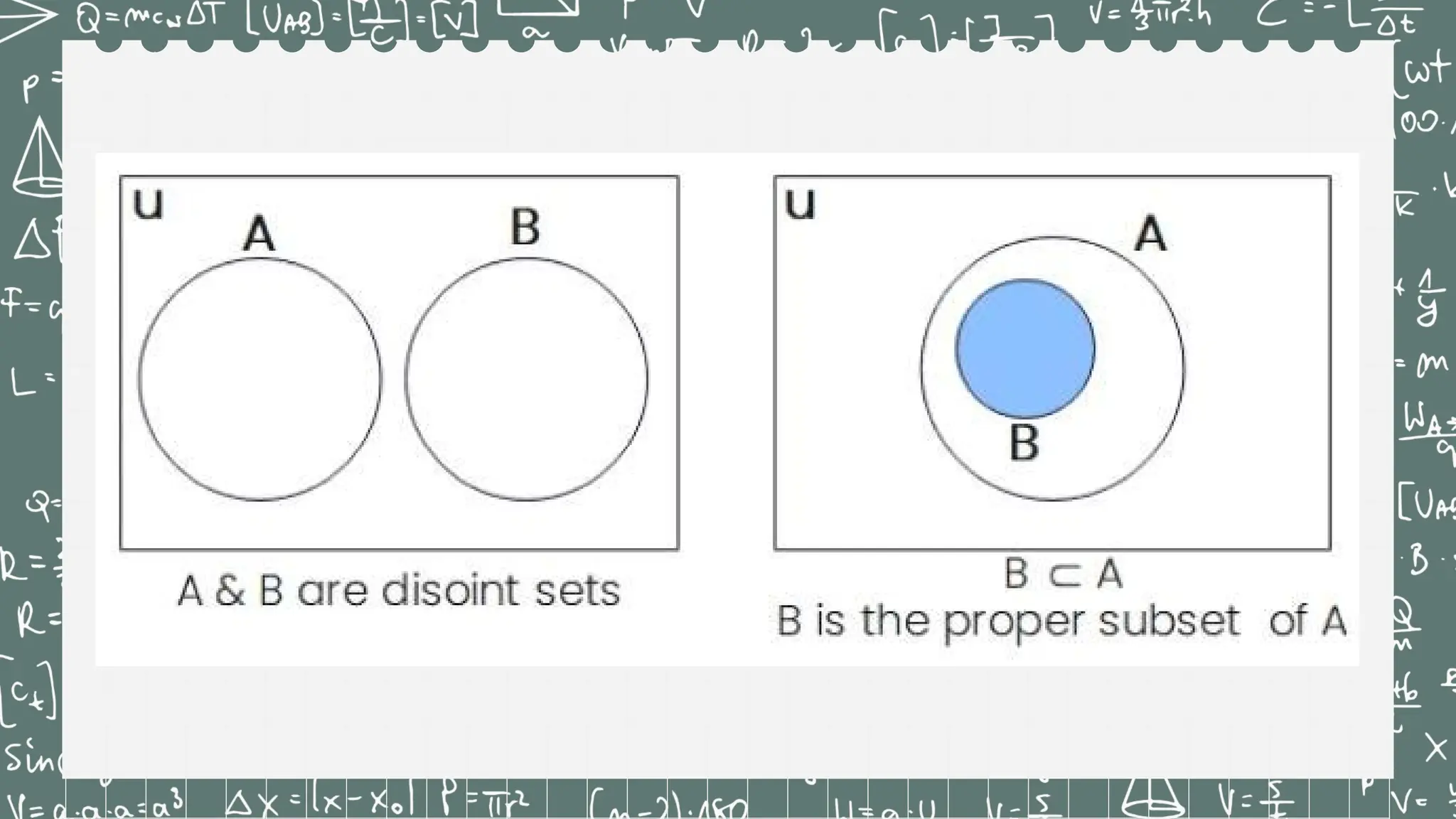
Disjoint sets are set with no common elements.
Example:
The set A = {a, b, c} and B = {e, f, g} are disjoint sets,
since no elements is common.
16.
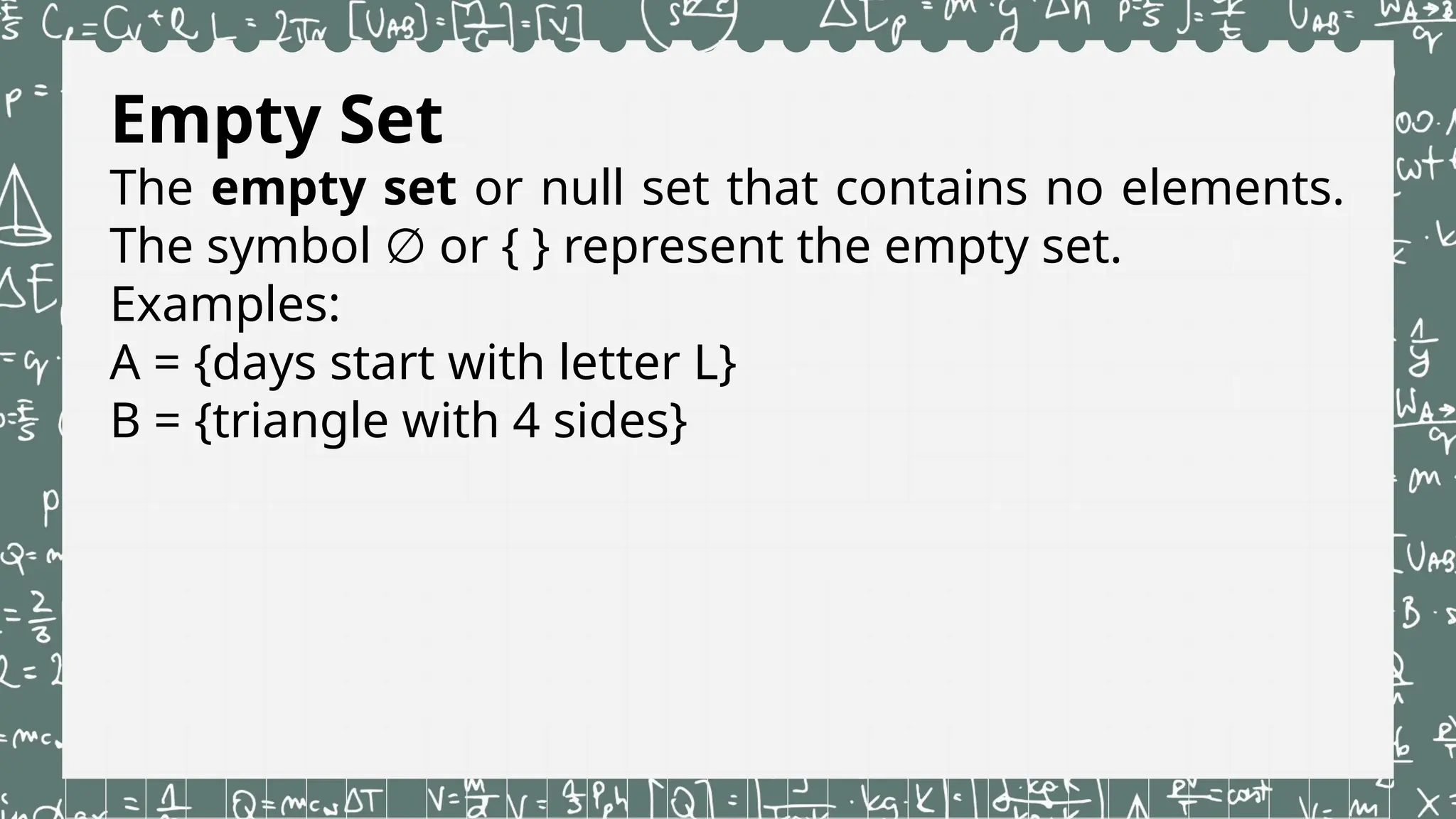
Empty Set
The emptyset or null set that contains no elements.
The symbol or { } represent the empty set.
∅
Examples:
A = {days start with letter L}
B = {triangle with 4 sides}
17.
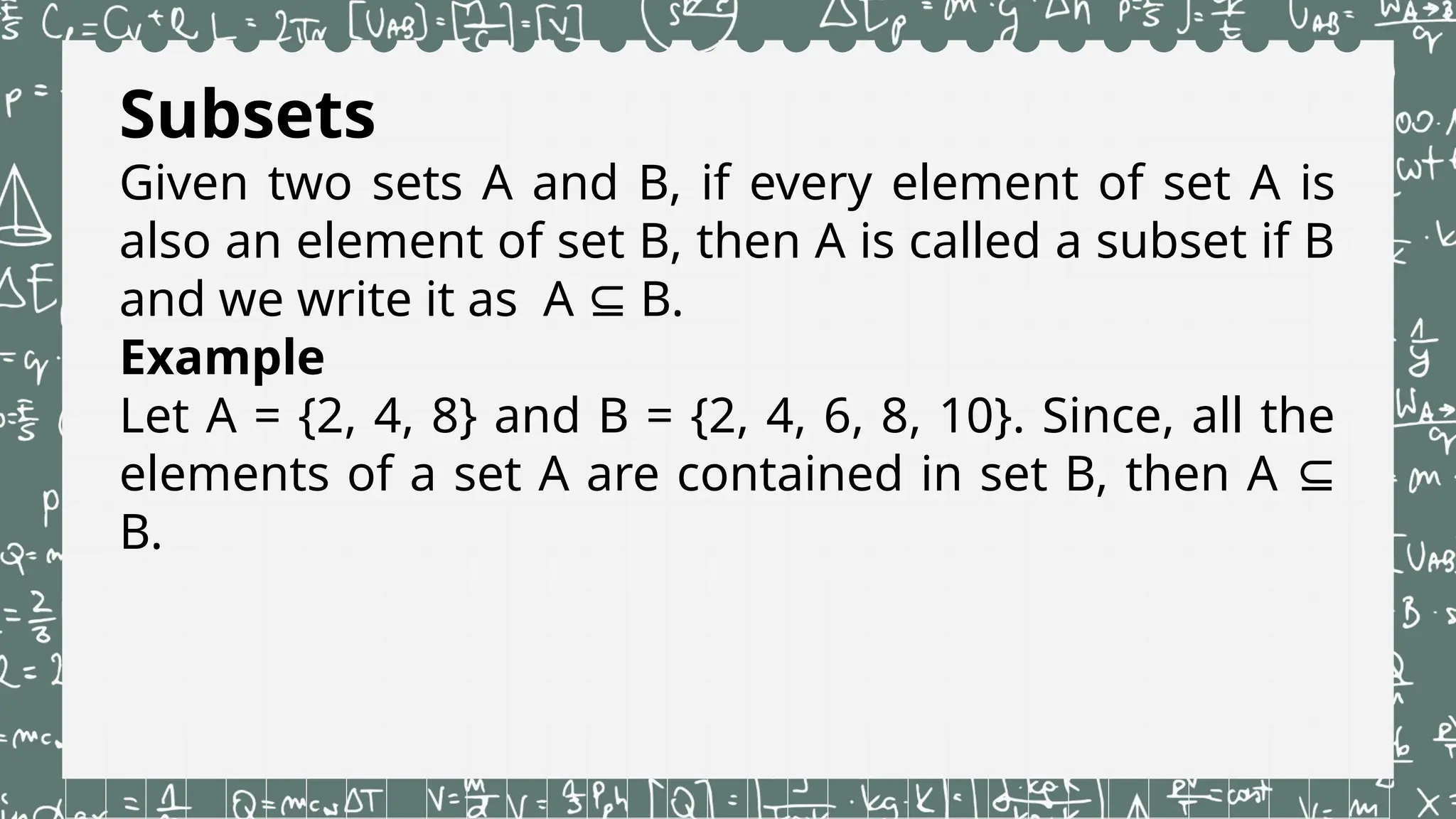
Subsets
Given two setsA and B, if every element of set A is
also an element of set B, then A is called a subset if B
and we write it as A B.
⊆
Example
Let A = {2, 4, 8} and B = {2, 4, 6, 8, 10}. Since, all the
elements of a set A are contained in set B, then A ⊆
B.
18.
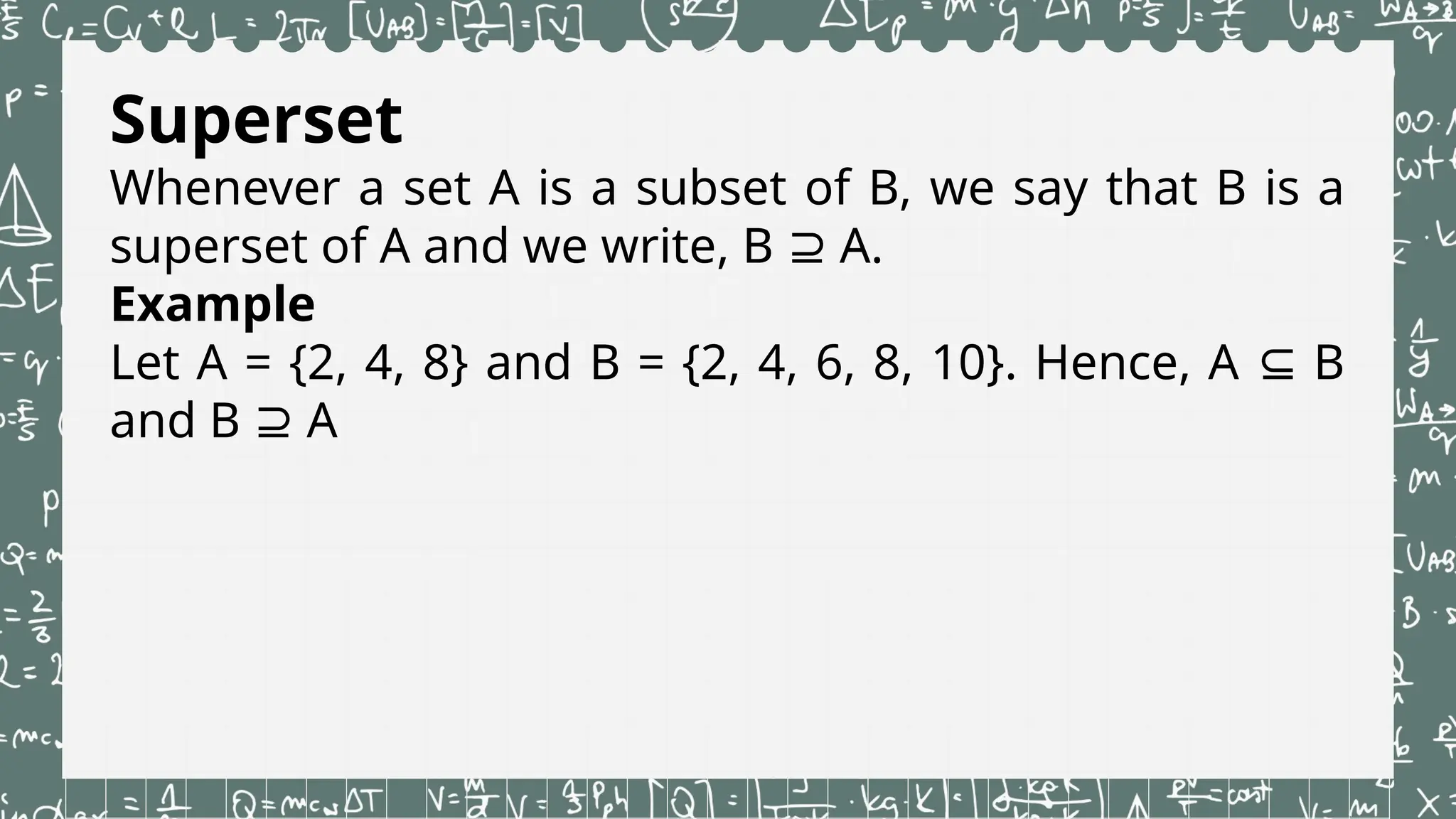
Superset
Whenever a setA is a subset of B, we say that B is a
superset of A and we write, B A.
⊇
Example
Let A = {2, 4, 8} and B = {2, 4, 6, 8, 10}. Hence, A B
⊆
and B A
⊇
19.
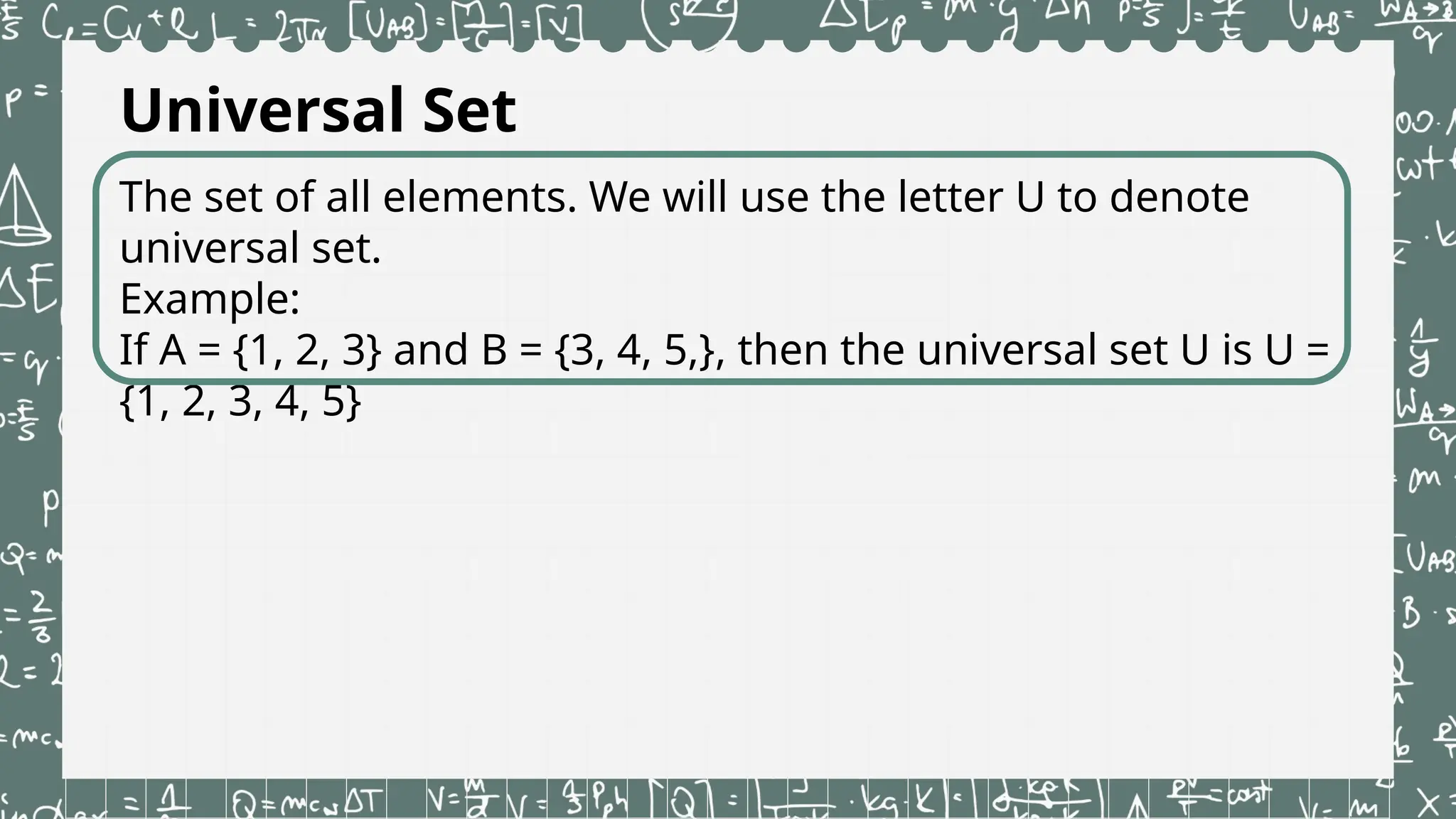
Universal Set
The setof all elements. We will use the letter U to denote
universal set.
Example:
If A = {1, 2, 3} and B = {3, 4, 5,}, then the universal set U is U =
{1, 2, 3, 4, 5}
20.
Operation of Sets
Setscan be combine in a number of different ways to
produce another set. There are operations that
involved in a set. The following operations are union,
intersection, complementation, set difference, and
cartesian product.
21.
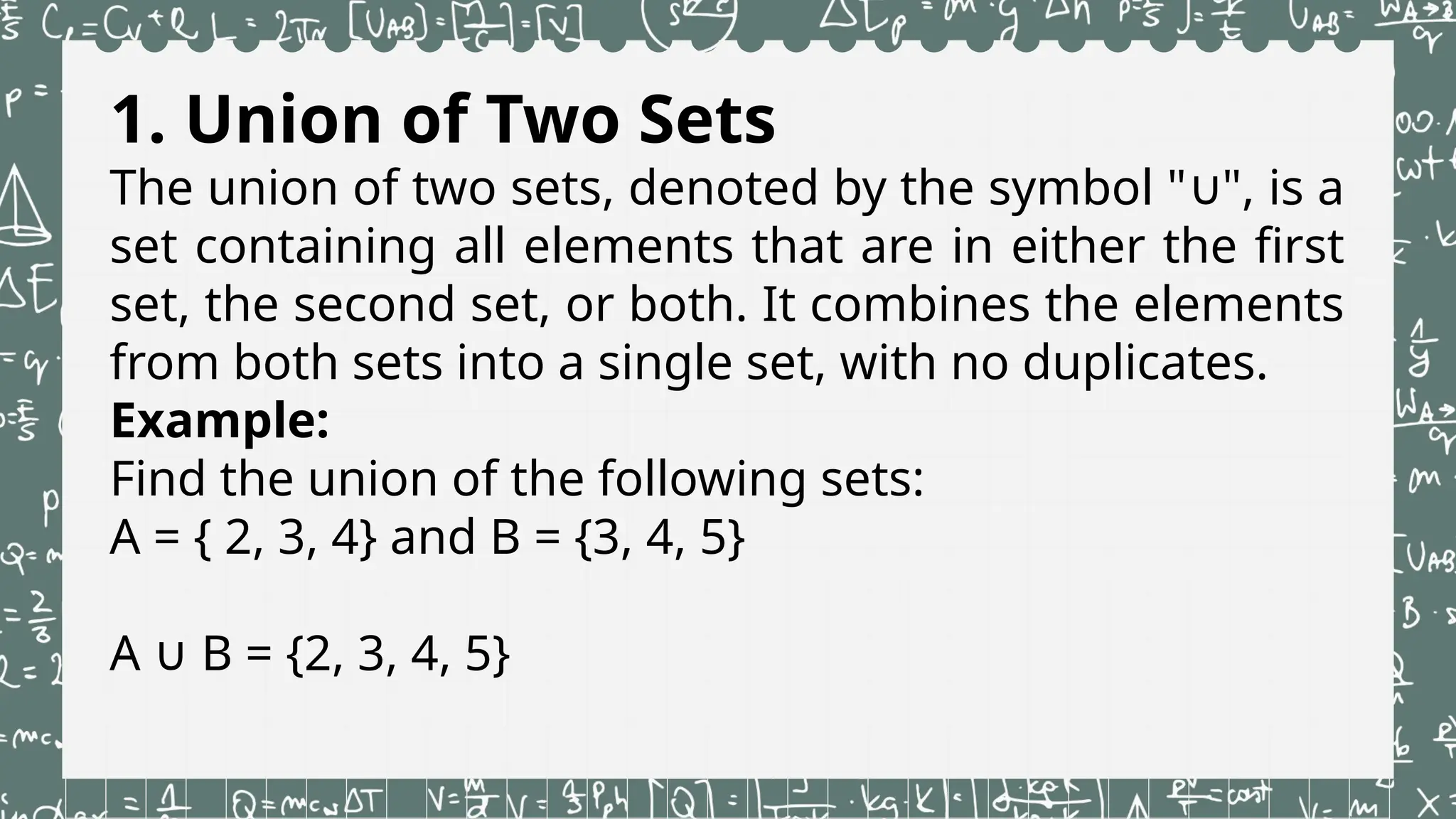
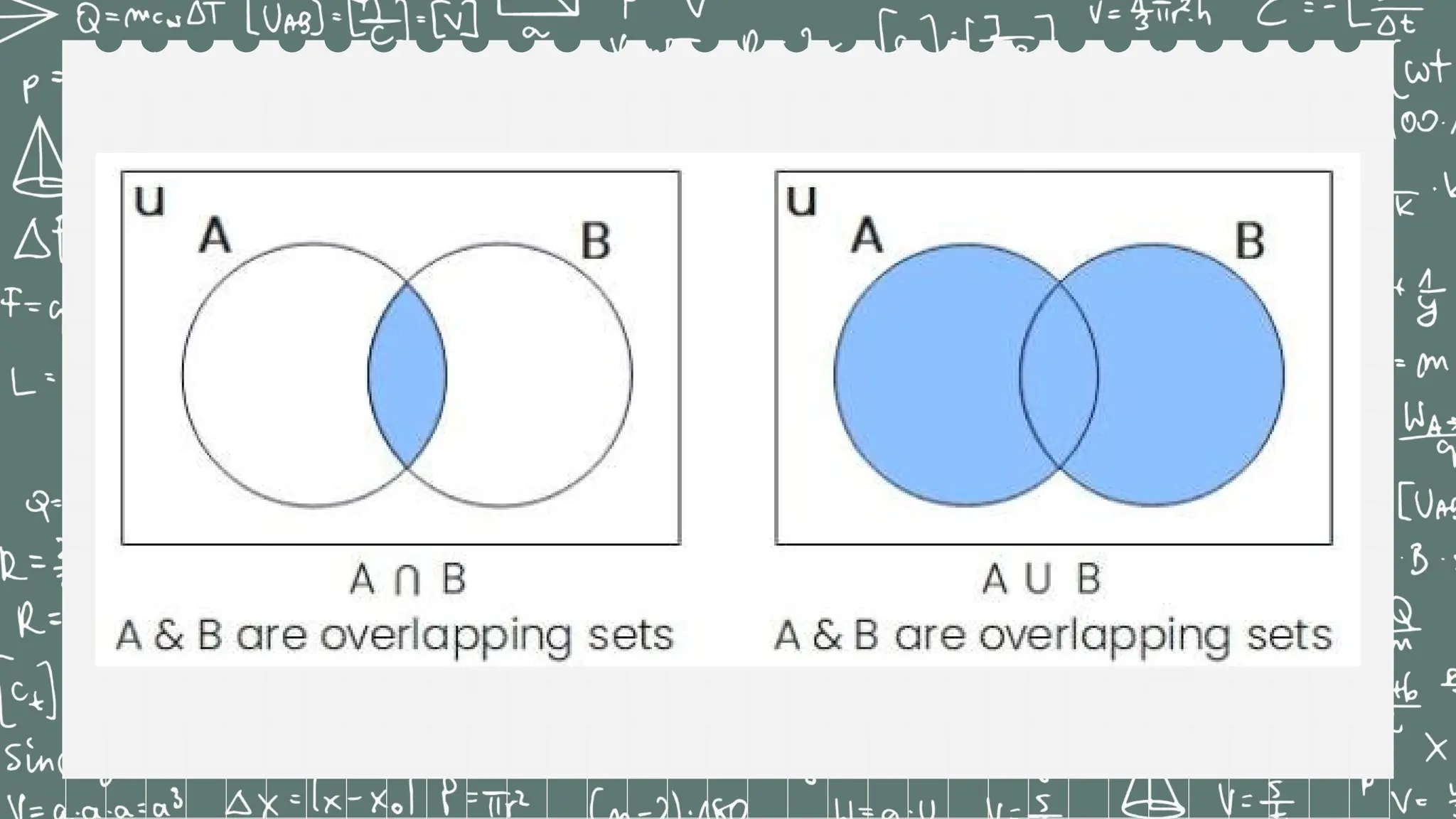
1. Union ofTwo Sets
The union of two sets, denoted by the symbol " ", is a
∪
set containing all elements that are in either the first
set, the second set, or both. It combines the elements
from both sets into a single set, with no duplicates.
Example:
Find the union of the following sets:
A = { 2, 3, 4} and B = {3, 4, 5}
A B = {2, 3, 4, 5}
∪
22.
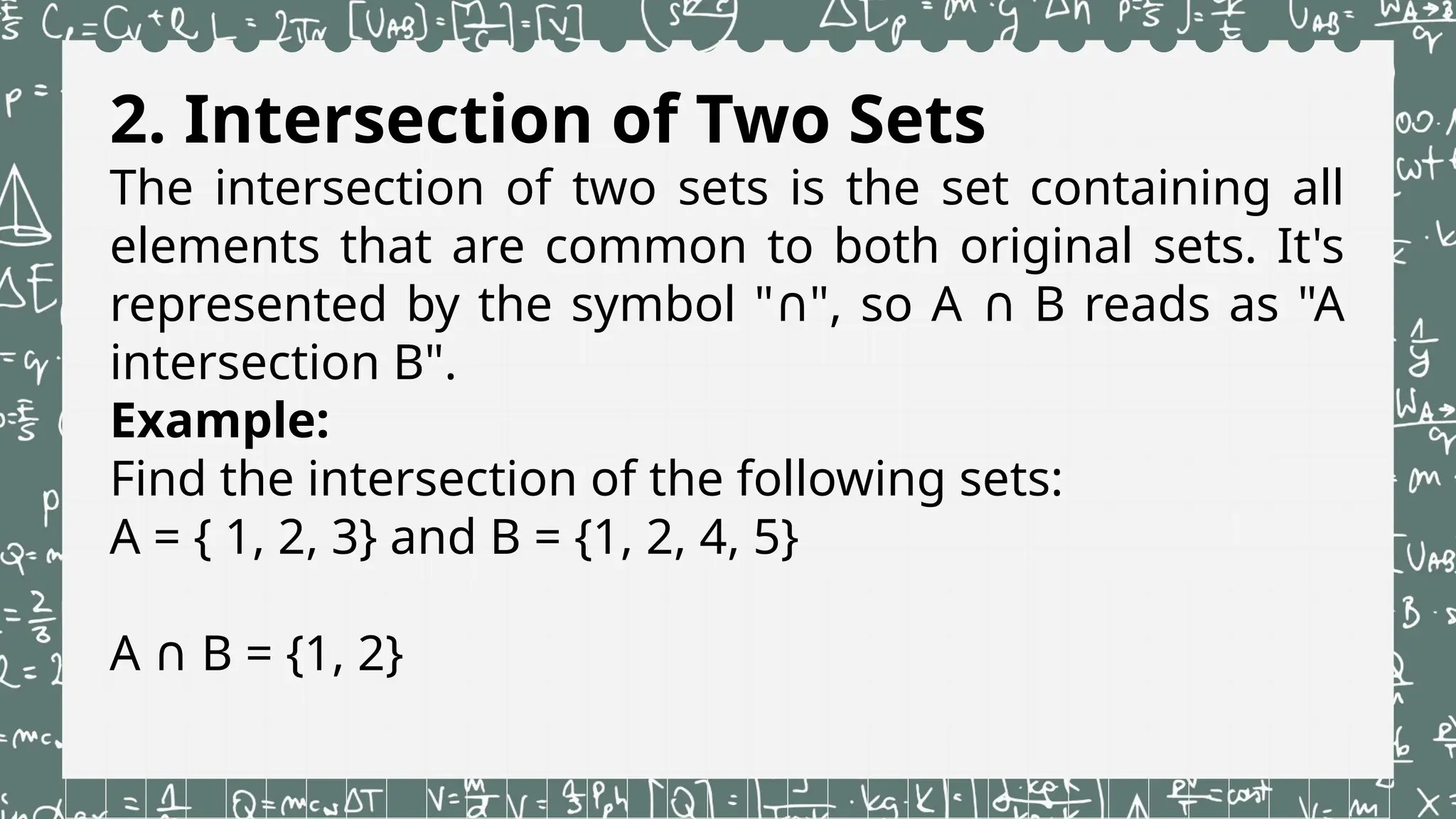
2. Intersection ofTwo Sets
The intersection of two sets is the set containing all
elements that are common to both original sets. It's
represented by the symbol " ", so A B reads as "A
∩ ∩
intersection B".
Example:
Find the intersection of the following sets:
A = { 1, 2, 3} and B = {1, 2, 4, 5}
A B = {1, 2}
∩
23.
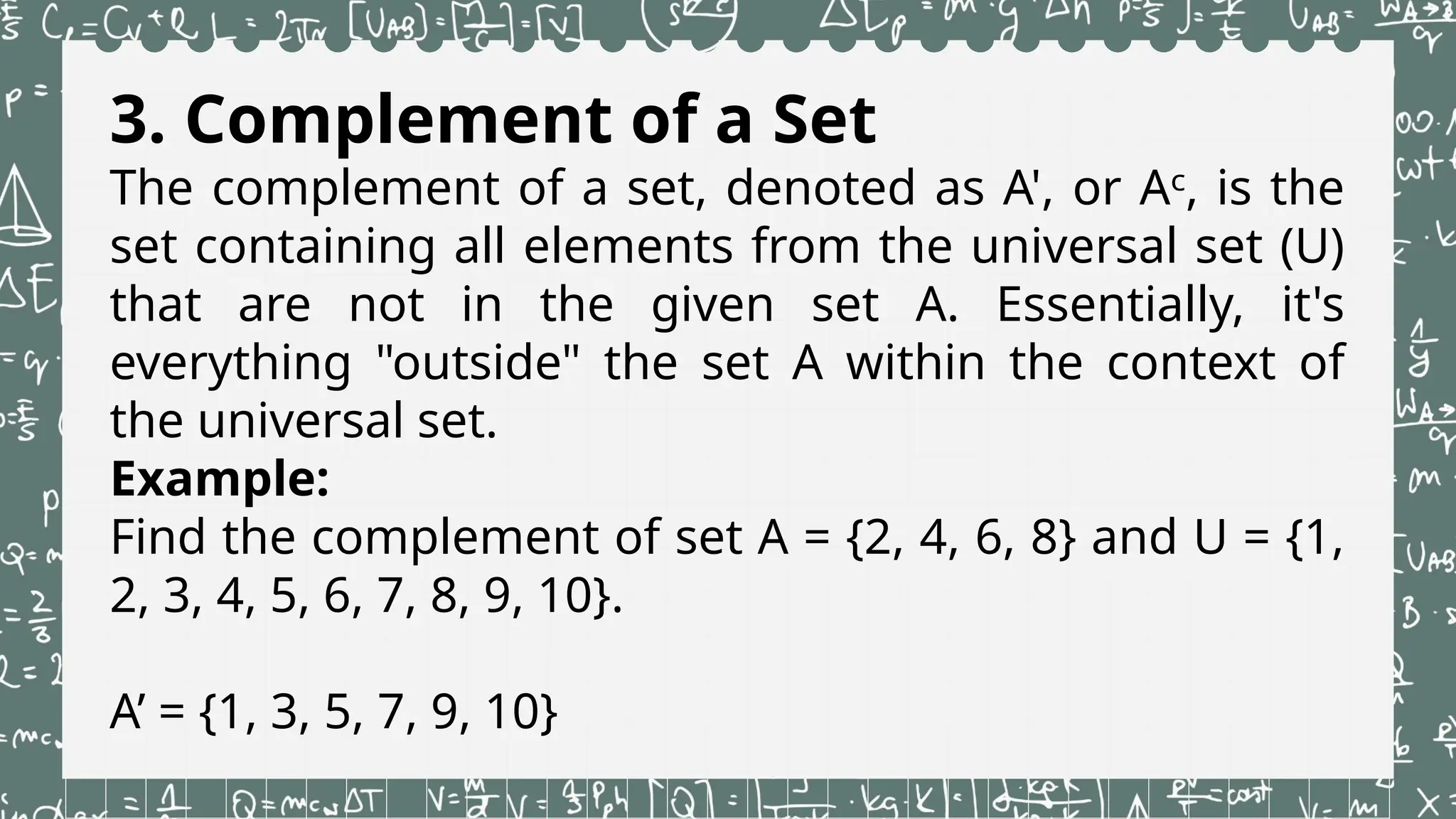
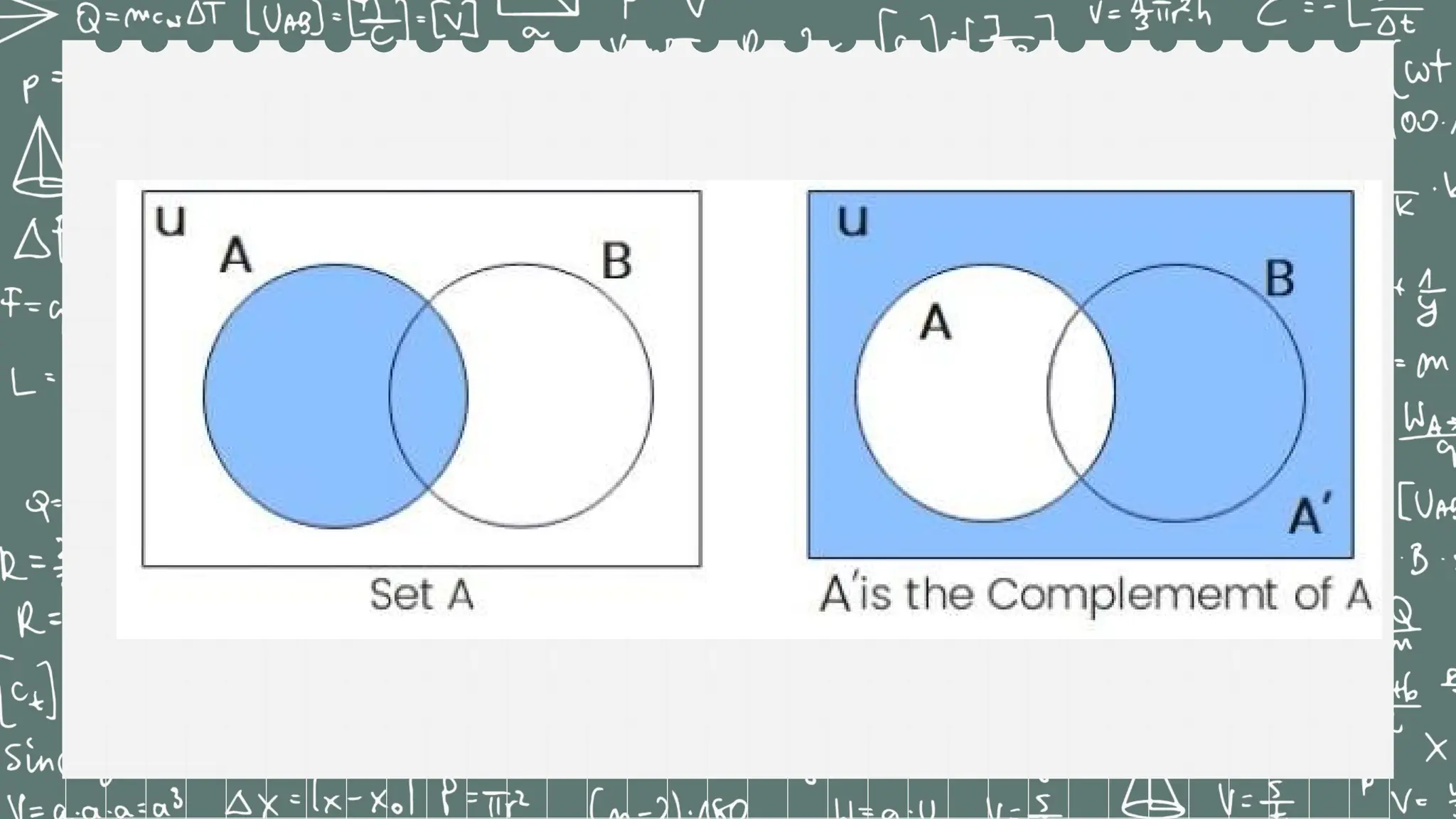
3. Complement ofa Set
The complement of a set, denoted as A', or Aᶜ, is the
set containing all elements from the universal set (U)
that are not in the given set A. Essentially, it's
everything "outside" the set A within the context of
the universal set.
Example:
Find the complement of set A = {2, 4, 6, 8} and U = {1,
2, 3, 4, 5, 6, 7, 8, 9, 10}.
A’ = {1, 3, 5, 7, 9, 10}
24.
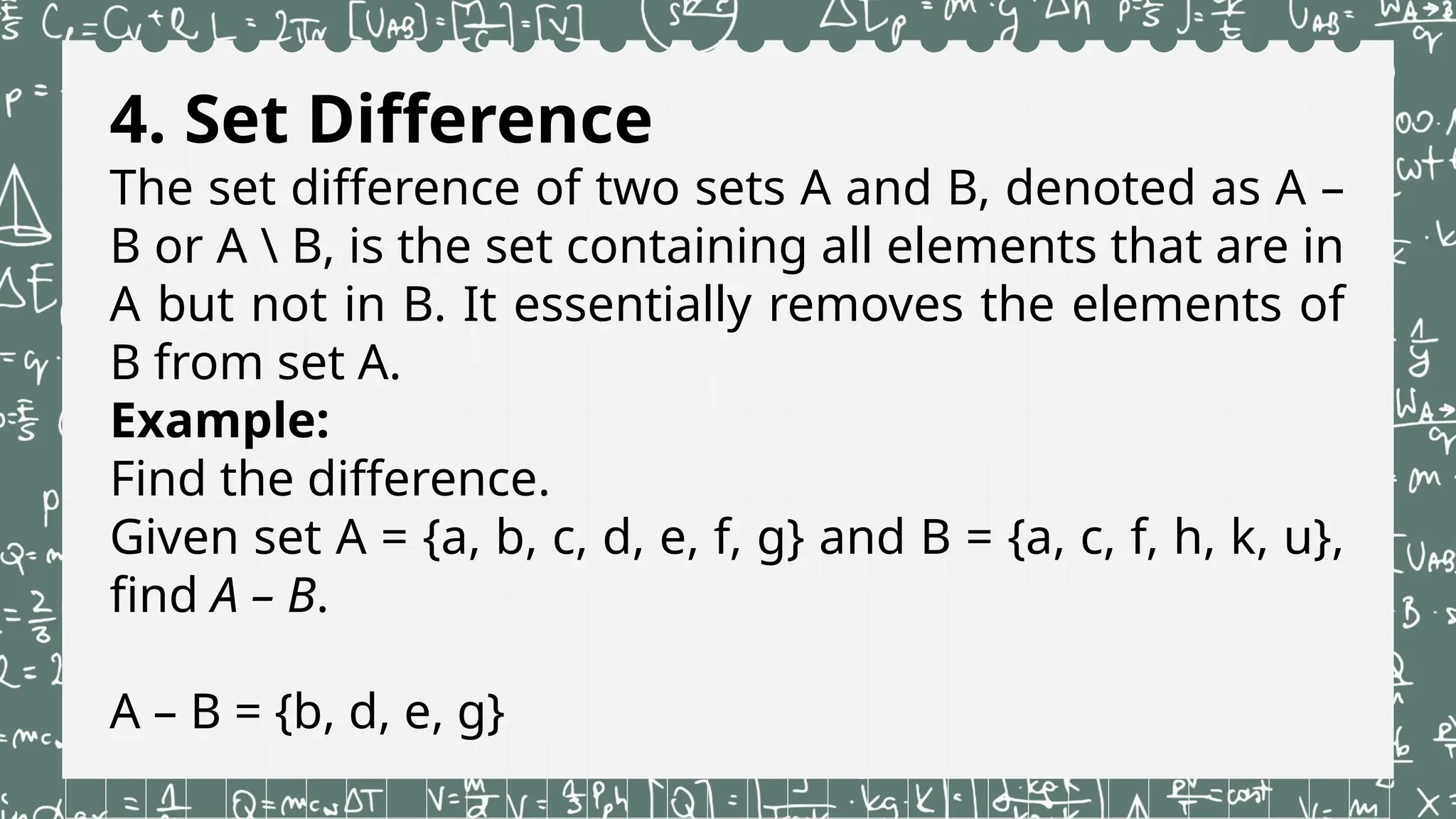
4. Set Difference
Theset difference of two sets A and B, denoted as A –
B or A B, is the set containing all elements that are in
A but not in B. It essentially removes the elements of
B from set A.
Example:
Find the difference.
Given set A = {a, b, c, d, e, f, g} and B = {a, c, f, h, k, u},
find A – B.
A – B = {b, d, e, g}
25.
5. Cartesian Product
TheCartesian product of two sets, A and B, is a new
set formed by creating all possible ordered pairs
where the first element of each pair comes from set A
and the second element comes from set B. It's
denoted as A × B.
Example:
If A = {1, 2} and B = {a, b},
then the Cartesian product A × B is:
A × B = {(1, a), (1, b), (2, a), (2, b)}
26.
Venn Diagram
A VennDiagram is a pictorial representation of the
relationships between two or more sets. We can
represent sets using venn diagrams. In a Venn
Diagram, the sets are represented by shapes; usually
circles or ovals. The elements of a set are labeled
within the circle.
Editor's Notes
#2 Sets are everywhere — from your playlists, your contacts, to your classes. So yes, you're using sets even if you don’t realize it!"
🗨️ "Understanding the language of sets will help you appreciate how mathematics describes and organizes the world."
#3 "Let’s begin by understanding what we mean by language."
📘 Definition of Language:
Language is a systematic method of communication used by people to express thoughts, ideas, and information. It typically involves the use of spoken sounds, written words, or conventional symbols that follow specific rules or structures."
🗨️ "In mathematics, we also use a language — but instead of words and grammar, we use symbols, numbers, and logical structures. That’s what we call the language of sets."
#4 Language was invented for one powerful purpose — to communicate ideas to others. Whether spoken, written, or signed, language allows us to express thoughts clearly and logically."
🗨️ "But did you know that mathematics has its own language? It was developed to communicate ideas precisely — without ambiguity or misunderstanding."
📘 The Language of Mathematics includes:
Numbers – to measure and count.
Sets – to group and classify objects or ideas.
Functions – to represent relationships between quantities.
Operations – like addition, subtraction, union, intersection, and more.
🗨️ "Mathematics gives us a way to describe patterns, solve problems, and understand how the world works — from the smallest particles to the largest galaxies."
#5 Mathematics relies heavily on symbols. These symbols help us express complex ideas in a simple and universal way — one of the many reasons why math is considered a universal language."
Here are some of the most commonly used symbols:
✅ 1. Digits (Numerals)
0, 1, 2, 3, 4, 5, 6, 7, 8, 9
🗨️ "These are the basic building blocks of numbers. Every number in the world is made using these ten digits."
➕ 2. Operations
+ (Addition)
– (Subtraction)
× or · (Multiplication)
÷ or / (Division)
🗨️ "These symbols allow us to perform calculations and solve problems."
🔣 3. Set Symbols
∈ – "is an element of"
∉ – "is not an element of"
∩ – Intersection (common elements)
∪ – Union (combined elements)
⊆ – Subset
⊇ – Superset
∅ – Empty set
🗨️ "These are essential when working with sets, which we’ll explore in detail today."
🔤 4. Variables
Commonly: a, b, c, x, y, z
🗨️ "Variables represent unknown values or quantities that can change. They are used in equations, functions, and formulas."
🧮 5. Special Mathematical Symbols
= (Equals)
≠ (Not equal)
< (Less than)
> (Greater than)
≤ (Less than or equal to)
≥ (Greater than or equal to)
π (Pi, ≈ 3.1416 – the ratio of a circle’s circumference to its diameter)
🗨️ "These symbols help us write comparisons, define constants, and build mathematical expressions."
✨ Closing Thought:
🗨️ "Just like words make up sentences, mathematical symbols build expressions, equations, and ideas. The more fluent you become in this language, the better you’ll understand the logic of the world around you."
#7 "Just like spoken or written language has grammar — a set of rules for how words are arranged to make sense — mathematics also has its own grammar."
🗨️ "This grammar is made up of symbols, rules, and structures that allow us to create clear and logical expressions, equations, and statements."
📘 Key Idea:
“The mathematical notation used for formulas has its own grammar — one that is not tied to any specific natural language, but instead, shared globally among mathematicians and learners, no matter what their mother tongue is.”
🗨️ "That means a mathematical expression written here in the Philippines can be understood the same way by someone in Japan, France, or Brazil. Why? Because math is a universal language — and its grammar is consistent worldwide."
🔍 Examples of Mathematical Grammar:
Order matters:
3+(4×2)3 + (4 \times 2)3+(4×2) is not the same as (3+4)×2(3 + 4) \times 2(3+4)×2
This follows the PEMDAS rule (Parentheses, Exponents, Multiplication and Division, Addition and Subtraction)
Variables must be clearly defined:
You can’t just say “x” unless you define what it stands for.
Equations must be balanced:
Whatever you do on one side, you must do on the other side (like grammar agreement in sentences)
Symbols must be used correctly:
∪ means union, not addition.
⊆ means subset, not equality.
#8 Let’s now dive into one of the most important concepts in the language of mathematics — the concept of a set."
📘 Definition:
A set is a well-defined collection of distinct objects.
🟢 “Well-defined” means that it is clear whether an object belongs to the set or not.
🟢 “Distinct” means that no element is repeated within the set.
🧠 Key Characteristics of Sets:
🔠 A set is usually named using capital letters, such as A, B, or C.
🟰 The elements (or members) of a set are the objects contained in it.
🧾 Elements are listed inside braces { }, and separated by commas.
🗂️ A set is well-defined if its contents are clearly and specifically listed.
🧺 Examples:
A = {a, e, i, o, u}
📌 This is a set of vowels in the English alphabet.
B = {set of plane figures}
📌 This is a descriptive set. It can include elements like: triangle, square, rectangle, etc.
C = {Ca, Au, Ag}
📌 This is a set of chemical element symbols for calcium, gold, and silver.
❗ Reminders:
🟡 Avoid duplicates: Each element appears only once in a set.
🟡 Order doesn’t matter: {1, 2, 3} is the same as {3, 2, 1}
🟡 Use curly braces: Always enclose the list of elements within { }.
💬 Sample Questions to Ask the Class:
"Is this a well-defined set: {tall people}?"
(No, because “tall” is subjective.)
"What are some examples of a well-defined set from your daily life?"
(E.g., {days of the week}, {colors of the rainbow})
Would you like me to prepare visual aids like a chart or a printable handout summarizing this?
Ask ChatGPT
#9 ✅ 1. The set of all positive numbers less than 8
📝 N = {1, 2, 3, 4, 5, 6, 7}
✔️ Well-defined
💬 "We clearly know which numbers are included. There’s no room for personal interpretation."
⚠️ 2. The set of even numbers divisible by 3 and less than 50
📝 S = {6, 12, 18, 24, 30, 36, 42, 38}
❌ Not accurate
💬 "It’s meant to be well-defined, but there's an error: 38 is not divisible by 3, so it shouldn't be in the set."
✅ Correct version:
📝 S = {6, 12, 18, 24, 30, 36, 42, 48}
✔️ Well-defined once corrected
❓ 3. The set of tall people
📝 No specific listing
❌ Not well-defined
💬 "What counts as 'tall' can vary from person to person. One person’s idea of tall might be different from another’s."
🗨️ "This is an example of a not well-defined set because it is based on a subjective description."
✅ 4. The set of months with 30 days
📝 M = {September, November, April, June}
✔️ Well-defined
💬 "There are exactly four months with 30 days, and they are specifically listed here."
❓ 5. The set of nice cars
📝 No listing; depends on opinion
❌ Not well-defined
💬 "What’s considered a 'nice car' depends on personal preferences — brand, model, design, etc. So it’s not a well-defined set."
#10 Now that we know what sets and elements are, let’s look at how we represent them using mathematical notation."
📘 Basic Symbols:
If x ∈ S
🔹 This means that x is an element of set S
🗣️ Read as: “x belongs to S” or “x is in S”
If x ∉ S
🔹 This means that x is NOT an element of set S
🗣️ Read as: “x does not belong to S”
🗨️ "These notations help us easily check whether something is part of a set or not."
📊 Representing Large Sets:
🧾 When a set has many elements, especially when they follow a pattern, we can use ellipses (…) to represent it concisely.
Example 1:
{1, 2, 3, …, 100}
🔹 This is the set of all integers from 1 to 100
Example 2:
{1, 2, 3, …}
🔹 This refers to the set of all positive integers (goes on forever)
💡 What is an Ellipsis (…)?
🔣 The symbol … is called an ellipsis
🗣️ It is read as “and so forth” or “and so on”
🗨️ "We use it when the pattern is obvious and continues indefinitely or up to a clear endpoint."
✅ Quick Check:
Ask students:
Is 5 ∈ {1, 2, 3, 4, 5}?
Is 10 ∉ {1, 2, 3, …, 9}?
What does the ellipsis in {2, 4, 6, 8, …} tell us?
#11 "Mathematics organizes numbers into sets based on their properties. Let’s look at the most important sets of numbers you’ll encounter."
🧮 1. N = Set of Natural Numbers
📘 N = {1, 2, 3, 4, …}
✔️ These are the counting numbers — the numbers we first learn as children.
🔹 No zero, no negatives, no decimals.
🧮 2. W = Set of Whole Numbers
📘 W = {0, 1, 2, 3, …}
✔️ Just like natural numbers, but it includes zero.
🧮 3. Z = Set of Integers
📘 Z = {..., -3, -2, -1, 0, 1, 2, 3, ...}
✔️ Includes all positive and negative whole numbers, and zero.
🗨️ "Think of it as extending the number line in both directions."
🧮 4. Q = Set of Rational Numbers
📘 Q = {a/b | a, b ∈ Z, b ≠ 0}
✔️ Any number that can be written as a fraction.
✔️ Includes decimals that terminate (like 0.5) or repeat (like 0.333…).
🧮 5. Q′ = Set of Irrational Numbers
📘 Q′ = {numbers like √2, π, e}
❌ Cannot be written as a fraction.
❌ Non-terminating, non-repeating decimals.
🧮 6. R = Set of Real Numbers
📘 R = Q ∪ Q′
✔️ All rational and irrational numbers together.
✔️ Everything that can be placed on the number line.
🧮 7. C = Set of Complex Numbers
📘 C = {a + bi | a, b ∈ R and i = √–1}
✔️ Includes all real numbers and imaginary numbers.
✔️ Used in advanced mathematics, engineering, and physics.
#13 Finite Examples include the set of days in a week, the set of colors in a rainbow, or the set of letters in the English alphabet.
Infinite 1. Set of Natural Numbers: This set includes all positive whole numbers: {1, 2, 3, 4, ...}.
2. Set of Integers: This set includes all whole numbers, both positive, negative, and zero: {..., -3, -2, -1, 0, 1, 2, 3, ...}.
3. Set of Real Numbers: This set includes all rational and irrational numbers, such as fractions, decimals, and square roots.
4. Set of Points on a Line: Any line, even a line segment, contains an infinite number of points.
5. Set of Prime Numbers: This set includes all prime numbers, which are numbers greater than 1 that are only divisible by 1 and themselves: {2, 3, 5, 7, 11, ...}.
6. Set of Rational Numbers: This set includes all numbers that can be expressed as a fraction (e.g., 1/2, -3/4, 5/7).
7. Set of Even Numbers: This set includes all numbers that are divisible by 2: {2, 4, 6, 8, ...}.
8. Set of Odd Numbers: This set includes all numbers that are not divisible by 2: {1, 3, 5, 7, ...}.
9. The Cantor Set: This is a more complex example created by repeatedly removing the middle third of a line segment.
#14 Equal Sets
Here are some more examples:
{red, green, blue} is equal to {green, blue, red}
{apple, banana, orange} is equal to {banana, orange, apple}
{10, 20, 30} is equal to {30, 20, 10}
{a, b, c} is equal to {c, a, b}
{x, y, z} is equal to {z, y, x}
{ } is equal to { }: The empty set is equal to itself.
Equivalent
Here are some more examples:
{apple, banana, cherry}: and {red, green, yellow} are equivalent sets because both contain three elements.
{1, 2, 3, 4, 5}: and {a, e, i, o, u} are equivalent sets because both contain five elements.
{dog, cat, bird}: and {sun, moon, star} are equivalent sets because both contain three elements.
{}: (the empty set) and {{}} (a set containing the empty set) are not equivalent. The empty set has 0 elements, while the second set has 1 element.
A set of 11 players on a cricket team and a set of 11 players on a football team are equivalent sets because both contain 11 elements.
#15 Joint Sets:
Definition: Two sets are considered joint if they have at least one element in common.
Example:
Set A = {apple, banana, cherry}
Set B = {banana, grape, orange}
In this case, 'banana' is the shared element, making A and B joint sets.
Another Example:Set C = {1, 2, 3}
Set D = {3, 4, 5}
Here, '3' is the common element, so C and D are joint sets.
Examples:
Example 1:
Let A = {1, 2, 3} and B = {4, 5, 6}. Since there are no common elements between A and B, they are disjoint.
Example 2:
Let A = {apple, banana} and B = {cherry, date}. These sets are also disjoint because they have no shared fruits.
Example 3:
In a class, the set of students who play soccer and the set of students who play basketball could be disjoint if no student plays both sports.
Example 4:
In a group of people, the set of males and the set of females are disjoint (assuming no intersex individuals).
Example 5:
The set of even numbers and the set of odd numbers are disjoint sets.
Example 6:
A = {x | x is an even number} and B = {x | x is a prime number}. A and B are disjoint, as no even number (except 2) is also a prime number.
Example 7:
Let X = {a, b, c} and Y = {d, e, f}. These are disjoint sets because there are no common elements. The intersection X ∩ Y = ∅.
Example 8:
Consider a class where students are divided into two groups: those who study math and those who study science. If no student studies both math and science, then these two sets of students are disjoint.
#16 Examples of Empty Sets:
Months with 32 days: No month in the Gregorian calendar has 32 days.
Even numbers that are also odd: An even number is divisible by 2, while an odd number is not. No number can satisfy both conditions simultaneously.
Integers between 0 and 1: There are no whole numbers that fall between 0 and 1.
Natural numbers less than 0: Natural numbers start from 1.
Square roots of negative numbers: The square root of a negative number is not a real number.
A month with a Tuesday that falls on a Sunday: This is a contradiction, as Tuesdays cannot fall on a Sunday within the same month.
The intersection of two disjoint sets: If two sets have no common elements, their intersection will be an empty set.
A prime number between 14 and 16: The numbers between 14 and 16 are 15. 15 is not a prime number.
A student in both 9th and 10th grade simultaneously: Students typically attend only one grade level at a time.
A dog with 6 legs: Dogs typically have 4 legs.
#17 Examples:
Example 1:
If set A = {1, 2, 3} and set B = {1, 2}, then B is a proper subset of A because all elements of B are in A, but A has an element (3) that is not in B.
Example 2:
If set A = {1, 2, 3} and set B = {1, 2, 3}, then B is a subset of A, but it is not a proper subset, because they contain the same elements.
Example 3:
The set of even numbers {2, 4, 6, ...} is a proper subset of the set of whole numbers {0, 1, 2, 3, ...}.
Example 4:
The set of rational numbers is a proper subset of the set of real numbers.
Example 5:
If set A = {a, b, c} then sets like {a, b}, {b, c}, {a, c}, {a}, {b}, {c}, and {} (the empty set) are all subsets of A.
#19 Examples:
Example 1:
If you're working with sets of even and odd numbers, the universal set could be the set of all integers or even the set of natural numbers (positive integers).
Example 2:
If you have sets of different fruits, like {apple, banana} and {banana, cherry}, the universal set could be {apple, banana, cherry}.
Example 3:
If you're discussing sets of students in different classes, the universal set might be the set of all students in the entire school.
Example 4:
If you're dealing with sets of geometric shapes, the universal set could be the set of all possible geometric shapes, or perhaps a more specific set like all polygons.
Example 5:
In a more abstract context, the universal set could be the set of all real numbers when discussing sets of rational and irrational numbers.
Universal Set Definition - BYJU'S
A universal set (usually denoted by U) is a set which has elements of all the related sets, without any repetition of elements. Sa...
BYJU'S
Universal Set Symbol, Definition & Examples - Lesson
Examples of Universal Sets. For instance, define set A as the set of all positive odd integers and set B as the set of all positiv...
Study.com
Universal set - Definition and Examples
Example 1. Consider, there are three sets, namely X, Y, and Z. The elements of each set are given below: X={2, 4, 6, 8} Y={3, 7, 9...
The Story of Mathematics
Show all
AI responses may include mistakes. L
#21 D = {1, 2, 3, 4, 5, 6, 7, 8, 9} and E = {5, 10, 15}
D ∪ E = {1, 2, 3, 4, 5, 6, 7, 8, 9, 10, 15}
Example 1:
Set A = {a, b, c}
Set B = {c, d, e}
A ∪ B = {a, b, c, d, e}
Example 2:
Set A = {1, 2, 4, 6}
Set B = {2, 3, 6, 7, 8, 9}
A ∪ B = {1, 2, 3, 4, 6, 7, 8, 9}
#22 C = {1, 3, 5} and D = {2, 4, 6}
C ∩ D = ∅
Example:
Set A: {1, 2, 3, 4, 5}
Set B: {3, 4, 6, 8}
A ∩ B: {3, 4}
Let A = { − 2 , 4 , 5 , 6 , 8 } , and let B = { 4 , 6 , 9 , 10 }
Let A = {a, b, c, d} and B = {b, d, e}. Then A ∩ B = {b, d}
#23 C = {1, 3, 5} and D = {2, 4, 6}
C ∩ D = ∅
Examples:
1. Numbers:
If your universal set (U) is all integers from 1 to 10 ( {1, 2, 3, 4, 5, 6, 7, 8, 9, 10} ), and set A is the even numbers within that range ( {2, 4, 6, 8, 10} ), then the complement of A (A') would be the odd numbers ( {1, 3, 5, 7, 9} ).
2. Colors:
If your universal set (U) is all the colors of the rainbow ( {red, orange, yellow, green, blue, indigo, violet} ), and set A is the set of warm colors ( {red, orange, yellow} ), then the complement of A (A') would be the cool colors ( {green, blue, indigo, violet} ).
3. Letters:
If your universal set (U) is the alphabet ( {a, b, c, ..., x, y, z} ), and set A is the set of vowels ( {a, e, i, o, u} ), then the complement of A (A') would be the set of consonants ( {b, c, d, f, g, h, j, k, l, m, n, p, q, r, s, t, v, w, x, y, z} ).
4. Shapes:
If the universal set (U) is all shapes, and set A is the set of circles, then the complement of A (A') would be the set of all shapes that are not circles, such as squares, triangles, etc.
5. Real Numbers:
If the universal set (U) is all real numbers and set A is the set of all integers, then the complement of A (A') would be the set of all non-integer real numbers (like fractions and decimals).
#24 If A = {1, 2, 3, 4} and B = {2, 4, 5}, then A - B = {1, 3}.
Let's say:
Set A = {1, 2, 3, 4, 5}
Set B = {3, 4, 5, 6, 7}
Then:
A - B = {1, 2} (because 1 and 2 are in A but not in B)
B - A = {6, 7} (because 6 and 7 are in B but not in A)
#25 If A = {1, 2, 3, 4} and B = {2, 4, 5}, then A - B = {1, 3}.
Example 1:
Set A = {1, 2}
Set B = {a, b, c}
A x B = {(1, a), (1, b), (1, c), (2, a), (2, b), (2, c)}
Example 2:
Set X = {dog, cat}
Set Y = {red, blue}
X x Y = {(dog, red), (dog, blue), (cat, red), (cat, blue)}
Example 3:
Set A = {apple, banana}
Set B = {1, 2, 3}
A x B = {(apple, 1), (apple, 2), (apple, 3), (banana, 1), (banana, 2), (banana, 3)}