CS 695: Virtualization and Cloud
Computing
Lecture 3: Techniques to design
Virtual Machine Monitors
Mythili Vutukuru
IIT Bombay
Spring 2021
What does VMM do?
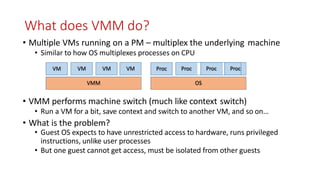
• Multiple VMs running on a PM – multiplex the underlying machine
• Similar to how OS multiplexes processes on CPU
• VMM performs machine switch (much like context switch)
• Run a VM for a bit, save context and switch to another VM, and so on…
• What is the problem?
• Guest OS expects to have unrestricted access to hardware, runs privileged
instructions, unlike user processes
• But one guest cannot get access, must be isolated from other guests
VM
VMM
VM
VM VM Proc
OS
Proc Proc Proc
Trap and emulate VMM (1)
• All CPUs have multiple privilege levels
• Ring 0,1,2,3 in x86 CPUs
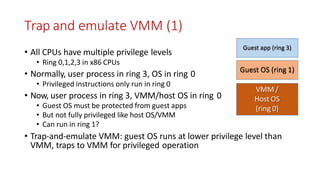
• Normally, user process in ring 3, OS in ring 0
• Privileged instructions only run in ring 0
• Now, user process in ring 3, VMM/host OS in ring 0
• Guest OS must be protected from guest apps
• But not fully privileged like host OS/VMM
• Can run in ring 1?
• Trap-and-emulate VMM: guest OS runs at lower privilege level than
VMM, traps to VMM for privileged operation
Guest app (ring 3)
Guest OS (ring 1)
VMM /
Host OS
(ring 0)
Trap and emulate VMM (2)
• Guest app has to handle syscall/interrupt
• Special trap instr (int n), traps to VMM
• VMM doesn’t know how to handle trap
• VMM jumps to guest OS trap handler
• Trap handled by guest OS normally
• Guest OS performs return from trap
• Privileged instr, traps to VMM
• VMM jumps to corresponding user process
• Any privileged action by guest OS traps to VMM, emulated by VMM
• Example: set IDT, set CR3, access hardware
• Sensitive data structures like IDT must be managed by VMM, not guest OS
Guest app
(ring 3)
Guest OS
(ring 1)
VMM /
Host OS
(ring 0)
Trap and
emulate
Problems with trap and emulate
• Guest OS may realize it is running at lower privilege level
• Some registers in x86 reflect CPU privilege level (code segment/CS)
• Guest OS can read these values and get offended!
• Some x86 instructions which change hardware state (sensitive
instructions) run in both privileged and unprivileged modes
• Will behave differently when guest OS is in ring 0 vs in less privileged ring 1
• OS behaves incorrectly in ring1, will not trap to VMM
• Why these problems?
• OSes not developed to run at a lower privilege level
• Instruction set architecture of x86 is not easily virtualizable (x86 wasn’t
designed with virtualization in mind)
Example: Problems with trap and emulate
• Eflags register is a set of CPU flags
• IF (interrupt flag) indicates if interrupts on/off
• Consider the popf instruction in x86
• Pops values on top of stack and sets eflags
• Executed in ring 0, all flags set normally
• Executed in ring 1, only some flags set
• IF is not set as it is privileged flag
• So, popf is a sensitive instruction, not
privileged, does not trap, behaves differently
when executed in different privilege levels
• Guest OS is buggy in ring 1
CPU
EIP
EAX EDX
…..
Eflags
Code/data
Heap
Stack
…..
Popek Goldberg theorem
• Sensitive instruction = changes hardware state
• Privileged instruction = runs only in privileged mode
• Traps to ring 0 if executed from unprivileged rings
• In order to build a VMM efficiently via trap-and-emulate method,
sensitive instructions should be a subset of privileged instructions
• x86 does not satisfy this criteria, so trap and emulate VMM is not possible
Sensitive
instructions
Privileged
instructions
CPU instructions
x86
Techniques to virtualize x86 (1)
• Paravirtualization: rewrite guest OS code to be virtualizable
• Guest OS won’t invoke privileged operations, makes “hypercalls” to VMM
• Needs OS source code changes, cannot work with unmodified OS
• Example: Xen hypervisor
• Full virtualization: CPU instructions of guest OS are translated to be
virtualizable
• Sensitive instructions translated to trap to VMM
• Dynamic (on the fly) binary translation, so works with unmodified OS
• Higher overhead than paravirtualization
• Example: VMWare workstation
Techniques to virtualize x86 (2)
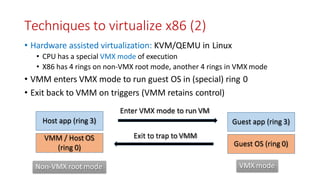
• Hardware assisted virtualization: KVM/QEMU in Linux
• CPU has a special VMX mode of execution
• X86 has 4 rings on non-VMX root mode, another 4 rings in VMX mode
• VMM enters VMX mode to run guest OS in (special) ring 0
• Exit back to VMM on triggers (VMM retains control)
Guest app (ring 3)
Guest OS (ring 0)
Host app (ring 3)
VMM / Host OS
(ring 0)
Non-VMX root mode VMX mode
Enter VMX mode to run VM
Exit to trap to VMM
Memory virtualization
• What about address translation in virtual machines?
Page
Guest
Virtual Addresses (GVA)
Guest
Physical Addresses (GPA)
Address = Y
Address = Z
Address = X
Host/Machine
Physical Addresses (HPA)
Address = Y’
Address = Z’
Address = X’
Guest page table VMM / Host page table
Techniques for memory virtualization
• Guest page table has GVAGPA mapping
• Each guest OS thinks it has access to all RAM starting at address 0
• VMM / Host OS has GPAHPA mapping
• Guest “RAM” pages are distributed across host memory
• Which page table should MMU use?
• Shadow paging: VMM creates a combined mapping GVAHPA and MMU
is given a pointer to this page table
• VMM tracks changes to guest page table and updates shadow page table
• Extended page tables (EPT): MMU hardware is aware of virtualization,
takes pointers to two separate page tables
• Address translation walks both page tables
• EPT is more efficient but requires hardware support
I/O Virtualization
• Guest OS needs to access I/O devices, but cannot give full control of
I/O to any one guest OS
• Two main techniques for I/O virtualization:
• Emulation: guest OS I/O operations trap to VMM, emulated by doing I/O in
VMM/host OS
• Direct I/O or device passthrough: assign a slice of a device directly to each VM
• Many optimizations exist, active area of research
Summary
• Techniques for CPU virtualization
• Paravirtualization: rewrite guest OS source code
• Full virtualization: dynamic binary translation
• Hardware-assisted virtualization: CPU has special virtualization mode
• Techniques for memory virtualization:
• Shadow page tables: combined GVAHPA mappings
• Extended page tables: MMU is given separate GVAGPA and GPAHPA
mappings
• I/O virtualization: emulation, device passthrough
• VMMs use a combination of above techniques
• We will study all of the above techniques in detail

003-vmm.pptx

  • 1.
    CS 695: Virtualizationand Cloud Computing Lecture 3: Techniques to design Virtual Machine Monitors Mythili Vutukuru IIT Bombay Spring 2021
  • 2.
    What does VMMdo? • Multiple VMs running on a PM – multiplex the underlying machine • Similar to how OS multiplexes processes on CPU • VMM performs machine switch (much like context switch) • Run a VM for a bit, save context and switch to another VM, and so on… • What is the problem? • Guest OS expects to have unrestricted access to hardware, runs privileged instructions, unlike user processes • But one guest cannot get access, must be isolated from other guests VM VMM VM VM VM Proc OS Proc Proc Proc
  • 3.
    Trap and emulateVMM (1) • All CPUs have multiple privilege levels • Ring 0,1,2,3 in x86 CPUs • Normally, user process in ring 3, OS in ring 0 • Privileged instructions only run in ring 0 • Now, user process in ring 3, VMM/host OS in ring 0 • Guest OS must be protected from guest apps • But not fully privileged like host OS/VMM • Can run in ring 1? • Trap-and-emulate VMM: guest OS runs at lower privilege level than VMM, traps to VMM for privileged operation Guest app (ring 3) Guest OS (ring 1) VMM / Host OS (ring 0)
  • 4.
    Trap and emulateVMM (2) • Guest app has to handle syscall/interrupt • Special trap instr (int n), traps to VMM • VMM doesn’t know how to handle trap • VMM jumps to guest OS trap handler • Trap handled by guest OS normally • Guest OS performs return from trap • Privileged instr, traps to VMM • VMM jumps to corresponding user process • Any privileged action by guest OS traps to VMM, emulated by VMM • Example: set IDT, set CR3, access hardware • Sensitive data structures like IDT must be managed by VMM, not guest OS Guest app (ring 3) Guest OS (ring 1) VMM / Host OS (ring 0) Trap and emulate
  • 5.
    Problems with trapand emulate • Guest OS may realize it is running at lower privilege level • Some registers in x86 reflect CPU privilege level (code segment/CS) • Guest OS can read these values and get offended! • Some x86 instructions which change hardware state (sensitive instructions) run in both privileged and unprivileged modes • Will behave differently when guest OS is in ring 0 vs in less privileged ring 1 • OS behaves incorrectly in ring1, will not trap to VMM • Why these problems? • OSes not developed to run at a lower privilege level • Instruction set architecture of x86 is not easily virtualizable (x86 wasn’t designed with virtualization in mind)
  • 6.
    Example: Problems withtrap and emulate • Eflags register is a set of CPU flags • IF (interrupt flag) indicates if interrupts on/off • Consider the popf instruction in x86 • Pops values on top of stack and sets eflags • Executed in ring 0, all flags set normally • Executed in ring 1, only some flags set • IF is not set as it is privileged flag • So, popf is a sensitive instruction, not privileged, does not trap, behaves differently when executed in different privilege levels • Guest OS is buggy in ring 1 CPU EIP EAX EDX ….. Eflags Code/data Heap Stack …..
  • 7.
    Popek Goldberg theorem •Sensitive instruction = changes hardware state • Privileged instruction = runs only in privileged mode • Traps to ring 0 if executed from unprivileged rings • In order to build a VMM efficiently via trap-and-emulate method, sensitive instructions should be a subset of privileged instructions • x86 does not satisfy this criteria, so trap and emulate VMM is not possible Sensitive instructions Privileged instructions CPU instructions x86
  • 8.
    Techniques to virtualizex86 (1) • Paravirtualization: rewrite guest OS code to be virtualizable • Guest OS won’t invoke privileged operations, makes “hypercalls” to VMM • Needs OS source code changes, cannot work with unmodified OS • Example: Xen hypervisor • Full virtualization: CPU instructions of guest OS are translated to be virtualizable • Sensitive instructions translated to trap to VMM • Dynamic (on the fly) binary translation, so works with unmodified OS • Higher overhead than paravirtualization • Example: VMWare workstation
  • 9.
    Techniques to virtualizex86 (2) • Hardware assisted virtualization: KVM/QEMU in Linux • CPU has a special VMX mode of execution • X86 has 4 rings on non-VMX root mode, another 4 rings in VMX mode • VMM enters VMX mode to run guest OS in (special) ring 0 • Exit back to VMM on triggers (VMM retains control) Guest app (ring 3) Guest OS (ring 0) Host app (ring 3) VMM / Host OS (ring 0) Non-VMX root mode VMX mode Enter VMX mode to run VM Exit to trap to VMM
  • 10.
    Memory virtualization • Whatabout address translation in virtual machines? Page Guest Virtual Addresses (GVA) Guest Physical Addresses (GPA) Address = Y Address = Z Address = X Host/Machine Physical Addresses (HPA) Address = Y’ Address = Z’ Address = X’ Guest page table VMM / Host page table
  • 11.
    Techniques for memoryvirtualization • Guest page table has GVAGPA mapping • Each guest OS thinks it has access to all RAM starting at address 0 • VMM / Host OS has GPAHPA mapping • Guest “RAM” pages are distributed across host memory • Which page table should MMU use? • Shadow paging: VMM creates a combined mapping GVAHPA and MMU is given a pointer to this page table • VMM tracks changes to guest page table and updates shadow page table • Extended page tables (EPT): MMU hardware is aware of virtualization, takes pointers to two separate page tables • Address translation walks both page tables • EPT is more efficient but requires hardware support
  • 12.
    I/O Virtualization • GuestOS needs to access I/O devices, but cannot give full control of I/O to any one guest OS • Two main techniques for I/O virtualization: • Emulation: guest OS I/O operations trap to VMM, emulated by doing I/O in VMM/host OS • Direct I/O or device passthrough: assign a slice of a device directly to each VM • Many optimizations exist, active area of research
  • 13.
    Summary • Techniques forCPU virtualization • Paravirtualization: rewrite guest OS source code • Full virtualization: dynamic binary translation • Hardware-assisted virtualization: CPU has special virtualization mode • Techniques for memory virtualization: • Shadow page tables: combined GVAHPA mappings • Extended page tables: MMU is given separate GVAGPA and GPAHPA mappings • I/O virtualization: emulation, device passthrough • VMMs use a combination of above techniques • We will study all of the above techniques in detail