1
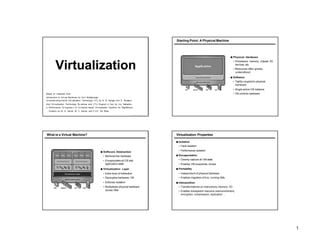
What is a Virtual Machine?
Behaveslike hardware
Encapsulates all OS and
application state
Extra level of indirection
Decouples hardware, OS
Enforces isolation
Multiplexes physical hardware
across VMs
Virtualization Properties
Fault isolation
Performance isolation
Cleanly capture all VM state
Enables VM snapshots, clones
Independent of physical hardware
Enables migration of live, running VMs
Transformations on instructions, memory, I/O
Enables transparent resource overcommitment,
encryption, compression, replication …
Virtualization
Based on materials from:
Introduction to Virt ual Machines by Ca rl Waldspurger
Un dersta nding Inte l® Virt ualization Technology (VT) by N. B. Sahgal and D. Rodgers
Inte l Virt ualization Technology Ro admap and VT-d Support in Xen by Jun Nakajima
A Performance Co mpariso n of Co ntainer-based Virt ualization Systems for MapReduce
Clusters by M. G. Xavier, M. V. Neves, and C.A.F. De Rose
© 2010VM ware Inc .Allrights reserv ed
Starting Point: A Physical Machine
Processors, memory, chipset, I/O
devices, etc.
Tightly coupled to physical
Single active OS instance
OS controls hardware
2
Types of Virtualization
Higher performance
ESX, Xen, HyperV, KVM
Easier to install
Leverage host’s device drivers
VMware Workstation, Parallels
Attribution: http://itechthoughts.wordpress.com/tag/full-virtualization/
Types of Virtualization
Unmodified OS, virtualization is transparent to OS
OS modified to be virtualized
Attribution http://forums.techarena.in/guides-tutorials/1104460.htm
Virtualization Applications Types of Virtualization
3
Processor Virtualization
Attribution: http://itechthoughts.wordpress.com/tag/full-virtualization/
Trap and Emulate
What is a Virtual Machine Monitor?
Equivalent execution: Programs running in the virtualized environment run
identically to running natively.
Performance: A statistically dominant subset of the instructions must be
executed directly on the CPU.
Safety and isolation: A VMM most completely control system resources.
What Needs to Virtualized Virtualized?
Privileged
Unprivileged
4
Processor Paravirtualization
Page table updates
HW Support
Codenamed "Vanderpool"
Available since Itanium 2 (2005), Xeon and Centrino (2006)
AMD-V
Codename “Pacifica”
Available since Athlon 64 (2006)
x86 Virtualization Challenges
x86 ISA includes instructions that read or modify privileged state
But which don’t trap in unprivileged mode
Pop top-of-stack into EFLAGS register
EFLAGS.IF bit privileged (interrupt enable flag)
POPF silently ignores attempts to alter EFLAGS.IF in unprivileged mode!
So no trap to return control to VMM
x86 Virtualization Approaches
5
VM Entry and VM Exit
■ VM Entry
■ VM Exit
■ VMM can control which instructions cause VM exists
Benefits: VT Helps Improve VMMs
Eliminates need for binary patching / translation
Facilitates support for Legacy OS
Eliminates need for complex SW techniques
Simpler and smaller VMMs
Smaller trusted-computing base
Intel VT-x Operating Modes
Fully privileged, intended for VM monitor
Not fully privileged, intended for guest software
Reduces Guest SW privilege w/o relying on rings
Solution to Ring Aliasing and Ring Compression
6
Memory Virtualization Techniques
TLB invalidation requests, page table creation, write to existing page tables
x86 Memory Management Primer
Maps virtual to physical page addresses
CR3 points to page table root
HW walks the page tables
Inserts virtual to physical mapping
7
Issues with Nested Page Tables
Simplifies monitor design
Guest page table is in physical address space
Need to walk PhysMap multiple times
•
•
Memory Reclamation
Memory Paravirtualization
VMM validates that guest owns machine address
Hardware Support
Since Corei7 (2008)
Since Opteron and Phenom II (2007)
8
Page Sharing I/O Virtualization
Page Sharing
9
Direct Mapped/PCI Passthrough Hardware Support
AMD-Vi
IO Paravirtualization
10
Operating System Level Virtualization
Shared operating system
A group of OS processes in an insolated environment
Lightweight virtualization layer
Operating System-Level Virtualization
Each container has:
•
•
•
•
•
•
Intel VT-d VT-d Applied to Pass-through Model
11
Hypervisor vs. System-Level Virtualization
Hypervisor OS-Level/Container
Different Kernel OS Single Kernel
Device Emulation Syscall
Limits per machine Limits per process
Higher overhead Lower overhead
More secure Less secure

Virtualization for computing servers and cloud

  • 1.
    1 What is aVirtual Machine? Behaveslike hardware Encapsulates all OS and application state Extra level of indirection Decouples hardware, OS Enforces isolation Multiplexes physical hardware across VMs Virtualization Properties Fault isolation Performance isolation Cleanly capture all VM state Enables VM snapshots, clones Independent of physical hardware Enables migration of live, running VMs Transformations on instructions, memory, I/O Enables transparent resource overcommitment, encryption, compression, replication … Virtualization Based on materials from: Introduction to Virt ual Machines by Ca rl Waldspurger Un dersta nding Inte l® Virt ualization Technology (VT) by N. B. Sahgal and D. Rodgers Inte l Virt ualization Technology Ro admap and VT-d Support in Xen by Jun Nakajima A Performance Co mpariso n of Co ntainer-based Virt ualization Systems for MapReduce Clusters by M. G. Xavier, M. V. Neves, and C.A.F. De Rose © 2010VM ware Inc .Allrights reserv ed Starting Point: A Physical Machine Processors, memory, chipset, I/O devices, etc. Tightly coupled to physical Single active OS instance OS controls hardware
  • 2.
    2 Types of Virtualization Higherperformance ESX, Xen, HyperV, KVM Easier to install Leverage host’s device drivers VMware Workstation, Parallels Attribution: http://itechthoughts.wordpress.com/tag/full-virtualization/ Types of Virtualization Unmodified OS, virtualization is transparent to OS OS modified to be virtualized Attribution http://forums.techarena.in/guides-tutorials/1104460.htm Virtualization Applications Types of Virtualization
  • 3.
    3 Processor Virtualization Attribution: http://itechthoughts.wordpress.com/tag/full-virtualization/ Trapand Emulate What is a Virtual Machine Monitor? Equivalent execution: Programs running in the virtualized environment run identically to running natively. Performance: A statistically dominant subset of the instructions must be executed directly on the CPU. Safety and isolation: A VMM most completely control system resources. What Needs to Virtualized Virtualized? Privileged Unprivileged
  • 4.
    4 Processor Paravirtualization Page tableupdates HW Support Codenamed "Vanderpool" Available since Itanium 2 (2005), Xeon and Centrino (2006) AMD-V Codename “Pacifica” Available since Athlon 64 (2006) x86 Virtualization Challenges x86 ISA includes instructions that read or modify privileged state But which don’t trap in unprivileged mode Pop top-of-stack into EFLAGS register EFLAGS.IF bit privileged (interrupt enable flag) POPF silently ignores attempts to alter EFLAGS.IF in unprivileged mode! So no trap to return control to VMM x86 Virtualization Approaches
  • 5.
    5 VM Entry andVM Exit ■ VM Entry ■ VM Exit ■ VMM can control which instructions cause VM exists Benefits: VT Helps Improve VMMs Eliminates need for binary patching / translation Facilitates support for Legacy OS Eliminates need for complex SW techniques Simpler and smaller VMMs Smaller trusted-computing base Intel VT-x Operating Modes Fully privileged, intended for VM monitor Not fully privileged, intended for guest software Reduces Guest SW privilege w/o relying on rings Solution to Ring Aliasing and Ring Compression
  • 6.
    6 Memory Virtualization Techniques TLBinvalidation requests, page table creation, write to existing page tables x86 Memory Management Primer Maps virtual to physical page addresses CR3 points to page table root HW walks the page tables Inserts virtual to physical mapping
  • 7.
    7 Issues with NestedPage Tables Simplifies monitor design Guest page table is in physical address space Need to walk PhysMap multiple times • • Memory Reclamation Memory Paravirtualization VMM validates that guest owns machine address Hardware Support Since Corei7 (2008) Since Opteron and Phenom II (2007)
  • 8.
    8 Page Sharing I/OVirtualization Page Sharing
  • 9.
    9 Direct Mapped/PCI PassthroughHardware Support AMD-Vi IO Paravirtualization
  • 10.
    10 Operating System LevelVirtualization Shared operating system A group of OS processes in an insolated environment Lightweight virtualization layer Operating System-Level Virtualization Each container has: • • • • • • Intel VT-d VT-d Applied to Pass-through Model
  • 11.
    11 Hypervisor vs. System-LevelVirtualization Hypervisor OS-Level/Container Different Kernel OS Single Kernel Device Emulation Syscall Limits per machine Limits per process Higher overhead Lower overhead More secure Less secure