OS vs. VMM
Hwanju Kim
1
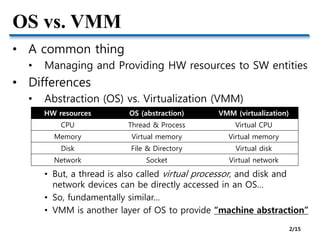
OS vs. VMM
• A common thing
• Managing and Providing HW resources to SW entities
• Differences
• Abstraction (OS) vs. Virtualization (VMM)
• But, a thread is also called virtual processor, and disk and
network devices can be directly accessed in an OS…
• So, fundamentally similar…
• VMM is another layer of OS to provide “machine abstraction”
HW resources OS (abstraction) VMM (virtualization)
CPU Thread & Process Virtual CPU
Memory Virtual memory Virtual memory
Disk File & Directory Virtual disk
Network Socket Virtual network
2/15
CPU Virtualization
• Privileged level
• VMM makes OS step down to less-privileged layer
• VMM must trap and virtualize any OS’s attempt to
run privileged operations
OS
Application
VMM
OS
Application
OS VMM
[Issue] How to trap and virtualize OS’s privileged operations
3/15
CPU Management
• Another scheduling layer: “VMM scheduler”
Virtual
CPU
OS VMM
[Issue] How to efficiently schedule virtual CPUs 4/15
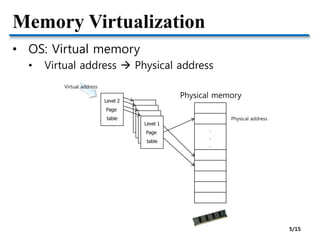
Memory Virtualization
• OS: Virtual memory
• Virtual address  Physical address
Level 2
Page
table
Page
table
Page
table
Page
table
Level 1
Page
table
.
.
.
Physical memory
Virtual address
Physical address
5/15
Memory Virtualization
• VMM: “Virtualizing virtual memory”
• Virtual  Physical  Machine
Level 2
Page
table
Page
table
Page
table
Page
table
Level 1
Page
table
.
.
.
Machine memory
Virtual address
Physical
to
Machine
Pseudo physical
memory
Terminology
- Xen
Virtual  (Pseudo) Physical  Machine
- Others (general)
Guest-virtual  Guest-physical  Host-physical
[Issue] How to transparently and efficiently
manage additional memory translation 6/15
Memory Management
• Memory sharing
• OS
• Parent-child copy-on-write sharing
• VMM
• No semantic of parent-child relationship
• Content-based page sharing invented by VMware [OSDI’02]
• Memory oversubscription (to be explained later)
VM 1 VM 2
Machine Memory
[Issue] How to efficiently use limited memory by avoiding
redundant and idle memory 7/15
I/O Virtualization
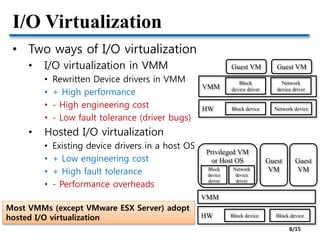
• Two ways of I/O virtualization
• I/O virtualization in VMM
• Rewritten Device drivers in VMM
• + High performance
• - High engineering cost
• - Low fault tolerance (driver bugs)
• Hosted I/O virtualization
• Existing device drivers in a host OS
• + Low engineering cost
• + High fault tolerance
• - Performance overheads
VMM
Guest VM
Block
device driver
Network
device driver
HW Block device Network device
Guest VM
VMM
Privileged VM
or Host OS
Block
device
driver
HW Block device Block device
Guest
VMNetwork
device
driver
Guest
VM
Most VMMs (except VMware ESX Server) adopt
hosted I/O virtualization
8/15
Block I/O Virtualization
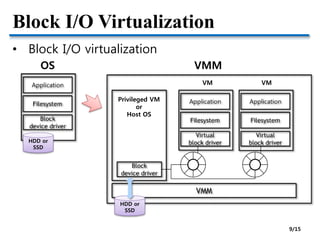
• Block I/O virtualization
HDD or
SSD
VM VM
Privileged VM
or
Host OS
HDD or
SSD
OS VMM
9/15
Network I/O Virtualization
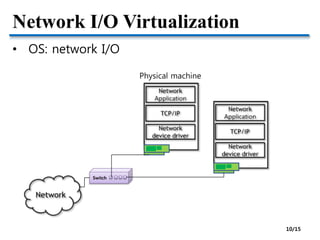
• OS: network I/O
Physical machine
Switch
10/15
Network I/O Virtualization
• VMM: Virtualizing network devices
VM VMPrivileged VM or Host OS
Virtual
switch
[Issue] How to achieve near-native I/O performance? 11/15
OS over VMM
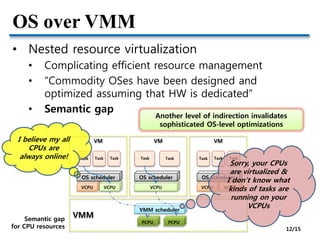
• Nested resource virtualization
• Complicating efficient resource management
• “Commodity OSes have been designed and
optimized assuming that HW is dedicated”
• Semantic gap
PCPU
VMM scheduler
PCPU
VCPU VCPU
OS scheduler
VCPU
OS scheduler
VMM
VM VM VM
VCPU VCPU
OS scheduler
Task Task Task Task Task TaskTask Task
I believe my all
CPUs are
always online!
Sorry, your CPUs
are virtualized &
I don’t know what
kinds of tasks are
running on your
VCPUs
Another level of indirection invalidates
sophisticated OS-level optimizations
Semantic gap
for CPU resources 12/15
Nested Virtualization
• IBM’s Turtles project [OSDI’10]
• Nesting is being continued…
• Nesting is being needed…
• Cloud of cloud
• Gang migration
• Hypervisor development
Guest VMM
Guest
VM
Host VMM
HW
Guest VMM
Guest
VM
Guest
VM
Guest
VM
Microkernels Meet Recursive Virtual Machines [OSDI’96]
13/15
Nested Virtualization is Not New
• Theoretical analysis
• [IEEE Computer’74], [Commun. ACM’74], [SIGOPS rev’75]
• Hardware architecture
• [ACM’75]
• Nested virtualization on IBM z/VM
• [IBM system journal’91]
• Microkernel-based nested virtualization
• [OSDI’96]
• Nested virtualization on KVM with AMD
• [Linux Plumbers Conference’09]
• Nested virtualization on Xen
• [Xen summit’09]
• Blue Pill
• [Blackhat’09]
14/15
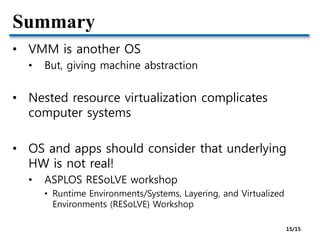
Summary
• VMM is another OS
• But, giving machine abstraction
• Nested resource virtualization complicates
computer systems
• OS and apps should consider that underlying
HW is not real!
• ASPLOS RESoLVE workshop
• Runtime Environments/Systems, Layering, and Virtualized
Environments (RESoLVE) Workshop
15/15

2. OS vs. VMM

  • 1.
  • 2.
    OS vs. VMM •A common thing • Managing and Providing HW resources to SW entities • Differences • Abstraction (OS) vs. Virtualization (VMM) • But, a thread is also called virtual processor, and disk and network devices can be directly accessed in an OS… • So, fundamentally similar… • VMM is another layer of OS to provide “machine abstraction” HW resources OS (abstraction) VMM (virtualization) CPU Thread & Process Virtual CPU Memory Virtual memory Virtual memory Disk File & Directory Virtual disk Network Socket Virtual network 2/15
  • 3.
    CPU Virtualization • Privilegedlevel • VMM makes OS step down to less-privileged layer • VMM must trap and virtualize any OS’s attempt to run privileged operations OS Application VMM OS Application OS VMM [Issue] How to trap and virtualize OS’s privileged operations 3/15
  • 4.
    CPU Management • Anotherscheduling layer: “VMM scheduler” Virtual CPU OS VMM [Issue] How to efficiently schedule virtual CPUs 4/15
  • 5.
    Memory Virtualization • OS:Virtual memory • Virtual address  Physical address Level 2 Page table Page table Page table Page table Level 1 Page table . . . Physical memory Virtual address Physical address 5/15
  • 6.
    Memory Virtualization • VMM:“Virtualizing virtual memory” • Virtual  Physical  Machine Level 2 Page table Page table Page table Page table Level 1 Page table . . . Machine memory Virtual address Physical to Machine Pseudo physical memory Terminology - Xen Virtual  (Pseudo) Physical  Machine - Others (general) Guest-virtual  Guest-physical  Host-physical [Issue] How to transparently and efficiently manage additional memory translation 6/15
  • 7.
    Memory Management • Memorysharing • OS • Parent-child copy-on-write sharing • VMM • No semantic of parent-child relationship • Content-based page sharing invented by VMware [OSDI’02] • Memory oversubscription (to be explained later) VM 1 VM 2 Machine Memory [Issue] How to efficiently use limited memory by avoiding redundant and idle memory 7/15
  • 8.
    I/O Virtualization • Twoways of I/O virtualization • I/O virtualization in VMM • Rewritten Device drivers in VMM • + High performance • - High engineering cost • - Low fault tolerance (driver bugs) • Hosted I/O virtualization • Existing device drivers in a host OS • + Low engineering cost • + High fault tolerance • - Performance overheads VMM Guest VM Block device driver Network device driver HW Block device Network device Guest VM VMM Privileged VM or Host OS Block device driver HW Block device Block device Guest VMNetwork device driver Guest VM Most VMMs (except VMware ESX Server) adopt hosted I/O virtualization 8/15
  • 9.
    Block I/O Virtualization •Block I/O virtualization HDD or SSD VM VM Privileged VM or Host OS HDD or SSD OS VMM 9/15
  • 10.
    Network I/O Virtualization •OS: network I/O Physical machine Switch 10/15
  • 11.
    Network I/O Virtualization •VMM: Virtualizing network devices VM VMPrivileged VM or Host OS Virtual switch [Issue] How to achieve near-native I/O performance? 11/15
  • 12.
    OS over VMM •Nested resource virtualization • Complicating efficient resource management • “Commodity OSes have been designed and optimized assuming that HW is dedicated” • Semantic gap PCPU VMM scheduler PCPU VCPU VCPU OS scheduler VCPU OS scheduler VMM VM VM VM VCPU VCPU OS scheduler Task Task Task Task Task TaskTask Task I believe my all CPUs are always online! Sorry, your CPUs are virtualized & I don’t know what kinds of tasks are running on your VCPUs Another level of indirection invalidates sophisticated OS-level optimizations Semantic gap for CPU resources 12/15
  • 13.
    Nested Virtualization • IBM’sTurtles project [OSDI’10] • Nesting is being continued… • Nesting is being needed… • Cloud of cloud • Gang migration • Hypervisor development Guest VMM Guest VM Host VMM HW Guest VMM Guest VM Guest VM Guest VM Microkernels Meet Recursive Virtual Machines [OSDI’96] 13/15
  • 14.
    Nested Virtualization isNot New • Theoretical analysis • [IEEE Computer’74], [Commun. ACM’74], [SIGOPS rev’75] • Hardware architecture • [ACM’75] • Nested virtualization on IBM z/VM • [IBM system journal’91] • Microkernel-based nested virtualization • [OSDI’96] • Nested virtualization on KVM with AMD • [Linux Plumbers Conference’09] • Nested virtualization on Xen • [Xen summit’09] • Blue Pill • [Blackhat’09] 14/15
  • 15.
    Summary • VMM isanother OS • But, giving machine abstraction • Nested resource virtualization complicates computer systems • OS and apps should consider that underlying HW is not real! • ASPLOS RESoLVE workshop • Runtime Environments/Systems, Layering, and Virtualized Environments (RESoLVE) Workshop 15/15