
Transportation Engineering – II (Town Planning)
1/7/2018
Prof. S.K. Patil, www.skpatil.com 1
.
Course Learning Outcomes:
• At the end of this session, the student will be able to explain
necessity of village planning
Village Settlements
Prof. (Dr.) Sachin Kishor Patil
B.E. Civil, M.E. Civil Environmental Engineering, Ph.D. (IIT, Bombay)
❑ Professor & Head of Department
❑ Department of Civil Engineering
❑ AMGOI, Vathar, Kolhapur, MH, India.
1/7/2018
Prof. S.K. Patil, www.skpatil.com 2
Disclaimer and acknowledgment
The study material presented by Prof. S K Patil is licensed under
The study material presented herewith is web sourced made
available for community use under Creative Commons Attribution-
NonCommercial-ShareAlike 3.0 unported License.
If you feel the ownership of some of the content, I can acknowledge
or remove as the case may be. Permissions beyond the scope of this
license can be requested at www.skpatil.com
Necessity of Village Planning
1/15/2018Prof.S.K.Patil,www.skpatil.com
3
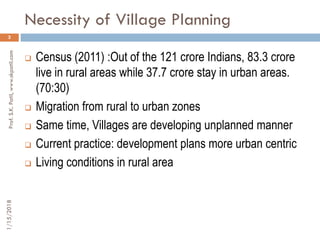
 Census (2011) :Out of the 121 crore Indians, 83.3 crore
live in rural areas while 37.7 crore stay in urban areas.
(70:30)
 Migration from rural to urban zones
 Same time, Villages are developing unplanned manner
 Current practice: development plans more urban centric
 Living conditions in rural area
Comparison of rural and urban area
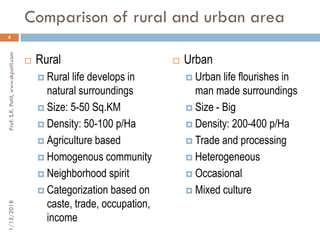
 Rural
 Rural life develops in
natural surroundings
 Size: 5-50 Sq.KM
 Density: 50-100 p/Ha
 Agriculture based
 Homogenous community
 Neighborhood spirit
 Categorization based on
caste, trade, occupation,
income
 Urban
 Urban life flourishes in
man made surroundings
 Size - Big
 Density: 200-400 p/Ha
 Trade and processing
 Heterogeneous
 Occasional
 Mixed culture
1/15/2018
4
Prof.S.K.Patil,www.skpatil.com
Village types :Rural Settlements
1/15/2018Prof.S.K.Patil,www.skpatil.com
5
 Nucleated (clustered) settlement
 Linear settlement
 Scattered (dispersed) settlement
 Nucleated (clustered) settlement
 Most houses centered around common place (e.g. temple)
 Growth happens in concentric rings
 Seen around plain areas
Village types :Rural Settlements
1/15/2018Prof.S.K.Patil,www.skpatil.com
6
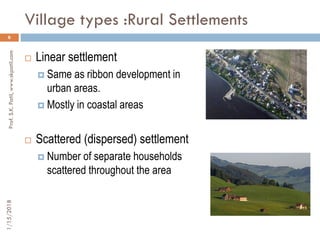
 Linear settlement
 Same as ribbon development in
urban areas.
 Mostly in coastal areas
 Scattered (dispersed) settlement
 Number of separate households
scattered throughout the area
Principles of village planning
1/15/2018Prof.S.K.Patil,www.skpatil.com
7
 Most principles of urban planning can be applied except specialized
constraint
 Ideal Location- Cultivable land and water
 Communication
 Arterial road should not cross through
 Approach road should link arterial road
 Proper roads to nearby villages and towns- Accessibilty
 Village Centre
 Hub, Gram-panchayat, temple, market
 Accessible
 Neighborhood unit planning
Village development
1/15/2018Prof.S.K.Patil,www.skpatil.com
8
 Replan
 Master Plan
 Conflict resolutions

3.4 village planning

  • 1.
    Transportation Engineering –II (Town Planning) 1/7/2018 Prof. S.K. Patil, www.skpatil.com 1 . Course Learning Outcomes: • At the end of this session, the student will be able to explain necessity of village planning Village Settlements
  • 2.
    Prof. (Dr.) SachinKishor Patil B.E. Civil, M.E. Civil Environmental Engineering, Ph.D. (IIT, Bombay) ❑ Professor & Head of Department ❑ Department of Civil Engineering ❑ AMGOI, Vathar, Kolhapur, MH, India. 1/7/2018 Prof. S.K. Patil, www.skpatil.com 2 Disclaimer and acknowledgment The study material presented by Prof. S K Patil is licensed under The study material presented herewith is web sourced made available for community use under Creative Commons Attribution- NonCommercial-ShareAlike 3.0 unported License. If you feel the ownership of some of the content, I can acknowledge or remove as the case may be. Permissions beyond the scope of this license can be requested at www.skpatil.com
  • 3.
    Necessity of VillagePlanning 1/15/2018Prof.S.K.Patil,www.skpatil.com 3  Census (2011) :Out of the 121 crore Indians, 83.3 crore live in rural areas while 37.7 crore stay in urban areas. (70:30)  Migration from rural to urban zones  Same time, Villages are developing unplanned manner  Current practice: development plans more urban centric  Living conditions in rural area
  • 4.
    Comparison of ruraland urban area  Rural  Rural life develops in natural surroundings  Size: 5-50 Sq.KM  Density: 50-100 p/Ha  Agriculture based  Homogenous community  Neighborhood spirit  Categorization based on caste, trade, occupation, income  Urban  Urban life flourishes in man made surroundings  Size - Big  Density: 200-400 p/Ha  Trade and processing  Heterogeneous  Occasional  Mixed culture 1/15/2018 4 Prof.S.K.Patil,www.skpatil.com
  • 5.
    Village types :RuralSettlements 1/15/2018Prof.S.K.Patil,www.skpatil.com 5  Nucleated (clustered) settlement  Linear settlement  Scattered (dispersed) settlement  Nucleated (clustered) settlement  Most houses centered around common place (e.g. temple)  Growth happens in concentric rings  Seen around plain areas
  • 6.
    Village types :RuralSettlements 1/15/2018Prof.S.K.Patil,www.skpatil.com 6  Linear settlement  Same as ribbon development in urban areas.  Mostly in coastal areas  Scattered (dispersed) settlement  Number of separate households scattered throughout the area
  • 7.
    Principles of villageplanning 1/15/2018Prof.S.K.Patil,www.skpatil.com 7  Most principles of urban planning can be applied except specialized constraint  Ideal Location- Cultivable land and water  Communication  Arterial road should not cross through  Approach road should link arterial road  Proper roads to nearby villages and towns- Accessibilty  Village Centre  Hub, Gram-panchayat, temple, market  Accessible  Neighborhood unit planning
  • 8.