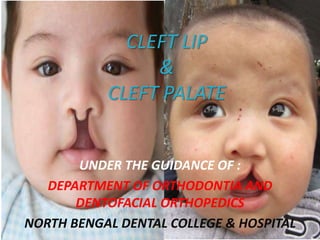

CLEFT LIP
&
CLEFT PALATE
UNDER THE GUIDANCE OF :
DEPARTMENT OF ORTHODONTIA AND
DENTOFACIAL ORTHOPEDICS
NORTH BENGAL DENTAL COLLEGE & HOSPITAL
INTRODUCTION
• Cleft Lip: It is a birth defect which results in a
unilateral or bilateral opening in the upper lip
between the mouth and nose.
• Cleft palate: ‘A breach in continuity of palate’
or ‘A furrow in the palatal vault’.
It is a birth defect characterised by an opening in
the roof of the mouth caused by lack of tissue
development.
*Most commonly seen congenital deformities at
the time of birth.
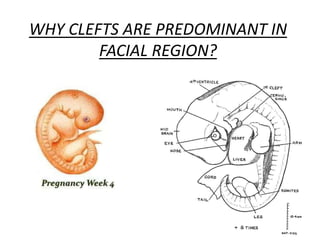
WHY CLEFTS ARE PREDOMINANT IN
FACIAL REGION?
WHY CLEFTS ARE PREDOMINANT IN
FACIAL REGION?
• Heart develops and starts to pump before the
development of facial structures.
• Development of face is very complex
procedure as many processes have to be fuse
with each others so it requires more inherent
developmental force.
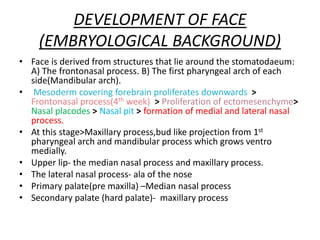
HISTORICAL REVIEW
• Parea,a French surgeon in 1561 first try to put an obturator
to fill the cavity produced by cleft to facilitate eating and
speech.
• Le Monnier in 1764 tried to repair cleft palate surgically.
(all surgical approach are failed due to the tension developed
at the median suture.)
* In 1826 Dieffenbach suggested separation of soft tissues of
palate from underlyimg bone & recommended use of lateral
relaxation incision in the soft tissue of hard palate to close
palate.
*Ferguson in 1844 & Von langenback in 1862 create
mucoperiosteal flap by elevating periosteum with palatal
mucosa.
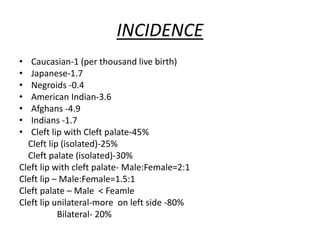
INCIDENCE
• Caucasian-1 (per thousand live birth)
• Japanese-1.7
• Negroids -0.4
• American Indian-3.6
• Afghans -4.9
• Indians -1.7
• Cleft lip with Cleft palate-45%
Cleft lip (isolated)-25%
Cleft palate (isolated)-30%
Cleft lip with cleft palate- Male:Female=2:1
Cleft lip – Male:Female=1.5:1
Cleft palate – Male < Feamle
Cleft lip unilateral-more on left side -80%
Bilateral- 20%
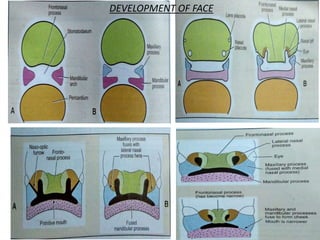
DEVELOPMENT OF FACE
(EMBRYOLOGICAL BACKGROUND)
• Face is derived from structures that lie around the stomatodaeum:
A) The frontonasal process. B) The first pharyngeal arch of each
side(Mandibular arch).
• Mesoderm covering forebrain proliferates downwards >
Frontonasal process(4th week) > Proliferation of ectomesenchyme>
Nasal placodes > Nasal pit > formation of medial and lateral nasal
process.
• At this stage>Maxillary process,bud like projection from 1st
pharyngeal arch and mandibular process which grows ventro
medially.
• Upper lip- the median nasal process and maxillary process.
• The lateral nasal process- ala of the nose
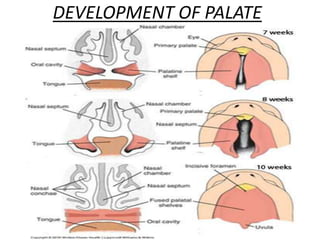
• Primary palate(pre maxilla) –Median nasal process
• Secondary palate (hard palate)- maxillary process
DEVELOPMENT OF FACE
DEVELOPMENT OF PALATE
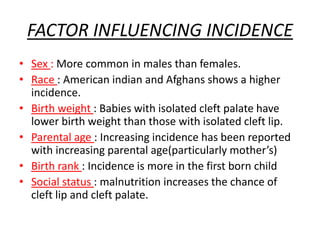
FACTOR INFLUENCING INCIDENCE
• Sex : More common in males than females.
• Race : American indian and Afghans shows a higher
incidence.
• Birth weight : Babies with isolated cleft palate have
lower birth weight than those with isolated cleft lip.
• Parental age : Increasing incidence has been reported
with increasing parental age(particularly mother’s)
• Birth rank : Incidence is more in the first born child
• Social status : malnutrition increases the chance of
cleft lip and cleft palate.
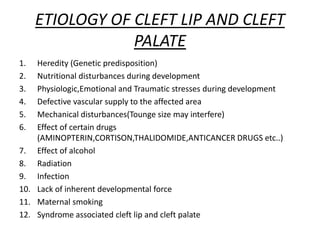
ETIOLOGY OF CLEFT LIP AND CLEFT
PALATE
1. Heredity (Genetic predisposition)
2. Nutritional disturbances during development
3. Physiologic,Emotional and Traumatic stresses during development
4. Defective vascular supply to the affected area
5. Mechanical disturbances(Tounge size may interfere)
6. Effect of certain drugs
(AMINOPTERIN,CORTISON,THALIDOMIDE,ANTICANCER DRUGS etc..)
7. Effect of alcohol
8. Radiation
9. Infection
10. Lack of inherent developmental force
11. Maternal smoking
12. Syndrome associated cleft lip and cleft palate
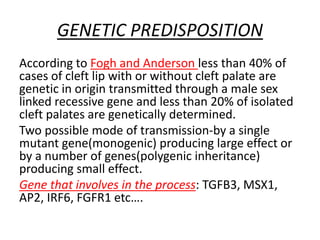
GENETIC PREDISPOSITION
According to Fogh and Anderson less than 40% of
cases of cleft lip with or without cleft palate are
genetic in origin transmitted through a male sex
linked recessive gene and less than 20% of isolated
cleft palates are genetically determined.
Two possible mode of transmission-by a single
mutant gene(monogenic) producing large effect or
by a number of genes(polygenic inheritance)
producing small effect.
Gene that involves in the process: TGFB3, MSX1,
AP2, IRF6, FGFR1 etc….
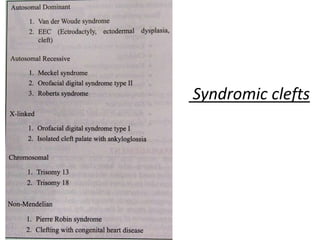
Syndromic clefts
THEORIES OF
CLEFT LIP AND CLEFT PALATE
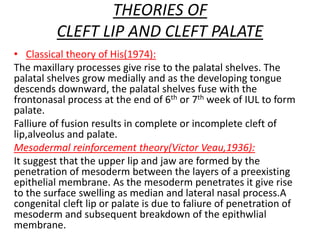
• Classical theory of His(1974):
The maxillary processes give rise to the palatal shelves. The
palatal shelves grow medially and as the developing tongue
descends downward, the palatal shelves fuse with the
frontonasal process at the end of 6th or 7th week of IUL to form
palate.
Falliure of fusion results in complete or incomplete cleft of
lip,alveolus and palate.
Mesodermal reinforcement theory(Victor Veau,1936):
It suggest that the upper lip and jaw are formed by the
penetration of mesoderm between the layers of a preexisting
epithelial membrane. As the mesoderm penetrates it give rise
to the surface swelling as median and lateral nasal process.A
congenital cleft lip or palate is due to faliure of penetration of
mesoderm and subsequent breakdown of the epithwlial
membrane.
CLASSIFICATION OF
CLEFT LIP AND CLEFT PALATE
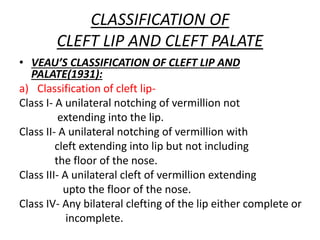
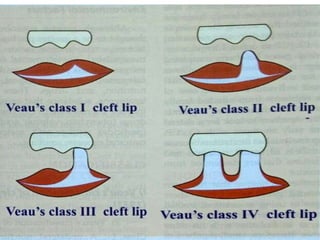
• VEAU’S CLASSIFICATION OF CLEFT LIP AND
PALATE(1931):
a) Classification of cleft lip-
Class I- A unilateral notching of vermillion not
extending into the lip.
Class II- A unilateral notching of vermillion with
cleft extending into lip but not including
the floor of the nose.
Class III- A unilateral cleft of vermillion extending
upto the floor of the nose.
Class IV- Any bilateral clefting of the lip either complete or
incomplete.
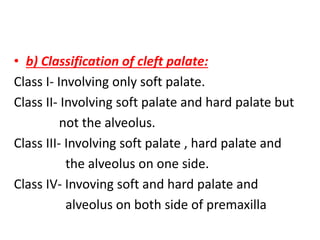
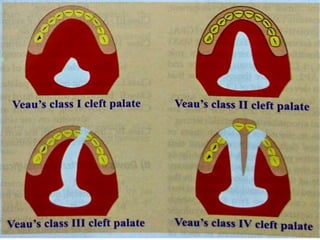
• b) Classification of cleft palate:
Class I- Involving only soft palate.
Class II- Involving soft palate and hard palate but
not the alveolus.
Class III- Involving soft palate , hard palate and
the alveolus on one side.
Class IV- Invoving soft and hard palate and
alveolus on both side of premaxilla
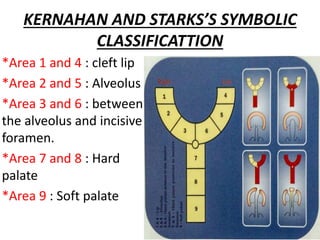
KERNAHAN AND STARKS’S SYMBOLIC
CLASSIFICATTION
*Area 1 and 4 : cleft lip
*Area 2 and 5 : Alveolus
*Area 3 and 6 : between
the alveolus and incisive
foramen.
*Area 7 and 8 : Hard
palate
*Area 9 : Soft palate
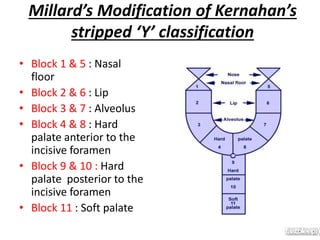
Millard’s Modification of Kernahan’s
stripped ‘Y’ classification
• Block 1 & 5 : Nasal
floor
• Block 2 & 6 : Lip
• Block 3 & 7 : Alveolus
• Block 4 & 8 : Hard
palate anterior to the
incisive foramen
• Block 9 & 10 : Hard
palate posterior to the
incisive foramen
• Block 11 : Soft palate
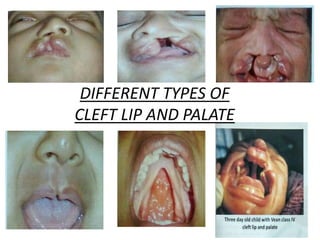
DIFFERENT TYPES OF
CLEFT LIP AND PALATE
PROBLEMS ASSOCIATED WITH
CLEFT LIP AND CLEFT PALATE
• Psychological problem: The disfigurement caused by the condition
is enough to cause Psychological stress for the patient and the
family. The child often has to put uo with staring, teasing ,pity etc…
• Dental problem:
1. Multiple missing teeth(mainly upper lateral incisor)
2. Mobile premaxilla
3. Anterior & Posterior cross bite
4. Ectopically erupting teeth
5. Impacted teeth
6. Supernumeraries
7. Poor oral hygine
8. Multiple decayed teeth
9. Periodontal complication
• Esthetic problem
• Insufficient suction to pull milk from nipple.
• Excessive air intake during feeding
• Chocking
• Nasal regurgitation
• Speech defect and hearing problem
• Respiratory tract infection
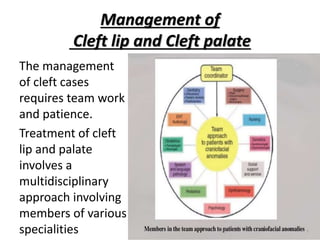
Management of
Cleft lip and Cleft palate
The management
of cleft cases
requires team work
and patience.
Treatment of cleft
lip and palate
involves a
multidisciplinary
approach involving
members of various
specialities
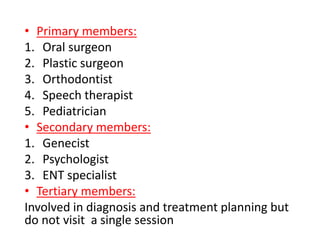
• Primary members:
1. Oral surgeon
2. Plastic surgeon
3. Orthodontist
4. Speech therapist
5. Pediatrician
• Secondary members:
1. Genecist
2. Psychologist
3. ENT specialist
• Tertiary members:
Involved in diagnosis and treatment planning but
do not visit a single session
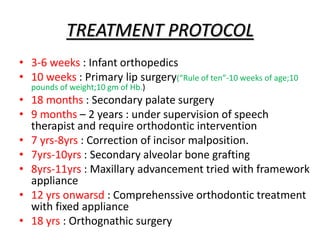
TREATMENT PROTOCOL
• 3-6 weeks : Infant orthopedics
• 10 weeks : Primary lip surgery(“Rule of ten”-10 weeks of age;10
pounds of weight;10 gm of Hb.)
• 18 months : Secondary palate surgery
• 9 months – 2 years : under supervision of speech
therapist and require orthodontic intervention
• 7 yrs-8yrs : Correction of incisor malposition.
• 7yrs-10yrs : Secondary alveolar bone grafting
• 8yrs-11yrs : Maxillary advancement tried with framework
appliance
• 12 yrs onwarsd : Comprehenssive orthodontic treatment
with fixed appliance
• 18 yrs : Orthognathic surgery
TREATMENT
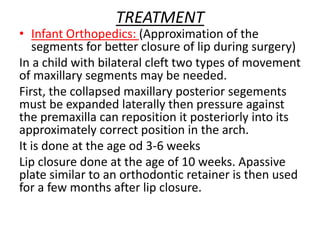
• Infant Orthopedics: (Approximation of the
segments for better closure of lip during surgery)
In a child with bilateral cleft two types of movement
of maxillary segments may be needed.
First, the collapsed maxillary posterior segements
must be expanded laterally then pressure against
the premaxilla can reposition it posteriorly into its
approximately correct position in the arch.
It is done at the age od 3-6 weeks
Lip closure done at the age of 10 weeks. Apassive
plate similar to an orthodontic retainer is then used
for a few months after lip closure.
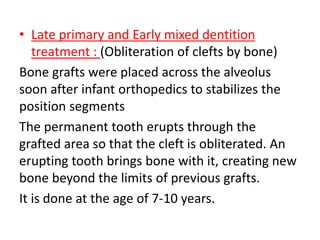
• Late primary and Early mixed dentition
treatment : (Obliteration of clefts by bone)
Bone grafts were placed across the alveolus
soon after infant orthopedics to stabilizes the
position segments
The permanent tooth erupts through the
grafted area so that the cleft is obliterated. An
erupting tooth brings bone with it, creating new
bone beyond the limits of previous grafts.
It is done at the age of 7-10 years.
• Early permanent dentition treatment: (closing of the spaces
caused by missing teeth)
A resin bonded bridge that provides a semipermanent
replacement of missing teeth can be extremely helpful.
Orthodontic tooth movement may be needed and orthodontic
treatment is often completed at the age of 14 years but a
permanent bridge can not be placed untill age 17 or 18 years.
This is done at the age of 12-18 years.
• Orthognathic surgery: (Final correction and Esthetics)
Orhtognathic surgery to bring deficient maxilla downward and
forward or surgical mandibular setback may be nedded.
Prosthetic rehabilitation fixed permanent bridges.
Lip revision , nasal correction and the restoration of
nasophiltral angle.
This is done at 18years onwards
REFERENCES
• CONTEMPORARY ORTHODONTICS
FIFTH EDITION
WILLIAM R. PROFFIT, HENRY W. FIELDS,
DAVID M. SARVER
• TEXT BOOK OF ORTHODONTICS
THIRD EDITION
GURKEERAT SINGH
Cleft lip & cleft palate

Cleft lip & cleft palate

  • 1.
    CLEFT LIP & CLEFT PALATE UNDERTHE GUIDANCE OF : DEPARTMENT OF ORTHODONTIA AND DENTOFACIAL ORTHOPEDICS NORTH BENGAL DENTAL COLLEGE & HOSPITAL
  • 2.
    INTRODUCTION • Cleft Lip:It is a birth defect which results in a unilateral or bilateral opening in the upper lip between the mouth and nose. • Cleft palate: ‘A breach in continuity of palate’ or ‘A furrow in the palatal vault’. It is a birth defect characterised by an opening in the roof of the mouth caused by lack of tissue development. *Most commonly seen congenital deformities at the time of birth.
  • 3.
    WHY CLEFTS AREPREDOMINANT IN FACIAL REGION?
  • 4.
    WHY CLEFTS AREPREDOMINANT IN FACIAL REGION? • Heart develops and starts to pump before the development of facial structures. • Development of face is very complex procedure as many processes have to be fuse with each others so it requires more inherent developmental force.
  • 5.
    HISTORICAL REVIEW • Parea,aFrench surgeon in 1561 first try to put an obturator to fill the cavity produced by cleft to facilitate eating and speech. • Le Monnier in 1764 tried to repair cleft palate surgically. (all surgical approach are failed due to the tension developed at the median suture.) * In 1826 Dieffenbach suggested separation of soft tissues of palate from underlyimg bone & recommended use of lateral relaxation incision in the soft tissue of hard palate to close palate. *Ferguson in 1844 & Von langenback in 1862 create mucoperiosteal flap by elevating periosteum with palatal mucosa.
  • 6.
    INCIDENCE • Caucasian-1 (perthousand live birth) • Japanese-1.7 • Negroids -0.4 • American Indian-3.6 • Afghans -4.9 • Indians -1.7 • Cleft lip with Cleft palate-45% Cleft lip (isolated)-25% Cleft palate (isolated)-30% Cleft lip with cleft palate- Male:Female=2:1 Cleft lip – Male:Female=1.5:1 Cleft palate – Male < Feamle Cleft lip unilateral-more on left side -80% Bilateral- 20%
  • 7.
    DEVELOPMENT OF FACE (EMBRYOLOGICALBACKGROUND) • Face is derived from structures that lie around the stomatodaeum: A) The frontonasal process. B) The first pharyngeal arch of each side(Mandibular arch). • Mesoderm covering forebrain proliferates downwards > Frontonasal process(4th week) > Proliferation of ectomesenchyme> Nasal placodes > Nasal pit > formation of medial and lateral nasal process. • At this stage>Maxillary process,bud like projection from 1st pharyngeal arch and mandibular process which grows ventro medially. • Upper lip- the median nasal process and maxillary process. • The lateral nasal process- ala of the nose • Primary palate(pre maxilla) –Median nasal process • Secondary palate (hard palate)- maxillary process
  • 8.
  • 9.
  • 10.
    FACTOR INFLUENCING INCIDENCE •Sex : More common in males than females. • Race : American indian and Afghans shows a higher incidence. • Birth weight : Babies with isolated cleft palate have lower birth weight than those with isolated cleft lip. • Parental age : Increasing incidence has been reported with increasing parental age(particularly mother’s) • Birth rank : Incidence is more in the first born child • Social status : malnutrition increases the chance of cleft lip and cleft palate.
  • 11.
    ETIOLOGY OF CLEFTLIP AND CLEFT PALATE 1. Heredity (Genetic predisposition) 2. Nutritional disturbances during development 3. Physiologic,Emotional and Traumatic stresses during development 4. Defective vascular supply to the affected area 5. Mechanical disturbances(Tounge size may interfere) 6. Effect of certain drugs (AMINOPTERIN,CORTISON,THALIDOMIDE,ANTICANCER DRUGS etc..) 7. Effect of alcohol 8. Radiation 9. Infection 10. Lack of inherent developmental force 11. Maternal smoking 12. Syndrome associated cleft lip and cleft palate
  • 12.
    GENETIC PREDISPOSITION According toFogh and Anderson less than 40% of cases of cleft lip with or without cleft palate are genetic in origin transmitted through a male sex linked recessive gene and less than 20% of isolated cleft palates are genetically determined. Two possible mode of transmission-by a single mutant gene(monogenic) producing large effect or by a number of genes(polygenic inheritance) producing small effect. Gene that involves in the process: TGFB3, MSX1, AP2, IRF6, FGFR1 etc….
  • 13.
  • 14.
    THEORIES OF CLEFT LIPAND CLEFT PALATE • Classical theory of His(1974): The maxillary processes give rise to the palatal shelves. The palatal shelves grow medially and as the developing tongue descends downward, the palatal shelves fuse with the frontonasal process at the end of 6th or 7th week of IUL to form palate. Falliure of fusion results in complete or incomplete cleft of lip,alveolus and palate. Mesodermal reinforcement theory(Victor Veau,1936): It suggest that the upper lip and jaw are formed by the penetration of mesoderm between the layers of a preexisting epithelial membrane. As the mesoderm penetrates it give rise to the surface swelling as median and lateral nasal process.A congenital cleft lip or palate is due to faliure of penetration of mesoderm and subsequent breakdown of the epithwlial membrane.
  • 15.
    CLASSIFICATION OF CLEFT LIPAND CLEFT PALATE • VEAU’S CLASSIFICATION OF CLEFT LIP AND PALATE(1931): a) Classification of cleft lip- Class I- A unilateral notching of vermillion not extending into the lip. Class II- A unilateral notching of vermillion with cleft extending into lip but not including the floor of the nose. Class III- A unilateral cleft of vermillion extending upto the floor of the nose. Class IV- Any bilateral clefting of the lip either complete or incomplete.
  • 17.
    • b) Classificationof cleft palate: Class I- Involving only soft palate. Class II- Involving soft palate and hard palate but not the alveolus. Class III- Involving soft palate , hard palate and the alveolus on one side. Class IV- Invoving soft and hard palate and alveolus on both side of premaxilla
  • 19.
    KERNAHAN AND STARKS’SSYMBOLIC CLASSIFICATTION *Area 1 and 4 : cleft lip *Area 2 and 5 : Alveolus *Area 3 and 6 : between the alveolus and incisive foramen. *Area 7 and 8 : Hard palate *Area 9 : Soft palate
  • 20.
    Millard’s Modification ofKernahan’s stripped ‘Y’ classification • Block 1 & 5 : Nasal floor • Block 2 & 6 : Lip • Block 3 & 7 : Alveolus • Block 4 & 8 : Hard palate anterior to the incisive foramen • Block 9 & 10 : Hard palate posterior to the incisive foramen • Block 11 : Soft palate
  • 21.
  • 22.
    PROBLEMS ASSOCIATED WITH CLEFTLIP AND CLEFT PALATE • Psychological problem: The disfigurement caused by the condition is enough to cause Psychological stress for the patient and the family. The child often has to put uo with staring, teasing ,pity etc… • Dental problem: 1. Multiple missing teeth(mainly upper lateral incisor) 2. Mobile premaxilla 3. Anterior & Posterior cross bite 4. Ectopically erupting teeth 5. Impacted teeth 6. Supernumeraries 7. Poor oral hygine 8. Multiple decayed teeth 9. Periodontal complication
  • 23.
    • Esthetic problem •Insufficient suction to pull milk from nipple. • Excessive air intake during feeding • Chocking • Nasal regurgitation • Speech defect and hearing problem • Respiratory tract infection
  • 24.
    Management of Cleft lipand Cleft palate The management of cleft cases requires team work and patience. Treatment of cleft lip and palate involves a multidisciplinary approach involving members of various specialities
  • 25.
    • Primary members: 1.Oral surgeon 2. Plastic surgeon 3. Orthodontist 4. Speech therapist 5. Pediatrician • Secondary members: 1. Genecist 2. Psychologist 3. ENT specialist • Tertiary members: Involved in diagnosis and treatment planning but do not visit a single session
  • 26.
    TREATMENT PROTOCOL • 3-6weeks : Infant orthopedics • 10 weeks : Primary lip surgery(“Rule of ten”-10 weeks of age;10 pounds of weight;10 gm of Hb.) • 18 months : Secondary palate surgery • 9 months – 2 years : under supervision of speech therapist and require orthodontic intervention • 7 yrs-8yrs : Correction of incisor malposition. • 7yrs-10yrs : Secondary alveolar bone grafting • 8yrs-11yrs : Maxillary advancement tried with framework appliance • 12 yrs onwarsd : Comprehenssive orthodontic treatment with fixed appliance • 18 yrs : Orthognathic surgery
  • 27.
    TREATMENT • Infant Orthopedics:(Approximation of the segments for better closure of lip during surgery) In a child with bilateral cleft two types of movement of maxillary segments may be needed. First, the collapsed maxillary posterior segements must be expanded laterally then pressure against the premaxilla can reposition it posteriorly into its approximately correct position in the arch. It is done at the age od 3-6 weeks Lip closure done at the age of 10 weeks. Apassive plate similar to an orthodontic retainer is then used for a few months after lip closure.
  • 28.
    • Late primaryand Early mixed dentition treatment : (Obliteration of clefts by bone) Bone grafts were placed across the alveolus soon after infant orthopedics to stabilizes the position segments The permanent tooth erupts through the grafted area so that the cleft is obliterated. An erupting tooth brings bone with it, creating new bone beyond the limits of previous grafts. It is done at the age of 7-10 years.
  • 29.
    • Early permanentdentition treatment: (closing of the spaces caused by missing teeth) A resin bonded bridge that provides a semipermanent replacement of missing teeth can be extremely helpful. Orthodontic tooth movement may be needed and orthodontic treatment is often completed at the age of 14 years but a permanent bridge can not be placed untill age 17 or 18 years. This is done at the age of 12-18 years. • Orthognathic surgery: (Final correction and Esthetics) Orhtognathic surgery to bring deficient maxilla downward and forward or surgical mandibular setback may be nedded. Prosthetic rehabilitation fixed permanent bridges. Lip revision , nasal correction and the restoration of nasophiltral angle. This is done at 18years onwards
  • 30.
    REFERENCES • CONTEMPORARY ORTHODONTICS FIFTHEDITION WILLIAM R. PROFFIT, HENRY W. FIELDS, DAVID M. SARVER • TEXT BOOK OF ORTHODONTICS THIRD EDITION GURKEERAT SINGH