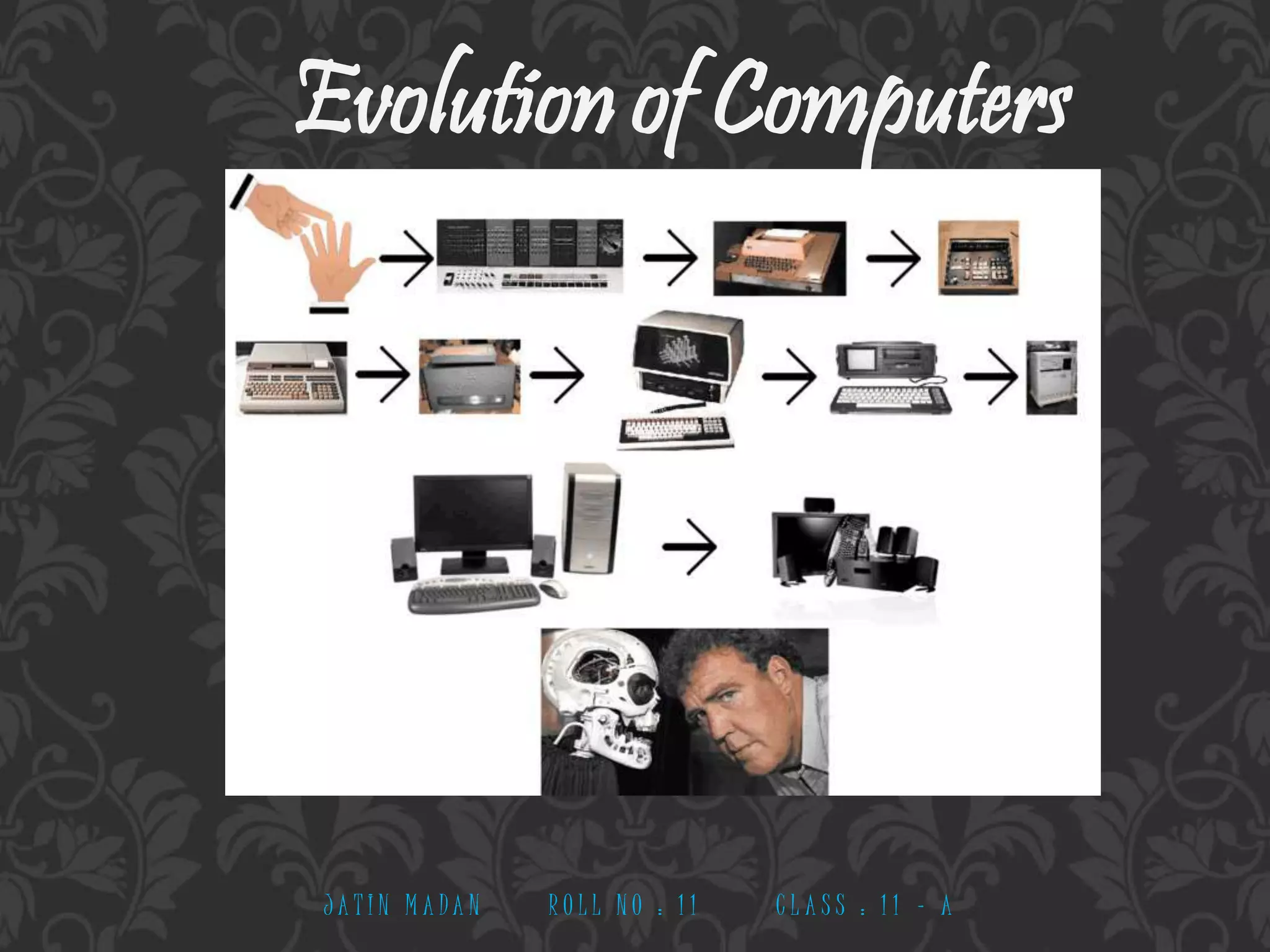

Evolution of Computers
J A T I N M A DA N R O L L N O : 1 1 C L A S S : 1 1 - A
BIBLIOGRAPHY
 Topics taken from :-
Sumita Arora
Wikipedia
 Source of Information :-
http://en.wikipedia.org/wiki/Computer
*Wikipedia
*Sumita Arora (C++)
 Source of Images :-
https://www.google.co.in/search?espv=2&biw=1364&bih=707&tbm=isch&sa
=1&q=evolution+of+computer&btnG
J A T I N M A D A N R O L L N O : 1 1 C L A S S : 1 1 - A
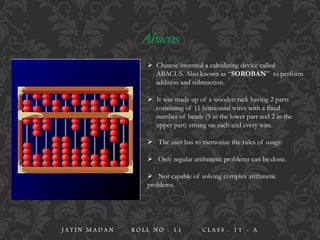
 Chinese invented a calculating device called
ABACUS. Also known as “SOROBAN” to perform
addition and subtraction.
 It was made up of a wooden rack having 2 parts
consisting of 11 horizontal wires with a fixed
number of beads (5 in the lower part and 2 in the
upper part) strung on each and every wire.
 The user has to memorize the rules of usage.
 Only regular arithmetic problems can be done.
 Not capable of solving complex arithmetic
problems.
Abacus
J A T I N M A D A N R O L L N O : 1 1 C L A S S : 1 1 - A
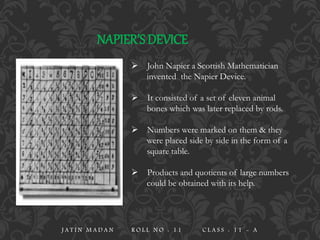
NAPIER’S DEVICE
 John Napier a Scottish Mathematician
invented the Napier Device.
 It consisted of a set of eleven animal
bones which was later replaced by rods.
 Numbers were marked on them & they
were placed side by side in the form of a
square table.
 Products and quotients of large numbers
could be obtained with its help.
J A T I N M A D A N R O L L N O : 1 1 C L A S S : 1 1 - A
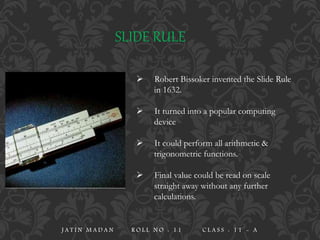
SLIDE RULE
 Robert Bissoker invented the Slide Rule
in 1632.
 It turned into a popular computing
device
 It could perform all arithmetic &
trigonometric functions.
 Final value could be read on scale
straight away without any further
calculations.
J A T I N M A D A N R O L L N O : 1 1 C L A S S : 1 1 - A
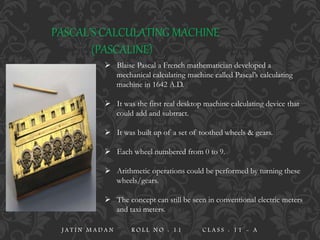
PASCAL’S CALCULATING MACHINE
(PASCALINE)
 Blaise Pascal a French mathematician developed a
mechanical calculating machine called Pascal’s calculating
machine in 1642 A.D.
 It was the first real desktop machine calculating device that
could add and subtract.
 It was built up of a set of toothed wheels & gears.
 Each wheel numbered from 0 to 9.
 Arithmetic operations could be performed by turning these
wheels/gears.
 The concept can still be seen in conventional electric meters
and taxi meters.
J A T I N M A D A N R O L L N O : 1 1 C L A S S : 1 1 - A
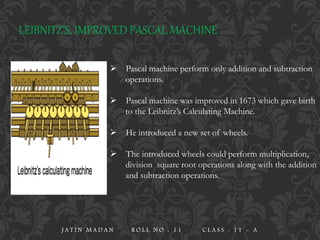
LEIBNITZ’S, IMPROVED PASCAL MACHINE
 Pascal machine perform only addition and subtraction
operations.
 Pascal machine was improved in 1673 which gave birth
to the Leibnitz’s Calculating Machine.
 He introduced a new set of wheels.
 The introduced wheels could perform multiplication,
division square root operations along with the addition
and subtraction operations.
J A T I N M A D A N R O L L N O : 1 1 C L A S S : 1 1 - A
PUNCHED CARD MACHINE
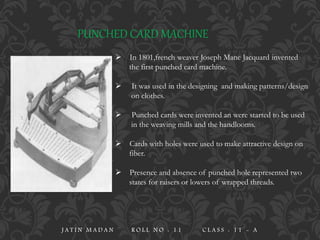
 In 1801,french weaver Joseph Mane Jacquard invented
the first punched card machine.
 It was used in the designing and making patterns/design
on clothes.
 Punched cards were invented an were started to be used
in the weaving mills and the handlooms.
 Cards with holes were used to make attractive design on
fiber.
 Presence and absence of punched hole represented two
states for raisers or lowers of wrapped threads.
J A T I N M A D A N R O L L N O : 1 1 C L A S S : 1 1 - A
CHARLES BABBAGE’S ENGINE
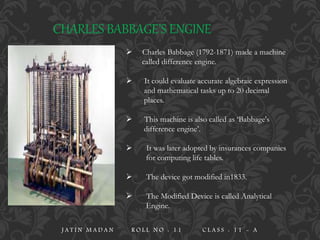
 Charles Babbage (1792-1871) made a machine
called difference engine.
 It could evaluate accurate algebraic expression
and mathematical tasks up to 20 decimal
places.
 This machine is also called as ‘Babbage's
difference engine’.
 It was later adopted by insurances companies
for computing life tables.
 The device got modified in1833.
 The Modified Device is called Analytical
Engine.
J A T I N M A D A N R O L L N O : 1 1 C L A S S : 1 1 - A
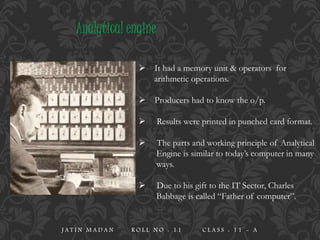
 It had a memory unit & operators for
arithmetic operations.
 Producers had to know the o/p.
 Results were printed in punched card format.
 The parts and working principle of Analytical
Engine is similar to today’s computer in many
ways.
 Due to his gift to the IT Sector, Charles
Babbage is called “Father of computer”.
Analytical engine
J A T I N M A D A N R O L L N O : 1 1 C L A S S : 1 1 - A
HOLLERITHIS CARD READING
MACHINE
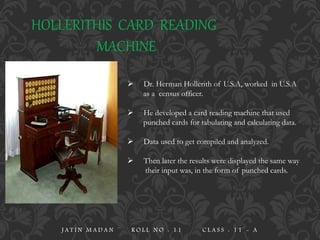
 Dr. Herman Hollerith of U.S.A, worked in U.S.A
as a census officer.
 He developed a card reading machine that used
punched cards for tabulating and calculating data.
 Data used to get compiled and analyzed.
 Then later the results were displayed the same way
their input was, in the form of punched cards.
J A T I N M A D A N R O L L N O : 1 1 C L A S S : 1 1 - A
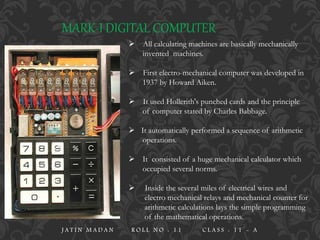
MARK-I DIGITAL COMPUTER
 All calculating machines are basically mechanically
invented machines.
 First electro-mechanical computer was developed in
1937 by Howard Aiken.
 It used Hollerith's punched cards and the principle
of computer stated by Charles Babbage.
 It automatically performed a sequence of arithmetic
operations.
 It consisted of a huge mechanical calculator which
occupied several norms.
 Inside the several miles of electrical wires and
electro mechanical relays and mechanical counter for
arithmetic calculations lays the simple programming
of the mathematical operations.
J A T I N M A D A N R O L L N O : 1 1 C L A S S : 1 1 - A
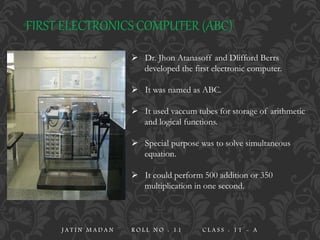
FIRST ELECTRONICS COMPUTER (ABC)
 Dr. Jhon Atanasoff and Dlifford Berrs
developed the first electronic computer.
 It was named as ABC.
 It used vaccum tubes for storage of arithmetic
and logical functions.
 Special purpose was to solve simultaneous
equation.
 It could perform 500 addition or 350
multiplication in one second.
J A T I N M A D A N R O L L N O : 1 1 C L A S S : 1 1 - A
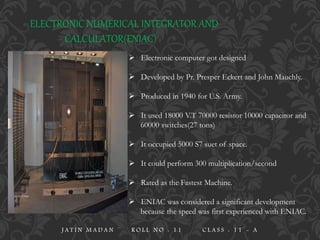
ELECTRONIC NUMERICAL INTEGRATOR AND
CALCULATOR(ENIAC)
 Electronic computer got designed
 Developed by Pr. Presper Eckert and John Mauchly.
 Produced in 1940 for U.S. Army.
 It used 18000 V.T 70000 resistor 10000 capacitor and
60000 switches(27 tons)
 It occupied 5000 S7 suet of space.
 It could perform 300 multiplication/second
 Rated as the Fastest Machine.
 ENIAC was considered a significant development
because the speed was first experienced with ENIAC.
J A T I N M A D A N R O L L N O : 1 1 C L A S S : 1 1 - A
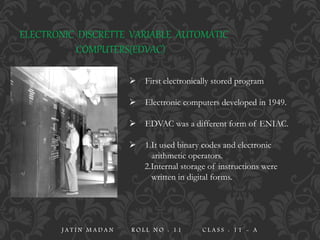
ELECTRONIC DISCRETTE VARIABLE AUTOMATIC
COMPUTERS(EDVAC)
 First electronically stored program
 Electronic computers developed in 1949.
 EDVAC was a different form of ENIAC.
 1.It used binary codes and electronic
arithmetic operators.
2.Internal storage of instructions were
written in digital forms.
J A T I N M A D A N R O L L N O : 1 1 C L A S S : 1 1 - A
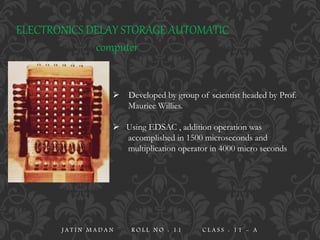
ELECTRONICS DELAY STORAGE AUTOMATIC
computer
 Developed by group of scientist headed by Prof.
Mauriee Willies.
 Using EDSAC , addition operation was
accomplished in 1500 microseconds and
multiplication operator in 4000 micro seconds
J A T I N M A D A N R O L L N O : 1 1 C L A S S : 1 1 - A
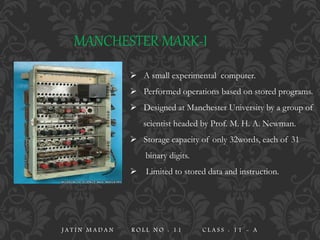
MANCHESTER MARK-I
 A small experimental computer.
 Performed operations based on stored programs.
 Designed at Manchester University by a group of
scientist headed by Prof. M. H. A. Newman.
 Storage capacity of only 32words, each of 31
binary digits.
 Limited to stored data and instruction.
J A T I N M A D A N R O L L N O : 1 1 C L A S S : 1 1 - A
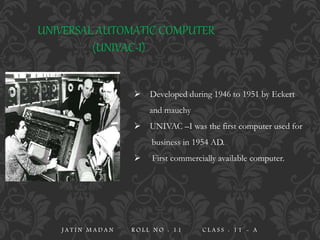
UNIVERSAL AUTOMATIC COMPUTER
(UNIVAC-I)
 Developed during 1946 to 1951 by Eckert
and mauchy
 UNIVAC –I was the first computer used for
business in 1954 AD.
 First commercially available computer.
J A T I N M A D A N R O L L N O : 1 1 C L A S S : 1 1 - A
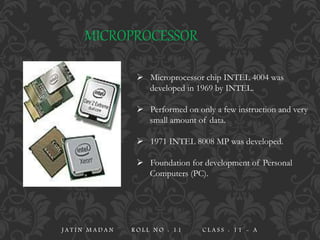
MICROPROCESSOR
 Microprocessor chip INTEL 4004 was
developed in 1969 by INTEL.
 Performed on only a few instruction and very
small amount of data.
 1971 INTEL 8008 MP was developed.
 Foundation for development of Personal
Computers (PC).
J A T I N M A D A N R O L L N O : 1 1 C L A S S : 1 1 - A
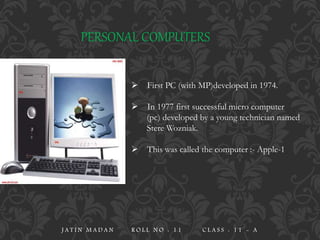
PERSONAL COMPUTERS
 First PC (with MP)developed in 1974.
 In 1977 first successful micro computer
(pc) developed by a young technician named
Stere Wozniak.
 This was called the computer :- Apple-1
J A T I N M A D A N R O L L N O : 1 1 C L A S S : 1 1 - A
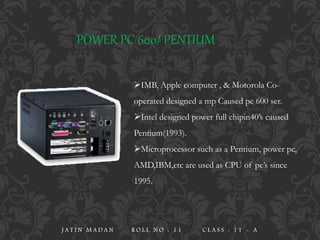
IMB, Apple computer , & Motorola Co-
operated designed a mp Caused pc 600 ser.
Intel designed power full chipin40’s caused
Pentium(1993).
Microprocessor such as a Pentium, power pc,
AMD,IBM,etc are used as CPU of pc’s since
1995.
POWER PC 600/ PENTIUM
J A T I N M A D A N R O L L N O : 1 1 C L A S S : 1 1 - A

Evolution of computers

  • 1.
    Evolution of Computers JA T I N M A DA N R O L L N O : 1 1 C L A S S : 1 1 - A
  • 2.
    BIBLIOGRAPHY  Topics takenfrom :- Sumita Arora Wikipedia  Source of Information :- http://en.wikipedia.org/wiki/Computer *Wikipedia *Sumita Arora (C++)  Source of Images :- https://www.google.co.in/search?espv=2&biw=1364&bih=707&tbm=isch&sa =1&q=evolution+of+computer&btnG J A T I N M A D A N R O L L N O : 1 1 C L A S S : 1 1 - A
  • 3.
     Chinese inventeda calculating device called ABACUS. Also known as “SOROBAN” to perform addition and subtraction.  It was made up of a wooden rack having 2 parts consisting of 11 horizontal wires with a fixed number of beads (5 in the lower part and 2 in the upper part) strung on each and every wire.  The user has to memorize the rules of usage.  Only regular arithmetic problems can be done.  Not capable of solving complex arithmetic problems. Abacus J A T I N M A D A N R O L L N O : 1 1 C L A S S : 1 1 - A
  • 4.
    NAPIER’S DEVICE  JohnNapier a Scottish Mathematician invented the Napier Device.  It consisted of a set of eleven animal bones which was later replaced by rods.  Numbers were marked on them & they were placed side by side in the form of a square table.  Products and quotients of large numbers could be obtained with its help. J A T I N M A D A N R O L L N O : 1 1 C L A S S : 1 1 - A
  • 5.
    SLIDE RULE  RobertBissoker invented the Slide Rule in 1632.  It turned into a popular computing device  It could perform all arithmetic & trigonometric functions.  Final value could be read on scale straight away without any further calculations. J A T I N M A D A N R O L L N O : 1 1 C L A S S : 1 1 - A
  • 6.
    PASCAL’S CALCULATING MACHINE (PASCALINE) Blaise Pascal a French mathematician developed a mechanical calculating machine called Pascal’s calculating machine in 1642 A.D.  It was the first real desktop machine calculating device that could add and subtract.  It was built up of a set of toothed wheels & gears.  Each wheel numbered from 0 to 9.  Arithmetic operations could be performed by turning these wheels/gears.  The concept can still be seen in conventional electric meters and taxi meters. J A T I N M A D A N R O L L N O : 1 1 C L A S S : 1 1 - A
  • 7.
    LEIBNITZ’S, IMPROVED PASCALMACHINE  Pascal machine perform only addition and subtraction operations.  Pascal machine was improved in 1673 which gave birth to the Leibnitz’s Calculating Machine.  He introduced a new set of wheels.  The introduced wheels could perform multiplication, division square root operations along with the addition and subtraction operations. J A T I N M A D A N R O L L N O : 1 1 C L A S S : 1 1 - A
  • 8.
    PUNCHED CARD MACHINE In 1801,french weaver Joseph Mane Jacquard invented the first punched card machine.  It was used in the designing and making patterns/design on clothes.  Punched cards were invented an were started to be used in the weaving mills and the handlooms.  Cards with holes were used to make attractive design on fiber.  Presence and absence of punched hole represented two states for raisers or lowers of wrapped threads. J A T I N M A D A N R O L L N O : 1 1 C L A S S : 1 1 - A
  • 9.
    CHARLES BABBAGE’S ENGINE Charles Babbage (1792-1871) made a machine called difference engine.  It could evaluate accurate algebraic expression and mathematical tasks up to 20 decimal places.  This machine is also called as ‘Babbage's difference engine’.  It was later adopted by insurances companies for computing life tables.  The device got modified in1833.  The Modified Device is called Analytical Engine. J A T I N M A D A N R O L L N O : 1 1 C L A S S : 1 1 - A
  • 10.
     It hada memory unit & operators for arithmetic operations.  Producers had to know the o/p.  Results were printed in punched card format.  The parts and working principle of Analytical Engine is similar to today’s computer in many ways.  Due to his gift to the IT Sector, Charles Babbage is called “Father of computer”. Analytical engine J A T I N M A D A N R O L L N O : 1 1 C L A S S : 1 1 - A
  • 11.
    HOLLERITHIS CARD READING MACHINE Dr. Herman Hollerith of U.S.A, worked in U.S.A as a census officer.  He developed a card reading machine that used punched cards for tabulating and calculating data.  Data used to get compiled and analyzed.  Then later the results were displayed the same way their input was, in the form of punched cards. J A T I N M A D A N R O L L N O : 1 1 C L A S S : 1 1 - A
  • 12.
    MARK-I DIGITAL COMPUTER All calculating machines are basically mechanically invented machines.  First electro-mechanical computer was developed in 1937 by Howard Aiken.  It used Hollerith's punched cards and the principle of computer stated by Charles Babbage.  It automatically performed a sequence of arithmetic operations.  It consisted of a huge mechanical calculator which occupied several norms.  Inside the several miles of electrical wires and electro mechanical relays and mechanical counter for arithmetic calculations lays the simple programming of the mathematical operations. J A T I N M A D A N R O L L N O : 1 1 C L A S S : 1 1 - A
  • 13.
    FIRST ELECTRONICS COMPUTER(ABC)  Dr. Jhon Atanasoff and Dlifford Berrs developed the first electronic computer.  It was named as ABC.  It used vaccum tubes for storage of arithmetic and logical functions.  Special purpose was to solve simultaneous equation.  It could perform 500 addition or 350 multiplication in one second. J A T I N M A D A N R O L L N O : 1 1 C L A S S : 1 1 - A
  • 14.
    ELECTRONIC NUMERICAL INTEGRATORAND CALCULATOR(ENIAC)  Electronic computer got designed  Developed by Pr. Presper Eckert and John Mauchly.  Produced in 1940 for U.S. Army.  It used 18000 V.T 70000 resistor 10000 capacitor and 60000 switches(27 tons)  It occupied 5000 S7 suet of space.  It could perform 300 multiplication/second  Rated as the Fastest Machine.  ENIAC was considered a significant development because the speed was first experienced with ENIAC. J A T I N M A D A N R O L L N O : 1 1 C L A S S : 1 1 - A
  • 15.
    ELECTRONIC DISCRETTE VARIABLEAUTOMATIC COMPUTERS(EDVAC)  First electronically stored program  Electronic computers developed in 1949.  EDVAC was a different form of ENIAC.  1.It used binary codes and electronic arithmetic operators. 2.Internal storage of instructions were written in digital forms. J A T I N M A D A N R O L L N O : 1 1 C L A S S : 1 1 - A
  • 16.
    ELECTRONICS DELAY STORAGEAUTOMATIC computer  Developed by group of scientist headed by Prof. Mauriee Willies.  Using EDSAC , addition operation was accomplished in 1500 microseconds and multiplication operator in 4000 micro seconds J A T I N M A D A N R O L L N O : 1 1 C L A S S : 1 1 - A
  • 17.
    MANCHESTER MARK-I  Asmall experimental computer.  Performed operations based on stored programs.  Designed at Manchester University by a group of scientist headed by Prof. M. H. A. Newman.  Storage capacity of only 32words, each of 31 binary digits.  Limited to stored data and instruction. J A T I N M A D A N R O L L N O : 1 1 C L A S S : 1 1 - A
  • 18.
    UNIVERSAL AUTOMATIC COMPUTER (UNIVAC-I) Developed during 1946 to 1951 by Eckert and mauchy  UNIVAC –I was the first computer used for business in 1954 AD.  First commercially available computer. J A T I N M A D A N R O L L N O : 1 1 C L A S S : 1 1 - A
  • 19.
    MICROPROCESSOR  Microprocessor chipINTEL 4004 was developed in 1969 by INTEL.  Performed on only a few instruction and very small amount of data.  1971 INTEL 8008 MP was developed.  Foundation for development of Personal Computers (PC). J A T I N M A D A N R O L L N O : 1 1 C L A S S : 1 1 - A
  • 20.
    PERSONAL COMPUTERS  FirstPC (with MP)developed in 1974.  In 1977 first successful micro computer (pc) developed by a young technician named Stere Wozniak.  This was called the computer :- Apple-1 J A T I N M A D A N R O L L N O : 1 1 C L A S S : 1 1 - A
  • 21.
    IMB, Apple computer, & Motorola Co- operated designed a mp Caused pc 600 ser. Intel designed power full chipin40’s caused Pentium(1993). Microprocessor such as a Pentium, power pc, AMD,IBM,etc are used as CPU of pc’s since 1995. POWER PC 600/ PENTIUM J A T I N M A D A N R O L L N O : 1 1 C L A S S : 1 1 - A
  • 22.
    J A TI N M A D A N R O L L N O : 1 1 C L A S S : 1 1 - A