
Coastal Processes and
Features
IGCSE Geography
Shirin Bagchi
Introduction
 Coastal processes are the set of mechanisms that operate along a
coastline, bringing about various combinations of erosion and
deposition.
 The land water interface along the coastline is always in a highly
dynamic state and nature works towards maintaining an equilibrium
condition.
 The energy due to tide, waves, wind and currents is constantly
working in the coastal zone. Dissipation of energy (due to tide, wind,
waves and current) is often provided by the beaches, mudflats,
marshes and mangroves.
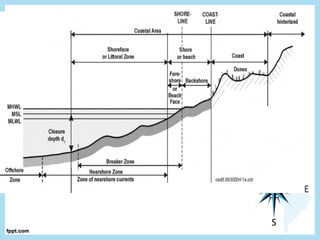
1.Coastal profile
‱ The offshore
‱ Nearshore
‱ Beach
‱ Coast
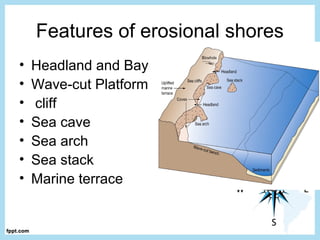
Features of erosional shores
‱ Headland and Bay
‱ Wave-cut Platform
‱ cliff
‱ Sea cave
‱ Sea arch
‱ Sea stack
‱ Marine terrace
Features of erosional shores
Headland and Bay
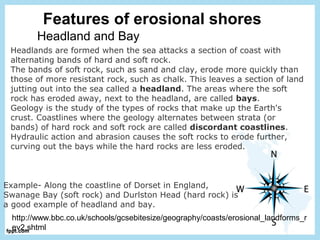
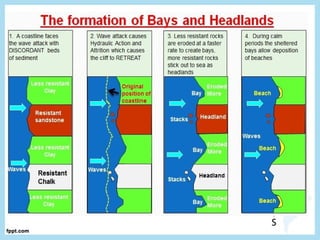
Headlands are formed when the sea attacks a section of coast with
alternating bands of hard and soft rock.
The bands of soft rock, such as sand and clay, erode more quickly than
those of more resistant rock, such as chalk. This leaves a section of land
jutting out into the sea called a headland. The areas where the soft
rock has eroded away, next to the headland, are called bays.
Geology is the study of the types of rocks that make up the Earth's
crust. Coastlines where the geology alternates between strata (or
bands) of hard rock and soft rock are called discordant coastlines.
Hydraulic action and abrasion causes the soft rocks to erode further,
curving out the bays while the hard rocks are less eroded.
http://www.bbc.co.uk/schools/gcsebitesize/geography/coasts/erosional_landforms_r
ev2.shtml
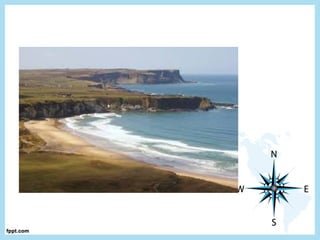
Example- Along the coastline of Dorset in England,
Swanage Bay (soft rock) and Durlston Head (hard rock) is
a good example of headland and bay.
Features of erosional shores
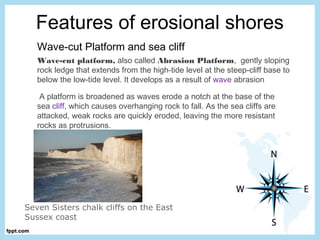
Wave-cut Platform and sea cliff
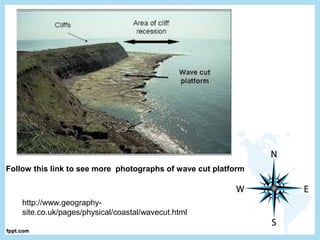
Wave-cut platform, also called Abrasion Platform,  gently sloping
rock ledge that extends from the high-tide level at the steep-cliff base to
below the low-tide level. It develops as a result of wave abrasion
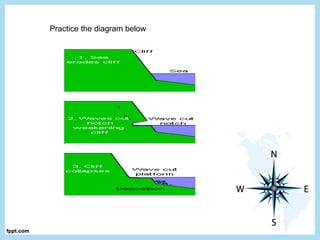
 A platform is broadened as waves erode a notch at the base of the
sea cliff, which causes overhanging rock to fall. As the sea cliffs are
attacked, weak rocks are quickly eroded, leaving the more resistant
rocks as protrusions. 
Seven Sisters chalk cliffs on the East
Sussex coast
http://www.geography-
site.co.uk/pages/physical/coastal/wavecut.html
Follow this link to see more photographs of wave cut platform
Practice the diagram below
Features of erosional shores
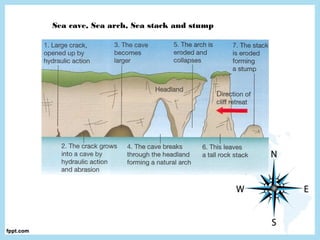
Sea cave, Sea arch, Sea stack and stump
A sea cave,  is formed in a cliff by wave action. Sea caves occur on almost
every headland or coast where the waves break directly on a rock cliff and
are formed by mechanical erosion rather than the chemical solution
process that is responsible for the majority of inland caves. Zones of
weakness in the cliff give way under the force of the waves and are eroded
out due to constant abrasion; these cavities are enlarged by the hydraulic
pressure built up by each wave. Holes, commonly known as blowholes,
may eventually be forced through the roof of the cave to allow the pressure
created by each wave to be released as a jet of spray.
Sea cave, Sea arch, Sea stack and stump
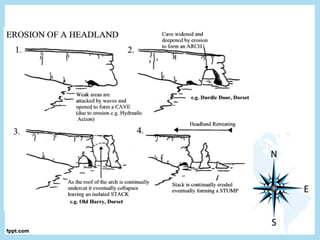
Weathering and erosion can create caves, arches, stacks and stumps along a
headland.
‱Caves occur when waves force their way into cracks in the cliff face. The
water contains sand and other materials that grind away at the rock until the
cracks become a cave. Hydraulic action is the predominant process.
‱If the cave is formed in a headland, it may eventually break through to the
other side forming an arch.
‱The arch will gradually become bigger until it can no longer support the top of
the arch. When the arch collapses, it leaves the headland on one side and
a stack (a tall column of rock) on the other.
‱The stack will be attacked at the base in the same way that a wave-cut notch
is formed. This weakens the structure and it will eventually collapse to form
a stump.
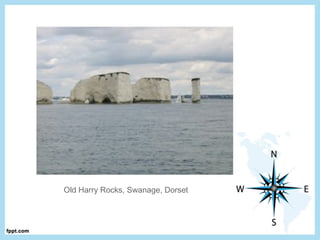
‱One of the best examples in Britain is Old Harry Rocks, a stack found off a
headland in the Isle of Purbeck.
Old Harry Rocks, Swanage, Dorset
Features of depositional shores
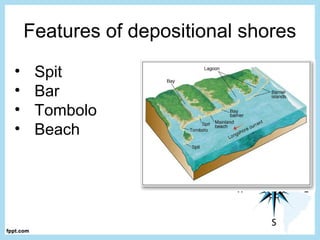
‱ Spit
‱ Bar
‱ Tombolo
‱ Beach
Features of depositional shores
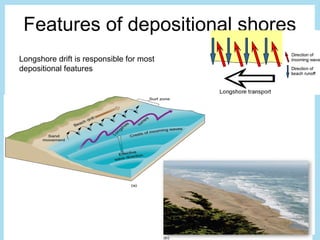
Longshore drift is responsible for most
depositional features
Features of depositional shores
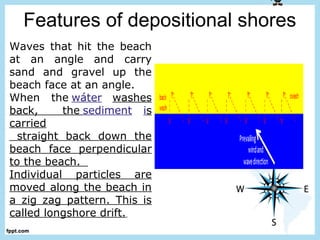
Waves that hit the beach
at an angle and carry
sand and gravel up the
beach face at an angle.
When the wĂĄter washes
back, the sediment is
carried
straight back down the
beach face perpendicular
to the beach.
Individual particles are
moved along the beach in
a zig zag pattern. This is
called longshore drift.
Features of depositional shores
https://www.youtube.com/watch?v=U9EhVa4MmEs
Watch this link from Youtube to understand the
process of longshore drift better.
Features of depositional shores
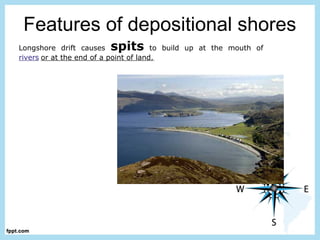
Longshore drift causes spits to build up at the mouth of
rivers or at the end of a point of land.
Features of depositional shores
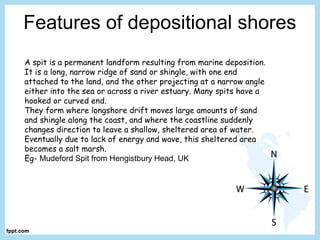
A spit is a permanent landform resulting from marine deposition.
It is a long, narrow ridge of sand or shingle, with one end
attached to the land, and the other projecting at a narrow angle
either into the sea or across a river estuary. Many spits have a
hooked or curved end.
They form where longshore drift moves large amounts of sand
and shingle along the coast, and where the coastline suddenly
changes direction to leave a shallow, sheltered area of water.
Eventually due to lack of energy and wave, this sheltered area
becomes a salt marsh.
Eg- Mudeford Spit from Hengistbury Head, UK
Features of depositional shores
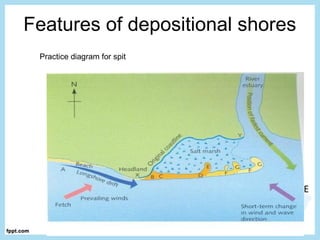
Practice diagram for spit
Features of depositional shores
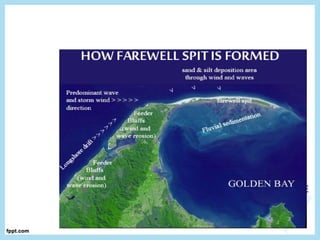
https://www.youtube.com/watch?
v=Fe9YBuK_qEo
Watch this video to understand the
formation of spit
Features of depositional shores
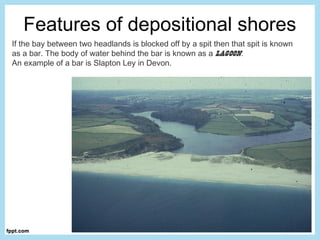
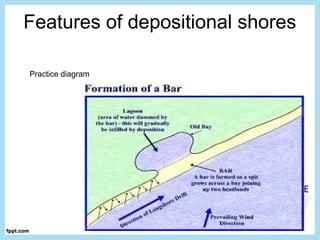
If the bay between two headlands is blocked off by a spit then that spit is known
as a bar. The body of water behind the bar is known as a lagoon.
An example of a bar is Slapton Ley in Devon.
Features of depositional shores
Practice diagram
Features of depositional shores
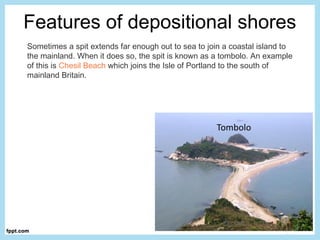
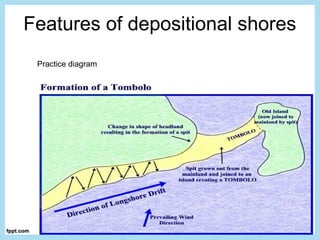
Sometimes a spit extends far enough out to sea to join a coastal island to
the mainland. When it does so, the spit is known as a tombolo. An example
of this is Chesil Beach which joins the Isle of Portland to the south of
mainland Britain.
Features of depositional shores
Practice diagram
Features of depositional shores
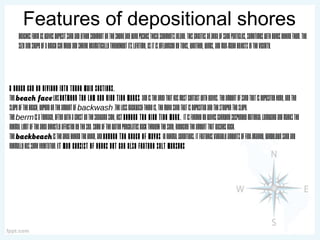
Beachesformaswavesdepositsandandothersedimentontheshoreandwindpushesthesesedimentsinland.Thiscreatesanareaofsandparticles,sometimeswithdunesbehindthem.The
sizeandshapeofabeachcangrowandshrinkdramaticallythroughoutitslifetime,asitisinfluencedbytides,weather,winds,andman-madeobjectsinthevicinity.
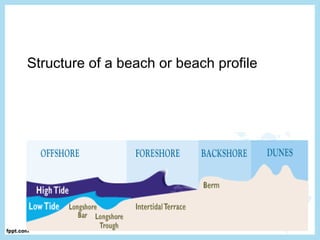
A beach can be divided into three main sections.
Thebeach faceliesbetween the low and high tide marks andistheareathathasmostcontactwithwaves.Theamountofsandthatisdepositedhere,andthe
slopeofthebeach,dependontheamountofbackwash.Thelessbackwashthereis,themoresandthatisdepositedandthesteepertheslope.
Thebermisaterrace,oftenwithacrestontheseawardside,justbeyond the high tide mark. Itisformedbywavescarryingsuspendedmateriallandwardandmarksthe
normallimitoftheareadirectlyaffectedbythesea.Someofthewaterpercolatesbackthroughthesand,reducingtheamountthatwashesback.
Thebackbeachistheareabehindtheberm,andbeyond the reach of waves innormalconditions.Itfeaturesvariableamountsoffine-grained,windblownsandand
normallyhassomevegetation.It may consist of dunes but can also feature salt marshes
Structure of a beach or beach profile
Features of depositional shores
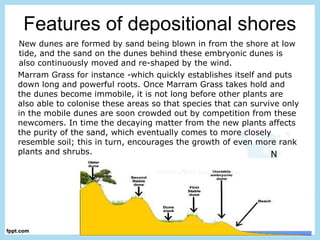
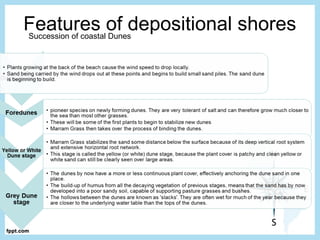
New dunes are formed by sand being blown in from the shore at low
tide, and the sand on the dunes behind these embryonic dunes is
also continuously moved and re-shaped by the wind.
Marram Grass for instance -which quickly establishes itself and puts
down long and powerful roots. Once Marram Grass takes hold and
the dunes become immobile, it is not long before other plants are
also able to colonise these areas so that species that can survive only
in the mobile dunes are soon crowded out by competition from these
newcomers. In time the decaying matter from the new plants affects
the purity of the sand, which eventually comes to more closely
resemble soil; this in turn, encourages the growth of even more rank
plants and shrubs.
Features of depositional shoresSuccession of coastal Dunes
Features of depositional shores
https://www.youtube.com/watch?
v=ZWEJq03NBao
Watch this video for a revision on erosional and
depositional Features on coast
Websites to visit-
http://www.geographyalltheway.com/igcse_geography/natur
al_environments/marine_processes/igcse_coasts.htm
http://revisionworld.com/gcse-revision/geography
www.bbc.co.uk/schools/gcsebitesize

Coastal processes and features by shirin

  • 1.
    Coastal Processes and Features IGCSEGeography Shirin Bagchi
  • 2.
    Introduction  Coastal processesare the set of mechanisms that operate along a coastline, bringing about various combinations of erosion and deposition.  The land water interface along the coastline is always in a highly dynamic state and nature works towards maintaining an equilibrium condition.  The energy due to tide, waves, wind and currents is constantly working in the coastal zone. Dissipation of energy (due to tide, wind, waves and current) is often provided by the beaches, mudflats, marshes and mangroves.
  • 3.
    1.Coastal profile ‱ Theoffshore ‱ Nearshore ‱ Beach ‱ Coast
  • 5.
    Features of erosionalshores ‱ Headland and Bay ‱ Wave-cut Platform ‱ cliff ‱ Sea cave ‱ Sea arch ‱ Sea stack ‱ Marine terrace
  • 6.
    Features of erosionalshores Headland and Bay Headlands are formed when the sea attacks a section of coast with alternating bands of hard and soft rock. The bands of soft rock, such as sand and clay, erode more quickly than those of more resistant rock, such as chalk. This leaves a section of land jutting out into the sea called a headland. The areas where the soft rock has eroded away, next to the headland, are called bays. Geology is the study of the types of rocks that make up the Earth's crust. Coastlines where the geology alternates between strata (or bands) of hard rock and soft rock are called discordant coastlines. Hydraulic action and abrasion causes the soft rocks to erode further, curving out the bays while the hard rocks are less eroded. http://www.bbc.co.uk/schools/gcsebitesize/geography/coasts/erosional_landforms_r ev2.shtml Example- Along the coastline of Dorset in England, Swanage Bay (soft rock) and Durlston Head (hard rock) is a good example of headland and bay.
  • 9.
    Features of erosionalshores Wave-cut Platform and sea cliff Wave-cut platform, also called Abrasion Platform,  gently sloping rock ledge that extends from the high-tide level at the steep-cliff base to below the low-tide level. It develops as a result of wave abrasion  A platform is broadened as waves erode a notch at the base of the sea cliff, which causes overhanging rock to fall. As the sea cliffs are attacked, weak rocks are quickly eroded, leaving the more resistant rocks as protrusions.  Seven Sisters chalk cliffs on the East Sussex coast
  • 10.
  • 11.
  • 12.
    Features of erosionalshores Sea cave, Sea arch, Sea stack and stump A sea cave,  is formed in a cliff by wave action. Sea caves occur on almost every headland or coast where the waves break directly on a rock cliff and are formed by mechanical erosion rather than the chemical solution process that is responsible for the majority of inland caves. Zones of weakness in the cliff give way under the force of the waves and are eroded out due to constant abrasion; these cavities are enlarged by the hydraulic pressure built up by each wave. Holes, commonly known as blowholes, may eventually be forced through the roof of the cave to allow the pressure created by each wave to be released as a jet of spray.
  • 13.
    Sea cave, Seaarch, Sea stack and stump
  • 14.
    Weathering and erosion can create caves,arches, stacks and stumps along a headland. ‱Caves occur when waves force their way into cracks in the cliff face. The water contains sand and other materials that grind away at the rock until the cracks become a cave. Hydraulic action is the predominant process. ‱If the cave is formed in a headland, it may eventually break through to the other side forming an arch. ‱The arch will gradually become bigger until it can no longer support the top of the arch. When the arch collapses, it leaves the headland on one side and a stack (a tall column of rock) on the other. ‱The stack will be attacked at the base in the same way that a wave-cut notch is formed. This weakens the structure and it will eventually collapse to form a stump. ‱One of the best examples in Britain is Old Harry Rocks, a stack found off a headland in the Isle of Purbeck.
  • 15.
    Old Harry Rocks,Swanage, Dorset
  • 17.
    Features of depositionalshores ‱ Spit ‱ Bar ‱ Tombolo ‱ Beach
  • 18.
    Features of depositionalshores Longshore drift is responsible for most depositional features
  • 19.
    Features of depositionalshores Waves that hit the beach at an angle and carry sand and gravel up the beach face at an angle. When the wĂĄter washes back, the sediment is carried straight back down the beach face perpendicular to the beach. Individual particles are moved along the beach in a zig zag pattern. This is called longshore drift.
  • 20.
    Features of depositionalshores https://www.youtube.com/watch?v=U9EhVa4MmEs Watch this link from Youtube to understand the process of longshore drift better.
  • 21.
    Features of depositionalshores Longshore drift causes spits to build up at the mouth of rivers or at the end of a point of land.
  • 22.
    Features of depositionalshores A spit is a permanent landform resulting from marine deposition. It is a long, narrow ridge of sand or shingle, with one end attached to the land, and the other projecting at a narrow angle either into the sea or across a river estuary. Many spits have a hooked or curved end. They form where longshore drift moves large amounts of sand and shingle along the coast, and where the coastline suddenly changes direction to leave a shallow, sheltered area of water. Eventually due to lack of energy and wave, this sheltered area becomes a salt marsh. Eg- Mudeford Spit from Hengistbury Head, UK
  • 23.
    Features of depositionalshores Practice diagram for spit
  • 25.
    Features of depositionalshores https://www.youtube.com/watch? v=Fe9YBuK_qEo Watch this video to understand the formation of spit
  • 26.
    Features of depositionalshores If the bay between two headlands is blocked off by a spit then that spit is known as a bar. The body of water behind the bar is known as a lagoon. An example of a bar is Slapton Ley in Devon.
  • 27.
    Features of depositionalshores Practice diagram
  • 28.
    Features of depositionalshores Sometimes a spit extends far enough out to sea to join a coastal island to the mainland. When it does so, the spit is known as a tombolo. An example of this is Chesil Beach which joins the Isle of Portland to the south of mainland Britain.
  • 29.
    Features of depositionalshores Practice diagram
  • 30.
    Features of depositionalshores Beachesformaswavesdepositsandandothersedimentontheshoreandwindpushesthesesedimentsinland.Thiscreatesanareaofsandparticles,sometimeswithdunesbehindthem.The sizeandshapeofabeachcangrowandshrinkdramaticallythroughoutitslifetime,asitisinfluencedbytides,weather,winds,andman-madeobjectsinthevicinity. A beach can be divided into three main sections. Thebeach faceliesbetween the low and high tide marks andistheareathathasmostcontactwithwaves.Theamountofsandthatisdepositedhere,andthe slopeofthebeach,dependontheamountofbackwash.Thelessbackwashthereis,themoresandthatisdepositedandthesteepertheslope. Thebermisaterrace,oftenwithacrestontheseawardside,justbeyond the high tide mark. Itisformedbywavescarryingsuspendedmateriallandwardandmarksthe normallimitoftheareadirectlyaffectedbythesea.Someofthewaterpercolatesbackthroughthesand,reducingtheamountthatwashesback. Thebackbeachistheareabehindtheberm,andbeyond the reach of waves innormalconditions.Itfeaturesvariableamountsoffine-grained,windblownsandand normallyhassomevegetation.It may consist of dunes but can also feature salt marshes
  • 31.
    Structure of abeach or beach profile
  • 32.
    Features of depositionalshores New dunes are formed by sand being blown in from the shore at low tide, and the sand on the dunes behind these embryonic dunes is also continuously moved and re-shaped by the wind. Marram Grass for instance -which quickly establishes itself and puts down long and powerful roots. Once Marram Grass takes hold and the dunes become immobile, it is not long before other plants are also able to colonise these areas so that species that can survive only in the mobile dunes are soon crowded out by competition from these newcomers. In time the decaying matter from the new plants affects the purity of the sand, which eventually comes to more closely resemble soil; this in turn, encourages the growth of even more rank plants and shrubs.
  • 33.
    Features of depositionalshoresSuccession of coastal Dunes
  • 34.
    Features of depositionalshores https://www.youtube.com/watch? v=ZWEJq03NBao Watch this video for a revision on erosional and depositional Features on coast
  • 35.