Motor learning& 
Recovery of function 
by, 
Dr/ Shimaa A. Essa 
Lecturer of physical therapy for neurological & 
neurosurgical disorders, King Khaled University
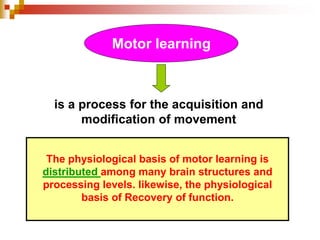
Motor learning 
is a process for the acquisition and 
modification of movement 
The physiological basis of motor learning is 
distributed among many brain structures and 
processing levels. likewise, the physiological 
basis of Recovery of function.
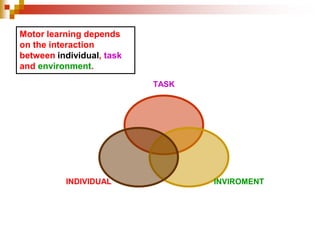
TASK 
Motor learning depends 
on the interaction 
between individual, task 
and environment. 
INDIVIDUAL INVIROMENT
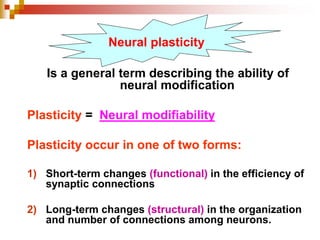
Neural plasticity 
Is a general term describing the ability of 
neural modification 
Plasticity = Neural modifiability 
Plasticity occur in one of two forms: 
1) Short-term changes (functional) in the efficiency of 
synaptic connections 
2) Long-term changes (structural) in the organization 
and number of connections among neurons.
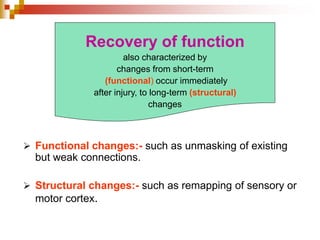
Recovery of function 
 Functional changes:- such as unmasking of existing 
but weak connections. 
 Structural changes:- such as remapping of sensory or 
motor cortex. 
also characterized by 
changes from short-term 
(functional) occur immediately 
after injury, to long-term (structural) 
changes
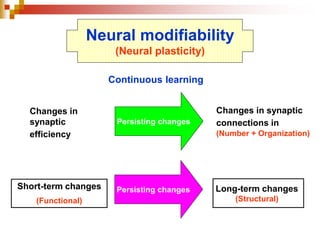
Persisting changes 
Changes in 
synaptic 
efficiency 
Continuous learning 
Short-term changes Persisting changes 
(Functional) 
Changes in synaptic 
connections in 
(Number + Organization) 
Long-term changes 
(Structural) 
Neural modifiability 
(Neural plasticity)
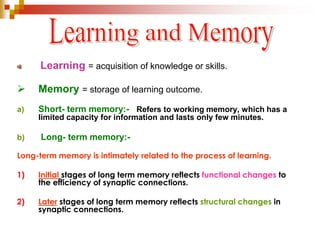
Learning = acquisition of knowledge or skills. 
 Memory = storage of learning outcome. 
a) Short- term memory:- Refers to working memory, which has a 
limited capacity for information and lasts only few minutes. 
b) Long- term memory:- 
Long-term memory is intimately related to the process of learning. 
1) Initial stages of long term memory reflects functional changes to 
the efficiency of synaptic connections. 
2) Later stages of long term memory reflects structural changes in 
synaptic connections.
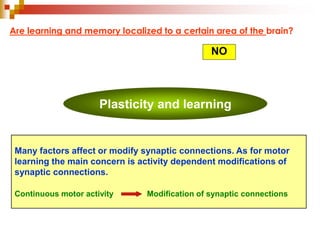
Are learning and memory localized to a certain area of the brain? 
NO 
Plasticity and learning 
Many factors affect or modify synaptic connections. As for motor 
learning the main concern is activity dependent modifications of 
synaptic connections. 
Continuous motor activity Modification of synaptic connections
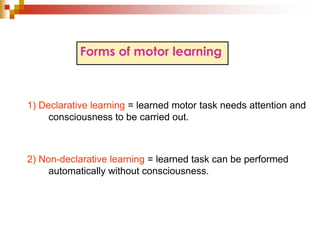
Forms of motor learning 
1) Declarative learning = learned motor task needs attention and 
consciousness to be carried out. 
2) Non-declarative learning = learned task can be performed 
automatically without consciousness.
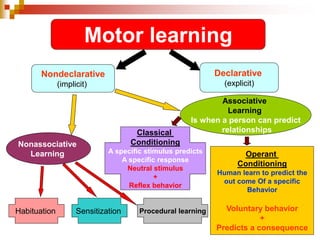
Motor learning 
Nondeclarative 
(implicit) 
Declarative 
(explicit) 
Nonassociative 
Learning 
Associative 
Learning 
Is when a person can predict 
relationships 
Classical 
Conditioning 
A specific stimulus predicts 
A specific response 
Neutral stimulus 
+ 
Reflex behavior 
Habituation Sensitization Procedural learning 
Operant 
Conditioning 
Human learn to predict the 
out come Of a specific 
Behavior 
Voluntary behavior 
+ 
Predicts a consequence
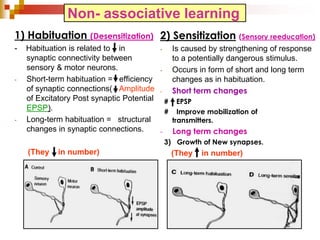
Non- associative learning 
1) Habituation (Desensitization) 
- Habituation is related to in 
synaptic connectivity between 
sensory & motor neurons. 
- Short-term habituation = efficiency 
of synaptic connections( Amplitude 
of Excitatory Post synaptic Potential 
EPSP). 
- Long-term habituation = structural 
changes in synaptic connections. 
(They in number) 
2) Sensitization (Sensory reeducation) 
- Is caused by strengthening of response 
to a potentially dangerous stimulus. 
- Occurs in form of short and long term 
changes as in habituation. 
- Short term changes 
# EPSP 
# Improve mobilization of 
transmitters. 
- Long term changes 
3) Growth of New synapses. 
(They in number)
3) Procedural learning 
Is a more complex form of non-declarative learning. It includes 
learning and execution of motor and non-declarative cognitive 
s k i l l s . I t o c c u r s t h r o u g h t r i a l - a n d - e r r o r p r a c t i c e . 
**what is The neural system underlying procedural (implicit) 
learning? 
1) Frontal lobe ( Sensorimotor cortex). 
2) Basal ganglia (Tail of Cuadate nucleus). 
3) Parital lobe. 4) Cerebellum ( adaptation). 
**what is The neural system underlying (explicit) learning? 
1) Frontal brain areas (supplementary motor area, prefrontal cortex). 
2) Head of cuadate nucleus. 
3) Hippocampus. 4) other medial temporal lobe structures.
 Motor cortex contributes to procedural 
learning, and the shift from implicit to explicit 
knowledge. 
 Sensorimotor cortex has a role in motor 
learning , its damage doesn't cause loss of already 
learned skills but only slows down the learning of 
NEW motor skills.
Plasticity and declarative (explicit form of learning) 
Declarative learning requires Attention & Consciousness. 
Procedural learning is expressed through improvement of performance of 
a learned task, while Declarative learning may be expressed in a form 
other than the learned task. 
In humans, lesions in the temporal lobe of cortex and hippocampus may 
interfere with the lay down of declarative memory, 
Hippocampus is critical for declarative learning. 
Motor learning includes both simple forms ( classical & operant 
conditioning), and more complex forms (procedural & declarative 
learning) involving acquisition of skilled movements.
Early induced plasticity & Recovery of function 
Early transient events that depress brain functions: 
1- Edema of 2 forms:- 
a) Local = next to the primary injury site, lead to compression of 
axons and physiological neuronal block. (reduction of edema 
restore a portion of functional loss). 
b) Remote = not part of primary injury and causes depression of 
brain functions. 
2- Diaschisis:- is a transient CNS disorder involving loss of 
function in a structurally intact brain area. Caused by 
reduction of brain blood flow or metabolism.
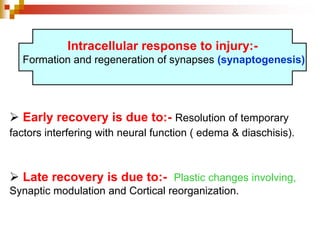
Intracellular response to injury:- 
Formation and regeneration of synapses (synaptogenesis) 
 Early recovery is due to:- Resolution of temporary 
factors interfering with neural function ( edema & diaschisis). 
 Late recovery is due to:- Plastic changes involving, 
Synaptic modulation and Cortical reorganization.
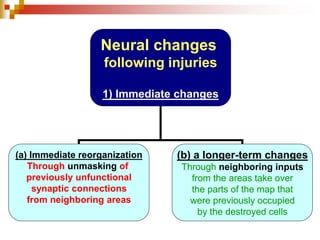
Neural changes 
following injuries 
1) Immediate changes 
(a) Immediate reorganization 
Through unmasking of 
previously unfunctional 
synaptic connections 
from neighboring areas 
(b) a longer-term changes 
Through neighboring inputs 
from the areas take over 
the parts of the map that 
were previously occupied 
by the destroyed cells
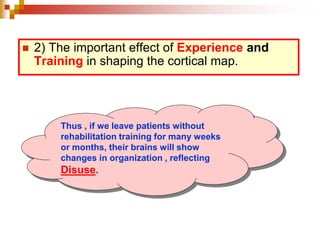
 2) The important effect of Experience and 
Training in shaping the cortical map. 
Thus , if we leave patients without 
rehabilitation training for many weeks 
or months, their brains will show 
changes in organization , reflecting 
Disuse.
Good news 
Proper training appears to make 
a difference no matter when it’s 
given. Since the brain continues 
to be plastic through out our 
lives.

Motor learning & recovery of function

  • 1.
    Motor learning& Recoveryof function by, Dr/ Shimaa A. Essa Lecturer of physical therapy for neurological & neurosurgical disorders, King Khaled University
  • 2.
    Motor learning isa process for the acquisition and modification of movement The physiological basis of motor learning is distributed among many brain structures and processing levels. likewise, the physiological basis of Recovery of function.
  • 3.
    TASK Motor learningdepends on the interaction between individual, task and environment. INDIVIDUAL INVIROMENT
  • 4.
    Neural plasticity Isa general term describing the ability of neural modification Plasticity = Neural modifiability Plasticity occur in one of two forms: 1) Short-term changes (functional) in the efficiency of synaptic connections 2) Long-term changes (structural) in the organization and number of connections among neurons.
  • 5.
    Recovery of function  Functional changes:- such as unmasking of existing but weak connections.  Structural changes:- such as remapping of sensory or motor cortex. also characterized by changes from short-term (functional) occur immediately after injury, to long-term (structural) changes
  • 6.
    Persisting changes Changesin synaptic efficiency Continuous learning Short-term changes Persisting changes (Functional) Changes in synaptic connections in (Number + Organization) Long-term changes (Structural) Neural modifiability (Neural plasticity)
  • 7.
    Learning = acquisitionof knowledge or skills.  Memory = storage of learning outcome. a) Short- term memory:- Refers to working memory, which has a limited capacity for information and lasts only few minutes. b) Long- term memory:- Long-term memory is intimately related to the process of learning. 1) Initial stages of long term memory reflects functional changes to the efficiency of synaptic connections. 2) Later stages of long term memory reflects structural changes in synaptic connections.
  • 8.
    Are learning andmemory localized to a certain area of the brain? NO Plasticity and learning Many factors affect or modify synaptic connections. As for motor learning the main concern is activity dependent modifications of synaptic connections. Continuous motor activity Modification of synaptic connections
  • 9.
    Forms of motorlearning 1) Declarative learning = learned motor task needs attention and consciousness to be carried out. 2) Non-declarative learning = learned task can be performed automatically without consciousness.
  • 10.
    Motor learning Nondeclarative (implicit) Declarative (explicit) Nonassociative Learning Associative Learning Is when a person can predict relationships Classical Conditioning A specific stimulus predicts A specific response Neutral stimulus + Reflex behavior Habituation Sensitization Procedural learning Operant Conditioning Human learn to predict the out come Of a specific Behavior Voluntary behavior + Predicts a consequence
  • 11.
    Non- associative learning 1) Habituation (Desensitization) - Habituation is related to in synaptic connectivity between sensory & motor neurons. - Short-term habituation = efficiency of synaptic connections( Amplitude of Excitatory Post synaptic Potential EPSP). - Long-term habituation = structural changes in synaptic connections. (They in number) 2) Sensitization (Sensory reeducation) - Is caused by strengthening of response to a potentially dangerous stimulus. - Occurs in form of short and long term changes as in habituation. - Short term changes # EPSP # Improve mobilization of transmitters. - Long term changes 3) Growth of New synapses. (They in number)
  • 12.
    3) Procedural learning Is a more complex form of non-declarative learning. It includes learning and execution of motor and non-declarative cognitive s k i l l s . I t o c c u r s t h r o u g h t r i a l - a n d - e r r o r p r a c t i c e . **what is The neural system underlying procedural (implicit) learning? 1) Frontal lobe ( Sensorimotor cortex). 2) Basal ganglia (Tail of Cuadate nucleus). 3) Parital lobe. 4) Cerebellum ( adaptation). **what is The neural system underlying (explicit) learning? 1) Frontal brain areas (supplementary motor area, prefrontal cortex). 2) Head of cuadate nucleus. 3) Hippocampus. 4) other medial temporal lobe structures.
  • 13.
     Motor cortexcontributes to procedural learning, and the shift from implicit to explicit knowledge.  Sensorimotor cortex has a role in motor learning , its damage doesn't cause loss of already learned skills but only slows down the learning of NEW motor skills.
  • 14.
    Plasticity and declarative(explicit form of learning) Declarative learning requires Attention & Consciousness. Procedural learning is expressed through improvement of performance of a learned task, while Declarative learning may be expressed in a form other than the learned task. In humans, lesions in the temporal lobe of cortex and hippocampus may interfere with the lay down of declarative memory, Hippocampus is critical for declarative learning. Motor learning includes both simple forms ( classical & operant conditioning), and more complex forms (procedural & declarative learning) involving acquisition of skilled movements.
  • 15.
    Early induced plasticity& Recovery of function Early transient events that depress brain functions: 1- Edema of 2 forms:- a) Local = next to the primary injury site, lead to compression of axons and physiological neuronal block. (reduction of edema restore a portion of functional loss). b) Remote = not part of primary injury and causes depression of brain functions. 2- Diaschisis:- is a transient CNS disorder involving loss of function in a structurally intact brain area. Caused by reduction of brain blood flow or metabolism.
  • 16.
    Intracellular response toinjury:- Formation and regeneration of synapses (synaptogenesis)  Early recovery is due to:- Resolution of temporary factors interfering with neural function ( edema & diaschisis).  Late recovery is due to:- Plastic changes involving, Synaptic modulation and Cortical reorganization.
  • 17.
    Neural changes followinginjuries 1) Immediate changes (a) Immediate reorganization Through unmasking of previously unfunctional synaptic connections from neighboring areas (b) a longer-term changes Through neighboring inputs from the areas take over the parts of the map that were previously occupied by the destroyed cells
  • 18.
     2) Theimportant effect of Experience and Training in shaping the cortical map. Thus , if we leave patients without rehabilitation training for many weeks or months, their brains will show changes in organization , reflecting Disuse.
  • 19.
    Good news Propertraining appears to make a difference no matter when it’s given. Since the brain continues to be plastic through out our lives.