Presented by- Dr Shibani Sarangi
MDS 1st year(OMFS)
Suturing techniques
and
principles
1
INTRODUCTION
 The most common cause of postoperative
infections is poor surgical techniques, usually
related to devitalized tissues remaining in the
wound and also inadequate closure.
 Thus closure of wound by suturing helps to
obliterate dead space where accumulation of blood
or other tissue fluids could prevent direct apposition
of tissues and provide an environment favorable for
bacterial growth.
 Sutures also distribute the tension of wound closure
over a larger volume of tissues.
2
HISTORY
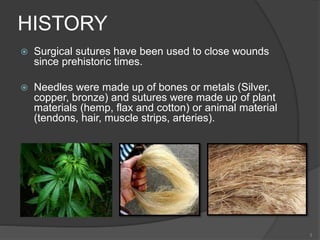
 Surgical sutures have been used to close wounds
since prehistoric times.
 Needles were made up of bones or metals (Silver,
copper, bronze) and sutures were made up of plant
materials (hemp, flax and cotton) or animal material
(tendons, hair, muscle strips, arteries).
3
 DEFINATIONS-
 Suture material is an artificial fiber used to keep wound
together until they hold sufficiently well by themselves
by natural fiber (collagen) which is synthesized and
woven into a stronger scar .
 Suture is a stitch/series of stiches made to secure
apposition of the edges of a surgical/traumatic wound
-Wilkins
 Any strand of material utilized to ligate blood vessels or
approximate tissues .
-Silverstein L.H 1999
4
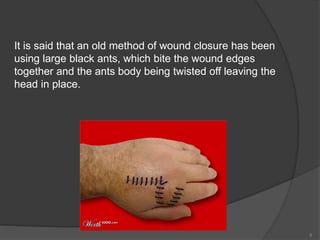
It is said that an old method of wound closure has been
using large black ants, which bite the wound edges
together and the ants body being twisted off leaving the
head in place.
5
6
GOALS OF SUTURING –
• Maintain hemostasis
• Permit primary intention healing
• Provide support for tissue margins
• Reduce post-operative pain
• Prevent bone exposure
• Permit proper flap position
7
REQUISITES OF AN IDEAL SUTURE
Postlethwait 1971, Varma 1974, Ethicon 1985
•Tensile strength: adequate material strength will prevent
suture breakdown & use of proper knots for the material used
will prevent untying or knot slippage.
•Tissue biocompatibility: sutures made from organic
material will evoke a higher tissue response than synthetic
sutures.
• Tissue reaction - amount & size of suture material.
• Low capillarity: multifilament type soak up tissue fluid by
capillary action providing a rich medium for microbes
increasing chances of inflammation & infection
8
•Good handling & knotting properties: ease of tying & a
thread type that permits minimal knot slippage also
influence thread selection.
• Sterilization without deterioration of properties: most
sutures available in packages are sterilized by dry heat &
ethylene oxide gas.
SUTURE MATERIAL
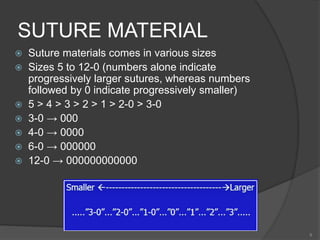
 Suture materials comes in various sizes
 Sizes 5 to 12-0 (numbers alone indicate
progressively larger sutures, whereas numbers
followed by 0 indicate progressively smaller)
 5 > 4 > 3 > 2 > 1 > 2-0 > 3-0
 3-0 → 000
 4-0 → 0000
 6-0 → 000000
 12-0 → 000000000000
9
10
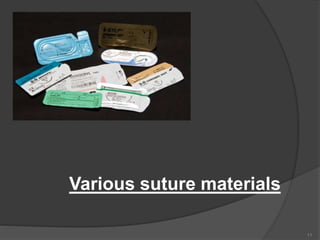
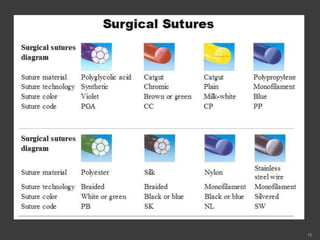
Various suture materials
11
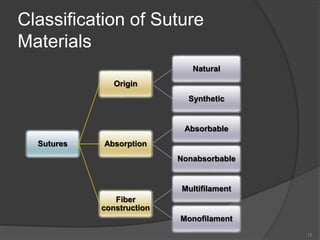
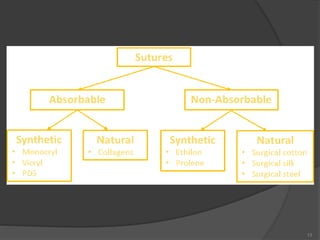
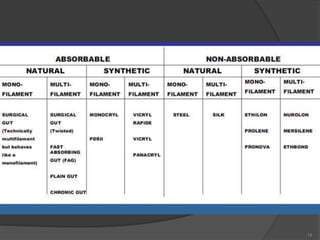
Classification of Suture
Materials
12
Sutures
Origin
Natural
Synthetic
Absorption
Absorbable
Nonabsorbable
Fiber
construction
Multifilament
Monofilament
13
14
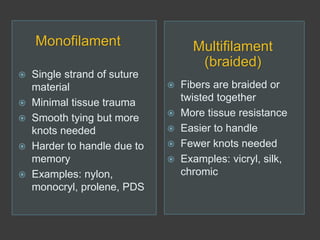
Monofilament Multifilament
(braided)
 Single strand of suture
material
 Minimal tissue trauma
 Smooth tying but more
knots needed
 Harder to handle due to
memory
 Examples: nylon,
monocryl, prolene, PDS
 Fibers are braided or
twisted together
 More tissue resistance
 Easier to handle
 Fewer knots needed
 Examples: vicryl, silk,
chromic
16
SUTURE MATERIALS IN
DETAIL
17
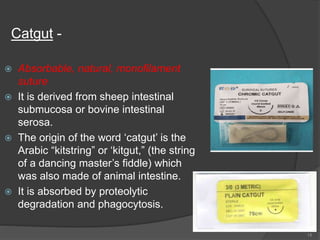
Catgut -
 Absorbable, natural, monofilament
suture
 It is derived from sheep intestinal
submucosa or bovine intestinal
serosa.
 The origin of the word ‘catgut’ is the
Arabic “kitstring” or ‘kitgut,” (the string
of a dancing master’s fiddle) which
was also made of animal intestine.
 It is absorbed by proteolytic
degradation and phagocytosis.
18
 When placed intra-orally through mucosal surfaces, the
sutures generally are gone in 3 to 5 days.
 Chromic gut is plain gut that has been tanned with a solution
of Chromium salts. The chromium salts act as a cross-linking
agent and increase the tensile strength of the material and its
resistance to absorption by the body.
 Advantages:
1. Increased strength
2. Prolonged rate of absorption
3. Less stimulation for tissue reaction
19
Uses-
 Plain catgut –
-Smooth vessels
-Subcutaneous tissue
 Chromic catgut:
1-0/2-0 - ligation of medium sized blood vessels.
3-0/4-0 - Close muscle layer in cleft lip repair.
5-0/6-0 - In plastic surgery
20
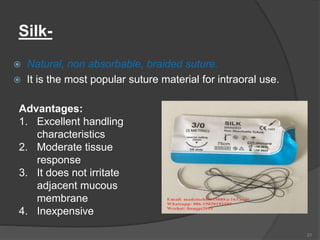
Silk-
 Natural, non absorbable, braided suture.
 It is the most popular suture material for intraoral use.
21
Advantages:
1. Excellent handling
characteristics
2. Moderate tissue
response
3. It does not irritate
adjacent mucous
membrane
4. Inexpensive
Disadvantage:-
1. Stitch Granuloma
2. Infection rate is more
 Although classed as a non-absorbable suture, silk is an
organic substance that undergoes slow proteolysis
when implanted.
- Douglas (1949)
 It usually disappears after 2 yrs of implantation.
22
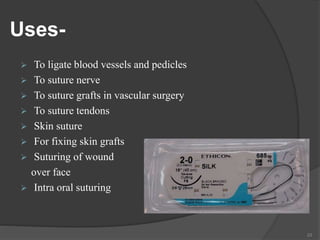
Uses-
 To ligate blood vessels and pedicles
 To suture nerve
 To suture grafts in vascular surgery
 To suture tendons
 Skin suture
 For fixing skin grafts
 Suturing of wound
over face
 Intra oral suturing
23
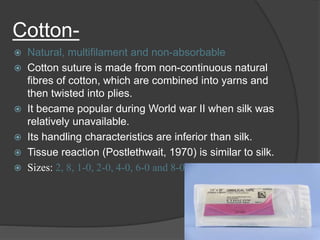
Cotton-
 Natural, multifilament and non-absorbable
 Cotton suture is made from non-continuous natural
fibres of cotton, which are combined into yarns and
then twisted into plies.
 It became popular during World war II when silk was
relatively unavailable.
 Its handling characteristics are inferior than silk.
 Tissue reaction (Postlethwait, 1970) is similar to silk.
 Sizes: 2, 8, 1-0, 2-0, 4-0, 6-0 and 8-0
24
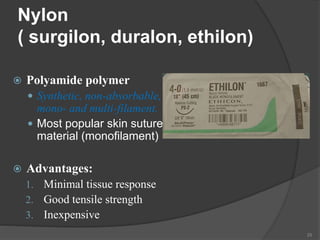
Nylon
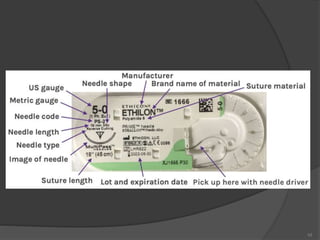
( surgilon, duralon, ethilon)
 Polyamide polymer
 Synthetic, non-absorbable,
mono- and multi-filament.
 Most popular skin suture
material (monofilament)
 Advantages:
1. Minimal tissue response
2. Good tensile strength
3. Inexpensive
25
 Disadvantage:
1. Because of its stiffness, large knot required.
2. Tendency to tear through non-keratinized tissue, nylon is
not frequently used intra-orally.
3. Possess “memory”… multiple square knots are necessary
to maintain the tie.
26
Polyglycolic Acid (Dexon, Surgicryl)
 Polyglycolic acid is hydroxyacetic acid.
 Synthetic, absorbable and multifilament
 Advantages:
1. Good tensile strength
2. Easy handling
3. Good knot tying ability
4. Smooth passage through tissues
5. Less tissue edema
27
Uses -
 It is commonly used for subcutaneous sutures,
intra-cutaneous closures, abdominal and thoracic
surgeries.
28
Polyglactin 910(Vicryl)
 Vicryl (polyglactin 910) is an absorbable, synthetic,
braided suture.
 It is indicated for soft tissue approximation
and ligation.
 Enzymatic degradation
 Approx. 3 – 4 weeks in tissue and is completely
absorbed by hydrolysis within 60 days.
29
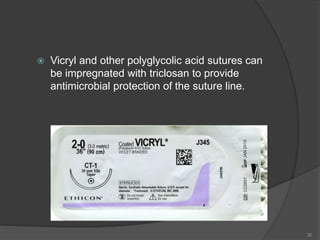
 Vicryl and other polyglycolic acid sutures can
be impregnated with triclosan to provide
antimicrobial protection of the suture line.
30
Polydiaxonone-
 It is sterile, monofilament synthetic absorbable suture
composed of the polyester.
 Advantages:-
1. Wound support for longer periods up to 50 days.
2. Superior tensile strength and outstanding pliability.
3. Its monofilament structure provides good handling
properties and excellent knot security.
4. Absorption of suture is by hydrolysis within 180 days
from implantation day.
5. Minimal tissue reaction.
31
Poliglecaprone 25 (Monocryl)-
 Coploymer of glycolide and caprolactone.
 Monfilament type of suture which undergoes hydrolysis in
90-120 days.
 It has the best tensile strength among the available suture
materials with minimal tissue reaction.
 Its is the most flexible, synthetic absorbable monofilament
ever.
 Glide easily over the tissues
32
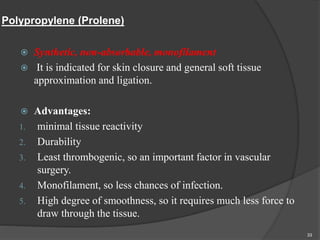
Polypropylene (Prolene)
 Synthetic, non-absorbable, monofilament
 It is indicated for skin closure and general soft tissue
approximation and ligation.
 Advantages:
1. minimal tissue reactivity
2. Durability
3. Least thrombogenic, so an important factor in vascular
surgery.
4. Monofilament, so less chances of infection.
5. High degree of smoothness, so it requires much less force to
draw through the tissue.
33
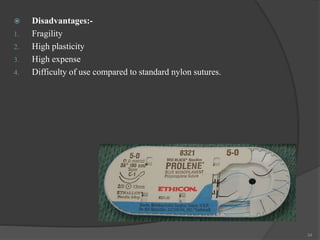
 Disadvantages:-
1. Fragility
2. High plasticity
3. High expense
4. Difficulty of use compared to standard nylon sutures.
34
Irradiated Polyglactin 910
(Vicryl Rapide)-
 IRPG is a braided co-polymer of glycolic and lactic acid that
is surface treated with polyglactin 370 and Calcium stearate
and has received gamma radiation.
 Advantages over other materials are:-
1. Good tensile strength
2. Forms secure knots
3. Minimal tissue reaction
4. Faster absorption rate
 Popular among pediatric surgeons because of its faster
absorption rate which makes suture removal unnecessary or
simple (sutures can be wiped off)
35
NEEDLES
36
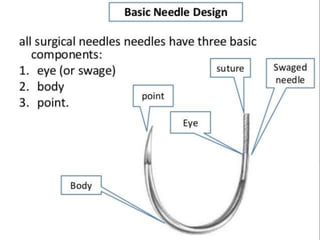
Anatomy of a Needle
37
38
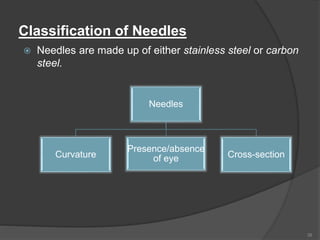
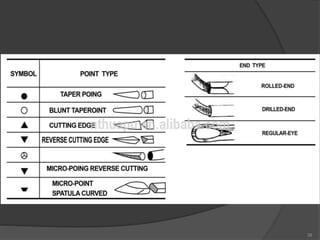
Classification of Needles
 Needles are made up of either stainless steel or carbon
steel.
39
Needles
Curvature
Presence/absence
of eye Cross-section
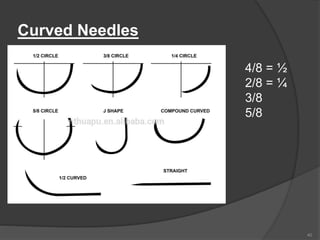
Curved Needles
40
4/8 = ½
2/8 = ¼
3/8
5/8
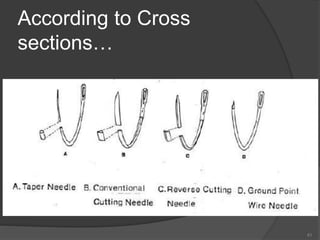
According to Cross
sections…
41
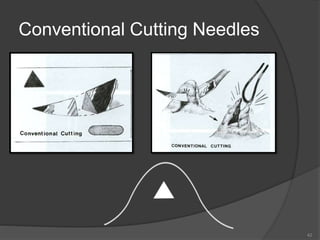
Conventional Cutting Needles
42
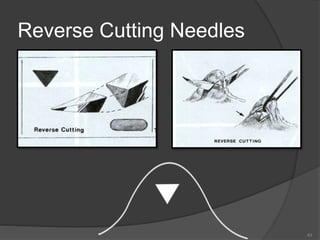
Reverse Cutting Needles
43
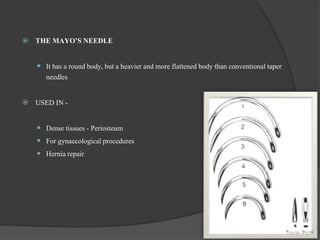
 THE MAYO’S NEEDLE
 It has a round body, but a heavier and more flattened body than conventional taper
needles
 USED IN -
 Dense tissues - Periosteum
 For gynaecological procedures
 Hernia repair
44
Armamenterium for
suturing
45
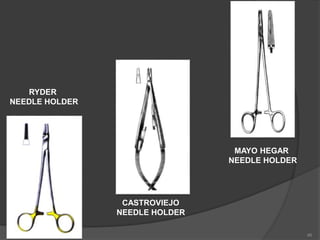
MAYO HEGAR
NEEDLE HOLDER
RYDER
NEEDLE HOLDER
CASTROVIEJO
NEEDLE HOLDER
46
47
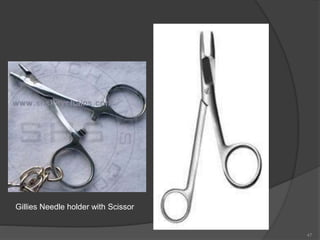
Gillies Needle holder with Scissor
48
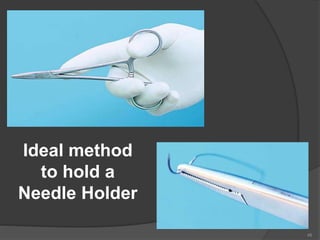
Ideal method
to hold a
Needle Holder
PRINCIPLES OF SUTURING
49
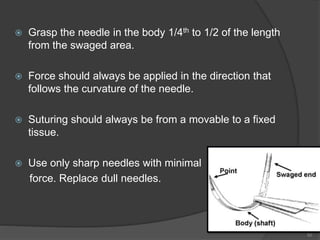
 Grasp the needle in the body 1/4th to 1/2 of the length
from the swaged area.
 Force should always be applied in the direction that
follows the curvature of the needle.
 Suturing should always be from a movable to a fixed
tissue.
 Use only sharp needles with minimal
force. Replace dull needles.
50
 Never force the needle through the tissue.
 Avoid retrieving the needle from the tissue by the tip.
This will damage or dull the needle.
 The needle should enter the tissue perpendicular to the
surface. If the needle pierces the tissue obliquely, a tear
may develop.
• The suture should be placed at an equal distance from the
incision on both the sides and at an equal depth.
51
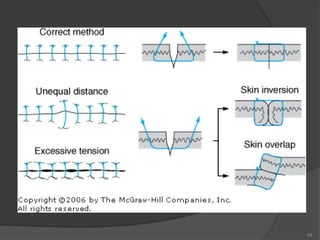
 If one tissue side is thinner than the other the needle should
pass from the thinner tissue to the thicker one.
 If one tissue plane is deeper than the other, then the needle
should pass from the deeper to the superficial side.
• The tissues should not be closed under tension, since they will
tear or necrosed around the suture. If tension is present the
tissues should be undermined to relieve it.
52
-The knot should not be placed over the incision line.
-Sutures should be placed approximately 3-4mm apart.
-The suture should be tied so that the tissue is approximated
and the edges are everted.
53
54
Knot & Knot Tying
55
“Suture security is the ability of the knot and material to
maintain tissue approximation during the healing process”
Failure – occurs due to untying by knot slippage or
breakage. Since the knot strength is always less than the
tensile strength of the material, when a force is applied the
site of disruption is always the knot.
This is because shear forces produced in the knot lead to
breakage.
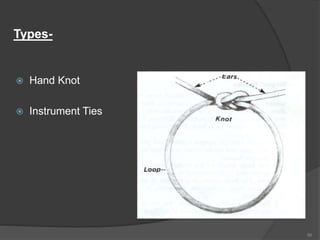
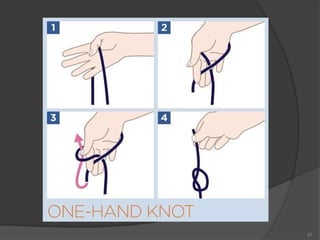
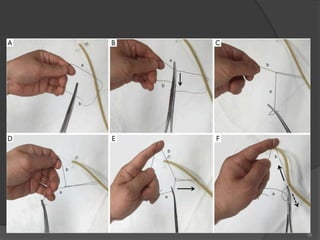
Types-
 Hand Knot
 Instrument Ties
56
57
58
59
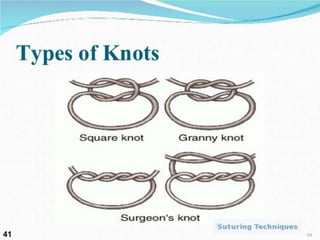
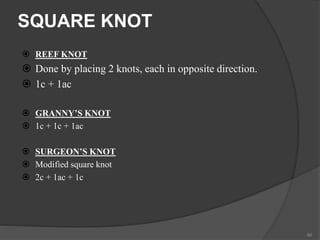
SQUARE KNOT
 REEF KNOT
 Done by placing 2 knots, each in opposite direction.
 1c + 1ac
 GRANNY’S KNOT
 1c + 1c + 1ac
 SURGEON’S KNOT
 Modified square knot
 2c + 1ac + 1c
60
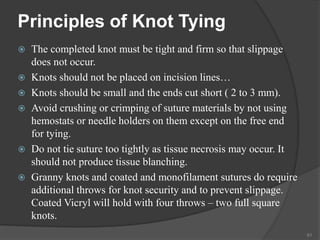
Principles of Knot Tying
 The completed knot must be tight and firm so that slippage
does not occur.
 Knots should not be placed on incision lines…
 Knots should be small and the ends cut short ( 2 to 3 mm).
 Avoid crushing or crimping of suture materials by not using
hemostats or needle holders on them except on the free end
for tying.
 Do not tie suture too tightly as tissue necrosis may occur. It
should not produce tissue blanching.
 Granny knots and coated and monofilament sutures do require
additional throws for knot security and to prevent slippage.
Coated Vicryl will hold with four throws – two full square
knots.
61
62
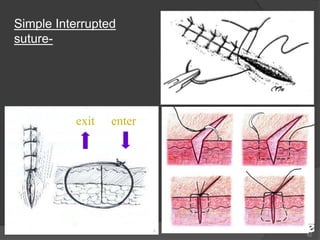
enterexit
Simple Interrupted
suture-
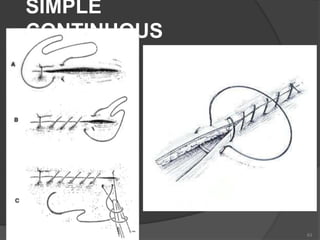
SIMPLE
CONTINUOUS
63
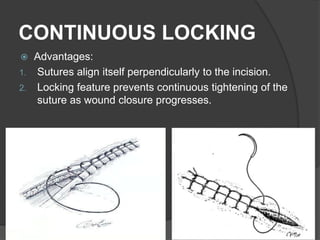
CONTINUOUS LOCKING
 Advantages:
1. Sutures align itself perpendicularly to the incision.
2. Locking feature prevents continuous tightening of the
suture as wound closure progresses.
64
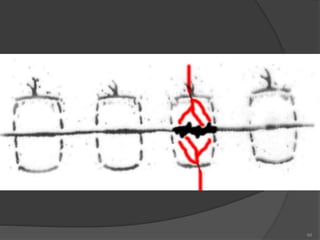
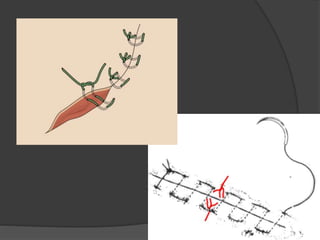
Mattress Sutures
 Purpose:
 To provide more tissue eversion than
with Interrupted sutures
 In areas where wound contraction could
cause dehiscence or broad scar
formation. E.g. abdomen or hip areas.
 2 types: Horizontal & Vertical
65
66
67
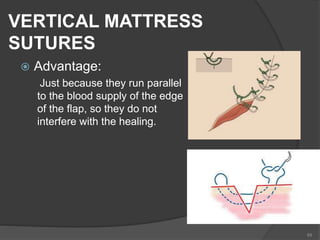
VERTICAL MATTRESS
SUTURES
 Advantage:
Just because they run parallel
to the blood supply of the edge
of the flap, so they do not
interfere with the healing.
68
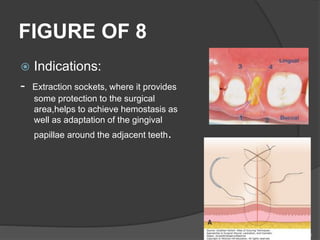
FIGURE OF 8
 Indications:
- Extraction sockets, where it provides
some protection to the surgical
area,helps to achieve hemostasis as
well as adaptation of the gingival
papillae around the adjacent teeth.
69
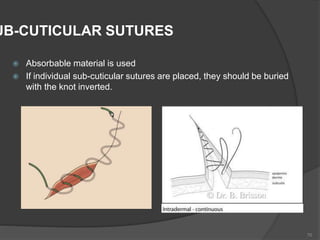
UB-CUTICULAR SUTURES
 Absorbable material is used
 If individual sub-cuticular sutures are placed, they should be buried
with the knot inverted.
70
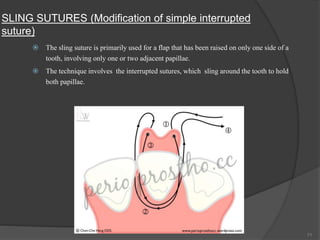
SLING SUTURES (Modification of simple interrupted
suture)
 The sling suture is primarily used for a flap that has been raised on only one side of a
tooth, involving only one or two adjacent papillae.
 The technique involves the interrupted sutures, which sling around the tooth to hold
both papillae.
71
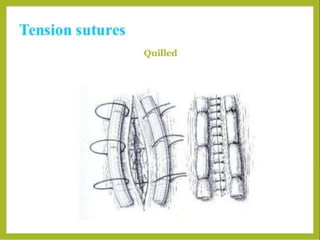
TENSION SUTURE
 This type of suture is used to prevent wound dehiscence.
 A suture materials of good strength like non-absorbable nylon or prolene is used with a
plastic tubing to reduce the tension exerted by the sutures on the tissues.
72
73
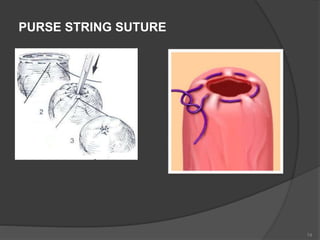
PURSE STRING SUTURE
74
75
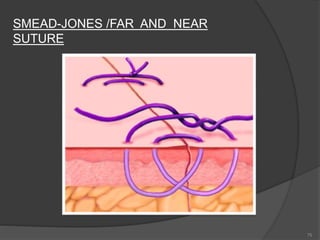
SMEAD-JONES /FAR AND NEAR
SUTURE
 Principles for Suture Removal:-
1. The area should be swabbed with hydrogen peroxide for removal of
encrusted necrotic debris, blood, and serum from about the sutures.
2. A sharp suture scissors should be used to cut the loops of a suture. No. 23
explorer can be used to help lift the sutures if they are within the sulcus or
in close opposition to the tissue. This will avoid tissue damage and
unnecessary pain.
3. A cotton pliers is then used to remove the sutures. The location of the
knots should be noted so that they can be removed first
4. Sutures should be removed in 7 to 10 days to prevent epithelialization or
wicking about the suture.
5. Suture should be cut as close to the skin surface as possible
76
OTHER ADJUNCTS TO
WOUND CLOSURE
77
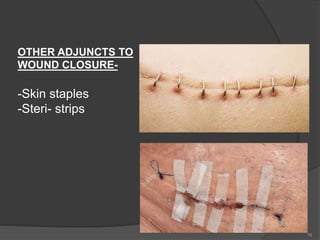
OTHER ADJUNCTS TO
WOUND CLOSURE-
-Skin staples
-Steri- strips
78
COMPLICATIONS OF WOUND
CLOSURE
79
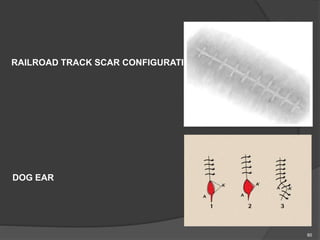
RAILROAD TRACK SCAR CONFIGURATION
80
DOG EAR
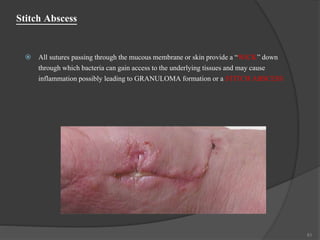
 All sutures passing through the mucous membrane or skin provide a “WICK” down
through which bacteria can gain access to the underlying tissues and may cause
inflammation possibly leading to GRANULOMA formation or a STITCH ABSCESS
81
Stitch Abscess
REFERENCES-
 Oral & Maxillofacial Surgery. Vol. I : By Daniel M. Laskin.
 Peterson’s Contemporary Oral and Maxillofacial Surgery
 Textbook of Oral Surgery-James Hupp
 Internet (Wikipedia)
82
THANK YOU
83

Suturing materials,techniques and principles

  • 1.
    Presented by- DrShibani Sarangi MDS 1st year(OMFS) Suturing techniques and principles 1
  • 2.
    INTRODUCTION  The mostcommon cause of postoperative infections is poor surgical techniques, usually related to devitalized tissues remaining in the wound and also inadequate closure.  Thus closure of wound by suturing helps to obliterate dead space where accumulation of blood or other tissue fluids could prevent direct apposition of tissues and provide an environment favorable for bacterial growth.  Sutures also distribute the tension of wound closure over a larger volume of tissues. 2
  • 3.
    HISTORY  Surgical sutureshave been used to close wounds since prehistoric times.  Needles were made up of bones or metals (Silver, copper, bronze) and sutures were made up of plant materials (hemp, flax and cotton) or animal material (tendons, hair, muscle strips, arteries). 3
  • 4.
     DEFINATIONS-  Suturematerial is an artificial fiber used to keep wound together until they hold sufficiently well by themselves by natural fiber (collagen) which is synthesized and woven into a stronger scar .  Suture is a stitch/series of stiches made to secure apposition of the edges of a surgical/traumatic wound -Wilkins  Any strand of material utilized to ligate blood vessels or approximate tissues . -Silverstein L.H 1999 4
  • 5.
    It is saidthat an old method of wound closure has been using large black ants, which bite the wound edges together and the ants body being twisted off leaving the head in place. 5
  • 6.
    6 GOALS OF SUTURING– • Maintain hemostasis • Permit primary intention healing • Provide support for tissue margins • Reduce post-operative pain • Prevent bone exposure • Permit proper flap position
  • 7.
    7 REQUISITES OF ANIDEAL SUTURE Postlethwait 1971, Varma 1974, Ethicon 1985 •Tensile strength: adequate material strength will prevent suture breakdown & use of proper knots for the material used will prevent untying or knot slippage. •Tissue biocompatibility: sutures made from organic material will evoke a higher tissue response than synthetic sutures. • Tissue reaction - amount & size of suture material. • Low capillarity: multifilament type soak up tissue fluid by capillary action providing a rich medium for microbes increasing chances of inflammation & infection
  • 8.
    8 •Good handling &knotting properties: ease of tying & a thread type that permits minimal knot slippage also influence thread selection. • Sterilization without deterioration of properties: most sutures available in packages are sterilized by dry heat & ethylene oxide gas.
  • 9.
    SUTURE MATERIAL  Suturematerials comes in various sizes  Sizes 5 to 12-0 (numbers alone indicate progressively larger sutures, whereas numbers followed by 0 indicate progressively smaller)  5 > 4 > 3 > 2 > 1 > 2-0 > 3-0  3-0 → 000  4-0 → 0000  6-0 → 000000  12-0 → 000000000000 9
  • 10.
  • 11.
  • 12.
  • 13.
  • 14.
  • 15.
    Monofilament Multifilament (braided)  Singlestrand of suture material  Minimal tissue trauma  Smooth tying but more knots needed  Harder to handle due to memory  Examples: nylon, monocryl, prolene, PDS  Fibers are braided or twisted together  More tissue resistance  Easier to handle  Fewer knots needed  Examples: vicryl, silk, chromic
  • 16.
  • 17.
  • 18.
    Catgut -  Absorbable,natural, monofilament suture  It is derived from sheep intestinal submucosa or bovine intestinal serosa.  The origin of the word ‘catgut’ is the Arabic “kitstring” or ‘kitgut,” (the string of a dancing master’s fiddle) which was also made of animal intestine.  It is absorbed by proteolytic degradation and phagocytosis. 18
  • 19.
     When placedintra-orally through mucosal surfaces, the sutures generally are gone in 3 to 5 days.  Chromic gut is plain gut that has been tanned with a solution of Chromium salts. The chromium salts act as a cross-linking agent and increase the tensile strength of the material and its resistance to absorption by the body.  Advantages: 1. Increased strength 2. Prolonged rate of absorption 3. Less stimulation for tissue reaction 19
  • 20.
    Uses-  Plain catgut– -Smooth vessels -Subcutaneous tissue  Chromic catgut: 1-0/2-0 - ligation of medium sized blood vessels. 3-0/4-0 - Close muscle layer in cleft lip repair. 5-0/6-0 - In plastic surgery 20
  • 21.
    Silk-  Natural, nonabsorbable, braided suture.  It is the most popular suture material for intraoral use. 21 Advantages: 1. Excellent handling characteristics 2. Moderate tissue response 3. It does not irritate adjacent mucous membrane 4. Inexpensive
  • 22.
    Disadvantage:- 1. Stitch Granuloma 2.Infection rate is more  Although classed as a non-absorbable suture, silk is an organic substance that undergoes slow proteolysis when implanted. - Douglas (1949)  It usually disappears after 2 yrs of implantation. 22
  • 23.
    Uses-  To ligateblood vessels and pedicles  To suture nerve  To suture grafts in vascular surgery  To suture tendons  Skin suture  For fixing skin grafts  Suturing of wound over face  Intra oral suturing 23
  • 24.
    Cotton-  Natural, multifilamentand non-absorbable  Cotton suture is made from non-continuous natural fibres of cotton, which are combined into yarns and then twisted into plies.  It became popular during World war II when silk was relatively unavailable.  Its handling characteristics are inferior than silk.  Tissue reaction (Postlethwait, 1970) is similar to silk.  Sizes: 2, 8, 1-0, 2-0, 4-0, 6-0 and 8-0 24
  • 25.
    Nylon ( surgilon, duralon,ethilon)  Polyamide polymer  Synthetic, non-absorbable, mono- and multi-filament.  Most popular skin suture material (monofilament)  Advantages: 1. Minimal tissue response 2. Good tensile strength 3. Inexpensive 25
  • 26.
     Disadvantage: 1. Becauseof its stiffness, large knot required. 2. Tendency to tear through non-keratinized tissue, nylon is not frequently used intra-orally. 3. Possess “memory”… multiple square knots are necessary to maintain the tie. 26
  • 27.
    Polyglycolic Acid (Dexon,Surgicryl)  Polyglycolic acid is hydroxyacetic acid.  Synthetic, absorbable and multifilament  Advantages: 1. Good tensile strength 2. Easy handling 3. Good knot tying ability 4. Smooth passage through tissues 5. Less tissue edema 27
  • 28.
    Uses -  Itis commonly used for subcutaneous sutures, intra-cutaneous closures, abdominal and thoracic surgeries. 28
  • 29.
    Polyglactin 910(Vicryl)  Vicryl(polyglactin 910) is an absorbable, synthetic, braided suture.  It is indicated for soft tissue approximation and ligation.  Enzymatic degradation  Approx. 3 – 4 weeks in tissue and is completely absorbed by hydrolysis within 60 days. 29
  • 30.
     Vicryl andother polyglycolic acid sutures can be impregnated with triclosan to provide antimicrobial protection of the suture line. 30
  • 31.
    Polydiaxonone-  It issterile, monofilament synthetic absorbable suture composed of the polyester.  Advantages:- 1. Wound support for longer periods up to 50 days. 2. Superior tensile strength and outstanding pliability. 3. Its monofilament structure provides good handling properties and excellent knot security. 4. Absorption of suture is by hydrolysis within 180 days from implantation day. 5. Minimal tissue reaction. 31
  • 32.
    Poliglecaprone 25 (Monocryl)- Coploymer of glycolide and caprolactone.  Monfilament type of suture which undergoes hydrolysis in 90-120 days.  It has the best tensile strength among the available suture materials with minimal tissue reaction.  Its is the most flexible, synthetic absorbable monofilament ever.  Glide easily over the tissues 32
  • 33.
    Polypropylene (Prolene)  Synthetic,non-absorbable, monofilament  It is indicated for skin closure and general soft tissue approximation and ligation.  Advantages: 1. minimal tissue reactivity 2. Durability 3. Least thrombogenic, so an important factor in vascular surgery. 4. Monofilament, so less chances of infection. 5. High degree of smoothness, so it requires much less force to draw through the tissue. 33
  • 34.
     Disadvantages:- 1. Fragility 2.High plasticity 3. High expense 4. Difficulty of use compared to standard nylon sutures. 34
  • 35.
    Irradiated Polyglactin 910 (VicrylRapide)-  IRPG is a braided co-polymer of glycolic and lactic acid that is surface treated with polyglactin 370 and Calcium stearate and has received gamma radiation.  Advantages over other materials are:- 1. Good tensile strength 2. Forms secure knots 3. Minimal tissue reaction 4. Faster absorption rate  Popular among pediatric surgeons because of its faster absorption rate which makes suture removal unnecessary or simple (sutures can be wiped off) 35
  • 36.
  • 37.
    Anatomy of aNeedle 37
  • 38.
  • 39.
    Classification of Needles Needles are made up of either stainless steel or carbon steel. 39 Needles Curvature Presence/absence of eye Cross-section
  • 40.
    Curved Needles 40 4/8 =½ 2/8 = ¼ 3/8 5/8
  • 41.
  • 42.
  • 43.
  • 44.
     THE MAYO’SNEEDLE  It has a round body, but a heavier and more flattened body than conventional taper needles  USED IN -  Dense tissues - Periosteum  For gynaecological procedures  Hernia repair 44
  • 45.
  • 46.
    MAYO HEGAR NEEDLE HOLDER RYDER NEEDLEHOLDER CASTROVIEJO NEEDLE HOLDER 46
  • 47.
  • 48.
    48 Ideal method to holda Needle Holder
  • 49.
  • 50.
     Grasp theneedle in the body 1/4th to 1/2 of the length from the swaged area.  Force should always be applied in the direction that follows the curvature of the needle.  Suturing should always be from a movable to a fixed tissue.  Use only sharp needles with minimal force. Replace dull needles. 50
  • 51.
     Never forcethe needle through the tissue.  Avoid retrieving the needle from the tissue by the tip. This will damage or dull the needle.  The needle should enter the tissue perpendicular to the surface. If the needle pierces the tissue obliquely, a tear may develop. • The suture should be placed at an equal distance from the incision on both the sides and at an equal depth. 51
  • 52.
     If onetissue side is thinner than the other the needle should pass from the thinner tissue to the thicker one.  If one tissue plane is deeper than the other, then the needle should pass from the deeper to the superficial side. • The tissues should not be closed under tension, since they will tear or necrosed around the suture. If tension is present the tissues should be undermined to relieve it. 52
  • 53.
    -The knot shouldnot be placed over the incision line. -Sutures should be placed approximately 3-4mm apart. -The suture should be tied so that the tissue is approximated and the edges are everted. 53
  • 54.
  • 55.
    Knot & KnotTying 55 “Suture security is the ability of the knot and material to maintain tissue approximation during the healing process” Failure – occurs due to untying by knot slippage or breakage. Since the knot strength is always less than the tensile strength of the material, when a force is applied the site of disruption is always the knot. This is because shear forces produced in the knot lead to breakage.
  • 56.
    Types-  Hand Knot Instrument Ties 56
  • 57.
  • 58.
  • 59.
  • 60.
    SQUARE KNOT  REEFKNOT  Done by placing 2 knots, each in opposite direction.  1c + 1ac  GRANNY’S KNOT  1c + 1c + 1ac  SURGEON’S KNOT  Modified square knot  2c + 1ac + 1c 60
  • 61.
    Principles of KnotTying  The completed knot must be tight and firm so that slippage does not occur.  Knots should not be placed on incision lines…  Knots should be small and the ends cut short ( 2 to 3 mm).  Avoid crushing or crimping of suture materials by not using hemostats or needle holders on them except on the free end for tying.  Do not tie suture too tightly as tissue necrosis may occur. It should not produce tissue blanching.  Granny knots and coated and monofilament sutures do require additional throws for knot security and to prevent slippage. Coated Vicryl will hold with four throws – two full square knots. 61
  • 62.
  • 63.
  • 64.
    CONTINUOUS LOCKING  Advantages: 1.Sutures align itself perpendicularly to the incision. 2. Locking feature prevents continuous tightening of the suture as wound closure progresses. 64
  • 65.
    Mattress Sutures  Purpose: To provide more tissue eversion than with Interrupted sutures  In areas where wound contraction could cause dehiscence or broad scar formation. E.g. abdomen or hip areas.  2 types: Horizontal & Vertical 65
  • 66.
  • 67.
  • 68.
    VERTICAL MATTRESS SUTURES  Advantage: Justbecause they run parallel to the blood supply of the edge of the flap, so they do not interfere with the healing. 68
  • 69.
    FIGURE OF 8 Indications: - Extraction sockets, where it provides some protection to the surgical area,helps to achieve hemostasis as well as adaptation of the gingival papillae around the adjacent teeth. 69
  • 70.
    UB-CUTICULAR SUTURES  Absorbablematerial is used  If individual sub-cuticular sutures are placed, they should be buried with the knot inverted. 70
  • 71.
    SLING SUTURES (Modificationof simple interrupted suture)  The sling suture is primarily used for a flap that has been raised on only one side of a tooth, involving only one or two adjacent papillae.  The technique involves the interrupted sutures, which sling around the tooth to hold both papillae. 71
  • 72.
    TENSION SUTURE  Thistype of suture is used to prevent wound dehiscence.  A suture materials of good strength like non-absorbable nylon or prolene is used with a plastic tubing to reduce the tension exerted by the sutures on the tissues. 72
  • 73.
  • 74.
  • 75.
  • 76.
     Principles forSuture Removal:- 1. The area should be swabbed with hydrogen peroxide for removal of encrusted necrotic debris, blood, and serum from about the sutures. 2. A sharp suture scissors should be used to cut the loops of a suture. No. 23 explorer can be used to help lift the sutures if they are within the sulcus or in close opposition to the tissue. This will avoid tissue damage and unnecessary pain. 3. A cotton pliers is then used to remove the sutures. The location of the knots should be noted so that they can be removed first 4. Sutures should be removed in 7 to 10 days to prevent epithelialization or wicking about the suture. 5. Suture should be cut as close to the skin surface as possible 76
  • 77.
  • 78.
    OTHER ADJUNCTS TO WOUNDCLOSURE- -Skin staples -Steri- strips 78
  • 79.
  • 80.
    RAILROAD TRACK SCARCONFIGURATION 80 DOG EAR
  • 81.
     All suturespassing through the mucous membrane or skin provide a “WICK” down through which bacteria can gain access to the underlying tissues and may cause inflammation possibly leading to GRANULOMA formation or a STITCH ABSCESS 81 Stitch Abscess
  • 82.
    REFERENCES-  Oral &Maxillofacial Surgery. Vol. I : By Daniel M. Laskin.  Peterson’s Contemporary Oral and Maxillofacial Surgery  Textbook of Oral Surgery-James Hupp  Internet (Wikipedia) 82
  • 83.

Editor's Notes

  • #16 Polydiaxonone
  • #40 Atraumatic or Traumatic…
  • #49 Thumb goes into the upper ring. Ring finger goes into the lower ring. The middle finger goes in front of the lower ring just below the hatchet. And the index finger supports the body or hinge portion of the holder. Multiple point of contact gives more stability.
  • #51 Needle should always be inserted perpendicular to the tissue and along its curvature. Movable to fixed tissue Use sharp needle only
  • #52 Do not force the needle through the tissue. If our needle selection is proper then it will not be necessary. The needle will pass through the tissue easily. Do not retrieve the needle by the tip Always take an adequate tissue bite.
  • #53 Equal distance and equal depth Thinner to thicker Deeper to superficial
  • #54 Do not close the tissue under tension, lead to tear or necrosis. Undermine the tissue to relieve the tension. Knot should not be placed over the incision. Sutures kept 3-4 mm apart.
  • #59 In instrument tie, the suture material Is looped around the jaws of the needle holder and then the free end of the suture material is held with the holder. Then we pull the needle end of the suture and not the free end of the suture. So the knot is automatically placed at the side where the first bite is taken.
  • #62 knot must be tight to avoid slippage. Do not place knot at incision line. Knot ears should be small 2-3mm Avoid crushing or crimping of suture materials by needle holder Do not tie the knot too tightly. No blanching. Granny knot, coated or monofilament sutures require extra throw for knot security and prevent slippage.
  • #64 Rapid technique There is even distribution of tension over the entire suture line If the tissue swell at one area, the remaining sutured area can provide a degree of slack that will help relieve the pressure. Watertight closure (Shoen, 1976) Should not be used in areas of existing tension
  • #67 Strangulation of the of the terminal capillaries leading to the compromised blood supply. Which causes necrosis.
  • #75 Used to repair a punched out small hole like defect or in gastrostomy.