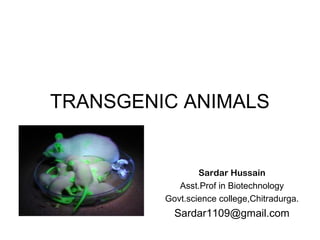
TRANSGENIC ANIMALS
Sardar Hussain
Asst.Prof in Biotechnology
Govt.science college,Chitradurga.
Sardar1109@gmail.com
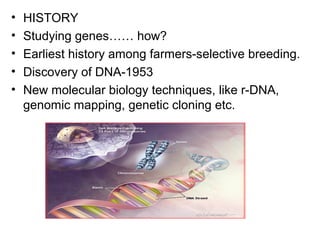
• HISTORY
• Studying genes…… how?
• Earliest history among farmers-selective breeding.
• Discovery of DNA-1953
• New molecular biology techniques, like r-DNA,
genomic mapping, genetic cloning etc.
TRANSGENESIS:
• A new technology
direct manipulation of genetic material.
• Term transgenic-J.W.Gordon and
F.H.Rudell.
• Tailor made animals-wanted characters.
• More efficient than selective breeding.
What are Transgenic?
• Transgenes?
•GMO?
•Transgenic are genetically modified
organisms with DNA from another
source inserted into their genome
•Genes from other species/organisms.
•Organisms that have transgenes are called
genetically modified organisms. As their
genome is modified.
A large number of transgenic animals have
been created
•Mice
•Cows
•Pigs
•Sheep
•Goats
• Fish
• Frogs
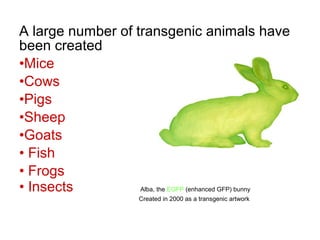
• Insects Alba, the EGFP (enhanced GFP) bunny
Created in 2000 as a transgenic artwork
Transgenic animals For what reason?
• Introduction of a desired character.
• Animal model for human diseases
• Animal system to produce biomolecules
(„Pharming“)
How are transgenic animals
produced?
• The underlying principle in the production
of transgenic animals is the introduction of
a foreign gene or genes into an animal
(the inserted genes are called
transgenes). The foreign genes “must be
transmitted through the germ line, so that
every cell, including germ cells, of the
animal contain the same modified genetic
material.”26 (Germ cells are cells whose
function is to transmit genes to an
organism’s offspring.)
• To date, there are three basic methods of
producing transgenic animals:
• DNA microinjection
• Retrovirus-mediated gene transfer
• Embryonic stem cell-mediated gene
transfer
The production of transgenic animals by microinjection
DNA Microinjection
•The mouse was the first animal to undergo
successful gene transfer using DNA microinjection.
• This method involves:
•Transfer of a desired gene construct (of a single
gene or a combination of genes that are
recombined and then cloned) from another
member of the same species or from a different
species into the pronucleus of a reproductive cell
•The manipulated cell, which first must be cultured
in vitro (in a lab, not in a live animal) to develop to
a specific embryonic phase, is then transferred to
the recipient female
How do transgenic contribute to human
welfare?
•The benefits of these animals to human
welfare can be grouped into areas:
•Agriculture
•Medicine
•Industry
•Disease resistance
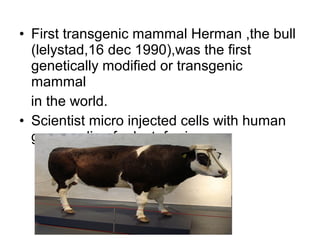
• First transgenic mammal Herman ,the bull
(lelystad,16 dec 1990),was the first
genetically modified or transgenic
mammal
in the world.
• Scientist micro injected cells with human
gene coding for lactoferrin.
• In 1997, first transgenic cow ROSIE,
• Produced human protein enriched milk at
2.4g/lt, contains human gene Alfa
lactalbumin.
• α-lactalbumin is an important
whey protein in cow's milk (~1 g/l), and is
also present in the milk of many other
mammalian species.
Problems:
•Abnormalities suffered are more
•Reduced fertility
•Weak immune system
•Respiratory and circulatory problems.
• Religious and ethical considerations-Man
playing the role of GOD.
• Should scientists focus on in vitro (cultured in a
lab) transgenic methods rather than, or before,
using live animals to alleviate animal suffering?
• Should such protocols demand that only the
most promising research be permitted?
• Is human welfare the only consideration?
• What about the welfare of other life forms?
Conclusion
•Interestingly, the creation of transgenic animals
has resulted in a shift in the use of laboratory
animals — from the use of higher-order species
such as dogs to lower-order species such as mice
— and has decreased the number of animals used
in such experimentation, especially in the
development of disease models. This is certainly a
good turn of events since transgenic technology
holds great potential in many fields, including
agriculture, medicine, and industry.
• References:
• www.bioteklipi.co.
• www.wikipedia.com
• www.amazon.edu
• www.mit.edu.
• www.google.com
Thank you

Transgenic animals

  • 1.
    TRANSGENIC ANIMALS Sardar Hussain Asst.Profin Biotechnology Govt.science college,Chitradurga. Sardar1109@gmail.com
  • 2.
    • HISTORY • Studyinggenes…… how? • Earliest history among farmers-selective breeding. • Discovery of DNA-1953 • New molecular biology techniques, like r-DNA, genomic mapping, genetic cloning etc.
  • 3.
    TRANSGENESIS: • A newtechnology direct manipulation of genetic material. • Term transgenic-J.W.Gordon and F.H.Rudell. • Tailor made animals-wanted characters. • More efficient than selective breeding.
  • 4.
    What are Transgenic? •Transgenes? •GMO? •Transgenic are genetically modified organisms with DNA from another source inserted into their genome •Genes from other species/organisms. •Organisms that have transgenes are called genetically modified organisms. As their genome is modified.
  • 5.
    A large numberof transgenic animals have been created •Mice •Cows •Pigs •Sheep •Goats • Fish • Frogs • Insects Alba, the EGFP (enhanced GFP) bunny Created in 2000 as a transgenic artwork
  • 6.
    Transgenic animals Forwhat reason? • Introduction of a desired character. • Animal model for human diseases • Animal system to produce biomolecules („Pharming“)
  • 7.
    How are transgenicanimals produced?
  • 8.
    • The underlyingprinciple in the production of transgenic animals is the introduction of a foreign gene or genes into an animal (the inserted genes are called transgenes). The foreign genes “must be transmitted through the germ line, so that every cell, including germ cells, of the animal contain the same modified genetic material.”26 (Germ cells are cells whose function is to transmit genes to an organism’s offspring.)
  • 9.
    • To date,there are three basic methods of producing transgenic animals: • DNA microinjection • Retrovirus-mediated gene transfer • Embryonic stem cell-mediated gene transfer
  • 10.
    The production oftransgenic animals by microinjection
  • 11.
    DNA Microinjection •The mousewas the first animal to undergo successful gene transfer using DNA microinjection. • This method involves: •Transfer of a desired gene construct (of a single gene or a combination of genes that are recombined and then cloned) from another member of the same species or from a different species into the pronucleus of a reproductive cell •The manipulated cell, which first must be cultured in vitro (in a lab, not in a live animal) to develop to a specific embryonic phase, is then transferred to the recipient female
  • 13.
    How do transgeniccontribute to human welfare? •The benefits of these animals to human welfare can be grouped into areas: •Agriculture •Medicine •Industry •Disease resistance
  • 14.
    • First transgenicmammal Herman ,the bull (lelystad,16 dec 1990),was the first genetically modified or transgenic mammal in the world. • Scientist micro injected cells with human gene coding for lactoferrin.
  • 15.
    • In 1997,first transgenic cow ROSIE, • Produced human protein enriched milk at 2.4g/lt, contains human gene Alfa lactalbumin. • α-lactalbumin is an important whey protein in cow's milk (~1 g/l), and is also present in the milk of many other mammalian species.
  • 16.
    Problems: •Abnormalities suffered aremore •Reduced fertility •Weak immune system •Respiratory and circulatory problems.
  • 17.
    • Religious andethical considerations-Man playing the role of GOD. • Should scientists focus on in vitro (cultured in a lab) transgenic methods rather than, or before, using live animals to alleviate animal suffering? • Should such protocols demand that only the most promising research be permitted? • Is human welfare the only consideration? • What about the welfare of other life forms?
  • 18.
    Conclusion •Interestingly, the creationof transgenic animals has resulted in a shift in the use of laboratory animals — from the use of higher-order species such as dogs to lower-order species such as mice — and has decreased the number of animals used in such experimentation, especially in the development of disease models. This is certainly a good turn of events since transgenic technology holds great potential in many fields, including agriculture, medicine, and industry.
  • 19.
    • References: • www.bioteklipi.co. •www.wikipedia.com • www.amazon.edu • www.mit.edu. • www.google.com
  • 20.