The Michelson
Interferometer
LO9 PHYSICS 101
• With the aid of two mirrors, light is brought to
interference.While moving one of the mirrors, the
alternation in the interference pattern is observed
and the wavelength of the laser light is determined.
• From a the Michelson Interferometer we can learn
about interference, wavelength, diffraction index,
and phase.
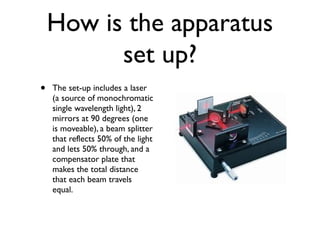
• The set-up includes a laser
(a source of monochromatic
single wavelength light), 2
mirrors at 90 degrees (one
is moveable), a beam splitter
that reflects 50% of the light
and lets 50% through, and a
compensator plate that
makes the total distance
that each beam travels
equal.
How is the apparatus
set up?
How do we create an
interference pattern?
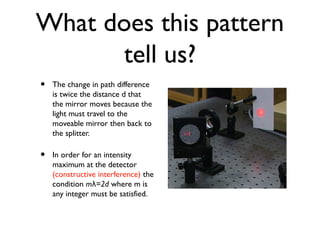
• If the two paths are
equal in length and we
gradually adjust the
moveable mirror, the
image at the detector
goes from bright (zero
path difference) to dim
(a path difference of one
half wavelength) to
bright again and so on.
What does this pattern
tell us?
• The change in path difference
is twice the distance d that
the mirror moves because the
light must travel to the
moveable mirror then back to
the splitter.
• In order for an intensity
maximum at the detector
(constructive interference) the
condition m =2dλ where m is
any integer must be satisfied.
What does this pattern
tell us?
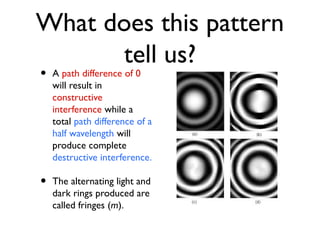
• A path difference of 0
will result in
constructive
interference while a
total path difference of a
half wavelength will
produce complete
destructive interference.
• The alternating light and
dark rings produced are
called fringes (m).
TestYour
Understanding
• You shoot a laser of unknown wavelength
using a Michelson Interferometer and slowly
move the adjustable mirror at a steady pace
to produce even fringes.
• You notice that after a change in position of
the mirror of 726nm, you are able to count
around 11 fringes on the photodectotor.
What must the wavelength of the light source
be?
Solution
• Since m =2dλ and we know that the change in
position of the mirror was 726nm and resulted in
11 fringes, we can solve for the remaining unknown
which is the wavelength of this laser.
• =(2*726nm)/11=132nmλ
Image Sources
• #1:http://www.academia.edu/7006694/Interferometer
• #2:
http://www.phy.davidson.edu/stuhome/cabell_f/diffractionfinal/p
• #3:
http://electron6.phys.utk.edu/optics421/Laboratories/Lab7.htm
• #4:
http://opticalengineering.spiedigitallibrary.org/article.as
px?articleid=1088823
Thank you for watching!

Michelson interferometer

  • 1.
  • 2.
    • With theaid of two mirrors, light is brought to interference.While moving one of the mirrors, the alternation in the interference pattern is observed and the wavelength of the laser light is determined. • From a the Michelson Interferometer we can learn about interference, wavelength, diffraction index, and phase.
  • 3.
    • The set-upincludes a laser (a source of monochromatic single wavelength light), 2 mirrors at 90 degrees (one is moveable), a beam splitter that reflects 50% of the light and lets 50% through, and a compensator plate that makes the total distance that each beam travels equal. How is the apparatus set up?
  • 4.
    How do wecreate an interference pattern? • If the two paths are equal in length and we gradually adjust the moveable mirror, the image at the detector goes from bright (zero path difference) to dim (a path difference of one half wavelength) to bright again and so on.
  • 5.
    What does thispattern tell us? • The change in path difference is twice the distance d that the mirror moves because the light must travel to the moveable mirror then back to the splitter. • In order for an intensity maximum at the detector (constructive interference) the condition m =2dλ where m is any integer must be satisfied.
  • 6.
    What does thispattern tell us? • A path difference of 0 will result in constructive interference while a total path difference of a half wavelength will produce complete destructive interference. • The alternating light and dark rings produced are called fringes (m).
  • 7.
    TestYour Understanding • You shoota laser of unknown wavelength using a Michelson Interferometer and slowly move the adjustable mirror at a steady pace to produce even fringes. • You notice that after a change in position of the mirror of 726nm, you are able to count around 11 fringes on the photodectotor. What must the wavelength of the light source be?
  • 8.
    Solution • Since m=2dλ and we know that the change in position of the mirror was 726nm and resulted in 11 fringes, we can solve for the remaining unknown which is the wavelength of this laser. • =(2*726nm)/11=132nmλ
  • 9.
    Image Sources • #1:http://www.academia.edu/7006694/Interferometer •#2: http://www.phy.davidson.edu/stuhome/cabell_f/diffractionfinal/p • #3: http://electron6.phys.utk.edu/optics421/Laboratories/Lab7.htm • #4: http://opticalengineering.spiedigitallibrary.org/article.as px?articleid=1088823
  • 10.
    Thank you forwatching!