SENSORY SYNDROMES IN
PARIETAL STROKE
Article in Neurology 43(10):1942-
9 · November 1993 with 239 Reads
DOI: 10.1212/WNL.43.10.1942
Source: PubMed
Abstract
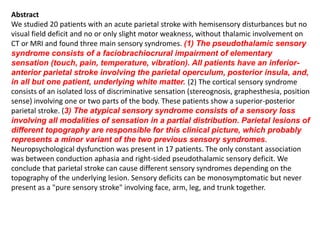
We studied 20 patients with an acute parietal stroke with hemisensory disturbances but no
visual field deficit and no or only slight motor weakness, without thalamic involvement on
CT or MRI and found three main sensory syndromes. (1) The pseudothalamic sensory
syndrome consists of a faciobrachiocrural impairment of elementary
sensation (touch, pain, temperature, vibration). All patients have an inferior-
anterior parietal stroke involving the parietal operculum, posterior insula, and,
in all but one patient, underlying white matter. (2) The cortical sensory syndrome
consists of an isolated loss of discriminative sensation (stereognosis, graphesthesia, position
sense) involving one or two parts of the body. These patients show a superior-posterior
parietal stroke. (3) The atypical sensory syndrome consists of a sensory loss
involving all modalities of sensation in a partial distribution. Parietal lesions of
different topography are responsible for this clinical picture, which probably
represents a minor variant of the two previous sensory syndromes.
Neuropsychological dysfunction was present in 17 patients. The only constant association
was between conduction aphasia and right-sided pseudothalamic sensory deficit. We
conclude that parietal stroke can cause different sensory syndromes depending on the
topography of the underlying lesion. Sensory deficits can be monosymptomatic but never
present as a "pure sensory stroke" involving face, arm, leg, and trunk together.
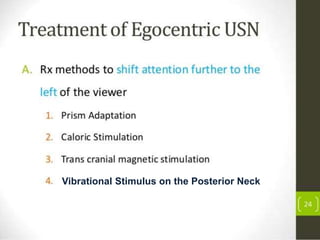
Vibrational Stimulus on the Posterior Neck
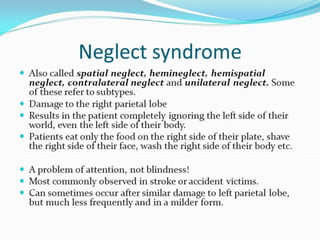
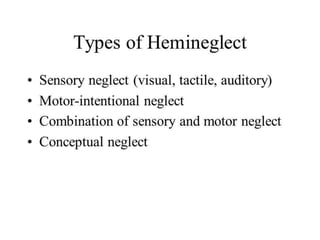
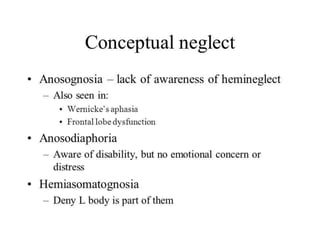
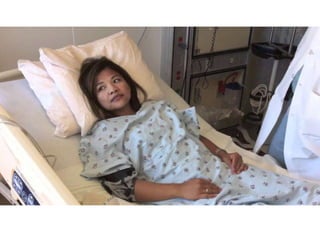
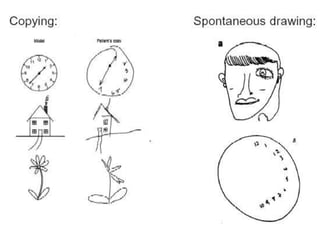
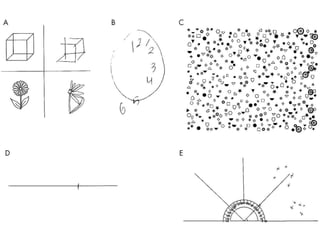
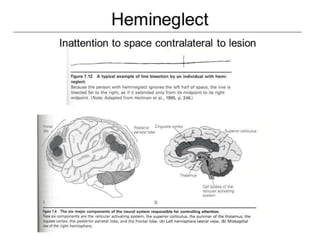
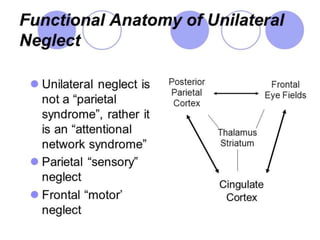
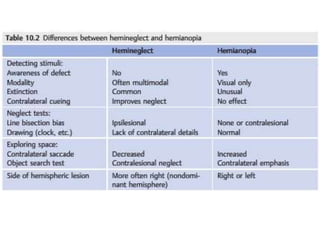
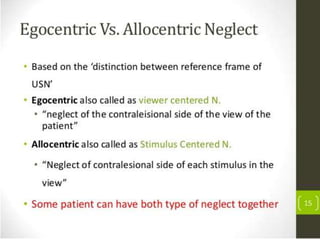
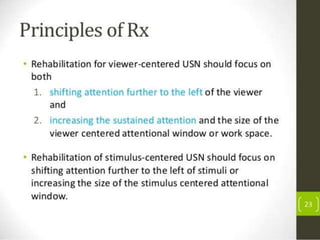
Hemineglect

Hemineglect

  • 14.
    SENSORY SYNDROMES IN PARIETALSTROKE Article in Neurology 43(10):1942- 9 · November 1993 with 239 Reads DOI: 10.1212/WNL.43.10.1942 Source: PubMed
  • 15.
    Abstract We studied 20patients with an acute parietal stroke with hemisensory disturbances but no visual field deficit and no or only slight motor weakness, without thalamic involvement on CT or MRI and found three main sensory syndromes. (1) The pseudothalamic sensory syndrome consists of a faciobrachiocrural impairment of elementary sensation (touch, pain, temperature, vibration). All patients have an inferior- anterior parietal stroke involving the parietal operculum, posterior insula, and, in all but one patient, underlying white matter. (2) The cortical sensory syndrome consists of an isolated loss of discriminative sensation (stereognosis, graphesthesia, position sense) involving one or two parts of the body. These patients show a superior-posterior parietal stroke. (3) The atypical sensory syndrome consists of a sensory loss involving all modalities of sensation in a partial distribution. Parietal lesions of different topography are responsible for this clinical picture, which probably represents a minor variant of the two previous sensory syndromes. Neuropsychological dysfunction was present in 17 patients. The only constant association was between conduction aphasia and right-sided pseudothalamic sensory deficit. We conclude that parietal stroke can cause different sensory syndromes depending on the topography of the underlying lesion. Sensory deficits can be monosymptomatic but never present as a "pure sensory stroke" involving face, arm, leg, and trunk together.
  • 20.
    Vibrational Stimulus onthe Posterior Neck