04/28/161 Sagar Kishor Savale
CONTENT
04/28/162
๏ถINTRODUCTION
๏ถDEFINITION
๏ถDETERMINATION OF PARTITION COEFFICIENT
๏ถGENERAL FEATURES
๏ถLIMITATION
๏ถREFERENCE
Sagar Kishor Savale
INTRODUCTION 1,4
04/28/163
The movement of molecules from one phase to another is called
partitioning.
๏‚—If two immiscible phases are placed adjacent to each other, the
solute will distribute itself between two immiscible phases until
equilibrium is attained; therefore no further transfer of solute
occurs.
๏‚—When a substance is added in excess quantity in two immiscible
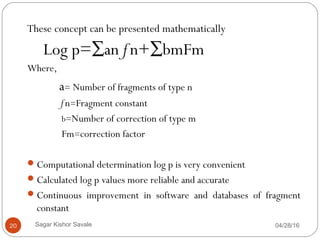
solvents, it distributes itself between two liquid phases so that each
becomes saturated.
Sagar Kishor Savale
DEFINITION 1,2
04/28/164
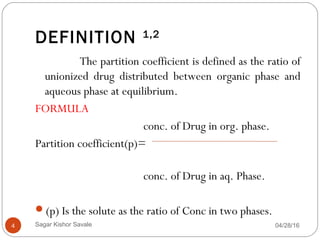
The partition coefficient is defined as the ratio of
unionized drug distributed between organic phase and
aqueous phase at equilibrium.
FORMULA
conc. of Drug in org. phase.
Partition coefficient(p)=
conc. of Drug in aq. Phase.
๏‚—(p) Is the solute as the ratio of Conc in two phases.
Sagar Kishor Savale
04/28/165
The partitioning of a drug molecule between two phases can be
quantified by a partition coefficient
โ€˜pโ€™=SA/SB
In which
SA means solubility of a compound in phase A
SB means solubility of a compound in phase B
๏ถThe org.phase usally chloroform and aq. Phase usally water
๏ถDivided conc of org.phase and aq.phase.
Sagar Kishor Savale
04/28/166
๏ถComplete description then exact aq.phase and org.phase should
be specified
Example.
Measure the organic phase partition coefficient is 1-octanol.
1-octanol is organic liquid that is immiscible with water.
However
It is not pure hydrocarbon.
1-octanol good mimic of polarity of biological membrane lipid.
Because it is largely hydrocarbon.
๏‚ง (P) Is provide relative solubility of compound in aq.phase &
org.phase
๏‚ง As result (P) provide valuable information for drug design..
Sagar Kishor Savale
04/28/167
Log p values 1
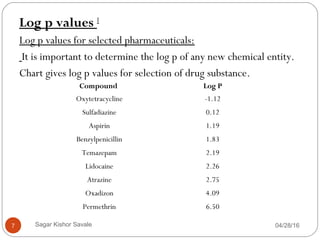
Log p values for selected pharmaceuticals:
It is important to determine the log p of any new chemical entity.
Chart gives log p values for selection of drug substance.
Compound Log P
Oxytetracycline -1.12
Sulfadiazine 0.12
Aspirin 1.19
Benzylpenicillin 1.83
Temazepam 2.19
Lidocaine 2.26
Atrazine 2.75
Oxadizon 4.09
Permethrin 6.50
Sagar Kishor Savale
04/28/168
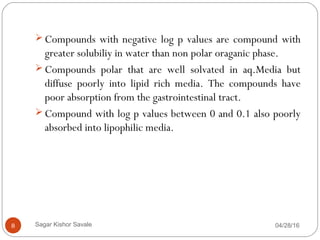
๏ƒ˜ Compounds with negative log p values are compound with
greater solubiliy in water than non polar oraganic phase.
๏ƒ˜ Compounds polar that are well solvated in aq.Media but
diffuse poorly into lipid rich media. The compounds have
poor absorption from the gastrointestinal tract.
๏ƒ˜ Compound with log p values between 0 and 0.1 also poorly
absorbed into lipophilic media.
Sagar Kishor Savale
04/28/169
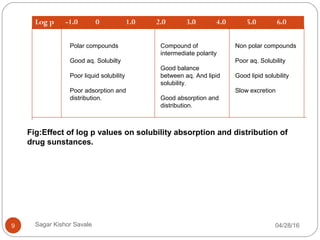
Log p -1.0 0 1.0 2.0 3.0 4.0 5.0 6.0
Polar compounds
Good aq. Solubilty
Poor liquid solubility
Poor adsorption and
distribution.
Compound of
intermediate polarity
Good balance
between aq. And lipid
solubility.
Good absorption and
distribution.
Non polar compounds
Poor aq. Solubility
Good lipid solubility
Slow excretion
Fig:Effect of log p values on solubility absorption and distribution of
drug sunstances.
Sagar Kishor Savale
DISTRIBUTION COEFFICIENT 4
04/28/1610
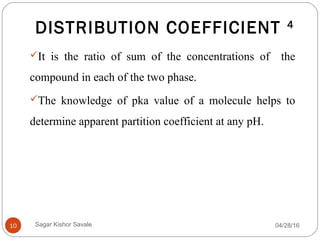
๏ƒผIt is the ratio of sum of the concentrations of the
compound in each of the two phase.
๏ƒผThe knowledge of pka value of a molecule helps to
determine apparent partition coefficient at any pH.
Sagar Kishor Savale
04/28/1611
Where,
[Drug molecule]o = concentration of drug in its molecular form in octan-1-ol;
[Drug molecule]w = concentration of drug in its molecular form in water;
[Drug ion]w =concentration of drug in its ionised form in water.
Sagar Kishor Savale
DETERMINATION OF PARTITION
COEFFICIENT 1,3,4
04/28/1612
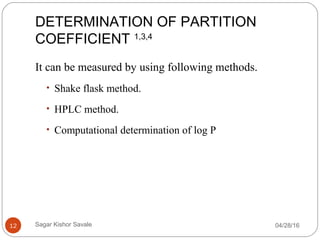
It can be measured by using following methods.
โ€ข Shake flask method.
โ€ข HPLC method.
โ€ข Computational determination of log P
Sagar Kishor Savale
SHAKE FLASK METHOD:
04/28/1613 Sagar Kishor Savale
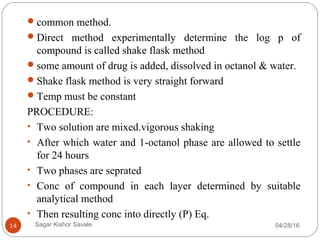
๏‚—common method.
๏‚—Direct method experimentally determine the log p of
compound is called shake flask method
๏‚—some amount of drug is added, dissolved in octanol & water.
๏‚—Shake flask method is very straight forward
๏‚—Temp must be constant
PROCEDURE:
โ€ข Two solution are mixed.vigorous shaking
โ€ข After which water and 1-octanol phase are allowed to settle
for 24 hours
โ€ข Two phases are seprated
โ€ข Conc of compound in each layer determined by suitable
analytical method
โ€ข Then resulting conc into directly (P) Eq.
04/28/1614 Sagar Kishor Savale
Continueโ€ฆ
๏‚—Give the (P).and convert into log p value
The distribution of solute is measured by methods.
1. UV-Visible spectroscopy-
๏‚— In this method, after dissolving the drug between two phases, they are
separated.
๏‚— Standard dilutions are prepared.
๏‚— The absorbance is measured at suitable wavelength.
๏‚— By using calibration curve, the concentration of the sample in both
organic and aqueous phase can be measured.
04/28/1615 Sagar Kishor Savale
Advantages of shake flask method:
๏‚— Most accurate method.
๏‚— Accurate for broadest range of solutes(neutral or charged compounds).
๏‚— Simple and lab operative procedure.
Disadvantages:
๏‚— Time consuming(>30min per sample)
๏‚— Octanol and water must be mixed and equilibrated (takes 24hours)
๏‚— Large amounts of material are required.
04/28/1616 Sagar Kishor Savale
HPLC method:
๏‚— By correlating its retention time with similar compounds with known
logP values.
๏‚— HPLC is performed on analytical columns packed with a commercially
available solid phase containing long hydrocarbon chains (e.g. C8,
C18) chemically bound onto silica.
๏‚— Mixtures of chemicals are eluted in order of their hydrophobicity, with
water-soluble chemicals eluted first and oil-soluble chemicals last.
๏‚— This enables the relationship between the retention time on such a
(reverse phase) column and the n-octanol/water partition coefficient.
04/28/1617 Sagar Kishor Savale
Advantages:
๏‚—Fast method of determination (5-20 min per sample).
Disadvantages:
๏‚—Since the logP value is determined by linear regression,
several compounds with similar structures must have
known logP values.
04/28/1618 Sagar Kishor Savale
Computational determination of log P
๏‚—The method used by these software packages are generally
on hydrophobic fragmental constant.
Developed by Rekker ,Hansch and Leo
๏‚—Effort has gone into developing software that can calculate
Log P values based on molecular structure
๏‚—Log P predicting software is common and widely used
๏‚—Log p calculatig commands can also often be found on
molecular structure drawing software
๏‚—Log p compound nationally breaking the compound up into
series is known fragment.
04/28/1619 Sagar Kishor Savale
These concept can be presented mathematically
Log p=โˆ‘anฦ’n+โˆ‘bmFm
Where,
a= Number of fragments of type n
ฦ’n=Fragment constant
b=Number of correction of type m
Fm=correction factor
๏‚—Computational determination log p is very convenient
๏‚—Calculated log p values more reliable and accurate
๏‚—Continuous improvement in software and databases of fragment
constant
04/28/1620 Sagar Kishor Savale
General Features 4
๏‚— Drugs partition themselves between the aqueous phase and lipophilic
membrane.
๏‚— If the partition coefficient of drug is more than one it is more lipophilicity
๏‚— If the partition coefficient of drug is less than one it is less lipophilic.
๏‚— It is a measure of how well substance partitions between lipid and water.
๏‚— Hydrophobic drugs with high partition coefficients are preferentially
distributed to hydrophobic compartments such as bilipid layers of cells.
๏‚— Hydrophilic drugs with low partition coefficient are found in hydrophilic
compartments such as blood serum.
๏‚— Partition coefficients have no units. 04/28/1621 Sagar Kishor Savale
Limitations 4
๏‚— Dilute solutions: The conc. of solute must be low in two solvents. This law
does not holds good when the concentrations are high.
๏‚— Constant temperature: Temperature should be kept constant throughout the
experiment, since solubility is dependent on temperature.
๏‚— Same molecular state: Solute must be in the same molecular state in both the
solvent.
๏‚— Equilibrium concentration: This is achieved by shaking the mixture for
longer time.
๏‚— Non-miscibility of solvents: So, the solvents are to be allowed for separation
for a sufficient time.
04/28/1622 Sagar Kishor Savale
References:
1) Humphrey moynihan, abina crean,2010,the
physicochemical basis of pharmaceuticals,oxford indian
edition.216-223.
2) Leon Lachman,lieberman H. A.Z,1991, The Theory And
Practice Of Industrial Pharmacy,third Edition,varghese
Publishing House,Mumbai.188-189.
3) The pharmaceutical codex principles and practice of
pharmaceutics,twelth edition, cbs publishers and
distributers, New delhi.70,188,313.
4) http: //www.pharmainfo.net/reviews/partitioncoefficient
04/28/1623 Sagar Kishor Savale
04/28/1624 Sagar Kishor Savale

Partition coefficient

  • 1.
  • 2.
    CONTENT 04/28/162 ๏ถINTRODUCTION ๏ถDEFINITION ๏ถDETERMINATION OF PARTITIONCOEFFICIENT ๏ถGENERAL FEATURES ๏ถLIMITATION ๏ถREFERENCE Sagar Kishor Savale
  • 3.
    INTRODUCTION 1,4 04/28/163 The movementof molecules from one phase to another is called partitioning. ๏‚—If two immiscible phases are placed adjacent to each other, the solute will distribute itself between two immiscible phases until equilibrium is attained; therefore no further transfer of solute occurs. ๏‚—When a substance is added in excess quantity in two immiscible solvents, it distributes itself between two liquid phases so that each becomes saturated. Sagar Kishor Savale
  • 4.
    DEFINITION 1,2 04/28/164 The partitioncoefficient is defined as the ratio of unionized drug distributed between organic phase and aqueous phase at equilibrium. FORMULA conc. of Drug in org. phase. Partition coefficient(p)= conc. of Drug in aq. Phase. ๏‚—(p) Is the solute as the ratio of Conc in two phases. Sagar Kishor Savale
  • 5.
    04/28/165 The partitioning ofa drug molecule between two phases can be quantified by a partition coefficient โ€˜pโ€™=SA/SB In which SA means solubility of a compound in phase A SB means solubility of a compound in phase B ๏ถThe org.phase usally chloroform and aq. Phase usally water ๏ถDivided conc of org.phase and aq.phase. Sagar Kishor Savale
  • 6.
    04/28/166 ๏ถComplete description thenexact aq.phase and org.phase should be specified Example. Measure the organic phase partition coefficient is 1-octanol. 1-octanol is organic liquid that is immiscible with water. However It is not pure hydrocarbon. 1-octanol good mimic of polarity of biological membrane lipid. Because it is largely hydrocarbon. ๏‚ง (P) Is provide relative solubility of compound in aq.phase & org.phase ๏‚ง As result (P) provide valuable information for drug design.. Sagar Kishor Savale
  • 7.
    04/28/167 Log p values1 Log p values for selected pharmaceuticals: It is important to determine the log p of any new chemical entity. Chart gives log p values for selection of drug substance. Compound Log P Oxytetracycline -1.12 Sulfadiazine 0.12 Aspirin 1.19 Benzylpenicillin 1.83 Temazepam 2.19 Lidocaine 2.26 Atrazine 2.75 Oxadizon 4.09 Permethrin 6.50 Sagar Kishor Savale
  • 8.
    04/28/168 ๏ƒ˜ Compounds withnegative log p values are compound with greater solubiliy in water than non polar oraganic phase. ๏ƒ˜ Compounds polar that are well solvated in aq.Media but diffuse poorly into lipid rich media. The compounds have poor absorption from the gastrointestinal tract. ๏ƒ˜ Compound with log p values between 0 and 0.1 also poorly absorbed into lipophilic media. Sagar Kishor Savale
  • 9.
    04/28/169 Log p -1.00 1.0 2.0 3.0 4.0 5.0 6.0 Polar compounds Good aq. Solubilty Poor liquid solubility Poor adsorption and distribution. Compound of intermediate polarity Good balance between aq. And lipid solubility. Good absorption and distribution. Non polar compounds Poor aq. Solubility Good lipid solubility Slow excretion Fig:Effect of log p values on solubility absorption and distribution of drug sunstances. Sagar Kishor Savale
  • 10.
    DISTRIBUTION COEFFICIENT 4 04/28/1610 ๏ƒผItis the ratio of sum of the concentrations of the compound in each of the two phase. ๏ƒผThe knowledge of pka value of a molecule helps to determine apparent partition coefficient at any pH. Sagar Kishor Savale
  • 11.
    04/28/1611 Where, [Drug molecule]o =concentration of drug in its molecular form in octan-1-ol; [Drug molecule]w = concentration of drug in its molecular form in water; [Drug ion]w =concentration of drug in its ionised form in water. Sagar Kishor Savale
  • 12.
    DETERMINATION OF PARTITION COEFFICIENT1,3,4 04/28/1612 It can be measured by using following methods. โ€ข Shake flask method. โ€ข HPLC method. โ€ข Computational determination of log P Sagar Kishor Savale
  • 13.
    SHAKE FLASK METHOD: 04/28/1613Sagar Kishor Savale
  • 14.
    ๏‚—common method. ๏‚—Direct methodexperimentally determine the log p of compound is called shake flask method ๏‚—some amount of drug is added, dissolved in octanol & water. ๏‚—Shake flask method is very straight forward ๏‚—Temp must be constant PROCEDURE: โ€ข Two solution are mixed.vigorous shaking โ€ข After which water and 1-octanol phase are allowed to settle for 24 hours โ€ข Two phases are seprated โ€ข Conc of compound in each layer determined by suitable analytical method โ€ข Then resulting conc into directly (P) Eq. 04/28/1614 Sagar Kishor Savale
  • 15.
    Continueโ€ฆ ๏‚—Give the (P).andconvert into log p value The distribution of solute is measured by methods. 1. UV-Visible spectroscopy- ๏‚— In this method, after dissolving the drug between two phases, they are separated. ๏‚— Standard dilutions are prepared. ๏‚— The absorbance is measured at suitable wavelength. ๏‚— By using calibration curve, the concentration of the sample in both organic and aqueous phase can be measured. 04/28/1615 Sagar Kishor Savale
  • 16.
    Advantages of shakeflask method: ๏‚— Most accurate method. ๏‚— Accurate for broadest range of solutes(neutral or charged compounds). ๏‚— Simple and lab operative procedure. Disadvantages: ๏‚— Time consuming(>30min per sample) ๏‚— Octanol and water must be mixed and equilibrated (takes 24hours) ๏‚— Large amounts of material are required. 04/28/1616 Sagar Kishor Savale
  • 17.
    HPLC method: ๏‚— Bycorrelating its retention time with similar compounds with known logP values. ๏‚— HPLC is performed on analytical columns packed with a commercially available solid phase containing long hydrocarbon chains (e.g. C8, C18) chemically bound onto silica. ๏‚— Mixtures of chemicals are eluted in order of their hydrophobicity, with water-soluble chemicals eluted first and oil-soluble chemicals last. ๏‚— This enables the relationship between the retention time on such a (reverse phase) column and the n-octanol/water partition coefficient. 04/28/1617 Sagar Kishor Savale
  • 18.
    Advantages: ๏‚—Fast method ofdetermination (5-20 min per sample). Disadvantages: ๏‚—Since the logP value is determined by linear regression, several compounds with similar structures must have known logP values. 04/28/1618 Sagar Kishor Savale
  • 19.
    Computational determination oflog P ๏‚—The method used by these software packages are generally on hydrophobic fragmental constant. Developed by Rekker ,Hansch and Leo ๏‚—Effort has gone into developing software that can calculate Log P values based on molecular structure ๏‚—Log P predicting software is common and widely used ๏‚—Log p calculatig commands can also often be found on molecular structure drawing software ๏‚—Log p compound nationally breaking the compound up into series is known fragment. 04/28/1619 Sagar Kishor Savale
  • 20.
    These concept canbe presented mathematically Log p=โˆ‘anฦ’n+โˆ‘bmFm Where, a= Number of fragments of type n ฦ’n=Fragment constant b=Number of correction of type m Fm=correction factor ๏‚—Computational determination log p is very convenient ๏‚—Calculated log p values more reliable and accurate ๏‚—Continuous improvement in software and databases of fragment constant 04/28/1620 Sagar Kishor Savale
  • 21.
    General Features 4 ๏‚—Drugs partition themselves between the aqueous phase and lipophilic membrane. ๏‚— If the partition coefficient of drug is more than one it is more lipophilicity ๏‚— If the partition coefficient of drug is less than one it is less lipophilic. ๏‚— It is a measure of how well substance partitions between lipid and water. ๏‚— Hydrophobic drugs with high partition coefficients are preferentially distributed to hydrophobic compartments such as bilipid layers of cells. ๏‚— Hydrophilic drugs with low partition coefficient are found in hydrophilic compartments such as blood serum. ๏‚— Partition coefficients have no units. 04/28/1621 Sagar Kishor Savale
  • 22.
    Limitations 4 ๏‚— Dilutesolutions: The conc. of solute must be low in two solvents. This law does not holds good when the concentrations are high. ๏‚— Constant temperature: Temperature should be kept constant throughout the experiment, since solubility is dependent on temperature. ๏‚— Same molecular state: Solute must be in the same molecular state in both the solvent. ๏‚— Equilibrium concentration: This is achieved by shaking the mixture for longer time. ๏‚— Non-miscibility of solvents: So, the solvents are to be allowed for separation for a sufficient time. 04/28/1622 Sagar Kishor Savale
  • 23.
    References: 1) Humphrey moynihan,abina crean,2010,the physicochemical basis of pharmaceuticals,oxford indian edition.216-223. 2) Leon Lachman,lieberman H. A.Z,1991, The Theory And Practice Of Industrial Pharmacy,third Edition,varghese Publishing House,Mumbai.188-189. 3) The pharmaceutical codex principles and practice of pharmaceutics,twelth edition, cbs publishers and distributers, New delhi.70,188,313. 4) http: //www.pharmainfo.net/reviews/partitioncoefficient 04/28/1623 Sagar Kishor Savale
  • 24.