CHEST TRAUMA 
• Presented by: 
Dr. Shah Khalid 
• November 19, 2012
Objectives 
Anatomy of Thorax 
Main Causes of Chest Injuries 
Different Types of Chest Injuries 
Treatments of Chest Injuries
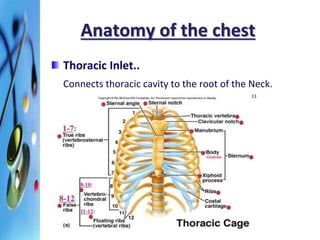
Anatomy of the chest 
Thoracic Inlet.. 
Connects thoracic cavity to the root of the Neck.
• Thoracic Outlet… 
Connects thoracic cavity with the Abdomen. 
Closed by Diaphragm.
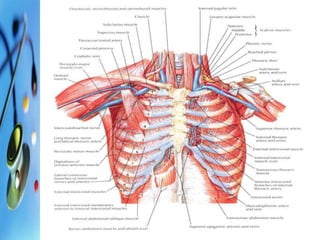
Thoracic Wall 
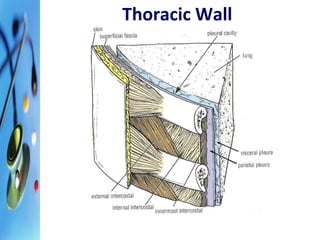
Posteriorly… Thoracic vertebrae 12. 
Anteriorly… Sternum and Costal Cartilages. 
Laterally… Ribs and Intercostal spaces.
Thoracic Wall
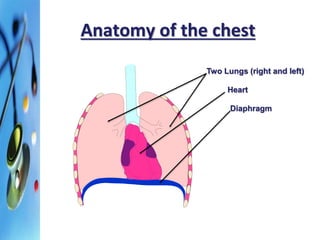
Anatomy of the chest 
Two Lungs (right and left) 
Heart 
Diaphragm
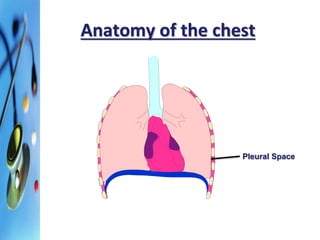
Anatomy of the chest 
Pleural Space
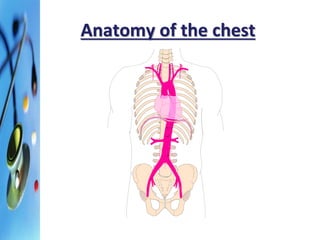
Anatomy of the chest
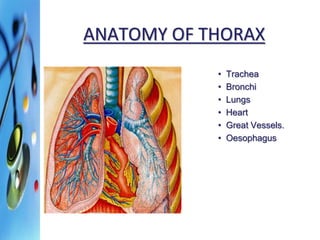
ANATOMY OF THORAX 
• Trachea 
• Bronchi 
• Lungs 
• Heart 
• Great Vessels. 
• Oesophagus
Chest Trauma 
• Thoracic injury… 25% of all injuries. 
• In another 25%, its contributor to other 
injuries. 
• Major Cause of death…. Hemorrhage.
Investigations 
• CXR…. 1st choice. 
• Ultrasound 
• CT Scan….. Gold Standard. 
Rapid Diagnosis, 3- dimensional Images. 
• Chest tube… may be theraputic and 
diagnostic. 
• Angiography.
General Management 
ATLS Principles of Resuscitation 
Aim… To Restore Physiology, rather than 
anatomy 
Early assessment and primary survey. 
Simultaneous aggressive resuscitation. 
Secondary survey with full examination. 
Transfer to a definitive site of care.
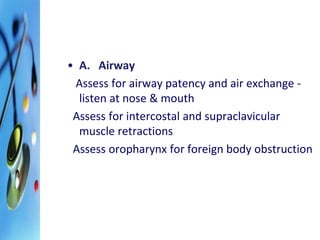
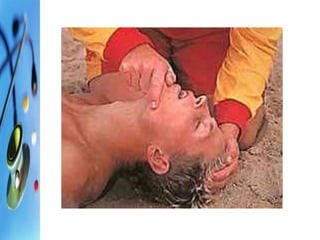
• A. Airway 
Assess for airway patency and air exchange - 
listen at nose & mouth 
Assess for intercostal and supraclavicular 
muscle retractions 
Assess oropharynx for foreign body obstruction
• B. Breathing 
Assess respiratory movements and quality 
of respirations - look, listen, feel. 
Shallow respirations are early indicator of 
distress - cyanosis is late.
• C. Circulation 
Skin - look and feel for color, temperature, 
capillary refill- Look for cyanosis. 
Assess pulses for quality, rate, regularity 
Look at neck veins - flat vs. distended-fluid 
deficit or decreased supply to body from heart 
due to compression. 
Assess the B.P.
• D. Disability. 
Immobilization of the spine. 
E. Exposure.
Main Causes of Chest 
Trauma 
• Blunt Trauma- 
Blunt force to chest. 
• Penetrating Trauma- 
Projectile that enters chest causing small or 
large hole. 
• Compression Injury- 
Chest is caught between two objects and chest 
is compressed.
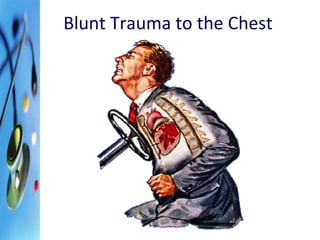
Blunt Trauma to the Chest
Chest wall injuries 
Buises 
Scratches 
Laceration 
Rib fractures 
Flail Chest 
Sternal fractures 
Thoracic spine injuries
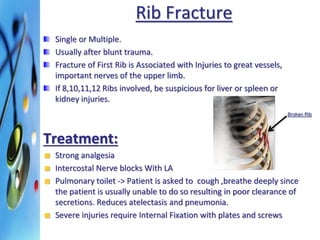
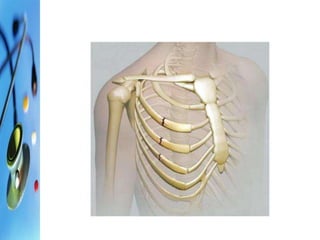
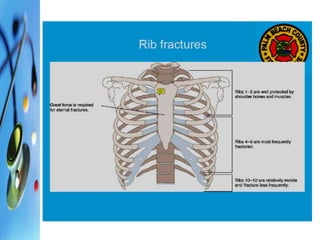
Rib Fracture 
Single or Multiple. 
Usually after blunt trauma. 
Fracture of First Rib is Associated with Injuries to great vessels, 
important nerves of the upper limb. 
If 8,10,11,12 Ribs involved, be suspicious for liver or spleen or 
kidney injuries. 
Treatment: 
Broken Rib 
Strong analgesia 
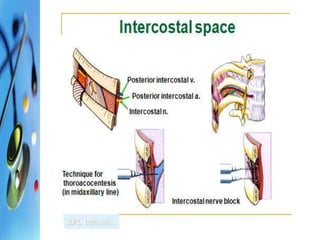
Intercostal Nerve blocks With LA 
Pulmonary toilet -> Patient is asked to cough ,breathe deeply since 
the patient is usually unable to do so resulting in poor clearance of 
secretions. Reduces atelectasis and pneumonia. 
Severe injuries require Internal Fixation with plates and screws
S/S 
Pleuritic chest pain 
Rapid shallow breathing 
Splenting 
Atelectasis 
hypoxemia.
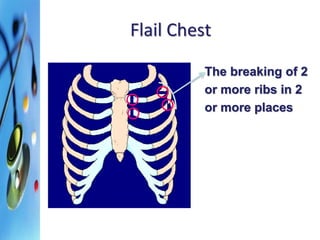
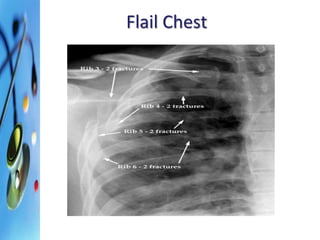
Flail Chest 
The breaking of 2 
or more ribs in 2 
or more places
Flail Chest
Flail Chest
S/S of Flail Chest 
• Painful Breathing. 
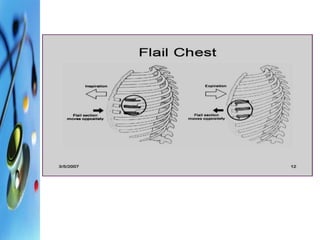
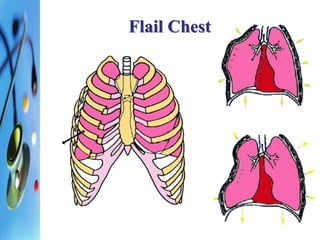
• Paradoxical Chest Movements. 
• Rapid, Shallow respiration, Dyspnea, 
Tachypnea, Tachycardia. 
• Bruising/Swelling. 
• Crepitus (Grinding of bone ends on palpation). 
• Diagnosis is purely clinical. 
• Chest X-Ray, ABG’s can be done to confirm.
Treatment of Flail Chest 
• ABC’s with c-spine control as indicated 
• High Flow oxygen 
• Adequate analgesia (Including opiates) 
• Intra-plural local analgesia 
• Observe the patient for development of 
Pneumothorax and even worse Tension 
Pneumothorax 
If Tension Develops Needle Decompress affected 
side 
• Surgery -> internal operative fixation. 
• Rapid Transport! Remember a True Emergency
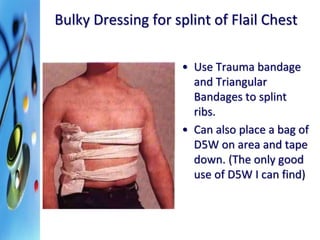
Bulky Dressing for splint of Flail Chest 
• Use Trauma bandage 
and Triangular 
Bandages to splint 
ribs. 
• Can also place a bag of 
D5W on area and tape 
down. (The only good 
use of D5W I can find)
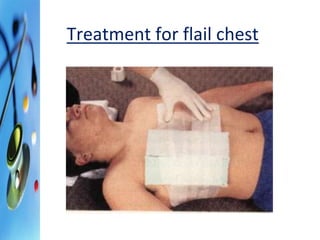
Treatment for flail chest
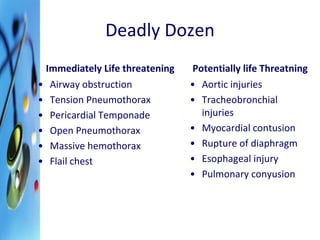
Deadly Dozen 
Immediately Life threatening 
• Airway obstruction 
• Tension Pneumothorax 
• Pericardial Temponade 
• Open Pneumothorax 
• Massive hemothorax 
• Flail chest 
Potentially life Threatning 
• Aortic injuries 
• Tracheobronchial 
injuries 
• Myocardial contusion 
• Rupture of diaphragm 
• Esophageal injury 
• Pulmonary conyusion
PNEUMOTHORAX 
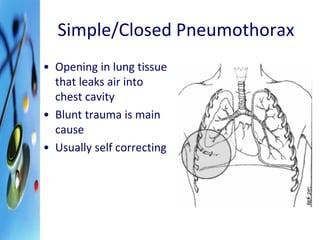
Pneumothorax is air in the pleural space resulting in partial or 
complete collapse of the lung space. 
Types: 
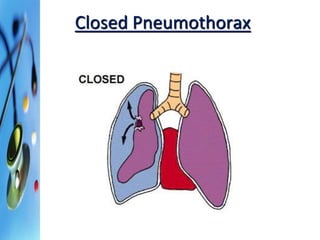
 Closed /Simple pneumothorax is one in which chest wall is 
intact and air enters the pleural space from lung surface 
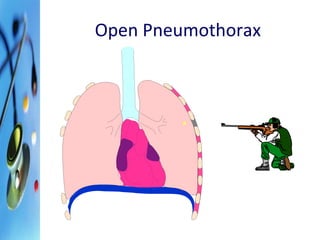
 Open pneumothorax is Sucking Chest Wound in which air 
enters the pleural space through opening in the chest wall.
Simple/Closed Pneumothorax 
• Opening in lung tissue 
that leaks air into 
chest cavity 
• Blunt trauma is main 
cause 
• Usually self correcting
Closed Pneumothorax
S/S of Simple/Closed 
Pneumothorax 
• Chest Pain 
• Dyspnea 
• Tachypnea 
• Decreased Breath Sounds on Affected Side
Treatment for Simple/Closed 
Pneumothorax 
• ABC’s with C-spine control 
• Airway Assistance as needed 
• Provide supportive care 
• Usually small and self limiting. 
• Monitor for Development of Tension 
Pneumothorax
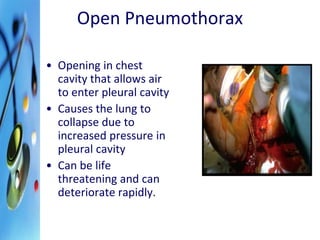
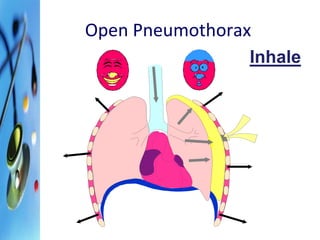
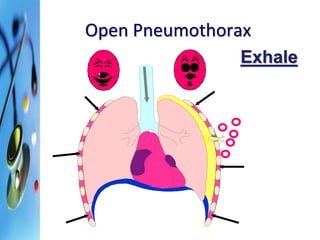
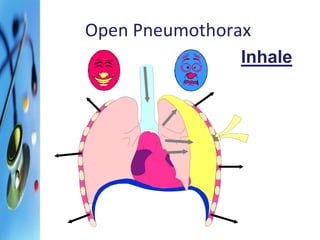
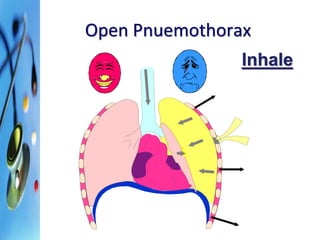
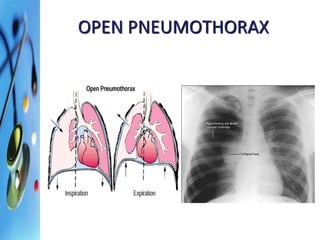
Open Pneumothorax 
• Opening in chest 
cavity that allows air 
to enter pleural cavity 
• Causes the lung to 
collapse due to 
increased pressure in 
pleural cavity 
• Can be life 
threatening and can 
deteriorate rapidly.
Open Pneumothorax
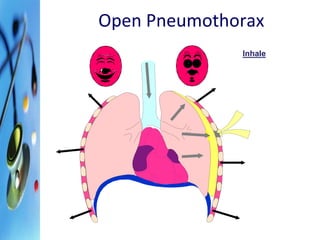
Open Pneumothorax 
Inhale
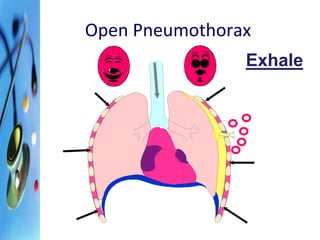
Open Pneumothorax 
Exhale
Open Pneumothorax 
Inhale
Open Pneumothorax 
Exhale
Open Pneumothorax 
Inhale
Open Pnuemothorax 
Inhale
OPEN PNEUMOTHORAX
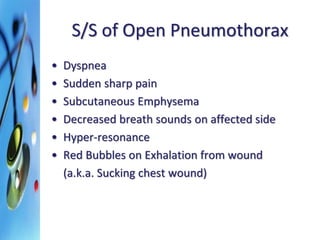
S/S of Open Pneumothorax 
• Dyspnea 
• Sudden sharp pain 
• Subcutaneous Emphysema 
• Decreased breath sounds on affected side 
• Hyper-resonance 
• Red Bubbles on Exhalation from wound 
(a.k.a. Sucking chest wound)
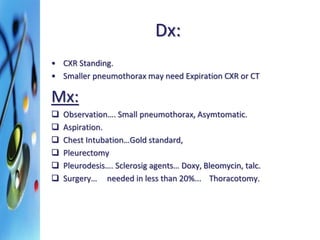
Dx: 
• CXR Standing. 
• Smaller pneumothorax may need Expiration CXR or CT 
Mx: 
 Observation…. Small pneumothorax, Asymtomatic. 
 Aspiration. 
 Chest Intubation…Gold standard, 
 Pleurectomy 
 Pleurodesis…. Sclerosig agents… Doxy, Bleomycin, talc. 
 Surgery… needed in less than 20%... Thoracotomy.
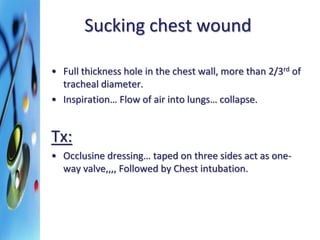
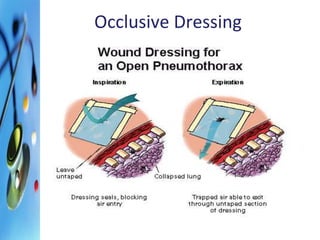
Sucking chest wound 
• Full thickness hole in the chest wall, more than 2/3rd of 
tracheal diameter. 
• Inspiration… Flow of air into lungs… collapse. 
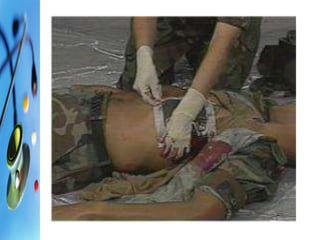
Tx: 
• Occlusine dressing… taped on three sides act as one-way 
valve,,,, Followed by Chest intubation.
• Do not remove clothing stuck to the wound 
• Do not clean the wound or remove objects 
stuck in the wound
Occlusive Dressing
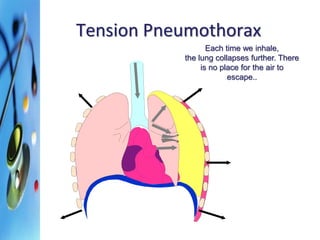
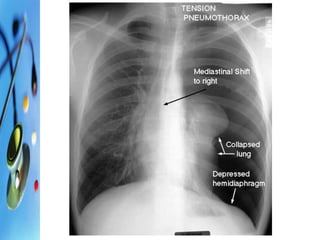
Tension Pneumothorax 
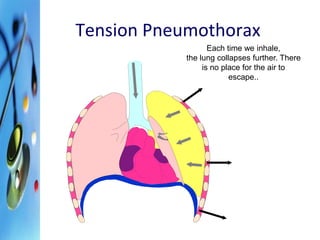
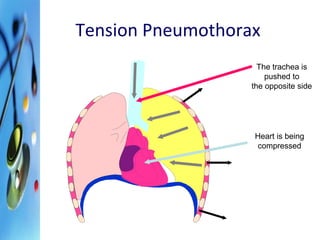
• Air builds in pleural space with no way for the air 
to escape 
• Results in collapse of lung on affected side that 
results in pressure on mediastium, the other lung, 
and great vessels,…. Decreasing venous return => 
Shock 
• Causes: 
Penetrating trauma, blunt trauma, Iatrogenic.
Tension Pneumothorax 
Each time we inhale, 
the lung collapses further. There 
is no place for the air to 
escape..
Tension Pneumothorax 
Each time we inhale, 
the lung collapses further. There 
is no place for the air to 
escape..
Tension Pneumothorax 
The trachea is 
pushed to 
the opposite side 
Heart is being 
compressed
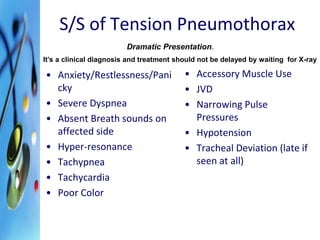
S/S of Tension Pneumothorax 
Dramatic Presentation. 
It’s a clinical diagnosis and treatment should not be delayed by waiting for X-ray 
• Anxiety/Restlessness/Pani 
cky 
• Severe Dyspnea 
• Absent Breath sounds on 
affected side 
• Hyper-resonance 
• Tachypnea 
• Tachycardia 
• Poor Color 
• Accessory Muscle Use 
• JVD 
• Narrowing Pulse 
Pressures 
• Hypotension 
• Tracheal Deviation (late if 
seen at all)
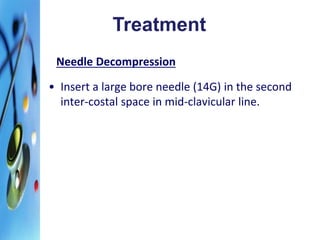
Treatment 
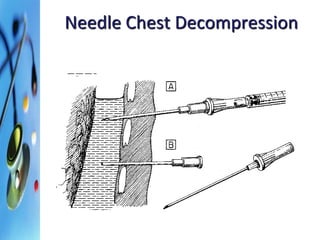
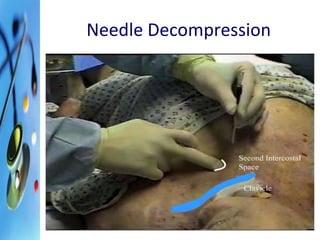
Needle Decompression 
• Insert a large bore needle (14G) in the second 
inter-costal space in mid-clavicular line.
Needle Chest Decompression
Needle Decompression
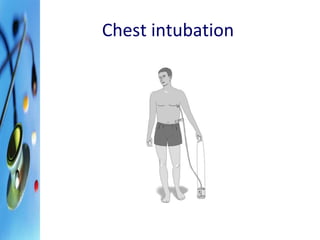
Chest intubation
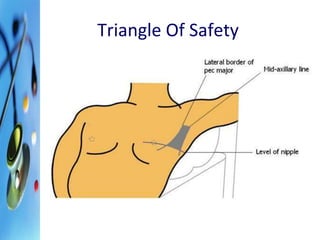
Triangle Of Safety
Indications 
• Pneumothorax 
• Malignant pleural effusion 
• Empyema and complicated parapneumonic 
pleural effusion 
• Traumatic haemopneumothorax 
• Postoperative—for example, thoracotomy, 
oesophagectomy, cardiac surgery.
Contra- Indications 
• Absolute…. Need for emrgency Thoracotomy 
• Relatives are 
Bleeding Diathesis 
Anti-coagulation 
Adhesions 
Loculations 
Pulmonary bullae 
69
Complications of chest tube 
• Hemorrhage 
• Infection 
• Trauma to the Liver, spleen, Diaphragm, Aorta, 
Heart. 
• Minor complications like, 
Subcut hematoma, Cough, dyspnea, 
• Improper placement
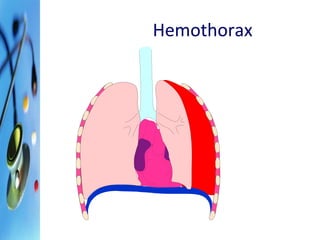
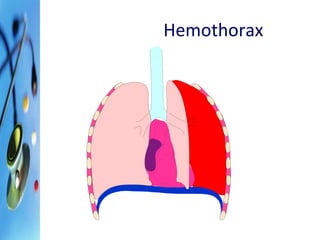
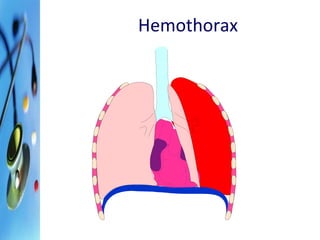
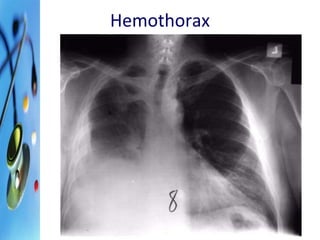
Hemothorax 
• Follows Blunt injury 
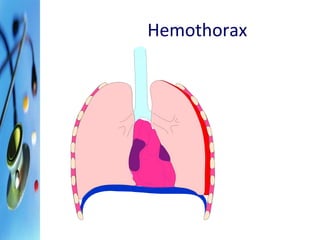
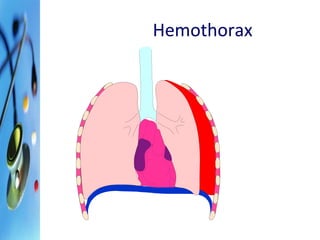
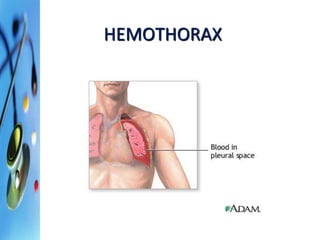
• Occurs when pleural space fills with blood 
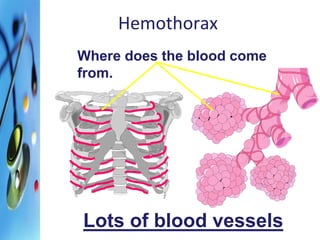
• Usually occurs due to lacerated blood vessel in 
thorax mainly Intercostal and internal 
mammary vessels. 
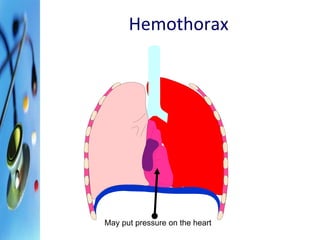
• As blood increases, it puts pressure on heart 
and other vessels in chest cavity 
• Each Lung can hold 1.5 liters of blood
Hemothorax
Hemothorax
Hemothorax
Hemothorax
Hemothorax
Hemothorax 
May put pressure on the heart
Hemothorax
HEMOTHORAX
Hemothorax 
Where does the blood come 
from. 
Lots of blood vessels
S/S of Hemothorax 
• Anxiety/Restlessness 
• Tachypnea 
• Signs of Shock 
• Frothy, Bloody Sputum 
• Diminished Breath Sounds on Affected Side 
• Dull percussion note… maybe resonant in supine 
position. 
• Tachycardia 
• Flat Neck Veins
Treatment for Hemothorax 
• ABC’s with c-spine control as indicated 
• General Shock Care due to Blood loss 
• Chest intubation 
• Thoracotomy… If more than 1500 ml blood 
drains initially, or ongoing hemorrhage of 
more than 200 ml/ hr over 3-4 hrs.
Pulmonary Contusion 
 Crushing and bruising of the lung parenchyma. 
 Sudden blow or blunt injury to the chest => compression 
of thoracic cavity and lung followed by an equally sudden 
decompression. Concussive and compressive force is 
most important cause. 
 The natural progression of pulmonary contusion is 
worsening hypoxemia for the first 24 to 48 hours. 
 X-ray findings not significant initially. 
 CT with contrast is confirmatory.
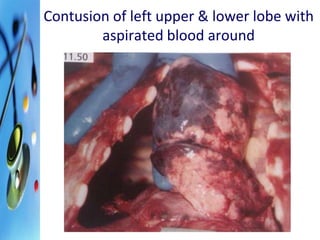
Contusion of left upper & lower lobe with 
aspirated blood around
S/S of Pul. Contusion 
• Hemoptysis 
• Dyspnea 
• Cough 
• Chest wall abrasion 
• Echymosis.
Tx. Of Pul. contusion 
• Oxygen administration 
• Pul. Toilet 
• Mechanical ventilation => in severe case
Subcutaneous Emphysema 
• Air collects in subcutaneous tissues from 
pressure of air in pleural cavity 
• Feels like rice crispies 
• Can be seen from neck to groin area 
• usually occurs on the chest, neck and face, 
where it is able to travel from the chest cavity 
along the fascia.
S/S of SCE 
• swelling of the neck 
• Chest pain 
• Neck pain 
• Dysphagia 
• Wheezing and difficulty breathing.
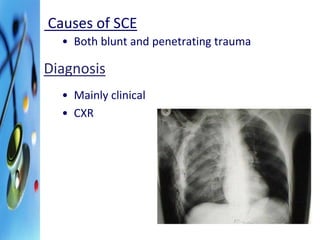
Causes of SCE 
• Both blunt and penetrating trauma 
Diagnosis 
• Mainly clinical 
• CXR
Treatment 
• Usually benign, no treatment needed. 
• If massive then small cuts in the skin. 
• Catheters in subcutaneous tissues. 
• Treat the underlying cause.
Tracheo-bronchial Injuries 
• Blunt and penetrating trauma 
• Presented as hoarseness, SCE. 
• Dyspnea , Pneumothorax , hemoptysis , 
Mediastinal crunch {Hamman’s Sign}, 
Intercostal retractions, Respiratory distress , 
Stridor. 
• Chest drain will reveal a large air leak and the 
collapsed lung may fail to re-expand. 
• Diagnosis => Bronchoscopy
Managment 
• Priority is to stabilize AIRWAY. 
• Intubation of the unaffected bronchus and 
operative repair.
Traumatic Asphyxia 
• Results from sudden compression injury to 
chest cavity 
• Can cause massive rupture of Vessels and 
organs of chest cavity 
• Ultimately Death
S/S of Traumatic Asphyxia 
• Severe Dyspnea 
• Distended Neck Veins 
• Bulging, Blood shot eyes 
• Swollen Tounge with cyanotic lips 
• Reddish-purple discoloration of face and neck 
• Petechiae
Treatment for Traumatic 
Asphyxia 
• ABC’s with c-spine control as indicated 
• High Flow oxygen 
• Treat for shock 
• Care for associated injuries
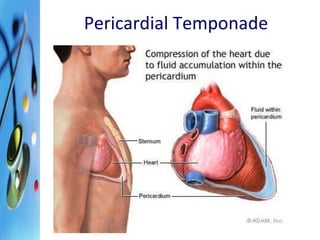
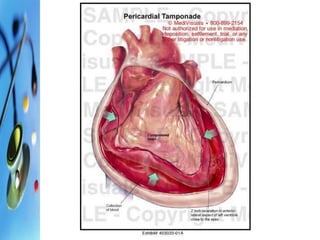
Pericardial Temponade
Pericardial Tamponade 
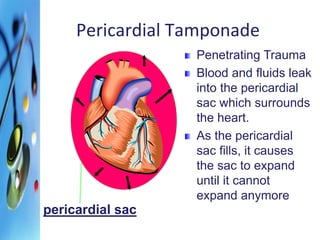
Penetrating Trauma 
Blood and fluids leak 
into the pericardial 
sac which surrounds 
the heart. 
As the pericardial 
sac fills, it causes 
the sac to expand 
until it cannot 
expand anymore 
pericardial sac
Pericardial Tamponade 
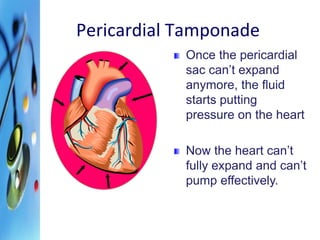
Once the pericardial 
sac can’t expand 
anymore, the fluid 
starts putting 
pressure on the heart 
Now the heart can’t 
fully expand and can’t 
pump effectively.
Pericardial Tamponade 
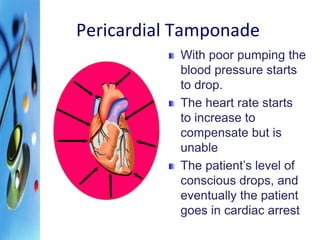
With poor pumping the 
blood pressure starts 
to drop. 
The heart rate starts 
to increase to 
compensate but is 
unable 
The patient’s level of 
conscious drops, and 
eventually the patient 
goes in cardiac arrest
S/S of Pericardial Tamponade 
• Distended Neck Veins 
• Increased Heart Rate 
• Muffled heart sound 
• Respiratory Rate increases 
• Poor skin color 
• Hypotension 
• Death 
• Beck’s Triad… Low BP, Raise venous pressure, 
Muffled Heart sounds.
• All the pts with penetrating injury anywhere 
near the heart + Shock => Always suspect 
cardiac injury. 
• Must be differentiated from Tension 
pneumothorax. 
• In case of major bleeding from other site, neck 
veins may be flat.
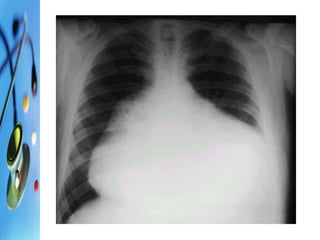
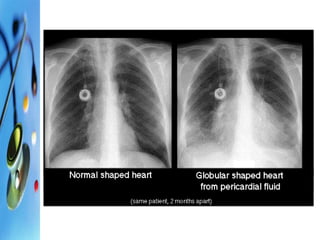
Dx: 
• Clinical suspicion. 
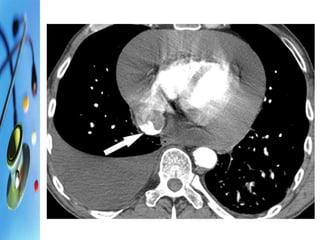
• CXR… enlarged Globular heart shadow. 
• Echo…. Fluid in pericardial sac. 
• Central venous pressure… high 
• CT scan
Treatment of Pericardial Tamponade 
• ABC’s with c-spine control as indicated 
• High Flow oxygen. 
• Treat S/S of shock 
• Rapid Transport 
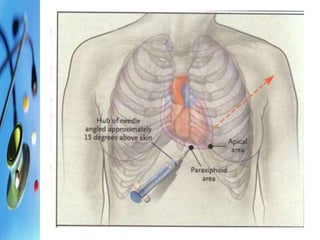
• What patient needs is Pericardiocentesis
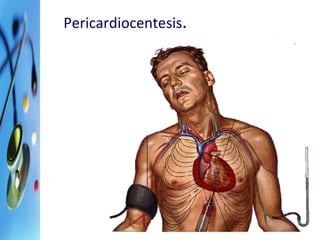
Pericardiocentesis 
• Using aseptic technique, Insert at least 3” 
needle at the angle of the Xiphoid Cartilage at 
the 7th rib 
• Advance needle at 45 degree towards the 
clavicle while aspirating syringe till blood 
return is seen 
• Continue to Aspirate till syringe is full then 
discard blood and attempt again till signs of no 
more blood 
• Closely monitor patient due to small amout of 
blood aspirated can cause a rapid change in 
blood pressure
Pericardiocentesis.
Definitive treatment 
• Sternotomy 
• Left Thoracotomy
Pericardial Tamponade 
•Is A Dire Emergency
Blunt Myocardial Injury 
• Rarely Causes hemodynamic Instability. 
• Dx on ECG.. Echo, Trans esophageal Echo, 
Cardiac enzymes… Little role. 
• Complication… Arrythmias in 1st 24 hrs.
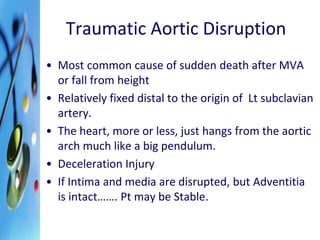
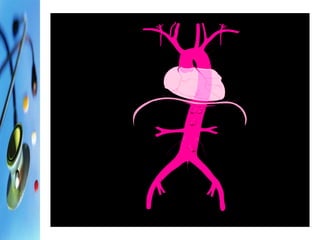
Traumatic Aortic Disruption 
• Most common cause of sudden death after MVA 
or fall from height 
• Relatively fixed distal to the origin of Lt subclavian 
artery. 
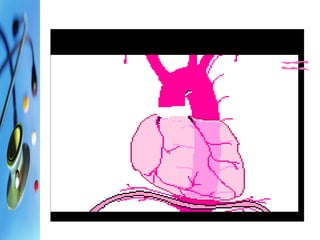
• The heart, more or less, just hangs from the aortic 
arch much like a big pendulum. 
• Deceleration Injury 
• If Intima and media are disrupted, but Adventitia 
is intact……. Pt may be Stable.
S/S Of Traumatic Aortic 
Rupture 
• Burning or Tearing Sensation in chest or 
shoulder blades 
• Rapidly dropping Blood Pressure 
• Pulse Rapidly Increasing 
• Asymmetry of both upper limbs, or upper and 
lower limbs Blood Pressure. 
• Widened Pulse Pressure. 
• Chest wall contusions 
• Rapid Loss of Consciousness.
Dx 
• CXR Erect…. Widened Mediastinum 
• Aortogram. 
• CT with Contrast. 
• Trans-esophageal echo.
Treatment of Traumatic 
Aortic Rupture 
• ABC’s with c-spine control as indicated 
• High Flow oxygen. 
• Treatment for Shock 
• Control of systolic B.P to less than 100mmHg. 
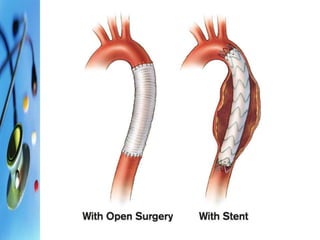
• Stenting. 
• Direct repair 
• Excision and grafting using a Dacron graft.
OESOPHAGEAL INJURY 
• Results from penetrating trauma; blunt injury is rare 
• Patient can present with odynophagia, subcutaneous 
or mediastinal emphysema, pleural effusion, air in the 
retro-oesophageal space and unexplained fever within 
24 hours of injury 
• Combination of oesophagogram and oesophagoscopy 
confirm diagnosis 
• CT can be done 
• Treatment is operative repair and drainage 
• Mid-oesophageal injury => Right thoracotomy. 
• Distal oesophageal injury => Left thoracotomy.
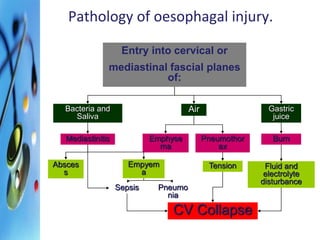
Pathology of oesophagal injury. 
Entry into cervical or 
mediastinal fascial planes 
of: 
Air Gastric 
juice 
Bacteria and 
Saliva 
Mediastinitis Emphyse 
ma 
Pneumothor 
ax 
Burn 
Absces 
s 
Empyem 
a 
Sepsis Pneumo 
nia 
Tension Fluid and 
electrolyte 
disturbance 
CV Collapse
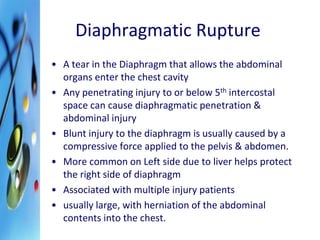
Diaphragmatic Rupture 
• A tear in the Diaphragm that allows the abdominal 
organs enter the chest cavity 
• Any penetrating injury to or below 5th intercostal 
space can cause diaphragmatic penetration & 
abdominal injury 
• Blunt injury to the diaphragm is usually caused by a 
compressive force applied to the pelvis & abdomen. 
• More common on Left side due to liver helps protect 
the right side of diaphragm 
• Associated with multiple injury patients 
• usually large, with herniation of the abdominal 
contents into the chest.
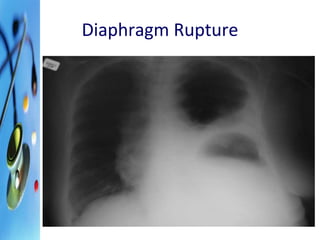
Diaphragm Rupture
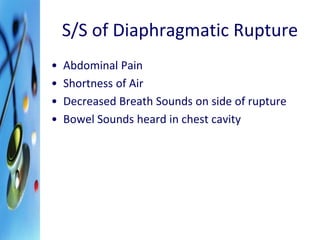
S/S of Diaphragmatic Rupture 
• Abdominal Pain 
• Shortness of Air 
• Decreased Breath Sounds on side of rupture 
• Bowel Sounds heard in chest cavity
Dx 
• - Chest radiography after placement of a 
nasogastric tube, Contrast studies of the upper 
or lower gastrointestinal tract, CT scan & 
diagnostic peritoneal lavage. 
• Most accurate evaluation is by video-assisted 
thoracoscopy (VATS) or laparoscopy.
Treatment of Diaphragmatic Rupture 
.Operative Repair. 
Penetrating diaphragmatic injury must be 
repaired via the abdomen and not the chest, 
to rule out penetrating hollow viscus injury. 
Laproscopy can be done.
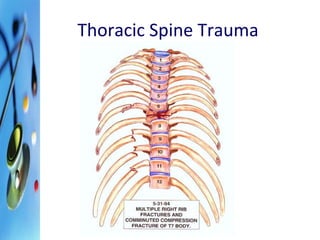
Thoracic Spine Trauma
INDICATIONS FOR THORACOTOMY 
• Post-traumatic cardiovascular collapse 
• Pericardial tamponade 
• Vascular injury to the thoracic outlet 
• Control of Hge from lung injury 
• Massive Air leak 
• Proved tracheobronchial injury 
• Internal cardiac massage
Types 
• Emergency / Resuscitative Thoracotomy. 
For bleeding control. 
• Planned Thoracotomy. 
For repair of specific injury
Approaches 
• Median Sternotomy. 
• Anterolateral Approach. 
131
Median Sternotomy 
• Anterior aspect of the heart 
• Anterior mediastinum 
• Ascending and arch of aorta 
• Pul. Arteries 
• Trachea.. Carina
Lt A/L Thoracotomy 
• Lt lung and hilum 
• Thoracic Aorta 
• Origin of Lt Sub clavian artery 
• Lt side of the heart 
• Lower esophagus
Rt A/L Thoracotomy 
• Rt lung and hilum 
• Azygous vein 
• SVC 
• IVC 
• Upper esophagus 
• Thoracic trachea 
134
Summary 
• Chest Injuries are common and often life 
threatening in trauma patients. So, Rapid 
identification and treatment of these patients is 
paramount to patient survival. Airway 
management is very important and aggressive 
management is sometimes needed for proper 
management of most chest injuries.
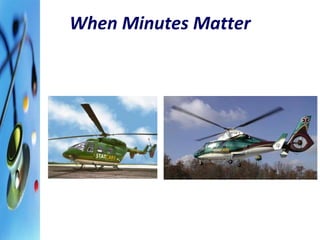
When Minutes Matter
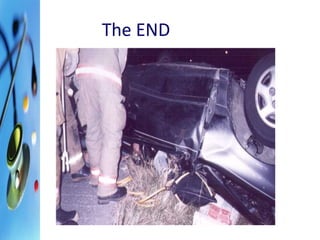
The END

Chest trauma

  • 1.
    CHEST TRAUMA •Presented by: Dr. Shah Khalid • November 19, 2012
  • 2.
    Objectives Anatomy ofThorax Main Causes of Chest Injuries Different Types of Chest Injuries Treatments of Chest Injuries
  • 3.
    Anatomy of thechest Thoracic Inlet.. Connects thoracic cavity to the root of the Neck.
  • 4.
    • Thoracic Outlet… Connects thoracic cavity with the Abdomen. Closed by Diaphragm.
  • 5.
    Thoracic Wall Posteriorly…Thoracic vertebrae 12. Anteriorly… Sternum and Costal Cartilages. Laterally… Ribs and Intercostal spaces.
  • 7.
  • 9.
    Anatomy of thechest Two Lungs (right and left) Heart Diaphragm
  • 10.
    Anatomy of thechest Pleural Space
  • 11.
  • 12.
    ANATOMY OF THORAX • Trachea • Bronchi • Lungs • Heart • Great Vessels. • Oesophagus
  • 13.
    Chest Trauma •Thoracic injury… 25% of all injuries. • In another 25%, its contributor to other injuries. • Major Cause of death…. Hemorrhage.
  • 14.
    Investigations • CXR….1st choice. • Ultrasound • CT Scan….. Gold Standard. Rapid Diagnosis, 3- dimensional Images. • Chest tube… may be theraputic and diagnostic. • Angiography.
  • 15.
    General Management ATLSPrinciples of Resuscitation Aim… To Restore Physiology, rather than anatomy Early assessment and primary survey. Simultaneous aggressive resuscitation. Secondary survey with full examination. Transfer to a definitive site of care.
  • 16.
    • A. Airway Assess for airway patency and air exchange - listen at nose & mouth Assess for intercostal and supraclavicular muscle retractions Assess oropharynx for foreign body obstruction
  • 18.
    • B. Breathing Assess respiratory movements and quality of respirations - look, listen, feel. Shallow respirations are early indicator of distress - cyanosis is late.
  • 19.
    • C. Circulation Skin - look and feel for color, temperature, capillary refill- Look for cyanosis. Assess pulses for quality, rate, regularity Look at neck veins - flat vs. distended-fluid deficit or decreased supply to body from heart due to compression. Assess the B.P.
  • 20.
    • D. Disability. Immobilization of the spine. E. Exposure.
  • 21.
    Main Causes ofChest Trauma • Blunt Trauma- Blunt force to chest. • Penetrating Trauma- Projectile that enters chest causing small or large hole. • Compression Injury- Chest is caught between two objects and chest is compressed.
  • 22.
    Blunt Trauma tothe Chest
  • 23.
    Chest wall injuries Buises Scratches Laceration Rib fractures Flail Chest Sternal fractures Thoracic spine injuries
  • 24.
    Rib Fracture Singleor Multiple. Usually after blunt trauma. Fracture of First Rib is Associated with Injuries to great vessels, important nerves of the upper limb. If 8,10,11,12 Ribs involved, be suspicious for liver or spleen or kidney injuries. Treatment: Broken Rib Strong analgesia Intercostal Nerve blocks With LA Pulmonary toilet -> Patient is asked to cough ,breathe deeply since the patient is usually unable to do so resulting in poor clearance of secretions. Reduces atelectasis and pneumonia. Severe injuries require Internal Fixation with plates and screws
  • 25.
    S/S Pleuritic chestpain Rapid shallow breathing Splenting Atelectasis hypoxemia.
  • 28.
    Flail Chest Thebreaking of 2 or more ribs in 2 or more places
  • 29.
  • 31.
  • 32.
    S/S of FlailChest • Painful Breathing. • Paradoxical Chest Movements. • Rapid, Shallow respiration, Dyspnea, Tachypnea, Tachycardia. • Bruising/Swelling. • Crepitus (Grinding of bone ends on palpation). • Diagnosis is purely clinical. • Chest X-Ray, ABG’s can be done to confirm.
  • 33.
    Treatment of FlailChest • ABC’s with c-spine control as indicated • High Flow oxygen • Adequate analgesia (Including opiates) • Intra-plural local analgesia • Observe the patient for development of Pneumothorax and even worse Tension Pneumothorax If Tension Develops Needle Decompress affected side • Surgery -> internal operative fixation. • Rapid Transport! Remember a True Emergency
  • 34.
    Bulky Dressing forsplint of Flail Chest • Use Trauma bandage and Triangular Bandages to splint ribs. • Can also place a bag of D5W on area and tape down. (The only good use of D5W I can find)
  • 35.
  • 36.
    Deadly Dozen ImmediatelyLife threatening • Airway obstruction • Tension Pneumothorax • Pericardial Temponade • Open Pneumothorax • Massive hemothorax • Flail chest Potentially life Threatning • Aortic injuries • Tracheobronchial injuries • Myocardial contusion • Rupture of diaphragm • Esophageal injury • Pulmonary conyusion
  • 37.
    PNEUMOTHORAX Pneumothorax isair in the pleural space resulting in partial or complete collapse of the lung space. Types:  Closed /Simple pneumothorax is one in which chest wall is intact and air enters the pleural space from lung surface  Open pneumothorax is Sucking Chest Wound in which air enters the pleural space through opening in the chest wall.
  • 38.
    Simple/Closed Pneumothorax •Opening in lung tissue that leaks air into chest cavity • Blunt trauma is main cause • Usually self correcting
  • 39.
  • 40.
    S/S of Simple/Closed Pneumothorax • Chest Pain • Dyspnea • Tachypnea • Decreased Breath Sounds on Affected Side
  • 41.
    Treatment for Simple/Closed Pneumothorax • ABC’s with C-spine control • Airway Assistance as needed • Provide supportive care • Usually small and self limiting. • Monitor for Development of Tension Pneumothorax
  • 42.
    Open Pneumothorax •Opening in chest cavity that allows air to enter pleural cavity • Causes the lung to collapse due to increased pressure in pleural cavity • Can be life threatening and can deteriorate rapidly.
  • 43.
  • 44.
  • 45.
  • 46.
  • 47.
  • 48.
  • 49.
  • 50.
  • 51.
    S/S of OpenPneumothorax • Dyspnea • Sudden sharp pain • Subcutaneous Emphysema • Decreased breath sounds on affected side • Hyper-resonance • Red Bubbles on Exhalation from wound (a.k.a. Sucking chest wound)
  • 52.
    Dx: • CXRStanding. • Smaller pneumothorax may need Expiration CXR or CT Mx:  Observation…. Small pneumothorax, Asymtomatic.  Aspiration.  Chest Intubation…Gold standard,  Pleurectomy  Pleurodesis…. Sclerosig agents… Doxy, Bleomycin, talc.  Surgery… needed in less than 20%... Thoracotomy.
  • 53.
    Sucking chest wound • Full thickness hole in the chest wall, more than 2/3rd of tracheal diameter. • Inspiration… Flow of air into lungs… collapse. Tx: • Occlusine dressing… taped on three sides act as one-way valve,,,, Followed by Chest intubation.
  • 54.
    • Do notremove clothing stuck to the wound • Do not clean the wound or remove objects stuck in the wound
  • 55.
  • 57.
    Tension Pneumothorax •Air builds in pleural space with no way for the air to escape • Results in collapse of lung on affected side that results in pressure on mediastium, the other lung, and great vessels,…. Decreasing venous return => Shock • Causes: Penetrating trauma, blunt trauma, Iatrogenic.
  • 58.
    Tension Pneumothorax Eachtime we inhale, the lung collapses further. There is no place for the air to escape..
  • 59.
    Tension Pneumothorax Eachtime we inhale, the lung collapses further. There is no place for the air to escape..
  • 60.
    Tension Pneumothorax Thetrachea is pushed to the opposite side Heart is being compressed
  • 62.
    S/S of TensionPneumothorax Dramatic Presentation. It’s a clinical diagnosis and treatment should not be delayed by waiting for X-ray • Anxiety/Restlessness/Pani cky • Severe Dyspnea • Absent Breath sounds on affected side • Hyper-resonance • Tachypnea • Tachycardia • Poor Color • Accessory Muscle Use • JVD • Narrowing Pulse Pressures • Hypotension • Tracheal Deviation (late if seen at all)
  • 63.
    Treatment Needle Decompression • Insert a large bore needle (14G) in the second inter-costal space in mid-clavicular line.
  • 64.
  • 65.
  • 66.
  • 67.
  • 68.
    Indications • Pneumothorax • Malignant pleural effusion • Empyema and complicated parapneumonic pleural effusion • Traumatic haemopneumothorax • Postoperative—for example, thoracotomy, oesophagectomy, cardiac surgery.
  • 69.
    Contra- Indications •Absolute…. Need for emrgency Thoracotomy • Relatives are Bleeding Diathesis Anti-coagulation Adhesions Loculations Pulmonary bullae 69
  • 70.
    Complications of chesttube • Hemorrhage • Infection • Trauma to the Liver, spleen, Diaphragm, Aorta, Heart. • Minor complications like, Subcut hematoma, Cough, dyspnea, • Improper placement
  • 71.
    Hemothorax • FollowsBlunt injury • Occurs when pleural space fills with blood • Usually occurs due to lacerated blood vessel in thorax mainly Intercostal and internal mammary vessels. • As blood increases, it puts pressure on heart and other vessels in chest cavity • Each Lung can hold 1.5 liters of blood
  • 72.
  • 73.
  • 74.
  • 75.
  • 76.
  • 77.
    Hemothorax May putpressure on the heart
  • 78.
  • 79.
  • 80.
    Hemothorax Where doesthe blood come from. Lots of blood vessels
  • 81.
    S/S of Hemothorax • Anxiety/Restlessness • Tachypnea • Signs of Shock • Frothy, Bloody Sputum • Diminished Breath Sounds on Affected Side • Dull percussion note… maybe resonant in supine position. • Tachycardia • Flat Neck Veins
  • 82.
    Treatment for Hemothorax • ABC’s with c-spine control as indicated • General Shock Care due to Blood loss • Chest intubation • Thoracotomy… If more than 1500 ml blood drains initially, or ongoing hemorrhage of more than 200 ml/ hr over 3-4 hrs.
  • 83.
    Pulmonary Contusion Crushing and bruising of the lung parenchyma.  Sudden blow or blunt injury to the chest => compression of thoracic cavity and lung followed by an equally sudden decompression. Concussive and compressive force is most important cause.  The natural progression of pulmonary contusion is worsening hypoxemia for the first 24 to 48 hours.  X-ray findings not significant initially.  CT with contrast is confirmatory.
  • 84.
    Contusion of leftupper & lower lobe with aspirated blood around
  • 85.
    S/S of Pul.Contusion • Hemoptysis • Dyspnea • Cough • Chest wall abrasion • Echymosis.
  • 86.
    Tx. Of Pul.contusion • Oxygen administration • Pul. Toilet • Mechanical ventilation => in severe case
  • 87.
    Subcutaneous Emphysema •Air collects in subcutaneous tissues from pressure of air in pleural cavity • Feels like rice crispies • Can be seen from neck to groin area • usually occurs on the chest, neck and face, where it is able to travel from the chest cavity along the fascia.
  • 88.
    S/S of SCE • swelling of the neck • Chest pain • Neck pain • Dysphagia • Wheezing and difficulty breathing.
  • 89.
    Causes of SCE • Both blunt and penetrating trauma Diagnosis • Mainly clinical • CXR
  • 90.
    Treatment • Usuallybenign, no treatment needed. • If massive then small cuts in the skin. • Catheters in subcutaneous tissues. • Treat the underlying cause.
  • 91.
    Tracheo-bronchial Injuries •Blunt and penetrating trauma • Presented as hoarseness, SCE. • Dyspnea , Pneumothorax , hemoptysis , Mediastinal crunch {Hamman’s Sign}, Intercostal retractions, Respiratory distress , Stridor. • Chest drain will reveal a large air leak and the collapsed lung may fail to re-expand. • Diagnosis => Bronchoscopy
  • 92.
    Managment • Priorityis to stabilize AIRWAY. • Intubation of the unaffected bronchus and operative repair.
  • 93.
    Traumatic Asphyxia •Results from sudden compression injury to chest cavity • Can cause massive rupture of Vessels and organs of chest cavity • Ultimately Death
  • 94.
    S/S of TraumaticAsphyxia • Severe Dyspnea • Distended Neck Veins • Bulging, Blood shot eyes • Swollen Tounge with cyanotic lips • Reddish-purple discoloration of face and neck • Petechiae
  • 95.
    Treatment for Traumatic Asphyxia • ABC’s with c-spine control as indicated • High Flow oxygen • Treat for shock • Care for associated injuries
  • 96.
  • 98.
    Pericardial Tamponade PenetratingTrauma Blood and fluids leak into the pericardial sac which surrounds the heart. As the pericardial sac fills, it causes the sac to expand until it cannot expand anymore pericardial sac
  • 99.
    Pericardial Tamponade Oncethe pericardial sac can’t expand anymore, the fluid starts putting pressure on the heart Now the heart can’t fully expand and can’t pump effectively.
  • 100.
    Pericardial Tamponade Withpoor pumping the blood pressure starts to drop. The heart rate starts to increase to compensate but is unable The patient’s level of conscious drops, and eventually the patient goes in cardiac arrest
  • 101.
    S/S of PericardialTamponade • Distended Neck Veins • Increased Heart Rate • Muffled heart sound • Respiratory Rate increases • Poor skin color • Hypotension • Death • Beck’s Triad… Low BP, Raise venous pressure, Muffled Heart sounds.
  • 102.
    • All thepts with penetrating injury anywhere near the heart + Shock => Always suspect cardiac injury. • Must be differentiated from Tension pneumothorax. • In case of major bleeding from other site, neck veins may be flat.
  • 103.
    Dx: • Clinicalsuspicion. • CXR… enlarged Globular heart shadow. • Echo…. Fluid in pericardial sac. • Central venous pressure… high • CT scan
  • 107.
    Treatment of PericardialTamponade • ABC’s with c-spine control as indicated • High Flow oxygen. • Treat S/S of shock • Rapid Transport • What patient needs is Pericardiocentesis
  • 108.
    Pericardiocentesis • Usingaseptic technique, Insert at least 3” needle at the angle of the Xiphoid Cartilage at the 7th rib • Advance needle at 45 degree towards the clavicle while aspirating syringe till blood return is seen • Continue to Aspirate till syringe is full then discard blood and attempt again till signs of no more blood • Closely monitor patient due to small amout of blood aspirated can cause a rapid change in blood pressure
  • 109.
  • 111.
    Definitive treatment •Sternotomy • Left Thoracotomy
  • 112.
  • 113.
    Blunt Myocardial Injury • Rarely Causes hemodynamic Instability. • Dx on ECG.. Echo, Trans esophageal Echo, Cardiac enzymes… Little role. • Complication… Arrythmias in 1st 24 hrs.
  • 114.
    Traumatic Aortic Disruption • Most common cause of sudden death after MVA or fall from height • Relatively fixed distal to the origin of Lt subclavian artery. • The heart, more or less, just hangs from the aortic arch much like a big pendulum. • Deceleration Injury • If Intima and media are disrupted, but Adventitia is intact……. Pt may be Stable.
  • 117.
    S/S Of TraumaticAortic Rupture • Burning or Tearing Sensation in chest or shoulder blades • Rapidly dropping Blood Pressure • Pulse Rapidly Increasing • Asymmetry of both upper limbs, or upper and lower limbs Blood Pressure. • Widened Pulse Pressure. • Chest wall contusions • Rapid Loss of Consciousness.
  • 118.
    Dx • CXRErect…. Widened Mediastinum • Aortogram. • CT with Contrast. • Trans-esophageal echo.
  • 119.
    Treatment of Traumatic Aortic Rupture • ABC’s with c-spine control as indicated • High Flow oxygen. • Treatment for Shock • Control of systolic B.P to less than 100mmHg. • Stenting. • Direct repair • Excision and grafting using a Dacron graft.
  • 121.
    OESOPHAGEAL INJURY •Results from penetrating trauma; blunt injury is rare • Patient can present with odynophagia, subcutaneous or mediastinal emphysema, pleural effusion, air in the retro-oesophageal space and unexplained fever within 24 hours of injury • Combination of oesophagogram and oesophagoscopy confirm diagnosis • CT can be done • Treatment is operative repair and drainage • Mid-oesophageal injury => Right thoracotomy. • Distal oesophageal injury => Left thoracotomy.
  • 122.
    Pathology of oesophagalinjury. Entry into cervical or mediastinal fascial planes of: Air Gastric juice Bacteria and Saliva Mediastinitis Emphyse ma Pneumothor ax Burn Absces s Empyem a Sepsis Pneumo nia Tension Fluid and electrolyte disturbance CV Collapse
  • 123.
    Diaphragmatic Rupture •A tear in the Diaphragm that allows the abdominal organs enter the chest cavity • Any penetrating injury to or below 5th intercostal space can cause diaphragmatic penetration & abdominal injury • Blunt injury to the diaphragm is usually caused by a compressive force applied to the pelvis & abdomen. • More common on Left side due to liver helps protect the right side of diaphragm • Associated with multiple injury patients • usually large, with herniation of the abdominal contents into the chest.
  • 124.
  • 125.
    S/S of DiaphragmaticRupture • Abdominal Pain • Shortness of Air • Decreased Breath Sounds on side of rupture • Bowel Sounds heard in chest cavity
  • 126.
    Dx • -Chest radiography after placement of a nasogastric tube, Contrast studies of the upper or lower gastrointestinal tract, CT scan & diagnostic peritoneal lavage. • Most accurate evaluation is by video-assisted thoracoscopy (VATS) or laparoscopy.
  • 127.
    Treatment of DiaphragmaticRupture .Operative Repair. Penetrating diaphragmatic injury must be repaired via the abdomen and not the chest, to rule out penetrating hollow viscus injury. Laproscopy can be done.
  • 128.
  • 129.
    INDICATIONS FOR THORACOTOMY • Post-traumatic cardiovascular collapse • Pericardial tamponade • Vascular injury to the thoracic outlet • Control of Hge from lung injury • Massive Air leak • Proved tracheobronchial injury • Internal cardiac massage
  • 130.
    Types • Emergency/ Resuscitative Thoracotomy. For bleeding control. • Planned Thoracotomy. For repair of specific injury
  • 131.
    Approaches • MedianSternotomy. • Anterolateral Approach. 131
  • 132.
    Median Sternotomy •Anterior aspect of the heart • Anterior mediastinum • Ascending and arch of aorta • Pul. Arteries • Trachea.. Carina
  • 133.
    Lt A/L Thoracotomy • Lt lung and hilum • Thoracic Aorta • Origin of Lt Sub clavian artery • Lt side of the heart • Lower esophagus
  • 134.
    Rt A/L Thoracotomy • Rt lung and hilum • Azygous vein • SVC • IVC • Upper esophagus • Thoracic trachea 134
  • 135.
    Summary • ChestInjuries are common and often life threatening in trauma patients. So, Rapid identification and treatment of these patients is paramount to patient survival. Airway management is very important and aggressive management is sometimes needed for proper management of most chest injuries.
  • 136.
  • 137.