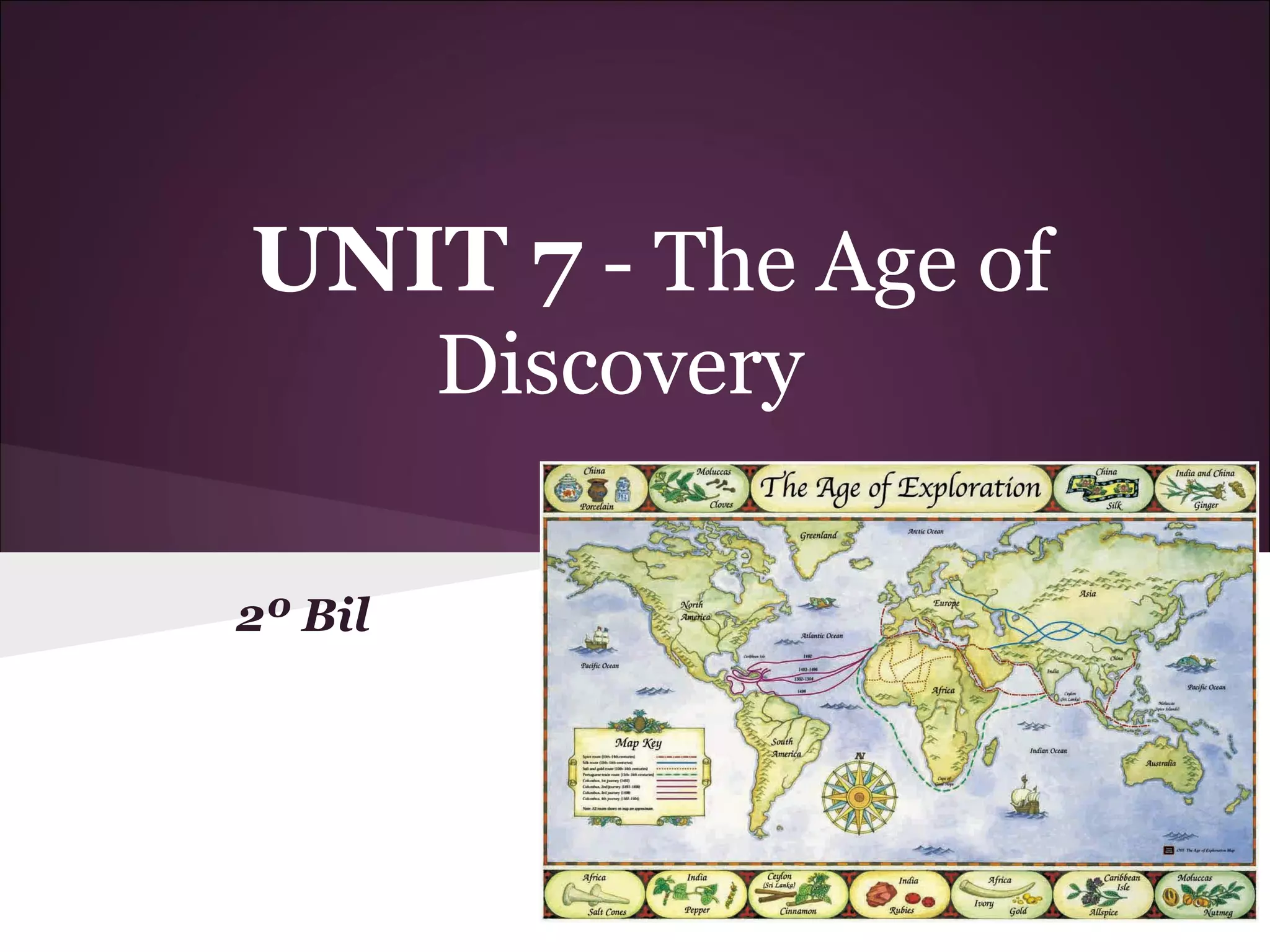

UNIT 7 - The Age of
Discovery
2º Bil
1- Why were the discoveries made?
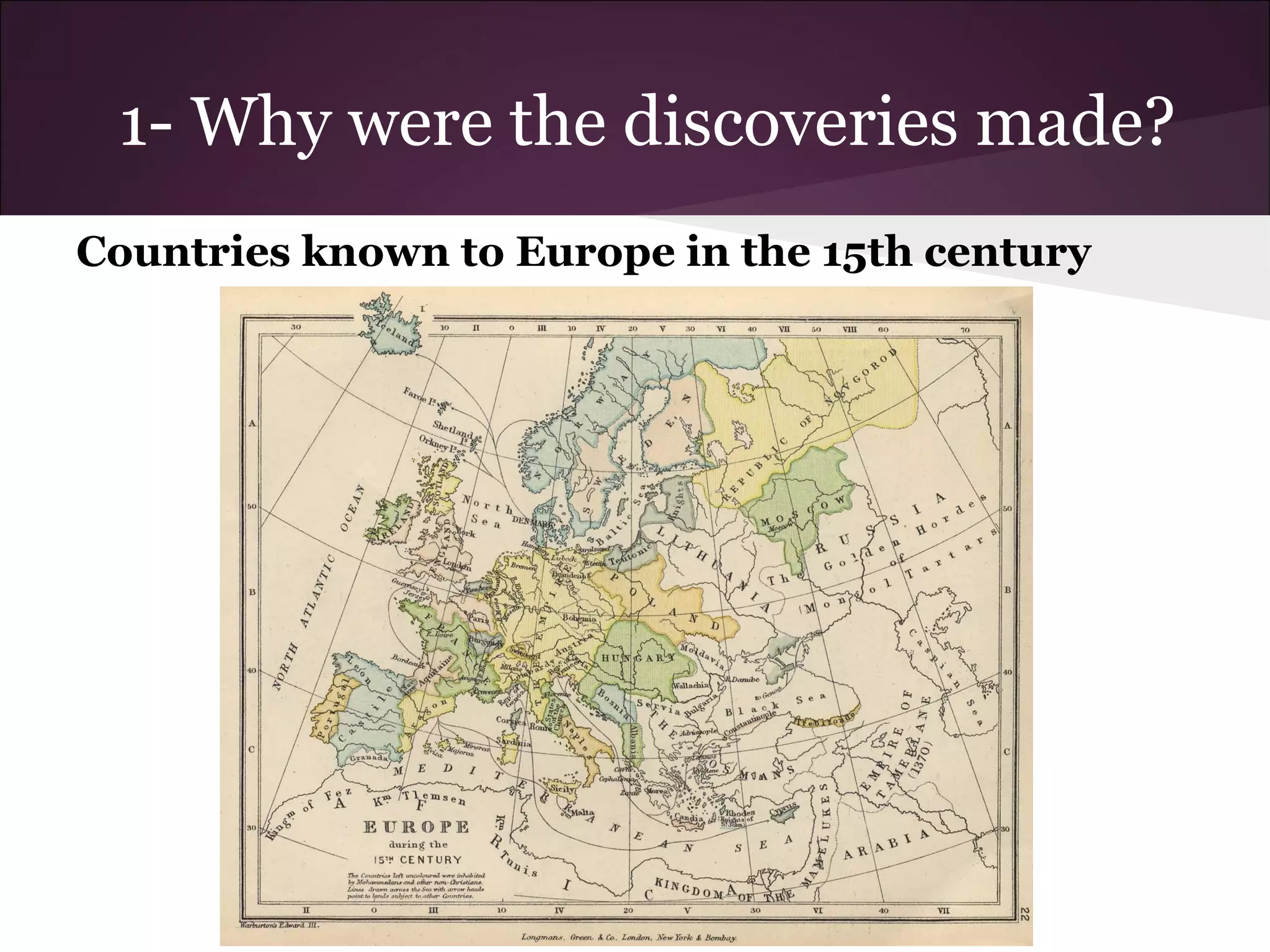
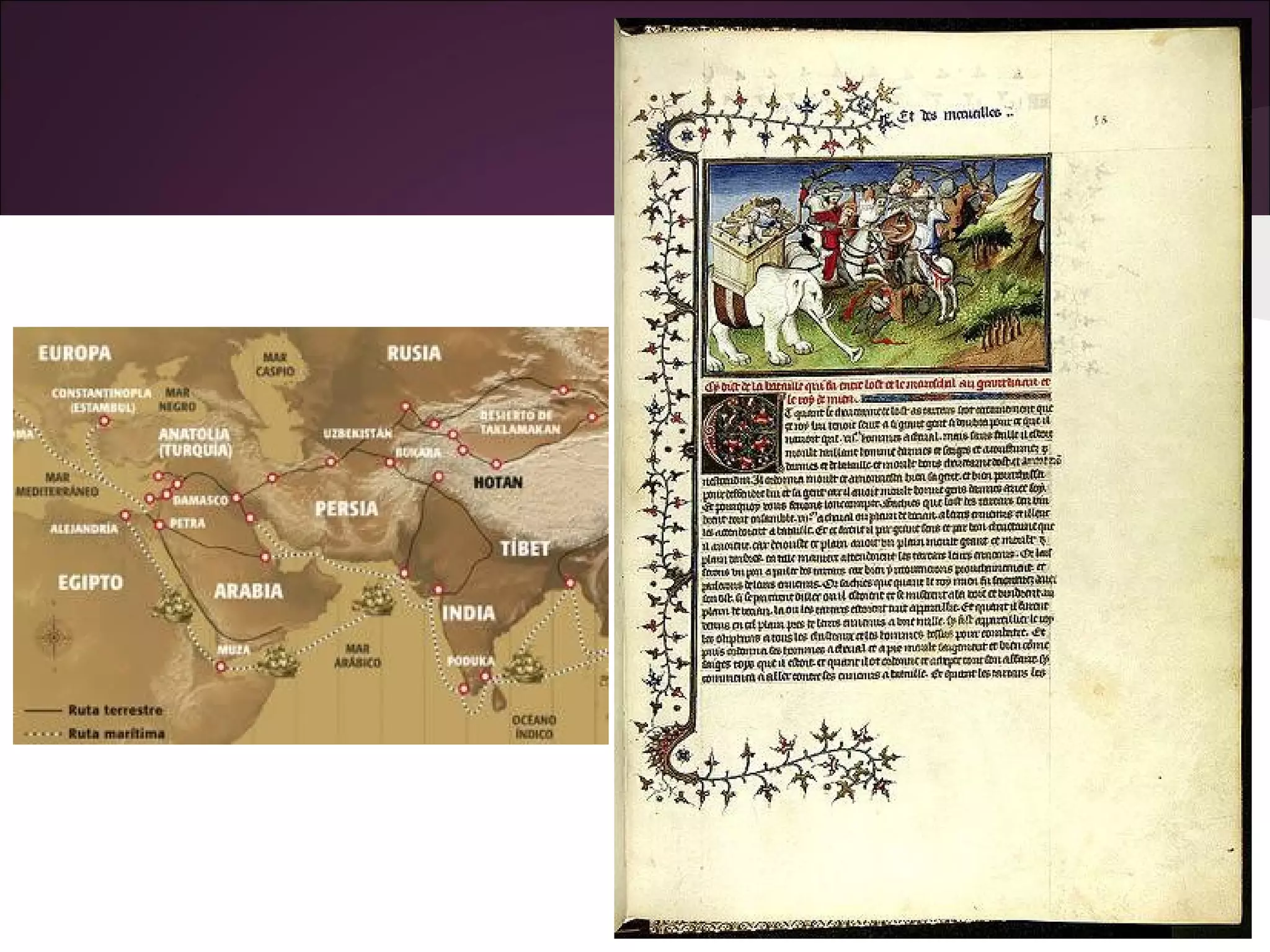
Countries known to Europe in the 15th century
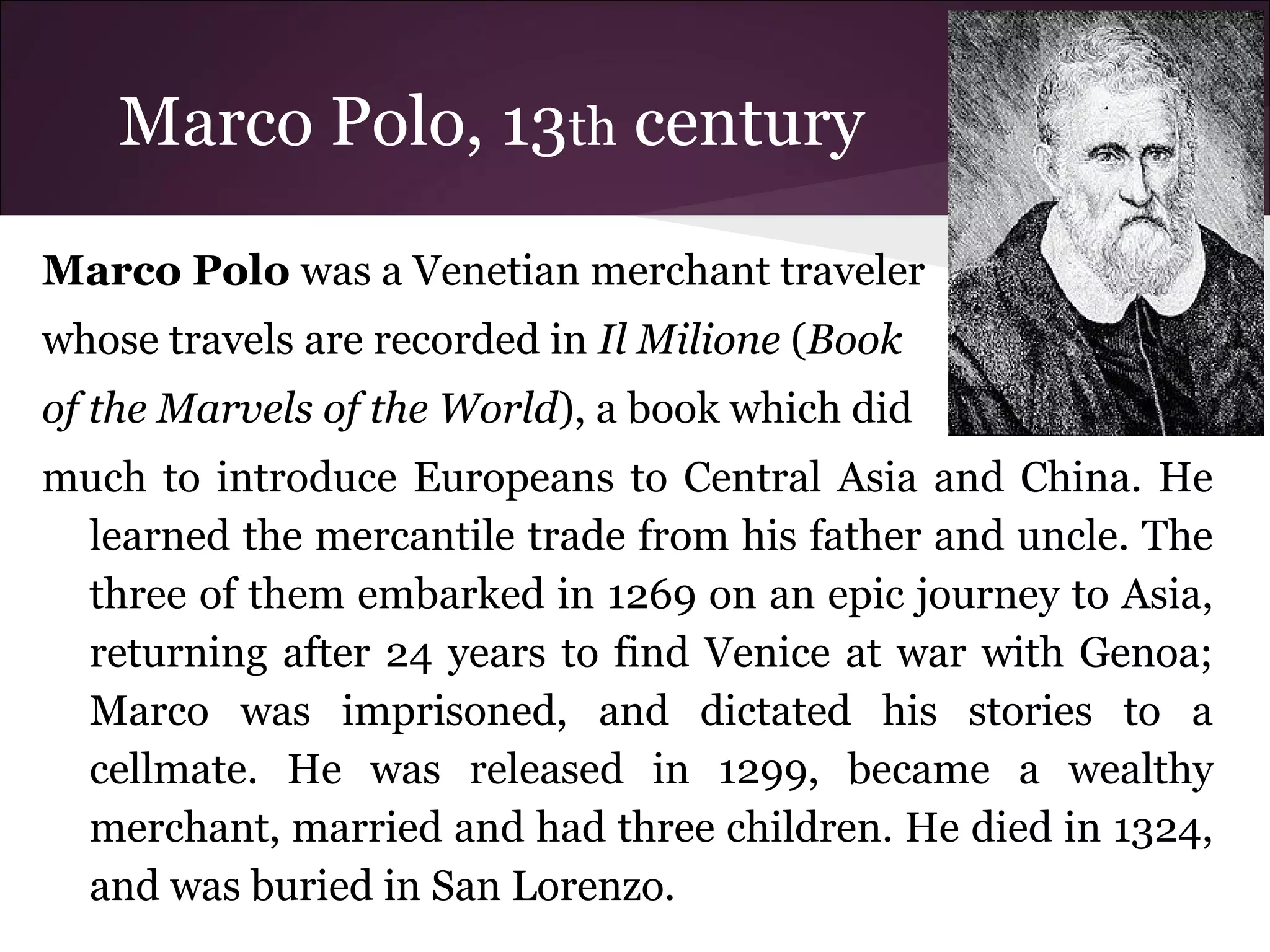
Marco Polo, 13th century
Marco Polo was a Venetian merchant traveler
whose travels are recorded in Il Milione (Book
of the Marvels of the World), a book which did
much to introduce Europeans to Central Asia and China. He
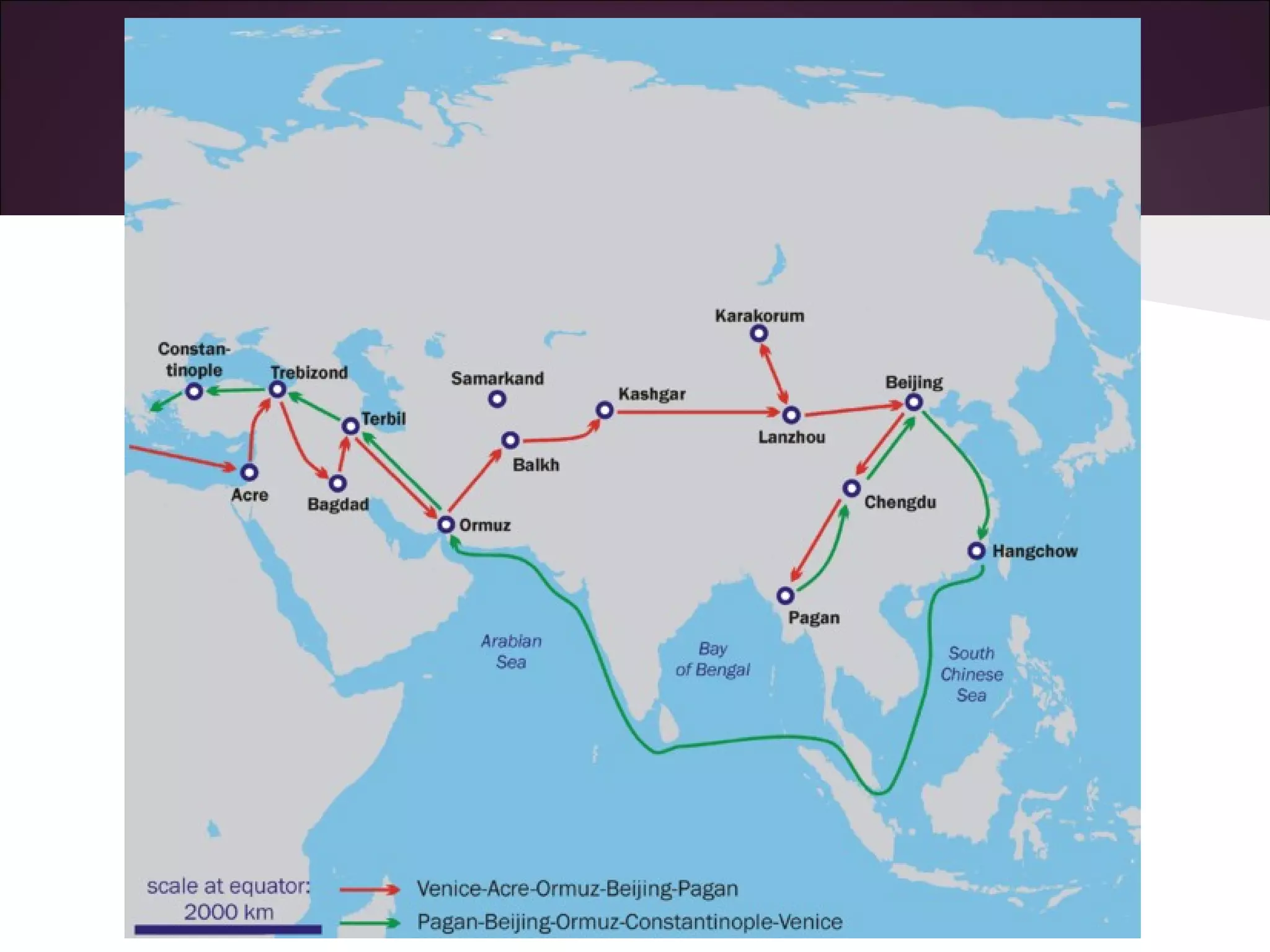
learned the mercantile trade from his father and uncle. The
three of them embarked in 1269 on an epic journey to Asia,
returning after 24 years to find Venice at war with Genoa;
Marco was imprisoned, and dictated his stories to a
cellmate. He was released in 1299, became a wealthy
merchant, married and had three children. He died in 1324,
and was buried in San Lorenzo.
Reason for the discoveries
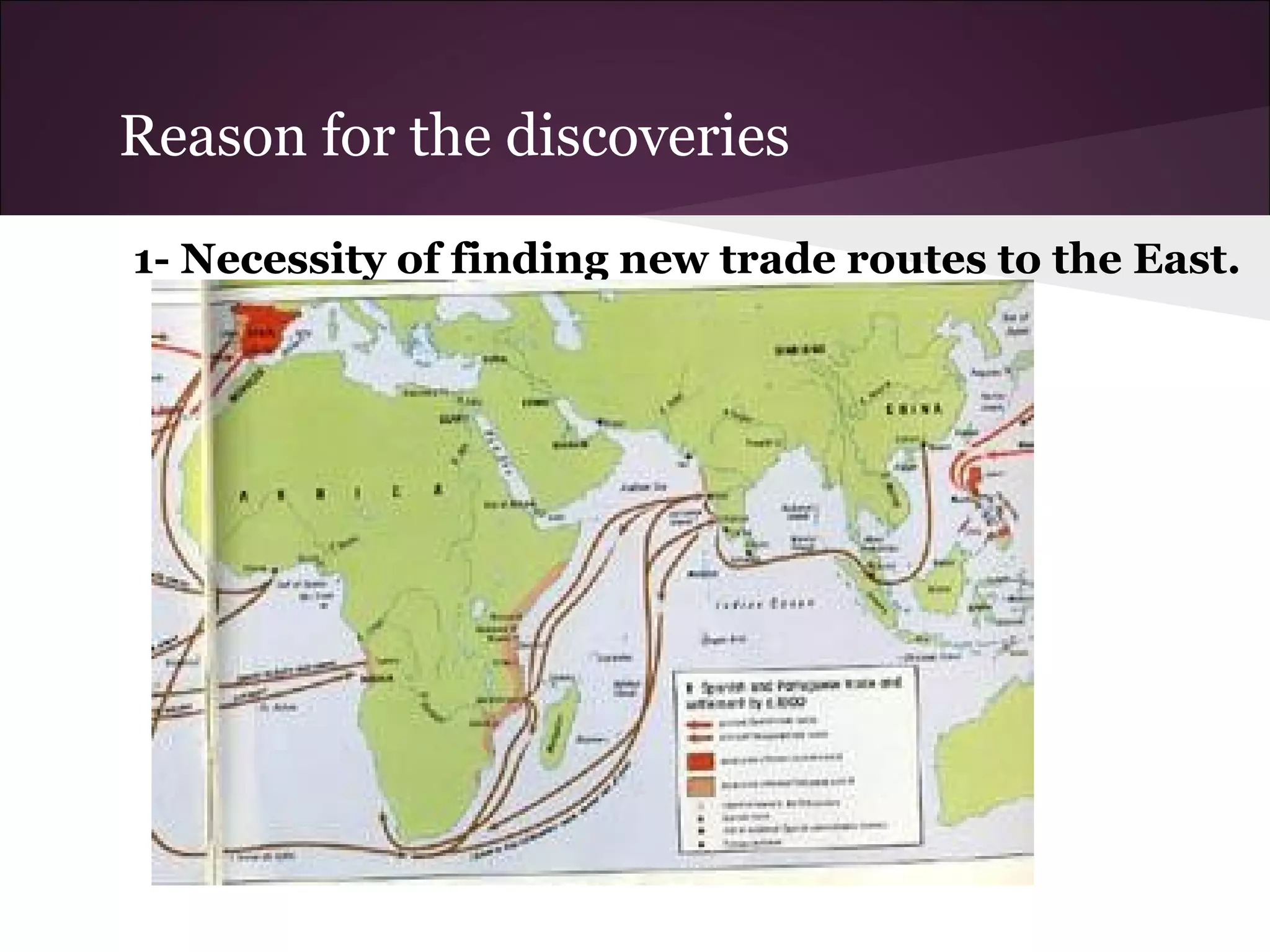
1- Necessity of finding new trade routes to the East.
Reason for the discoveries
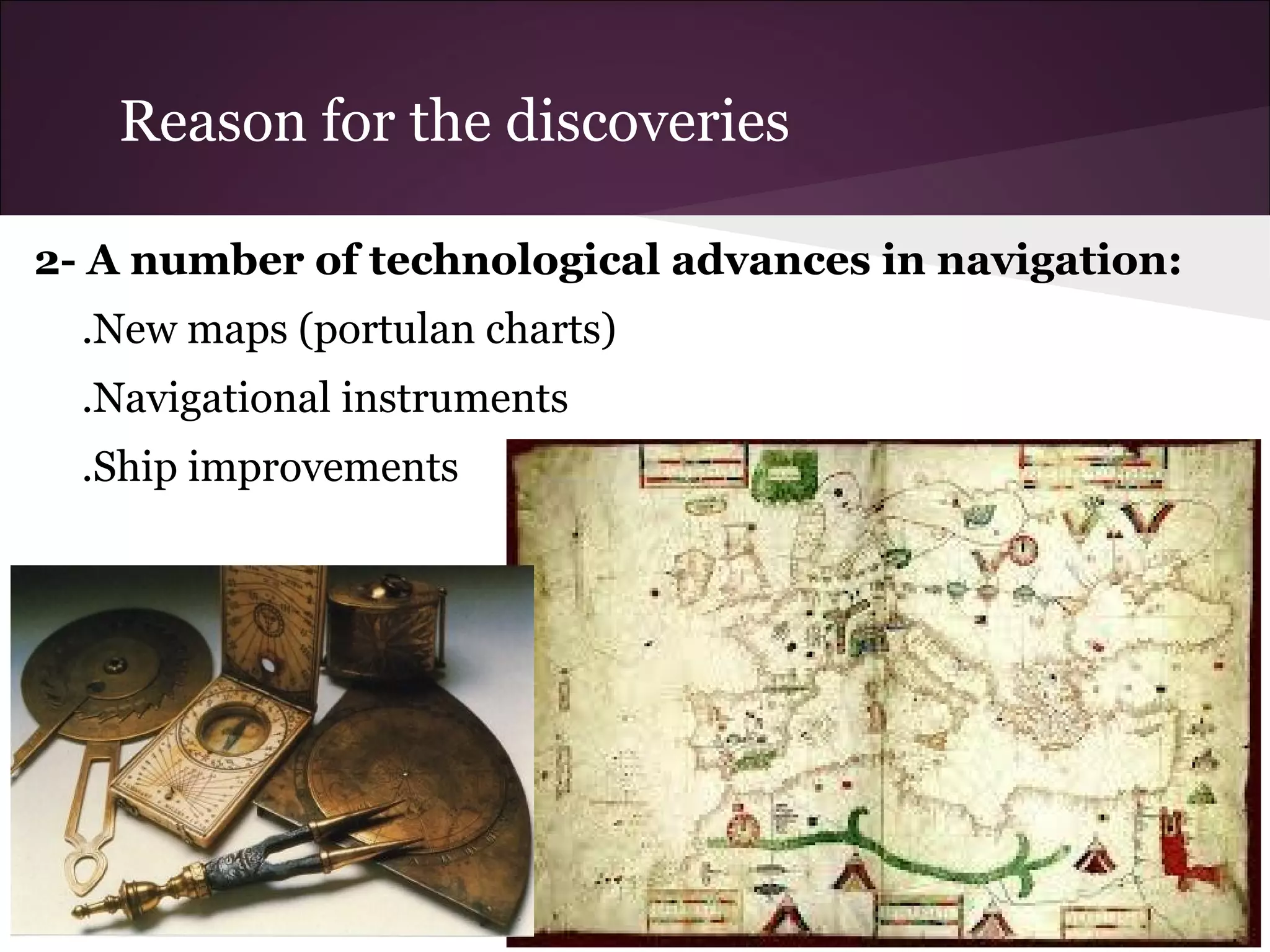
2- A number of technological advances in navigation:
.New maps (portulan charts)
.Navigational instruments
.Ship improvements
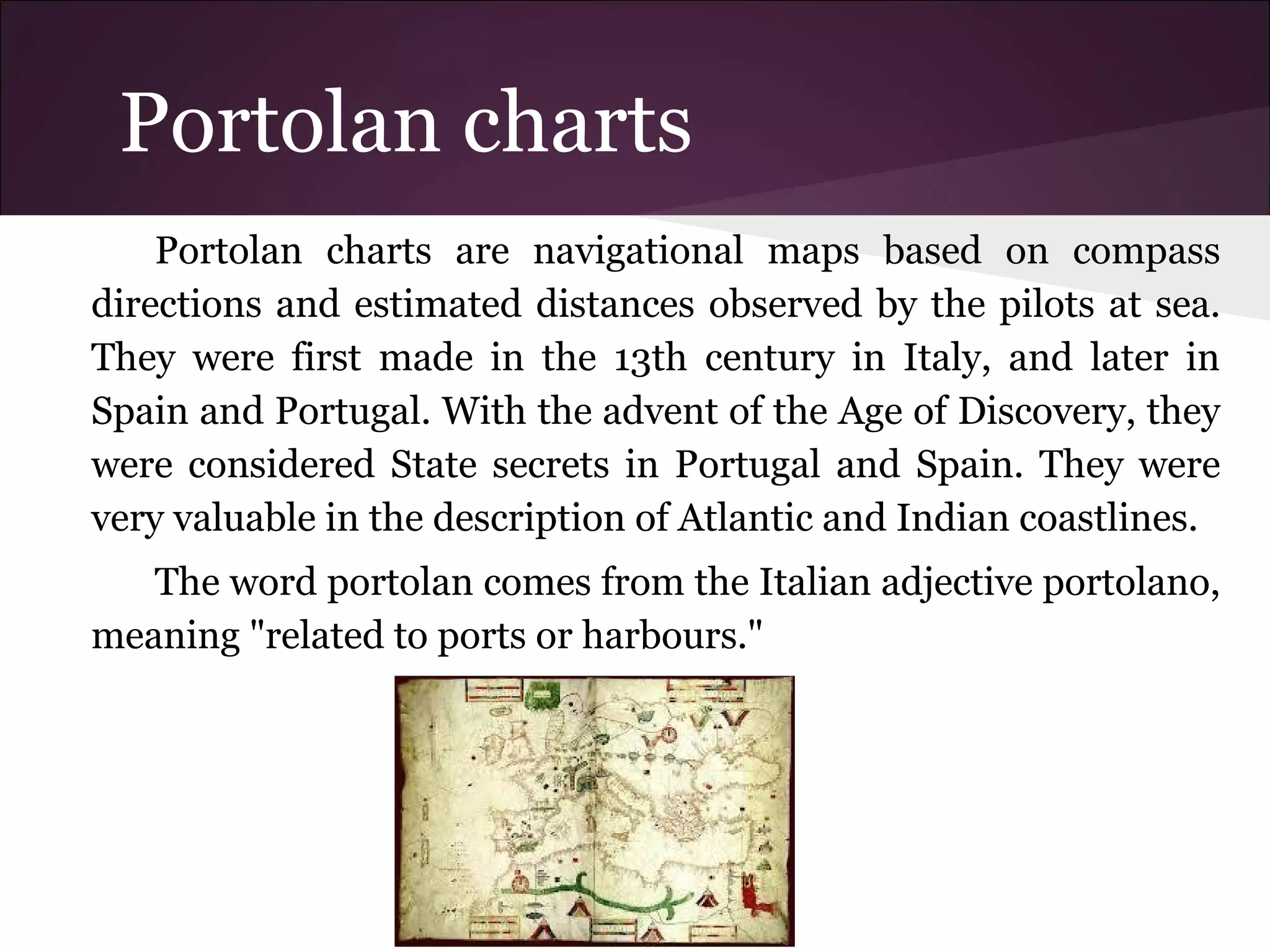
Portolan charts
Portolan charts are navigational maps based on compass
directions and estimated distances observed by the pilots at sea.
They were first made in the 13th century in Italy, and later in
Spain and Portugal. With the advent of the Age of Discovery, they
were considered State secrets in Portugal and Spain. They were
very valuable in the description of Atlantic and Indian coastlines.
The word portolan comes from the Italian adjective portolano,
meaning "related to ports or harbours."
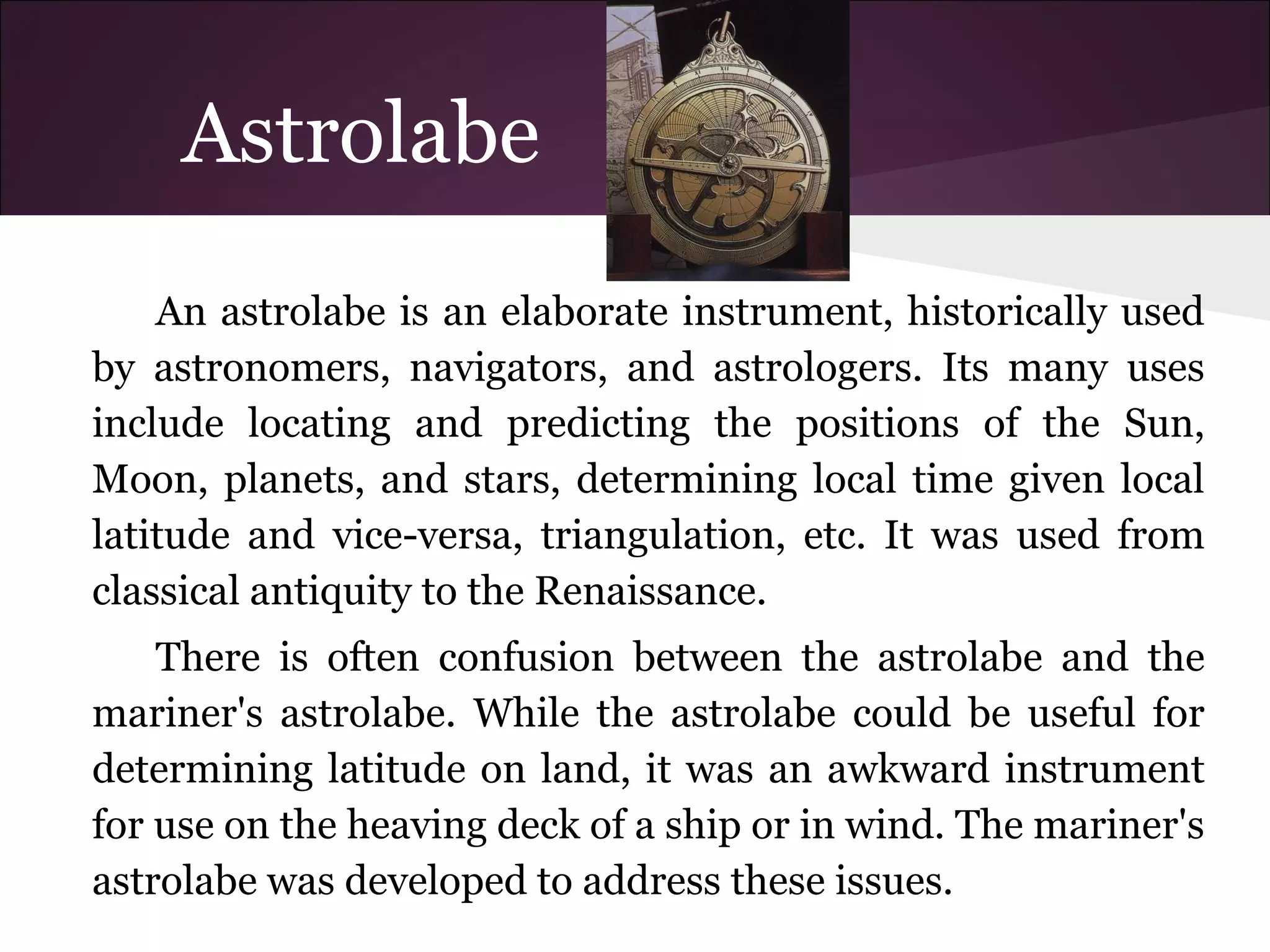
Astrolabe
An astrolabe is an elaborate instrument, historically used
by astronomers, navigators, and astrologers. Its many uses
include locating and predicting the positions of the Sun,
Moon, planets, and stars, determining local time given local
latitude and vice-versa, triangulation, etc. It was used from
classical antiquity to the Renaissance.
There is often confusion between the astrolabe and the
mariner's astrolabe. While the astrolabe could be useful for
determining latitude on land, it was an awkward instrument
for use on the heaving deck of a ship or in wind. The mariner's
astrolabe was developed to address these issues.
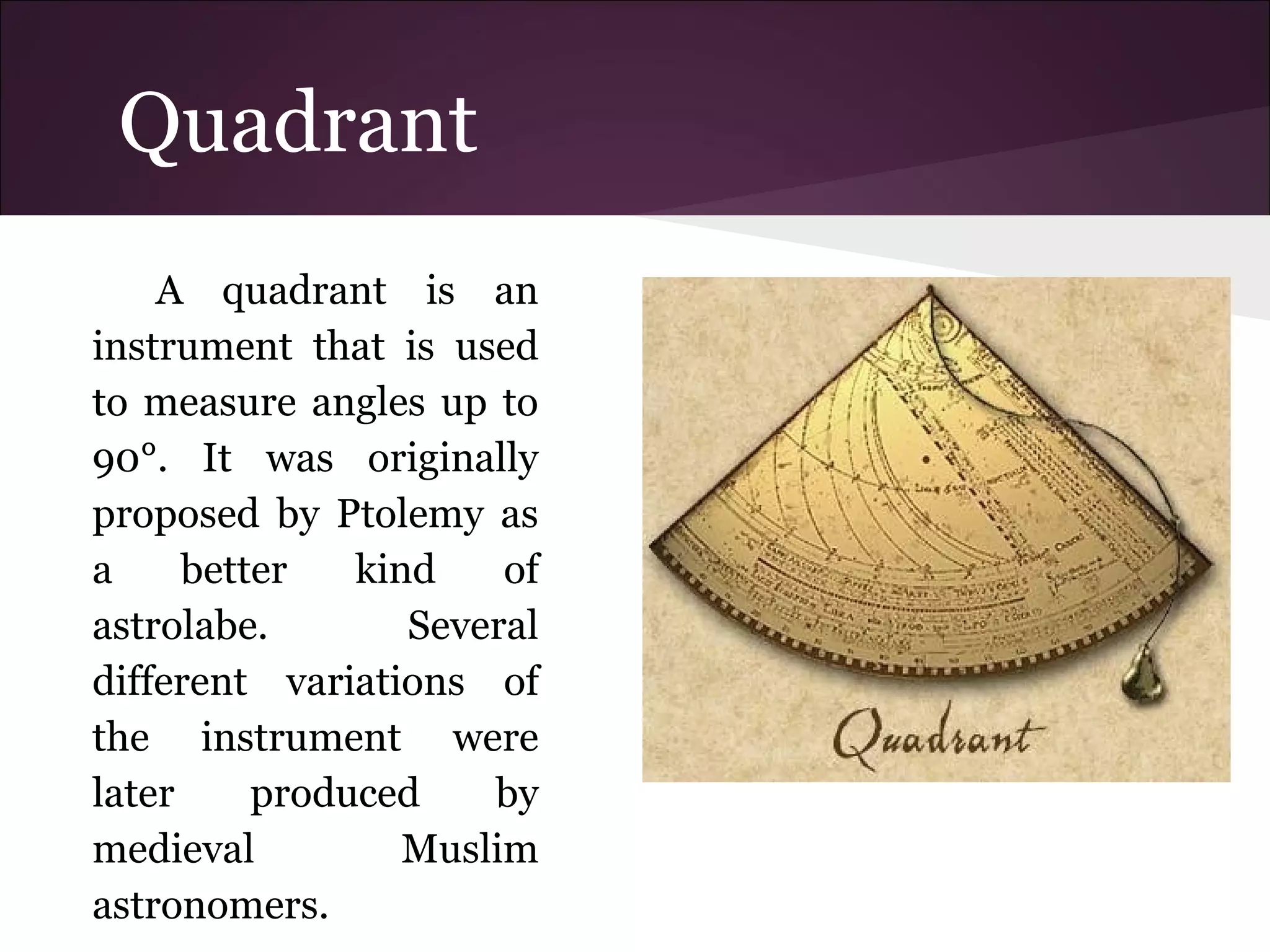
Quadrant
A quadrant is an
instrument that is used
to measure angles up to
90°. It was originally
proposed by Ptolemy as
a better kind of
astrolabe. Several
different variations of
the instrument were
later produced by
medieval Muslim
astronomers.
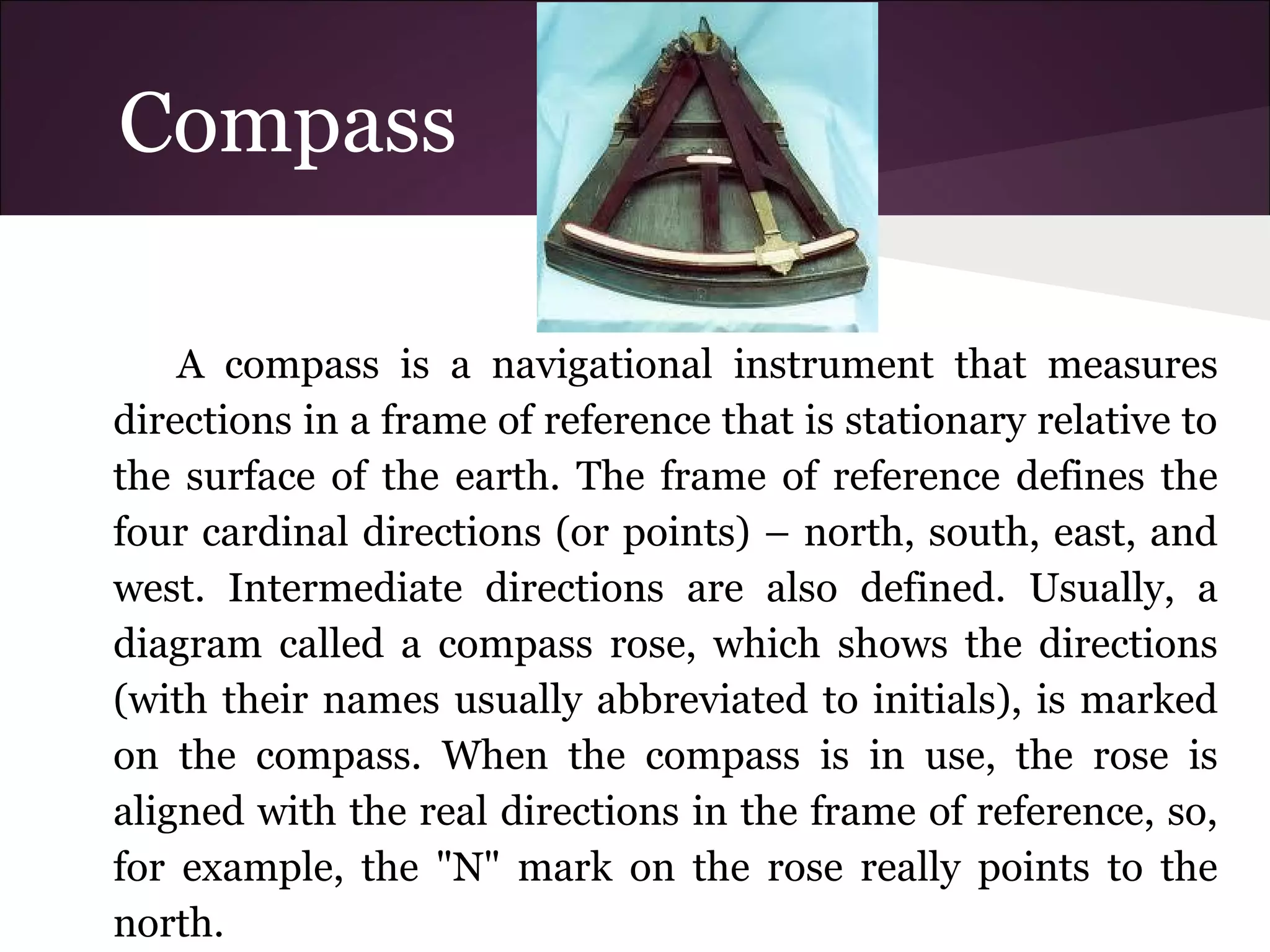
Compass
A compass is a navigational instrument that measures
directions in a frame of reference that is stationary relative to
the surface of the earth. The frame of reference defines the
four cardinal directions (or points) – north, south, east, and
west. Intermediate directions are also defined. Usually, a
diagram called a compass rose, which shows the directions
(with their names usually abbreviated to initials), is marked
on the compass. When the compass is in use, the rose is
aligned with the real directions in the frame of reference, so,
for example, the "N" mark on the rose really points to the
north.
HOMEWORK
Exercise 1 on page 67.
2- What were the
new sea routes?
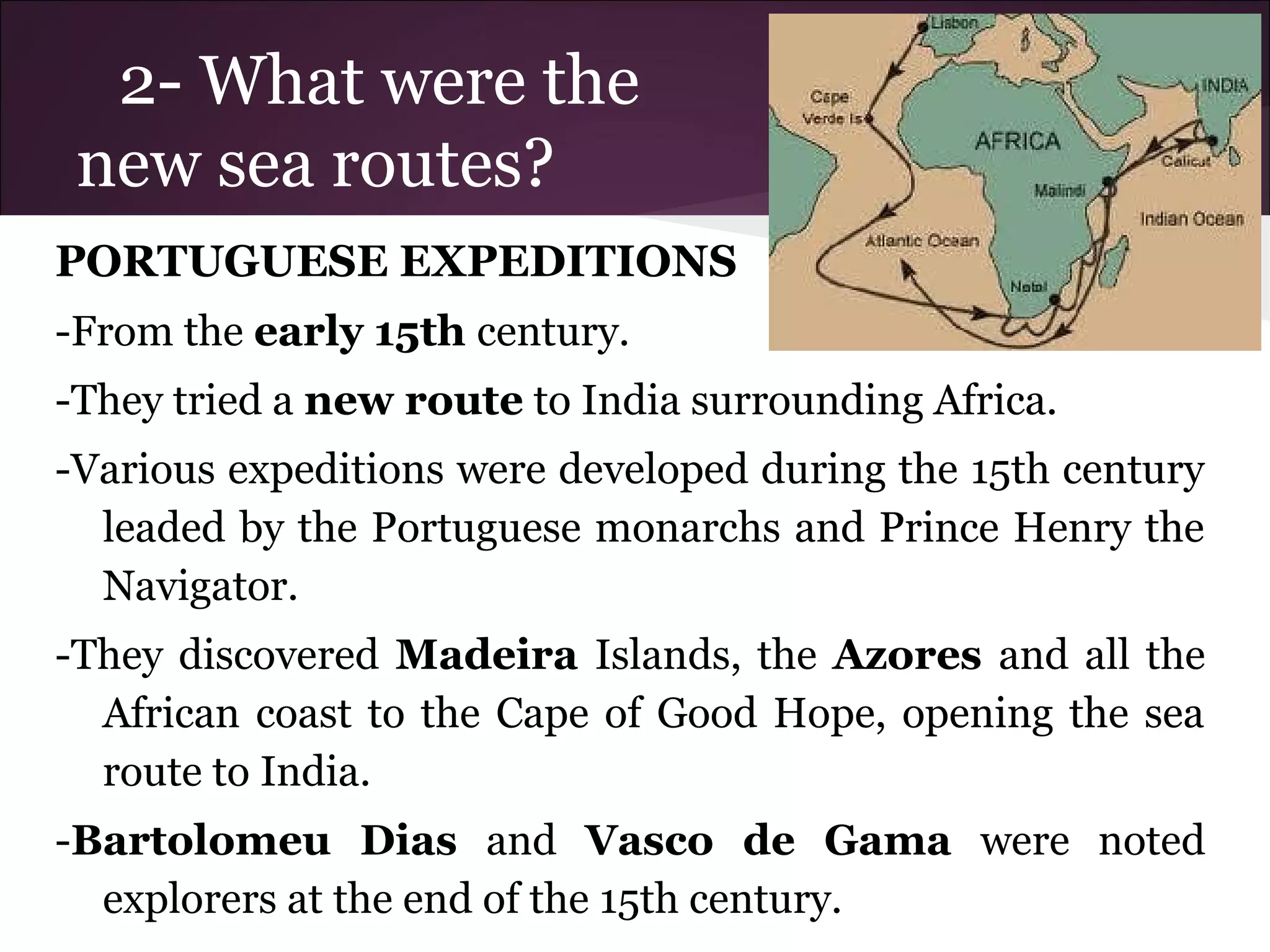
PORTUGUESE EXPEDITIONS
-From the early 15th century.
-They tried a new route to India surrounding Africa.
-Various expeditions were developed during the 15th century
leaded by the Portuguese monarchs and Prince Henry the
Navigator.
-They discovered Madeira Islands, the Azores and all the
African coast to the Cape of Good Hope, opening the sea
route to India.
-Bartolomeu Dias and Vasco de Gama were noted
explorers at the end of the 15th century.
2- What were the new sea routes?
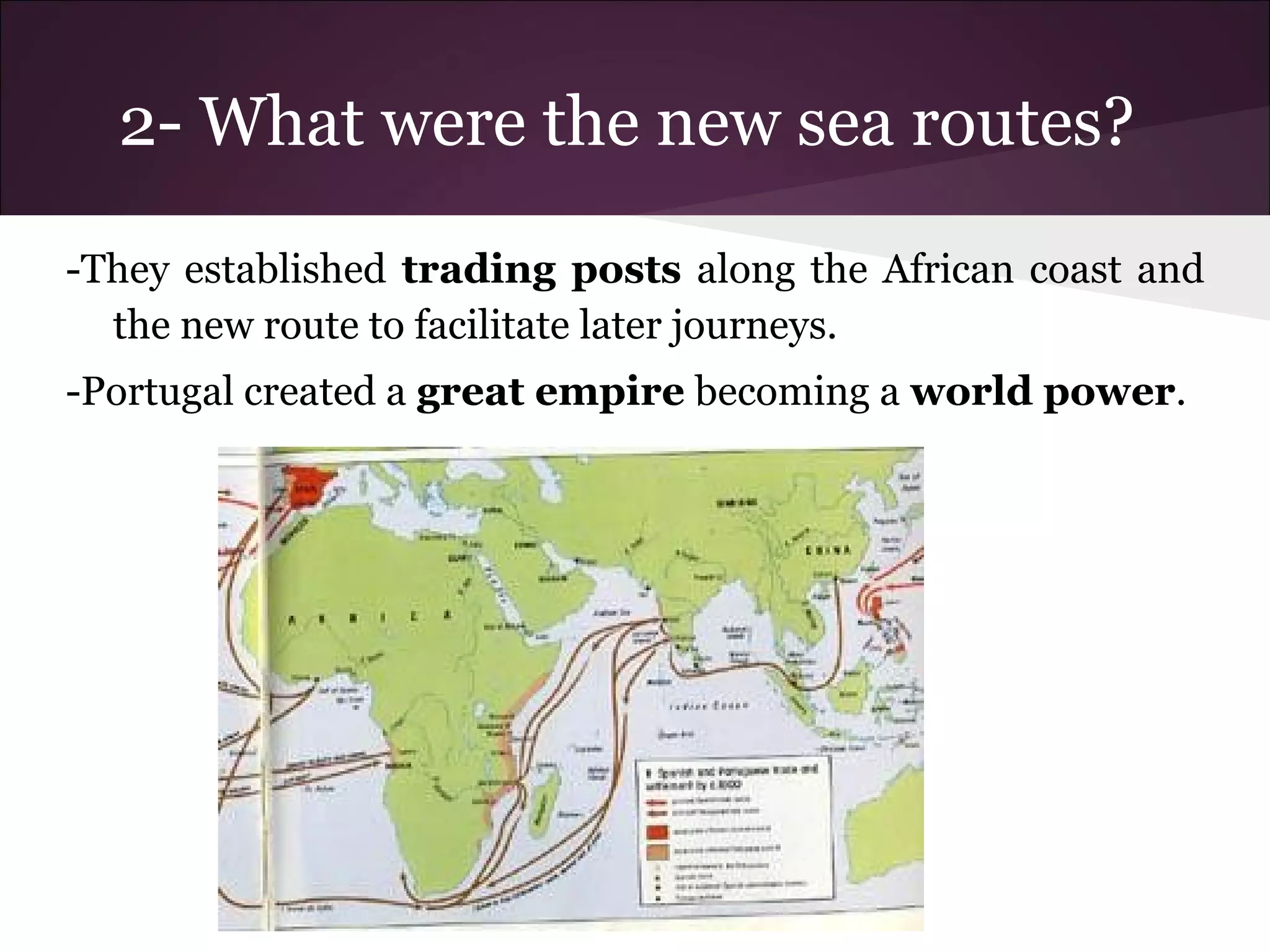
-They established trading posts along the African coast and
the new route to facilitate later journeys.
-Portugal created a great empire becoming a world power.
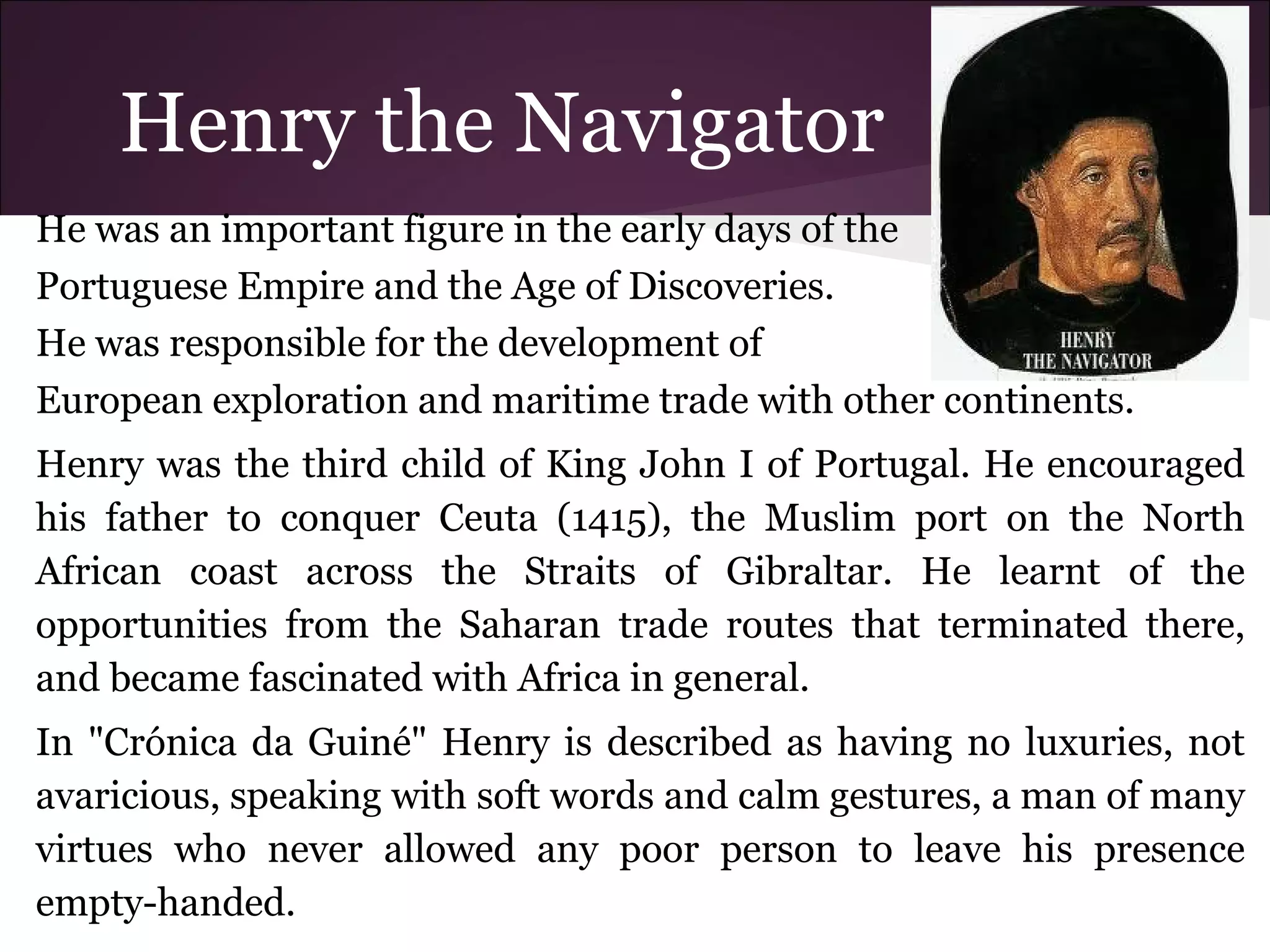
Henry the Navigator
He was an important figure in the early days of the
Portuguese Empire and the Age of Discoveries.
He was responsible for the development of
European exploration and maritime trade with other continents.
Henry was the third child of King John I of Portugal. He encouraged
his father to conquer Ceuta (1415), the Muslim port on the North
African coast across the Straits of Gibraltar. He learnt of the
opportunities from the Saharan trade routes that terminated there,
and became fascinated with Africa in general.
In "Crónica da Guiné" Henry is described as having no luxuries, not
avaricious, speaking with soft words and calm gestures, a man of many
virtues who never allowed any poor person to leave his presence
empty-handed.
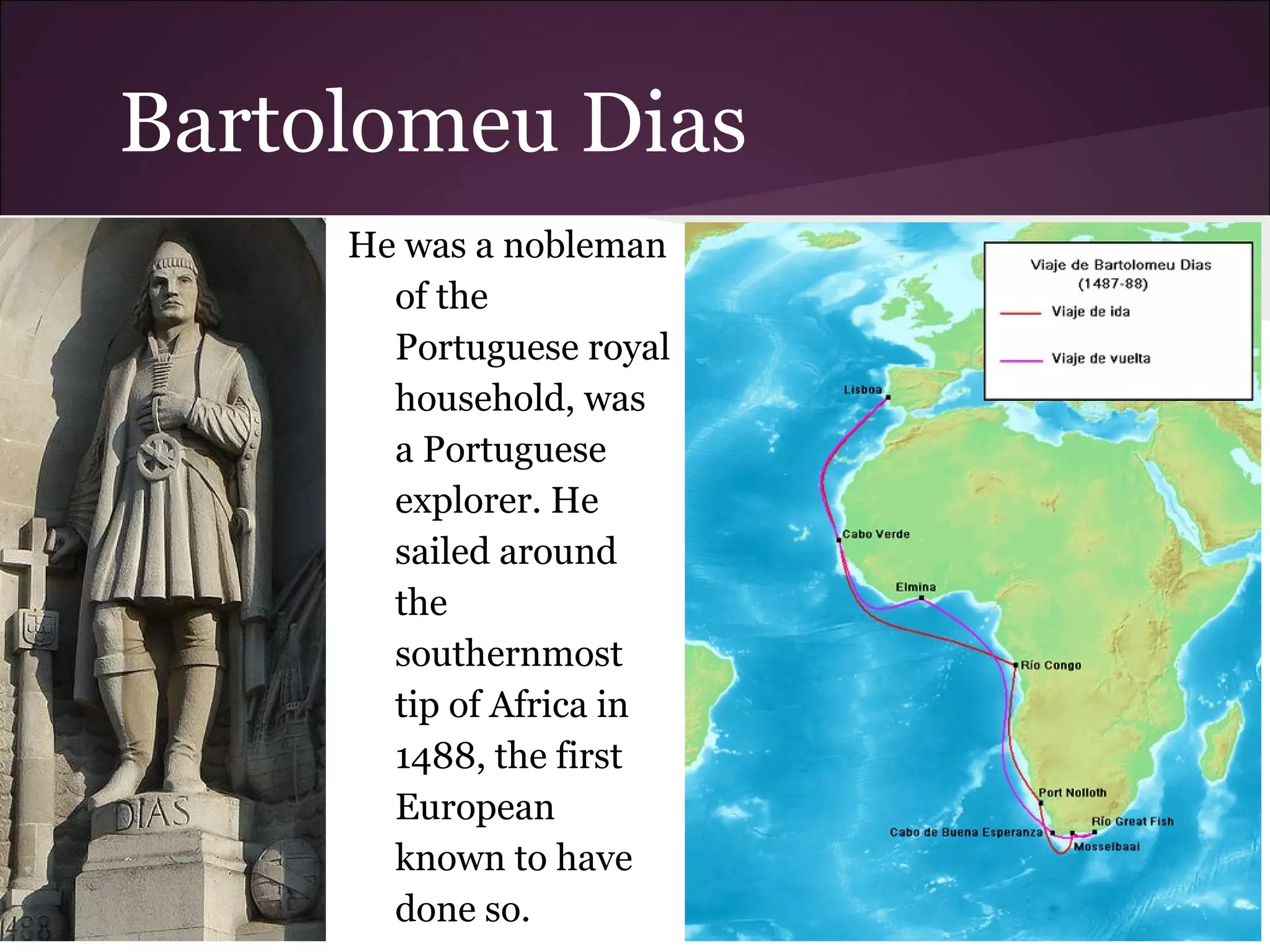
Bartolomeu Dias
He was a nobleman
of the
Portuguese royal
household, was
a Portuguese
explorer. He
sailed around
the
southernmost
tip of Africa in
1488, the first
European
known to have
done so.
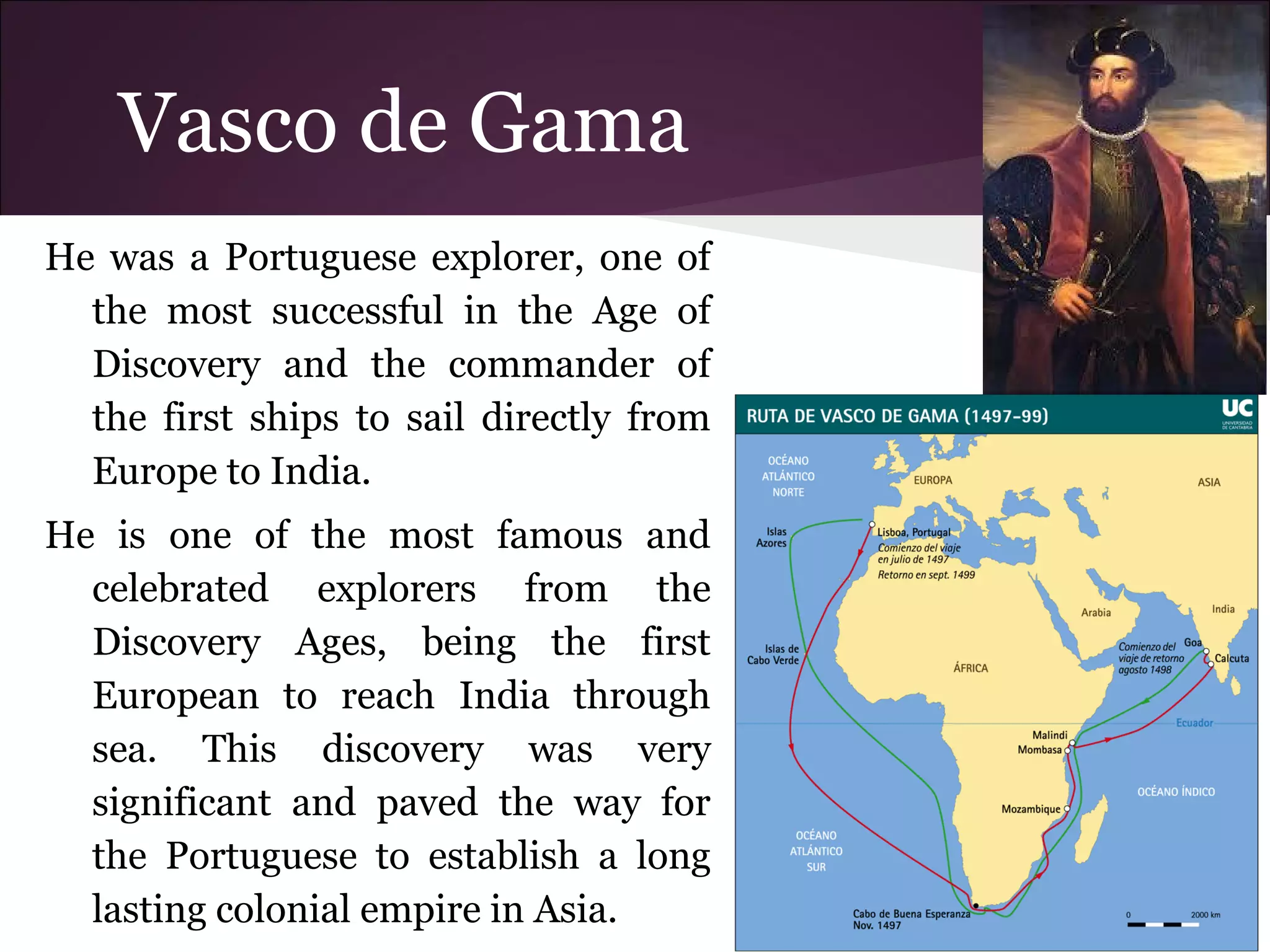
Vasco de Gama
He was a Portuguese explorer, one of
the most successful in the Age of
Discovery and the commander of
the first ships to sail directly from
Europe to India.
He is one of the most famous and
celebrated explorers from the
Discovery Ages, being the first
European to reach India through
sea. This discovery was very
significant and paved the way for
the Portuguese to establish a long
lasting colonial empire in Asia.
Spanish and Portuguese rivalry
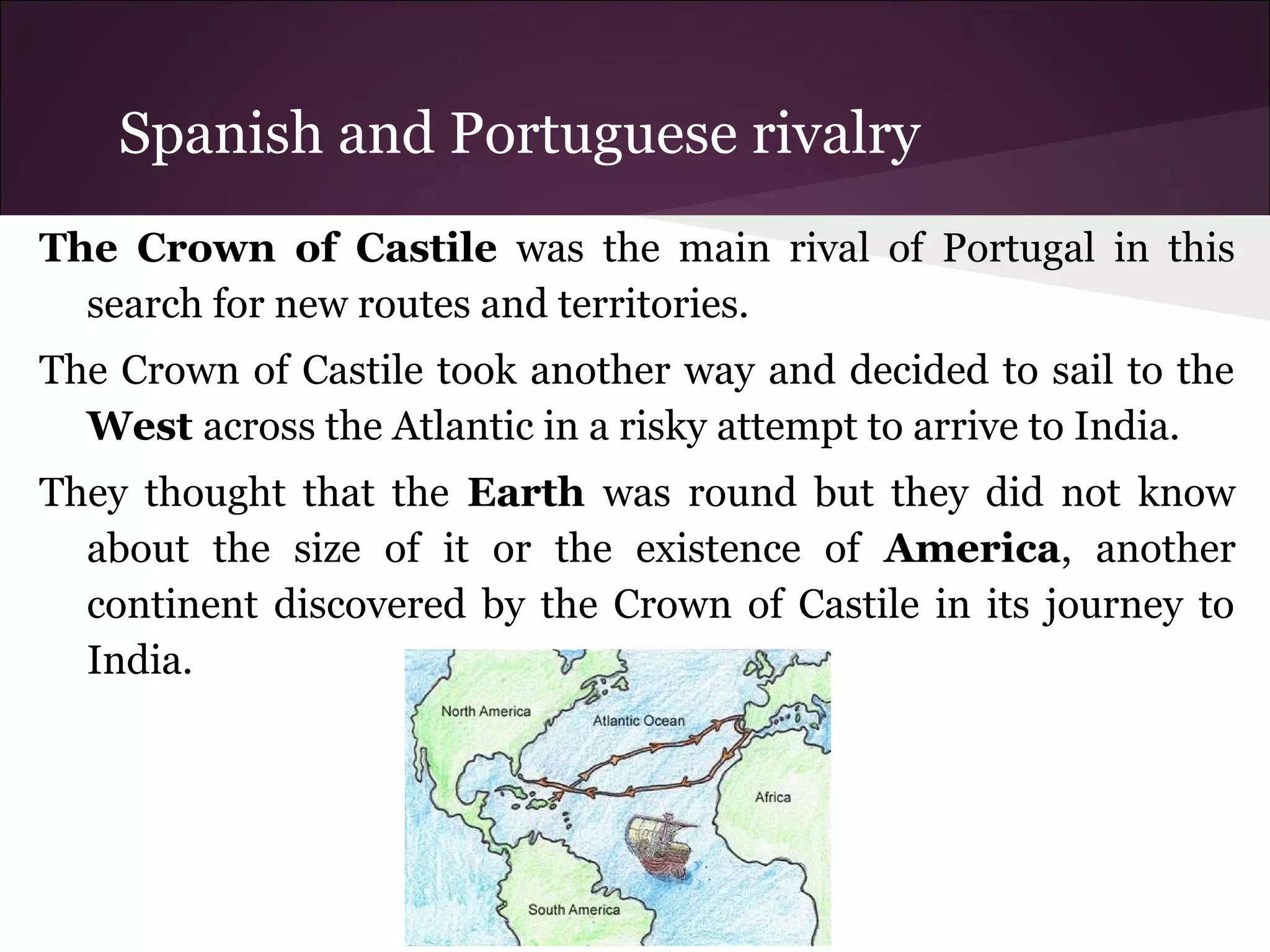
The Crown of Castile was the main rival of Portugal in this
search for new routes and territories.
The Crown of Castile took another way and decided to sail to the
West across the Atlantic in a risky attempt to arrive to India.
They thought that the Earth was round but they did not know
about the size of it or the existence of America, another
continent discovered by the Crown of Castile in its journey to
India.
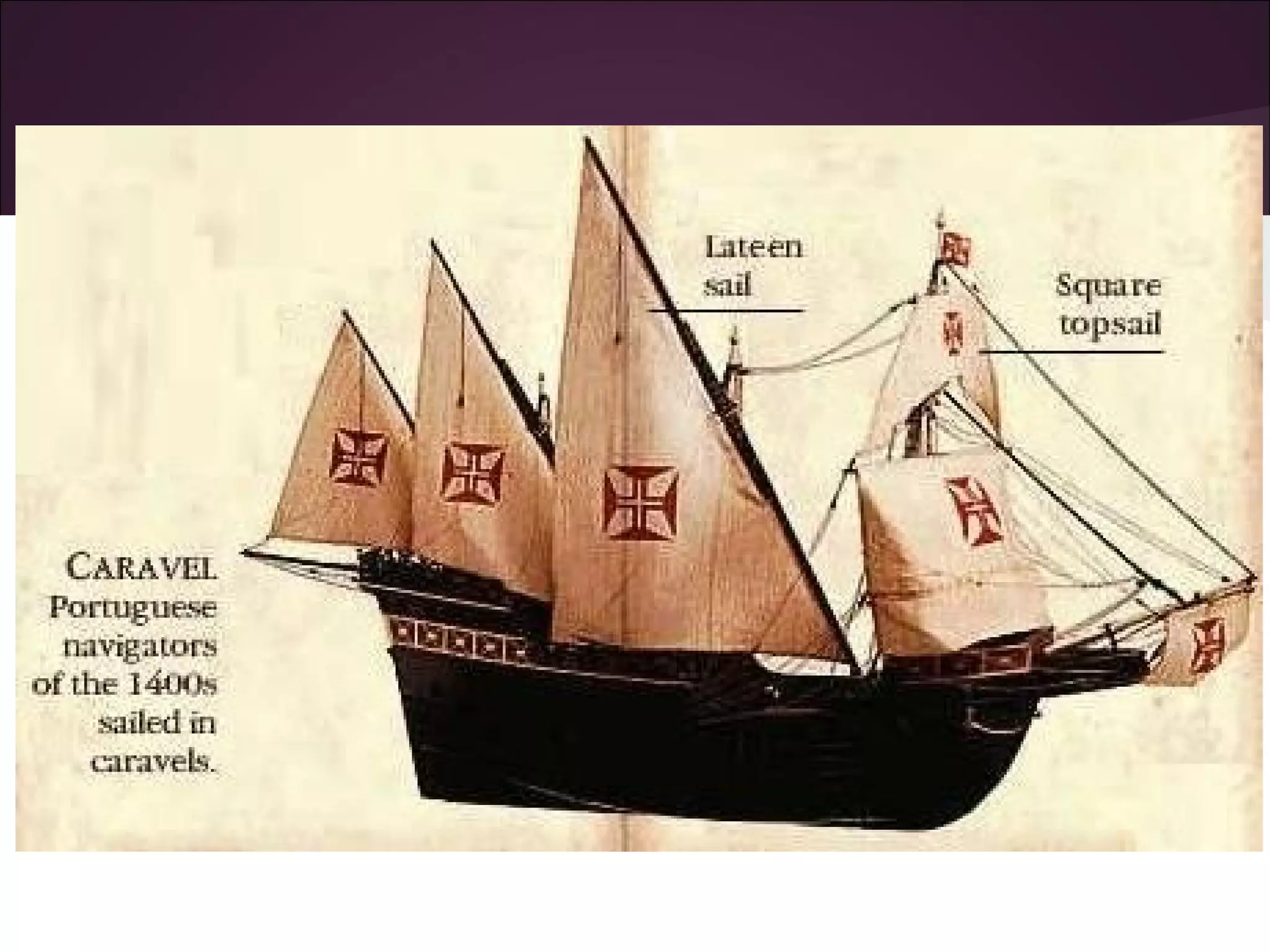
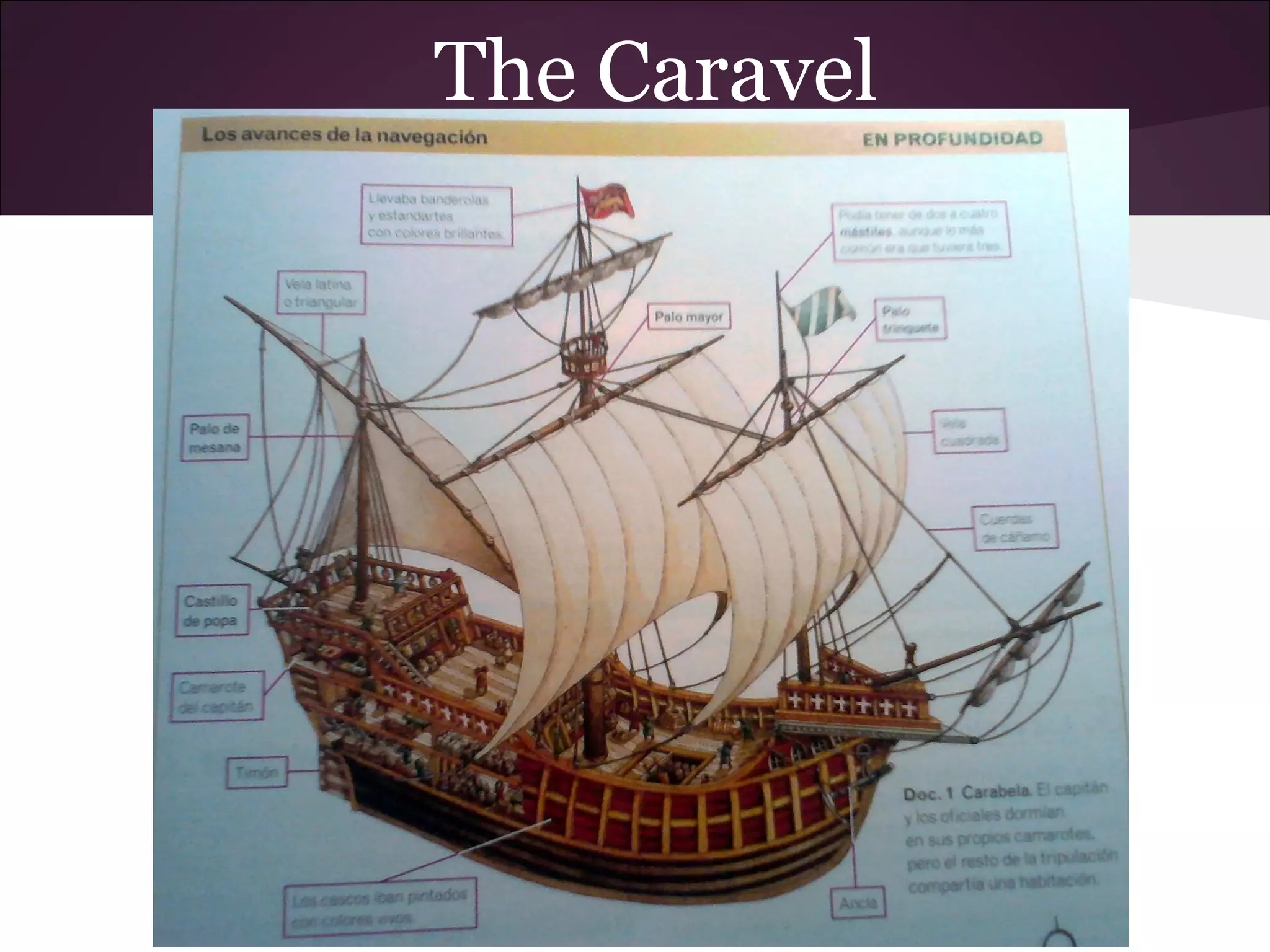
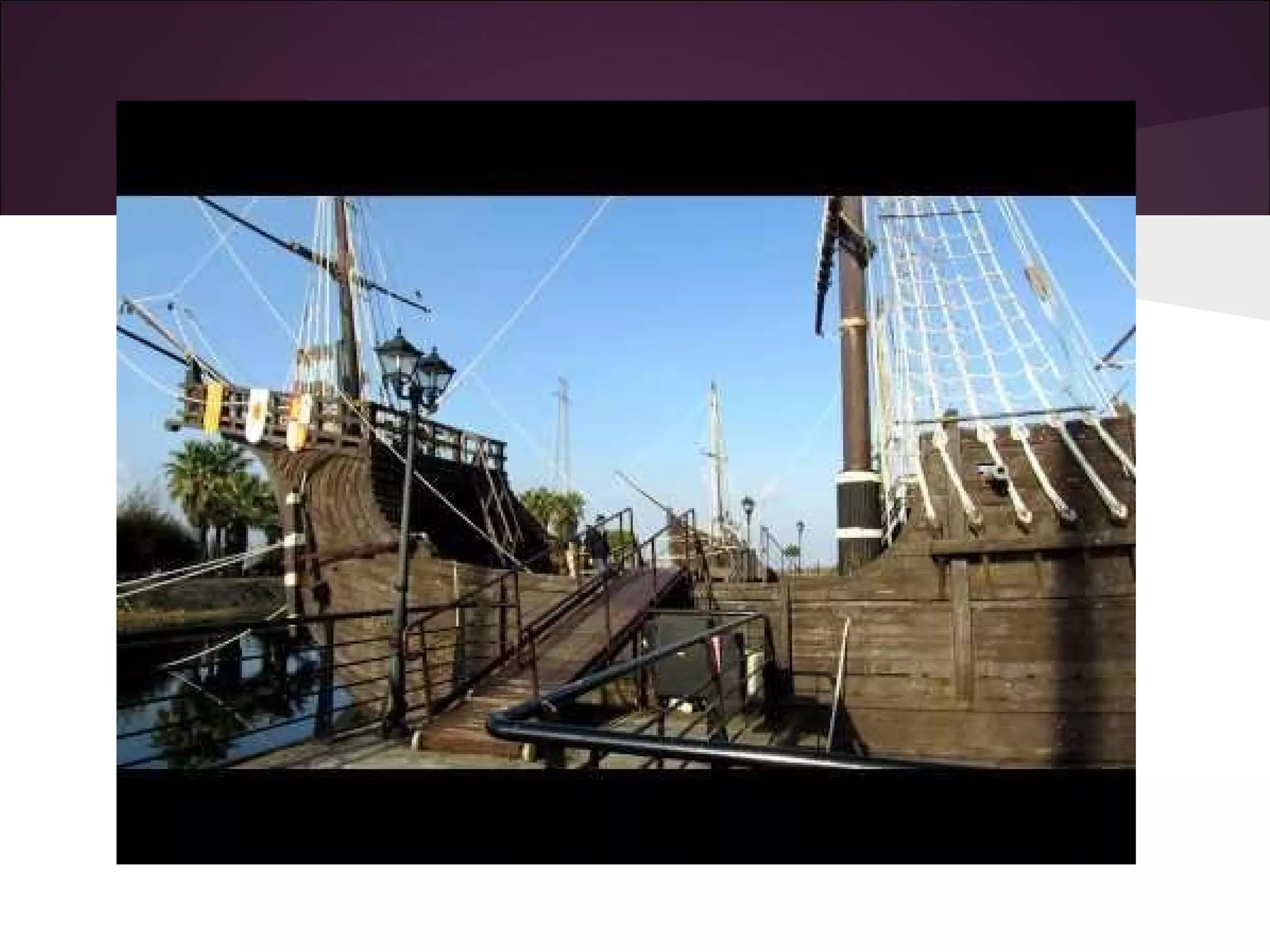
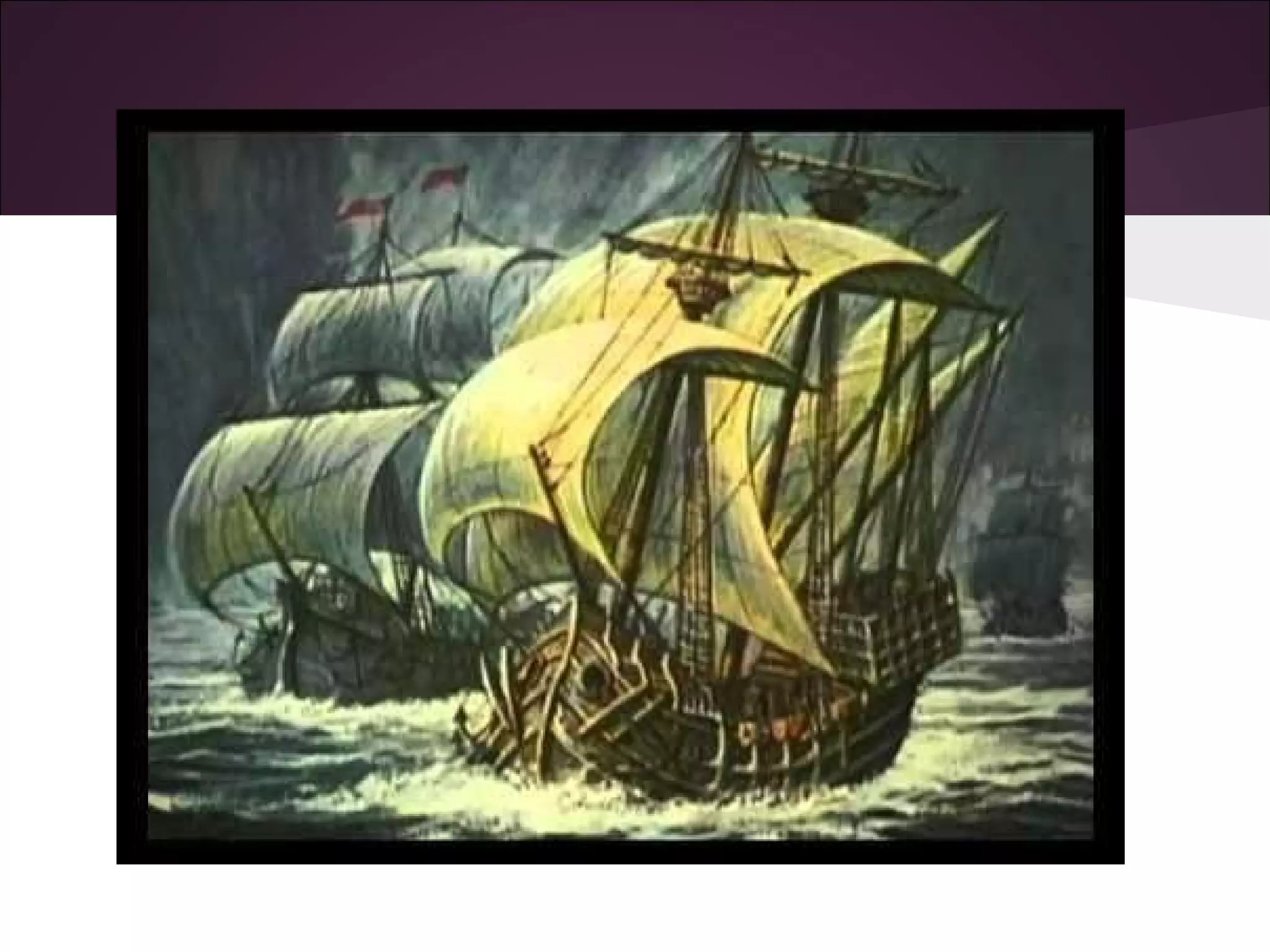
The Caravel
Activities
Exercises 1 and 2 on page 68, and exercise 1 on page 69.
3- How was America discovered?
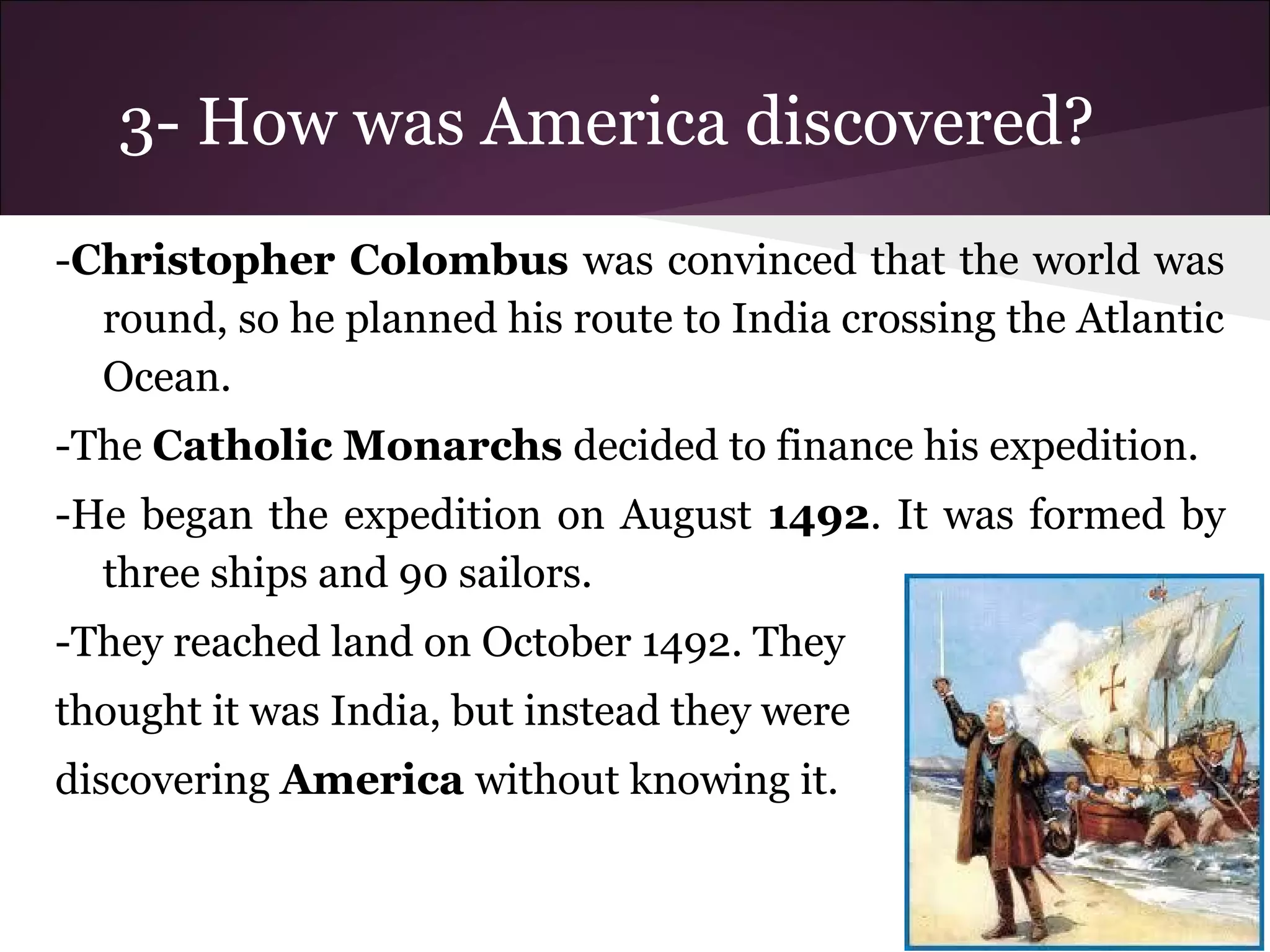
-Christopher Colombus was convinced that the world was
round, so he planned his route to India crossing the Atlantic
Ocean.
-The Catholic Monarchs decided to finance his expedition.
-He began the expedition on August 1492. It was formed by
three ships and 90 sailors.
-They reached land on October 1492. They
thought it was India, but instead they were
discovering America without knowing it.
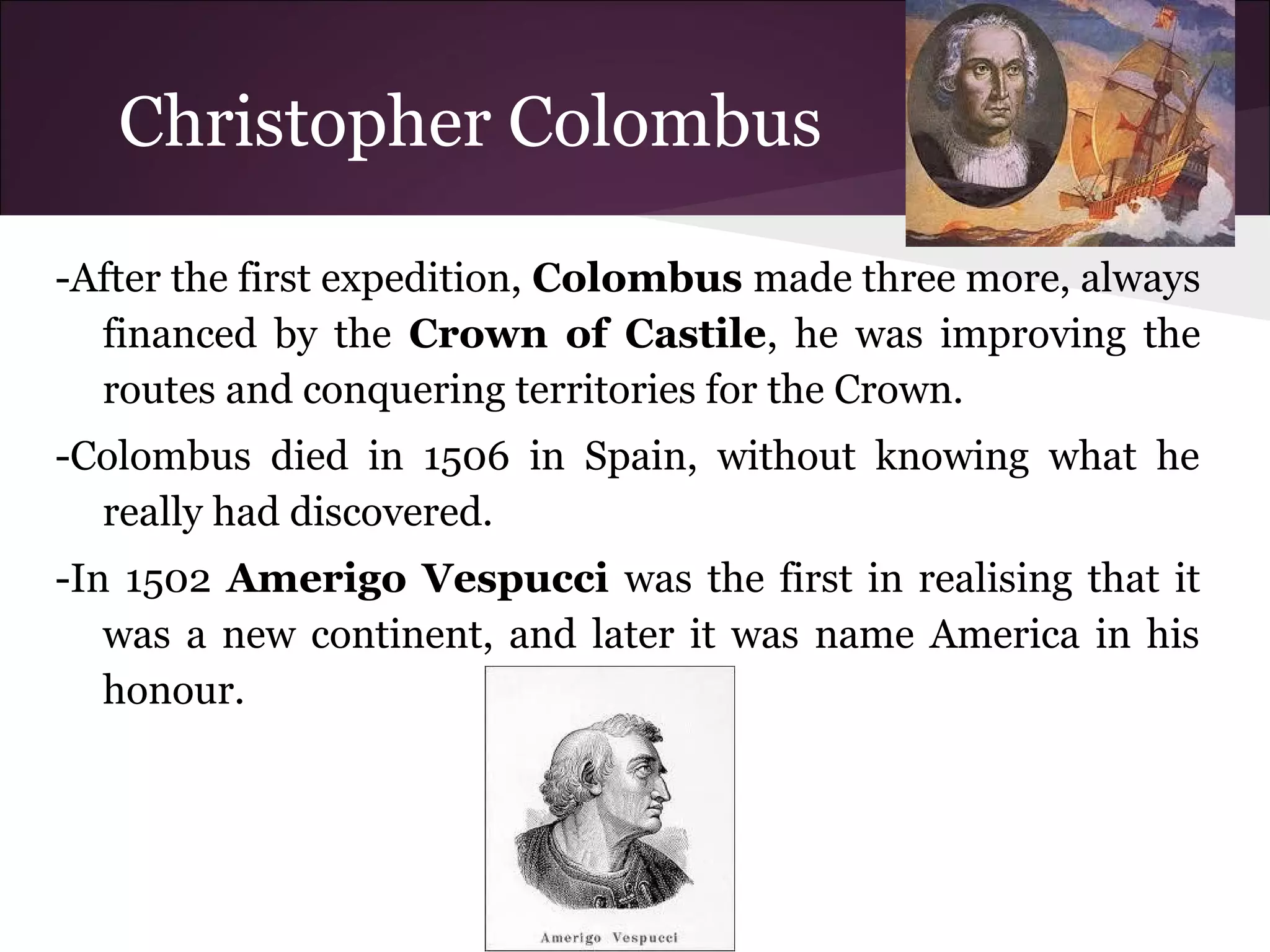
Christopher Colombus
-After the first expedition, Colombus made three more, always
financed by the Crown of Castile, he was improving the
routes and conquering territories for the Crown.
-Colombus died in 1506 in Spain, without knowing what he
really had discovered.
-In 1502 Amerigo Vespucci was the first in realising that it
was a new continent, and later it was name America in his
honour.
Activity
Exercise 1 on page 70.
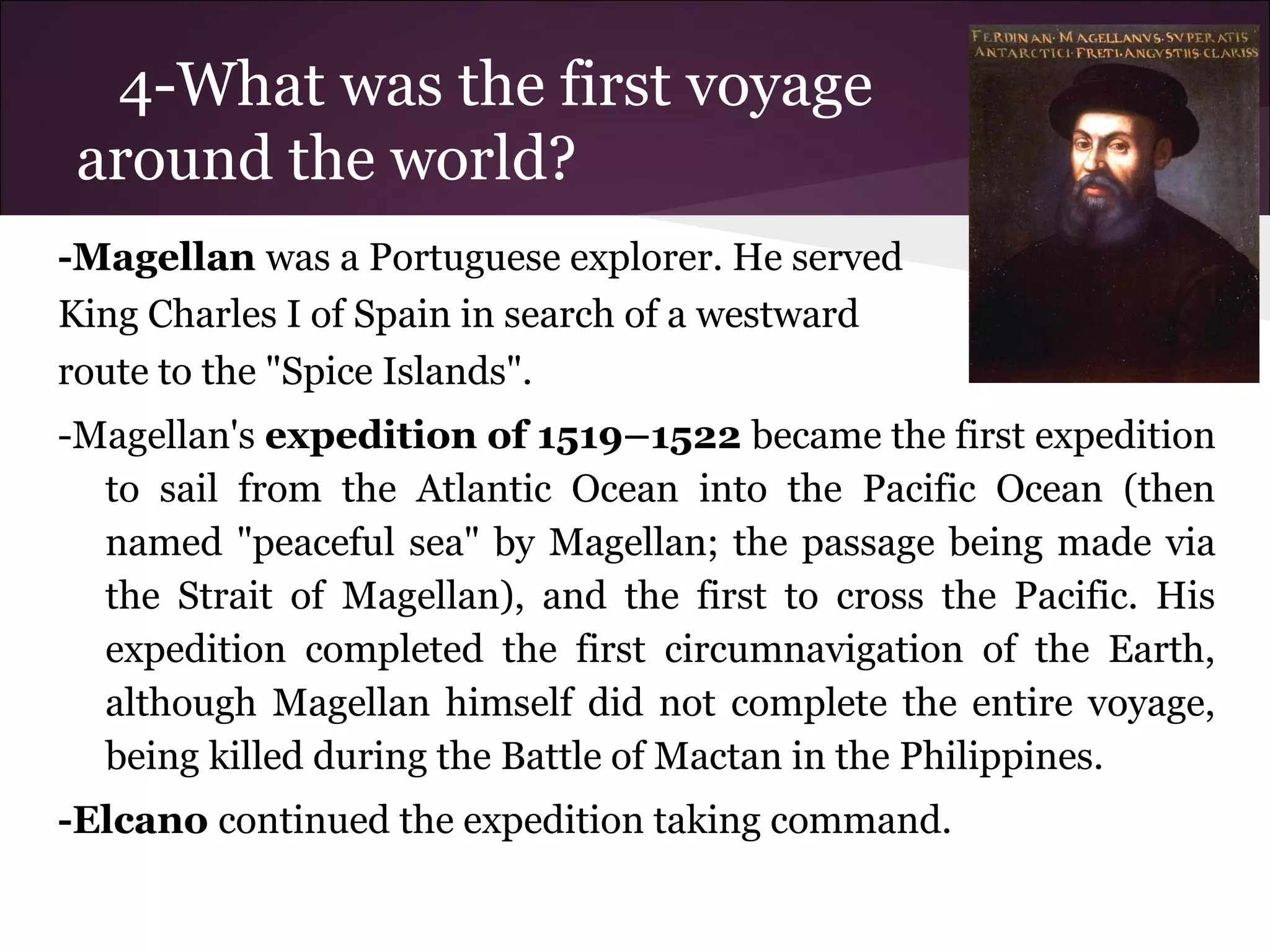
4-What was the first voyage
around the world?
-Magellan was a Portuguese explorer. He served
King Charles I of Spain in search of a westward
route to the "Spice Islands".
-Magellan's expedition of 1519–1522 became the first expedition
to sail from the Atlantic Ocean into the Pacific Ocean (then
named "peaceful sea" by Magellan; the passage being made via
the Strait of Magellan), and the first to cross the Pacific. His
expedition completed the first circumnavigation of the Earth,
although Magellan himself did not complete the entire voyage,
being killed during the Battle of Mactan in the Philippines.
-Elcano continued the expedition taking command.
Activity
Exercise 3 on page 71
5- What were the consequences of the
discoveries?
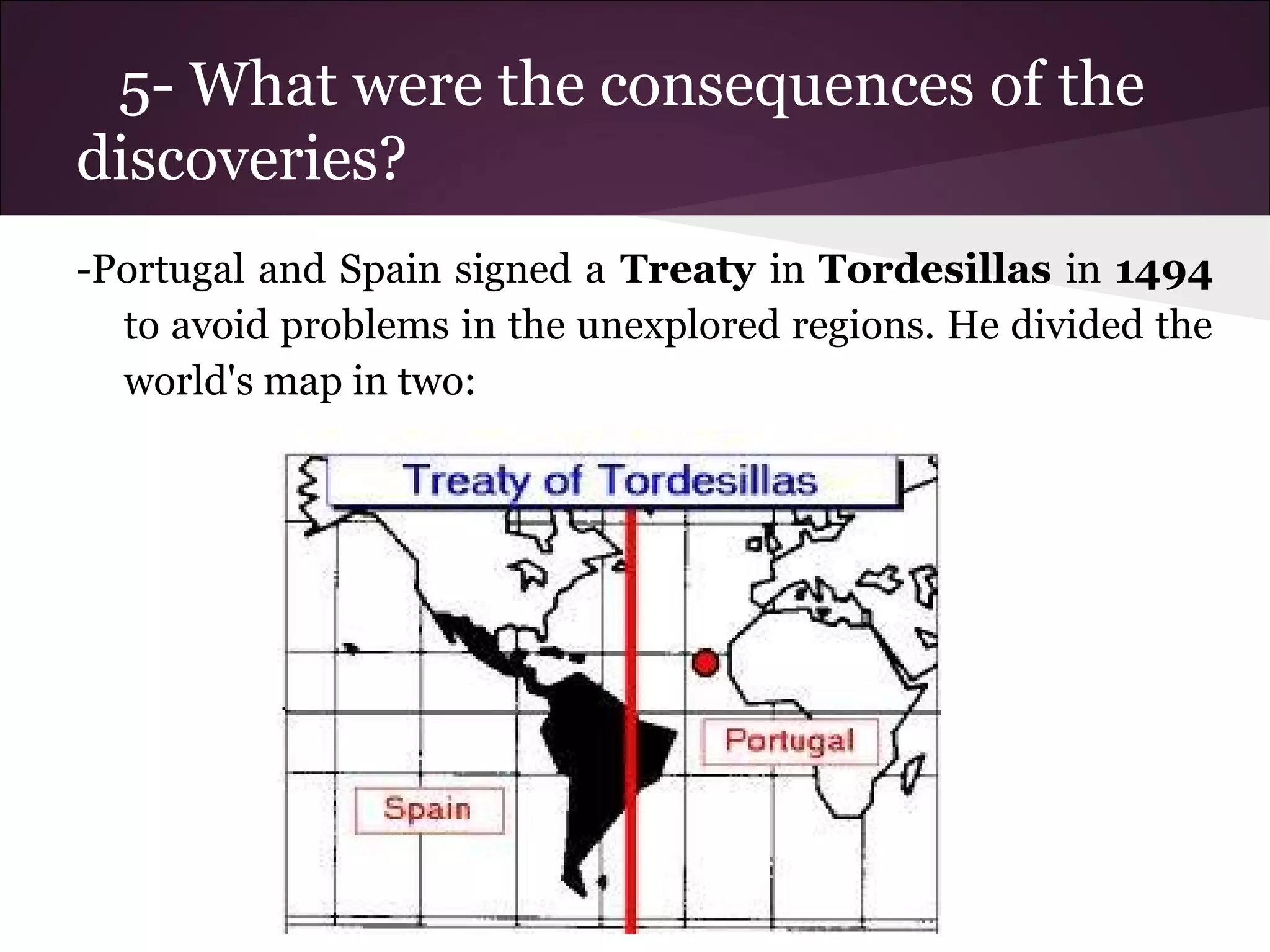
-Portugal and Spain signed a Treaty in Tordesillas in 1494
to avoid problems in the unexplored regions. He divided the
world's map in two:
Europeans supremacy
-But they were not alone in the world, and other European
countries began their expeditions as well.
-During the next five centuries there were a big rivalry
between these European countries.
-The discoveries brought progress in science (geography,
cartography and natural sciences), new plants and animals
were discovered.
-Social and knowledge exchanges were also a
consequence.
-Diseases from European people caused dramatic effect on
native people of America, that was a very bad consequence
for them.
Activities
Exercises 1 and 2 on page 72.
Work in groups
Page 73, exercise 2: Project: Pre-Columbian America.
-Make groups or 2-3 people.
-Make a Presentation or poster
completing tasks a and b.
-Remember NOT to copy and paste...
elaborate your works!

Unit 7 - The Age of Discoveries - 2º bil ESO

  • 1.
    UNIT 7 -The Age of Discovery 2º Bil
  • 2.
    1- Why werethe discoveries made? Countries known to Europe in the 15th century
  • 3.
    Marco Polo, 13thcentury Marco Polo was a Venetian merchant traveler whose travels are recorded in Il Milione (Book of the Marvels of the World), a book which did much to introduce Europeans to Central Asia and China. He learned the mercantile trade from his father and uncle. The three of them embarked in 1269 on an epic journey to Asia, returning after 24 years to find Venice at war with Genoa; Marco was imprisoned, and dictated his stories to a cellmate. He was released in 1299, became a wealthy merchant, married and had three children. He died in 1324, and was buried in San Lorenzo.
  • 6.
    Reason for thediscoveries 1- Necessity of finding new trade routes to the East.
  • 8.
    Reason for thediscoveries 2- A number of technological advances in navigation: .New maps (portulan charts) .Navigational instruments .Ship improvements
  • 9.
    Portolan charts Portolan chartsare navigational maps based on compass directions and estimated distances observed by the pilots at sea. They were first made in the 13th century in Italy, and later in Spain and Portugal. With the advent of the Age of Discovery, they were considered State secrets in Portugal and Spain. They were very valuable in the description of Atlantic and Indian coastlines. The word portolan comes from the Italian adjective portolano, meaning "related to ports or harbours."
  • 10.
    Astrolabe An astrolabe isan elaborate instrument, historically used by astronomers, navigators, and astrologers. Its many uses include locating and predicting the positions of the Sun, Moon, planets, and stars, determining local time given local latitude and vice-versa, triangulation, etc. It was used from classical antiquity to the Renaissance. There is often confusion between the astrolabe and the mariner's astrolabe. While the astrolabe could be useful for determining latitude on land, it was an awkward instrument for use on the heaving deck of a ship or in wind. The mariner's astrolabe was developed to address these issues.
  • 11.
    Quadrant A quadrant isan instrument that is used to measure angles up to 90°. It was originally proposed by Ptolemy as a better kind of astrolabe. Several different variations of the instrument were later produced by medieval Muslim astronomers.
  • 12.
    Compass A compass isa navigational instrument that measures directions in a frame of reference that is stationary relative to the surface of the earth. The frame of reference defines the four cardinal directions (or points) – north, south, east, and west. Intermediate directions are also defined. Usually, a diagram called a compass rose, which shows the directions (with their names usually abbreviated to initials), is marked on the compass. When the compass is in use, the rose is aligned with the real directions in the frame of reference, so, for example, the "N" mark on the rose really points to the north.
  • 14.
  • 15.
    2- What werethe new sea routes? PORTUGUESE EXPEDITIONS -From the early 15th century. -They tried a new route to India surrounding Africa. -Various expeditions were developed during the 15th century leaded by the Portuguese monarchs and Prince Henry the Navigator. -They discovered Madeira Islands, the Azores and all the African coast to the Cape of Good Hope, opening the sea route to India. -Bartolomeu Dias and Vasco de Gama were noted explorers at the end of the 15th century.
  • 16.
    2- What werethe new sea routes? -They established trading posts along the African coast and the new route to facilitate later journeys. -Portugal created a great empire becoming a world power.
  • 17.
    Henry the Navigator Hewas an important figure in the early days of the Portuguese Empire and the Age of Discoveries. He was responsible for the development of European exploration and maritime trade with other continents. Henry was the third child of King John I of Portugal. He encouraged his father to conquer Ceuta (1415), the Muslim port on the North African coast across the Straits of Gibraltar. He learnt of the opportunities from the Saharan trade routes that terminated there, and became fascinated with Africa in general. In "Crónica da Guiné" Henry is described as having no luxuries, not avaricious, speaking with soft words and calm gestures, a man of many virtues who never allowed any poor person to leave his presence empty-handed.
  • 19.
    Bartolomeu Dias He wasa nobleman of the Portuguese royal household, was a Portuguese explorer. He sailed around the southernmost tip of Africa in 1488, the first European known to have done so.
  • 21.
    Vasco de Gama Hewas a Portuguese explorer, one of the most successful in the Age of Discovery and the commander of the first ships to sail directly from Europe to India. He is one of the most famous and celebrated explorers from the Discovery Ages, being the first European to reach India through sea. This discovery was very significant and paved the way for the Portuguese to establish a long lasting colonial empire in Asia.
  • 23.
    Spanish and Portugueserivalry The Crown of Castile was the main rival of Portugal in this search for new routes and territories. The Crown of Castile took another way and decided to sail to the West across the Atlantic in a risky attempt to arrive to India. They thought that the Earth was round but they did not know about the size of it or the existence of America, another continent discovered by the Crown of Castile in its journey to India.
  • 25.
  • 27.
    Activities Exercises 1 and2 on page 68, and exercise 1 on page 69.
  • 28.
    3- How wasAmerica discovered? -Christopher Colombus was convinced that the world was round, so he planned his route to India crossing the Atlantic Ocean. -The Catholic Monarchs decided to finance his expedition. -He began the expedition on August 1492. It was formed by three ships and 90 sailors. -They reached land on October 1492. They thought it was India, but instead they were discovering America without knowing it.
  • 29.
    Christopher Colombus -After thefirst expedition, Colombus made three more, always financed by the Crown of Castile, he was improving the routes and conquering territories for the Crown. -Colombus died in 1506 in Spain, without knowing what he really had discovered. -In 1502 Amerigo Vespucci was the first in realising that it was a new continent, and later it was name America in his honour.
  • 32.
  • 33.
    4-What was thefirst voyage around the world? -Magellan was a Portuguese explorer. He served King Charles I of Spain in search of a westward route to the "Spice Islands". -Magellan's expedition of 1519–1522 became the first expedition to sail from the Atlantic Ocean into the Pacific Ocean (then named "peaceful sea" by Magellan; the passage being made via the Strait of Magellan), and the first to cross the Pacific. His expedition completed the first circumnavigation of the Earth, although Magellan himself did not complete the entire voyage, being killed during the Battle of Mactan in the Philippines. -Elcano continued the expedition taking command.
  • 35.
  • 36.
    5- What werethe consequences of the discoveries? -Portugal and Spain signed a Treaty in Tordesillas in 1494 to avoid problems in the unexplored regions. He divided the world's map in two:
  • 37.
    Europeans supremacy -But theywere not alone in the world, and other European countries began their expeditions as well. -During the next five centuries there were a big rivalry between these European countries. -The discoveries brought progress in science (geography, cartography and natural sciences), new plants and animals were discovered. -Social and knowledge exchanges were also a consequence. -Diseases from European people caused dramatic effect on native people of America, that was a very bad consequence for them.
  • 38.
  • 39.
    Work in groups Page73, exercise 2: Project: Pre-Columbian America. -Make groups or 2-3 people. -Make a Presentation or poster completing tasks a and b. -Remember NOT to copy and paste... elaborate your works!