MADE BY
ROSHALMARIA THOMAS
IV/II
 PULP CAVITY
 The pulp cavity is
the central cavity
within a tooth
and is entirely
enclosed by
dentin except at
apical foramen.
 It is divided into:
1. Coronal portion
pulp chamber
2. Radicular
 PULP CHAMBER
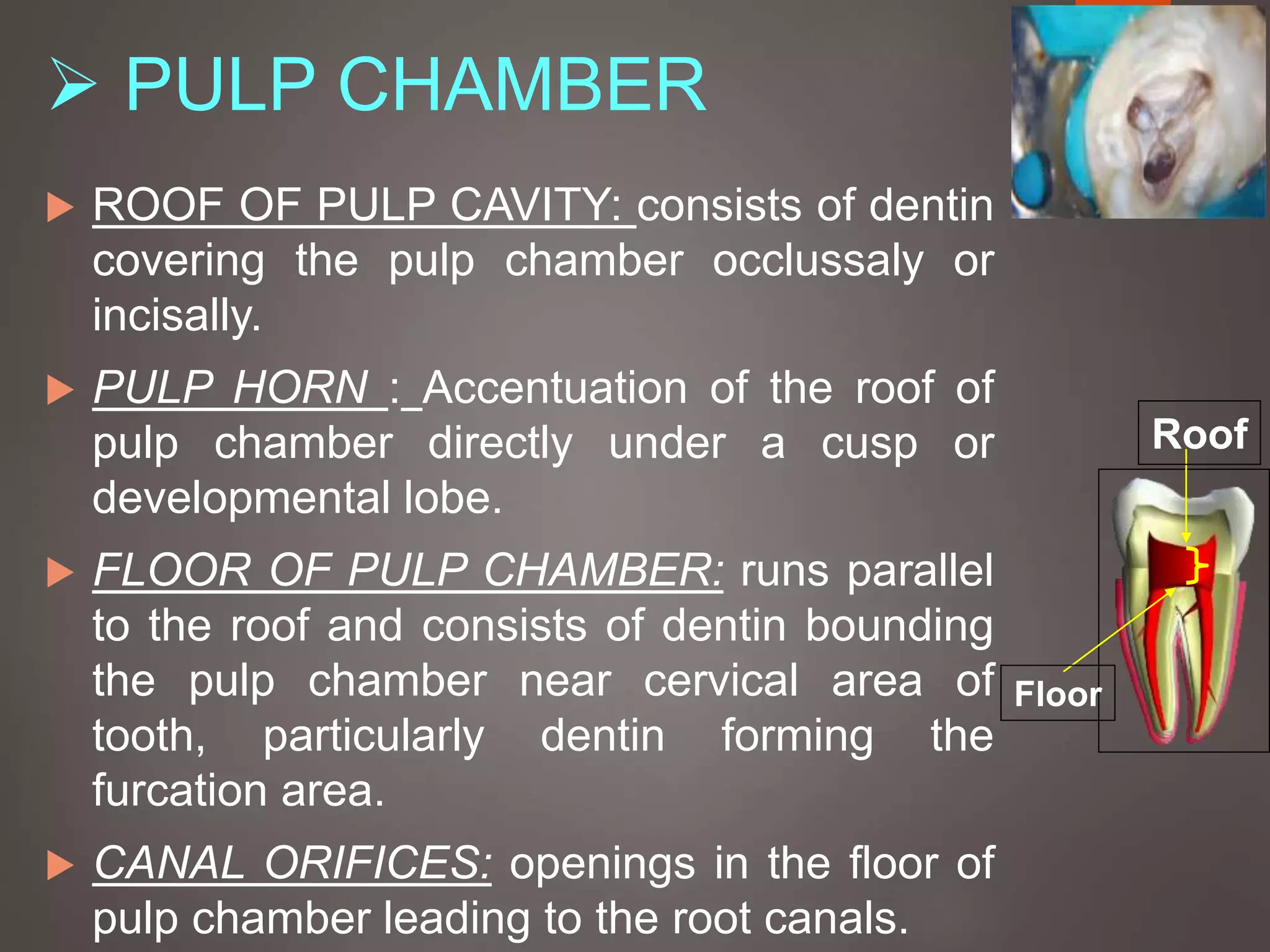
 ROOF OF PULP CAVITY: consists of dentin
covering the pulp chamber occlussaly or
incisally.
 PULP HORN : Accentuation of the roof of
pulp chamber directly under a cusp or
developmental lobe.
 FLOOR OF PULP CHAMBER: runs parallel
to the roof and consists of dentin bounding
the pulp chamber near cervical area of
tooth, particularly dentin forming the
furcation area.
 CANAL ORIFICES: openings in the floor of
pulp chamber leading to the root canals.
Floor
Roof
 ROOT CANALS
 Portion of the
pulp cavity from
the canal orifice
to the apical
foramen
 Divided into 3
section( for
convenience)
1. Coronal third
2. Middle third
3. Apical third
 The root canal
curvature
 Straight canal
extending with
minimal apical
curvature
 Gradual curvature of
canal with straight
apical ending
 Gradual curvature of
entire canal
 Sharp curvature of
canal near the apex
 Success of negotiating narrow curved canal
depends on
 Degree of curvature
 Size and constriction of root canal
 Size and flexibility of endodontic instrument blade
 Skill of operator
 Classification based on canal cross-section
 Round/circular
 Oval
 Long oval
 Flattened(flat/ribbon)
 Irregular
 Vertucci’s Classification
 Weine’s Classification
 ISTHMUS
 A narrow passage or anatomic part connecting
two larger structures (root canals)
 APICAL FORAMEN
 In young incompletely developed teeth the apical
foramen is funnel shaped with wider portion extending
outward
 As root develops the apical foramen becomes narrower
 Apical foramen is not the most constricted part of root
apexapical foramen is not always located at the centre
of the root apex
 LATERAL CANALS AND
ACCESSARY FORAMINA
 Lateral canals frequently occur in apical third of root
 May occur in areas of bifurcation and trifurcation of
multirooted teeth
 With increasing age, number of accessory foramina
reduce due to calcification of contained soft tissue
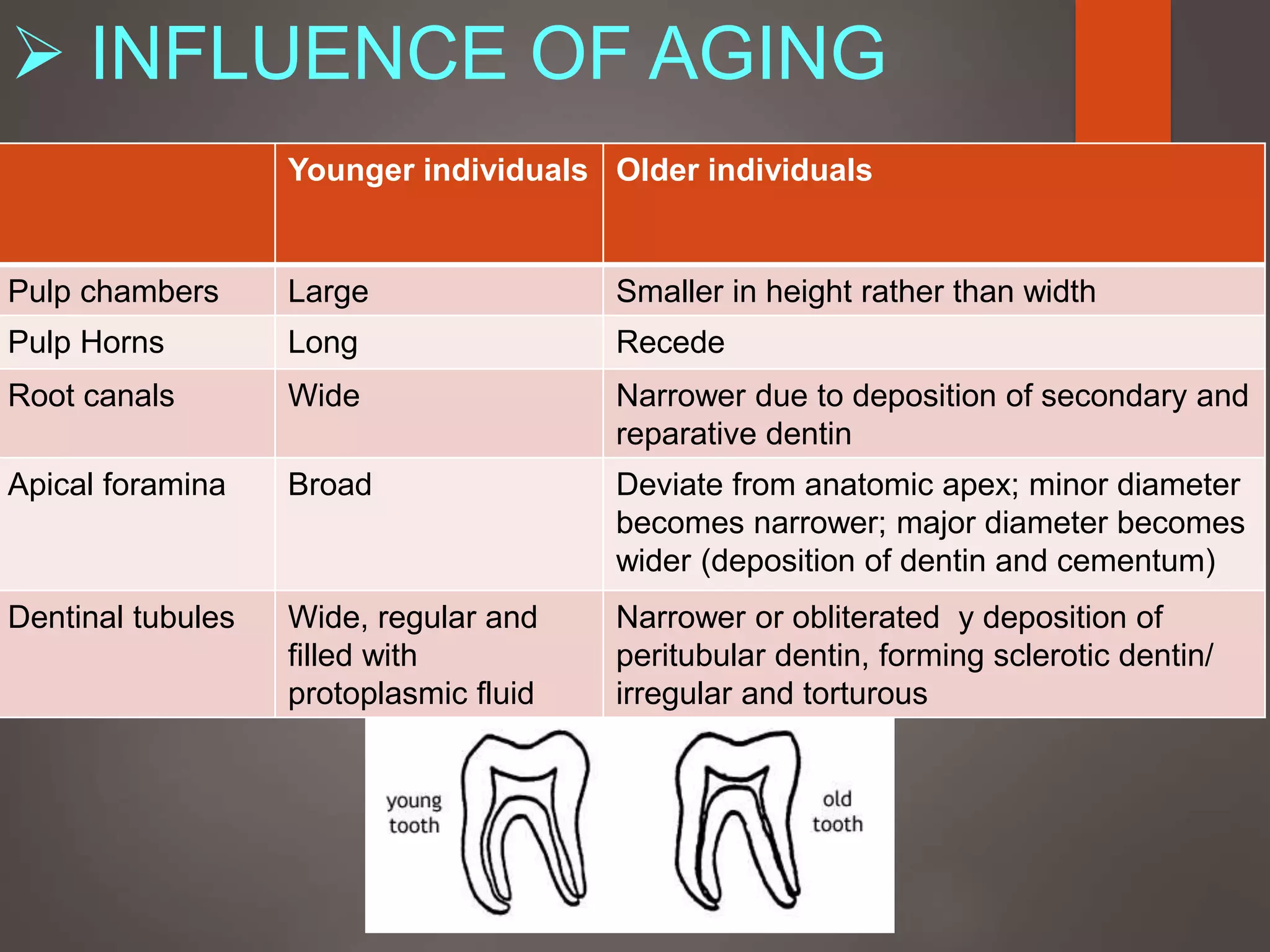
 INFLUENCE OF AGING
Younger individuals Older individuals
Pulp chambers Large Smaller in height rather than width
Pulp Horns Long Recede
Root canals Wide Narrower due to deposition of secondary and
reparative dentin
Apical foramina Broad Deviate from anatomic apex; minor diameter
becomes narrower; major diameter becomes
wider (deposition of dentin and cementum)
Dentinal tubules Wide, regular and
filled with
protoplasmic fluid
Narrower or obliterated y deposition of
peritubular dentin, forming sclerotic dentin/
irregular and torturous
METHODS OF DETERMINING PULP
ANATOMY
1. CLINICAL METHODS
I. Anatomy studies
II. Radiographs
III. Explorations
IV. High resolution compound tomography
V. Visualisation endogram
VI. Fiberoptic endoscope
VII. Magnetic resonance imaging
Anatomic Studies
Radigraphs
Exploration
Micro CT
2. IN VITRO METHODS
i. sectioning of teeth
ii. use of dyes
iii. Contrasting media
iv. Scanning electron microscope analysis
 VARIATIONS IN
INTERNAL ANATOMY
 Variations in development
i. Gemination
ii. Fusion
iii. Concrescence
iv. Taurodontism
v. Talon’s cusp
vi. Dilaceration
vii. Extra root canal
viii. Dens invaginatus
ix. Dens evaginatus
20Maxillary Central Incisor
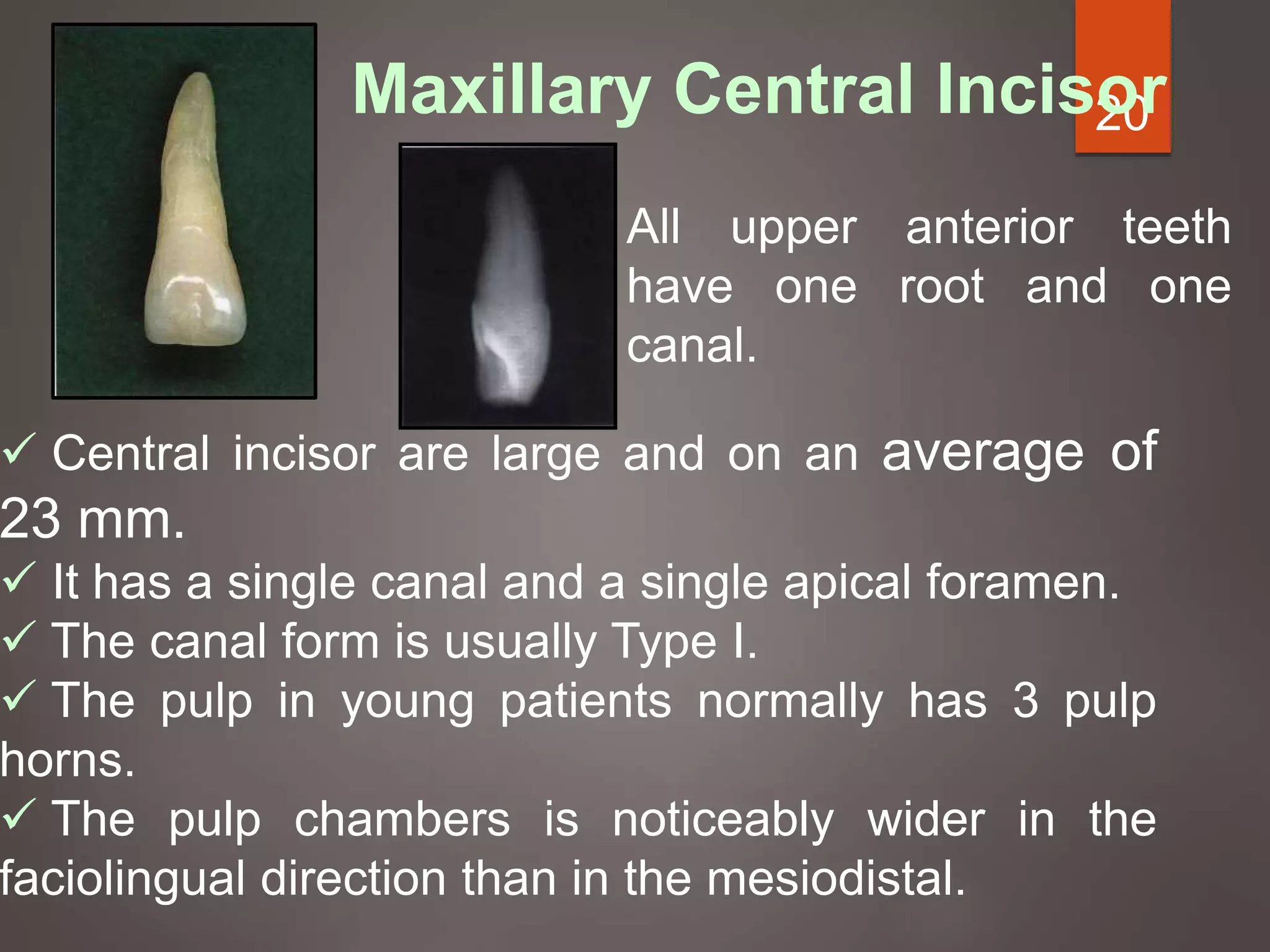
 Central incisor are large and on an average of
23 mm.
 It has a single canal and a single apical foramen.
 The canal form is usually Type I.
 The pulp in young patients normally has 3 pulp
horns.
 The pulp chambers is noticeably wider in the
faciolingual direction than in the mesiodistal.
All upper anterior teeth
have one root and one
canal.
21
Maxillary Lateral Incisor
It is shorter than central incisor.
Average length of 21- 22 mm.
It has a single canal and a single apical
foramen.
The canal form is usually Type I.
In young patients have two only pulp horn and is
wider in labiopalatal dimension.
The canal is tapered and the apex is often
curved generally in distal direction.
22
Maxillary Canine
It is the longest tooth (26.5 mm)
Seldom has more than one canal
The pulp chamber is quite narrow M- D,
and there is one pulp horn pointed to the
incisal angle.
The pulp space is much wider labiopalatally
and the pulp space follows this outline.
Oval Type I root canal.
The root apex is often tapered and very
thin.
The canal is usually straight but may show
a distal apical curvature.
23
Mandibular Central and Lateral Incisors
CENTRAL
LATERAL
Average length is 21 mm, but the
central incisor may be shorter than the
lateral.
The root canal morphology may be
place into 1 or 3 configurations. Type I
canal form is most prevalent, Types II
and III are less prevalent.
The pulp chamber is smaller replica
of the upper incisors.
When the tooth has a single root canal
it is normally straight but may curve to
the distal.
24
Mandibular Canine
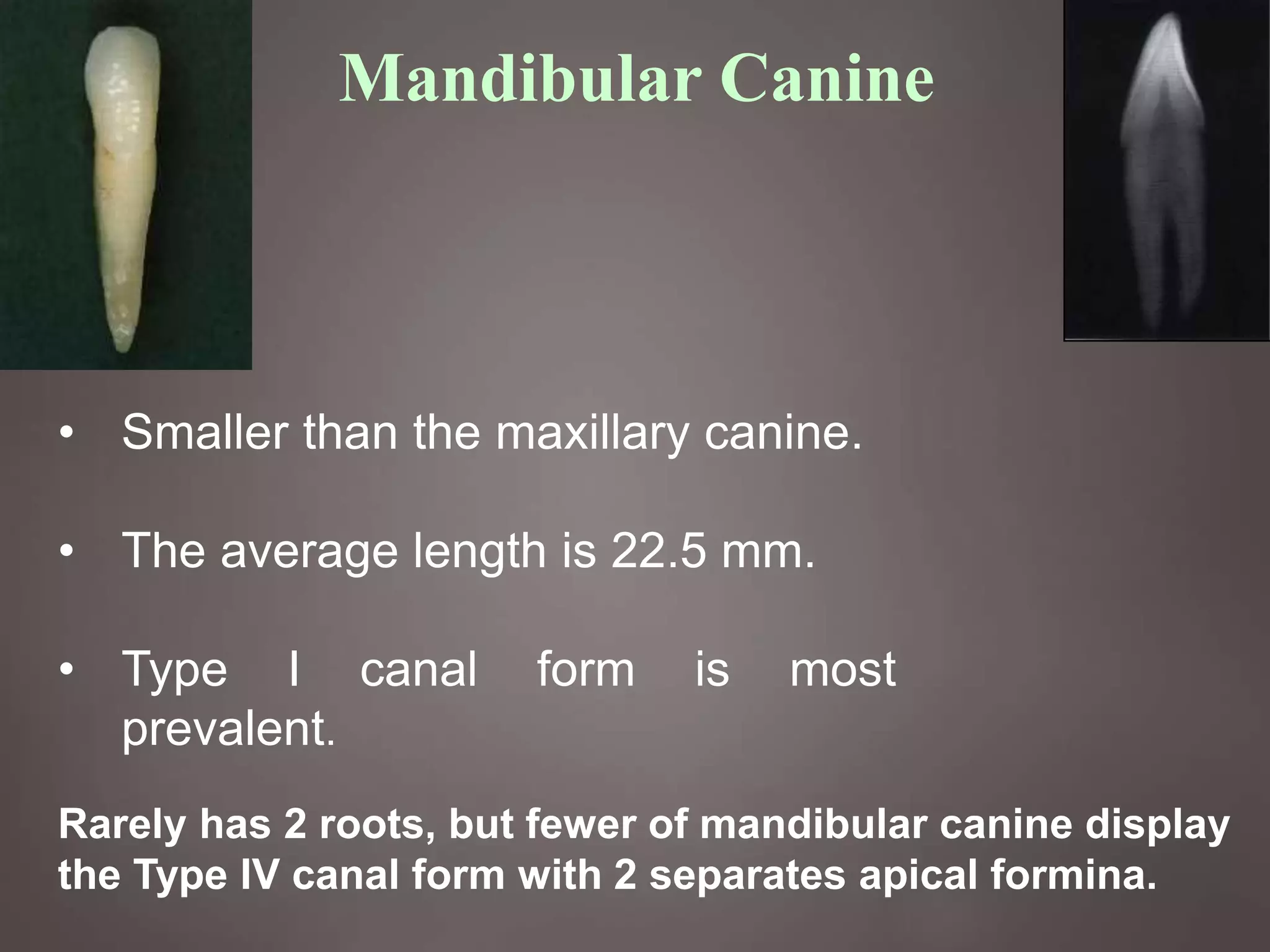
• Smaller than the maxillary canine.
• The average length is 22.5 mm.
• Type I canal form is most
prevalent.
Rarely has 2 roots, but fewer of mandibular canine display
the Type IV canal form with 2 separates apical formina.
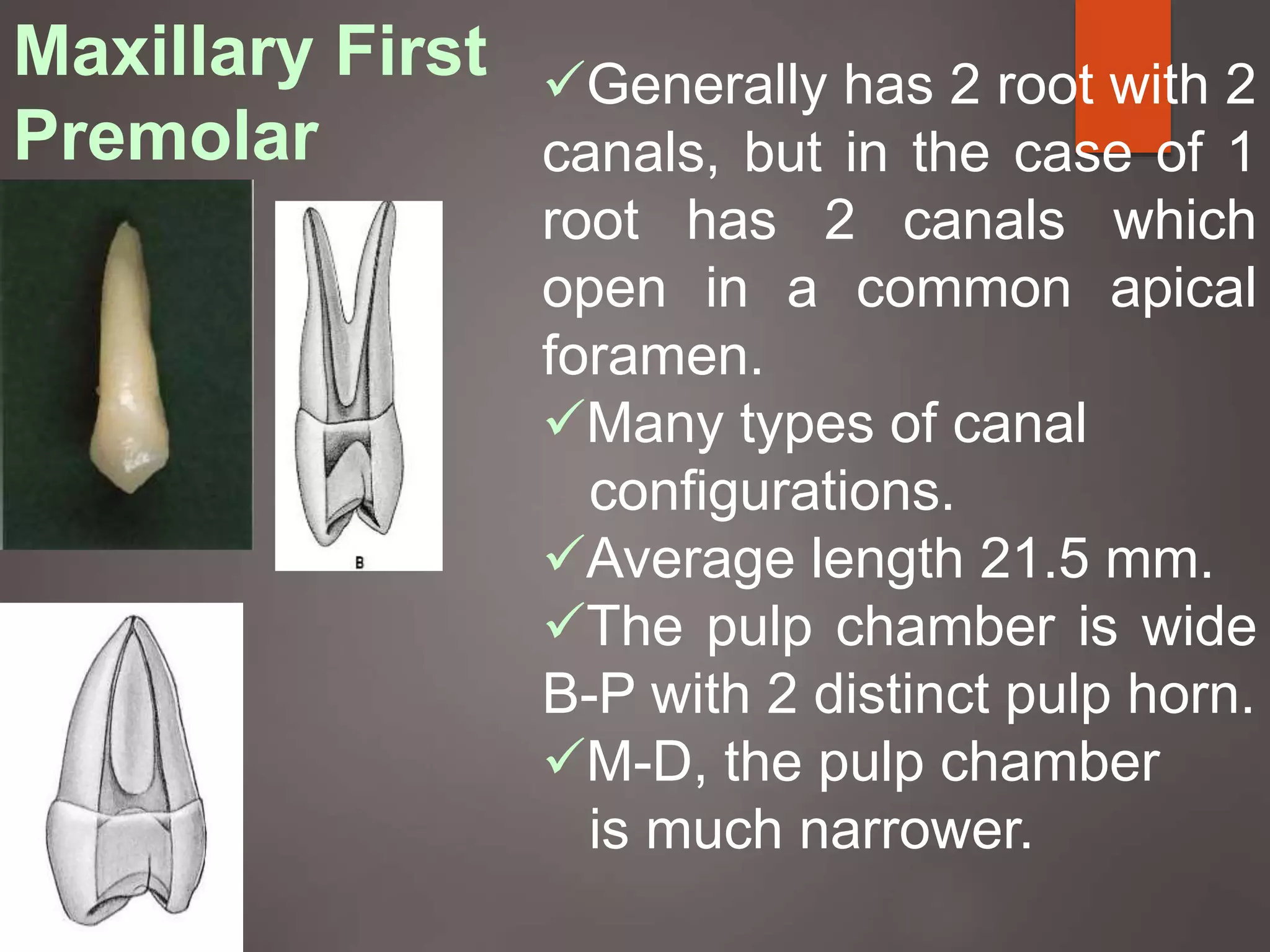
Maxillary First
Premolar
Generally has 2 root with 2
canals, but in the case of 1
root has 2 canals which
open in a common apical
foramen.
Many types of canal
configurations.
Average length 21.5 mm.
The pulp chamber is wide
B-P with 2 distinct pulp horn.
M-D, the pulp chamber
is much narrower.
Maxillary Second Premolar
 The typical second premolar has one
root and one canal and sometimes
has an apical distal curvature.
 The Type I canal form is prevalent with
a frequency of 48%, approximately the same
as types II and IV-VII combined.
 The pulp chamber is wider B-P and narrower M-
D and has 2 well define pulp horns.
 The canal orifice is directly in the centre of the
tooth.
 Average length: 21 mm.
Mandibular Premolars
Usually has a single delicate root
with a mesial concavity, but
occasionally present a division of
the root in the apical half.
As a rule, both teeth have a single canal.
The coronal pulp is wide B-L with a large buccal horn
and a small lingual horn.
The shape of the canal is similar in first and second
premolars.
Its buccolingual extension is broad until the
middle third of the canal, but is very narrow in
the apical third.
Average Length: 22mm
Maxillary First Molars
 Generally three rooted with 3 canals. Additional canal is
located in the MB root.
 Large pulp chamber, triangular in shape, with the
base toward the buccal and the apex toward the lingual
surface.
 Slightly curved buccal roots.
 DP curvature of the MB root.
 Apical-buccal curvature of the
palatal root (55%)
 Average Length:
MB: 20mm
DB: 19.5mm
P: 20.5mm
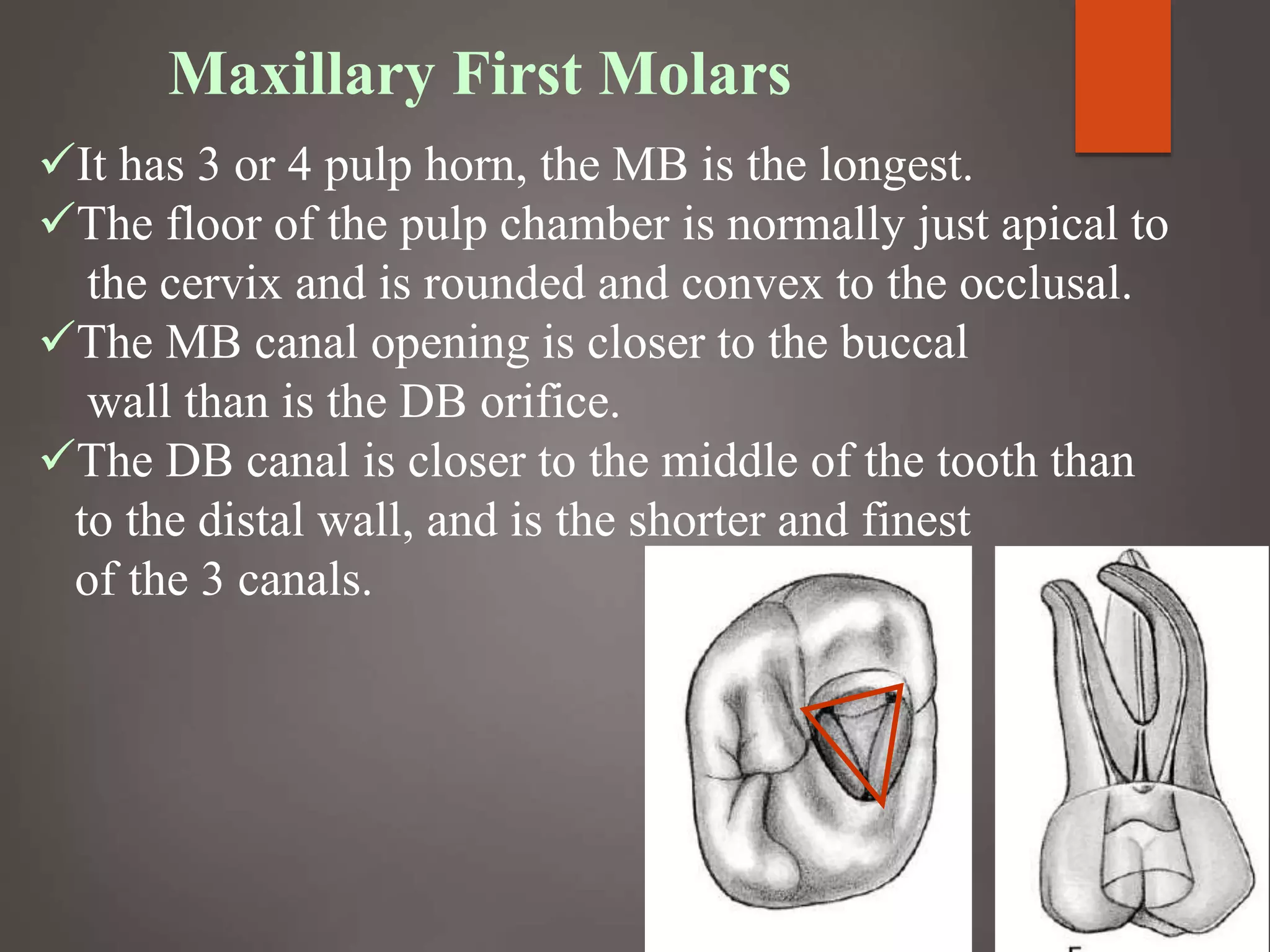
It has 3 or 4 pulp horn, the MB is the longest.
The floor of the pulp chamber is normally just apical to
the cervix and is rounded and convex to the occlusal.
The MB canal opening is closer to the buccal
wall than is the DB orifice.
The DB canal is closer to the middle of the tooth than
to the distal wall, and is the shorter and finest
of the 3 canals.
Maxillary First Molars
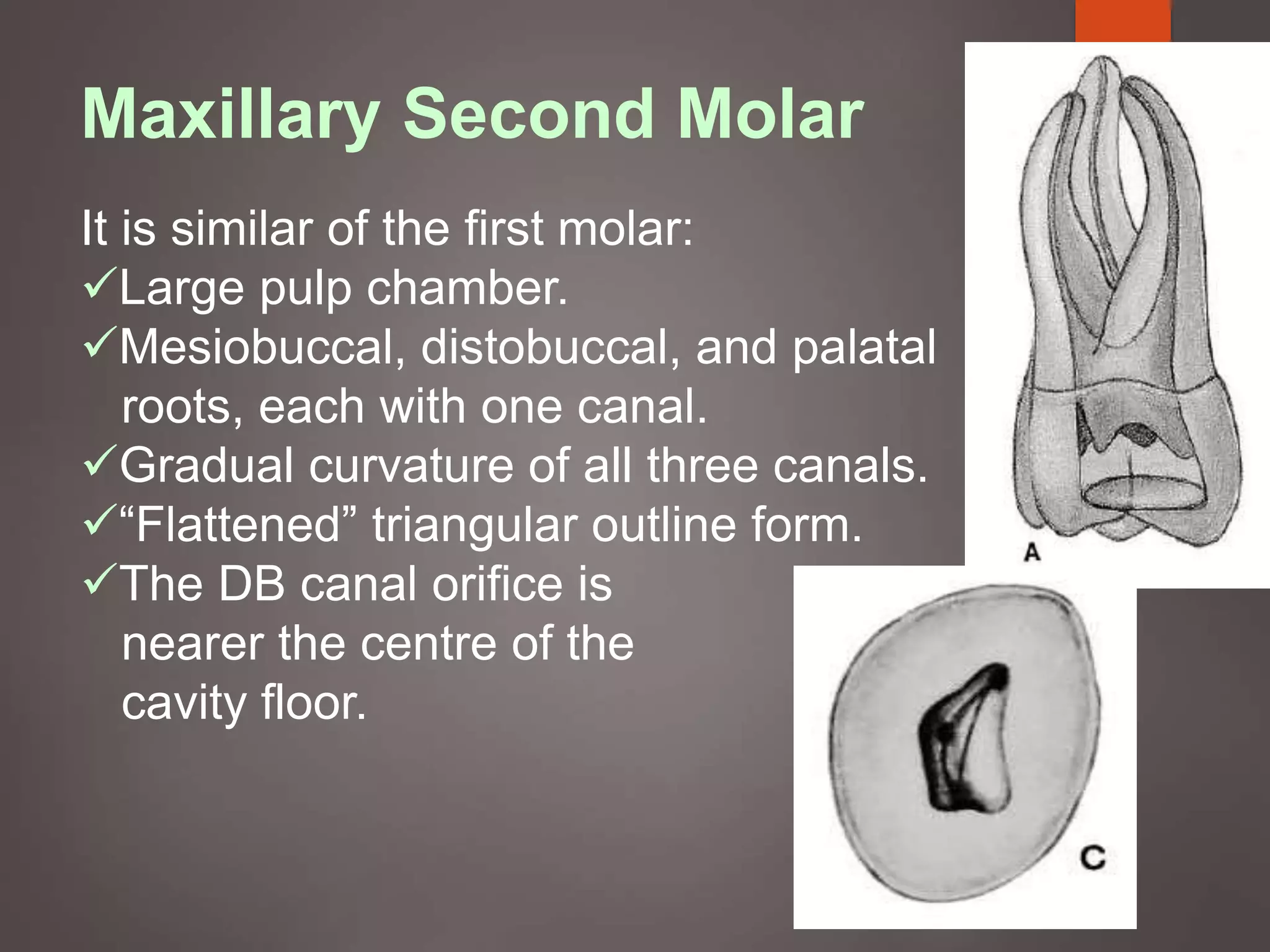
Maxillary Second Molar
It is similar of the first molar:
Large pulp chamber.
Mesiobuccal, distobuccal, and palatal
roots, each with one canal.
Gradual curvature of all three canals.
“Flattened” triangular outline form.
The DB canal orifice is
nearer the centre of the
cavity floor.
Mandibular First Molar
 Usually has 2 roots one mesial
and one distal.
 The Distal root is smoller and vertical.
 Distal curvature of the mesial root (84% of the time) which has two
canals.
 The distal canal is larger and more oval.
 The MB is the most difficult canal to instrument because its tortuous
path.
 The cavity is primarily within the mesial half of the tooth but is
extensive enough to allow positioning of instruments and filling
materials.
 Triangular outline form reflects the anatomy of the pulp chamber,
with the base toward mesialand the apex toward the distal surface.
 Average Length: 21 mm
Mandibular Second Molar
It is smaller version of the first molar
with an average length of 20mm.
The mesial root has 2 canals and the
distal one.
The mesial canals tend to fuse in the
apical third to give rise to one main
apical foramen.
Commonly has fused roots.
Anatomy of pulp space

Anatomy of pulp space

  • 2.
  • 3.
     PULP CAVITY The pulp cavity is the central cavity within a tooth and is entirely enclosed by dentin except at apical foramen.  It is divided into: 1. Coronal portion pulp chamber 2. Radicular
  • 4.
     PULP CHAMBER ROOF OF PULP CAVITY: consists of dentin covering the pulp chamber occlussaly or incisally.  PULP HORN : Accentuation of the roof of pulp chamber directly under a cusp or developmental lobe.  FLOOR OF PULP CHAMBER: runs parallel to the roof and consists of dentin bounding the pulp chamber near cervical area of tooth, particularly dentin forming the furcation area.  CANAL ORIFICES: openings in the floor of pulp chamber leading to the root canals. Floor Roof
  • 5.
     ROOT CANALS Portion of the pulp cavity from the canal orifice to the apical foramen  Divided into 3 section( for convenience) 1. Coronal third 2. Middle third 3. Apical third
  • 7.
     The rootcanal curvature  Straight canal extending with minimal apical curvature  Gradual curvature of canal with straight apical ending  Gradual curvature of entire canal  Sharp curvature of canal near the apex
  • 8.
     Success ofnegotiating narrow curved canal depends on  Degree of curvature  Size and constriction of root canal  Size and flexibility of endodontic instrument blade  Skill of operator  Classification based on canal cross-section  Round/circular  Oval  Long oval  Flattened(flat/ribbon)  Irregular
  • 9.
  • 10.
  • 11.
     ISTHMUS  Anarrow passage or anatomic part connecting two larger structures (root canals)
  • 12.
     APICAL FORAMEN In young incompletely developed teeth the apical foramen is funnel shaped with wider portion extending outward  As root develops the apical foramen becomes narrower  Apical foramen is not the most constricted part of root apexapical foramen is not always located at the centre of the root apex
  • 13.
     LATERAL CANALSAND ACCESSARY FORAMINA  Lateral canals frequently occur in apical third of root  May occur in areas of bifurcation and trifurcation of multirooted teeth  With increasing age, number of accessory foramina reduce due to calcification of contained soft tissue
  • 14.
     INFLUENCE OFAGING Younger individuals Older individuals Pulp chambers Large Smaller in height rather than width Pulp Horns Long Recede Root canals Wide Narrower due to deposition of secondary and reparative dentin Apical foramina Broad Deviate from anatomic apex; minor diameter becomes narrower; major diameter becomes wider (deposition of dentin and cementum) Dentinal tubules Wide, regular and filled with protoplasmic fluid Narrower or obliterated y deposition of peritubular dentin, forming sclerotic dentin/ irregular and torturous
  • 15.
    METHODS OF DETERMININGPULP ANATOMY 1. CLINICAL METHODS I. Anatomy studies II. Radiographs III. Explorations IV. High resolution compound tomography V. Visualisation endogram VI. Fiberoptic endoscope VII. Magnetic resonance imaging
  • 16.
  • 17.
    2. IN VITROMETHODS i. sectioning of teeth ii. use of dyes iii. Contrasting media iv. Scanning electron microscope analysis
  • 18.
     VARIATIONS IN INTERNALANATOMY  Variations in development i. Gemination ii. Fusion iii. Concrescence iv. Taurodontism v. Talon’s cusp vi. Dilaceration vii. Extra root canal viii. Dens invaginatus ix. Dens evaginatus
  • 20.
    20Maxillary Central Incisor Central incisor are large and on an average of 23 mm.  It has a single canal and a single apical foramen.  The canal form is usually Type I.  The pulp in young patients normally has 3 pulp horns.  The pulp chambers is noticeably wider in the faciolingual direction than in the mesiodistal. All upper anterior teeth have one root and one canal.
  • 21.
    21 Maxillary Lateral Incisor Itis shorter than central incisor. Average length of 21- 22 mm. It has a single canal and a single apical foramen. The canal form is usually Type I. In young patients have two only pulp horn and is wider in labiopalatal dimension. The canal is tapered and the apex is often curved generally in distal direction.
  • 22.
    22 Maxillary Canine It isthe longest tooth (26.5 mm) Seldom has more than one canal The pulp chamber is quite narrow M- D, and there is one pulp horn pointed to the incisal angle. The pulp space is much wider labiopalatally and the pulp space follows this outline. Oval Type I root canal. The root apex is often tapered and very thin. The canal is usually straight but may show a distal apical curvature.
  • 23.
    23 Mandibular Central andLateral Incisors CENTRAL LATERAL Average length is 21 mm, but the central incisor may be shorter than the lateral. The root canal morphology may be place into 1 or 3 configurations. Type I canal form is most prevalent, Types II and III are less prevalent. The pulp chamber is smaller replica of the upper incisors. When the tooth has a single root canal it is normally straight but may curve to the distal.
  • 24.
    24 Mandibular Canine • Smallerthan the maxillary canine. • The average length is 22.5 mm. • Type I canal form is most prevalent. Rarely has 2 roots, but fewer of mandibular canine display the Type IV canal form with 2 separates apical formina.
  • 25.
    Maxillary First Premolar Generally has2 root with 2 canals, but in the case of 1 root has 2 canals which open in a common apical foramen. Many types of canal configurations. Average length 21.5 mm. The pulp chamber is wide B-P with 2 distinct pulp horn. M-D, the pulp chamber is much narrower.
  • 26.
    Maxillary Second Premolar The typical second premolar has one root and one canal and sometimes has an apical distal curvature.  The Type I canal form is prevalent with a frequency of 48%, approximately the same as types II and IV-VII combined.  The pulp chamber is wider B-P and narrower M- D and has 2 well define pulp horns.  The canal orifice is directly in the centre of the tooth.  Average length: 21 mm.
  • 27.
    Mandibular Premolars Usually hasa single delicate root with a mesial concavity, but occasionally present a division of the root in the apical half. As a rule, both teeth have a single canal. The coronal pulp is wide B-L with a large buccal horn and a small lingual horn. The shape of the canal is similar in first and second premolars. Its buccolingual extension is broad until the middle third of the canal, but is very narrow in the apical third. Average Length: 22mm
  • 28.
    Maxillary First Molars Generally three rooted with 3 canals. Additional canal is located in the MB root.  Large pulp chamber, triangular in shape, with the base toward the buccal and the apex toward the lingual surface.  Slightly curved buccal roots.  DP curvature of the MB root.  Apical-buccal curvature of the palatal root (55%)  Average Length: MB: 20mm DB: 19.5mm P: 20.5mm
  • 29.
    It has 3or 4 pulp horn, the MB is the longest. The floor of the pulp chamber is normally just apical to the cervix and is rounded and convex to the occlusal. The MB canal opening is closer to the buccal wall than is the DB orifice. The DB canal is closer to the middle of the tooth than to the distal wall, and is the shorter and finest of the 3 canals. Maxillary First Molars
  • 30.
    Maxillary Second Molar Itis similar of the first molar: Large pulp chamber. Mesiobuccal, distobuccal, and palatal roots, each with one canal. Gradual curvature of all three canals. “Flattened” triangular outline form. The DB canal orifice is nearer the centre of the cavity floor.
  • 31.
    Mandibular First Molar Usually has 2 roots one mesial and one distal.  The Distal root is smoller and vertical.  Distal curvature of the mesial root (84% of the time) which has two canals.  The distal canal is larger and more oval.  The MB is the most difficult canal to instrument because its tortuous path.  The cavity is primarily within the mesial half of the tooth but is extensive enough to allow positioning of instruments and filling materials.  Triangular outline form reflects the anatomy of the pulp chamber, with the base toward mesialand the apex toward the distal surface.  Average Length: 21 mm
  • 32.
    Mandibular Second Molar Itis smaller version of the first molar with an average length of 20mm. The mesial root has 2 canals and the distal one. The mesial canals tend to fuse in the apical third to give rise to one main apical foramen. Commonly has fused roots.

Editor's Notes

  • #5 In anterior teeth, the pulp chamber gradually merges into the root canal and the division becomes indistinct. In multi-rooted tooth, pulp cavity consists of a single pulp chamber and usually 3 or more root canals. Canal orifices are not separate structures but are continuous with the pulp chamber and root canals The walls of pulp chamber derive their name from corresponding walls of tooth surface Angles- corresponding angles like mesiobucccal
  • #6 Accessary or lateral canals- lateral branching of main root canal generally occurring in apical third or furcation area of root Apical foramina- aperture at or near the apex f the root thru which the blood vessels and nerves enter or leave the pulp Accesary foramina
  • #8 A straight canal extending the entire length of the root is uncommon Either constriction is present before apex is reached or as is often the case a curvature may be present Curvature of about 20%-difficult or impossible to negotiate with endodontic instruments 30% if root canal is wide
  • #10 Type I: 1 canal extends from the pulp chamber to apex. (1) Type II: 2 separate canals leave the pulp chamber and join short of apex to form 1 canal(2-1) Type III: 1 canal leaves the pulp chamber and divides into 2 roots; the two then merge to exit as 1 canal. (1-2-1) Type IV: 2 separate distinct canals extend from the pulp chamber to apex. (2) Type V: 1 canal exits the pulp chamber and divides short of the apex into 2 separate canals with separate apical foramina. (1-2) Type VI: 2 separate canals leave the pulp chamber, merge in the body of root and redivide short of apex to exit as 2 distinct canals. (2-1-2) Type VII: 1 canal leaves the pulp chamber, divides and then rejoins in the body of root and finally redivides into 2 distinct canals short of the apex. (1-2-1-2) Type VIII: 3 separate distinct canals extend from pulp chamber to apex (3)
  • #12 Identified using METHYLENE BLUE DYE Contains pulp or pulpally derived tissue and acts as store house for bacteria- prepared thoroughly Type 1- faint communication between two canals Type 2 complete isthmus with definite connection Type 3 complete but very short Type 4 complete or incomplete isthmus between 3/more canals Type5 2/3 canal openings without visible connections
  • #14 The periodontal vessels curve around the root apex of a developing tooth n usually =get entrapped in the HERS resulting in formation of lateral canals n accessary foramina
  • #15 Reparative dentin is devoid of dentinal tubules and moisture content is reduced