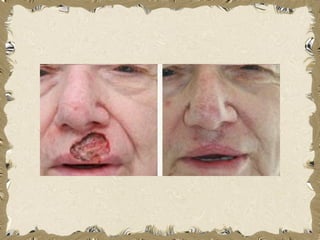
Lip Anatomy and Reconstruction
Lip Reconstruction
• Lips provide important aesthetic (ie. Mick
  Jagger) and functional role (both sphincteric
  and fine motor movements)
• The vermilion is highly sensitive to
  temperature, touch and pain
• Aims of reconstruction are to restore
  function, maintain sensation and avoid
  cosmetic deformity
Lip Reconstruction
• Most lip reconstructions will be performed
  for lip cancer
• Which lip is SCCA most commonly found?
• Lower Lip
• Which lip is BCCA most commonly found?
Lip Reconstruction
• Traumatic injury to the lips is more challenging
• Meticulous cleansing with minimal debridement to
  preserve as much tissue as possible usually allows
  for primary closure
• Critical landmarks (vermilion border, philtrum,
  commissures) are realigned first
• Closure proceeds: muscle layer, mucosa, skin
• Flaps may be needed for closure or revision, but
  are usually done as a delayed procedure
• Injury to Marginal Mandibular Nerve?
• Which side is injured?
• Right side is higher than left at rest.
Lip Anatomy
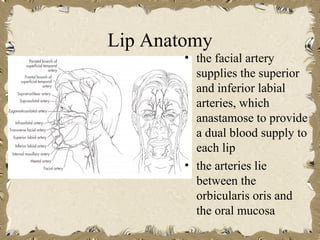
        • the facial artery
          supplies the superior
          and inferior labial
          arteries, which
          anastamose to provide
          a dual blood supply to
          each lip
        • the arteries lie
          between the
          orbicularis oris and
          the oral mucosa
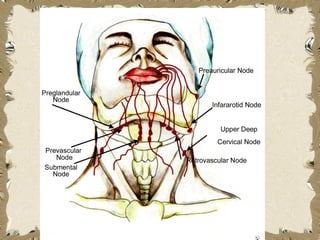
• What is lymphatic drainage of lips?
• What are the only muscles which are not
  supplied on the undersurface?
•   3 deep perioral muscles:
•   Mentalis
•   Levator Anguli Oris
•   Buccinator
• What is function of superficial portion of
  orbicularis oris?
• Fine movements
• What is function of deep?
• sphincteric
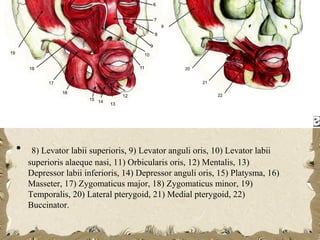
•    8) Levator labii superioris, 9) Levator anguli oris, 10) Levator labii
    superioris alaeque nasi, 11) Orbicularis oris, 12) Mentalis, 13)
    Depressor labii inferioris, 14) Depressor anguli oris, 15) Platysma, 16)
    Masseter, 17) Zygomaticus major, 18) Zygomaticus minor, 19)
    Temporalis, 20) Lateral pterygoid, 21) Medial pterygoid, 22)
    Buccinator.
• 3 layers of muscles
• Group I: Orbicularis oris, buccinator, levator
  anguli oris, depressor anguli oris,
  zygomaticus major, risorius
• Group II: Levator labii superioris, levator
  labii superioris alaeque nasi, zygomaticus
  minor
• Group III: Depressor labii inferiorius,
  mentalis, platysma
Lip Anatomy
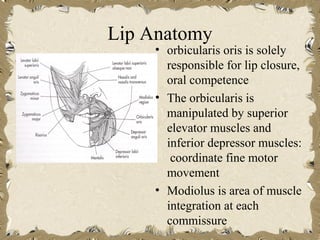
     • orbicularis oris is solely
       responsible for lip closure,
       oral competence
     • The orbicularis is
       manipulated by superior
       elevator muscles and
       inferior depressor muscles:
        coordinate fine motor
       movement
     • Modiolus is area of muscle
       integration at each
       commissure
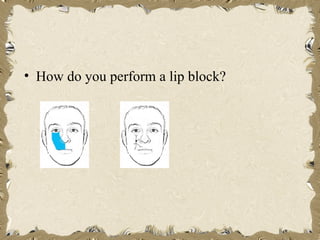
• How do you perform a lip block?
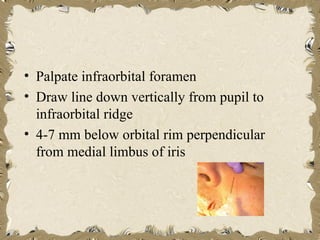
• Palpate infraorbital foramen
• Draw line down vertically from pupil to
  infraorbital ridge
• 4-7 mm below orbital rim perpendicular
  from medial limbus of iris
Mental Nerve
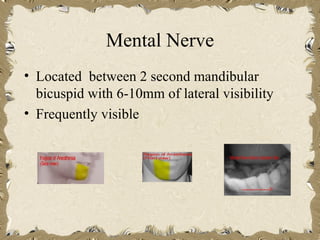
• Located between 2 second mandibular
  bicuspid with 6-10mm of lateral visibility
• Frequently visible
Lip Anatomy
• Motor innervation to the orbicularis oris is
  via the buccal branch of CN VII
• The marginal mandibular nerve supplies the
  depressor muscles
• These nerves run deep to the muscles
• The trigeminal nerve supplies sensation to
  the upper lip via the superior labial nerve, a
  branch of the infraorbital nerve, and the
  lower lip via the mental nerve
Lip
• Vermillion- Border between skin of face and
  lip
• Wet lip (mucous membrane)-nonkertanized
• Dry lip (exterior lip)-kertanized
• Red lip
• White lip
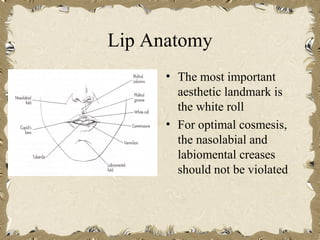
Lip Anatomy
      • The most important
        aesthetic landmark is
        the white roll
      • For optimal cosmesis,
        the nasolabial and
        labiomental creases
        should not be violated
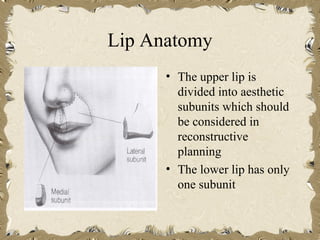
Lip Anatomy
      • The upper lip is
        divided into aesthetic
        subunits which should
        be considered in
        reconstructive
        planning
      • The lower lip has only
        one subunit
•   Oral commissure involved?
•   Eastlander
•   Not involved?
•   Abbe
• How wide should the Abbe flap be?
• ½ the size of the defect
•   Disadvantage of Abbe flap
•   Risk of microstomia
•   2-staged procedure
•   Risk of patient tearing flap by opening
    mouth too wide
• Primary complication of Eastlander flap
• Microstomia
• Major advantage of Karpandzic circumoral
  rotation flap?
• Orbicularis oculi preserved
Vermilion Reconstruction
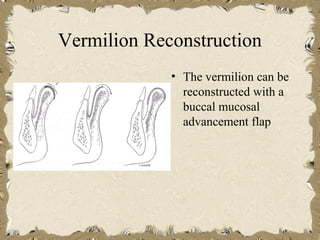
             • The vermilion can be
               reconstructed with a
               buccal mucosal
               advancement flap
Vermilion Reconstruction
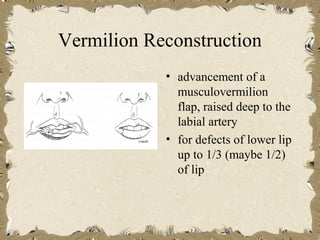
            • advancement of a
              musculovermilion
              flap, raised deep to the
              labial artery
            • for defects of lower lip
              up to 1/3 (maybe 1/2)
              of lip
Vermilion Reconstruction
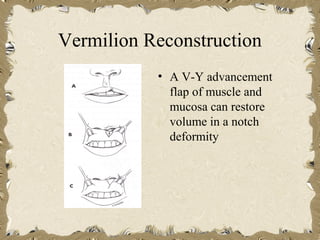
           • A V-Y advancement
             flap of muscle and
             mucosa can restore
             volume in a notch
             deformity
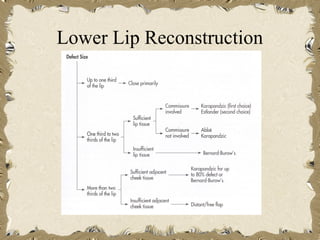
Lower Lip Reconstruction
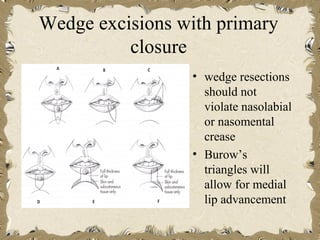
Wedge excisions with primary
          closure
                 • wedge resections
                   should not
                   violate nasolabial
                   or nasomental
                   crease
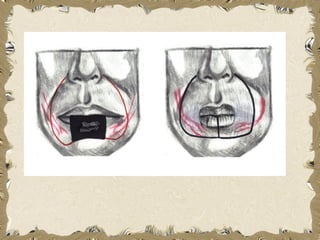
                 • Burow’s
                   triangles will
                   allow for medial
                   lip advancement
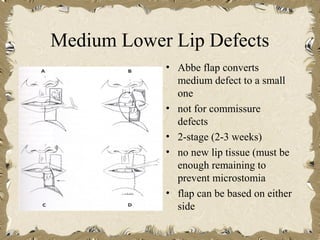
Medium Lower Lip Defects
            • Abbe flap converts
              medium defect to a small
              one
            • not for commissure
              defects
            • 2-stage (2-3 weeks)
            • no new lip tissue (must be
              enough remaining to
              prevent microstomia
            • flap can be based on either
              side
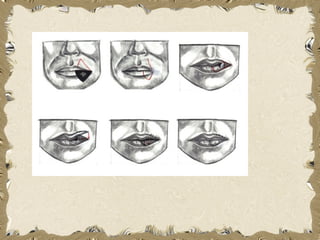
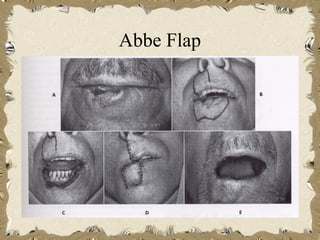
Abbe Flap
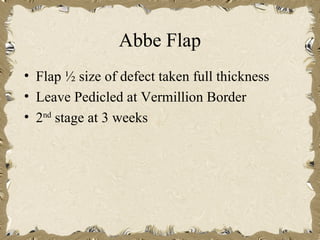
• Flap ½ size of defect taken full thickness
• Leave Pedicled at Vermillion Border
• 2nd stage at 3 weeks
Abbe Flap
Medium Lower Lip Defects
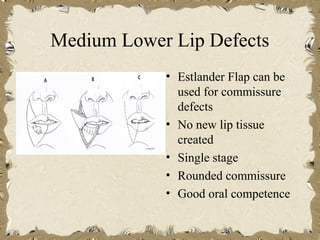
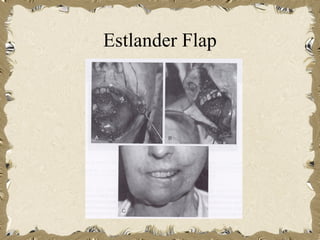
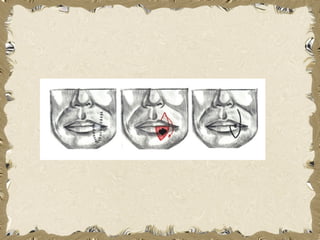
            • Estlander Flap can be
              used for commissure
              defects
            • No new lip tissue
              created
            • Single stage
            • Rounded commissure
            • Good oral competence
Estlander Flap
Medium Lower Lip Defects
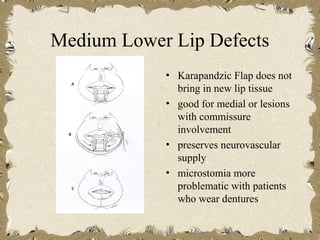
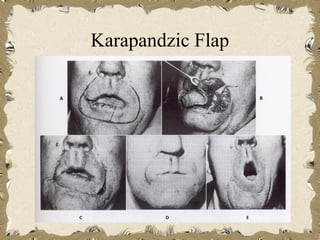
            • Karapandzic Flap does not
              bring in new lip tissue
            • good for medial or lesions
              with commissure
              involvement
            • preserves neurovascular
              supply
            • microstomia more
              problematic with patients
              who wear dentures
Karapandzic Flap
Medium Lower Lip Defects
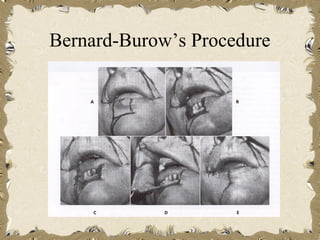
            • Bernard-Burow’s
              procedure generated new
              lip tissue to prevent
              microstomia
            • The advanced tissue lacks
              sensation and sphincteric
              function
            • Burow’s triangles are skin
              and subq tissue only
            • buccal mucosa advanced
              for vermilion
Bernard-Burow’s Procedure
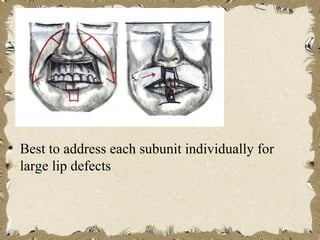
Large Lower Lip Defects
• Karapandzic flap may be used in lesions up
  to 80% of lip, may cause microstomia
• Bernard-Burow’s procedure provides new
  lip tissue, but sensation and competence
  problems can lead to drooling
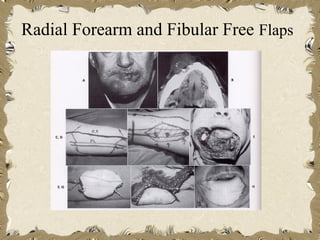
• Free flap may be needed in massive defects
  or those with insufficient lip or cheek tissue
  for reconstruction
• Best to address each subunit individually for
  large lip defects
Radial Forearm and Fibular Free Flaps
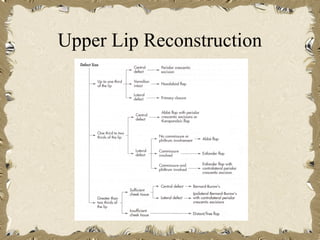
Upper Lip Reconstruction
• Special considerations include presence of
  central structures (cupid’s bow, philtrum)
• In men, facial hair aids in hiding scars
• In men, nonhair-bearing flaps brought into
  hear-bearing areas can be noticeable
• The upper lip is less important in oral
  competence
• more lower lip tissue can be “borrowed” for
  upper lip reconstruction
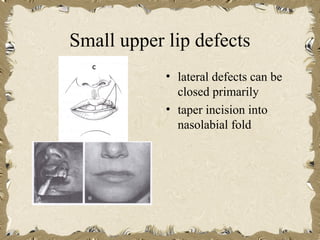
Small upper lip defects
            • lateral defects can be
              closed primarily
            • taper incision into
              nasolabial fold
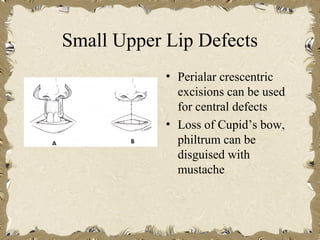
Small Upper Lip Defects
            • Perialar crescentric
              excisions can be used
              for central defects
            • Loss of Cupid’s bow,
              philtrum can be
              disguised with
              mustache
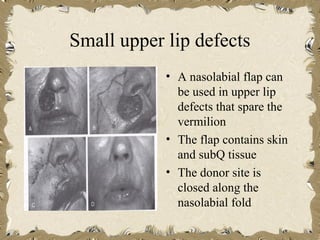
Small upper lip defects
            • A nasolabial flap can
              be used in upper lip
              defects that spare the
              vermilion
            • The flap contains skin
              and subQ tissue
            • The donor site is
              closed along the
              nasolabial fold
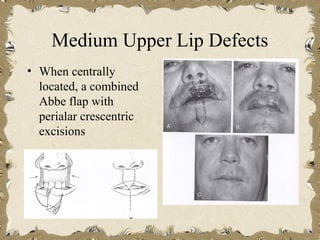
Medium Upper Lip Defects
• When centrally
  located, a combined
  Abbe flap with
  perialar crescentric
  excisions
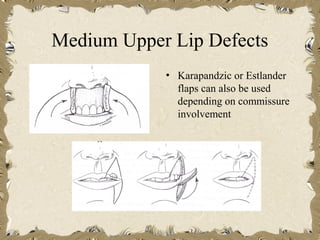
Medium Upper Lip Defects
            • Karapandzic or Estlander
              flaps can also be used
              depending on commissure
              involvement
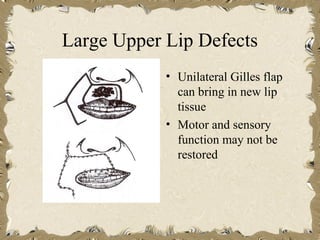
Large Upper Lip Defects
            • Unilateral Gilles flap
              can bring in new lip
              tissue
            • Motor and sensory
              function may not be
              restored
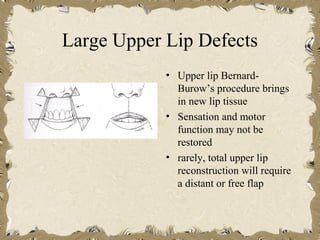
Large Upper Lip Defects
            • Upper lip Bernard-
              Burow’s procedure brings
              in new lip tissue
            • Sensation and motor
              function may not be
              restored
            • rarely, total upper lip
              reconstruction will require
              a distant or free flap
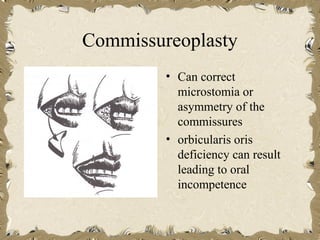
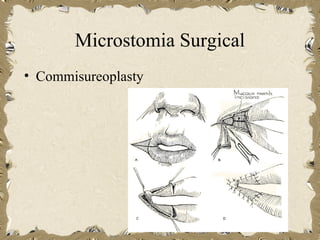
Commissureoplasty
         • Can correct
           microstomia or
           asymmetry of the
           commissures
         • orbicularis oris
           deficiency can result
           leading to oral
           incompetence
Microstomia
• Electrical
• Early ointment
• Early debridement not advised due to
  necrosis of muscle and soft tissue which
  extends beyond which is visible
Microstomia Surgical
• Commisureoplasty
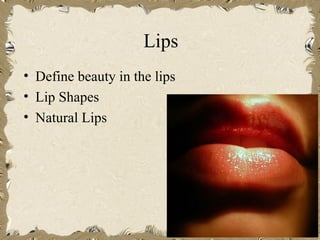
Lips
• Define beauty in the lips
• Lip Shapes
• Natural Lips
Lips
•   Injectable fillers
•   Soft lip injection
•   Lasts 4-6 months
•   Fat transfer offers longer lasting results in
    some patients but some unpredictability
How to make your lips fuller
      without a procedure?
• Lip plumpers
• Drink a lot of water
Do Lip Plumpers Work?
•   Study by Dr. Most at U of Washington
•   Used Lip Explosion
•   14 patients used for three months
•   No measurable difference
•   Only one patient thought would use the
    product again
Lip Augmenation
• Fat transfer
• Implants (Gore-Tex, Alloderm)
• Surgical Advancements
Surgical Advancment
• V-Y incision
• 2:1 relationship exists b/t Y limb and lip
  height
www.shahmd.com

Lip reconstruction

  • 1.
    Lip Anatomy andReconstruction
  • 2.
    Lip Reconstruction • Lipsprovide important aesthetic (ie. Mick Jagger) and functional role (both sphincteric and fine motor movements) • The vermilion is highly sensitive to temperature, touch and pain • Aims of reconstruction are to restore function, maintain sensation and avoid cosmetic deformity
  • 3.
    Lip Reconstruction • Mostlip reconstructions will be performed for lip cancer
  • 4.
    • Which lipis SCCA most commonly found?
  • 5.
  • 6.
    • Which lipis BCCA most commonly found?
  • 7.
    Lip Reconstruction • Traumaticinjury to the lips is more challenging • Meticulous cleansing with minimal debridement to preserve as much tissue as possible usually allows for primary closure • Critical landmarks (vermilion border, philtrum, commissures) are realigned first • Closure proceeds: muscle layer, mucosa, skin • Flaps may be needed for closure or revision, but are usually done as a delayed procedure
  • 8.
    • Injury toMarginal Mandibular Nerve? • Which side is injured? • Right side is higher than left at rest.
  • 9.
    Lip Anatomy • the facial artery supplies the superior and inferior labial arteries, which anastamose to provide a dual blood supply to each lip • the arteries lie between the orbicularis oris and the oral mucosa
  • 10.
    • What islymphatic drainage of lips?
  • 12.
    • What arethe only muscles which are not supplied on the undersurface?
  • 13.
    3 deep perioral muscles: • Mentalis • Levator Anguli Oris • Buccinator
  • 14.
    • What isfunction of superficial portion of orbicularis oris? • Fine movements • What is function of deep? • sphincteric
  • 15.
    8) Levator labii superioris, 9) Levator anguli oris, 10) Levator labii superioris alaeque nasi, 11) Orbicularis oris, 12) Mentalis, 13) Depressor labii inferioris, 14) Depressor anguli oris, 15) Platysma, 16) Masseter, 17) Zygomaticus major, 18) Zygomaticus minor, 19) Temporalis, 20) Lateral pterygoid, 21) Medial pterygoid, 22) Buccinator.
  • 16.
    • 3 layersof muscles • Group I: Orbicularis oris, buccinator, levator anguli oris, depressor anguli oris, zygomaticus major, risorius • Group II: Levator labii superioris, levator labii superioris alaeque nasi, zygomaticus minor • Group III: Depressor labii inferiorius, mentalis, platysma
  • 17.
    Lip Anatomy • orbicularis oris is solely responsible for lip closure, oral competence • The orbicularis is manipulated by superior elevator muscles and inferior depressor muscles: coordinate fine motor movement • Modiolus is area of muscle integration at each commissure
  • 18.
    • How doyou perform a lip block?
  • 19.
    • Palpate infraorbitalforamen • Draw line down vertically from pupil to infraorbital ridge • 4-7 mm below orbital rim perpendicular from medial limbus of iris
  • 20.
    Mental Nerve • Locatedbetween 2 second mandibular bicuspid with 6-10mm of lateral visibility • Frequently visible
  • 21.
    Lip Anatomy • Motorinnervation to the orbicularis oris is via the buccal branch of CN VII • The marginal mandibular nerve supplies the depressor muscles • These nerves run deep to the muscles • The trigeminal nerve supplies sensation to the upper lip via the superior labial nerve, a branch of the infraorbital nerve, and the lower lip via the mental nerve
  • 22.
    Lip • Vermillion- Borderbetween skin of face and lip • Wet lip (mucous membrane)-nonkertanized • Dry lip (exterior lip)-kertanized • Red lip • White lip
  • 23.
    Lip Anatomy • The most important aesthetic landmark is the white roll • For optimal cosmesis, the nasolabial and labiomental creases should not be violated
  • 24.
    Lip Anatomy • The upper lip is divided into aesthetic subunits which should be considered in reconstructive planning • The lower lip has only one subunit
  • 25.
    Oral commissure involved? • Eastlander • Not involved? • Abbe
  • 26.
    • How wideshould the Abbe flap be? • ½ the size of the defect
  • 27.
    Disadvantage of Abbe flap • Risk of microstomia • 2-staged procedure • Risk of patient tearing flap by opening mouth too wide
  • 28.
    • Primary complicationof Eastlander flap • Microstomia
  • 29.
    • Major advantageof Karpandzic circumoral rotation flap?
  • 30.
  • 31.
    Vermilion Reconstruction • The vermilion can be reconstructed with a buccal mucosal advancement flap
  • 32.
    Vermilion Reconstruction • advancement of a musculovermilion flap, raised deep to the labial artery • for defects of lower lip up to 1/3 (maybe 1/2) of lip
  • 33.
    Vermilion Reconstruction • A V-Y advancement flap of muscle and mucosa can restore volume in a notch deformity
  • 34.
  • 35.
    Wedge excisions withprimary closure • wedge resections should not violate nasolabial or nasomental crease • Burow’s triangles will allow for medial lip advancement
  • 36.
    Medium Lower LipDefects • Abbe flap converts medium defect to a small one • not for commissure defects • 2-stage (2-3 weeks) • no new lip tissue (must be enough remaining to prevent microstomia • flap can be based on either side
  • 37.
    Abbe Flap • Flap½ size of defect taken full thickness • Leave Pedicled at Vermillion Border • 2nd stage at 3 weeks
  • 38.
  • 40.
    Medium Lower LipDefects • Estlander Flap can be used for commissure defects • No new lip tissue created • Single stage • Rounded commissure • Good oral competence
  • 41.
  • 43.
    Medium Lower LipDefects • Karapandzic Flap does not bring in new lip tissue • good for medial or lesions with commissure involvement • preserves neurovascular supply • microstomia more problematic with patients who wear dentures
  • 44.
  • 46.
    Medium Lower LipDefects • Bernard-Burow’s procedure generated new lip tissue to prevent microstomia • The advanced tissue lacks sensation and sphincteric function • Burow’s triangles are skin and subq tissue only • buccal mucosa advanced for vermilion
  • 47.
  • 48.
    Large Lower LipDefects • Karapandzic flap may be used in lesions up to 80% of lip, may cause microstomia • Bernard-Burow’s procedure provides new lip tissue, but sensation and competence problems can lead to drooling • Free flap may be needed in massive defects or those with insufficient lip or cheek tissue for reconstruction
  • 49.
    • Best toaddress each subunit individually for large lip defects
  • 50.
    Radial Forearm andFibular Free Flaps
  • 51.
  • 52.
    Upper Lip Reconstruction •Special considerations include presence of central structures (cupid’s bow, philtrum) • In men, facial hair aids in hiding scars • In men, nonhair-bearing flaps brought into hear-bearing areas can be noticeable • The upper lip is less important in oral competence • more lower lip tissue can be “borrowed” for upper lip reconstruction
  • 53.
    Small upper lipdefects • lateral defects can be closed primarily • taper incision into nasolabial fold
  • 54.
    Small Upper LipDefects • Perialar crescentric excisions can be used for central defects • Loss of Cupid’s bow, philtrum can be disguised with mustache
  • 55.
    Small upper lipdefects • A nasolabial flap can be used in upper lip defects that spare the vermilion • The flap contains skin and subQ tissue • The donor site is closed along the nasolabial fold
  • 56.
    Medium Upper LipDefects • When centrally located, a combined Abbe flap with perialar crescentric excisions
  • 57.
    Medium Upper LipDefects • Karapandzic or Estlander flaps can also be used depending on commissure involvement
  • 58.
    Large Upper LipDefects • Unilateral Gilles flap can bring in new lip tissue • Motor and sensory function may not be restored
  • 59.
    Large Upper LipDefects • Upper lip Bernard- Burow’s procedure brings in new lip tissue • Sensation and motor function may not be restored • rarely, total upper lip reconstruction will require a distant or free flap
  • 60.
    Commissureoplasty • Can correct microstomia or asymmetry of the commissures • orbicularis oris deficiency can result leading to oral incompetence
  • 61.
    Microstomia • Electrical • Earlyointment • Early debridement not advised due to necrosis of muscle and soft tissue which extends beyond which is visible
  • 62.
  • 63.
    Lips • Define beautyin the lips • Lip Shapes • Natural Lips
  • 64.
    Lips • Injectable fillers • Soft lip injection • Lasts 4-6 months • Fat transfer offers longer lasting results in some patients but some unpredictability
  • 65.
    How to makeyour lips fuller without a procedure? • Lip plumpers • Drink a lot of water
  • 66.
    Do Lip PlumpersWork? • Study by Dr. Most at U of Washington • Used Lip Explosion • 14 patients used for three months • No measurable difference • Only one patient thought would use the product again
  • 67.
    Lip Augmenation • Fattransfer • Implants (Gore-Tex, Alloderm) • Surgical Advancements
  • 68.
    Surgical Advancment • V-Yincision • 2:1 relationship exists b/t Y limb and lip height
  • 70.