Terminology
• Prosthodontics: the branch of dentistry that
  deals with the replacement missing dental
  ,oral and craniofacial structure.
• Prosthesis: an artificial replacement of an
  absent part of the human body.
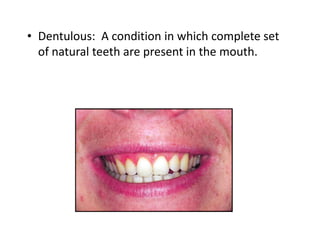
• Dentulous: A condition in which complete set
  of natural teeth are present in the mouth.
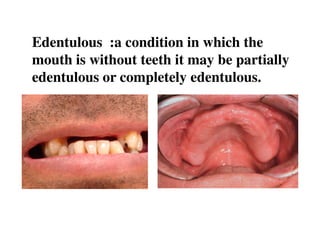
Edentulous :a condition in which the
mouth is without teeth it may be partially
edentulous or completely edentulous.
WASHINGTON’S DENTURE
OBJECTIVES OF COMPLETE DENTURE
OBJECTIVES OF COMPLETE
       DENTURE
OBJECTIVES OF COMPLETE
       DENTURE
Fitting surface


Buccal flange

                                         Polished surface


                      Occlusal surface
Anatomy for Complete Dentures
EXTRA ORAL LANDMARKS
Lips

• Vermilion Border
  – Denture provides lip support
     • Affects vermilion border width
Lips

• Philtrum
  – Depression below nose
Lips
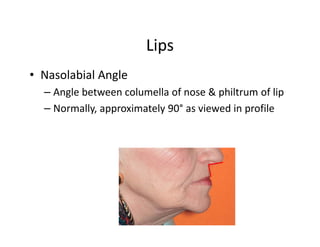
• Nasolabial Angle
  – Angle between columella of nose & philtrum of lip
  – Normally, approximately 90° as viewed in profile
• 4- Naso-labial sulcus:
     Naso-
  – Def.: it is a depression that extends from the ala of the nose
    in a downward and lateral direction to the corner of the
    mouth.
  – Prosthetic importance:
    it becomes more prominent with
  aging and teeth loss so should be
  restored by proper:-
    – vertical dimension
    - anterior teeth positioning
    - labial flange
• Mento-labial sulcus
  Mento-       sulcus:
  – Def.: it is the sulcus between lower lip and chin.
  – Prosthetic importance:
    its curvature indicates the character of maxillo-mandibular
    relationship.


         Class II angle   Class I angle   Class III angle
• Modiolus:
  – Def.: this is located at the confluence of the
    buccinator and other facial muscles near the angle
    of the mouth.
  – Prosthetic importance:
  sunken cheeks appearance and
  droped angle observed by loss
  of maxillary teeth.
Intra-oral landmarks
SUPPORTING STRUCTURE
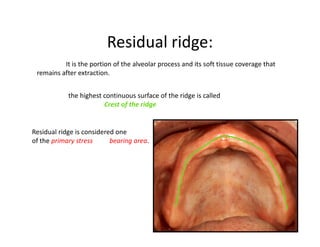
Residual ridge:
          It is the portion of the alveolar process and its soft tissue coverage that
 remains after extraction.


            the highest continuous surface of the ridge is called
                        Crest of the ridge


Residual ridge is considered one
of the primary stress      bearing area.
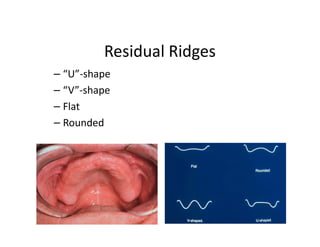
Residual Ridges
– “U”-shape
– “V”-shape
– Flat
– Rounded
Maxillary tuberosity
              It is a prominent bulge located just behind and above the distal end of the
    maxillary ridge

well formed tuberosities offer wide coverage so enhancing support and
retention of the denture.


However extremely large ones
needs surgical correction.
Maxilla
• Maxillary Tuberosities
  – Oversized
  – Resorbed
  – Undercut
Maxilla
• Incisive Papilla
   – Landmark for setting of teeth
Maxilla
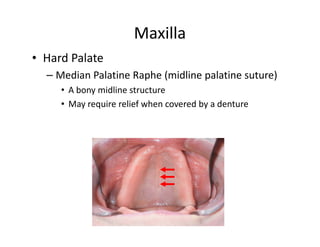
• Hard Palate
  – Median Palatine Raphe (midline palatine suture)
     • A bony midline structure
     • May require relief when covered by a denture
Maxilla

• Torus Palatinus
  – May require removal
Maxilla
• “Hamular” Notch
  – Posterior border denture
     • Between the bony tuberosity and hamulus
     • “Soft displaceable tissue”, for comfort and retention
Maxilla
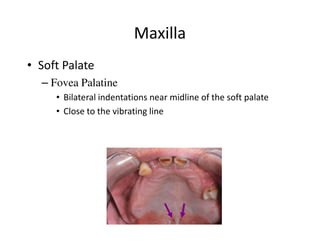
• Soft Palate
  – Fovea Palatine
     • Bilateral indentations near midline of the soft palate
     • Close to the vibrating line
Maxilla
• Soft Palate
  –Vibrating Line
    • Critical posterior border dentures
    • Junction of movable and immovable
      portions of the soft palate
Mandible


• Ridge form
  – U-shape best
  – Non-moveable best
  – Advise patient if poor
  – Affects:
     • retention
     • stability
Mandible
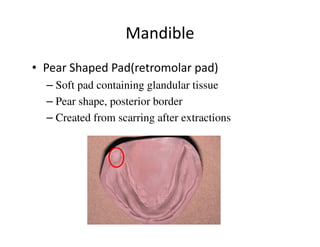
• Pear Shaped Pad(retromolar pad)
  – Soft pad containing glandular tissue
  – Pear shape, posterior border
  – Created from scarring after extractions
Mandible
• External Oblique Ridge
  – Do not extend dentures to this ridge
Mandible
• Buccal Shelf
  – Primary denture bearing area of mandibular denture
  – Between height of bridge & external oblique ridge
  – Resorbs more slowly
Mandible

• Lingual Tori
  – Raised bony structures
  – May require relief when covered by a denture
  – Thin mucosa can ulcerate easily
Mandible
• Mylohyoid Ridge
  – Origin of mylohyoid muscle which influences length
    of lingual flange
  – Can be prominent, and/or sharp, requiring relief
Mandible
• Genial Tubercles
  – Attachment for the genioglossus muscle
  – Tubercles may be higher than the ridge with severe
    resorption
BORDER STRUCTURES THAT LIMITS
 THE PREPHERY OF THE DENTURE
Labial frenum
Frena (singular = frenum)
• Must be relieved to allow movement, without
  impingement
• If prominent, adequate relief can weaken a denture
• If too much relief, retention is lost
• Check prominence intraorally
Lingual frenum


                 Buccal frenum
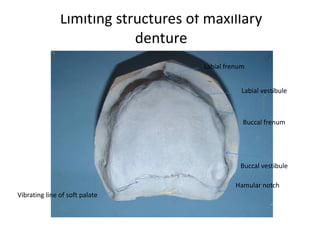
Limiting structures of maxillary
                           denture
                                     Labial frenum


                                                 Labial vestibule


                                                 Buccal frenum


                                                Buccal vestibule

                                               Hamular notch
Vibrating line of soft palate
Limiting structures of mandibular
             denture
   Labial frenum

                                     Buccal frenum


                   Lingual frenum             Buccal
                                              vestibule


                     Lingual pouch


                                              Retromolar bad
• Retention :resistance to the dislodging forces along
  the path of placement.

• Stability :to be firm, steady or constant to resist
  displacement by functional horizontal or rotational
  stresses.

• Support :the foundation area on which a dental
  prosthesis rest. It is the resistance to the force
  toward the tissue.
Take time TO LIVE…
Because time passes… QUICKLY
     And NEVER returns!

anatomy-for-complete-denture

  • 1.
    Terminology • Prosthodontics: thebranch of dentistry that deals with the replacement missing dental ,oral and craniofacial structure. • Prosthesis: an artificial replacement of an absent part of the human body.
  • 2.
    • Dentulous: Acondition in which complete set of natural teeth are present in the mouth.
  • 3.
    Edentulous :a conditionin which the mouth is without teeth it may be partially edentulous or completely edentulous.
  • 5.
  • 6.
  • 7.
  • 8.
  • 9.
    Fitting surface Buccal flange Polished surface Occlusal surface
  • 10.
  • 11.
  • 12.
    Lips • Vermilion Border – Denture provides lip support • Affects vermilion border width
  • 13.
    Lips • Philtrum – Depression below nose
  • 14.
    Lips • Nasolabial Angle – Angle between columella of nose & philtrum of lip – Normally, approximately 90° as viewed in profile
  • 15.
    • 4- Naso-labialsulcus: Naso- – Def.: it is a depression that extends from the ala of the nose in a downward and lateral direction to the corner of the mouth. – Prosthetic importance: it becomes more prominent with aging and teeth loss so should be restored by proper:- – vertical dimension - anterior teeth positioning - labial flange
  • 16.
    • Mento-labial sulcus Mento- sulcus: – Def.: it is the sulcus between lower lip and chin. – Prosthetic importance: its curvature indicates the character of maxillo-mandibular relationship. Class II angle Class I angle Class III angle
  • 17.
    • Modiolus: – Def.: this is located at the confluence of the buccinator and other facial muscles near the angle of the mouth. – Prosthetic importance: sunken cheeks appearance and droped angle observed by loss of maxillary teeth.
  • 18.
  • 19.
  • 20.
    Residual ridge: It is the portion of the alveolar process and its soft tissue coverage that remains after extraction. the highest continuous surface of the ridge is called Crest of the ridge Residual ridge is considered one of the primary stress bearing area.
  • 21.
    Residual Ridges – “U”-shape –“V”-shape – Flat – Rounded
  • 22.
    Maxillary tuberosity It is a prominent bulge located just behind and above the distal end of the maxillary ridge well formed tuberosities offer wide coverage so enhancing support and retention of the denture. However extremely large ones needs surgical correction.
  • 23.
    Maxilla • Maxillary Tuberosities – Oversized – Resorbed – Undercut
  • 24.
    Maxilla • Incisive Papilla – Landmark for setting of teeth
  • 25.
    Maxilla • Hard Palate – Median Palatine Raphe (midline palatine suture) • A bony midline structure • May require relief when covered by a denture
  • 26.
    Maxilla • Torus Palatinus – May require removal
  • 27.
    Maxilla • “Hamular” Notch – Posterior border denture • Between the bony tuberosity and hamulus • “Soft displaceable tissue”, for comfort and retention
  • 28.
    Maxilla • Soft Palate – Fovea Palatine • Bilateral indentations near midline of the soft palate • Close to the vibrating line
  • 29.
    Maxilla • Soft Palate –Vibrating Line • Critical posterior border dentures • Junction of movable and immovable portions of the soft palate
  • 30.
    Mandible • Ridge form – U-shape best – Non-moveable best – Advise patient if poor – Affects: • retention • stability
  • 31.
    Mandible • Pear ShapedPad(retromolar pad) – Soft pad containing glandular tissue – Pear shape, posterior border – Created from scarring after extractions
  • 32.
    Mandible • External ObliqueRidge – Do not extend dentures to this ridge
  • 33.
    Mandible • Buccal Shelf – Primary denture bearing area of mandibular denture – Between height of bridge & external oblique ridge – Resorbs more slowly
  • 34.
    Mandible • Lingual Tori – Raised bony structures – May require relief when covered by a denture – Thin mucosa can ulcerate easily
  • 36.
    Mandible • Mylohyoid Ridge – Origin of mylohyoid muscle which influences length of lingual flange – Can be prominent, and/or sharp, requiring relief
  • 37.
    Mandible • Genial Tubercles – Attachment for the genioglossus muscle – Tubercles may be higher than the ridge with severe resorption
  • 38.
    BORDER STRUCTURES THATLIMITS THE PREPHERY OF THE DENTURE
  • 39.
  • 40.
    Frena (singular =frenum) • Must be relieved to allow movement, without impingement • If prominent, adequate relief can weaken a denture • If too much relief, retention is lost • Check prominence intraorally
  • 41.
    Lingual frenum Buccal frenum
  • 42.
    Limiting structures ofmaxillary denture Labial frenum Labial vestibule Buccal frenum Buccal vestibule Hamular notch Vibrating line of soft palate
  • 43.
    Limiting structures ofmandibular denture Labial frenum Buccal frenum Lingual frenum Buccal vestibule Lingual pouch Retromolar bad
  • 44.
    • Retention :resistanceto the dislodging forces along the path of placement. • Stability :to be firm, steady or constant to resist displacement by functional horizontal or rotational stresses. • Support :the foundation area on which a dental prosthesis rest. It is the resistance to the force toward the tissue.
  • 45.
    Take time TOLIVE… Because time passes… QUICKLY And NEVER returns!