All problems are
                                opportunities in
                                     disguise


                               Problem statement
                                                   Prepared by Roberto Rocco
                                            Chair Spatial Planning and Strategy, TU Delft
                     !"#$$%&'%()"%(*+)+,%


Monday, 14February, 2011                                                                    1
ANY Academic endeavour
                   starts with a question
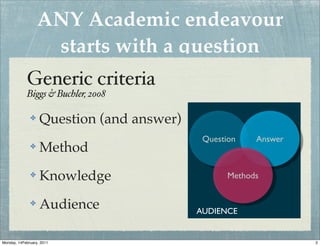
            Generic criteria
            Biggs & Buchler, 2008

              ✤    Question (and answer)
                                            Question    Answer
              ✤    Method
              ✤    Knowledge                      Methods


              ✤    Audience                AUDIENCE


Monday, 14February, 2011                                         2
Context
       ✴The problem statement provides the context for the
         research study and typically generates QUESTIONS
         which the research hopes to answer (objective of the
         research)
       ✴In considering whether or not to move forward with a
         research project, you will generally spend some time
         considering the problem.


Monday, 14February, 2011                                        3
Hooking the reader

       ✴In your research project, the statement of the problem is
       the first part of the proposal to be read [apart from the title
       and the abstract, if you decide to have one]. The problem
       statement should "hook" the reader and establish a
       persuasive context for what follows.


Monday, 14February, 2011                                                4
What is the problem?
       ✴You need to be able to clearly answer the question:
       "what is the problem"? and "why is this problem worth my
       attention"? (this helps you define the RELEVANCE)

       ✴At the same time, the problem statement limits scope by
            focusing on some variables and not others. It also
            provides an opportunity for you to demonstrate why
            these variables are important. (ditto)


Monday, 14February, 2011                                          5
Is it transferable?
       ✴It is also important to be able to make your problem
       ‘”transferable”. Does it happen in other places (even with
       slight variations)?

       ✴This means that the problem at hand is not only a problem
       perceived by you as an individual (although you might have
       a special interest in it), but a problem that is recognized by
       society or by other members of the academic world. It can
       also be integrated and built upon by other people.


Monday, 14February, 2011                                                6
Remember: nothing is completely
       transferable
             But the main elements, MIGHT be. For instance:

             Regeneration strategies can be used by various cities with the
             same problems.

             Solutions for urbanization in flood-able areas in the Dutch
             Deltametropolis might be transferable to other Delta regions.

             Spatial solutions for urbanization in Haiti after the big
             earthquake of 2010 might be transferable to other areas
             afflicted by similar natural disasters.

Monday, 14February, 2011                                                      7
What is the logic of enquiry?


       ✴MOST IMPORTANT, your problem must have some
       connection with spatial planning and design. Remember
       the LOGICS OF ENQUIRY. This means that the problem
       you want to analyze has some connection with space!


Monday, 14February, 2011                                       8
Remember
                                       there are
                                   different logics
                                      of enquiry
                      You need to
                     find the more
                   relevant for your
                   problem and for
                     the discipline


Monday, 14February, 2011                              9
✴Stating that China is industrializing quickly is not as
       relevant (for Urbanism) as stating that the rapid
       industrialization of China is producing massive urban
       growth!


Monday, 14February, 2011                                          10
Manageable in 1 year?

       ✴Another question arises: is your problem
       MANAGEABLE within the scope of spatial planning and
       design?

       ✴Is your problem manageable within the scope of the
            Masters Course of the TU Delft? (meaning: can you
            research and find design solutions for that problem
            within the framework given by the University)?


Monday, 14February, 2011                                         11
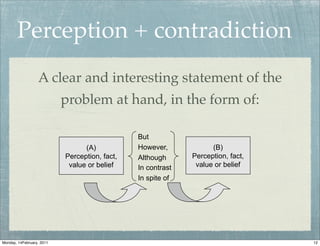
Perception + contradiction
                  A clear and interesting statement of the
                           problem at hand, in the form of:

                                               But
                                 (A)           However,            (B)
                           Perception, fact,   Although      Perception, fact,
                            value or belief    In contrast    value or belief
                                               In spite of


Monday, 14February, 2011                                                         12
Start by introducing the context
       highlighting the possibilities


                  Utrecht is the fourth largest city in the Randstad
                  (west part of the Netherlands) with approximately
                  300.000 inhabitants in 2009 (CBS, 2010). It is
                  centrally located in the network of highways and
                  railways of the country. It possesses the largest
                  university of the country and a diversified service
                  oriented economy (Gemeente Utrecht, 2007). In the
                  last few years, the city has gained approximately
                  30.000 new dwellings (CBS, 2010).


Monday, 14February, 2011                                               13
But then introduce a problem or
            a set of problems

              HOWEVER, Utrecht does not take full advantage of
              its central position because of the chronic congestion
              of the roads surrounding the city. Inhabitants and
              commuters complain that it is very difficult to reach
              the city centre from the city ring road. Transferia
              (the Dutch concept of car parking near the ring
              roads) are unattractive and not so well connected.
              This is one of the structural elements making
              Utrecht less competitive in the Randstad in terms of
              office location, which is hampering city growth.


Monday, 14February, 2011                                               14
DON’T YOU FEEL
                    LIKE ASKING A
                    QUESTION AT THE
                    END OF THE LAST
                    SLIDE? WHAT
                    WOULD THAT
                    QUESTION BE?


Monday, 14February, 2011              15
That’s
                           your research
                             question!


Monday, 14February, 2011                   16
EXAMPLE Research Question


       ✴How to improve competitiveness of the
       city of Utrecht by improving connectivity
       and car accessibility to the city centre ?


Monday, 14February, 2011                            17
Sub research questions

       Sub research questions are questions that aim to answer
       underlying elements of your main research question. They will
       help you define your research strategy by highlighting what are
       elements you need to know to answer your research question.

       1. How is city competitiveness related to physical connectivity?
       2. What are spatial/ geographical advantages of Utrecht?
       3. How is the city of Utrecht performing in the Randstad?


Monday, 14February, 2011                                                  18
Narrowed down research
       questions
       1. Does accessibility and connectivity from new ring roads to
             city centres affect office occupancy?

       2. What are structural problems hampering car accessibility
             from the ring-road to the city centre of Utrecht?

       3. What is the function of transferia in improving car
             accessibility to the centre of Utrecht and how can they be
             improved?


Monday, 14February, 2011                                                  19
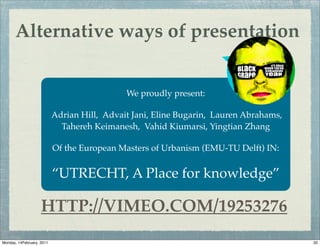
Alternative ways of presentation


                                             We proudly present:
                                               Produced by:
                           Adrian Hill, Advait Jani, Eline Bugarin, Lauren Abrahams,
                                                Adrian Hill
                             Tahereh Keimanesh, Vahid Kiumarsi, Yingtian Zhang

                           Of the European Masters of Urbanism (EMU-TU Delft) IN:


                           “UTRECHT, A Place for knowledge”

                    HTTP://VIMEO.COM/19253276
Monday, 14February, 2011                                                               20
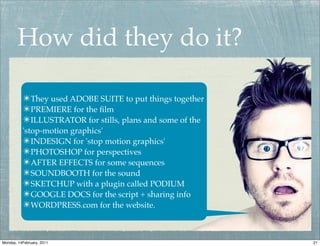
How did they do it?

          ✴They used ADOBE SUITE to put things together
          ✴PREMIERE for the film
          ✴ILLUSTRATOR for stills, plans and some of the
          'stop-motion graphics'
          ✴INDESIGN for 'stop motion graphics'
          ✴PHOTOSHOP for perspectives
          ✴AFTER EFFECTS for some sequences
          ✴SOUNDBOOTH for the sound
          ✴SKETCHUP with a plugin called PODIUM
          ✴GOOGLE DOCS for the script + sharing info
          ✴WORDPRESS.com for the website.


Monday, 14February, 2011                                   21
Thanks!
       Questions? Write to
       r.c.rocco@tudelft.nl
        With special thanks to Matt Smith (ChernobylBob) of Gloucester, UK, whose
        photos adorn these pages.
        Matt’s photographs are available at: www.flickr.com/photos/chernobylbob/


        Prepared by Roberto Rocco, TU Delft
        r.c.rocco@tudelft.nl


Monday, 14February, 2011                                                            22

HOW TO BUILD YOUR PROBLEM STATEMENT

  • 1.
    All problems are opportunities in disguise Problem statement Prepared by Roberto Rocco Chair Spatial Planning and Strategy, TU Delft !"#$$%&'%()"%(*+)+,% Monday, 14February, 2011 1
  • 2.
    ANY Academic endeavour starts with a question Generic criteria Biggs & Buchler, 2008 ✤ Question (and answer) Question Answer ✤ Method ✤ Knowledge Methods ✤ Audience AUDIENCE Monday, 14February, 2011 2
  • 3.
    Context ✴The problem statement provides the context for the research study and typically generates QUESTIONS which the research hopes to answer (objective of the research) ✴In considering whether or not to move forward with a research project, you will generally spend some time considering the problem. Monday, 14February, 2011 3
  • 4.
    Hooking the reader ✴In your research project, the statement of the problem is the first part of the proposal to be read [apart from the title and the abstract, if you decide to have one]. The problem statement should "hook" the reader and establish a persuasive context for what follows. Monday, 14February, 2011 4
  • 5.
    What is theproblem? ✴You need to be able to clearly answer the question: "what is the problem"? and "why is this problem worth my attention"? (this helps you define the RELEVANCE) ✴At the same time, the problem statement limits scope by focusing on some variables and not others. It also provides an opportunity for you to demonstrate why these variables are important. (ditto) Monday, 14February, 2011 5
  • 6.
    Is it transferable? ✴It is also important to be able to make your problem ‘”transferable”. Does it happen in other places (even with slight variations)? ✴This means that the problem at hand is not only a problem perceived by you as an individual (although you might have a special interest in it), but a problem that is recognized by society or by other members of the academic world. It can also be integrated and built upon by other people. Monday, 14February, 2011 6
  • 7.
    Remember: nothing iscompletely transferable But the main elements, MIGHT be. For instance: Regeneration strategies can be used by various cities with the same problems. Solutions for urbanization in flood-able areas in the Dutch Deltametropolis might be transferable to other Delta regions. Spatial solutions for urbanization in Haiti after the big earthquake of 2010 might be transferable to other areas afflicted by similar natural disasters. Monday, 14February, 2011 7
  • 8.
    What is thelogic of enquiry? ✴MOST IMPORTANT, your problem must have some connection with spatial planning and design. Remember the LOGICS OF ENQUIRY. This means that the problem you want to analyze has some connection with space! Monday, 14February, 2011 8
  • 9.
    Remember there are different logics of enquiry You need to find the more relevant for your problem and for the discipline Monday, 14February, 2011 9
  • 10.
    ✴Stating that Chinais industrializing quickly is not as relevant (for Urbanism) as stating that the rapid industrialization of China is producing massive urban growth! Monday, 14February, 2011 10
  • 11.
    Manageable in 1year? ✴Another question arises: is your problem MANAGEABLE within the scope of spatial planning and design? ✴Is your problem manageable within the scope of the Masters Course of the TU Delft? (meaning: can you research and find design solutions for that problem within the framework given by the University)? Monday, 14February, 2011 11
  • 12.
    Perception + contradiction A clear and interesting statement of the problem at hand, in the form of: But (A) However, (B) Perception, fact, Although Perception, fact, value or belief In contrast value or belief In spite of Monday, 14February, 2011 12
  • 13.
    Start by introducingthe context highlighting the possibilities Utrecht is the fourth largest city in the Randstad (west part of the Netherlands) with approximately 300.000 inhabitants in 2009 (CBS, 2010). It is centrally located in the network of highways and railways of the country. It possesses the largest university of the country and a diversified service oriented economy (Gemeente Utrecht, 2007). In the last few years, the city has gained approximately 30.000 new dwellings (CBS, 2010). Monday, 14February, 2011 13
  • 14.
    But then introducea problem or a set of problems HOWEVER, Utrecht does not take full advantage of its central position because of the chronic congestion of the roads surrounding the city. Inhabitants and commuters complain that it is very difficult to reach the city centre from the city ring road. Transferia (the Dutch concept of car parking near the ring roads) are unattractive and not so well connected. This is one of the structural elements making Utrecht less competitive in the Randstad in terms of office location, which is hampering city growth. Monday, 14February, 2011 14
  • 15.
    DON’T YOU FEEL LIKE ASKING A QUESTION AT THE END OF THE LAST SLIDE? WHAT WOULD THAT QUESTION BE? Monday, 14February, 2011 15
  • 16.
    That’s your research question! Monday, 14February, 2011 16
  • 17.
    EXAMPLE Research Question ✴How to improve competitiveness of the city of Utrecht by improving connectivity and car accessibility to the city centre ? Monday, 14February, 2011 17
  • 18.
    Sub research questions Sub research questions are questions that aim to answer underlying elements of your main research question. They will help you define your research strategy by highlighting what are elements you need to know to answer your research question. 1. How is city competitiveness related to physical connectivity? 2. What are spatial/ geographical advantages of Utrecht? 3. How is the city of Utrecht performing in the Randstad? Monday, 14February, 2011 18
  • 19.
    Narrowed down research questions 1. Does accessibility and connectivity from new ring roads to city centres affect office occupancy? 2. What are structural problems hampering car accessibility from the ring-road to the city centre of Utrecht? 3. What is the function of transferia in improving car accessibility to the centre of Utrecht and how can they be improved? Monday, 14February, 2011 19
  • 20.
    Alternative ways ofpresentation We proudly present: Produced by: Adrian Hill, Advait Jani, Eline Bugarin, Lauren Abrahams, Adrian Hill Tahereh Keimanesh, Vahid Kiumarsi, Yingtian Zhang Of the European Masters of Urbanism (EMU-TU Delft) IN: “UTRECHT, A Place for knowledge” HTTP://VIMEO.COM/19253276 Monday, 14February, 2011 20
  • 21.
    How did theydo it? ✴They used ADOBE SUITE to put things together ✴PREMIERE for the film ✴ILLUSTRATOR for stills, plans and some of the 'stop-motion graphics' ✴INDESIGN for 'stop motion graphics' ✴PHOTOSHOP for perspectives ✴AFTER EFFECTS for some sequences ✴SOUNDBOOTH for the sound ✴SKETCHUP with a plugin called PODIUM ✴GOOGLE DOCS for the script + sharing info ✴WORDPRESS.com for the website. Monday, 14February, 2011 21
  • 22.
    Thanks! Questions? Write to r.c.rocco@tudelft.nl With special thanks to Matt Smith (ChernobylBob) of Gloucester, UK, whose photos adorn these pages. Matt’s photographs are available at: www.flickr.com/photos/chernobylbob/ Prepared by Roberto Rocco, TU Delft r.c.rocco@tudelft.nl Monday, 14February, 2011 22