
Beta Receptor Blockers
Dr. Ritu Budania
MBBS, MD
Overview
• Introduction
• Classification
• Pharmacological actions
• Pharmacokinetics
• Therapeutic uses
• Adverse effects & Contraindications
• Recent advances
• Summary
Introduction
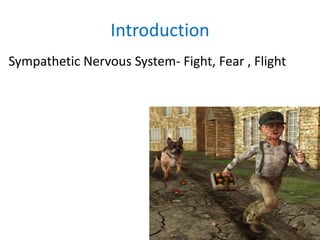
Sympathetic Nervous System- Fight, Fear , Flight
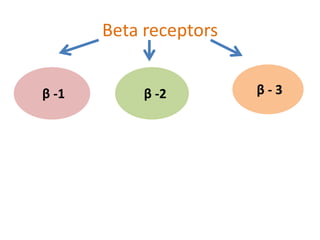
Beta receptors
β -1 β -2 β - 3
Beta Receptor
Blockers
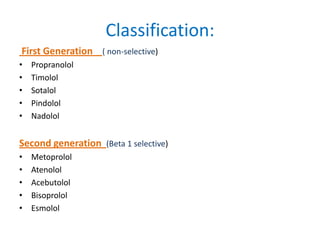
Classification:
First Generation ( non-selective)
• Propranolol
• Timolol
• Sotalol
• Pindolol
• Nadolol
Second generation (Beta 1 selective)
• Metoprolol
• Atenolol
• Acebutolol
• Bisoprolol
• Esmolol
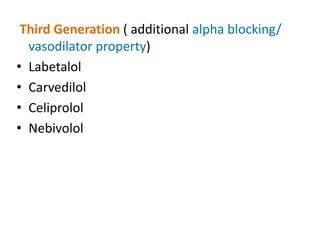
Third Generation ( additional alpha blocking/
vasodilator property)
• Labetalol
• Carvedilol
• Celiprolol
• Nebivolol
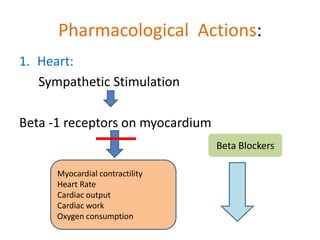
Pharmacological Actions:
1. Heart:
Sympathetic Stimulation
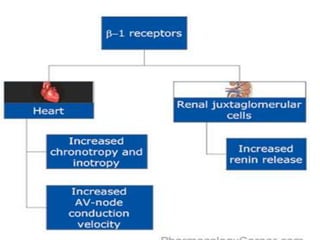
Beta -1 receptors on myocardium
Myocardial contractility
Heart Rate
Cardiac output
Cardiac work
Oxygen consumption
Beta Blockers
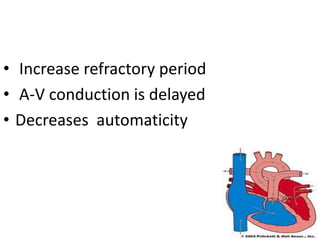
• Increase refractory period
• A-V conduction is delayed
• Decreases automaticity
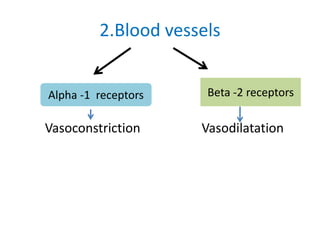
2.Blood vessels
Vasoconstriction Vasodilatation
Alpha -1 receptors Beta -2 receptors
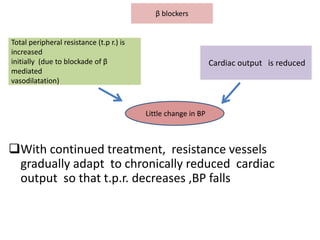
With continued treatment, resistance vessels
gradually adapt to chronically reduced cardiac
output so that t.p.r. decreases ,BP falls
Total peripheral resistance (t.p r.) is
increased
initially (due to blockade of β
mediated
vasodilatation)
Cardiac output is reduced
Little change in BP
β blockers
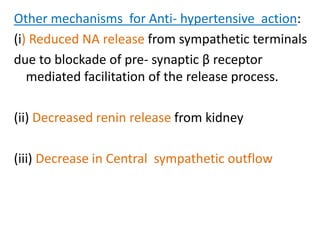
Other mechanisms for Anti- hypertensive action:
(i) Reduced NA release from sympathetic terminals
due to blockade of pre- synaptic β receptor
mediated facilitation of the release process.
(ii) Decreased renin release from kidney
(iii) Decrease in Central sympathetic outflow
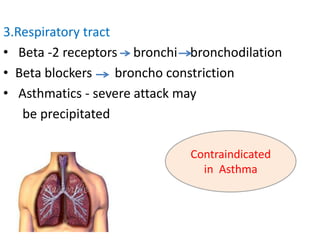
3.Respiratory tract
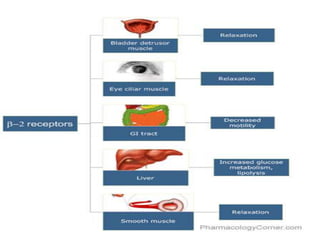
• Beta -2 receptors bronchi bronchodilation
• Beta blockers broncho constriction
• Asthmatics - severe attack may
be precipitated
Contraindicated
in Asthma
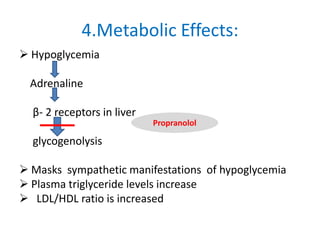
4.Metabolic Effects:
 Hypoglycemia
Adrenaline
β- 2 receptors in liver
glycogenolysis
 Masks sympathetic manifestations of hypoglycemia
 Plasma triglyceride levels increase
 LDL/HDL ratio is increased
Propranolol
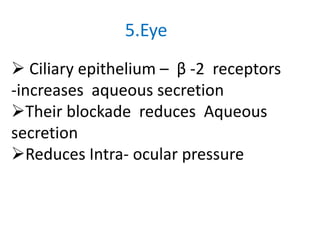
5.Eye
 Ciliary epithelium – β -2 receptors
-increases aqueous secretion
Their blockade reduces Aqueous
secretion
Reduces Intra- ocular pressure
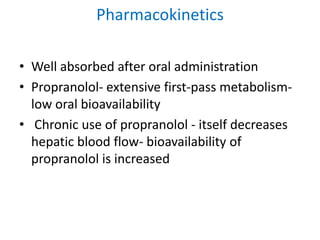
Pharmacokinetics
• Well absorbed after oral administration
• Propranolol- extensive first-pass metabolism-
low oral bioavailability
• Chronic use of propranolol - itself decreases
hepatic blood flow- bioavailability of
propranolol is increased
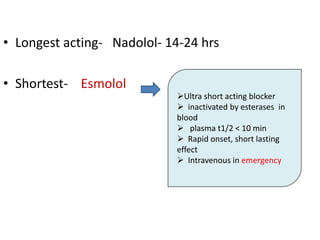
• Longest acting- Nadolol- 14-24 hrs
• Shortest- Esmolol
Ultra short acting blocker
 inactivated by esterases in
blood
 plasma t1/2 < 10 min
 Rapid onset, short lasting
effect
 Intravenous in emergency
Lipid insoluble( Atenolol, Sotalol)
• Less CNS side effects
• Less first pass metabolism
• Long t ½- 6- 20 hrs
Drugs with partial agonistic activity
• intrinsic sympathomimetic action
• Pindolol, Acebutolol
1. Less Bradycardia
preferred in those prone to severe bradycardia
2. Withdrawal is less likely to exacerbate hypertension or
angina
3. Plasma lipid profile is not worsened
Advantages of Cardio selective Beta
blockers over non -selective blockers:
1. safer in asthmatics
2. safer in diabetics
3 .Peripheral vascular disease
4. less deleterious effect on lipid profile
5. Less liable to impair exercise capacity
Therapeutic uses
Cardiovascular uses Non-cardiovascular uses
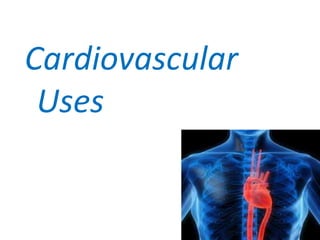
Cardiovascular
Uses
1.Hypertension:
• Past- recommended as first-line therapy
• Present status - benefits have been
overshadowed by their side-effect profile
•sexual dysfunction
•fatigue
• depression
• metabolic abnormalities
Consider Beta blocker if:
 intolerance or contraindication to ACE
inhibitors/angiotensin II receptor antagonists
With increased sympathetic drive- HTN with
tachycardia
Tense young patient
Post MI
• Atenolol 25–100 mg
• Metoprolol 25–100 mg
• Propranolol 40–160 mg
• Labetalol 200–800 mg
• Carvedilol 12.5–50 mg
• Combined with Calcium channel blockers-
check reflex tachycardia
 Atenolol
-Most commonly used
- Selective β-1 blocker
- Low lipid solubility.
-Does not cross BBB- CNS ADR are less
-Longer duration of action, OD dosing
 Metoprolol
-Cardioselective Beta 1 blocker
-Can be used in Diabetics with HTN, CHF
Hypertensive Emergency:
Systolic BP >180 mm of Hg
Diastolic BP > 120 mm of Hg
Treatment:
1.Sodium nitroprusside- DOC
2.Glyceryl trinitrate
3. Esmolol
0.25-0.5 mg/kg IV over 1 min, then 0.05-0.1
mg/kg/min IV for 4 min
4.Labetalol
Labetolol
• 3rd generation
• Alpha -1 blocker
• β -1 blocker
• Partial agonist β -2
(Vasodilation,Bronchodilation)
Uses:
• Hypertensive emergencies
• Pheochromocytoma
• Pregnancy induced hypertension
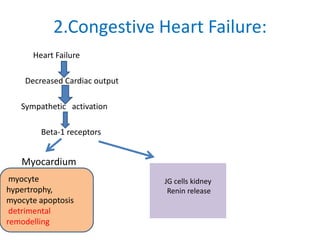
2.Congestive Heart Failure:
Heart Failure
Decreased Cardiac output
Sympathetic activation
Beta-1 receptors
Myocardium
myocyte
hypertrophy,
myocyte apoptosis
detrimental
remodelling
JG cells kidney
Renin release
β blocker in CHF -proper patient selection :
 mild to moderate (NYHA class II, III ) cases of
dilated cardiomyopathy with systolic
dysfunction
No place in decompensated patients.
 Stopped during an episode of acute heart
failure
Starting dose -very low -then titrated
upward
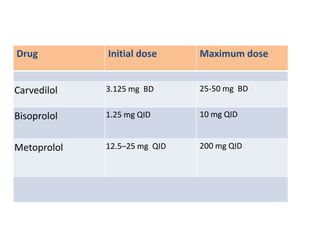
Drug Initial dose Maximum dose
Carvedilol 3.125 mg BD 25-50 mg BD
Bisoprolol 1.25 mg QID 10 mg QID
Metoprolol 12.5–25 mg QID 200 mg QID
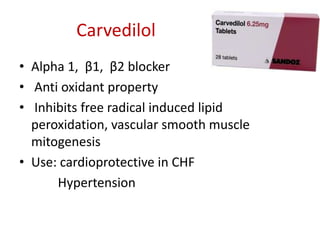
Carvedilol
• Alpha 1, β1, β2 blocker
• Anti oxidant property
• Inhibits free radical induced lipid
peroxidation, vascular smooth muscle
mitogenesis
• Use: cardioprotective in CHF
Hypertension
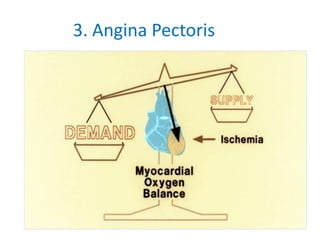
3. Angina Pectoris
Beta blockers Decrease cardiac work load
Decrease myocardial oxygen demand
 Angina of effort (Classical Angina)
Combined with nitrates for chronic prophylaxis
Cardioselective-
Metoprolol 25- 100 mg
Atenolol 25- 100 mg
Abrupt withdrawal- precipitate Angina / MI- up
regulation of beta receptors
Contraindicated in Prinzmetals angina
4.Myocardial Infarction
a. Myocardial salvage during evolution of MI
β blockers-
(i) limit infarct size by reducing oxygen consumption, prevents
re- infarction
(ii) prevent arrhythmias including ventricular fibrillation
• Not given if-
- Heart rate < 60/min
- Systolic BP < 90 mm Hg
- PR interval > 0.24 sec
- LVF
• Within 4-6 hrs Metoprolol- 5 mg i.v every 5 mins – 3 doses
• Metoprolol 25–50 mg orally every 6 h
b. Secondary prophylaxis of MI :
Decrease subsequent mortality by 20%.
(i) By preventing re-infarction
(ii) By preventing sudden ventricular fibrillation
at the second attack of MI
• β- 1 selective antagonist –Atenolol ,
Carvedilol
• Atleast for 2 years
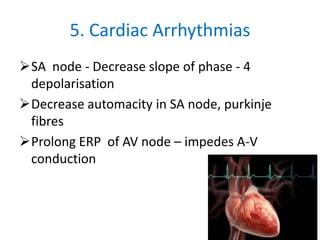
5. Cardiac Arrhythmias
SA node - Decrease slope of phase - 4
depolarisation
Decrease automacity in SA node, purkinje
fibres
Prolong ERP of AV node – impedes A-V
conduction
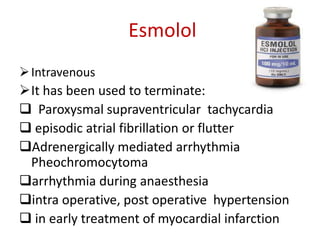
Esmolol
Intravenous
It has been used to terminate:
 Paroxysmal supraventricular tachycardia
 episodic atrial fibrillation or flutter
Adrenergically mediated arrhythmia
Pheochromocytoma
arrhythmia during anaesthesia
intra operative, post operative hypertension
 in early treatment of myocardial infarction
 Sotalol
• Additional K channel blocking
• Class III anti-arrhythmic
Acebutolol- 20- 40mg
Propranolol - 40 – 80 mg
6.Dissecting aortic aneurysm
• Intravenous Propranolol, Metoprolol-
maintain heart rate of approximately 60
beats/min
7.Hypertrophic obstructive cardiomyopathy
 Subaortic region is hypertrophic
 Forceful contraction of this region under
sympathetic stimulation (exercise, emotion)
increases outflow resistance
8. Mitral valve prolapse
Non- cardiovascular
uses
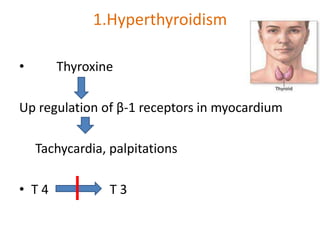
1.Hyperthyroidism
• Thyroxine
Up regulation of β-1 receptors in myocardium
Tachycardia, palpitations
• T 4 T 3
β blockers given -
(i) with carbimazole or radioiodine
(ii) with iodide preoperatively
(iii) Thyroid storm (thyrotoxic crisis): emergency
Propranolol- 1-2 mg slow i.v. 40-80 mg
orally
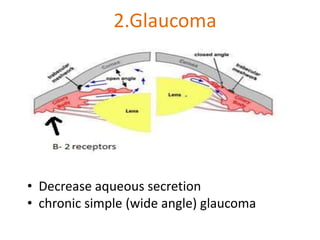
2.Glaucoma
• Decrease aqueous secretion
• chronic simple (wide angle) glaucoma
Advantages of topical β- blockers over
Miotics
No
change in pupil size
 myopia
 headache
fluctuations in i.o.t
 convenient OD / BD dosing
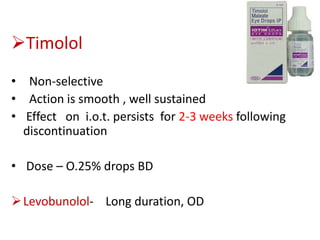
Timolol
• Non-selective
• Action is smooth , well sustained
• Effect on i.o.t. persists for 2-3 weeks following
discontinuation
• Dose – O.25% drops BD
Levobunolol- Long duration, OD
Side effects
• Redness and dryness of eye
• Allergic blepharoconjunctivitis
• Corneal hypoesthesia
• Systemic side effects- threatening
bronchospasm- asthmatics, bradycardia
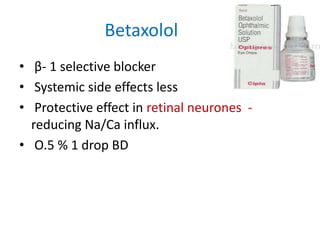
Betaxolol
• β- 1 selective blocker
• Systemic side effects less
• Protective effect in retinal neurones -
reducing Na/Ca influx.
• O.5 % 1 drop BD
3. Pheochromocytoma:
• Adrenal gland tumour
Excess catecholamines
hypertension, tachycardia
• First alpha blocker is given then Beta blocker
otherwise dangerous rise in BP can occur
4. Migraine
• Prophylaxis
• severe migraine
• Propranolol
- most effective drug
- reduces frequency, severity of attacks- in 70%
patients
- Effect seen in 4 weeks
-Dose- 40 mg BD to 160 mg BD
• Others- timolol, metoprolol,atenolol
5.Anxiety
- Stage fright, Nervousness, panic
- Propranolol- 10- 20 mg BD
6. Alcohol Withdrawal
7.Oesophageal variceal bleeding and
portal hypertension
-Nadolol + isosorbide mononitrate
Contraindications
1. Asthma, COPD
2. Prinzmetals angina
3. Bradycardia
Heart Block
Acute decompensated heart failure
4. Peripheral Vascular disease
Adverse Effects
1 . Adverse Lipid profile-
total TG and LDL- cholesterol increase
 HDL- cholesterol falls.
Cardioselective β blockers - little/no
deleterious effect on blood lipids
2.Fatigue and reduced exercise capacity
3.CNS side effects
sleep disturbance, bad dreams, sexual dysfunction
4.Hypoglycemia
-Masks sympathetic symptoms of hypoglycemia
5.Rebound Hypertension
-Chronic therapy up regulation of Beta receptors
-sudden withdrawal rebound hypertension
-Gradually tapered and Withdrawn
6. Miscellaneous:
Labetalol- postural hypotension, Hepatoxicity
Beta blocker Overdose
• Glucagon
- specific antidote
-positive inotropic action on the heart
• Cardiac pacing
• If bronchospasm occurs- Ipratopium
• Other antidotes –Salbutamol
and Isoprenaline
Celiprolol
• Selective β1 blocker
• Weak β2 agonistic activity
• Nitric oxide release ,vasodilatation
• No deleterious effects on lipid profile
• Safe in asthmatics
• Hypertension, Angina
• Dose:200mg OD -400mg OD
Nebivolol
• highly selective β1 blocker
• Nitric oxide release, vasodilatation
• Use: Hypertension
• Dose - 2.5 mg OD
Newer uses:
• Post traumatic stress disorder
• Agoraphobia
Uses under study:
• Propranolol -for orbital , periorbital hemangiomas in infants
• Breast cancer
• Pindolol- depression
New β blockers:
• Nipradilol (nonselective β-receptor and
selective α1-receptor blocking properties,
glaucoma)
• Dilevalol ( stereoisomer of Labetalol)- HTN
• Bopindolol
• Butoxamine
-Selective β 2 blocker
- Experimental drug
Summary
• Therapeutically important class of drugs
To summarise:
• Heart failure- Carvedilol
• Hypertension- Atenolol
• Emergency - Esmolol
• Migraine - Propranolol
• Glaucoma - Timolol
References
1.T. Westfall, D. Westfall, Adrenergic agonists & antagonists, Goodman &
Gilman’s The Pharmacological basis of Therapeutics, 12 th edition,
2006, Pg 237-296
2.HL, KK Sharma. Principles of Pharmacology. 2nd ed. Pg 185- 190
3.K. D. Tripathi, Adrenergic and Antiadrenergic drugs, Essentials of Medical
Pharmacology,6th edition, 2008, Pg 134-148
4.Longo, Fausi, Kasper. Harrisons principles of Internal Medicine, 18TH ed.
5.NICE clinical guideline 127.Developed by the Newcastle Guideline
Development and Research Unit and updated by the National Clinical
Guideline Centre and the British Hypertension Society. Hypertension
Clinical management of primary hypertension in adult
6.Kenji Inoue,Kei Noguchi, Masato Wakakura,Goji Tomita .Effect of five years of
treatment with nipradilol eye drops in patients with normal tension
glaucoma
7.Lalonde RL, Tenero DM, Kazierad .Dilevalol: an overview of its clinical
pharmacology and therapeutic use in hypertension
Beta blockers

Beta blockers

  • 1.
    Beta Receptor Blockers Dr.Ritu Budania MBBS, MD
  • 2.
    Overview • Introduction • Classification •Pharmacological actions • Pharmacokinetics • Therapeutic uses • Adverse effects & Contraindications • Recent advances • Summary
  • 3.
  • 4.
  • 7.
  • 8.
    Classification: First Generation (non-selective) • Propranolol • Timolol • Sotalol • Pindolol • Nadolol Second generation (Beta 1 selective) • Metoprolol • Atenolol • Acebutolol • Bisoprolol • Esmolol
  • 9.
    Third Generation (additional alpha blocking/ vasodilator property) • Labetalol • Carvedilol • Celiprolol • Nebivolol
  • 10.
    Pharmacological Actions: 1. Heart: SympatheticStimulation Beta -1 receptors on myocardium Myocardial contractility Heart Rate Cardiac output Cardiac work Oxygen consumption Beta Blockers
  • 11.
    • Increase refractoryperiod • A-V conduction is delayed • Decreases automaticity
  • 12.
  • 13.
    With continued treatment,resistance vessels gradually adapt to chronically reduced cardiac output so that t.p.r. decreases ,BP falls Total peripheral resistance (t.p r.) is increased initially (due to blockade of β mediated vasodilatation) Cardiac output is reduced Little change in BP β blockers
  • 14.
    Other mechanisms forAnti- hypertensive action: (i) Reduced NA release from sympathetic terminals due to blockade of pre- synaptic β receptor mediated facilitation of the release process. (ii) Decreased renin release from kidney (iii) Decrease in Central sympathetic outflow
  • 15.
    3.Respiratory tract • Beta-2 receptors bronchi bronchodilation • Beta blockers broncho constriction • Asthmatics - severe attack may be precipitated Contraindicated in Asthma
  • 16.
    4.Metabolic Effects:  Hypoglycemia Adrenaline β-2 receptors in liver glycogenolysis  Masks sympathetic manifestations of hypoglycemia  Plasma triglyceride levels increase  LDL/HDL ratio is increased Propranolol
  • 17.
    5.Eye  Ciliary epithelium– β -2 receptors -increases aqueous secretion Their blockade reduces Aqueous secretion Reduces Intra- ocular pressure
  • 18.
    Pharmacokinetics • Well absorbedafter oral administration • Propranolol- extensive first-pass metabolism- low oral bioavailability • Chronic use of propranolol - itself decreases hepatic blood flow- bioavailability of propranolol is increased
  • 19.
    • Longest acting-Nadolol- 14-24 hrs • Shortest- Esmolol Ultra short acting blocker  inactivated by esterases in blood  plasma t1/2 < 10 min  Rapid onset, short lasting effect  Intravenous in emergency
  • 20.
    Lipid insoluble( Atenolol,Sotalol) • Less CNS side effects • Less first pass metabolism • Long t ½- 6- 20 hrs
  • 21.
    Drugs with partialagonistic activity • intrinsic sympathomimetic action • Pindolol, Acebutolol 1. Less Bradycardia preferred in those prone to severe bradycardia 2. Withdrawal is less likely to exacerbate hypertension or angina 3. Plasma lipid profile is not worsened
  • 22.
    Advantages of Cardioselective Beta blockers over non -selective blockers: 1. safer in asthmatics 2. safer in diabetics 3 .Peripheral vascular disease 4. less deleterious effect on lipid profile 5. Less liable to impair exercise capacity
  • 23.
    Therapeutic uses Cardiovascular usesNon-cardiovascular uses
  • 24.
  • 25.
    1.Hypertension: • Past- recommendedas first-line therapy • Present status - benefits have been overshadowed by their side-effect profile •sexual dysfunction •fatigue • depression • metabolic abnormalities
  • 26.
    Consider Beta blockerif:  intolerance or contraindication to ACE inhibitors/angiotensin II receptor antagonists With increased sympathetic drive- HTN with tachycardia Tense young patient Post MI
  • 27.
    • Atenolol 25–100mg • Metoprolol 25–100 mg • Propranolol 40–160 mg • Labetalol 200–800 mg • Carvedilol 12.5–50 mg • Combined with Calcium channel blockers- check reflex tachycardia
  • 28.
     Atenolol -Most commonlyused - Selective β-1 blocker - Low lipid solubility. -Does not cross BBB- CNS ADR are less -Longer duration of action, OD dosing  Metoprolol -Cardioselective Beta 1 blocker -Can be used in Diabetics with HTN, CHF
  • 29.
    Hypertensive Emergency: Systolic BP>180 mm of Hg Diastolic BP > 120 mm of Hg Treatment: 1.Sodium nitroprusside- DOC 2.Glyceryl trinitrate 3. Esmolol 0.25-0.5 mg/kg IV over 1 min, then 0.05-0.1 mg/kg/min IV for 4 min 4.Labetalol
  • 30.
    Labetolol • 3rd generation •Alpha -1 blocker • β -1 blocker • Partial agonist β -2 (Vasodilation,Bronchodilation) Uses: • Hypertensive emergencies • Pheochromocytoma • Pregnancy induced hypertension
  • 31.
    2.Congestive Heart Failure: HeartFailure Decreased Cardiac output Sympathetic activation Beta-1 receptors Myocardium myocyte hypertrophy, myocyte apoptosis detrimental remodelling JG cells kidney Renin release
  • 32.
    β blocker inCHF -proper patient selection :  mild to moderate (NYHA class II, III ) cases of dilated cardiomyopathy with systolic dysfunction No place in decompensated patients.  Stopped during an episode of acute heart failure Starting dose -very low -then titrated upward
  • 33.
    Drug Initial doseMaximum dose Carvedilol 3.125 mg BD 25-50 mg BD Bisoprolol 1.25 mg QID 10 mg QID Metoprolol 12.5–25 mg QID 200 mg QID
  • 34.
    Carvedilol • Alpha 1,β1, β2 blocker • Anti oxidant property • Inhibits free radical induced lipid peroxidation, vascular smooth muscle mitogenesis • Use: cardioprotective in CHF Hypertension
  • 35.
  • 36.
    Beta blockers Decreasecardiac work load Decrease myocardial oxygen demand  Angina of effort (Classical Angina)
  • 37.
    Combined with nitratesfor chronic prophylaxis Cardioselective- Metoprolol 25- 100 mg Atenolol 25- 100 mg Abrupt withdrawal- precipitate Angina / MI- up regulation of beta receptors Contraindicated in Prinzmetals angina
  • 38.
    4.Myocardial Infarction a. Myocardialsalvage during evolution of MI β blockers- (i) limit infarct size by reducing oxygen consumption, prevents re- infarction (ii) prevent arrhythmias including ventricular fibrillation • Not given if- - Heart rate < 60/min - Systolic BP < 90 mm Hg - PR interval > 0.24 sec - LVF • Within 4-6 hrs Metoprolol- 5 mg i.v every 5 mins – 3 doses • Metoprolol 25–50 mg orally every 6 h
  • 39.
    b. Secondary prophylaxisof MI : Decrease subsequent mortality by 20%. (i) By preventing re-infarction (ii) By preventing sudden ventricular fibrillation at the second attack of MI • β- 1 selective antagonist –Atenolol , Carvedilol • Atleast for 2 years
  • 40.
    5. Cardiac Arrhythmias SAnode - Decrease slope of phase - 4 depolarisation Decrease automacity in SA node, purkinje fibres Prolong ERP of AV node – impedes A-V conduction
  • 41.
    Esmolol Intravenous It has beenused to terminate:  Paroxysmal supraventricular tachycardia  episodic atrial fibrillation or flutter Adrenergically mediated arrhythmia Pheochromocytoma arrhythmia during anaesthesia intra operative, post operative hypertension  in early treatment of myocardial infarction
  • 42.
     Sotalol • AdditionalK channel blocking • Class III anti-arrhythmic Acebutolol- 20- 40mg Propranolol - 40 – 80 mg
  • 43.
    6.Dissecting aortic aneurysm •Intravenous Propranolol, Metoprolol- maintain heart rate of approximately 60 beats/min
  • 44.
    7.Hypertrophic obstructive cardiomyopathy Subaortic region is hypertrophic  Forceful contraction of this region under sympathetic stimulation (exercise, emotion) increases outflow resistance 8. Mitral valve prolapse
  • 45.
  • 46.
    1.Hyperthyroidism • Thyroxine Up regulationof β-1 receptors in myocardium Tachycardia, palpitations • T 4 T 3
  • 47.
    β blockers given- (i) with carbimazole or radioiodine (ii) with iodide preoperatively (iii) Thyroid storm (thyrotoxic crisis): emergency Propranolol- 1-2 mg slow i.v. 40-80 mg orally
  • 48.
    2.Glaucoma • Decrease aqueoussecretion • chronic simple (wide angle) glaucoma
  • 49.
    Advantages of topicalβ- blockers over Miotics No change in pupil size  myopia  headache fluctuations in i.o.t  convenient OD / BD dosing
  • 50.
    Timolol • Non-selective • Actionis smooth , well sustained • Effect on i.o.t. persists for 2-3 weeks following discontinuation • Dose – O.25% drops BD Levobunolol- Long duration, OD
  • 51.
    Side effects • Rednessand dryness of eye • Allergic blepharoconjunctivitis • Corneal hypoesthesia • Systemic side effects- threatening bronchospasm- asthmatics, bradycardia
  • 52.
    Betaxolol • β- 1selective blocker • Systemic side effects less • Protective effect in retinal neurones - reducing Na/Ca influx. • O.5 % 1 drop BD
  • 53.
    3. Pheochromocytoma: • Adrenalgland tumour Excess catecholamines hypertension, tachycardia • First alpha blocker is given then Beta blocker otherwise dangerous rise in BP can occur
  • 54.
    4. Migraine • Prophylaxis •severe migraine • Propranolol - most effective drug - reduces frequency, severity of attacks- in 70% patients - Effect seen in 4 weeks -Dose- 40 mg BD to 160 mg BD • Others- timolol, metoprolol,atenolol
  • 55.
    5.Anxiety - Stage fright,Nervousness, panic - Propranolol- 10- 20 mg BD
  • 56.
    6. Alcohol Withdrawal 7.Oesophagealvariceal bleeding and portal hypertension -Nadolol + isosorbide mononitrate
  • 57.
    Contraindications 1. Asthma, COPD 2.Prinzmetals angina 3. Bradycardia Heart Block Acute decompensated heart failure 4. Peripheral Vascular disease
  • 58.
    Adverse Effects 1 .Adverse Lipid profile- total TG and LDL- cholesterol increase  HDL- cholesterol falls. Cardioselective β blockers - little/no deleterious effect on blood lipids 2.Fatigue and reduced exercise capacity
  • 59.
    3.CNS side effects sleepdisturbance, bad dreams, sexual dysfunction 4.Hypoglycemia -Masks sympathetic symptoms of hypoglycemia 5.Rebound Hypertension -Chronic therapy up regulation of Beta receptors -sudden withdrawal rebound hypertension -Gradually tapered and Withdrawn 6. Miscellaneous: Labetalol- postural hypotension, Hepatoxicity
  • 60.
    Beta blocker Overdose •Glucagon - specific antidote -positive inotropic action on the heart • Cardiac pacing • If bronchospasm occurs- Ipratopium • Other antidotes –Salbutamol and Isoprenaline
  • 61.
    Celiprolol • Selective β1blocker • Weak β2 agonistic activity • Nitric oxide release ,vasodilatation • No deleterious effects on lipid profile • Safe in asthmatics • Hypertension, Angina • Dose:200mg OD -400mg OD
  • 62.
    Nebivolol • highly selectiveβ1 blocker • Nitric oxide release, vasodilatation • Use: Hypertension • Dose - 2.5 mg OD
  • 63.
    Newer uses: • Posttraumatic stress disorder • Agoraphobia Uses under study: • Propranolol -for orbital , periorbital hemangiomas in infants • Breast cancer • Pindolol- depression
  • 64.
    New β blockers: •Nipradilol (nonselective β-receptor and selective α1-receptor blocking properties, glaucoma) • Dilevalol ( stereoisomer of Labetalol)- HTN • Bopindolol
  • 65.
    • Butoxamine -Selective β2 blocker - Experimental drug
  • 66.
    Summary • Therapeutically importantclass of drugs To summarise: • Heart failure- Carvedilol • Hypertension- Atenolol • Emergency - Esmolol • Migraine - Propranolol • Glaucoma - Timolol
  • 67.
    References 1.T. Westfall, D.Westfall, Adrenergic agonists & antagonists, Goodman & Gilman’s The Pharmacological basis of Therapeutics, 12 th edition, 2006, Pg 237-296 2.HL, KK Sharma. Principles of Pharmacology. 2nd ed. Pg 185- 190 3.K. D. Tripathi, Adrenergic and Antiadrenergic drugs, Essentials of Medical Pharmacology,6th edition, 2008, Pg 134-148 4.Longo, Fausi, Kasper. Harrisons principles of Internal Medicine, 18TH ed. 5.NICE clinical guideline 127.Developed by the Newcastle Guideline Development and Research Unit and updated by the National Clinical Guideline Centre and the British Hypertension Society. Hypertension Clinical management of primary hypertension in adult
  • 68.
    6.Kenji Inoue,Kei Noguchi,Masato Wakakura,Goji Tomita .Effect of five years of treatment with nipradilol eye drops in patients with normal tension glaucoma 7.Lalonde RL, Tenero DM, Kazierad .Dilevalol: an overview of its clinical pharmacology and therapeutic use in hypertension