WHAT IS
PARAGRAPH
INDENT PARAGRAPHS
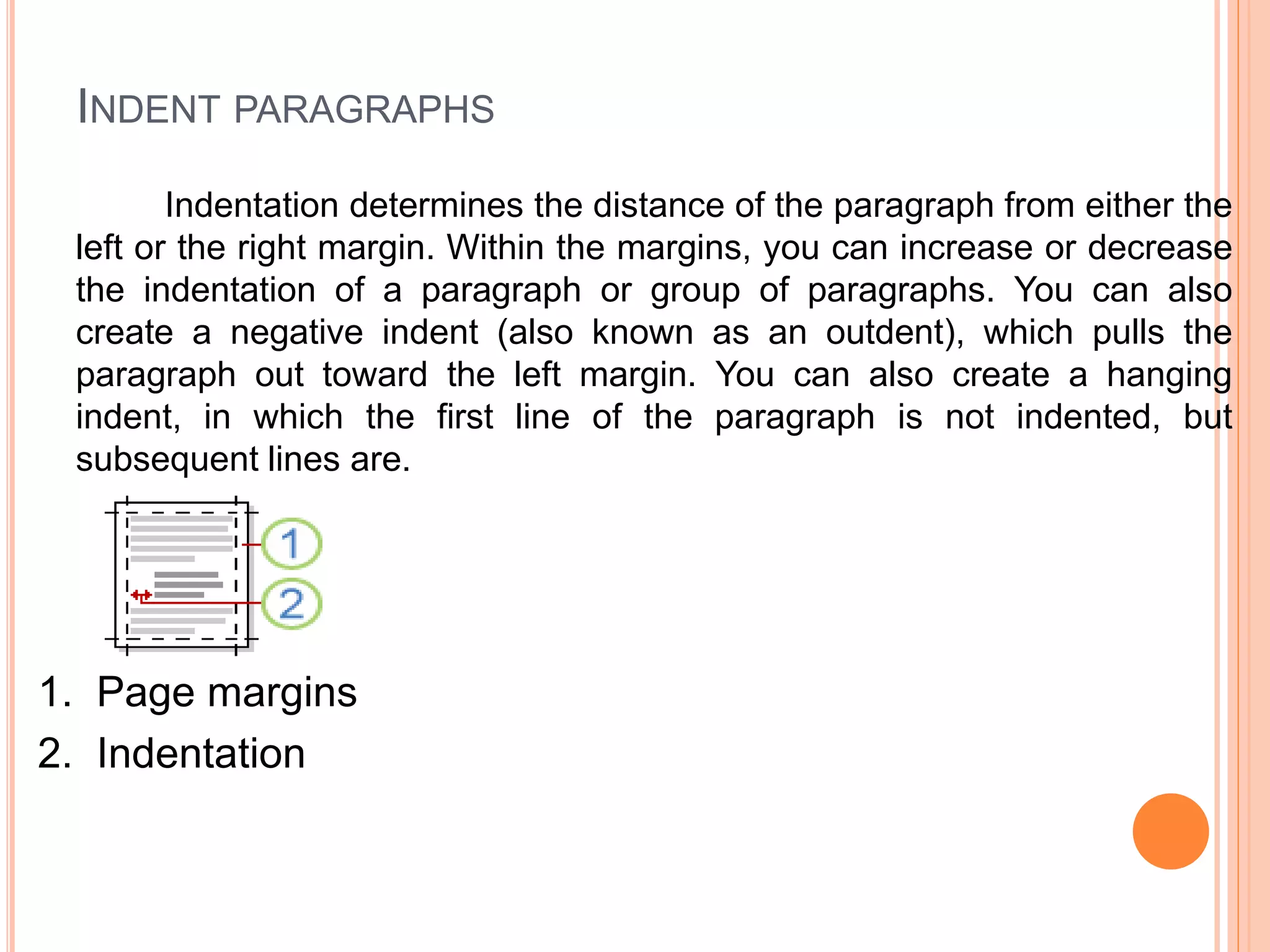
Indentation determines the distance of the paragraph from either the
left or the right margin. Within the margins, you can increase or decrease
the indentation of a paragraph or group of paragraphs. You can also
create a negative indent (also known as an outdent), which pulls the
paragraph out toward the left margin. You can also create a hanging
indent, in which the first line of the paragraph is not indented, but
subsequent lines are.
1. Page margins
2. Indentation
PARAGRAPH LENGTH
When it comes to length, there is no definitive rule to follow when
writing a paragraph for an essay. Some paragraphs may be short while
others are longer. (Generally, a paragraph should be at least four
sentences.) Either way, it is important that the length of a paragraph in an
essay matches the length of the essay. In other words, shorter essays
generally require shorter paragraphs, while longer essays often require
longer paragraphs that contain more information about a particular main
point.
The basic rule for determining paragraph length is to keep each
paragraph to only one main idea. If a paragraph contains multiple ideas, it is
likely that the ideas aren’t fully explained or supported (in other words, the
paragraph isn’t fully developed). Instead, it is beneficial to keep the
paragraph to one main idea in which most of the paragraph is dedicated to
supporting this idea through a variety of evidence: examples, illustrations,
statistics, quotes, paraphrases, causes, effects, and/or definitions, as
necessary.
If a paragraph begins with one idea and seems to end with another, it
has lost its focus. When this happens, check the topic sentence for
effectiveness and make sure everything that follows relates to it.
THREE COMPONENTS OF A GOOD PARAGRAPH
 Structure
All paragraphs have the same general structure. You will begin
with a topic sentence that gives the reader a general idea of what
your paragraph will cover. Next, you will have supporting sentences
that expand on the main idea presented in the topic sentence. To do
this, you may need to use research or give examples. Last, you will
have a concluding sentence that wraps up the paragraph. Without this
basic structure, the paragraph will not have a logical flow, making it
difficult to understand.
 Transitions
Paragraphs often require a transition phrase in the topic
sentence, concluding sentence or both sentences. This helps your
reader know that you will move from one piece of information to the
next, improving the clarity of your writing. These phrases also help
your reader see connections between data and examples. Some
common transitions might include “in contrast,” “for instance” or “in
conclusion.” You can also use sequential transitions for paragraphs
with a series of examples, such as “first,” “second” and “lastly.” These
types of transitions act as guideposts for your reader, helping her
navigate your essay.
 Content
To create a good paragraph, you also need quality content.
Do not try to fill an essay or research paper by repeating what
you already presented or including irrelevant information. If you
cannot find enough information to fill your paper, you may need
to rethink your topic or approach it from a different angle. As
well, you should make sure that you use research from quality
sources to show the credibility of the content.
 Evaluating Components
Once you finish writing, whether two paragraphs or a multi-
paragraph paper, you need to evaluate what you have. Although
you need to look at each paragraph component individually to
make sure it works well, read your entire essay to evaluate the
strength of your paragraphs. Ask yourself if it reads logically. Do
the paragraphs flow easily from one to the next with the use of
transitions? Do you have paragraphs that repeat information?
Did you quote your references and cite them as needed? When
you have strong paragraphs, your essay should read easily and
your reader should have a better understanding of the topic
when she puts down your paper.
CHARACTERISTICS OF A GOOD PARAGRAPH?
A good paragraph is characterised by a topic sentence, which includes
the topic and a controlling idea. Other characteristics include: supporting
ideas, optional concluding sentences as well as good coherenence. It should
also give details for and explain the supporting ideas further.
So you're writing a paragraph for an essay or for work and you want it
to be good? Here are the characteristics of a good paragraph: First, you need
a topic sentence. This includes the topic and purpose of your paragraph.
Second, you need supporting ideas. You should have about three to six of
these. The supporting ideas support the topic sentence. They explain and
describe the topic.
Third, you should have RENNS in your paragraph. RENNS stands for
reasons, examples, names, numbers, and sense. These further explain the
supporting ideas. Forth, you should have a concluding sentence. This is
optional, but it is highly recommended. It leaves the reader with something to
think about and it summarizes the supporting ideas. Fifth, all the sentences in
the paragraph should directly support the topic. Last, make sure that the
paragraph is well organized and easy to follow.
THANKS FOR YOUR ATTENTION
SEE YOU

What is paragraph

  • 1.
  • 2.
    INDENT PARAGRAPHS Indentation determinesthe distance of the paragraph from either the left or the right margin. Within the margins, you can increase or decrease the indentation of a paragraph or group of paragraphs. You can also create a negative indent (also known as an outdent), which pulls the paragraph out toward the left margin. You can also create a hanging indent, in which the first line of the paragraph is not indented, but subsequent lines are. 1. Page margins 2. Indentation
  • 3.
    PARAGRAPH LENGTH When itcomes to length, there is no definitive rule to follow when writing a paragraph for an essay. Some paragraphs may be short while others are longer. (Generally, a paragraph should be at least four sentences.) Either way, it is important that the length of a paragraph in an essay matches the length of the essay. In other words, shorter essays generally require shorter paragraphs, while longer essays often require longer paragraphs that contain more information about a particular main point. The basic rule for determining paragraph length is to keep each paragraph to only one main idea. If a paragraph contains multiple ideas, it is likely that the ideas aren’t fully explained or supported (in other words, the paragraph isn’t fully developed). Instead, it is beneficial to keep the paragraph to one main idea in which most of the paragraph is dedicated to supporting this idea through a variety of evidence: examples, illustrations, statistics, quotes, paraphrases, causes, effects, and/or definitions, as necessary. If a paragraph begins with one idea and seems to end with another, it has lost its focus. When this happens, check the topic sentence for effectiveness and make sure everything that follows relates to it.
  • 4.
    THREE COMPONENTS OFA GOOD PARAGRAPH  Structure All paragraphs have the same general structure. You will begin with a topic sentence that gives the reader a general idea of what your paragraph will cover. Next, you will have supporting sentences that expand on the main idea presented in the topic sentence. To do this, you may need to use research or give examples. Last, you will have a concluding sentence that wraps up the paragraph. Without this basic structure, the paragraph will not have a logical flow, making it difficult to understand.  Transitions Paragraphs often require a transition phrase in the topic sentence, concluding sentence or both sentences. This helps your reader know that you will move from one piece of information to the next, improving the clarity of your writing. These phrases also help your reader see connections between data and examples. Some common transitions might include “in contrast,” “for instance” or “in conclusion.” You can also use sequential transitions for paragraphs with a series of examples, such as “first,” “second” and “lastly.” These types of transitions act as guideposts for your reader, helping her navigate your essay.
  • 5.
     Content To createa good paragraph, you also need quality content. Do not try to fill an essay or research paper by repeating what you already presented or including irrelevant information. If you cannot find enough information to fill your paper, you may need to rethink your topic or approach it from a different angle. As well, you should make sure that you use research from quality sources to show the credibility of the content.  Evaluating Components Once you finish writing, whether two paragraphs or a multi- paragraph paper, you need to evaluate what you have. Although you need to look at each paragraph component individually to make sure it works well, read your entire essay to evaluate the strength of your paragraphs. Ask yourself if it reads logically. Do the paragraphs flow easily from one to the next with the use of transitions? Do you have paragraphs that repeat information? Did you quote your references and cite them as needed? When you have strong paragraphs, your essay should read easily and your reader should have a better understanding of the topic when she puts down your paper.
  • 6.
    CHARACTERISTICS OF AGOOD PARAGRAPH? A good paragraph is characterised by a topic sentence, which includes the topic and a controlling idea. Other characteristics include: supporting ideas, optional concluding sentences as well as good coherenence. It should also give details for and explain the supporting ideas further. So you're writing a paragraph for an essay or for work and you want it to be good? Here are the characteristics of a good paragraph: First, you need a topic sentence. This includes the topic and purpose of your paragraph. Second, you need supporting ideas. You should have about three to six of these. The supporting ideas support the topic sentence. They explain and describe the topic. Third, you should have RENNS in your paragraph. RENNS stands for reasons, examples, names, numbers, and sense. These further explain the supporting ideas. Forth, you should have a concluding sentence. This is optional, but it is highly recommended. It leaves the reader with something to think about and it summarizes the supporting ideas. Fifth, all the sentences in the paragraph should directly support the topic. Last, make sure that the paragraph is well organized and easy to follow.
  • 7.
    THANKS FOR YOURATTENTION SEE YOU