Sta.Elena(Camarines Norte)College,Inc.
Subject: Writing in the Discipline
Reporter: Group I Member
Cairel C.Capoy
Emeliza H. Gravador
Sheryll C. Salindo
Instructor: Mrs. Mary Joy Devine L. merciales
The Paragraph and Its Elements
NATURE AND DEFINITION
Paragraph-
comes from the Greek word paragraphos which
means “to write beside” or “written beside”.
-Part of discourse in writing which presents a single
idea or topic. This idea or topic is presented in one or
more sentences which may play a specific function
depending on the type of writing or issue you are
dealing with. Details are also provided by expanding
the idea so that it would create better understanding
on the part of the reader. This may be done through
different methods and approaches depending on the
writer’s choice.
A paragraph is a group of related
sentences developing a single topic or
idea; or it can be part of a language
composition focusing on a specific
portion of a large topic which it help to
develop or support (Vinuya et.al.224)
A paragraph has one main thought or
idea contained in a topic sentence
which may be found at the
beginning,or at the end, at the
middle, or at the beginning and
repeated at the end.
Sometimes the topic sentence is not
mentioned but is hinted; it is the readers
who then supply the topic sentence
based on their understanding of the
related sentences which are written and
read. The main idea is found in the topic
sentence; all other sentences support and
amplify it.
A paragraph may be noted by the
first sentence which is usually
indented by three to five spaces.
However, there are writers whom
they prefer not to have indentions
on their paragraph. This somehow
shows their style in writing.
In business letters, you can observed
indentions in some letter styles used by a
writer. In the “blocked letter style”, which is
now commonly adopted because it’s easy
to prepare and to some extent saves time
and space in writing, no indentions are
observed. In it, we also have the “blocked
paragraphs”.
Block Letter
1. When referring to typing or writing, block
letters refers to writing or typing that is
printed and not written in cursive or with any
joined letters.
Block style or block letter is a letter
(usually business letter) format where all
typed content is aligned with the left
margin and no indentation.
BLOCK PARAGRAPH
: a paragraph (as in a news story)
written as an independent unit to
allow its deletion or rearrangement
in the order of paragraphs without
loss of coherence.
Block Paragraphs
Block paragraphs look just like this. No indentation
at the start of each paragraph, single spaced,
regular font (usually size 12 Times New Roman),
and a line space between paragraphs. Do not justify
the entire paragraph. Note that the right side of the
paragraph is uneven. Just let word wrap take care of
that. In other words, don't use full justify; just
regular old left justify (the default).
In narratives, however, ideas or issues are
presented into paragraphs. Regardless of its
length, paragraphs may help explain what
happen or describe the situation and the
characters and the like. Each of the paragraph
may help each other from the first part up to
the end of a narrative so that the readers will
appreciate what they are reading.
It is therefore an important idea that one
should remember that paragraphs vary
on their purpose and functions in a
specific type or form of writing.
Undeveloped paragraphs of one or two
sentences are frequently used for the
following purposes (Hopper et.al.141)
1. In essays -to summarize what has been said
-to guide the reader from section to section
-to emphasize an important point
2. In dialogue -to indicate a new speech or a new speaker
*It may contain only a phrase or a word
“Is that your new car?” he asked.
“Yes.”
“Can I drive it for you?”
“Sure.”
3. In newspapers -to make the layout attractive
-to express facts and opinions simply and
emphatically.
LENGTH OF PARAGRAPHS
A paragraph may be independent unit or a
part of a long selection. The length of a
paragraph depends on the kind or type of
writing - (description, narration,
argumentation or exposition), the purpose
of writing and the complexity and the
reading habits of the readers or the
audience.
Basically, three (3) to eight (8) sentences or
around 200 to 700 words form a good
paragraph. However, one or two sentences
with complete thought or idea may do. If we
only have one sentence, the reader cannot
identify which is related sentence. Definitely,
this serves as part of those long
compositions
Paragraph length may range
from several hundred words
in a scholarly discussion to a
single phrase or sentence for
emphasis.
TYPES OF PARAGRAPHS
A. Isolated (Independent) Paragraph-
Presents everything about the topic that is
being discussed.
- often sufficient to your answers to essay
questions, in part of newspaper
columns, in advertisements and in an
accounts of simple narratives.
In other words, topics of a
limited scope usually need
only one paragraph which
falls under this type.
B. Related (Dependent) Paragraph- which
presents ideas from other paragraph
- It is observed in topic of a broader natures
which requires more
Than one paragraph to treat all of its
related aspects.
Related paragraph may function
as:
1. Introductory- introduces the
central idea of the composition.
This may do one or more of the
following functions:
Make the reader realize that a problem
exists
Announce the subject to be discussed
Create an image
Arouse intellectual curiosity
Excite the emotion of the reader and
involve him in what follows
A good introductory paragraph
is startling which catches the
reader’s interest and attention
leading to the details of the ideas
in the text.
Devices you can make use of:
a.Begins with the statements that startle or
shocks.
b. Begin with a question or several
questions to awaken your reader’s curiosity
and make him go into the body of your
compositions for the answer/s.
c.Begin with statement or statements that
arouse suspense.
d.Begin by telling an anecdote or a little story related
to you subject matter. Numerous interesting
compositions begin with an anecdote which is often
humorous. An anecdote can give concrete illustration
of the generalization that follows in the body of your
composition. An anecdote also encourages your
readers to go on.
e. Begin with an incident familiar to your readers,
something they have read or heard about.
f. Begin with a description creating an image
in the mind of the reader or evoking some
emotions in him.
g. Begin by including a well-known remark,
quotation, proverb or saying relevant to
your topic. Something familiar to your
reader is one way of making him want to
read on.
h. Begin by defining term or terms as
well as the exact scope of your subject
matter. (Using a definition can be very
effective in efforts to clarify difficult
terms or in an effort to orient your
reader on a particular topic or your
angel on a particular topic.
Avoid using dictionary definitions—especially of
common terms—because your reader will likely
know what they mean, or can easily access such
definition and then go on either to dispute the
definition, or expand on it within the context of
your paper. Definitions from authoritative texts
can be very helpful when writing persuasive
texts.)
i. Begin by a conversation. An interesting
dialogue is one way of arousing the
curiosity of your reader
Dialogue isn’t just about creating direct
quotations from different characters.
Sometimes dialogue is best when it’s put
into a summarized form, rather than the
drawn-out form of an actual conversation.
2. Developmental- discusses the various
aspects of the central idea.
The body of your composition consists of
eighty to ninety percent of what you have
to say. This is depending on the nature of
your topic, the type of your development
you have chosen and the purpose in writing
it.
3. Transitional- links the idea from one
paragraph to the next.
Longer compositions require short
paragraphs to bridge the gap between
one main division of your topic and the
next, or make a shift from one phase to
another phase of your subject. This may
take only one or two sentences.
Transitional paragraphs may do the following
functions:
a. Sum up what has been said
before beginning the next unit
b. Give one or more illustrations or
a point already made
c. State what you intend to do
next
d. Remind your reader what
your topic is all about
e. Introduce a series of
illustrations, measures or results
4. Concluding- provide a sense of finality to
the whole composition
The last paragraph of your composition
should make your writing seem complete. It
should convey a note of finality, and leave
the reader with a feeling of satisfaction that
the composition accomplished what it has
set out to do at the beginning.
Although there are instances when the
last sentence or two in the body should be
enough to end your composition, there are
times when you need a whole paragraph as
conclusion.
A concluding paragraph may do the
following functions:
a.Summarize in a few words all that you have
to said
b. Emphasize one or two main points
discussed in the body
c.Provide a climax to the series of points
discussed earlier
d. Round out the subject announced in the
introduction
e. Answer the question/s raised at the
beginning
f.Motivate the reader to act soon
g. Leave a question in the mind of
your reader, making him think about
your composition long after he has
finished reading it.
Note: Paragraph may be classified according to
their function-introductory, developmental,
transitional, and concluding according to the
way they are developed-narration, description,
exposition, and argumentation (employing
different methods and devices) and according to
their structures- deductive, inductive, deductive-
inductive, inductive-deductive, and hinted.
PARTS OF PARAGRAPH
1.Topic sentence- The most important
sentence in the paragraph.
This states the central idea being
developed.
It is usually in a generalization.
It may be implied or expressed.
This may be placed in the first part
(first or second sentence), middle
(preceded and followed by development
sentence) or end part(last or second to the
last sentence) of the paragraph.
It can also be both at the beginning
and at the end, expressed in a negative or
affirmative ways, or just re-stated at the
end.
1.Development Sentences- These
discusses the central idea.
They support the main idea and
make it more concrete and
meaningful by providing specific
details, examples, proofs, and
illustrations.
They should rather than tell
about your central idea. In
other words, these are the
supporting details of your
paragraph, which can be
classified as:
Descriptive- (tells how something
looks, feels, smells or taste)
othese details are the basic material of
writing, since all writing rests on the
observation, and descriptive details
are the means by which observation,
are reported.
Narrative- (details give specific
pieces of action which tell the
sequence of what is taking
place or what occurred);
Illustrative- (details explain,
illustrate with specific examples or
instances, define, interpret, or
paraphrase a general statement to
make its meaning clearer)
1.Transitions- These link your ideas
together and show their relationships.
This are otherwise known as the
transitional devices used to show
addition, contrast, cause and
consequence to name some.
Referents and words that show
chronological, spatial or
climactic relationships are also
transitions. Transition may be
within the paragraph or from
paragraph to paragraph to
long compositions.
STANDARD TRANSITIONS ACCORDING TO MEANING
ADDITION COMPARISON &
CONTRAST
ILLUSTRATION/GIVI
NG REASONS
furthermore
also
and
in addition
moreover
then
then, too
but
however
yet
still
in contrast
on the contrary
on the other hand
for example
for instance
take the case of
consider the
of course
because
actually
in a similar manner
in the same way
as well
besides
not only
not to be
forgotten
above all
then again, too
too
as well
also
likewise
like
all
equally
in the same way
at the same time
too
yet another
yet again
most of all
most importantly
as opposed to
in spite of
whereas
except for
unlike
different from
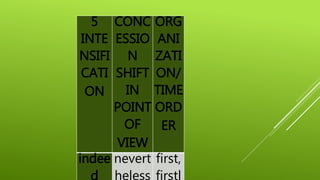
5
INTE
NSIFI
CATI
ON
CONC
ESSIO
N
SHIFT
IN
POINT
OF
VIEW
ORG
ANI
ZATI
ON/
TIME
ORD
ER
indee
d
nevert
heless
first,
firstl

English 2

  • 1.
    Sta.Elena(Camarines Norte)College,Inc. Subject: Writingin the Discipline Reporter: Group I Member Cairel C.Capoy Emeliza H. Gravador Sheryll C. Salindo Instructor: Mrs. Mary Joy Devine L. merciales
  • 2.
    The Paragraph andIts Elements NATURE AND DEFINITION Paragraph- comes from the Greek word paragraphos which means “to write beside” or “written beside”.
  • 3.
    -Part of discoursein writing which presents a single idea or topic. This idea or topic is presented in one or more sentences which may play a specific function depending on the type of writing or issue you are dealing with. Details are also provided by expanding the idea so that it would create better understanding on the part of the reader. This may be done through different methods and approaches depending on the writer’s choice.
  • 4.
    A paragraph isa group of related sentences developing a single topic or idea; or it can be part of a language composition focusing on a specific portion of a large topic which it help to develop or support (Vinuya et.al.224)
  • 5.
    A paragraph hasone main thought or idea contained in a topic sentence which may be found at the beginning,or at the end, at the middle, or at the beginning and repeated at the end.
  • 6.
    Sometimes the topicsentence is not mentioned but is hinted; it is the readers who then supply the topic sentence based on their understanding of the related sentences which are written and read. The main idea is found in the topic sentence; all other sentences support and amplify it.
  • 7.
    A paragraph maybe noted by the first sentence which is usually indented by three to five spaces. However, there are writers whom they prefer not to have indentions on their paragraph. This somehow shows their style in writing.
  • 8.
    In business letters,you can observed indentions in some letter styles used by a writer. In the “blocked letter style”, which is now commonly adopted because it’s easy to prepare and to some extent saves time and space in writing, no indentions are observed. In it, we also have the “blocked paragraphs”.
  • 9.
    Block Letter 1. Whenreferring to typing or writing, block letters refers to writing or typing that is printed and not written in cursive or with any joined letters. Block style or block letter is a letter (usually business letter) format where all typed content is aligned with the left margin and no indentation.
  • 11.
    BLOCK PARAGRAPH : aparagraph (as in a news story) written as an independent unit to allow its deletion or rearrangement in the order of paragraphs without loss of coherence.
  • 12.
    Block Paragraphs Block paragraphslook just like this. No indentation at the start of each paragraph, single spaced, regular font (usually size 12 Times New Roman), and a line space between paragraphs. Do not justify the entire paragraph. Note that the right side of the paragraph is uneven. Just let word wrap take care of that. In other words, don't use full justify; just regular old left justify (the default).
  • 13.
    In narratives, however,ideas or issues are presented into paragraphs. Regardless of its length, paragraphs may help explain what happen or describe the situation and the characters and the like. Each of the paragraph may help each other from the first part up to the end of a narrative so that the readers will appreciate what they are reading.
  • 14.
    It is thereforean important idea that one should remember that paragraphs vary on their purpose and functions in a specific type or form of writing. Undeveloped paragraphs of one or two sentences are frequently used for the following purposes (Hopper et.al.141)
  • 15.
    1. In essays-to summarize what has been said -to guide the reader from section to section -to emphasize an important point 2. In dialogue -to indicate a new speech or a new speaker *It may contain only a phrase or a word “Is that your new car?” he asked. “Yes.” “Can I drive it for you?” “Sure.” 3. In newspapers -to make the layout attractive -to express facts and opinions simply and emphatically.
  • 16.
    LENGTH OF PARAGRAPHS Aparagraph may be independent unit or a part of a long selection. The length of a paragraph depends on the kind or type of writing - (description, narration, argumentation or exposition), the purpose of writing and the complexity and the reading habits of the readers or the audience.
  • 17.
    Basically, three (3)to eight (8) sentences or around 200 to 700 words form a good paragraph. However, one or two sentences with complete thought or idea may do. If we only have one sentence, the reader cannot identify which is related sentence. Definitely, this serves as part of those long compositions
  • 18.
    Paragraph length mayrange from several hundred words in a scholarly discussion to a single phrase or sentence for emphasis.
  • 19.
    TYPES OF PARAGRAPHS A.Isolated (Independent) Paragraph- Presents everything about the topic that is being discussed. - often sufficient to your answers to essay questions, in part of newspaper columns, in advertisements and in an accounts of simple narratives.
  • 20.
    In other words,topics of a limited scope usually need only one paragraph which falls under this type.
  • 21.
    B. Related (Dependent)Paragraph- which presents ideas from other paragraph - It is observed in topic of a broader natures which requires more Than one paragraph to treat all of its related aspects.
  • 22.
    Related paragraph mayfunction as: 1. Introductory- introduces the central idea of the composition. This may do one or more of the following functions:
  • 23.
    Make the readerrealize that a problem exists Announce the subject to be discussed Create an image Arouse intellectual curiosity Excite the emotion of the reader and involve him in what follows
  • 24.
    A good introductoryparagraph is startling which catches the reader’s interest and attention leading to the details of the ideas in the text. Devices you can make use of:
  • 25.
    a.Begins with thestatements that startle or shocks. b. Begin with a question or several questions to awaken your reader’s curiosity and make him go into the body of your compositions for the answer/s. c.Begin with statement or statements that arouse suspense.
  • 26.
    d.Begin by tellingan anecdote or a little story related to you subject matter. Numerous interesting compositions begin with an anecdote which is often humorous. An anecdote can give concrete illustration of the generalization that follows in the body of your composition. An anecdote also encourages your readers to go on. e. Begin with an incident familiar to your readers, something they have read or heard about.
  • 27.
    f. Begin witha description creating an image in the mind of the reader or evoking some emotions in him. g. Begin by including a well-known remark, quotation, proverb or saying relevant to your topic. Something familiar to your reader is one way of making him want to read on.
  • 28.
    h. Begin bydefining term or terms as well as the exact scope of your subject matter. (Using a definition can be very effective in efforts to clarify difficult terms or in an effort to orient your reader on a particular topic or your angel on a particular topic.
  • 29.
    Avoid using dictionarydefinitions—especially of common terms—because your reader will likely know what they mean, or can easily access such definition and then go on either to dispute the definition, or expand on it within the context of your paper. Definitions from authoritative texts can be very helpful when writing persuasive texts.)
  • 30.
    i. Begin bya conversation. An interesting dialogue is one way of arousing the curiosity of your reader Dialogue isn’t just about creating direct quotations from different characters. Sometimes dialogue is best when it’s put into a summarized form, rather than the drawn-out form of an actual conversation.
  • 31.
    2. Developmental- discussesthe various aspects of the central idea. The body of your composition consists of eighty to ninety percent of what you have to say. This is depending on the nature of your topic, the type of your development you have chosen and the purpose in writing it.
  • 32.
    3. Transitional- linksthe idea from one paragraph to the next. Longer compositions require short paragraphs to bridge the gap between one main division of your topic and the next, or make a shift from one phase to another phase of your subject. This may take only one or two sentences.
  • 33.
    Transitional paragraphs maydo the following functions: a. Sum up what has been said before beginning the next unit b. Give one or more illustrations or a point already made
  • 34.
    c. State whatyou intend to do next d. Remind your reader what your topic is all about e. Introduce a series of illustrations, measures or results
  • 35.
    4. Concluding- providea sense of finality to the whole composition The last paragraph of your composition should make your writing seem complete. It should convey a note of finality, and leave the reader with a feeling of satisfaction that the composition accomplished what it has set out to do at the beginning.
  • 36.
    Although there areinstances when the last sentence or two in the body should be enough to end your composition, there are times when you need a whole paragraph as conclusion. A concluding paragraph may do the following functions:
  • 37.
    a.Summarize in afew words all that you have to said b. Emphasize one or two main points discussed in the body c.Provide a climax to the series of points discussed earlier d. Round out the subject announced in the introduction
  • 38.
    e. Answer thequestion/s raised at the beginning f.Motivate the reader to act soon g. Leave a question in the mind of your reader, making him think about your composition long after he has finished reading it.
  • 39.
    Note: Paragraph maybe classified according to their function-introductory, developmental, transitional, and concluding according to the way they are developed-narration, description, exposition, and argumentation (employing different methods and devices) and according to their structures- deductive, inductive, deductive- inductive, inductive-deductive, and hinted.
  • 40.
    PARTS OF PARAGRAPH 1.Topicsentence- The most important sentence in the paragraph. This states the central idea being developed. It is usually in a generalization. It may be implied or expressed.
  • 41.
    This may beplaced in the first part (first or second sentence), middle (preceded and followed by development sentence) or end part(last or second to the last sentence) of the paragraph. It can also be both at the beginning and at the end, expressed in a negative or affirmative ways, or just re-stated at the end.
  • 42.
    1.Development Sentences- These discussesthe central idea. They support the main idea and make it more concrete and meaningful by providing specific details, examples, proofs, and illustrations.
  • 43.
    They should ratherthan tell about your central idea. In other words, these are the supporting details of your paragraph, which can be classified as:
  • 44.
    Descriptive- (tells howsomething looks, feels, smells or taste) othese details are the basic material of writing, since all writing rests on the observation, and descriptive details are the means by which observation, are reported.
  • 45.
    Narrative- (details givespecific pieces of action which tell the sequence of what is taking place or what occurred);
  • 46.
    Illustrative- (details explain, illustratewith specific examples or instances, define, interpret, or paraphrase a general statement to make its meaning clearer)
  • 47.
    1.Transitions- These linkyour ideas together and show their relationships. This are otherwise known as the transitional devices used to show addition, contrast, cause and consequence to name some.
  • 48.
    Referents and wordsthat show chronological, spatial or climactic relationships are also transitions. Transition may be within the paragraph or from paragraph to paragraph to long compositions.
  • 49.
    STANDARD TRANSITIONS ACCORDINGTO MEANING ADDITION COMPARISON & CONTRAST ILLUSTRATION/GIVI NG REASONS furthermore also and in addition moreover then then, too but however yet still in contrast on the contrary on the other hand for example for instance take the case of consider the of course because actually
  • 50.
    in a similarmanner in the same way as well besides not only not to be forgotten above all then again, too too as well also likewise like all equally in the same way at the same time too
  • 51.
    yet another yet again mostof all most importantly as opposed to in spite of whereas except for unlike different from
  • 52.