PARAGRAPH WRITING
Manuela Otero gallego
What is a paragraphs
 A paragraph is a group of sentences
that fleshes out a single idea. In order
for a paragraph to be effective, it must
begin with a topic sentence, have
sentences that support the main idea
of that paragraph, and maintain a
consistent flow.
An effective paragraph
 presents a single idea
 begins with a topic sentence that
makes this single idea evident
 contains support in form of sentences
that convey this single idea
 is strategically organized to maintain
flow
 maintains your essay’s objective
 informs and entertains your reader
about your paper’s overall idea.
Essential elements
Unity
In order for a paragraph to maintain a
sense of unity, the paragraph must
focus solely on a single idea, point, or
argument that is being discussed.
Therefore, the paragraph should not
begin to stray and develop new ideas. If
you begin to write sentence that wander
from the paragraph’s main idea, then it
is time to start a new paragraph.
Essential elements
Coherence
Coherence is more commonly referred to as
the flow of your writing. When a paragraph
flows, the reader will be able to understand the
main idea that you have presented. How can
you ensure that your paragraph maintains a
flow? Well, after presenting your main idea in
your topic sentence, each sentence following
must build upon each other in an organized
manner. After writing your paragraph, go back
and read aloud what you have written to make
sure your ideas are clearly presented. If they
are, you have developed a coherent paragraph!
Essential elements
The topic sentence
The topic sentence is the most
important part of your paragraph; it tells
the reader the general idea of your
paragraphs and should essentially
“hook” them into wanting to read more!
The topic sentence helps to provide a
“general summary” for your paragraph.
A reader should encounter the topic
sentence and have a general idea of
what the paragraph will continue to
discuss.
Essential elements
Sufficient development
Now that your paragraph has a topic, it is
essential that this topic be sufficiently
developed. Do not limit yourself to a set
number of sentences. Yes, your paragraph
should not be too short or too long, but it
should be an appropriate length to flesh out the
entirety of your paragraph’s idea. A reader
should not be left with questions after a
sufficiently development paragraph. In order to
achieve this, you can provide examples, cite
work, provide necessary definitions, describe,
analyze, and organize your ideas.
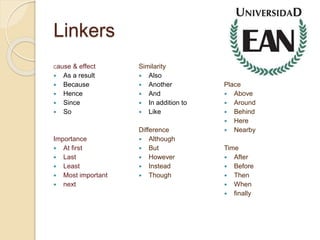
Linkers
Cause & effect
 As a result
 Because
 Hence
 Since
 So
Importance
 At first
 Last
 Least
 Most important
 next
Similarity
 Also
 Another
 And
 In addition to
 Like
Difference
 Although
 But
 However
 Instead
 Though
Place
 Above
 Around
 Behind
 Here
 Nearby
Time
 After
 Before
 Then
 When
 finally
Types of paragraphs
 Descriptive paragraph:
This type of paragraph describes
something and shows the reader what a
thing or a person is like. The words
chosen in the description often appeal
to the five senses of touch, smell, sight,
sound, and taste. Descriptive
paragraphs can be artistic and may
deviate from grammatical norms.
Types of paragraphs
 Narrative paragraph:
This type of paragraph tells a story.
There's a sequence of action or there's
a clear beginning, middle, and end to
the paragraph.
Types of paragraphs
 Expository paragraph:
This type of paragraph explains
something or provides instruction. It
could also describe a process and
move the reader step by step through a
method. This type of paragraph often
requires research, but it's possible that
the writer is able to rely on his or her
own knowledge and expertise.
Types of paragraphs
 Persuasive paragraph:
This type of paragraph tries to get the
reader to accept a particular point of
view or understand the writer's position.
This is the type of paragraph that many
teachers focus on because it's useful
when building an argument. It often
requires the collection of facts and
research.
Bibliography
 Paragraph Writing m nagaRAJU, Teacher Trainer, Soft
Skills Trainer at GDC, Gajwel (Retired) Published on Oct
15, 2009
http://www.slideshare.net/lionnagaraju/paragraph-writing-
2226904
 LEARN AMERICAN ENGLISH ONLINE | WRITE IN
ENGLISH- types of paragraphs
http://www.learnamericanenglishonline.com/Write_in_Engli
sh/WL10_types_of_paragraphs.html
 MONMOUTH UNIVERSITY WHERE LEADERS LOOK
FOWARD- Paragraphs
https://www.monmouth.edu/uploadedFiles/Resources_for_
Writers/The_Writing_Process/Paragraphs2013.pdf

Paragraph writing

  • 1.
  • 2.
    What is aparagraphs  A paragraph is a group of sentences that fleshes out a single idea. In order for a paragraph to be effective, it must begin with a topic sentence, have sentences that support the main idea of that paragraph, and maintain a consistent flow.
  • 3.
    An effective paragraph presents a single idea  begins with a topic sentence that makes this single idea evident  contains support in form of sentences that convey this single idea  is strategically organized to maintain flow  maintains your essay’s objective  informs and entertains your reader about your paper’s overall idea.
  • 4.
    Essential elements Unity In orderfor a paragraph to maintain a sense of unity, the paragraph must focus solely on a single idea, point, or argument that is being discussed. Therefore, the paragraph should not begin to stray and develop new ideas. If you begin to write sentence that wander from the paragraph’s main idea, then it is time to start a new paragraph.
  • 5.
    Essential elements Coherence Coherence ismore commonly referred to as the flow of your writing. When a paragraph flows, the reader will be able to understand the main idea that you have presented. How can you ensure that your paragraph maintains a flow? Well, after presenting your main idea in your topic sentence, each sentence following must build upon each other in an organized manner. After writing your paragraph, go back and read aloud what you have written to make sure your ideas are clearly presented. If they are, you have developed a coherent paragraph!
  • 6.
    Essential elements The topicsentence The topic sentence is the most important part of your paragraph; it tells the reader the general idea of your paragraphs and should essentially “hook” them into wanting to read more! The topic sentence helps to provide a “general summary” for your paragraph. A reader should encounter the topic sentence and have a general idea of what the paragraph will continue to discuss.
  • 7.
    Essential elements Sufficient development Nowthat your paragraph has a topic, it is essential that this topic be sufficiently developed. Do not limit yourself to a set number of sentences. Yes, your paragraph should not be too short or too long, but it should be an appropriate length to flesh out the entirety of your paragraph’s idea. A reader should not be left with questions after a sufficiently development paragraph. In order to achieve this, you can provide examples, cite work, provide necessary definitions, describe, analyze, and organize your ideas.
  • 8.
    Linkers Cause & effect As a result  Because  Hence  Since  So Importance  At first  Last  Least  Most important  next Similarity  Also  Another  And  In addition to  Like Difference  Although  But  However  Instead  Though Place  Above  Around  Behind  Here  Nearby Time  After  Before  Then  When  finally
  • 9.
    Types of paragraphs Descriptive paragraph: This type of paragraph describes something and shows the reader what a thing or a person is like. The words chosen in the description often appeal to the five senses of touch, smell, sight, sound, and taste. Descriptive paragraphs can be artistic and may deviate from grammatical norms.
  • 10.
    Types of paragraphs Narrative paragraph: This type of paragraph tells a story. There's a sequence of action or there's a clear beginning, middle, and end to the paragraph.
  • 11.
    Types of paragraphs Expository paragraph: This type of paragraph explains something or provides instruction. It could also describe a process and move the reader step by step through a method. This type of paragraph often requires research, but it's possible that the writer is able to rely on his or her own knowledge and expertise.
  • 12.
    Types of paragraphs Persuasive paragraph: This type of paragraph tries to get the reader to accept a particular point of view or understand the writer's position. This is the type of paragraph that many teachers focus on because it's useful when building an argument. It often requires the collection of facts and research.
  • 13.
    Bibliography  Paragraph Writingm nagaRAJU, Teacher Trainer, Soft Skills Trainer at GDC, Gajwel (Retired) Published on Oct 15, 2009 http://www.slideshare.net/lionnagaraju/paragraph-writing- 2226904  LEARN AMERICAN ENGLISH ONLINE | WRITE IN ENGLISH- types of paragraphs http://www.learnamericanenglishonline.com/Write_in_Engli sh/WL10_types_of_paragraphs.html  MONMOUTH UNIVERSITY WHERE LEADERS LOOK FOWARD- Paragraphs https://www.monmouth.edu/uploadedFiles/Resources_for_ Writers/The_Writing_Process/Paragraphs2013.pdf