Online Electric Vehicle
(OLEV):
REHAN FAZAL
REG. NO.-1171110180
WHAT IS OLEV ?????????????????
 Online Electric Vehicle (OLEV) is an electric
vehicle which works on the principle of electromagnetic
induction.
 It doesn’t require any fuel energy to run.
 On Tuesday, 9 March 2010 researchers from The Korea
Advanced Institute of Science and Technology(KAIST)
launched a public transport system using a "recharging
road".
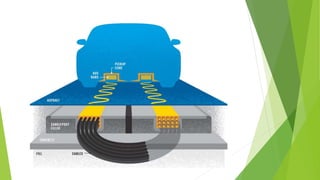
 Pick-up equipment underneath the vehicle then
collects power through non-contact
(wireless) magnetic induction which is used
either to power the vehicle for battery charging.
 The demonstration system is a trackless train with
an electric tractor hauling three passenger cars.
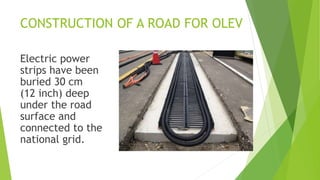
 Electric power strips have been buried 30 cm (12 in)
deep under the road surface and connected to the
national grid.
Inventor:
 Inventor OLEV technology is derived from a tram
patent filed by Nikola Tesla in 1894. In the 1990’s
California pioneered this technology Current
innovator of the technology is KAIST, who has
brought the technology to its current form. As of
2011, OLEV Technologies, a Massachusetts
company, has the sole license from KAIST to
introduce the technology to North and South
America
CONSTRUCTION OF A ROAD FOR OLEV
Electric power
strips have been
buried 30 cm
(12 inch) deep
under the road
surface and
connected to the
national grid.
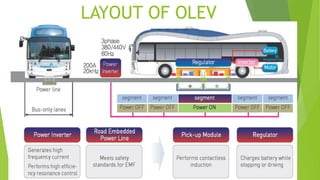
LAYOUT OF OLEV
WORKING
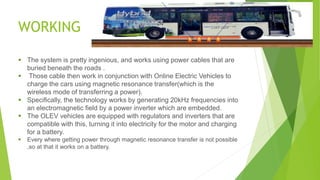
 The system is pretty ingenious, and works using power cables that are
buried beneath the roads .
 Those cable then work in conjunction with Online Electric Vehicles to
charge the cars using magnetic resonance transfer(which is the
wireless mode of transferring a power).
 Specifically, the technology works by generating 20kHz frequencies into
an electromagnetic field by a power inverter which are embedded.
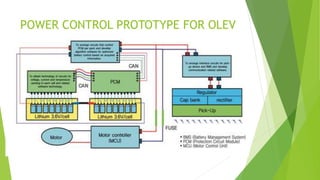
 The OLEV vehicles are equipped with regulators and inverters that are
compatible with this, turning it into electricity for the motor and charging
for a battery.
 Every where getting power through magnetic resonance transfer is not possible
,so at that it works on a battery.
POWER CONTROL PROTOTYPE FOR OLEV
AREA
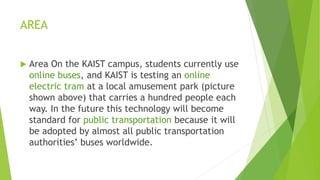
 Area On the KAIST campus, students currently use
online buses, and KAIST is testing an online
electric tram at a local amusement park (picture
shown above) that carries a hundred people each
way. In the future this technology will become
standard for public transportation because it will
be adopted by almost all public transportation
authorities’ buses worldwide.
How It Works:
 How It Works Online Electric Vehicle (OLEV)
is built with an on-board pick up device
that allows an electric vehicle to be
powered by an underground power line
while driving. This allows the vehicle to
carry 4/5 less battery capacity or weight,
because it only requires a small battery for
minimal operations off the power grid.
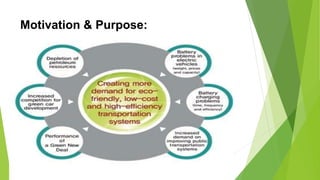
Motivation & Purpose:
Advantages:
 Advantages 80 % reduced operating cost than equivalent
gas powered vehicles.
 Lower maintenance costs than gas powered vehicles .
 Zero tail-pipe pollution .
 Zero recharging time and unlimited range (when operating
on an electric road)
Disadvantages:
 Our current electrical grid could not support mass market
adaptation of the online electric vehicle.
 Infrastructure for the OLEV in any form would be costly.
 Designing a system to charge consumers for the electricity
they use.
 Decline in road tax revenue.
 Currently the speed is limited to 40 miles per hour.
 Traffic might cause the OLEV to run out of power.
Thank you

Online Electric Vehicle

  • 1.
    Online Electric Vehicle (OLEV): REHANFAZAL REG. NO.-1171110180
  • 2.
    WHAT IS OLEV?????????????????  Online Electric Vehicle (OLEV) is an electric vehicle which works on the principle of electromagnetic induction.  It doesn’t require any fuel energy to run.  On Tuesday, 9 March 2010 researchers from The Korea Advanced Institute of Science and Technology(KAIST) launched a public transport system using a "recharging road".
  • 3.
     Pick-up equipmentunderneath the vehicle then collects power through non-contact (wireless) magnetic induction which is used either to power the vehicle for battery charging.  The demonstration system is a trackless train with an electric tractor hauling three passenger cars.  Electric power strips have been buried 30 cm (12 in) deep under the road surface and connected to the national grid.
  • 4.
    Inventor:  Inventor OLEVtechnology is derived from a tram patent filed by Nikola Tesla in 1894. In the 1990’s California pioneered this technology Current innovator of the technology is KAIST, who has brought the technology to its current form. As of 2011, OLEV Technologies, a Massachusetts company, has the sole license from KAIST to introduce the technology to North and South America
  • 5.
    CONSTRUCTION OF AROAD FOR OLEV Electric power strips have been buried 30 cm (12 inch) deep under the road surface and connected to the national grid.
  • 7.
  • 8.
    WORKING  The systemis pretty ingenious, and works using power cables that are buried beneath the roads .  Those cable then work in conjunction with Online Electric Vehicles to charge the cars using magnetic resonance transfer(which is the wireless mode of transferring a power).  Specifically, the technology works by generating 20kHz frequencies into an electromagnetic field by a power inverter which are embedded.  The OLEV vehicles are equipped with regulators and inverters that are compatible with this, turning it into electricity for the motor and charging for a battery.  Every where getting power through magnetic resonance transfer is not possible ,so at that it works on a battery.
  • 9.
  • 10.
    AREA  Area Onthe KAIST campus, students currently use online buses, and KAIST is testing an online electric tram at a local amusement park (picture shown above) that carries a hundred people each way. In the future this technology will become standard for public transportation because it will be adopted by almost all public transportation authorities’ buses worldwide.
  • 11.
    How It Works: How It Works Online Electric Vehicle (OLEV) is built with an on-board pick up device that allows an electric vehicle to be powered by an underground power line while driving. This allows the vehicle to carry 4/5 less battery capacity or weight, because it only requires a small battery for minimal operations off the power grid.
  • 12.
  • 13.
    Advantages:  Advantages 80% reduced operating cost than equivalent gas powered vehicles.  Lower maintenance costs than gas powered vehicles .  Zero tail-pipe pollution .  Zero recharging time and unlimited range (when operating on an electric road)
  • 14.
    Disadvantages:  Our currentelectrical grid could not support mass market adaptation of the online electric vehicle.  Infrastructure for the OLEV in any form would be costly.  Designing a system to charge consumers for the electricity they use.  Decline in road tax revenue.  Currently the speed is limited to 40 miles per hour.  Traffic might cause the OLEV to run out of power.
  • 15.