
3.POPULATION EXPLOSION
INTRODUCTION
Lecture by:
SRINVAS GAJJELA.
Assistant Professor.
Dept. of Biosciences & Bioengineering.
RGUKT Basar, Nirmal – TS.
• POPULATION : Population is a group of individuals of a
particular species, sharing a common gene pool and
occupying a particular area at a specific time.
• POPUALTION EXPLOSION : Refers to the sudden and
rapid rise in the size of the human population.
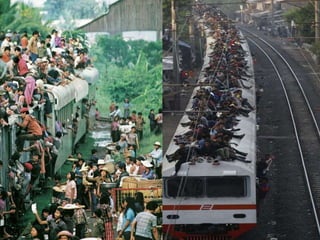
• Population explosion is a global phenomenon but it is
more prominent in under developed and developing
countries.
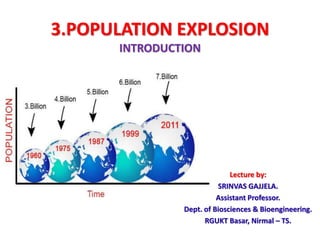
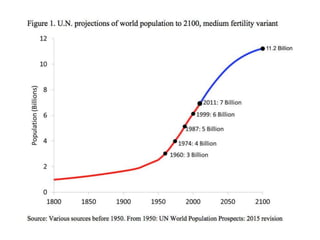
• The current Population of the world (as per May2018)
is 7.6 billion.
– While CHINA is the most populous country with over 1.38
billion people (1.43 billion in 2019).
– India is second populous country with 1.36 billion (2019).
and by 2025 India will overtake China.
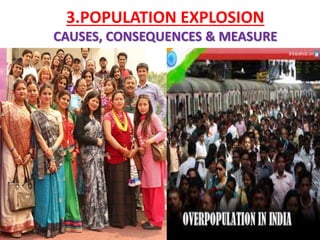
3.POPULATION EXPLOSION
CAUSES, CONSEQUENCES & MEASURE
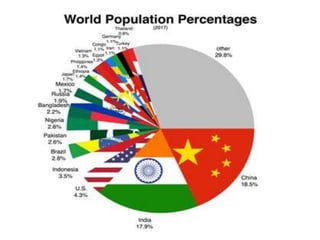
TOP 20 LARGEST COUNTRIES BY POPULATION (LIVE)
AS ON 29-08-2019 World Population 7,726,782,181
• 1 China1,434,689,133
• 2 India1,368,632,683
• 3 U.S.A.329,381,344
• 4 Indonesia271,097,865
• 5 Pakistan217,267,801
• 6 Brazil211,295,959
• 7 Nigeria201,801,920
• 8 Bangladesh163,314,028
• 9 Russia145,882,437
• 10 Mexico127,796,723
• 11 Japan126,797,387
• 12 Ethiopia112,545,975
• 13 Philippines108,355,000
• 14 Egypt100,704,133
• 15 Vietnam96,605,042
• 16 D.R. Congo87,238,211
• 17 Turkey83,577,817
• 18 Germany83,560,678
• 19 Iran83,089,591
• 20 Thailand 69,654 106
https://www.worldometers.info/world-population
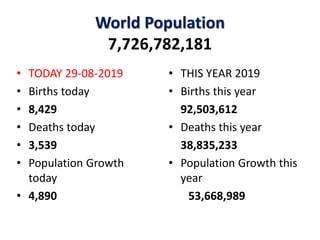
World Population
7,726,782,181
• TODAY 29-08-2019
• Births today
• 8,429
• Deaths today
• 3,539
• Population Growth
today
• 4,890
• THIS YEAR 2019
• Births this year
92,503,612
• Deaths this year
38,835,233
• Population Growth this
year
53,668,989
INDIA - POPULATION
• The current population of India is 1,368,603,132 as of
Thursday, August 29, 2019, based on the latest United
Nations estimates.
• India population is equivalent to 17.71% of the total
world population.
• India ranks number 2 in the list of countries (and
dependencies) by population.
• The population density in India is 460 per Km2 (1,190
people per mi2).
• The total land area is 2,973,190 Km2 (1,147,955 sq.
miles)
• 34.5 % of the population is urban (471,828,295 people in
2019).
• The median age in India is 27.1 years.
• According to the Indian census 2011, the population
of India was exactly 1,210,193,422, which means
India has crossed the 1-billion mark.
• This is the second most populous country of the
world after China.
• The various studies have projected that India will be
world’s number-1 populous country, surpassing
China, by 2025.
• Worlds’ population day – July 11th
• Study of human population is called Demography
World Population by Religion
• According to a recent study (based on the 2010 world
population of 6.9 billion) by The Pew Forum, there are:
• 2,173,180,000 Christians (31% of world population), of
which 50% are Catholic, 37% Protestant, 12%
Orthodox, and 1% other.
• 1,598,510,000 Muslims (23%), of which 87-90% are
Sunnis, 10-13% Shia.
• 1,126,500,000 No Religion affiliation (16%): atheists,
agnostics and people who do not identify with any
particular religion. One-in-five people (20%) in the
United States are religiously unaffiliated.
World Population by Religion
• 1,033,080,000 Hindus (15%), the overwhelming
majority (94%) of which live in India.
• 487,540,000 Buddhists (7%), of which half live in
China.
• 405,120,000 Folk Religionists (6%): faiths that are
closely associated with a particular group of people,
ethnicity or tribe.
• 58,110,000 Other Religions (1%): Baha’i faith,
Taoism, Jainism, Shintoism, Sikhism, Tenrikyo, Wicca,
Zoroastrianism and many others.
• 13,850,000 Jews (0.2%), four-fifths of which live in
two countries: United States (41%) and Israel (41%).
WHY POPULATION IS IMPORTANT ?
• We cannot have a sustainable planet without stabilizing
population.
• As human populations grow, human demands for resources
like water, land, trees, and energy also grow. Unfortunately,
the price of all this “growth” is paid for by other endangered
plants and animals and an increasingly volatile and dangerous
climate.
• Any truly meaningful conservation and sustainability efforts
must take the expanding human population footprint into
consideration.
• Globally, over 228,000 people are added every day — each
needs sufficient land, water, shelter, food, and energy for a
decent life.
WHY POPULATION IS IMPORTANT?
• In the 21st century, working on the population
issue means working against oppressive cultural
practices such as:
– the low status of women around the world,
– gender-based violence,
– genital mutilation, forced prostitution, and child
marriage.
• It means supporting girls’ education and
reproductive health.
• After all, the denial of the rights of women and girls are
important factors that significantly contribute to high
fertility and population growth: because they rob women
of social power and self-determination.
• eliminating scourges like child marriage, along
with strengthening women’s rights — global
population will stabilize and start a gradual
decline sooner rather than later.
• Vigorous pursuit of equal rights for women and
girls, including women’s reproductive self-
determination and girls’ education, is the heart of
good population advocacy.
__________________________________________
• Next lecture :
– CAUSES OF POPULATION EXPLOSION.
– CONSEQUENCES OF POPULATION EXPLOSION.

Population explosion introduction

  • 1.
    3.POPULATION EXPLOSION INTRODUCTION Lecture by: SRINVASGAJJELA. Assistant Professor. Dept. of Biosciences & Bioengineering. RGUKT Basar, Nirmal – TS.
  • 2.
    • POPULATION :Population is a group of individuals of a particular species, sharing a common gene pool and occupying a particular area at a specific time. • POPUALTION EXPLOSION : Refers to the sudden and rapid rise in the size of the human population. • Population explosion is a global phenomenon but it is more prominent in under developed and developing countries. • The current Population of the world (as per May2018) is 7.6 billion. – While CHINA is the most populous country with over 1.38 billion people (1.43 billion in 2019). – India is second populous country with 1.36 billion (2019). and by 2025 India will overtake China.
  • 3.
  • 4.
    TOP 20 LARGESTCOUNTRIES BY POPULATION (LIVE) AS ON 29-08-2019 World Population 7,726,782,181 • 1 China1,434,689,133 • 2 India1,368,632,683 • 3 U.S.A.329,381,344 • 4 Indonesia271,097,865 • 5 Pakistan217,267,801 • 6 Brazil211,295,959 • 7 Nigeria201,801,920 • 8 Bangladesh163,314,028 • 9 Russia145,882,437 • 10 Mexico127,796,723 • 11 Japan126,797,387 • 12 Ethiopia112,545,975 • 13 Philippines108,355,000 • 14 Egypt100,704,133 • 15 Vietnam96,605,042 • 16 D.R. Congo87,238,211 • 17 Turkey83,577,817 • 18 Germany83,560,678 • 19 Iran83,089,591 • 20 Thailand 69,654 106 https://www.worldometers.info/world-population
  • 7.
    World Population 7,726,782,181 • TODAY29-08-2019 • Births today • 8,429 • Deaths today • 3,539 • Population Growth today • 4,890 • THIS YEAR 2019 • Births this year 92,503,612 • Deaths this year 38,835,233 • Population Growth this year 53,668,989
  • 10.
    INDIA - POPULATION •The current population of India is 1,368,603,132 as of Thursday, August 29, 2019, based on the latest United Nations estimates. • India population is equivalent to 17.71% of the total world population. • India ranks number 2 in the list of countries (and dependencies) by population. • The population density in India is 460 per Km2 (1,190 people per mi2). • The total land area is 2,973,190 Km2 (1,147,955 sq. miles) • 34.5 % of the population is urban (471,828,295 people in 2019). • The median age in India is 27.1 years.
  • 11.
    • According tothe Indian census 2011, the population of India was exactly 1,210,193,422, which means India has crossed the 1-billion mark. • This is the second most populous country of the world after China. • The various studies have projected that India will be world’s number-1 populous country, surpassing China, by 2025. • Worlds’ population day – July 11th • Study of human population is called Demography
  • 12.
    World Population byReligion • According to a recent study (based on the 2010 world population of 6.9 billion) by The Pew Forum, there are: • 2,173,180,000 Christians (31% of world population), of which 50% are Catholic, 37% Protestant, 12% Orthodox, and 1% other. • 1,598,510,000 Muslims (23%), of which 87-90% are Sunnis, 10-13% Shia. • 1,126,500,000 No Religion affiliation (16%): atheists, agnostics and people who do not identify with any particular religion. One-in-five people (20%) in the United States are religiously unaffiliated.
  • 13.
    World Population byReligion • 1,033,080,000 Hindus (15%), the overwhelming majority (94%) of which live in India. • 487,540,000 Buddhists (7%), of which half live in China. • 405,120,000 Folk Religionists (6%): faiths that are closely associated with a particular group of people, ethnicity or tribe. • 58,110,000 Other Religions (1%): Baha’i faith, Taoism, Jainism, Shintoism, Sikhism, Tenrikyo, Wicca, Zoroastrianism and many others. • 13,850,000 Jews (0.2%), four-fifths of which live in two countries: United States (41%) and Israel (41%).
  • 14.
    WHY POPULATION ISIMPORTANT ? • We cannot have a sustainable planet without stabilizing population. • As human populations grow, human demands for resources like water, land, trees, and energy also grow. Unfortunately, the price of all this “growth” is paid for by other endangered plants and animals and an increasingly volatile and dangerous climate. • Any truly meaningful conservation and sustainability efforts must take the expanding human population footprint into consideration. • Globally, over 228,000 people are added every day — each needs sufficient land, water, shelter, food, and energy for a decent life.
  • 15.
    WHY POPULATION ISIMPORTANT? • In the 21st century, working on the population issue means working against oppressive cultural practices such as: – the low status of women around the world, – gender-based violence, – genital mutilation, forced prostitution, and child marriage. • It means supporting girls’ education and reproductive health. • After all, the denial of the rights of women and girls are important factors that significantly contribute to high fertility and population growth: because they rob women of social power and self-determination.
  • 16.
    • eliminating scourgeslike child marriage, along with strengthening women’s rights — global population will stabilize and start a gradual decline sooner rather than later. • Vigorous pursuit of equal rights for women and girls, including women’s reproductive self- determination and girls’ education, is the heart of good population advocacy. __________________________________________
  • 17.
    • Next lecture: – CAUSES OF POPULATION EXPLOSION. – CONSEQUENCES OF POPULATION EXPLOSION.